By the time Rose reached her son’s gate, rain had soaked through her cardigan and turned her shoes heavy with mud.
She stood beneath the security light, small and trembling, staring at the brick house her son had built behind iron bars.
Lewis’s house glowed warmly through the windows, every room bright, every curtain clean, every corner speaking of comfort Rose no longer knew.
She pressed the buzzer once, then waited with her cane clutched tightly, ashamed of how badly her stomach was cramping.
When Clara appeared at the door, she did not open the gate fully. She looked at Rose as though rainwater had dragged dirt inside.
“What are you doing here so late, Rose?” Clara asked, her voice flat enough to make the drizzle feel warmer.
Rose swallowed her pride, though it tasted bitter. “I came to see Lewis, dear. I need a little help with groceries.”
Clara’s eyes moved to Rose’s torn cloth bag, then to her worn shoes, then back to her face without kindness.
“Lewis is busy,” Clara said. “You should have called before coming all this way in this weather.”
“I tried,” Rose whispered. “My phone has no minutes left. I would not have come unless I had nothing.”
Clara stepped away from the gate, irritated, and called into the house with the sharpness of someone summoning a servant.
A moment later, Lewis appeared wearing a clean white shirt, phone in hand, his face tense before he even spoke.
“Mom?” he said, glancing behind him at Clara. “Why are you standing out there in the rain?”
Rose tried to smile, because a mother’s heart still searches for tenderness even in a closed face.
“I’m sorry, son,” she said softly. “I have no food left. I hoped you could lend me a little money.”
Lewis’s jaw tightened. For a moment, something like pain flashed in his eyes, quick and frightened.
Then Clara folded her arms behind him, and whatever had risen in Lewis disappeared beneath a colder expression.
“Money is tight,” he said. “The store has bills, suppliers, repairs. I cannot keep solving everyone’s problems.”
Rose stared at him, stunned by the word everyone, as if she were a stranger asking outside a market.
“I am not everyone,” she said, barely above the rain. “I am your mother, Lewis. I only need enough for bread.”
Clara gave a small laugh from the doorway. “Bread becomes medicine, medicine becomes electricity, then suddenly we are responsible for everything.”
Rose lowered her head, not because Clara was right, but because hunger had made her too tired to defend herself.
Lewis turned away, walked to his truck, and pulled a sack of rice from the back seat.
He carried it to the gate, opened it just enough, and pushed the heavy bag into Rose’s arms.
“Take this,” he said quickly. “It will last a while. Go home before the road gets worse.”
Rose almost dropped the rice. It was heavier than expected, pressing hard against her ribs and wet cardigan.
“Thank you, son,” she whispered, waiting for him to say one gentle thing, anything that sounded like family.
But Lewis only looked past her shoulder, toward the road, as if afraid someone might see them together.
Clara reached for the gate button. “Good night, Rose. Next time, call first instead of appearing like this.”
The gate clanged shut between them, louder than thunder, and Rose stood alone with rice in her arms.
On the long walk home, rain slid down her cheeks, hiding tears she refused to fully admit were there.
She told herself Lewis was tired. She told herself Clara embarrassed him. She told herself a thousand merciful lies.
“At least he gave me food,” Rose murmured into the dark. “A son who gives rice still remembers his mother.”
Her house waited at the edge of town, a leaning wooden place with one yellow bulb and a door that stuck.
Inside, the kitchen smelled of damp walls, old soap, and the loneliness of meals stretched too thin.
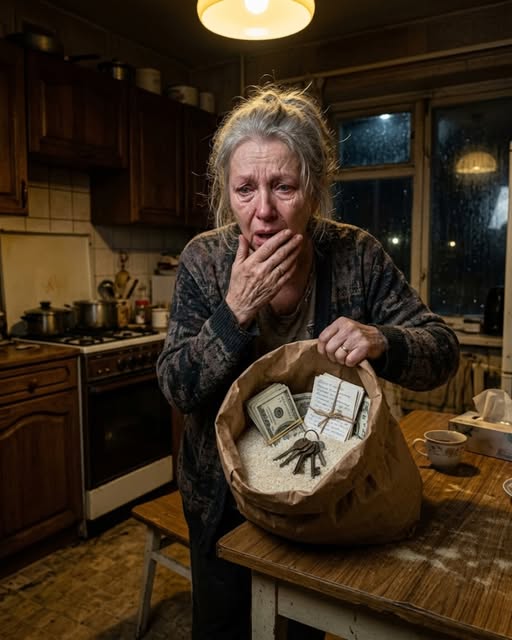
Rose set the rice on the table, rubbing her aching wrists, then reached for the dented pot beside the sink.
Her hands shook as she untied the sack, careful not to waste even one grain on the floor.
But when she pushed her fingers into the rice, she did not feel grain first. She felt smooth plastic.
Rose froze, heart thudding. Slowly, she dug deeper and pulled out a sealed envelope wrapped in clear kitchen film.
Inside lay a thick stack of cash, more money than she had touched in years, along with a small brass key.
Beneath the money was a folded note, the paper creased hard, as if Lewis had written it with shaking hands.
Rose sat down before her knees failed. She unfolded the note and recognized her son’s handwriting immediately.
“Mom, do not tell Clara,” it began. “Hide this money, lock your door, and wait for me tonight.”
Her breath caught in her throat as she read the next line, each word cutting through years of confusion.
“I know who has been taking what Dad left you. I am sorry I believed the wrong person.”
The room tilted around Rose. The rain, the gate, Clara’s laugh, Lewis’s cold face all returned at once.
She read the note twice, then a third time, because her mind refused to accept what her hands held.
“What Dad left me?” Rose whispered, looking toward the cracked photograph of her late husband, Henry, on the shelf.
Henry had died eight years earlier with rough hands, honest eyes, and a promise that Rose would never beg.
He had owned half the hardware store before Lewis expanded it. He had always said Rose would be protected.
But after the funeral, papers appeared, accounts closed, and Clara gently explained that Henry had left debts, not savings.
Rose had believed her, because grief makes a person easy to lead and easier to rob.
At midnight, three soft knocks sounded at the back door. Rose gripped her cane, her whole body shaking.
“Mom, it’s me,” Lewis whispered. “Please open quickly, and do not turn on the front light.”
Rose unlocked the door. Lewis stepped inside drenched, carrying a folder under his coat and guilt across his face.
For one long second, neither spoke. Then Rose lifted the note with trembling fingers.
“Lewis,” she said, her voice breaking, “what did your father leave me, and why did I never know?”
Lewis closed his eyes. “More than enough to live with dignity. A trust account, rent from the old warehouse, and store shares.”
Rose sat down slowly, as though every word had weight. “Clara told me your father died owing money.”
“She lied,” Lewis said, shame pulling his face tight. “And I was too proud, too busy, too blind to question her.”
He opened the folder and spread documents across Rose’s scarred kitchen table, beside the rice and money.
There were bank statements, property papers, copies of signatures, and checks Rose had never seen before.
Lewis pointed to one page. “Your monthly payments were redirected three years after Dad died. Clara handled the paperwork.”
Rose stared at a signature that looked almost like hers, except the R curled wrong.
“I never signed this,” she said, pressing one hand to her chest. “I could not even write that neatly.”
“I know,” Lewis said. “I found the original forms in Clara’s locked drawer yesterday while looking for tax records.”
Rose looked at him sharply. “Yesterday? Then why did you treat me like dirt at the gate tonight?”
Lewis flinched, and his answer came out rough. “Because Clara watches everything, and I needed her to believe I still knew nothing.”
He pushed the brass key toward her. “This opens Dad’s old deposit box. Clara never found it because he listed you only.”
Rose covered her mouth. “Henry kept telling me not to let anyone rush me after he was gone.”
“I should have listened for you,” Lewis said. “Instead, I let Clara call you careless, demanding, and ungrateful.”
For years, Clara had told Lewis that Rose gambled away help, sold gifts, and refused to manage money responsibly.
She had shown him fake receipts, forged requests, and messages Rose had never written, building a wall between mother and son.
“I thought you were ashamed of me,” Rose whispered. “Every visit became shorter, every call colder, and I blamed age.”
Lewis knelt beside her chair, rain dripping from his sleeves onto the floor. “No, Mom. I was ashamed of being fooled.”
Before Rose could answer, headlights swept across the kitchen wall. A car stopped outside her house.
Lewis went rigid. “She followed me,” he said, gathering the papers, but Rose placed one hand over his.
“Let her come,” Rose said quietly. “I have been hungry long enough. Tonight, I want the truth fed to everyone.”
The front door shook under Clara’s fist. “Lewis! Open this door now. I know you are in there.”
Rose rose slowly, cane in hand, and walked to the door with the cash hidden beneath a towel.
When she opened it, Clara stood on the step wearing a raincoat and fury, her polished face twisted with panic.
“So this is where you ran?” Clara snapped. “To whisper lies with a woman who enjoys making herself pitiful?”
Rose stepped aside. “Come in, Clara. The floor is poor, but it is honest, which may feel unfamiliar.”
Lewis stared at his mother, startled by the steel in her voice, a strength he had forgotten she possessed.
Clara entered, eyes jumping immediately to the rice sack, the papers, the folder, and Lewis’s pale face.
“What is all this?” Clara demanded. “Lewis, have you lost your mind bringing business documents here?”
“Not business documents,” Lewis said. “My father’s documents. My mother’s money. Your forged transfers.”
Clara’s face changed for half a second, just enough for Rose to see fear beneath the anger.
Then Clara laughed sharply. “Your mother is old, Lewis. She forgets things. She probably signed whatever she needed back then.”
Rose lifted the paper with the false signature. “I remember burying my husband. I remember being told I had nothing. I remember this lie.”
Clara turned on Lewis. “You believe her over me? After everything I built beside you?”
“You built nothing beside me,” Lewis said. “You built a cage around my mother and charged her rent for breathing.”
Clara slapped the folder off the table. Papers scattered across the floor like frightened birds.
“I kept this family respectable,” Clara hissed. “She would have drained us dry with her sad face and empty hands.”
Rose did not bend to pick up the papers. She stared at Clara, calm in a way that made the room colder.
“My empty hands raised the man you married,” Rose said. “My husband’s money helped buy the store you brag about.”
Clara’s mouth trembled, but rage quickly covered it. “That store would be nothing if I had not managed accounts.”
Lewis removed his phone from his pocket and set it on the table, screen glowing with an active recording.
“Then explain the accounts clearly,” he said. “Explain why my mother’s trust paid your credit cards for five years.”
Clara went still. Outside, rain ticked against the roof, patient and merciless.
“You recorded me?” she whispered. “You brought me here to trap me in this filthy little house?”
“No,” Lewis said. “You trapped yourself when you followed me here because you feared what Mom had found.”
Clara lunged toward the towel covering the money, but Rose struck the table with her cane.
“Do not touch one more thing that belongs to me,” Rose said, her voice ringing through the kitchen.
For the first time since Rose had known her, Clara stepped back.
Lewis bent and gathered the fallen papers. “The lawyer already has copies. So does Mr. Dalton, Dad’s old accountant.”
Clara’s anger cracked into desperation. “Lewis, listen to me. I did it because you were too soft with her.”
Rose let out a small, wounded laugh. “Soft? I ate boiled water some nights so your pride could stay untouched.”
Lewis looked at his mother as if every word struck him harder than Clara’s confession.
“You were hungry,” he said, voice breaking. “And I was driving past your house in a truck bought with your money.”
Clara wiped rain from her face with shaking hands. “I was protecting our future. Your mother had already lived her life.”
Rose straightened, seventy years of love and betrayal burning behind her eyes. “A mother’s life does not expire when her children prosper.”
The sentence settled in the room like a judgment.
Lewis picked up his phone. “I am calling Mr. Dalton and the lawyer now. Clara, you will leave this house.”
“You cannot throw me out over paperwork,” Clara said. “Think carefully before humiliating your own wife.”
“I should have thought carefully before humiliating my mother,” Lewis answered. “That mistake ends tonight.”
By morning, the story had already begun moving through town, though no one knew who first whispered it.
Some said Clara had stolen from a widow. Some said Lewis had hidden money in rice like a criminal.
Others argued Rose should have exposed them sooner, as if hunger were a courtroom where shame speaks easily.
At the hardware store, customers stopped pretending not to stare. Employees lowered their voices whenever Clara’s name surfaced.
Mr. Dalton arrived with his briefcase before noon, grim and furious, carrying records Henry had trusted him to preserve.
He sat at Rose’s kitchen table, adjusted his glasses, and spoke gently, as though every truth might bruise her.
“Henry left clear instructions,” he said. “You were to receive monthly income, ownership dividends, and access to emergency funds.”
Rose looked at Lewis, not accusingly, but with a sadness that made accusation unnecessary.
Lewis bowed his head. “I signed documents Clara placed before me. I thought they were routine business forms.”
Dalton’s mouth tightened. “Some signatures are yours, Lewis. Some are not. The forged ones will be difficult for Clara to explain.”
Clara’s lawyer called that afternoon, aggressive at first, then quieter when Dalton mentioned recordings, bank trails, and witness statements.
By evening, Clara had moved to her sister’s house, though she left behind threats wrapped in polite messages.
“You will regret making this public,” one text read. “People love gossip, Rose, but they forget quickly.”
Rose showed the message to Lewis. He read it once, then deleted Clara’s number from his mother’s phone.
“She took enough years from you,” he said. “She does not get another minute inside your peace.”
The next week, Lewis drove Rose to the bank, where the brass key opened a box untouched since Henry’s death.
Inside were letters, savings bonds, jewelry Rose thought had been sold, and one envelope addressed in Henry’s careful handwriting.
Rose opened it with trembling hands while Lewis stood beside her, silent and ashamed.
“My Rosie,” Henry had written, “if you are reading this, make no one small enough to fit inside their greed.”
Rose pressed the letter to her heart and wept there in the private room, not from weakness, but from release.
Lewis wept too, because forgiveness was now farther away than apology, and he finally understood the distance.
“I cannot undo it,” he said. “But I will spend whatever years I have left making sure you never beg again.”
Rose looked at him for a long time. “Do not buy forgiveness, Lewis. Become the son your father believed you were.”
Those words hurt him more than shouting would have, because they gave him work instead of punishment.
Over the following months, the stolen payments were restored through court agreements, frozen accounts, and property claims Clara could not escape.
The town talked endlessly, dividing itself between sympathy, outrage, and the cruel pleasure of watching a polished woman fall.

