The fluorescent lights inside Vanderbilt Medical Center buzzed like restless insects, casting a cold glow over every anxious face waiting for news that would either save or destroy their world tonight.
I sat in that plastic chair with my hands clenched so tightly that my knuckles turned pale, watching strangers walk past while my entire life quietly bled behind a hospital curtain somewhere down the hall.
My eight-year-old son, Jake, was inside those walls after being beaten nearly to death in his grandfather’s driveway while three grown men held him down and laughed like it was entertainment.
The doctors spoke in careful tones about concussion levels and possible brain swelling, but none of their medical language could translate the storm forming inside my chest.
I had lived a life that trained me to stay calm under pressure, yet nothing in that training prepared me for hearing my child whisper that his own family had turned into something unrecognizable.
Christine, my wife, called me eight times that night, but she never once came to the hospital, and that silence began to feel heavier than the screams I could not hear.
An elderly neighbor later told me she saw Jake walking alone down the sidewalk, missing one shoe, blood dripping from his ear, while no adult bothered to stop him.
Every second of that story carved something deeper into me, because it meant my son had been discarded in plain sight while adults chose indifference over responsibility.
When the doctor finally said Jake was awake, I stood up so fast the chair scraped the floor, and I followed her through endless hallways that smelled like bleach and exhaustion.
Each step toward his room felt like walking deeper into a version of reality I had never agreed to enter, where childhood innocence was replaced by hospital monitors and bruises.
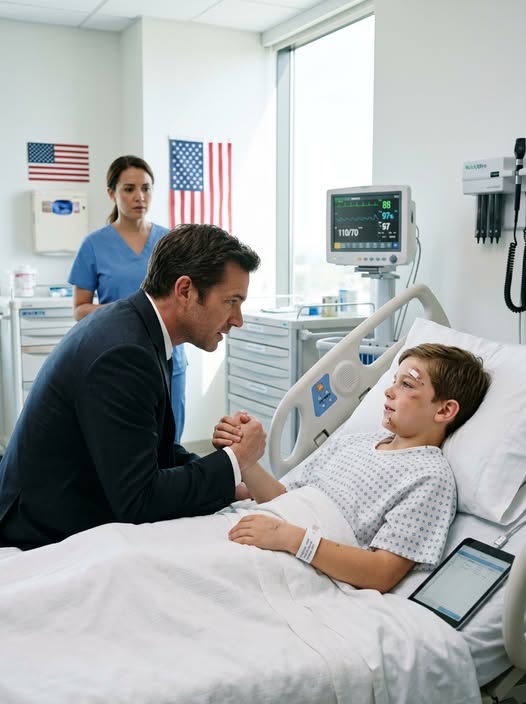
When I saw him lying there, his small body swallowed by white sheets, something inside me fractured in a way I will never be able to repair or forget.
Half his face was swollen purple, his hair stuck to his forehead, and his eyes searched for mine like he was afraid I might disappear if he blinked too long.
“Dad,” he whispered, and that single word carried more pain than anything I had ever heard in my entire life.
I took his hand gently, careful not to touch the bruises, and told him I was there, even though part of me felt like I had arrived too late to matter.
He tried to speak through cracked lips, telling me he had tried to run, but his voice broke as if even the memory of it hurt too much to carry.
I told him he didn’t need to explain anything, but children always try to explain pain, as if understanding it might somehow make it less real or less unfair.
Then he said the words that changed the shape of my entire world, telling me his grandfather had been angry and said I thought I was too good for the family.
His fingers trembled harder as he described how his uncles held his arms and legs, pinning him down while he begged them to stop with a voice no child should ever use.
The room felt smaller with every sentence he spoke, as if the walls were closing in to trap both of us inside a moment that should have never existed.
And then he whispered it, the part that still wakes me at night, that his grandfather slammed his head into the driveway while laughing and saying I would not come to save him.
For a moment, I could not breathe, because my mind refused to accept that adults I had once trusted could turn into something so cruel, so casually destructive.
I had seen violence before in places where survival was uncertain, but nothing prepared me for hearing it described by my own child in a hospital bed.
I kissed his forehead gently, avoiding the bruises, and stepped out into the hallway because I knew if I stayed one more second, I would shatter in front of him.
The doctor tried to speak to me as I left, but her voice blurred into the background as something colder and sharper began forming in the silence inside my head.
I didn’t call the police first, because part of me already understood that official procedures would not move at the speed of what had just been done to my son.
Instead, I called a number I had not used in years, one that existed in a past I thought I had buried under normal life and family routines.
When the voice on the other end answered, I asked for a cleanup team, and the silence that followed felt heavier than any confirmation I could have received.
I looked back through the hospital glass at my son lying alone in that bed, and I understood that everything I believed about distance and safety had already collapsed.
Somewhere across town, in a house in Brentwood, three grown men were sitting comfortably, drinking whiskey, laughing about something they believed would never come back to them.
They had no idea that the story they thought ended in that driveway was only the beginning of something far larger, something they would eventually realize they could not control.
When a detective later examined Jake’s injuries, he asked me what I did for a living, and I said nothing, because answers were no longer safe in that moment.
The question itself revealed everything about how the world works, how people assume they understand danger only when it wears the right uniform or speaks the right language.
My son’s breathing was steady but fragile, each monitor beep reminding me that survival is not the same thing as healing, and healing is not the same thing as justice.
I stayed by his bedside through the night, watching machines count his life in numbers while I counted the consequences forming quietly in places no hospital could measure.
Every time he stirred, I leaned closer, afraid he would forget I was there, because abandonment had already been taught to him by people who should have protected him.
The next morning, sunlight entered the room like something indifferent, and I realized the world outside the hospital continued as if nothing had been broken the night before.
That realization angered me more than anything else, because it meant suffering is often invisible to everyone except the people forced to live inside it.
Christine finally arrived hours later, but her presence felt distant, as if she had stepped into a situation she could not fully recognize or explain to herself.
I did not shout at her, because anger felt too small for what had already happened, and silence between us carried more truth than any argument could.
Jake woke again briefly, asking for water, and when he saw both of us, he seemed unsure whether safety could exist in the same room as the people who failed him.
That uncertainty is what broke me the most, because no child should ever have to question whether their parents are the safest thing in the world.
Later, I walked the hospital corridors alone, replaying every detail of what he said, trying to understand how cruelty can exist so casually inside familiar family structures.
The detective returned, observing me carefully, as if trying to match the injured child in the bed with the man standing beside him in silence.
He asked again what I did, and I still refused to answer, because some identities only matter when the wrong people learn them too early.
Meanwhile, Brentwood remained unchanged, with its quiet streets and polished houses hiding conversations that would soon be exposed in ways no one there had prepared for.
The illusion of safety is often strongest in places where consequences have never been personally experienced, and that illusion was about to be violently interrupted.
I thought about every birthday party, every school morning, every ordinary moment that had led up to this night, and how fragile all of it suddenly felt in hindsight.
My son’s injuries were not just physical damage, but a message written in pain that something deeply wrong had been allowed to grow without resistance.
And somewhere between medical reports and unanswered questions, I made a decision that my life would no longer follow the same rules it once did.
Because when a child learns fear inside their own family, the world that allowed it no longer has the right to pretend innocence.
The story did not end in that hospital room, and everyone involved would eventually understand that consequences have a way of arriving even when people believe they are safe.
What remains uncertain is not what happened in Brentwood that night, but how many other silences like this one still exist behind closed doors waiting to be heard.
And that question, more than anything else, is what turns one tragedy into something that spreads far beyond a single family and into a wider conversation no one can easily ignore.
The hospital hallway felt colder the next morning, not because the temperature had changed, but because truth has a way of stripping warmth from even the most ordinary fluorescent light.
I stood outside Jake’s room watching doctors move in and out like they were trying to outrun something they couldn’t yet name, and every second felt like a countdown I wasn’t allowed to see.
A nurse handed me updated scans, speaking softly, but I barely processed her words because my attention kept drifting back to my son’s breathing behind the closed curtain.
She said the swelling had stabilized for now, but that “now” was a fragile word in a place where children were being measured in uncertainty rather than recovery.
Inside the room, Jake was awake again, staring at the ceiling as if trying to find answers written somewhere between the cracks of white paint and buzzing machines.
When he saw me, his eyes softened slightly, but there was still something guarded in them, like he was learning the world could hurt him even while I stood right there.
I pulled a chair closer and sat down slowly, making sure every movement told him I was not leaving, not now, not ever again under any circumstance.
He whispered that he remembered the driveway, the laughter, and the sound of gravel pressing into his cheek like the ground itself had joined the attack against him.
Every word he spoke added weight to my chest, not because I was surprised, but because hearing it from him made it impossible to separate truth from responsibility.
I asked him if he wanted to talk more, but he shook his head slightly, as if his body had already reached its limit for reliving what adults had done.
Instead, he squeezed my hand, and that small grip carried more meaning than any report, any explanation, or any investigation that would later attempt to describe the same night.
Outside the room, I saw Christine standing near the hallway window, staring at her phone as if waiting for it to give her permission to enter her own guilt.
When she finally stepped inside, the air changed, not dramatically, but in that subtle way tension rearranges space when two people carry different versions of the same failure.
She tried to speak first, but no sentence seemed strong enough to survive what had already happened, so her voice dissolved before it could fully form into words.
Jake turned his head away slightly, not in anger, but in confusion, as if he was still trying to understand how people he trusted had become part of his injury.
I didn’t accuse her, because accusation felt too small compared to the silence she had chosen while her son walked alone bleeding through a neighborhood that should have protected him.
Instead, I asked where she had been, and her answer came slowly, broken into fragments that sounded more like avoidance than explanation.
She said her father had been angry, that things escalated, that she thought Jake would be safe inside the house with “family,” a word that now felt hollow.
The word family hung in the air like something fragile that had already shattered but still retained the shape of what it was supposed to represent.
A doctor interrupted us, reminding us that emotional stress could affect recovery, but none of us needed reminding that the damage was already deeper than medical charts could measure.
Later that day, a detective returned, this time with fewer questions and a longer silence, as if he had begun to understand that this case did not fit standard categories.
He looked at Jake’s injuries, then at me, and asked again what I did for a living, but this time his voice carried less curiosity and more caution.
I told him the truth still didn’t matter yet, because truth without timing often creates consequences that spread faster than understanding can contain them.
He nodded slowly, not because he agreed, but because experienced men learn when not to push too hard against something they can feel but cannot yet name.
Meanwhile, reports were already forming in the background, conversations between authorities, family members, and neighbors building a narrative that would eventually become public.
But none of those narratives included the part where an eight-year-old boy believed his father would not come, because that is the detail that breaks systems more than injuries ever could.
Jake slept for a few hours that afternoon, and I stayed beside him, watching each breath like it was a fragile negotiation between pain and survival.
Every time his face tightened in discomfort, I felt the same internal response, a silent promise forming that whatever had been done to him would not remain unanswered.
Outside the hospital, the world continued without interruption, people ordering coffee, answering emails, and arguing about things that suddenly felt distant from the reality inside that room.
That contrast was the most unsettling part, realizing how easily catastrophe can exist beside normal life without ever touching it unless it is forced to.
When night returned, I made another call, not out of impulse, but out of a growing understanding that some situations evolve beyond the limits of ordinary systems.
I did not describe details, only confirmed that I needed answers and that I no longer had the patience to wait for them to arrive slowly.
The voice on the other end did not ask questions, which told me everything I needed to know about how seriously the situation was already being understood.
I returned to Jake’s room after the call, and he was awake again, watching me as if he could sense that something irreversible was forming just beyond the walls.
He asked softly if everything would be okay, and I hesitated before answering, because honesty and protection rarely speak the same language in moments like this.
I told him I was there, and that no matter what happened next, he would never be alone in a situation like that again, not for as long as I was alive.
He closed his eyes again, not fully convinced, but slightly calmer, and that small shift felt like the only victory that still mattered in a world already damaged.