The war arrived at my front door two nights after Easter.
Not with sirens.
Not with shattered glass.
Not with some cinematic thunderstorm splitting the sky behind my mother’s silhouette.
It arrived at 8:47 p.m. on a Tuesday, while Mason was sitting cross-legged on the living room rug, carefully lining up his plastic dinosaurs by height, and Harper was at the kitchen island pretending to do homework while really watching me over the top of her laptop.
The doorbell rang once.
Then three more times in rapid succession.
Mason flinched so hard that the stegosaurus fell out of his hand.
I knew before I looked through the peephole.
Some part of me had known from the moment I drove away from my parents’ house on Easter Sunday that my mother would not experience my leaving as a consequence.
She would experience it as a theft.
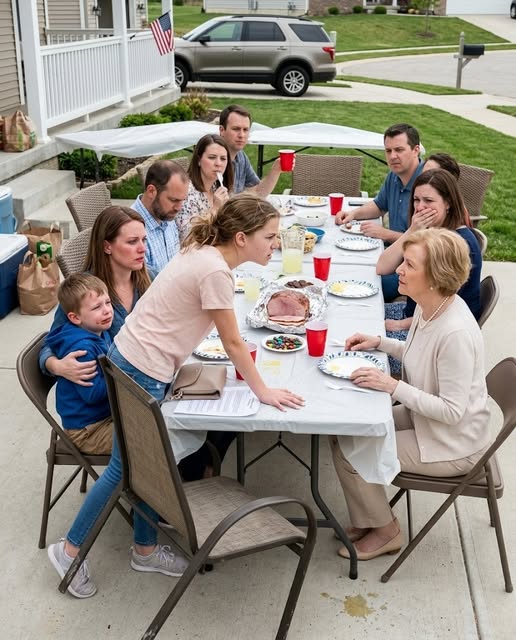
Because in my mother’s mind, my peace belonged to her.
My time belonged to her.
My paycheck belonged to her.
My children’s obedience belonged to her.
And if I withdrew any of those things, she would not ask what she had done wrong.
She would come to collect.
I looked through the peephole and saw my mother standing on my porch in a cream cardigan and pearls, her lips pressed into a thin line of manufactured injury. Behind her stood my father, hands in his pockets, looking like a man who had been dragged into a mess but fully intended to benefit if the mess went his way.
Aunt Linda was there too, holding her phone like she was ready to record my downfall.
Behind them, my cousin Blake leaned against the porch railing with a smug little smile.
Four people.
One porch light.
One locked door between my children and the family I should have left years ago.
Harper slid off the stool behind me.
“Mom?” she said quietly.
“Take Mason upstairs.”
Mason looked up, alarm already forming in his eyes. “Is it Grandma?”
I hated that he knew.
I hated that a six-year-old child had learned to identify danger by the sound of a doorbell.
“It’s okay, buddy,” I said, keeping my voice calm. “Harper’s going to take you upstairs and put on the planet documentary.”
“I don’t want Grandma to come in.”
“She won’t.”
That was the first promise I made in years that I actually intended to keep.
Harper didn’t move right away. Her jaw was clenched, her brown eyes fixed on the front door.
“I’m not leaving you alone with them.”
“Yes, you are,” I said softly. “Because Mason needs you more than I do.”
That got through.
She swallowed, nodded once, then took her brother’s hand.
As they went upstairs, my mother rang the bell again and knocked hard enough to rattle the glass.
“Emily,” she called through the door. “Open this door right now.”
My name sounded wrong in her mouth.
Not like a daughter.
Like an employee who had missed a shift.
I did not open the door.
I reached for my phone, opened the security camera app, and pressed record even though the porch camera was already capturing everything.
Then I spoke through the door.
“What do you want?”
My mother’s face changed instantly. She had not expected distance. She had expected shame.
“We need to talk,” she said.
“No, we don’t.”
“Do not embarrass this family further by acting dramatic in front of the neighbors.”
I almost laughed.
There it was.
Not “I hurt Mason.”
Not “I crossed a line.”
Not even “I’m sorry.”
Just the family image, polished like silver while everything inside it rotted.
“You came to my house uninvited at almost nine at night,” I said. “The embarrassment is already yours.”
Aunt Linda lifted her phone higher.
My mother noticed and arranged her face into something wounded.
“Emily, sweetheart,” she said, suddenly gentle. “We are here because we’re worried about you.”
That was when I knew this visit had been rehearsed.
My father shifted. “You left Easter in a pretty unstable state.”
“Unstable,” I repeated.
“You grabbed the kids and stormed out,” Aunt Linda said. “Your mother was humiliated.”
“My mother told my six-year-old son not to come to family gatherings anymore.”
“She did not say it like that,” Blake muttered.
I looked through the peephole directly at him.
“She said, ‘Next time, just don’t bring the kid.’ Mason heard her.”
My mother threw up one hand. “Oh, for heaven’s sake, I was talking about his behavior.”
“He was eating chocolate.”
“He makes things difficult.”
My hand tightened around the phone.
Behind me, from upstairs, I heard the low murmur of Harper turning on the TV for Mason. I imagined him sitting on her bedroom floor, knees pulled to his chest, asking if Grandma was mad because he had done something wrong.
Something in me hardened.
Not loudly.
Not dramatically.
Permanently.
“Mason is a child,” I said. “You are not.”
My mother’s expression cracked. For half a second, the injured grandmother vanished and the woman who raised me appeared.
Cold.
Sharp.
Entitled.
“You listen to me,” she said. “You do not get to cut us off because you had a tantrum.”
“There it is.”
“You have responsibilities to this family.”
“No,” I said. “I have responsibilities to my children.”
“You think those children are going to thank you for isolating them from their blood?”
“My children will thank me for protecting them from people who treat love like a hostage negotiation.”
My father stepped forward then, his voice low and tired.
“Emily, open the door.”
“No.”
“We’re not leaving until you talk to us like an adult.”
“You’re trespassing.”
Aunt Linda gave a brittle laugh. “Trespassing? On your own family’s porch?”
“Yes.”
Blake pushed off the railing. “You’re really going to call the cops on Grandma?”
I looked at my mother through the peephole.
The same woman who had watched Mason’s chin tremble on Easter.
The same woman who had trained everyone at that table to go silent when cruelty entered the room.
The same woman who had accepted my money for years and still thought she had the right to decide whether my son belonged.
“Yes,” I said. “If she doesn’t leave.”
My mother’s lips parted.
It was the first time in my life I had seen her genuinely surprised by me.
Then her face went still.
“Fine,” she said. “Since you want to be difficult, let’s discuss the mortgage.”
I blinked.
There it was.
The real reason.
Not reconciliation.
Not concern.
Not love.
The mortgage.
For eight years, I had been paying twelve hundred dollars a month toward my parents’ house. It started when my father lost his job at the manufacturing plant. Then he found work again, but somehow the payments never returned to him. My mother said they were still catching up. Then they needed help with property taxes. Then the water heater. Then my father’s truck. Then my aunt’s medical bills. Then Blake’s “temporary” tuition gap.
Temporary, in my family, meant until I died.
“I canceled the automatic payment yesterday,” I said.
My mother’s eyes flashed.
“You had no right.”
That sentence landed so absurdly that I actually smiled.
“No right to stop paying your mortgage?”
“You promised to help.”
“I promised to help during an emergency. I did not promise to bankroll adults who insult my children.”
My father’s face reddened. “We raised you.”
“And I repaid that debt in full somewhere around the third water heater.”
Aunt Linda stepped closer to the door. “You think you’re better than everyone because you have that big HR job and a house with a porch camera?”
“I think my children deserve peace.”
“You’re selfish,” my mother said.
“No,” I replied. “I’m finished.”
Silence spread across the porch.
Then my mother leaned toward the door, lowering her voice.
“You better think very carefully about what happens next.”
The hair on the back of my neck lifted.
“Is that a threat?”
“It’s advice.”
“No. It’s a threat. And it’s recorded.”
Aunt Linda’s phone dropped slightly.
My mother glanced up at the porch camera for the first time.
For a moment, nobody moved.
Then my father grabbed her elbow.
“Vivian,” he said quietly.
She yanked away from him.
“No. She needs to understand consequences.”
I laughed once, but there was no humor in it.
“That is exactly what I’m teaching.”
My mother stared at the closed door as if she could still command it to open by force of will alone.
Then she said the sentence that ended the last living piece of daughterly guilt inside me.
“You think you’re protecting those children? Maybe someone needs to look into whether you’re fit to keep them from their family.”
The porch went quiet.
Even Blake looked uncomfortable.
I felt my pulse slow down.
Not speed up.
Slow.
A strange calm moved through me, cold and clean.
“Leave my property,” I said. “Now.”
My father tried again. “Emily—”
“If any of you contact my children, come to their school, show up here again, or file a false report, I will give this recording to my attorney, the police, and every person whose sympathy you try to borrow.”
My mother’s chin lifted.
“You wouldn’t dare.”
I stepped closer to the door.
“Mom,” I said, and for the last time in my life, the word tasted like pleading. “You humiliated my son in front of twenty-three adults. You came to my home to demand money. Then you threatened my custody. I would dare things you have never seen from me.”
Nobody spoke.
Then, very softly, from the stairs behind me, Harper said, “Good.”
My stomach dropped.
I turned.
She was standing halfway down the staircase, Mason behind her, holding her sleeve. His eyes were wide and wet.
He had heard enough.
My mother saw them through the side window.
Her expression changed instantly.
“Mason,” she called, voice sweet as syrup. “Honey, Grandma didn’t mean—”
I moved between the window and my children.
“You do not speak to him.”
Mason whispered, “I don’t want to go with Grandma.”
My mother froze.
And there it was.
The thing she could not control.
The truth from the mouth of the child she had dismissed.
Harper wrapped one arm around him and looked at me.
“Mom,” she said, “call the police.”
My mother’s face twisted.
My father pulled her back again. “We’re leaving.”
“This isn’t over,” my mother snapped.
I looked through the glass at her one final time.
“Yes,” I said. “It is.”
They left.
But the war did not.
It changed uniforms.
The next morning, my phone was already burning when I woke up.
Thirty-seven missed calls.
Sixteen voicemails.
A group text with twenty-one unread messages.
My cousin Blake had posted on Facebook at 6:12 a.m.
Some people forget who fed them when they were helpless. Sad when daughters use grandchildren as weapons against loving grandparents. Pray for our family.
By seven, Aunt Linda had commented.
We are heartbroken. Some people care more about money than family.
By seven-thirty, my mother had posted a picture of Mason from Christmas two years earlier, cropped from a photo I had taken, his little face smeared with frosting.
Missing my babies today. A grandmother’s love never gives up, even when an unstable parent tries to erase us.
I stared at the word unstable until the letters blurred.
Then I set the phone down before I threw it.
Harper came into the kitchen in pajama pants and one of my old college sweatshirts.
“Is she posting?”
I looked up.
“How did you know?”
“Because bullies hate locked doors.”
I did not know whether to be proud or devastated that my thirteen-year-old understood that.
Mason shuffled in behind her, clutching his stuffed triceratops.
“Do I have school today?”
His voice was small.
I crouched in front of him.
“Yes, buddy. And Miss Carter will be happy to see you.”
“Will Grandma be there?”
“No.”
“Promise?”
I held his little shoulders gently.
“Promise.”
He studied my face with the seriousness only children have when they are deciding whether the world is safe.
Then he nodded.
After drop-off, I sat in my car in the elementary school parking lot and called the only person I knew who would tell me the truth without wrapping it in pity.
My best friend, Nora.
She answered on the second ring.
“Tell me you didn’t answer the door.”
“I didn’t open it.”
“Good.”
“She threatened custody.”
The line went quiet.
Then Nora said, “I’m coming over.”
“You have work.”
“I have PTO and rage. Both are useful.”
“Nora—”
“Emily. Listen to me carefully. Your mother just crossed from toxic into dangerous. You need an attorney.”
“I don’t even know what kind.”
“Family law. Harassment. Maybe both.”
“I feel ridiculous.”
“No, you feel trained.”
That shut me up.
Nora’s voice softened.
“She trained you to believe protecting yourself is overreacting. It isn’t.”
I looked toward the school doors where Mason had disappeared ten minutes earlier.
“Harper heard everything.”
“Then let her see you handle it the right way.”
The right way.
For years, the right way had meant smoothing things over.
Apologizing first.
Sending money quietly.
Pretending not to notice when my mother sharpened a comment and slid it between my ribs at Thanksgiving.
The right way had meant absorbing damage so no one else had to feel uncomfortable.
But that morning, sitting in the parking lot with my hands shaking around a cold coffee cup, I understood something that should have been obvious.
Peace without safety is just silence.
And I was done mistaking silence for peace.
By noon, Nora had sent me three attorney names.
By one, I had left voicemails with all of them.
By three, Child Protective Services called.
The woman’s voice was polite.
Professional.
Careful.
“Ms. Donnelly, my name is Rebecca Moore. I’m a caseworker with Franklin County Children Services. We received a report concerning your children, Harper and Mason Donnelly.”
For a moment, sound vanished from the world.
I saw Mason’s face on the stairs.
I heard my mother’s voice through the door.
Maybe someone needs to look into whether you’re fit.
I gripped the edge of my desk until my fingertips hurt.
“What kind of report?”
“I’d prefer to discuss it with you in person. Are the children safe and with you?”
“They’re at school.”
“Do you have any immediate concerns about them returning home with you today?”
“No,” I said, my voice cracking. “No. They’re safe. They are loved. This report is retaliation.”
“I understand this is upsetting.”
“No, you don’t understand. My mother threatened to do this last night because I stopped paying her mortgage.”
There was a pause.
Then Rebecca said, “Do you have documentation of that threat?”
I looked at my phone.
“Yes.”
“Good. Please preserve it. I’d like to schedule a home visit.”
I almost said, “Today?”
I almost begged for time to clean things that were already clean, organize things that were already organized, perform motherhood like a defendant.
Then I looked at the framed photo on my desk of Harper holding Mason the day he came home from the hospital, her five-year-old grin wide and proud, his newborn fist wrapped around her finger.
I was not guilty.
I was afraid.
Those were not the same thing.
“Come at four-thirty,” I said.
At four, Nora was in my living room vacuuming like she intended to personally remove trauma from the carpet.
“You don’t have to do that,” I said.
“I know.”
“Then why are you doing it?”
“Because I can’t legally punch your mother.”
Harper sat at the kitchen table with Mason, helping him with a worksheet, though she kept glancing toward the window.
At 4:28, a gray sedan pulled up outside.
Mason dropped his pencil.
“It’s not Grandma,” I said immediately.
Rebecca Moore was younger than I expected, maybe early thirties, with dark hair in a low bun and tired, kind eyes. She wore slacks, a navy jacket, and the expression of someone who had learned not to assume anything until she saw it herself.
She introduced herself to the kids first.
Not to me.
To them.
I respected her for that.
Mason hid half behind Harper but answered when she asked about his dinosaurs.
Harper was polite in the frosty way only a teenage girl defending her family can be.
Rebecca asked to look around the house.
I showed her everything.
The pantry.
The bedrooms.
The bathroom.
The homework station.
The medication drawer with Mason’s allergy medicine labeled and current.
The calendar on the fridge with therapy appointments, school events, dentist reminders, Harper’s debate club meetings, and Mason’s dinosaur museum day circled in blue.
I kept waiting for shame to show up.
It didn’t.
There were breakfast dishes in the sink.
There was a laundry basket on my bedroom floor.
There were crayons under the coffee table.
It looked like children lived there.
Not neglected children.
Just children.
After the walkthrough, Rebecca sat with me at the kitchen table while Nora took the kids into the living room.
“I can’t disclose every detail of the reporter,” Rebecca said, “but I can tell you the report alleged emotional instability, unsafe conditions, food insecurity, and isolation from extended family.”
I laughed.
I could not help it.
It came out broken.
“Food insecurity?”
Rebecca’s eyes flicked toward the pantry she had just seen.
“Yes.”
“My mother has eaten the lasagna out of that freezer.”
Rebecca’s mouth twitched, but she remained professional.
“You mentioned retaliation. Can you show me the recording?”
I played the porch video.
The room filled with my mother’s voice.
We’re worried about you.
You had no right.
Maybe someone needs to look into whether you’re fit.
When it ended, Rebecca was silent for a moment.
Then she asked, “Do you have any other documentation?”
I opened the Easter audio Harper had recorded on her phone.
I had not known she’d recorded until Monday morning, when she came into my room and handed me her phone without a word.
The recording was messy—wind, plates clinking, someone laughing too loudly.
Then my mother’s voice, clear enough.
“Next time, just don’t bring the kid.”
Then Mason’s trembling question.
“Mama, does Grandma not want me here?”
Rebecca closed her eyes for half a second.
When she opened them, she looked tired again.
Not doubtful.
Tired.
“I’m sorry he experienced that.”
I stared down at my hands.
“So am I.”
She asked to speak with Harper privately.
I agreed.
Then with Mason, gently, with me nearby but not answering for him.
Mason told her Grandma didn’t like when he talked about dinosaurs.
He told her Grandma said he was “too much.”
He told her he didn’t want to go to Grandma’s house because “the grown-ups get quiet there.”
That sentence did something to Rebecca’s face.
It did something to mine too.
Because that was exactly what it had been like growing up.
The grown-ups got quiet there.
The silence protected the cruelest person in the room.
When Rebecca left, she did not close the case on the spot. That was not how the system worked. She still had calls to make, school records to verify, boxes to check.
But at the door, she looked at me and said, “Based on what I saw today, I do not have immediate safety concerns.”
I nodded, but I couldn’t speak.
After she drove away, I went upstairs, shut myself in my bathroom, sat on the closed toilet seat, and cried so quietly my children would not hear.
Not because I was weak.
Because I was furious.
Because my mother had not merely insulted Mason.
She had tried to put the government between me and my children because I would not pay her bills.
And the worst part was not that I was surprised.
The worst part was that some small, obedient, damaged part of me had expected it.
That night, after Mason fell asleep with his night-light glowing blue across the walls, Harper knocked on my bedroom door.
“Can I come in?”
She was holding her phone.
I patted the bed.
She sat cross-legged beside me, older than she should have been and younger than she wanted me to notice.
“I’m sorry I recorded Easter,” she said.
I turned to her.
“Harper.”
“I know it was sneaky.”
“You protected your brother.”
Her eyes filled, but she blinked hard.
“I knew nobody would believe us.”
The words were so simple.
So damning.
I pulled her into my arms.
She resisted for one second—the reflex of a teenager who had dignity to maintain—then folded into me.
“I’m sorry,” I whispered into her hair.
“For what?”
“For teaching you that.”
She was quiet.
Then she said, “You didn’t. They did.”
I held her tighter.
For the next week, my family behaved exactly like people who had lost access to something they believed they owned.
My father called from different numbers.
Aunt Linda sent articles about “grandparent alienation.”
Blake messaged Harper on Instagram until she blocked him.
My mother mailed a handwritten letter addressed to Mason, which I did not give him.
On the outside of the envelope, in her careful cursive, she wrote:
Grandma will always love you, even if Mommy is angry.
I photographed it, sealed it in a folder, and gave it to my attorney.
Her name was Celeste Grant.
She was fifty-something, sharp-eyed, and wore red lipstick like it was armor.
Nora found her through a coworker who described her as “the kind of lawyer who makes bullies regret learning email.”
The moment I sat in Celeste’s office and handed her the folder, she flipped through the screenshots, the payment records, the Easter audio transcript, the porch video notes, and the CPS contact log without changing expression.
Then she looked at me over the top of her glasses.
“How long have you been supporting them financially?”
“Eight years.”
“How much per month?”
“It varied.”
“Average.”
I swallowed.
“About thirty-two hundred dollars.”
Celeste went still.
“Per month?”
“Yes.”
“For eight years?”
“Not always that high.”
She picked up a pen.
“Emily.”
I hated the gentleness in her voice because it meant the number had said something I hadn’t been ready to hear.
“Do you have totals?”
“No.”
“We’ll make them.”
“I don’t want to sue them for the money.”
“I didn’t say sue. I said make them. You need to understand the scale of what they’re losing because that explains the scale of their behavior.”
Over the next hour, Celeste did what no one in my family had ever done.
She treated my reality like evidence.
Not drama.
Evidence.
The automatic mortgage payments.
The Venmo transfers.
The “temporary” tuition help for Blake.
The $4,800 roof repair.
The $900 emergency vet bill for Aunt Linda’s dog.
The $2,200 dental bill for my father.
The groceries.
The insurance lapse.
The “just until Friday” loans that never returned.
By the time Celeste’s assistant ran the preliminary total, the number was sitting on the screen like a body.
$286,419.
I stared at it.
“That can’t be right.”
Celeste turned the screen toward me.
“It may be low. We haven’t added cash withdrawals.”
I felt sick.
Not because of the money alone.
Because I remembered every time I had told Harper we couldn’t do the beach rental that summer.
Every time I had delayed replacing my ten-year-old car.
Every time I had said no to myself because my mother had trained me to say yes to her.
Celeste tapped the folder.
“Your mother is not grieving a relationship. She’s reacting to the closure of an income stream.”
I looked down.
“She’s still my mother.”
“Yes,” Celeste said. “And that is why this works on you.”
I did not cry in her office.
I wanted to.
But I didn’t.
Celeste outlined the plan.
A cease-and-desist letter.
A formal no-contact demand regarding the children.
Documentation to CPS.
A police report for the threat and harassment, not because it would instantly fix everything, but because records mattered.
“Do not engage,” she said. “Do not defend yourself online. Do not answer emotional bait. Everything goes through me.”
“What if she comes to the house again?”
“Call the police.”
“What if she goes to the school?”
“Already handled?”
I hesitated.
Then I shook my head.
Celeste’s expression sharpened.
“Do that today.”
So I did.
I drove from her office straight to Harper’s middle school, then Mason’s elementary school. I sat with administrators and gave them photographs of my mother, father, Aunt Linda, and Blake.
I explained that no one outside the approved pickup list had permission to see or remove my children.
At Mason’s school, Miss Carter listened with her hands folded on her desk, her face softening when I told her what happened at Easter.
“Mason asked me Monday if families can vote someone out,” she said.
The room tilted slightly.
“He asked you that?”
She nodded.
“I told him no child can be voted out of a family worth belonging to.”
I put my hand over my mouth.
Miss Carter reached across the desk and squeezed my wrist.
“He’s a wonderful boy, Ms. Donnelly.”
“I know.”
“No,” she said firmly. “I mean it. He is bright, kind, observant, and funny. If someone made him feel like a burden, that is an adult failure. Not his.”
I sat in my car afterward and breathed until I could drive.
The cease-and-desist letter went out Friday morning.
My mother received it Friday afternoon.
At 5:03 p.m., she called me twelve times.
At 5:16, she called Harper.
At 5:18, Harper blocked her.
At 5:22, my mother posted on Facebook again.
There comes a point when a mother must tell the truth, no matter how painful. Please pray for my daughter. We are pursuing legal options to protect our grandchildren.
By 6:00, three relatives had commented with broken-heart emojis.
By 6:30, Nora had sent me screenshots because I had finally blocked them all.
At 7:10, Celeste emailed my mother’s post to herself with the subject line:
Exhibit G.
I slept badly that night.
Not because I feared losing.
Because some part of me still feared winning.
Winning meant there was no excuse left.
Winning meant I could no longer tell myself I had to endure it for the children, for the holidays, for family unity, for my father’s blood pressure, for my mother’s childhood, for whatever sad little explanation had kept me chained.
Winning meant admitting I could have left sooner.
That was the cruelest part of healing.
The freedom came with grief for the years I had spent unlocked but unmoving.
The next attack came from my father.
He showed up alone on Saturday morning while Harper was at debate club and Mason was helping me make pancakes.
This time, he did not ring repeatedly.
He knocked once.
A tired knock.
A father knock.
The kind that still had the power to pull me backward twenty years.
I checked the camera.
He stood on the porch in an old Ohio State sweatshirt, holding a paper grocery bag.
Mason looked up from the pancake batter.
“Who is it?”
“Grandpa.”
His face went uncertain.
“Is Grandma there?”
“No.”
“Can Grandpa come in?”
I looked at my son.
There was hope in his voice.
That hurt worse than fear.
Because my father had never been as openly cruel as my mother.
He had been something harder to explain to a child.
He had been present.
He had been pleasant.
He had been useless when it mattered.
I opened the main door but left the storm door locked.
My father lifted the bag.
“Brought those blueberry muffins Mason likes.”
Mason stepped beside me, peering around my leg.
My father smiled at him.
“Hey, buddy.”
Mason did not answer.
My father’s smile faltered.
“What do you want?” I asked.
He sighed.
“Emmy, come on.”
I hadn’t been Emmy since I was eleven and still believed he might rescue me from her.
“Don’t.”
He glanced toward the street, embarrassed.
“Can we talk without the glass between us?”
“No.”
His jaw tightened.
“It’s muffins, not a weapon.”
“Last time someone from your house came here, they threatened my custody.”
“That was your mother talking out of anger.”
“That was my mother revealing strategy.”
He looked away.
Behind me, Mason whispered, “Mommy, I don’t want muffins.”
My father heard.
Something like shame crossed his face.
Good, I thought.
Finally.
“Buddy,” he said softly, “Grandma didn’t mean to hurt your feelings.”
Mason pressed against my side.
“But she did.”
My father swallowed.
“I know.”
Those two words almost broke me.
Because they were the first honest words anyone from that house had spoken since Easter.
Then he ruined them.
“But you know how she gets.”
The old sentence.
The family hymn.
You know how she gets.
As if her cruelty were weather.
As if we were all obligated to dress accordingly.
I felt myself go calm again.
“Yes,” I said. “I know exactly how she gets. That’s why she’s not allowed near my children.”
He rubbed both hands over his face.
“Your mother is falling apart.”
“No. She is losing control.”
“The house payment bounced.”
“I know.”
“We’re going to be in trouble.”
“I know.”
“Emily, I’m sixty-four.”
“And I was twenty-nine when I started paying your mortgage.”
His eyes hardened then, not cruelly, but defensively.
“You offered.”
“I was guilted.”
“You wanted to help.”
“I wanted to be loved.”
That silenced him.
The words hung between us, ugly and alive.
My father looked down at the grocery bag.
For a second, I thought he might finally say it.
I’m sorry.
I should have stopped her.
You deserved better.
Instead, he said, “She’s still your mother.”
I closed my eyes.
There are sentences that sound like bridges until you realize they are cages.
I opened my eyes again.
“And I am still theirs.”
I put my hand on Mason’s shoulder.
“That matters more now.”
My father’s face crumpled, but whether from guilt or self-pity, I couldn’t tell.
“I don’t know how to fix this,” he said.
“You can start by telling the truth.”
“To who?”
“To yourself.”
He stared at me.
Then I unlocked the storm door, opened it a few inches, and took the grocery bag from his hand.
Not because I wanted the muffins.
Because Mason was watching, and I wanted him to know boundaries did not require cruelty.
“Thank you for bringing them,” I said. “But you cannot come inside. And you cannot come here without asking again.”
My father nodded slowly.
“Will you tell Mason I love him?”
Mason answered before I could.
“Love means you say stop when someone is mean.”
My father looked at him.
Really looked.
His eyes filled.
“You’re right,” he whispered.
Then he walked back to his car.
Mason watched him leave.
“Mommy?”
“Yeah?”
“If Grandpa knows, why didn’t he say stop?”
I looked at my father’s car as it pulled away.
“Because some grown-ups are afraid of the wrong things.”
Mason considered that.
Then he said, “I’m afraid of volcanoes, but I still like them.”
Despite everything, I laughed.
I kissed the top of his head.
“That makes you braver than a lot of people.”
By Monday, the CPS case was closed as unfounded.
Rebecca called me personally.
“I’m closing the investigation,” she said. “I also documented the retaliatory context and your cooperation.”
I gripped the phone.
“Thank you.”
“Ms. Donnelly?”
“Yes?”
“Keep the school precautions in place.”
My stomach tightened.
“Why?”
A pause.
“Because people who make false reports sometimes escalate when the report doesn’t produce the desired result.”
She was right.
That Thursday, my mother went to Mason’s school.
She arrived at 11:40 a.m., wearing sunglasses and carrying a gift bag.
She told the front office she was there to surprise her grandson for lunch.
The receptionist, who had clearly been sent from heaven with acrylic nails and no patience for nonsense, checked the file and told her she was not authorized.
My mother said there must be a mistake.
The receptionist said there was not.
My mother said she was his grandmother.
The receptionist said that did not make her authorized.
My mother started crying.
The receptionist called the principal.
The principal called me.
By the time I arrived, my mother was standing outside near the flagpole, her face flushed, still clutching the gift bag.
The American flag snapped above her in the spring wind while children played somewhere behind the building, their voices bright and unaware.
She looked smaller in daylight.
Not weaker.
Just smaller.
Like a monster pulled out from under the bed and revealed as a woman who needed everyone else to stay afraid so she could feel tall.
The principal stood beside me, firm and professional.
“Ms. Donnelly, do you want us to contact law enforcement?”
My mother gasped.
“Emily.”
I looked at her.
“What did I tell you?”
“I wanted to see Mason.”
“You are not allowed.”
“He’s my grandson.”
“He is my son.”
Her mouth trembled.
“You are poisoning them against me.”
“No. You did that yourself.”
She held up the gift bag.
“I brought him the dinosaur Lego set.”
I looked at the bag.
For one sharp second, sadness cut through the anger.
Because Mason would have loved it.
Because my mother knew that.
Because even her gifts had hooks.
“You need to leave,” I said.
She stepped closer.
“I will not be erased.”
The principal shifted, ready to intervene.
I held up one hand.
“You are not being erased. You are being removed from places where you cause harm.”
My mother’s eyes narrowed.
“You sound just like that lawyer.”
“Good.”
“There are grandparents’ rights.”
“There are also children’s rights.”
“He loves me.”
“He is afraid of you.”
That landed.
For a moment, her face went blank.
Then rage filled it.
“You always were ungrateful.”
The old insult.
The dull knife.
But this time, it didn’t go in.
“No,” I said. “I was useful. You confused the two.”
The principal called the school resource officer.
My mother left before he reached us, but not before turning back and saying, loud enough for the principal, receptionist, and two arriving parents to hear:
“You will regret humiliating me.”
I documented it.
Celeste filed for a civil protection order the next morning.
The hearing was scheduled for two weeks later.
In those two weeks, my life became strangely quiet.
Not peaceful.
Quiet.
The kind of quiet that follows surgery, when the infected thing has been cut out but the body has not yet learned it is safe.
Harper stopped flinching when my phone rang.
Mason started sleeping through the night again.
I blocked thirty-one relatives and discovered that my world did not end.
Bills came due, and for the first time in years, I paid only my own.
My bank account looked unfamiliar without all the family withdrawals.
There was money left.
Not endless money.
But enough.
Enough to sign Mason up for the summer dinosaur camp I had always told him was too expensive.
Enough to pay Harper’s debate travel fee without moving money from savings.
Enough to take both kids to the shoe store and say yes when Mason picked the sneakers with tiny green T-rexes on the sides.
At checkout, Harper looked at me oddly.
“What?”
She shook her head.
“Nothing.”
“No, tell me.”
She glanced at Mason, who was admiring his shoebox.
“It’s just weird.”
“What is?”
“Seeing you not panic about money.”
I felt that in my ribs.
“I didn’t realize you noticed.”
“Mom,” she said gently. “We noticed everything.”
That night, I opened my laptop and made another list.
Not of evidence.
Not of payments.
Of repairs.
Not house repairs.
Life repairs.
Therapy for Harper.
Therapy for me.
A family counselor for Mason if he needed it.
A weekend trip.
A savings account labeled OUR FUTURE.
I stared at the account name for a long time.
Then I transferred the exact amount I would have sent my parents that month.
$3,200.
For a few seconds, I expected guilt to rise.
Instead, I felt grief.
Then relief.
Then something almost like joy.
The court hearing was on a rainy Wednesday morning.
The courthouse smelled like wet coats, old paper, and coffee burnt beyond forgiveness.
Celeste met me in the hallway outside the courtroom. She wore a black suit and the same red lipstick.
“You ready?” she asked.
“No.”
“Good. Ready people underestimate things.”
Nora was with me. She had taken the day off and brought a folder full of printed screenshots, three protein bars, and the emotional energy of a guard dog.
Harper wanted to come.
I said no.
She argued.
I still said no.
Not because she wasn’t strong.
Because she had already been strong enough.
Children should not have to testify against the people adults failed to stop.
My mother arrived ten minutes later with my father and Aunt Linda.
She wore navy blue, pearls, and a face arranged for tragedy.
The moment she saw me, her eyes filled with tears.
Celeste leaned toward me.
“Do not react.”
“I know.”
“She is performing for the room.”
“I know.”
But knowing did not stop the child inside me from wanting to disappear.
My mother had always been good in public.
At church potlucks, she was gracious.
At weddings, elegant.
At funerals, indispensable.
She knew how to touch an arm, lower her voice, dab her eye at exactly the right time.
She had built an entire reputation out of being kind to people who did not depend on her.
The courtroom was smaller than I expected.
The judge was a woman named Patricia Harlan with silver hair, sharp eyes, and the deeply unimpressed posture of someone who had heard every version of family drama and developed immunity.
My mother’s attorney was a man named Mr. Keene, who kept calling the situation “a misunderstanding.”
Celeste let him.
For a while.
Mr. Keene argued that my mother was a loving grandmother who had been abruptly cut off after a minor holiday disagreement. He described me as overwhelmed, emotionally reactive, and financially punitive.
“Financially punitive,” I whispered.
Celeste touched my arm once.
Wait.
Mr. Keene said my parents had “relied upon certain family support arrangements” and that my sudden withdrawal had created distress.
The judge looked up.
“What support arrangements?”
Mr. Keene cleared his throat.
“Informal assistance.”
Celeste stood.
“Your Honor, if opposing counsel intends to introduce my client’s finances as evidence of instability or motive, I am prepared to provide eight years of records showing that Ms. Donnelly transferred nearly three hundred thousand dollars to various adult relatives, including the petitioner, who then retaliated when those payments stopped.”
The courtroom went still.
My mother’s face changed.
Just slightly.
But I saw it.
The mask slipped at the edges.
Judge Harlan looked at Mr. Keene.
“Counsel?”
Mr. Keene looked suddenly less comfortable.
“We are not seeking to litigate finances today.”
“Then do not imply them halfway,” the judge said.
Celeste’s mouth barely moved, but I knew she was pleased.
Then came the evidence.
The Easter audio.
My mother’s voice filled the courtroom.
“Next time, just don’t bring the kid.”
Then Mason’s voice.
“Mama, does Grandma not want me here?”
The judge’s pen stopped moving.
My mother stared at the table.
My father closed his eyes.
Aunt Linda looked away.
Then the porch video.
You had no right.
Maybe someone needs to look into whether you’re fit.
Then the school incident report.
Then the CPS closure letter.
Then the Facebook posts.
By the time Celeste finished, the phrase “minor holiday disagreement” lay dead on the floor.
Judge Harlan turned to my mother.
“Mrs. Callahan, did you go to the child’s school after being instructed not to contact him?”
My mother lifted her chin.
“I was concerned.”
“That was not my question.”
My mother faltered.
“Yes.”
“Did you threaten to pursue custody or report your daughter after she stopped providing financial support?”
“I was worried about the children.”
The judge looked down at the transcript.
“Your worry appears to have coincided with a bounced mortgage payment.”
My mother flushed.
Mr. Keene stood. “Your Honor—”
“Sit down, counsel.”
He sat.
Judge Harlan looked back at my mother.
“Do you understand that grandparent status does not entitle you to override a fit parent’s decision, particularly when your own behavior has caused distress to the children?”
My mother’s eyes filled again.
“She’s my daughter.”
Judge Harlan’s expression did not soften.
“Then you should have treated her like one.”
No one breathed.
Not even me.
For one suspended second, those words seemed to move backward through my life.
Through every holiday I had swallowed.
Every check I had written.
Every apology I had offered to end a conflict I had not started.
Then the judge granted the protection order.
No contact with me.
No contact with Harper.
No contact with Mason.
No visits to school, home, activities, or my workplace.
No third-party messages.
No social media posts naming or implying the children.
Six months, reviewable and extendable.
My mother made a sound like she had been slapped.
“This is cruel,” she whispered.
The judge looked at her.
“No, Mrs. Callahan. This is a boundary with legal consequences.”
After court, my mother tried to approach me in the hallway.
Celeste stepped between us.
“Do not,” she said.
My mother looked past her, straight at me.
For the first time, she did not look angry.
She looked desperate.
“Emily, please.”
That word.
Please.
She had used it so rarely with me.
She used commands.
Guilt.
Obligation.
Illness.
Silence.
But not please.
For one dangerous second, my heart moved.
Not toward forgiveness.
Toward habit.
Then my father stepped beside her.
His face was gray.
“Vivian,” he said quietly. “Leave her alone.”
My mother turned on him.
“What?”
He looked at me, then back at her.
“The judge is right.”
Aunt Linda gasped like he had cursed in church.
My mother stared at him.
He swallowed hard.
“We hurt them.”
My mother’s face twisted with betrayal.
“You weak man.”
He flinched.
I knew that flinch.
I had inherited it.
But then he did something I had never seen him do.
He did not retreat.
“No,” he said, voice shaking. “Weak was letting you call that boy a problem. Weak was taking Emily’s money and pretending it was respect. Weak was standing there while you threatened her children because the mortgage bounced.”
People in the hallway turned.
My mother’s eyes were wide with disbelief.
“After everything I’ve done for this family?”
My father’s laugh was small and broken.
“Vivian, you didn’t build a family. You built an audience.”
The words hit harder than shouting.
My mother slapped him.
The sound cracked through the hallway.
A deputy turned immediately.
Celeste pulled me back.
My father stood with his cheek red, eyes wet, and did not raise a hand.
He simply looked at my mother and said, “I’m done too.”
That was the second war.
The one I had not expected.
My parents separated three days later.
Not divorced immediately.
Not dramatically.
My father moved into a weekly rental near the highway with two duffel bags and an old framed photo of his parents.
I did not invite him into my life.
Not yet.
A protection order did not erase thirty years of cowardice.
But two weeks after the hearing, he mailed me a letter.
No guilt.
No demand.
No “but she’s your mother.”
Just three pages in shaky handwriting.
He wrote that he was sorry for every silence.
He wrote that he had confused keeping peace with being good.
He wrote that he did not expect access to my children, did not deserve it, and would respect whatever I decided.
At the bottom, he wrote:
Mason was right. Love means saying stop when someone is mean. I should have said stop a long time ago.
I read that sentence four times.
Then I put the letter in a drawer.
Not the evidence folder.
A different drawer.
Some things are not forgiveness.
Some things are just the first honest brick in a road that may or may not ever be built.
My mother violated the order once.
Of course she did.
It was a Sunday morning in June.
She sent Harper an email through an old school account we had forgotten existed.
The subject line was:
You are too young to understand.
The body said:
One day you will realize your mother destroyed this family because she could not handle correction. I hope you remember who loved you before she taught you hate.
Harper found it before I did.
She came into the kitchen holding her laptop, face pale but calm.
“I didn’t answer.”
I took the laptop.
Read it.
And for the first time in my life, my mother’s words did not enter me.
They stopped at the surface.
Like rain against glass.
I forwarded it to Celeste.
Celeste forwarded it to the court.
My mother received a warning and a fine.
The next violation would carry harsher consequences.
She did not contact us again.
Summer came slowly.
Then all at once.
Mason went to dinosaur camp and came home every day with dirt on his knees, facts in his mouth, and joy all over his face.
Harper won second place at a regional debate workshop and pretended not to care while secretly sleeping with the certificate on her nightstand.
I started therapy on a Thursday afternoon and spent the first session explaining that my childhood “wasn’t that bad.”
My therapist, Dr. Elaine Morris, listened quietly.
Then she asked, “Compared to what?”
I had no answer.
So I kept going back.
Week after week, I learned the language of things I had lived without naming.
Enmeshment.
Parentification.
Financial abuse.
Emotional coercion.
Scapegoating.
Trauma response.
But the most important word I learned was simpler.
No.
Not the angry no.
Not the defensive no.
The clean no.
No, that doesn’t work for me.
No, you may not speak to my child that way.
No, I will not pay that bill.
No, I will not confuse your emergency with my obligation.
No.
A complete sentence.
A locked door.
A life raft.
In August, I took the kids to Lake Michigan for four days.
Nothing fancy.
A small rental cottage with sandy floors, mismatched plates, and a porch that faced the water.
On the second night, we built a fire on the beach.
Mason roasted one marshmallow perfectly and then dropped it directly into the sand.
Harper laughed so hard she nearly fell off the log.
I expected Mason to cry.
Instead, he stared at the ruined marshmallow and said, “That one belongs to the beach now.”
We all lost it.
I laughed until my stomach hurt.
Real laughter.
Not polite.
Not strategic.
Not the kind I used at family gatherings to smooth over the next insult.
Real.
Later, after Mason fell asleep inside with his dinosaur book open on his chest, Harper and I sat on the porch under a sky crowded with stars.
She was quiet for a long time.
Then she said, “Do you miss them?”
I knew who she meant.
The old answer would have been careful.
The old answer would have protected her from my sadness.
But I was trying to raise children who did not need to become detectives to find the truth in a room.
“Sometimes,” I said.
She looked surprised.
“I miss who I wanted them to be. I miss the idea that somewhere under all that, there was a normal family waiting to come out.”
Harper nodded.
“Do you think Grandma loves us?”
I stared out at the black water.
“Yes,” I said slowly. “But not safely.”
Harper turned that over.
“That’s a thing?”
“It’s a very real thing.”
She pulled her sweatshirt sleeves over her hands.
“I don’t want unsafe love.”
I looked at my daughter—my brave, furious, tender daughter who had stood up at a picnic table because every adult there had forgotten how.
“You don’t have to accept it.”
She leaned her head on my shoulder.
For a while, we listened to the waves.
Then she whispered, “I’m proud of you, Mom.”
I closed my eyes.
There are things children should not have to say to parents.
But when they do, and when they mean them, something holy happens anyway.
“I’m proud of you too,” I whispered.
By September, my life had become almost unrecognizable in its ordinariness.
School mornings.
Work meetings.
Grocery lists.
Therapy appointments.
Soccer cleats.
Permission slips.
Movie nights.
A broken dishwasher.
A new dishwasher.
No screaming voicemails.
No emergency loans.
No holiday dread sitting weeks in advance at the base of my spine.
Then, in October, my father asked to meet.
He did it properly.
Through Celeste first.
A letter.
No pressure.
No expectation.
He wanted to apologize to Harper and Mason, but only if I believed it would not harm them.
I asked the kids separately.
Harper said, “I’ll hear him out, but if he says ‘that’s just how Grandma is,’ I’m leaving.”
Mason asked, “Will he bring muffins?”
I said maybe.
We met at a public park on a Saturday afternoon.
Nora came and sat on a bench nearby, reading a novel upside down because she was watching us the entire time.
My father looked thinner.
Older.
He brought no gifts.
I respected that more than muffins.
He sat across from my children at a picnic table under a maple tree just starting to turn red.
His hands shook.
“I owe you both an apology,” he said.
Harper crossed her arms.
Mason leaned against me.
My father looked at Mason first.
“Your grandmother said something cruel about you. I heard it. I knew it was wrong. And I did not stop her.”
Mason stared at the table.
“That hurt my feelings.”
My father nodded, tears gathering.
“I know. I’m sorry.”
“You should’ve said stop.”
“Yes,” my father whispered. “I should have.”
Then he looked at Harper.
“And you stood up when I didn’t.”
Harper’s eyes narrowed, but not in anger.
In assessment.
“I shouldn’t have had to.”
“No,” he said. “You shouldn’t have.”
That was the moment something shifted.
Not healed.
Shifted.
My father did not ask for a hug.
He did not ask when he could see them again.
He did not ask me to talk to my mother.
He simply apologized, answered their questions, and left after twenty minutes because I had said twenty minutes.
As he walked away, Harper said, “That was better than I expected.”
Mason said, “He forgot muffins.”
Harper rolled her eyes.
I laughed.
Progress, I learned, did not always look like reconciliation.
Sometimes it looked like a man leaving when the visit was over because a boundary had been set.
Thanksgiving came.
For the first time in my life, I did not go to my mother’s house.
I did not make green bean casserole for people who would insult it.
I did not dress my children for judgment.
I did not remind them to be patient with relatives who had never been patient with them.
Instead, Nora came over with her wife, Denise, and their twin boys. Miss Carter stopped by for pie because her flight home had been canceled. Our neighbor Mrs. Alvarez brought tamales and told Mason he was in charge of explaining dinosaurs to everyone.
He took the job seriously.
At one point, I stood in the kitchen doorway and watched the living room.
Harper was laughing with Nora’s boys over a card game.
Mason was explaining the difference between a velociraptor and a deinonychus to Mrs. Alvarez, who listened like he was delivering a university lecture.
Denise was helping with dishes even though I told her not to.
Nora caught me staring.
“You okay?”
I nodded.
But my throat was tight.
“I thought it would feel empty,” I said.
“What?”
“Not having them here.”
Nora looked around my warm, loud, safe house.
“Does it?”
I shook my head.
“No.”
She bumped my shoulder.
“Then maybe it wasn’t family you lost. Maybe it was just attendance.”
That sentence stayed with me.
Christmas passed.
Then winter.
Then the protection order was extended after Celeste presented the email violation and school incident. My mother appeared at the review hearing thinner, angrier, and still convinced she was the injured party.
The judge asked if she had completed the counseling recommended at the first hearing.
My mother said she did not need counseling for loving her grandchildren.
The judge extended the order for another year.
My mother looked at me with pure hatred.
And I felt… nothing.
Not numbness.
Not fear.
Just distance.
Like seeing a storm on a weather map over a state where I no longer lived.
In March, my father filed for divorce.
He told me through a letter, not a phone call.
He said he had started therapy.
He said he was attending a support group for people leaving emotionally abusive marriages.
He said he understood if that made me angry because I had been a child and had not been given the choice to leave.
It did make me angry.
Then it made me sad.
Then, eventually, it made me glad.
Healing was inconvenient that way.
It refused to be only one thing.
The next Easter arrived bright and cool, with tulips pushing through the soil and sunlight pouring over our backyard like a blessing.
I hosted a picnic.
Not a family picnic.
A real one.
The kind where everyone invited actually wanted my children there.
Nora and Denise came with the twins.
Mrs. Alvarez came with a folding chair and a cake shaped vaguely like a bunny.
Miss Carter came with her fiancé.
My father came for one hour, by invitation, after six months of consistent respect. He brought a fruit tray and asked where he should put it. He did not comment on the guest list. He did not ask about my mother. He did not overstay.
Harper watched him carefully at first.
Then, when he helped Mason fix a bent wing on a little foam airplane, she relaxed enough to go back to painting eggs with the twins.
I stood near the patio table, holding a glass of lemonade, and watched my son run across the grass with his repaired airplane lifted high over his head.
He was laughing.
Not cautiously.
Not checking adult faces first.
Laughing with his whole body.
Harper came to stand beside me.
“Full circle,” she said.
I looked at her.
“What?”
She nodded toward the table.
“Easter picnic. No villains.”
I smiled.
“Don’t say that too loud. Nora takes Monopoly very seriously.”
Harper grinned.
Then her expression softened.
“Do you ever think about what would’ve happened if we stayed that day?”
I looked toward the yard.
Mason had crashed the plane into a bush and was now explaining to Miss Carter that it had made “an emergency paleontological landing.”
“Yes,” I said. “I think about it.”
“What do you think?”
I took a slow breath.
“I think your brother would have learned that love means sitting quietly while people decide whether you are welcome. I think you would have learned that courage gets punished. And I would have kept calling it family because I was too scared to call it harm.”
Harper was quiet.
Then she said, “I’m glad we left.”
I put my arm around her shoulders.
“Me too.”
A few minutes later, Mason ran up to us, breathless and grass-stained.
“Mommy, Harper, come see! Grandpa knows how to make the airplane do loops!”
Harper looked at me.
I looked at my father across the yard.
He was standing by the maple tree, foam airplane in hand, waiting.
Not demanding.
Waiting.
That mattered.
“We’re coming,” I said.
Mason grabbed my hand.
His palm was sticky with frosting.
I did not pull away.
As we crossed the grass, I glanced once toward the empty place inside me where my mother’s voice used to live.
For years, it had narrated everything.
Too sensitive.
Ungrateful.
Dramatic.
Selfish.
Difficult.
Now, there was only the sound of children laughing, paper plates rustling, Nora accusing Denise of cheating at cornhole, and the spring wind moving gently through the trees.
My father handed Mason the airplane.
“Show your mom,” he said.
Mason lifted it carefully.
Harper stood on one side of him.
I stood on the other.
Together, we watched that little green airplane rise, wobble, catch the wind, and loop once above the yard before landing softly in the grass.
Mason threw both hands up.
“Did you see that?”
“I saw,” I said.
And I had.
I had seen all of it.
The insult.
The silence.
The doorbell.
The threat.
The courtroom.
The grief.
The rebuilding.
The way a family can shrink and somehow become larger.
The way a child can ask one heartbreaking question and finally wake the mother who should have protected him sooner.
The way a thirteen-year-old girl can stand up at a picnic table and become the voice every adult had swallowed.
The way leaving can feel like destruction until the air clears and you realize it was rescue.
That evening, after everyone left, the kids and I cleaned up the yard together.
Mason collected plastic eggs.
Harper folded blankets.
I carried plates into the kitchen and paused at the window.
Outside, my children were chasing each other across the grass in the last gold light of Easter Sunday.
Safe.
Wanted.
Free.
My phone sat on the counter, silent.
No missed calls.
No guilt messages.
No emergencies that somehow required my bank account.
Just silence.
Real silence this time.
The peaceful kind.
Mason burst through the back door holding a cracked blue egg.
“Mommy! This one has two chocolates!”
Harper followed behind him. “Because you put two in there, genius.”
“I forgot!”
I laughed.
Mason climbed onto a kitchen stool and looked at me with chocolate already melting on his fingers.
“Can we do Easter here every year?”
I looked at Harper.
She smiled.
Then I looked at my son.
“Yes,” I said. “Every year.”
He beamed.
And just like that, the question my mother had planted in him a year earlier finally lost its power.
Does Grandma not want me here?
Gone.
Answered.
Buried under sunlight, laughter, frosting, therapy, court orders, repaired airplanes, honest apologies, locked doors, and a table built by people who knew exactly who belonged.
My mother had once tried to make my child feel like an inconvenience.
But in the end, she taught me the most important lesson of my life.
A family is not proven by who shares your blood.
It is proven by who protects your children when cruelty enters the room.
And at my table, from that Easter forward, no child ever had to wonder if they were wanted.
They were the reason the table existed.

