My Parents Gave My $80K Car To My Brother—Until Highway Patrol Pulled Him Over And…
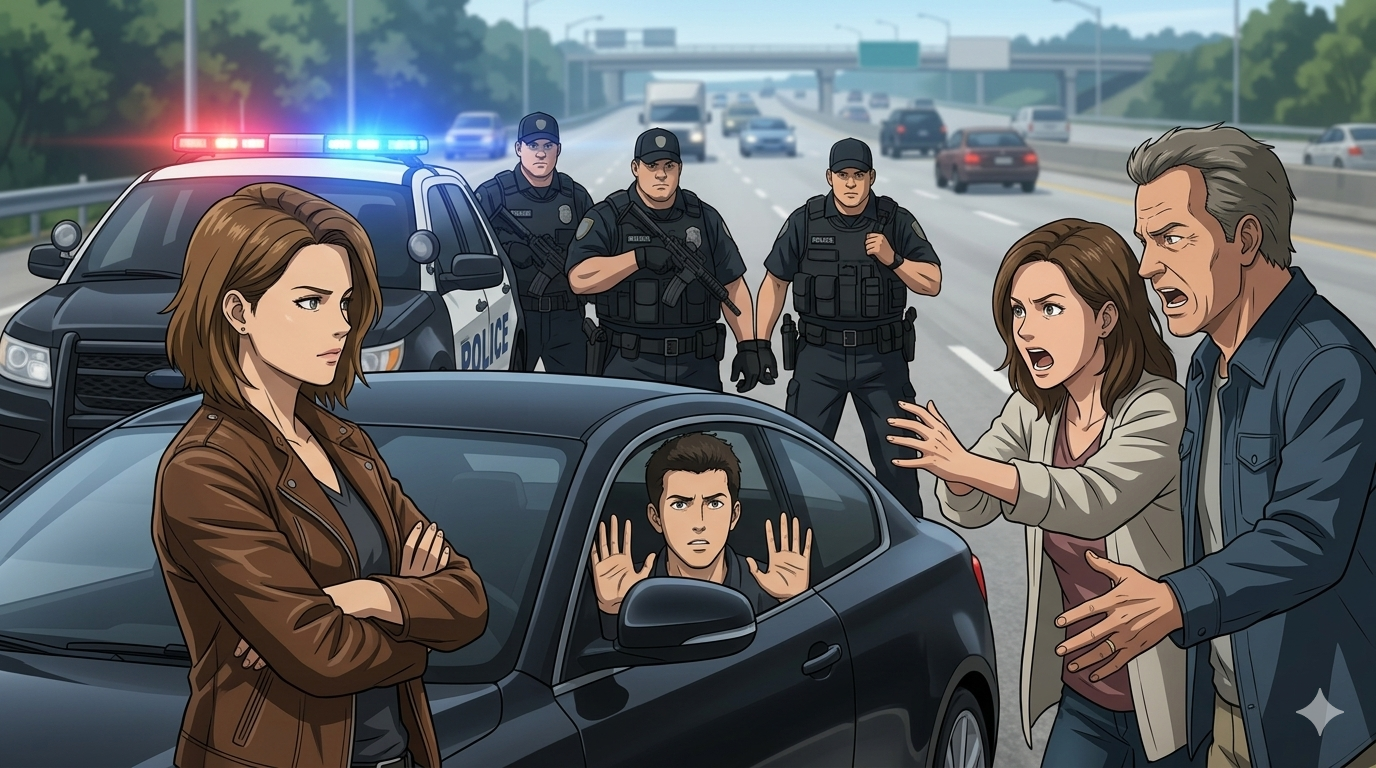
I Came Home From A Trip To An Empty Garage. My Entitled Parents Secretly Took The Keys To My Paid-Off Luxury Car And Gifted It To My Golden Child Brother. When I Demanded It Back, They Said: “Share, It’s Just A Car.” So, I Simply Reported It Stolen. Hours Later, He Was Speeding On The Highway When… …THE COPS DREW THEIR GUNS!
Part 1
The biometric lock on my front door chimed at 11:45 p.m., that soft little electronic note I usually found comforting. That night it sounded thin and weird in the cold, like something trying too hard to be cheerful. November rain had soaked through the shoulders of my trench coat on the walk from the driveway, and the fabric clung to my skin with that icy, heavy weight that makes you aware of every inch of your back.
I had just spent six days in Dallas inside a conference center with no windows, bad coffee, and fluorescent lighting that made everyone look mildly ill. I handled freight telematics for a regional logistics company, which meant my days were all missed routes, compliance logs, burned-out drivers, rerouted trailers, engine alerts, GPS pings, and men in polo shirts lying to me about why a truck had been parked at a barbecue restaurant for four hours. By Thursday night, my nerves felt like frayed wire.
All I wanted was a shower hot enough to burn off the airport, a quiet house, and my own bed.
The foyer looked exactly the way I’d left it. The thermostat was still set low. The stack of mail on the kitchen island was neat. My olive tree by the back window had dropped three dry leaves into the white ceramic pot. The place smelled faintly like lemon cleaner and the ghost of the candle I’d burned last Sunday before leaving for the airport.
I poured myself a glass of ice water and hit the wall switch that opened the garage.
The heavy insulated door rattled upward. The garage lights blinked on in stages, and my stomach dropped before my brain fully caught up.
My parking bay was empty.
Not “maybe I forgot where I parked” empty. Not “someone moved it to the driveway” empty. Empty in a way that made the smooth gray epoxy floor look larger than it should have. Empty in a way that made the whole garage feel exposed.
I set the glass down very carefully on the counter because if I didn’t, I was going to drop it.
There were no shards of glass. No splintered frame. No damage to the keypad. The side door to the alley was still deadbolted from the inside. The only sign my Audi had been there at all was the faint outline of tire dust near the back wall and a couple dark rain freckles where water had dripped off the undercarriage before I left for Dallas.
I drove a black 2024 Audi RS Q8. Obsidian paint. Twin-turbo V8. Paid off. Insured only under my name. Parked in my locked garage behind my locked house.
I work in logistics. I track moving assets for a living. People hear that and think it sounds boring, but theft has patterns, and panic wastes time. By the time most people would have been out in the street spinning in circles, I was already pulling up my home security app.
I scrubbed back through the garage camera.
Tuesday, 2:15 p.m.
The door from the kitchen opened, and my mother walked into frame carrying her leather handbag and wearing a cream raincoat she always thought made her look expensive. Right behind her came my younger brother, Chase, in a navy quarter-zip and white sneakers too clean for a man who claimed he was “between opportunities.”
He was grinning.
That was the part that made something go very cold inside me. He wasn’t nervous. He wasn’t sneaking. He wasn’t looking over his shoulder like a person who knew he was doing something wrong. He looked pleased with himself, like Christmas had shown up early and parked in my garage.
My mother reached into her handbag and pulled out a key fob.
Not a copied key. My spare.
I kept it locked in a fireproof biometric safe in my office.
She tossed it to him. He caught it one-handed, hit unlock, and my Audi flashed to life in bright white LED. Then the two of them got in. He backed out of my garage in broad daylight while she smiled like she’d just solved a household inconvenience.
The video ended.
For a second I just stared at the frozen image on my phone. My mother’s hand was still lifted in the air from where she’d tossed the key. Chase’s head was turned toward the side mirror. The garage door was halfway open, and the rain beyond it looked silver in the camera lens.
My parents had an emergency key to my house. I had given it to them two years ago when a pipe burst in the basement during a snowstorm and I was in Atlanta. They did not have access to my office safe. Which meant my mother had either guessed the hidden override location or gone looking until she found it.
That wasn’t borrowing. That was planning.
I called my mother.
She answered on the third ring, cheerful enough to make my teeth hurt. “Morgan, honey. You’re home early.”
Behind her I could hear steak knives on plates, low restaurant laughter, that padded expensive hush some places cultivate so everyone feels richer than they are. My parents loved places like that. They liked being seen ordering cabernet and talking too loudly about the market.
“Where is my car?” I asked.
A pause. Then, “Dallas went well, I assume?”
“Where is my Audi, Mom?”
She exhaled like I was the difficult one. “Morgan, please don’t start. Chase has a final-round interview tied to a regional leadership retreat this weekend, and he cannot show up in that little dented Honda looking like he’s still in college. Your father and I were helping him.”
I leaned my palm on the cold granite countertop. “You broke into my office safe.”
“Oh, for heaven’s sake, don’t be dramatic. I used the spare. You were out of town. The car was just sitting there.”
“It was sitting there because it’s mine.”
“It’s a family car,” she said, in that tone mothers use when they’re trying to turn theft into generosity. “You hardly drive it during the week. Chase needed something respectable. You make more than enough money. Take an Uber for a few days.”
There are moments when somebody says something so outrageous you almost admire the confidence.
I looked back at the frozen footage of my mother handing my brother the keys to my vehicle and understood, with a strange clean clarity, that this had not felt like stealing to either of them. It had felt like access. Like entitlement. Like they had always seen my life as a room they could walk into if they had the right excuse.
“You have thirty minutes,” I said, “to tell Chase to return my car, park it in my garage, and leave the keys on the kitchen counter.”
My mother laughed once, sharp and unbelieving. “Or what?”
“Thirty minutes.”
Her tone hardened. “We are celebrating your brother tonight. I’m not ruining this because you want to be selfish over a piece of metal.”
“Thirty minutes, Mom.”
“Grow up, Morgan,” she snapped. “We’ll discuss this at Sunday dinner when you calm down.”
She hung up.
I stood in the center of my kitchen with the rain ticking softly against the back windows and the refrigerator motor humming under the silence. Then I walked into my office.
The safe door stood open.
The manual override key sat on my desk pad, left there like an insult.
I didn’t call her back. I opened my laptop, logged into the commercial telematics system I used for work, and patched into the hidden transponder I’d had installed in the Audi six months earlier.
A map of the East Coast came up in clean blue and gray lines.
Then a red dot pulsed to life on Interstate 95.
Chase was already sixty miles south of my house, and he was doing ninety-four in a sixty-five. By the time my pulse caught up, my hand was already reaching for the phone.
Part 2
People think calling the police is dramatic.
What they really mean is that calling the police makes a situation real.
Up until that point, my mother could still pretend this was a family misunderstanding. Chase could still pretend he was just borrowing his sister’s car for the weekend. My father could still pretend money and volume and the right restaurant reservation could smooth the whole thing over by Sunday dinner.
The second I saw that red dot blowing down I-95 at ninety-four miles an hour, it stopped being family and started being liability.
I called state highway patrol, not local police.
Local officers would have looked at the address, seen that my mother had a house key, heard the word brother, and tried to kick it back into the warm fog of “civil matter.” I didn’t need that. I needed the people who dealt with speed, interstate movement, and vehicles as moving risk.
“State Highway Patrol dispatch,” a woman said, crisp and awake in a way I never am near midnight. “Operator forty-two.”
“My name is Morgan Ashford,” I said. “I need to report a stolen vehicle. I am the sole registered owner of a black 2024 Audi RS Q8. I have active live telematics on the vehicle right now.”
The shift in her voice was immediate. “Do you have the license plate and VIN?”
I read them off my screen.
“What is the current location?”
“Southbound I-95, just past mile marker one-twelve. Speed fluctuating between ninety-two and ninety-six.”
“Do you know who is driving the vehicle?”
“Yes. My brother. Chase Ashford. Twenty-four. He does not have permission to operate it, and he is not on my insurance policy.”
The keyboard on her end started clicking fast. “How was the vehicle taken?”
“My mother used an emergency house key to enter my home while I was out of state, accessed my office, opened a locked safe, removed the spare key fob, and handed it to him. I have security footage.”
That got another little pause.
“Are you willing to press charges, Ms. Ashford?”
“Yes.”
Not maybe. Not depending on whether he apologized. Not if my mother stopped crying. Yes.
She took another breath, sharper this time. “We are entering the vehicle into NCIC now. Stay on the line.”
The map on my laptop refreshed every few seconds. The red dot kept moving. Rain bands swirled pale green over the interstate, and the little icon marking my Audi cut through them like it was invincible. I knew that feeling. The cabin on that car could make eighty-five feel like fifty. It was quiet, insulated, fast in a way that almost erased consequence.
Chase had always loved machines he hadn’t paid for. Dirt bikes when we were kids. My dad’s boat in high school. Lease sedans in his twenties. He liked the look on his face reflected in expensive surfaces.
The dispatcher came back. “Units are moving to intercept near mile marker one-eighteen.”
I sat down in my office chair because my knees suddenly felt unreliable. “Understood.”
“Any known firearms?”
“No.”
“History of violence?”
I thought about it. Chase wasn’t violent in the way that leaves bruises. He was violent in the way that entitlement is violent. He assumed other people would absorb the impact of his choices. It was amazing how often the world rewarded that in men.
“He has a record of reckless driving and multiple at-fault collisions,” I said. “He panics when he gets cornered. He also believes rules are suggestions if they inconvenience him.”
The dispatcher made a small sound that might have been a breath or a nod. “Copy.”
My phone buzzed with texts while I stayed on the line.
Mom: Don’t do this.
Mom: We are handling it.
Mom: Chase is turning around.
She was lying. The dot kept moving south.
Then another message came.
Mom: Answer me.
I ignored it.
The dispatcher’s voice lowered as if she were reading from a live feed. “Unit four visual. Black Audi confirmed. Speed ninety-six.”
My fingers tightened around the edge of my desk.
I could hear bursts of radio traffic in the background now, clipped and coded. It sounded like another language at first, then like a machine building a shape around a decision.
At some point during those minutes, I became aware of ridiculous details. The lamp on my desk had one dead bulb. My suitcase was still standing open in the hall. A drop of rain slid off my coat sleeve and darkened the wood floor. My house was warm again, but I could still feel the Dallas airport air in my sinuses, stale and overconditioned.
I thought about Sunday dinners growing up. My mother bringing roast chicken to the table and serving Chase first because “he’s still growing,” when he was twenty and six-foot-two. My father tossing him car magazines and calling him “my boy” in that proud baritone that always made the room tilt toward my brother. I thought about the thousand tiny ways a family can teach you that what’s yours is communal while what belongs to the favorite child is sacred.
“Unit seven in position,” the dispatcher said.
A burst of static.
Then, “Stop initiated.”
The red dot on my screen slowed. For one weird second it sped up again, a small hard surge, and my jaw locked.
“Come on,” I said quietly, though I didn’t know whether I was talking to the officers or to physics.
The dot jerked right toward the shoulder.
Another refresh.
Speed: 27 mph.
Another.
0 mph.
A green banner slid across the top of the screen.
Vehicle ignition terminated.
The dispatcher spoke again, her tone steady. “Suspect vehicle stopped. Extraction in progress.”
I let out a breath that felt like I’d been holding it since the garage lights came on.
Then my phone started vibrating across the desk so violently it rattled against the wood.
Mom.
I looked at her name glowing on the screen, then at the green banner on my laptop, and answered.
Part 3
My mother was crying before I even said hello.
Not normal crying. Not the glossy, theatrical kind she pulled out at funerals and charity luncheons. This was ragged, breathless panic. I could hear traffic under her voice, the turn signal clicking somewhere in the background, my father saying something too muffled to make out.
“Morgan,” she gasped, “what did you do?”
I leaned back in my chair. “I reported a stolen vehicle.”
“You called the police on your own brother.” She sounded like I had set the house on fire for fun. “He called your father screaming. They had guns drawn, Morgan. Guns. They dragged him out in the rain.”
“He was driving ninety-six in a stolen eighty-thousand-dollar SUV on an interstate.”
“It was not stolen!”
“It was taken without my consent from my locked house.”
“You are twisting this.” Her voice climbed, shrill now. “He was going to a professional event. You have destroyed him.”
There was something almost mesmerizing about how smoothly she moved between justifications. It was for an interview. It was for a retreat. It was professional. It was family. It was harmless. Each version replaced the last one without any embarrassment at all.
“He had thirty minutes to bring it back,” I said.
“You gave an ultimatum like a child.”
“And you ignored it like a thief.”
She inhaled hard enough for me to hear it catch. Then my father’s voice cut in, deep and furious.
“Listen to me carefully,” he said. “You are calling that station right now and telling them this was a mistake.”
“It wasn’t.”
“It becomes a mistake if you say it becomes one.”
I almost laughed. That was my father in one sentence: the belief that a hard enough tone could bend reality.
“The vehicle was entered into NCIC,” I said. “The stop is already documented. Insurance is involved. This is not a dinner reservation you can cancel.”
“You ungrateful little—” He stopped himself, maybe because my mother was in the car, maybe because for once he heard how bad he sounded. Then he tried again. “Chase has a final-round interview tomorrow. This will follow him for years.”
“That would have been a good thing to consider before he stole my car.”
“You are his sister.”
“And he is a grown man.”
Silence on the line, except for the windshield wipers and my mother crying.
Finally my father said, very softly and very coldly, “If you don’t fix this, we are done with you.”
I looked around my office. At the safe still open. At the little brass lamp. At the legal pad on my desk with a grocery list half-written on it from last week. There was a strange peace in me by then, the kind that comes after the decision has already happened.
“Understood,” I said, and hung up.
I slept six hours.
That surprised me.
I thought I’d lie awake replaying everything, but apparently once my mind sorted the situation into categories—criminal, civil, insurance, next steps—I could rest. When my alarm went off at 6:30, the house smelled like rain-damp earth drifting in from the vents and the sharp clean soap from my shower. I dressed the way I dress for presentations I expect to go badly: navy blazer, white blouse, hair pinned back, low heels I can walk fast in.
The patrol precinct sat in a squat brick building forty minutes away, tucked behind a county maintenance yard. The lobby smelled like floor wax, burnt coffee, and wet wool. Everything was either beige, gray, or institutional blue. A television in the corner played a morning news show with the sound off, all too-bright smiles and weather graphics.
I sat on a hard plastic bench and waited for the detective assigned to the case.
My parents were already there.
My father stood at the dispatch glass with both hands planted on the counter, shoulders squared like he was trying to intimidate bulletproof plexiglass. His suit was wrinkled. His tie hung loose. My mother looked worse. Mascara smudged under her eyes, lipstick feathered, rain-spotted coat thrown on over last night’s clothes. She clutched her handbag like it was an anchor.
“My son is being held over a misunderstanding,” my father was saying. “He needs to be released immediately.”
The desk sergeant barely looked up. “Your son was arrested operating a vehicle listed as stolen in NCIC, sir.”
“It was not stolen,” my mother snapped. Then she turned, spotted me, and pointed. “There she is. Morgan. Tell him.”
I stayed seated.
My mother’s voice sharpened into that old command-note I’d grown up obeying before I knew I could ignore it. “Get up here and fix this.”
“I reported what happened,” I said.
“What happened,” she repeated, incredulous. “What happened is your brother borrowed a car.”
“With a key you took from my safe.”
Her face flushed high on her cheekbones. “You were out of town.”
The security door buzzed, and a man in a gray suit stepped into the lobby carrying a coffee and a black clipboard. Tall, late forties maybe, tired eyes, the kind of face that had seen enough family disaster to stop being impressed by any of it.
“Detective Miller,” he said.
My father pivoted instantly, all bluster repositioned toward a fresh target. “Detective, thank God. We need to clear this up. My daughter is weaponizing your department because she’s angry we let her brother use a family vehicle.”
Miller took a sip of coffee. “A family vehicle titled, registered, and insured exclusively to Ms. Ashford?”
My father’s jaw flexed. “That’s a technicality.”
Miller glanced at me, then back at them. “Ma’am,” he said to my mother, “did your daughter explicitly authorize you to enter her residence and remove the spare key to that vehicle?”
I watched something small and dangerous flicker behind my mother’s eyes.
She thought she saw a way out.
Her shoulders straightened. She lifted her chin. The panic on her face reorganized itself into righteousness, and I knew exactly what she was about to do even before she opened her mouth.
“Fine,” she said. “I took the key.”
Part 4
There are people who can hear the click of a trap closing and still mistake it for applause.
My mother was one of them.
The second she said, “I took the key,” she relaxed. Not all the way, but enough that I saw it. Enough to know she believed she had just saved Chase. In her mind, if she admitted she had handed him the fob, then the whole thing became maternal permission instead of theft. It became family, and family was the solvent she had used her entire life to dissolve consequences.
Detective Miller didn’t move. He just set his coffee on the ledge by the dispatch glass and uncapped his pen.
“Let me be precise,” he said. “You entered your daughter’s home while she was out of state.”
My mother gave a quick nod. “I had an emergency key.”
“Did she authorize you to enter for this purpose?”
“No, but—”
“You then accessed her office.”
“She keeps the spare in there.”
“In a locked safe?”
My father made a low warning sound in the back of his throat. “Eleanor.”
She ignored him.
“Yes,” she said. “But I’m her mother. I knew where the manual key was. I opened it, took the fob, and gave it to Chase. He did not steal that vehicle.”
The whole lobby seemed to sharpen.
I saw the exact instant my father understood what she had admitted. He went pale in a way I’d never seen before. He reached for her arm. “Stop talking.”
She jerked away from him. “Why? Someone in this family has to tell the truth.”
The irony nearly took my breath.
Miller clicked his pen once. “So you used an emergency house key to enter a private residence without the owner’s consent, bypassed a secured office, opened a locked safe, and removed the keys to a high-value vehicle. Is that your statement?”
She frowned at his tone, finally sensing that the floor underneath her was not where she thought it was. “I borrowed them for my son.”
“You removed them without permission,” he said.
“Because she would have said no.”
“Which means you knew you did not have consent.”
My mother opened her mouth, but this time nothing came out.
I stood and walked over, the manila envelope in my hand suddenly feeling heavier than paper should. “Detective,” I said, and handed it to him, “this contains timestamped footage from my foyer, office doorway, and garage. It shows both of them entering my house and removing the vehicle.”
My mother stared at the envelope like it had materialized out of smoke. “You recorded us?”
“I secured my home.”
The detective slid the envelope onto his clipboard. “Thank you, Ms. Ashford.”
Then he looked at my mother, and his face changed—not cruel, not dramatic, just official.
“Mrs. Ashford, based on your statement and the evidence provided, you are under arrest for residential burglary, larceny of a motor vehicle, and conspiracy.”
My mother actually laughed.
A tiny broken sound. “No.”
A female officer stepped through the security door.
“No,” my mother repeated, louder now. “This is insane. I didn’t break anything. I used a key.”
“Turn around, ma’am.”
My father stepped back.
That was the part I remember most clearly, more than the cuffs, more than the way my mother’s handbag hit the floor and spilled lipstick and receipts across the scuffed tile. My father stepped back. Not forward. Not even sideways. Back. Away from her, away from the detective, away from legal proximity.
“Arthur,” my mother said, in a voice that changed all at once from indignation to fear. “Do something.”
He swallowed. “I wasn’t there when she went into the house.”
She stared at him. “You knew.”
He didn’t answer.
The officer took her wrists. The handcuffs made that metallic ratcheting sound that every movie uses because it really is that final in person. My mother gasped as if the steel had been cold enough to burn.
“I’m your wife,” she said to my father, but it already sounded like she knew he’d left her standing alone.
I didn’t feel triumph. That surprised me too.
What I felt was recognition. A terrible, clean recognition. My mother had spent years believing she could edit truth with confidence. My father had spent years believing he could outsource messes to the women around him until the cost became personal. Chase had spent years believing he could drive straight over other people’s limits because somebody would always call it youthful potential.
There, in that gray lobby under humming fluorescent lights, every single one of them turned out to be exactly who I thought they were.
After they took my mother through the door, my father stood in the middle of the lobby with both hands hanging at his sides like he’d forgotten what they were for.
“Morgan,” he said quietly.
I turned.
“Please.” The word seemed to scrape him on the way out. “Your mother is sixty-two. Chase will lose everything.”
“He should have thought about that before he took my car.”
He stepped closer, lowering his voice. “I will pay for any damage. I will buy you a new one if that’s what this is about.”
That almost made me smile, because it told me he still didn’t understand. He thought the number on the invoice was the injury. He thought this was a consumer dispute.
“It’s not about replacing the car,” I said. “It’s about the fact that you all believed you could walk into my life and use it.”
He looked at me for a long second, and I watched him try to find the version of me that used to fold when he got stern enough. She wasn’t there anymore.
The impound lot released my Audi two days later after photographs, processing, and paperwork. It sat under a pale sky behind chain-link fence and coils of razor wire, looking absurdly sleek among battered pickups and state-seized junkers. The tow yard manager handed me the keys with the polite care people reserve for expensive things and grieving people.
The interior smelled wrong the second I opened the door.
Not damaged. Just used.
Cologne too sweet for me. Fast-food grease. Energy drink. Wet wool. Chase’s life, basically, laid over mine in a thin grimy film. There was a muddy shoe print on the passenger floor mat and a coffee splash dried near the cup holder. I stood there with the cold wind blowing through the lot and felt a fresh wave of anger so pure it made my hands shake.
Then I bent down and saw something black and gold half under the passenger seat.
It was a casino player card.
Chase’s name was embossed across the front.
Under it was a valet stub from Blackstone Ridge Resort, dated for the next day.
I sat down in the driver’s seat, the leather cold under my legs, and stared at it.
There had never been a corporate retreat.
There had never been an interview.
Part 5
The first lie had been the easiest one to spot.
Chase needed the car for a final-round interview, my mother had said. A corporate retreat. Senior partners. Project success. One of those phrases adults use when they want to make nonsense sound professional.
The second lie was buried in the details.
Blackstone Ridge wasn’t upstate in the harmless, buttoned-down way my mother had implied. It was a luxury casino resort just across the state line, the kind of place men in quarter-zips went to lose rent money while calling it networking. I knew the name because a few of our sales reps had once tried to expense a “client development dinner” there and gotten shredded by accounting.
I sat in my Audi with the door open and the cold cutting across the impound yard while I checked the rest of the cabin.
There was a garment bag in the back seat with two dress shirts still in plastic, a pair of loafers Chase definitely hadn’t bought himself, and a toiletry kit. In the center console I found a hotel confirmation email printed at my parents’ house on creamy paper. Two nights. Blackstone Ridge. Guest: Chase Ashford. Additional guest names redacted by the resort because he’d booked through a group package.
Not interview. Not retreat. Weekend.
The anger in me changed shape then.
Before, it had been clean. Technical. A boundary violated, an asset stolen, a liability created. Now it got messier. Hotter. They hadn’t taken my car in some panicked family emergency. They had taken it to dress my unemployed brother up for a boys’ weekend so he could pretend the life I’d built belonged to him.
My phone rang.
Detective Miller.
“Ms. Ashford,” he said when I answered. “We inventoried several personal items removed from the vehicle. You may want to know the suspect initially told the arresting troopers he was headed to a ‘leadership weekend’ with friends.”
I looked down at the casino card in my hand. “That tracks.”
“He also admitted there was no scheduled interview in the morning.”
I shut my eyes for a second. “Of course there wasn’t.”
Miller was quiet, then said, “I thought you’d prefer confirmation from me rather than from your family.”
I appreciated that more than I expected. “Thank you.”
“There’s one more thing,” he said. “Your brother claimed he assumed you’d back down once your parents got involved.”
I laughed then. A short ugly laugh that startled even me. “That also tracks.”
After I got home, I stripped the Audi the way people strip hotel beds after finding bedbugs. Floor mats out. Trash out. Cabin wiped down. I changed the garage code. Then I called a security company and upgraded every exterior lock on the house.
By sunset, my extended family had found me.
It started with my aunt Susan texting, Morgan, please tell me you did not have Eleanor arrested.
Then my cousin Jill sent, This has gone way too far.
Then somebody added me to a family group thread I’d muted years ago, and my phone started vibrating every thirty seconds with variations on the same theme: he’s your brother, she’s your mother, family is all you have, pride is a terrible thing, I’m sure this can still be resolved quietly.
Quietly.
That word kept showing up like it was holy.
Quietly was how my brother’s wrecks got handled. Quietly was how my father paid overdue bills so Chase could talk big at bars. Quietly was how my mother told relatives I was “so focused on work” when what she meant was I stopped attending dinners where Chase got praised for being charming while I got handed casserole dishes.
I didn’t answer any of them.
At 7:10 that night, my father called from a number I hadn’t blocked yet.
When I picked up, he skipped hello. “There was no need to humiliate your mother.”
“She confessed in a police station. I didn’t put the words in her mouth.”
“She was trying to protect your brother.”
“She was trying to protect the lie.”
He exhaled hard into the phone. “You have always resented him.”
That one landed because it had enough truth in it to sting. I had resented Chase, sometimes. Not because he existed. Because he was loved with an optimism nobody ever offered me. Because his mistakes got called potential, while my competence got treated like an available family resource.
“I don’t resent him,” I said. “I resent being treated like an extension cord you all can plug into whenever his life shorts out.”
My father was silent long enough that I heard the faint crackle of turn signal through his car speakers. Then he said, “You are making this uglier than it needs to be.”
“By telling the truth?”
“By refusing to let this stay inside the family.”
I went to the kitchen window. Outside, the wet street glowed orange under the cul-de-sac lights. My neighbor’s inflatable turkey had tipped sideways in the rain. “The moment Mom opened my safe,” I said, “it stopped being inside the family.”
He did something he almost never did then. He let irritation slip and said more than he meant to.
“Your mother only knew where that override key was because she’d been in your office before.”
The room went still.
I turned slowly from the window. “What?”
Another pause. Longer this time. He knew he’d stepped wrong.
“She was checking on the sump pump one afternoon last month,” he said too quickly. “You know how she is. She noticed things.”
I felt my scalp tighten. “She was in my office last month?”
“She didn’t take anything.”
“That’s not what I asked.”
He recovered his anger like a shield. “You’re twisting everything.”
“No,” I said, very quietly now. “I’m finally lining it up.”
I ended the call before he could say anything else.
Then I went straight to my security system, pulled up archived footage from the prior month, and started scrolling back through the days.
The Audi wasn’t the first boundary my mother had crossed.
It was just the first one she’d been stupid enough to admit out loud.
Part 6
You can ruin your own memories by watching them from the wrong camera angle.
My archived footage was stored in thirty-day blocks. Most of it was boring in the way healthy life is boring—delivery drivers, me leaving for work with my coffee mug, neighborhood kids cutting across the sidewalk, rain darkening the porch, the cleaning crew I used twice a month. I watched three weeks of normal until normal started to look staged.
Then, on a Thursday afternoon at 1:12 p.m., my front door opened.
My mother stepped inside.
She was carrying a reusable grocery tote and wearing gardening gloves, which I recognized immediately because she used those props whenever she wanted to imply usefulness. In her left hand was the emergency key I’d given her. She looked around the foyer for maybe half a second, not wary, just calculating.
Then she walked past the basement door.
Not to the utility room. Not to the kitchen. Straight to my office.
I watched from my desk chair with a sensation that was half nausea, half vindication. The office camera didn’t show the inside of the room—deliberately, because I didn’t like the feeling of a camera pointed at my desk—but it captured the door, the hall, and enough of the shelves to tell when someone entered. My mother disappeared inside for eleven minutes.
When she came out, she had her phone in her hand. She paused by the bookcase, reached up to the top shelf, and touched the hollowed-out old accounting textbook where I kept the safe override key. Not taking it. Just checking.
Learning.
I scrubbed back and watched it again.
Then again.
That was the thing about betrayal by family. The facts were often dull. Nobody wore a mask. Nobody crawled through a window. My mother did not look like a criminal. She looked like a woman in tasteful loafers checking a casserole in the oven. But there she was, in my house, mapping my private life like inventory.
I called Detective Miller and sent him the clip.
“You should file for a restraining order,” he said after he watched it.
“I was planning to.”
“No,” he said. “You were considering it. I’m telling you to do it.”
So I did.
The courthouse annex smelled like damp paper and old carpet. I filled out forms at a metal table under fluorescent lights while a clerk with pink reading glasses explained the boxes in a kind voice that suggested she’d seen every species of denial cross that room. Relationship to respondent. Nature of unauthorized entry. Prior incidents. Fear of further intrusion.
That last line hung me up.
Was I afraid?
Not in the cinematic way. I didn’t think Chase was going to kick down my door with a tire iron. I didn’t think my mother was going to crouch in my hydrangeas waiting for me. What I feared was something more exhausting: that they would keep reaching. Phone calls. Surprise visits. Guilt wrapped as concern. Tiny incursions until I was managing their feelings again instead of my own peace.
Yes, I checked.
By the time the temporary order was approved, my jaw hurt from clenching.
Three days later came arraignment.
Chase was led in wearing county khaki and a chain around his waist that made him look younger and meaner at the same time. The cocky softness had gone out of his face. He looked puffy-eyed and under-slept, his hair badly cut from whatever rushed trim he’d gotten before court. My mother sat at the defense table in a blouse I’d seen her wear to Easter brunches. She kept dabbing at her eyes with a folded tissue, but every now and then she’d stop crying long enough to scan the room and see who was watching.
My father looked like a man who had aged in compressed time.
He didn’t come over to me. He just sat behind them with a lawyer in an expensive charcoal suit and stared forward.
When Chase finally turned and saw me in the back row, something ugly lit up in his face. Not shame. Not fear. Injury. As if he genuinely believed I had violated some private agreement by refusing to rescue him from the consequences of stealing from me.
He leaned toward his attorney, said something, then looked at me again and smiled.
That smile did more to settle me than anything else had.
Because there it was. No remorse. No dawning adulthood. No flicker of, I can’t believe I did this. Just the same old family reflex in a new room: Morgan will bend. Morgan will get practical. Morgan will smooth it over because she always does the competent thing in the end.
The prosecutor reviewed the charges. Grand theft auto. Receiving stolen property. Reckless endangerment. Residential burglary. Conspiracy. My mother’s attorney tried to soften it into “misguided access among family members.” The judge looked unimpressed.
Dates were set. Conditions were stated. Contact restrictions reiterated.
As people started standing, Chase twisted around far enough to look at me directly.
“You owe me,” he mouthed.
The sheer absurdity of it almost made me laugh.
Then we were all pushed by the slow machinery of the court toward the exit, and I stepped into the hallway under yellowed lights while lawyers shuffled papers and families huddled in little islands of whispered panic.
My father came toward me at last.
Before he could speak, a deputy moved between us and said, “Sir, she has an active protective order.”
The look on my father’s face then was something I had never once seen when I was a child.
It was helplessness.
And for the first time in my life, I understood that he had always counted on me not noticing how little power he actually had when his voice stopped working.
That afternoon, when I got home, there was a manila envelope leaning against my front door.
No stamp. No return address.
Inside was a photocopy of a childhood picture of me and Chase on a beach, both sunburned, both smiling, and one handwritten line across the bottom in my mother’s slanted script:
Remember who will be gone when work is all you have.
I stood there in my entryway with the paper in my hand and the restraining order in my purse, and I realized they still thought fear of loneliness would bring me back.
What they didn’t know yet was that I had already chosen the loneliness.
Part 7
The ugliest apologies are the ones that arrive dressed as strategy.
A week after arraignment, Chase’s attorney emailed mine to ask whether I would support a reduced plea if my brother completed restitution, surrendered his license for a year, and issued “a formal statement of remorse.” My attorney forwarded it with a note that said, entirely dryly, Up to you. The state’s evidence is strong either way.
I almost deleted it without reading. Instead, I opened the attachment while eating takeout Thai at my kitchen island, rain rattling the skylight above the dining nook.
Chase’s “statement of remorse” was three pages long and managed not to apologize once.
He regretted that emotions had escalated. He regretted that law enforcement had been involved. He regretted that my career had made me “rigid about assets.” He regretted that our mother had acted “out of protective instinct.” He regretted that I seemed to view family relationships through a transactional lens.
I read the line twice because it was so perfect in its shamelessness.
I seemed to view family relationships through a transactional lens.
This from the man who had taken my eighty-thousand-dollar SUV to a casino weekend because his own car was embarrassing.
At the bottom, in pen, he had added a note.
You know Mom wasn’t trying to hurt you. Please don’t make this worse than it is.
Please don’t make this worse than it is.
That sentence had floated through my entire life like perfume over rot. When Chase borrowed money and didn’t pay it back. When my mother opened my mail “by accident.” When my father used my spare bedroom as leverage, telling relatives they could stay with me for conferences because I was “practical.” My role had always been not to make it worse. Which usually meant making it easier for them.
I sent one line to my attorney: No reduction request supported.
Then I blocked the email thread.
The next pressure point arrived through my aunt Susan, who invited me to lunch under the pretense of checking on me. We met at a diner halfway between our neighborhoods, the kind with laminated menus sticky at the corners and coffee that tasted like burnt pennies.
Her hair was shellacked into place. She wore a camel coat and a concerned expression she had probably practiced in the car mirror.
“You look tired,” she said as soon as I sat down.
“I’m fine.”
She folded her hands. “Your mother is devastated.”
I stirred cream into my coffee and watched it cloud. “Your point?”
“My point is that nobody wins here.”
“That depends how you define winning.”
She sighed like I was being difficult on purpose. “Morgan, families survive things when people choose grace.”
There it was again. Grace. Quiet. Understanding. Maturity. Every pretty word women are handed when the real expectation is surrender.
“She entered my house and opened my safe,” I said.
Susan lowered her voice. “I know Eleanor crossed a line. But Chase is young.”
“He’s twenty-four.”
“He has his whole life ahead of him.”
“So did I every time I bailed myself out without help.”
She looked at me then with the particular sadness some relatives reserve for women who stop cooperating. “You always were hard.”
That one didn’t sting. It landed like confirmation.
“Or,” I said, setting down my spoon, “I was raised around people who called me hard whenever I had a boundary.”
She sat back.
The waitress came, set down pie menus we hadn’t asked for, and left again.
My aunt tried one more angle. “Your father had to liquidate stock.”
I almost laughed at that too. “He said that to make me feel guilty?”
“He is scared.”
“Good.”
Her mouth tightened. “That’s a cruel thing to say.”
I thought about my mother in my office doorway, checking the hiding place for the override key like she was memorizing a map. I thought about Chase smiling at me in court. I thought about the note on the photo.
“No,” I said. “Cruel was teaching my brother that what belonged to me was available if he wanted it badly enough.”
I left money for my coffee and walked out before the pie arrived.
That evening my attorney called. “There’s something else,” she said. “The state pulled texts off your brother’s phone.”
I stopped pacing.
“They show your mother knew about the casino plan two days before the theft. She texted him that the Audi would ‘make the right impression’ and told him your Dallas trip was ‘the perfect window.’”
I went still.
There it was. The phrase that snapped the whole thing into place.
The perfect window.
Not spontaneous. Not emotional. Not even mostly about Chase. It had been opportunistic, neat, premeditated. My absence wasn’t a complication to work around. It was the plan.
“What else?” I asked.
My attorney hesitated. “There’s a draft message from your father to your brother telling him to ‘keep it clean, no tickets, no scratches, and have it back before Sunday dinner so this doesn’t become a thing.’”
I sat down slowly.
For the first few weeks, I had believed my father was doing what he always did—minimizing, managing after the fact, trying to hold together the theater of family. But this meant he had known beforehand. He had known, and he had chosen the same role he’d always chosen: not direct action, not honest refusal, just quiet permission positioned carefully enough to claim innocence later.
The room around me seemed to sharpen at the edges. The hum of the dishwasher. The refrigerator kicking on. Rainwater sliding down the black glass of the back door.
“Send me copies,” I said.
After we hung up, I went out to the garage.
The Audi sat exactly where I’d left it, black paint reflecting the overhead light in hard clean lines. For a moment I just stood there, breathing in cool air that smelled faintly of rubber and concrete.
Then I understood something I should have understood years earlier.
My mother had taken the key.
My brother had taken the car.
But my father had helped build the road they both expected to drive away on.
And once I saw that clearly, I knew the next hearing would not be about whether my family regretted what they’d done.
It would be about how far they were still willing to lie.
Part 8
Plea hearings are quiet compared to trials.
That surprised me. I had expected more thunder—more banging gavels, more dramatic objections, more cinematic suffering. Instead it was paperwork and posture and carefully chosen words spoken under lights too bright for anybody to hide in.
By the time the plea date arrived, winter had settled in for real. The courthouse steps were edged with old gray snow, and the marble lobby smelled like wet coats and overheated air. I wore charcoal that day instead of navy, not for symbolism, just because it was clean and made me feel like my spine had structure.
My mother took a plea.
So did Chase.
Not because they had discovered conscience. Because the digital evidence was ugly, the confession was on camera, the state had their messages, and their attorneys had done the math. Trials are expensive. Losing is more expensive.
My mother’s plea reduced the burglary count in exchange for admitting unlawful entry, conspiracy, and theft-related charges. Chase pled to receiving stolen property, reckless endangerment, and felony unauthorized use with aggravating factors. There would be restitution, supervised probation, loss of driving privileges, and sentencing arguments over whether any jail time would be suspended.
The whole thing sounded sterile until you looked at their faces.
My mother looked pinched and smaller, as though somebody had washed all the color out of her and let her dry in the wrong shape. Chase looked angry in that flat, sour way people do when they’re no longer convinced charm will save them but still believe somebody else is to blame.
My father sat behind them, hands clasped so tightly the knuckles gleamed white.
When the judge asked whether anyone wished to address the court before sentencing recommendations, Chase’s attorney stood and spoke about youth, pressure, family dynamics, professional instability, and a “catastrophic error in judgment that should not define a young man’s life.”
Then my mother’s attorney spoke about maternal overreach, emotional decision-making, an otherwise clean record, decades of civic involvement, charitable work, social standing.
Social standing.
I nearly smiled at that. Nothing makes status look sillier than hearing it pleaded beside criminal charges.
Then the prosecutor rose.
He did not raise his voice. He simply laid the facts down one after another like steel rods: unauthorized entry into a private residence; access to a locked safe; preplanned removal of a high-value vehicle; interstate reckless operation at significant speed; false statements to officers; documented messages showing advance coordination; continued attempts to pressure the victim outside proper channels.
He said victim, and the room shifted around that word.
Not difficult daughter. Not vindictive sister. Not career woman with boundary issues. Victim.
My attorney touched my sleeve. “You can speak if you want.”
I hadn’t been sure until that moment.
Then Chase turned slightly in his chair and looked back at me with that same old expression—resentful, expectant, almost bored. As if this were all still a long inconvenience I would eventually decide to end.
I stood.
The courtroom air felt dry enough to crack. My heels sounded too loud on the floor as I moved to the lectern. I could smell old wood polish and somebody’s peppermint gum from the front row.
“My name is Morgan Ashford,” I said. “I am the owner of the vehicle in this case.”
My voice didn’t shake. That was the first thing I noticed.
“I’ve heard this described in court today as a misunderstanding, an emotional decision, a family matter, and an error in judgment. It was none of those things.”
I looked at the judge, not at them.
“My mother entered my home while I was out of town. She accessed my private office, located the hidden override key to a locked safe, removed the spare key to my vehicle, and gave it to my brother. My brother then drove that vehicle nearly one hundred miles per hour on an interstate toward a casino resort while my parents told me he needed it for a job-related event. When I demanded its return, I was mocked and told to take an Uber.”
The courtroom was perfectly still.
“This case is not painful because of the car,” I said. “Cars can be repaired. Replaced. Reinsured. What is harder to repair is the knowledge that the people who raised you believed your house was theirs to enter, your safe was theirs to open, your property was theirs to use, and your no was negotiable if they wanted something badly enough.”
My mother started crying quietly.
I kept going.
“I am not asking the court for vengeance. I am asking the court to see this clearly. This was planned. It was coordinated. And even after the arrest, there were attempts to pressure me, guilt me, and intimidate me into lying so they could avoid consequences. If this had been done by strangers, no one would be asking for grace because of blood. They are asking because they assume I owe them access to me forever.”
My hands were steady on the lectern now.
“I don’t.”
When I finished, I stepped back.
No one spoke for a moment. Then the judge thanked me and moved on in that practical, almost gentle courtroom way that somehow makes everything feel more final.
Sentencing was set for later that month after final reports.
Outside the courtroom, people broke into clusters—lawyers murmuring, families pressing tissues into each other’s hands, deputies guiding defendants toward elevators. I was halfway down the hall when my father’s voice caught me.
“Morgan.”
The deputy near me stiffened, but my father kept his distance. He looked wrecked. Not theatrically. Just used up.
“Your mother wants to apologize,” he said.
I looked at him.
“She should have done that before she wrote on the back of my childhood photo.”
His face changed. Tiny, but I saw it. He hadn’t known about that.
“She shouldn’t have done that,” he said.
“No,” I replied. “She shouldn’t have done any of it.”
Then I turned and walked away, heels clicking over terrazzo, the courthouse doors pushing open to a slate-colored afternoon.
Behind me, I heard my father say my name once more.
I didn’t stop.
And a week later, when the final sentencing packets were filed, one page in particular told me everything I needed to know about what was coming next:
my mother’s written statement still referred to the Audi as “the family vehicle.”
Even now, with plea papers signed and the whole lie collapsed around her, she was still claiming it.
So I went to sentencing ready for the only thing left to settle—whether the court would finally say out loud what I had known from the first moment I saw the empty garage: that family was never a title transfer.
Part 9
On sentencing day, the sky was the color of dirty ice.
I got to the courthouse early enough to sit in my car for ten minutes with the engine off, watching people hunch through the cold toward the revolving doors. The Audi’s windshield held a thin film of frost around the edges, and the leather smelled clean again, like cedar from the detailer and the faint metallic note of winter air.
That mattered to me more than I expected. Not because I worshipped the car. Because it no longer smelled like them.
Inside, the courtroom was warmer than the hall, and I could feel the heat drying the backs of my knees under my coat. My attorney passed me the latest recommendation sheet. Chase would serve county time on weekends for a stretch, probation beyond that, restitution, license suspension, mandatory counseling, and a felony record that was not going to disappear on anyone else’s timeline. My mother would avoid active jail only if she completed strict probation, community service, restitution obligations, and no-contact compliance. Any violation, and the suspended sentence would snap down.
It was not cinematic punishment. It was worse for people like them.
It was ongoing.
The judge moved through the paperwork methodically. Chase’s attorney asked again for leniency. He talked about lost opportunity, damaged prospects, lessons already learned.
Lessons already learned.
I watched my brother while he listened to that. He didn’t look chastened. He looked inconvenienced.
Then it was his turn to address the court.
He stood, adjusted the sleeves of a borrowed suit, and said, “I never meant for any of this to happen.”
That was how he started.
Not I’m sorry. Not I stole my sister’s car. Not I endangered people on the road. Just a passive little fog-bank of a sentence where events somehow happened all around him.
He went on for two minutes, and every word made me colder. He talked about pressure. He talked about wanting to prove himself. He said he had made “a bad call.” He said his sister—he didn’t say my name—had always been the successful one, and he “misread the situation.” He said he respected the court.
Then my mother stood.
She cried, of course. She apologized to the judge, to the court staff, to “the system” for wasting resources. She talked about being a mother and wanting to help her son. She said she had “entered a home where love had once lived freely.” I actually felt my eyebrow lift at that. It was such a line. So polished, so self-dramatizing, so determined to make the scene about loss instead of trespass.
She did not look at me once.
That, more than the tears, told me everything.
The judge listened. He asked a few questions. Then he leaned back and folded his hands.
“Family relationship,” he said, “is not a defense to theft.”
The sentence landed in the room with the satisfying weight of something finally named correctly.
He went on. Consent mattered. Boundaries mattered. Private property did not become communal because one party found another party selfish. Courts were not interested in retrofitting permission onto criminal conduct after the fact. The coordinated nature of the offense, the speed involved, and the pressure placed on the victim after arrest were aggravating, not mitigating.
When he imposed the conditions, my brother’s face went rigid. My mother closed her eyes. My father put his hand over his mouth and stared down at the table in front of him.
And that was that.
It didn’t feel like victory.
It felt like a door being sealed.
Outside, the cold hit me hard enough to sting my teeth. I made it down the courthouse steps before I heard footsteps behind me.
My father.
He stopped a careful distance away this time, probably mindful of the order, probably also mindful that I was no longer a child he could crowd.
“They’re finished,” he said.
I tucked my gloves into my coat pocket. “That was up to them.”
He looked older than he had a month earlier, cheeks hollowed a little, coat hanging wrong at the shoulders. “We have to sell the lake place.”
I said nothing.
“Your mother lost her club membership. Chase’s offer from that retail management program was withdrawn when the background report updated. He’s stocking shelves at night now.”
There was an edge to his voice, but not quite blame. More like disbelief that the world had not bent around his family the way it used to.
“I assume I’m meant to feel sorry,” I said.
“I’m telling you what happened.”
“You’re telling me the consequences.”
He rubbed one hand over his face. “I don’t know how to talk to you anymore.”
Something about that could have broken me once. That tired father voice, that invitation to soften. But all I could think was: you never really talked to me. You managed me. You redirected me. You called me practical when what you meant was useful.
“You could try with the truth,” I said.
He gave a short humorless laugh. “The truth is I thought your mother would take the key, Chase would play successful for two days, and the car would be back before you knew it was gone.”
I looked at him.
There it was. No more convenient fog. No more after-the-fact helplessness. Just the plain ugly sentence at the center of the whole thing.
“I know,” I said.
He stared. “You know?”
“The texts,” I replied. “I know you knew.”
For a second he looked almost relieved, as if confession to me might lighten something.
Then he ruined it.
“You could still end this,” he said.
I laughed out loud, and steam rushed white into the winter air. “That’s your problem, Dad. You still think this is mine to end.”
He opened his mouth, closed it again, then finally said, “So that’s it? You never come back?”
I thought about Sunday dinners, about my mother slicing pie while Chase told stories that always grew on retelling. I thought about being fifteen and carrying in groceries while my father taught Chase to drive. I thought about the empty garage, the blinking map, the note on the photo.
“Yes,” I said. “That’s it.”
I walked to my car, unlocked it, and slid into the driver’s seat. The cabin wrapped around me in clean leather and low heat. Through the windshield, I saw my father still standing on the courthouse curb, coat unbuttoned, shoulders bent against the cold.
He looked suddenly very small.
Then my phone lit up in the cup holder with a new voicemail from an unknown number.
I listened before I pulled out of the lot.
It was my mother.
And she was not apologizing.
Part 10
My mother’s voicemail lasted forty-eight seconds.
Long enough to sound wounded. Long enough to sound furious. Long enough to sound exactly like herself.
“Morgan,” she said, voice tight and trembling, “I hope whatever satisfaction you wanted was worth it. Families survive bad decisions when people choose mercy. You chose humiliation. I hope you can live with what you’ve done to your brother.”
She hung up without saying goodbye.
I sat in the courthouse parking lot with the engine idling and listened to it twice.
That was the final gift she gave me, though she didn’t mean it as one. Not remorse. Not reflection. Not even the decency to hide the blame. Just one last polished attempt to move the burden where she had always wanted it—onto me.
I deleted the message.
Six months later, the world had rearranged itself into something quieter.
The restraining order became permanent. My attorney advised me to keep every communication, so I kept a file. There weren’t many after sentencing. A birthday card from my father with no return address and no note inside, just his signature. A church flyer my aunt slid into my mailbox with a sermon circled about forgiveness. One email from Chase, routed through his probation-approved account, asking if I would “at least sign off on the release of the family silver from grandmother’s estate,” as if we were back to discussing holiday seating charts and not the fact that he had once screamed on an interstate shoulder while troopers boxed in my stolen car.
I didn’t answer any of them.
I changed more than locks after that.
I changed the routes I drove to work. I changed the gym where I went on Saturdays. I changed my grocery store because the old one was too close to the neighborhood where I might run into my mother’s friends with their tilted heads and carefully loaded sympathy. I hired someone to install a steel lockbox for delivered packages and had exterior cameras upgraded with longer archival storage. Not because I was living in fear. Because peace is easier to keep when you stop pretending preparation is paranoia.
People at work learned pieces of the story. Not the whole thing. Just enough to understand why I took two Fridays off for court and why my jaw sometimes locked when my phone buzzed with unknown numbers. My boss, a woman named Denise who had raised three boys and trusted no one who called women difficult for having standards, sent me one message after sentencing:
Proud of you for not confusing love with access.
I saved that one.
By early spring, my father sold the lake place. By summer, my parents had listed the family house. I found that out not from them, but from the real estate photos online. The dining room looked smaller than I remembered. The living room lamps were gone. Even through a screen I could tell my mother had staged the place too carefully, stripping it of everything personal until it looked like no one had ever sulked, lied, celebrated, or slammed a door in it.
I didn’t feel grief when I saw it.
I felt distance.
The house had held my childhood, yes. It had also held the training program that taught me to apologize for existing at full size.
In October, a storage company delivered three cardboard boxes to my porch.
Inside were my old yearbooks, a quilt my grandmother made me for college, two photo albums, and a kitchen timer shaped like a chicken. No note. Just objects. Things returned now that they no longer fit into whatever version of the family my parents were trying to salvage.
I kept the quilt. I kept the timer because it made me laugh. I shredded the rest of the loose duplicate photos and stacked the albums in a closet.
Then November came around again.
The rain returned before Thanksgiving, cold and needling, and one Thursday night I pulled into my driveway after work and cut the engine in the dark. For a second I just sat there with both hands on the steering wheel, listening to the tick of cooling metal.
A year earlier, I had come home from Dallas to an empty garage.
Now the garage door rolled up under my remote, and the overhead LEDs clicked on, washing the epoxy floor in white light. The space inside waited exactly as it should. Dry. Locked. Mine.
I parked, stepped out, and stood there breathing in the smell of clean concrete, cold air, and the faint oil-and-rubber scent that clings to enclosed garages in winter. My phone buzzed once in my coat pocket.
Unknown number.
I looked at it.
For one brief second, the old reflex stirred. Maybe somebody was hurt. Maybe something had happened. Maybe I should just see.
Then I remembered my mother in my office doorway, fingers resting on the hiding place of my override key. I remembered Chase smiling in court. I remembered my father saying he thought the car would be back before I knew it was gone.
I blocked the number without opening the message.
Inside, the house was warm and quiet. I hung up my coat, set a pot of water on the stove for pasta, and crossed the kitchen to check the mail. Utility bill. Catalog. A postcard from Denise on a hiking trip in Oregon. Normal things. My favorite kind.
While the water heated, I walked down the hall and looked into my office.
The safe was closed. The bookshelf sat exactly where it always had. The old accounting textbook was still on the top shelf, but now the override key lived somewhere else entirely, somewhere no one knew and no one would ever be told.
Some stories end with reconciliation because people like to believe blood is a bridge.
Mine ended with paperwork, locks, silence, and the clean relief of finally understanding that some doors should close all the way.
I never forgave them.
I ate dinner at my own table, in my own house, with my own keys on the counter, and when I turned off the kitchen lights that night, the garage held exactly one car exactly where I had left it.
For the first time in my life, that was enough.
THE END!
Disclaimer: Our stories are inspired by real-life events but are carefully rewritten for entertainment. Any resemblance to actual people or situations is purely coincidental.

