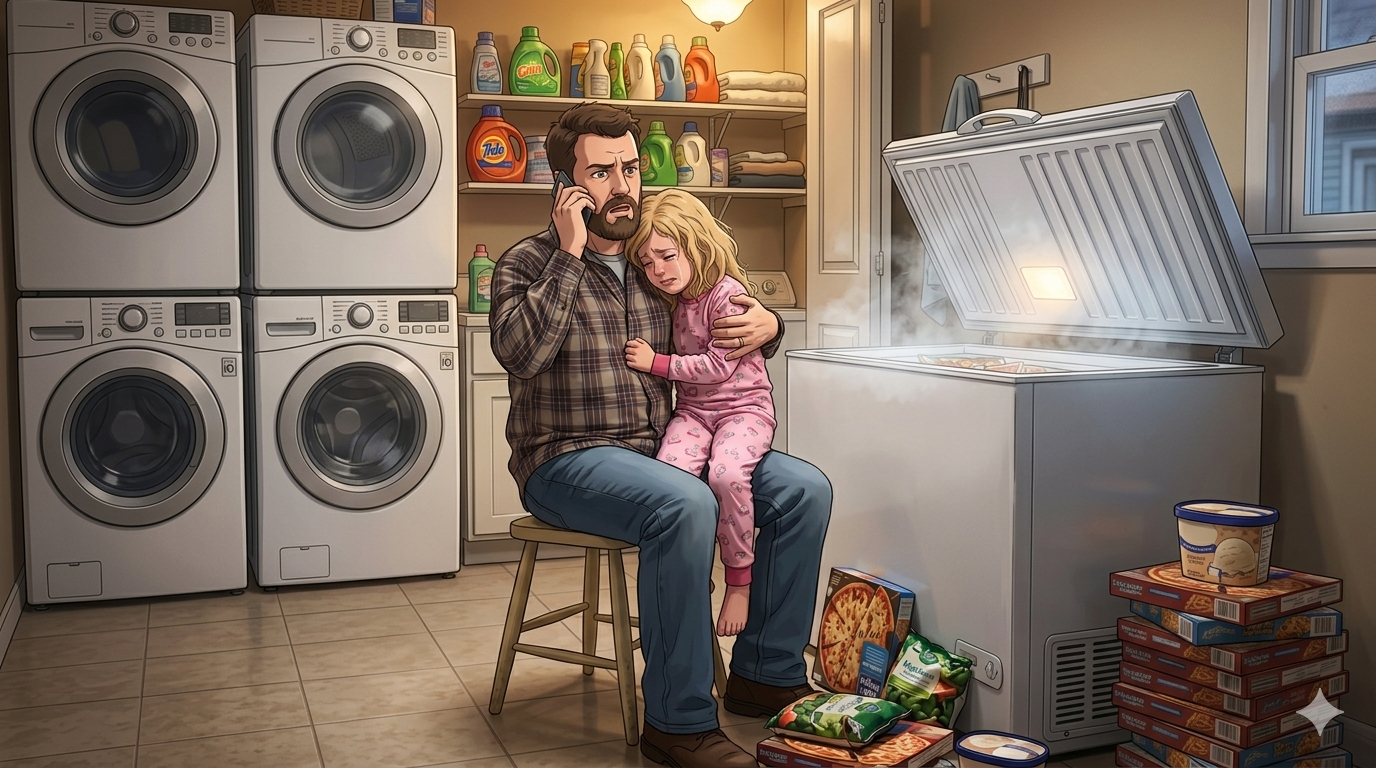
The scream came from inside the freezer in a way my mind refused to understand at first.
It came thin and warped, like the sound itself had frozen solid and had to break apart before it could become a voice. For one suspended second I tried to turn it into anything else. A cat. A television somewhere in the house. The old garage hinges complaining in the cold. Anything except what it really was.
I was standing in the garage of the house that had once been mine, the house where I had painted walls, refinished cabinets, built a crib, and marked my daughter’s height in pencil on the pantry frame.
Now it belonged to my ex-wife by decree, by signatures, by the quiet bureaucratic violence of divorce. I had only come to collect the last boxes of my life before they were thrown out.
It was 9:47 on a Thursday night in October. The air already carried that metallic Colorado chill that meant winter was waiting just beyond sight. The divorce had been final for three weeks.
On paper it had been clean. We had signed, divided assets, agreed to custody, used words like equitable and cooperative while attorneys guided our pens across legal lines. In reality, it had hollowed me out.
Taylor got the house. I got a one-room apartment over a laundromat, a futon that smelled faintly of detergent and somebody else’s cigarettes, and every other weekend with our daughter as long as everyone, as Taylor liked to say, stayed civil.
That morning she had texted me: Pick up your stuff by Friday. I’m throwing out whatever’s left.
No softness. No punctuation. Just a final notice.
So after my shift, I drove there without telling her. The plan was simple. Park. Load the boxes stacked in the garage. Avoid the house. Avoid the rooms I no longer had any right to stand in. Avoid her mother, Evelyn, if possible. Leave before memory got teeth.
The garage door was open when I pulled in. Light poured out in a hard yellow slab across the driveway. Taylor’s car was gone. Her mother’s sedan sat under the streetlight, dented bumper catching the glow.
Evelyn.
Even before the divorce, I could feel that woman in a room before I saw her. She had attended our wedding in mauve chiffon and pearls, then spent the next fourteen years letting me know—through pauses, lifted brows, tiny corrections, and compliments aimed elsewhere—that I was never the husband she had imagined for her daughter. Too ordinary. Too blue collar. Too literal. Not enough. She never had to say it plainly. She had mastered implication years ago.
I saw her car, felt the familiar knot of irritation, and still did not think danger. She watched Lily all the time when Taylor worked late. It was normal. Or maybe it had just become normal through repetition, the way bad arrangements often do.
My boxes were stacked neatly against the wall, labeled in Taylor’s handwriting: Books. Winter clothes. Tools. Office. Kitchen. An entire marriage reduced to categories one person could carry.
Then I heard the scream again.
This time there was no denial left in me. It was high, muffled, and full of a terror too primal to mistake. It came from the chest freezer at the back of the garage.
For one split second I still did not move. My hand stayed on the car door. My body knew before my mind did that something irreversible had already happened, and every rational part of me scrambled to invent a harmless explanation.
Then the scream came again, and this time words broke through it.
“Daddy! Daddy, help!”
The whole world narrowed to that sound.
I crossed the garage so fast I barely remember taking the steps. The freezer was the old one we had bought secondhand years ago when Taylor decided bulk shopping would save us money. Dented on one side, yellowing at the edges, stubborn latch. We had kept steaks in it, frozen vegetables, gallons of ice cream hidden behind chicken. Domestic life in one cold white box.
My hands grabbed the handle and yanked. The lid resisted for half a second, then tore open.
Cold hit my face like a blow. White vapor spilled out. And there she was.
Lily was curled into herself inside the freezer like something stored instead of something alive. Wedged between frozen vegetables and packages of meat. Knees pulled to her chest. Thin cotton pajamas covered in little stars. Frost in her hair. Lips blue in a way I will never stop seeing. Skin gray and waxy. She was shaking so violently her teeth clicked in sharp frantic bursts.
For one sickening moment the sight existed without language. Then my mind caught up and the fact slammed into me all at once.
My daughter.
I pulled her out without thinking. My arms simply moved. She weighed almost nothing, but the cold on her felt heavy, as if it wanted to keep her. I wrapped myself around her, pressing her against my chest, my coat, my neck, every bit of heat I had.
“I’ve got you,” I kept saying. “I’ve got you. Daddy’s here. Daddy’s here.”
Her hands clutched my jacket with shocking strength. My whole body was shaking now, not from the temperature but from the force of terror flooding through me.
“How long?” I asked, my voice splitting apart. “Lily, how long were you in there?”
She buried her face against my shoulder and shook her head weakly. “I don’t know.”
Then, in a voice so small it almost vanished, she whispered, “Grandma put me in.”
For a second I thought I had misheard.
“What?”
“She put me in when I was bad.” Her words came in broken bursts between shivers. “I spilled my juice. I didn’t mean to. I didn’t mean to, Daddy.”
Everything in me went hot and cold at once.
“Grandma put you in the freezer?”
She nodded.
“Has she done this before?”
Another nod. “She says it helps me think.”
There are moments when rage does not feel like heat. It feels like clarity. My panic narrowed into something hard and focused. I looked toward the door to the house and pictured Evelyn inside, calm and righteous, probably believing she was teaching character. I wanted to drag her into the garage and make her look at what she had done. But stronger than that rage was one instinct: get Lily warm, safe, breathing, away.
“Where is Grandma now?” I asked.
“In the living room,” Lily whispered. “She said I had to stay until I learned my lesson.”
I turned toward the truck. Heat. Blanket. 911. Hospital.
But as I stepped away, Lily suddenly went rigid in my arms.
“Daddy,” she said, voice changing. “Wait.”
I followed her gaze.
Against the far wall, partly hidden behind my boxes, sat another freezer. Smaller. Newer. One I had never seen before. Its cord was coiled on top. It was unplugged. But the lid was fastened with a heavy padlock.
Even before I understood why, something inside me recoiled.
“Lily,” I said carefully, “what is that?”
She pressed her face harder into my shoulder. “Don’t open that one.”
“Why?”
Her grip tightened around my neck. “Grandma says that’s where the bad ones go.”
My heart gave one ugly thud.
“The bad ones?”
“The ones who don’t come back.”
The garage changed then. Every edge became too sharp. I stared at the locked freezer and finally noticed the faint smell underneath the cold air—chemical, stale, and something else my mind did not want to name.
I needed an ambulance. I needed police. I needed to get my daughter into the truck and call for help.
But that second freezer sat in the room like gravity itself.
I carried Lily to the truck, started the engine, turned the heat all the way up, and wrapped her in the emergency blanket from behind the seat.
“Lock the doors,” I told her. “Don’t open them for anyone except me or a police officer. Do you understand?”
She nodded through chattering teeth.
I shut the door, heard the locks click, and dialed 911.
“My daughter was locked in a freezer,” I said the instant the dispatcher answered. “By her grandmother. She’s hypothermic. I need police and an ambulance at 847 Aspen Ridge Lane. Right now.”
The dispatcher’s voice sharpened. “Your daughter is out of the freezer now?”
“Yes. She’s in my truck. She’s conscious.”
“How old is she?”
“Seven.”
“And you said her grandmother put her there intentionally?”
“Yes.”
I turned back toward the garage as I spoke. The second freezer sat exactly where it had before, quiet and obscene.
“There’s another freezer in the garage,” I said. “Locked. My daughter says that’s where the bad ones go. The ones who don’t come back. I think there might be someone in it.”
Silence, brief but heavy.
“Sir,” the dispatcher said, slower now, “do not open that freezer. Officers and EMS are on the way. Stay with your daughter and do not touch anything.”
I had already stepped back into the garage.
“I need to know,” I said.
“Sir, do not open it. Police will be there in minutes.”
Minutes.
If there was someone inside and alive, minutes could be everything. Once you have opened one freezer and found your child inside it, the universe no longer gets to lecture you about what is unlikely.
“I’m opening it,” I said, and ended the call.
Maybe that sounds reckless. Maybe it was. But when your daughter has just told you that the bad ones don’t come back from the locked freezer in the garage, protocol loses its persuasive power.
The padlock was thick. I couldn’t break it by hand. Somewhere in the boxes Taylor had stacked for me was a crowbar from our last move. I tore through three boxes before I found it under an old lamp and a rolled rug.
Eighteen inches of steel.
I hit the lock once. The sound cracked through the garage like a gunshot. Again. The metal bent. On the third strike, it snapped.
I stood there for one breath, crowbar in my hand, heart pounding so hard I thought I might black out.
Then I lifted the lid.
The smell came first. Not rot, not exactly. Chemical. Preserving. Under it, the unmistakable wrongness of old flesh held in stillness.
Inside, wrapped in clear plastic sheeting, was a child’s body.
A boy.
Not a bundle. Not an abstraction. A boy. Small. Eyes closed. Skin waxen beneath the plastic. One hand turned palm-up near his chest. He looked less dead than paused, like sleep recreated badly by someone who had never truly seen a sleeping child.
I made a sound I didn’t recognize as human and staggered backward until my legs hit a box and I went down hard on the concrete.
Seven minutes later, police lights flooded the garage.
A young officer reached me first. “Sir. I need you to come with me.”
“There’s a body,” I said. The words were absurdly small. “A child.”
“We know, sir.”
They didn’t know, not really, but they knew enough. Another officer headed for the house. EMTs rushed to my truck. Lily was pounding on the fogged window, screaming for me, because I had promised not to leave and from where she sat, it must have looked like I had.
I went to her as soon as they opened the door.
“I’m here,” I said, taking her frozen hands. “I’m here, baby.”
At the hospital they cut off her damp pajama top and told me her core temperature was 91.2 degrees. Hypothermia. Too fast a rewarming could trigger dangerous heart rhythms. Heated blankets. Warm IV fluids. Continuous monitoring.
I sat beside her bed while color slowly returned to her lips and skin. Every time a nurse touched a monitor, my own pulse jumped with it.
Hours later, a detective came in. He introduced himself as Daniel Mercer. He looked at Lily, then at me, and said, “The doctors expect a full recovery. She’s lucky you found her when you did.”
Lucky.
The word nearly made me sick. I had almost waited until Friday. Almost decided it would be easier to lose the boxes than face the house.
“The second freezer,” I said. “Who was in it?”
He pulled up a chair. “Human remains. Male child. Approximately eight to ten years old. We’ll need dental confirmation, but the body appears to have been there a very long time.”
I stared at him. “A child.”
“Yes.”
Then he asked, “Do you know of any reason there would be a child’s body on the property?”
“No. God, no.”
He nodded once. “We need to ask about your former mother-in-law, Evelyn Parker.”
The name landed differently now. No longer domestic. No longer annoying. Now it belonged to an evidence log.
“She had a son,” Mercer said.
I frowned. “Taylor had a brother. Owen. She said he ran away when they were kids.”
Mercer watched my face. “Owen Parker disappeared in August 1994. Nine years old. Reported as a runaway. Body never recovered.”
The room went very still.
“You think it’s him.”
“We’ll need confirmation. But yes.”
Later, dental records proved it. It was Owen. He had died the night he disappeared. Blunt force trauma. Evelyn had reported him missing, accepted sympathy, answered police questions, and all the while kept his body sealed in cold for thirty years.
Taylor arrived at the hospital around three in the morning with mascara smeared and her face wet. She rushed to Lily’s bedside and whispered, “Oh my God.”
I stood so fast my chair scraped.
“Where were you?”
She stared at me like I was being cruel. “With a friend. My phone died. Ben, I didn’t know—”
“Your mother put our daughter in a freezer.”
Her face emptied. “What?”
“In the garage. She locked her in because she spilled juice.”
She shook her head sharply. “No. No, Mom wouldn’t—”
“Lily said she’s done it before.”
Something changed in Taylor’s face then. Not disbelief. Recognition.
“I didn’t know,” she whispered. “I swear I didn’t know.”
“You left her there.”
“Mom watches her all the time.”
“Yes,” I said. “That’s the problem.”
Then I told her about the second freezer.
“They think it might be Owen.”
For a second even her tears stopped.
“That’s impossible.”
“Did he run away?” I asked.
She looked at me, and for the first time in all our years together, I saw pure child fear inside her adult face.
“She said he was bad,” Taylor whispered. “That bad children go away and don’t come back.”
The words hit me like a physical blow because Lily had said nearly the same thing in the garage.
“Taylor,” I said, quieter now, “when you were little… did your mother lock you up somewhere?”
She stared at Lily. “The basement.”
The answer barely existed as sound.
“When I was bad,” she said flatly, “she’d put me down there in the dark. Sometimes for hours. If I cried, she left me longer.”
My rage did not disappear. But it had to make room for another truth. The woman in front of me had also been raised inside that terror.
Evelyn was charged with first-degree murder in Owen’s death, attempted murder of Lily, child abuse, false imprisonment, and a long chain of related crimes. She never confessed. Never cried. Never even pretended remorse.
A psychiatrist later explained that she did not see children as people with inner lives. She saw them as parts of her environment—things to control, correct, and remove when they disrupted order.
Journals found in her apartment proved worse than I expected. They were not diaries. They were logs. Grocery lists. Weather notes. Expense tallies. And between them, entries like:
O broke dish. Repeated defiance. No remorse.
T observed. Good. She must understand consequences.
Another one read:
T cried in basement after thirty-eight minutes. Better. Fear is useful if applied correctly.
And the line that still wakes me in the night:
She will not make the same mistakes her brother made. She will be a good girl. She has no choice.
I took full custody of Lily before the criminal trial even began. The judge said Taylor had not directly participated in the abuse and there was no evidence she knew about the freezer or Owen’s body. Then he said something harder: a parent’s duty is not only to love a child, but to see what is happening to that child, even when seeing requires you to challenge the system that raised you.
Taylor got supervised visitation.
I found a small house in Thornton two months later. One story. Two bedrooms. A yard big enough for a swing set. No garage. I chose it partly because I could afford it and partly because I could no longer look at garages without feeling my skin tighten.
Lily started therapy three days after leaving the hospital. At first she hated it because she thought talking about what happened meant walking back into the freezer with words. But slowly the nightmares were named. The fear of dark enclosed spaces was named. The panic around certain sounds and closed lids was named. Once a child can name a terror, it stops being the entire room. It becomes one object inside it.
The first six months were the hardest. She woke screaming that it was dark and cold and she couldn’t get out. I would run in, lift her, and repeat the same words until they became ritual.
You’re here. You’re home. You’re warm. She can’t get in. No one can lock you in. I’m right here.
Sometimes she’d whisper, “Promise?”
And I would say, “Promise,” even though the word frightened me. But what else is fatherhood if not the necessary overstatement of protection?
The criminal trial lasted two weeks. I testified. Taylor testified too, and that may have been the bravest thing I ever saw her do. She told the court about the basement. About Owen being bad and then suddenly gone. About growing up under the threat of disappearance without language for what it meant.
The jury took less than four hours.
Guilty on all counts.
Evelyn got life without parole. She was sixty-three. She would die in prison.
It was not enough. Nothing could ever be enough. But it was something.
Two years have passed now.
Lily is nine. She loves dinosaurs with scholarly seriousness, dragon books, syrup in reckless quantities, and a rescue channel on YouTube about baby animals. Elevators are still hard. Dark enclosed spaces are still hard. Public restrooms with loud hand dryers can still make her cry. But she laughs easily. She leaves socks in impossible places. She made honor roll. She argues with me about whether getting a puppy would teach responsibility or simply confirm what she already knows about love.
She is not untouched by what happened. No child could be.
But untouched is not the measure.
Alive is. Healing is. Safe enough to become fully herself is.
Taylor sees her twice a month now. I do not trust her the way I once did, and perhaps I never will. But hatred became more difficult to hold once I understood the architecture of her damage. She failed our daughter catastrophically. That remains true. She was also a child raised in terror by the same woman who killed her brother. That is true too.
Both truths live side by side.
Last month, Lily and I went to Owen’s grave.
After the trial, after the appeals window closed, after his remains were finally released, there had been a small funeral. Not much family left. A few cousins. An old neighbor. Taylor. Me. A handful of people who came because it felt wrong for a lost child to go into the ground alone.
The headstone was simple:
Owen Parker
1985–1994
Finally at rest
Lily had been too raw to attend the funeral, but later she asked if we could visit him ourselves.
“He was alone a long time,” she told me while I packed lunches one night. “In that cold place. I want him to know he’s not alone now.”
So we went.
It was early morning. The cemetery was almost empty. Lily carried yellow daisies and white carnations because, she said, they looked like something that belonged in sunlight.
She knelt and set the flowers at the base of the stone.
“Hi, Owen,” she said. “I’m Lily. I’m your niece.”
Her voice was steady.
“I know we never met, but I wanted to tell you I’m sorry for what Grandma did. I was in a cold place too. But my daddy found me. I wish somebody had found you.”
I put my hand on her shoulder. She leaned into it and kept looking at the stone.
“I’m going to be okay,” she told him. “And you’re not alone anymore. I’ll come visit again. Promise.”
When she stood up, she slipped her hand into mine and asked, with that abrupt practicality only children have, “Can we get pancakes now?”
I laughed. “Yes,” I said. “We can get pancakes.”
And that is what life after horror mostly is. Not triumph. Not closure. Pancakes after the cemetery. Homework after nightmares. Toothbrushes and permission slips and laughter returning in fragments until one day you realize it is returning more than it is not.
People ask how I missed the signs before that night. The honest answer is that I did not miss all of them. I misnamed them. Lily had started wetting the bed more. She grew withdrawn before certain visits. She had nightmares I blamed on the divorce. Once she told me she didn’t want to go to Grandma’s because “Grandma is cold,” and I, idiot that I was, translated that into emotional coldness because that was already my category for Evelyn.
We see what we are prepared to see.
The rest can be screaming in a garage and still take a second to become real.
That is the part I tell now when people want the story reduced to luck or heroism. Yes, luck was there. A text. An open garage door. A scream carrying far enough for me to hear. But luck is useless if, when the impossible sound comes, you spend too long arguing with it.
Children do not always tell us in neat sentences. They tell us in flinches. In silence around certain adults. In bedwetting, stomachaches, changed sleep, sudden fear of places or objects that should mean nothing. They speak in the language available to them. Adults get very good at mistranslation.
I don’t say that to make myself sound brave. The truth is worse and more useful than that.
I almost waited until Friday.
If there is any lesson in my story, it is not that I am a hero. It is that the line between rescue and tragedy can be thinner than inconvenience, thinner than pride, thinner than a text you almost ignore.
I can see Lily now through the kitchen window as I think this. She is on the swing set in the backyard, pumping too high, arguing with gravity, one shoelace untied, grass stains on both knees, dinosaur T-shirt half twisted. Two years ago I found her blue-lipped and shaking in a freezer. Tonight she is bargaining for three more minutes before dinner.
Life does not become fair after the worst thing.
It simply continues.
And if you are very lucky, if you listen fast enough, move fast enough, and refuse to look away from what should never have needed opening, it continues with the people you love still in it.
I used to think monsters announced themselves. I do not believe that anymore. Monsters look like grandmothers in cardigans. They bring casseroles. They remember birthdays. They live in normal rooms because normal rooms are where trust grows best.
The only defense is attention.
Not paranoia.
Attention.
Believing children when their fear arrives without courtroom polish. Looking twice at what your own mind wants to dismiss because the alternative is too terrible to entertain. Being willing to become inconvenient when convenience is what made the danger possible.
A while ago, Lily brought home a school worksheet asking students to list three things that make them feel safe. In careful looping handwriting, she wrote: my blue blanket, Chloe’s dog Daisy, and my dad when he hears me.
I found the paper folded in her backpack between a spelling quiz and an apple core wrapper, and I had to sit at the kitchen table for a long time before I could trust my face again.
Because survival is not only the rescue, the sirens, the verdict, the sentencing.
It is the years after.
It is teaching a child that not every closed lid means death, not every adult means danger, not every mistake means disappearance. It is teaching yourself that vigilance can live beside joy. That your child is not defined by what almost erased her.
I found my daughter by accident.
I found her because I showed up.
Both are true.
Fate may open a door. It may let a scream slip through insulation and put you under the right yellow garage light at the exact right minute.
Then it leaves.
What remains is whether you move. Whether you listen. Whether you are willing to tear open what everyone else has silently agreed not to see.
I moved. I listened. I opened the freezer.
And tonight, through the kitchen window, I can see that what came out of that cold did not only survive. She went on becoming herself.
In a minute I’ll open the back door and tell her dinner’s ready. She’ll ask for five more minutes. I’ll say two. She’ll bargain for four. We’ll settle on three, because that is what fathers and daughters do when the world, for one ordinary evening, is being kind.
Then she’ll come inside trailing cold air and grass and childhood, and the house will close around us not as a trap, but as shelter. And I will be grateful, again, for every indifferent force in the universe that put me there in time to hear her scream.
THE END!