He Invited His Ex to His Wedding—Then Saw Her Newborn Daughter
Six months after the divorce, I had convinced myself I would never hear Ryan Cole’s voice again.
That belief lasted until the morning I gave birth.
I was lying in a hospital bed, sore in places I did not know could ache, watching the tiny rise and fall of my daughter’s chest as she slept in the clear plastic bassinet beside me.
The room smelled faintly of antiseptic and warmed blankets.
My mother was seated by the window with a paper cup of coffee she had reheated twice and still had not finished.
Outside, the sky was a washed-out gray, the kind that made the whole city look quiet, as if it understood somebody’s life had just changed forever.
My phone buzzed against the tray table.
I almost ignored it.
I should have.
Then I saw the name on the screen.
Ryan Cole.
My ex-husband.
For a second, I thought maybe sleep deprivation was making me hallucinate.
Ryan had not called me in months.
Not on my birthday.
Not after my prenatal scare in my second trimester.
Not once when I moved out of the house we had chosen together.
Not when the divorce papers were finalized.
Not even when he knew the due date was getting close.
But there his name was, bright and ordinary, as though he belonged in my morning.
I answered before I could change my mind.
“Why are you calling me?”
His voice was strangely upbeat.
It had the polished confidence I used to admire and later came to hate, the tone he used when he wanted to sound generous while giving almost nothing.
“I’m getting married this weekend,” he said.
“I thought it would be decent to invite you.”
For a moment I was too stunned to speak.
Then a tired laugh escaped me.
“Ryan, I just gave birth.
I’m in the hospital.”
There was a pause long enough for me to picture him frowning.
“Fine,” he said at last, all warmth gone.
“I just wanted you to know.”
Then he hung up.
I lowered the phone slowly and stared at the ceiling.
I wish I could say his call meant nothing.
I wish I could say I was above being hurt by someone who had already broken me once.
But pain does not vanish on command just because you know better.
There I was, holding the first real joy I had felt in a long time, and somehow Ryan still found a way to press on the bruise he had left behind.
My mother looked up from her chair.
“Was that him?”
I nodded.
She pressed her lips together.
“He has nerve.”
That was one way to put it.
Ryan and I had been married for three years.
We met young, before titles and promotions and networking dinners became the center of his universe.
Back then he was funny, reckless in a charming way, and full of plans that included both of us.
He talked about future vacations, future homes, future children.
He would pull me into his lap in our first apartment and say things like, We’re building something.
I believed him.
Somewhere along the way, his ambition stopped being something that motivated him and became something that consumed him.
He started treating relationships like accessories to a life he was curating.
The right friends, the right clients, the right neighborhood, the right image.
He cared more and more about appearances and less and less about people.
When I found out I was pregnant, I cried before I even told him, but they were happy tears.
We had not exactly planned it, but we had talked about children enough that I thought this would still be good news.
Maybe surprising news.
Maybe scary news.
But good.
Ryan stared at the test in my hand as if it were a bill collector.
“This is bad timing,” he said.
I remember laughing nervously, waiting for him to smile and say he was kidding.
He did not.
Over the next week he became colder than I had ever seen him.
He said the baby would derail everything.
He said he had worked too hard to be tied down.
On the worst night, in a voice I still hear sometimes when I cannot sleep, he accused me of trying to trap him.
That sentence did not just damage our marriage.
It ended it.
A month later, he filed for divorce.
I was still nauseated every morning when I signed the papers.
He moved out.
Then he vanished with astonishing efficiency, as though I had become a problem his assistant could file away.
I built a life around the empty space he left.
I attended appointments alone or with my mother.
I learned how to hear the heartbeat without crying in the parking lot afterward.
I painted the nursery in my new apartment a soft cream because I wanted something calm, something that did not scream either sorrow or forced cheer.
I went to birthing classes where other women squeezed their husbands’ hands while I focused on breathing and pretended not to notice.
I told myself over and over that peace was more important than revenge, more important than explanations, more important than hearing Ryan admit he had been cruel.
By the time labor started, I thought I had made peace with the fact that my daughter would enter the world without her father.
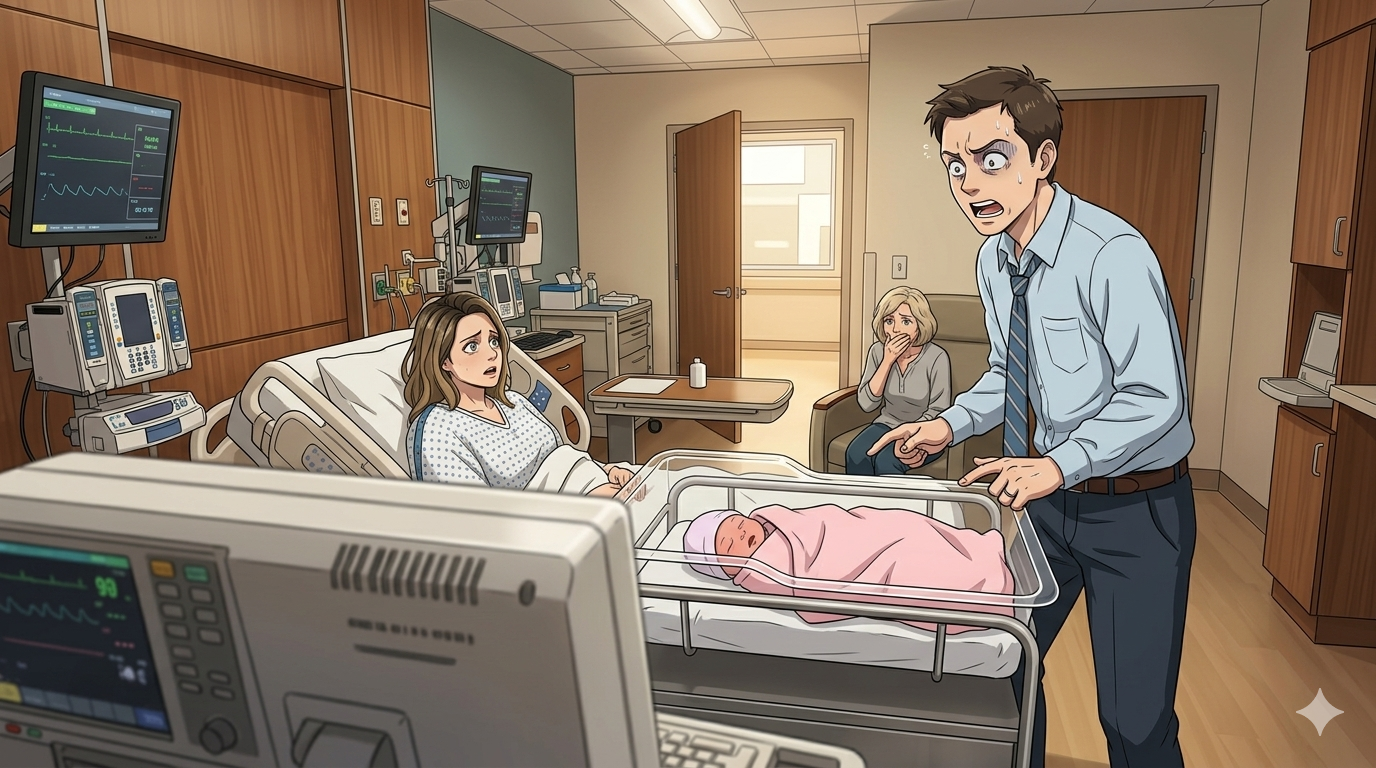
Then thirty minutes after his call, the hospital room door burst open.
The nurse checking my chart jumped.
My mother shot up from her chair so quickly it nearly tipped backward.
I jerked against my pillow, heart pounding.
Ryan stood in the doorway, breathing hard, his tie loosened, his face drained of color.
“Where is she?” he said.
At first I thought he meant me.
Then he strode past my bed, straight toward the bassinet.
Everything in the room seemed to go still.
He looked down at the baby.
My daughter had a head full of dark hair and a little crease between her brows that made her appear serious even in sleep.
Her fists were tucked under her chin.
Ryan stared at her as though he had just walked into a mirror and found a stranger waiting there.
His hands trembled.
“She looks exactly like me,” he whispered.
A nurse glanced at me, then quietly excused herself and slipped from the room, sensing she had walked into something not meant for witnesses.
“What are you doing here?” I asked.
He turned toward me, panic written across every line of his face.
“Why didn’t you tell me it was a girl?”
The question
was so absurd that a bitter laugh escaped me before I could stop it.
“Why would I tell you anything? You said the baby wasn’t yours.”
His mouth tightened.
“I didn’t mean that.”
I felt anger move through me, hot and steady.
“You said it.
That matters more than whether you feel like taking it back now.”
He ran a hand through his hair.
“I thought you lost the baby.”
I stared at him.
“My fiancée told me months ago you weren’t pregnant anymore,” he said.
“She said she heard it from someone at the firm who knew your cousin.
She told me there were complications and that you didn’t want me contacted.”
My chest went tight.
“Vanessa told you that?”
He nodded.
I almost laughed again, but this time from disbelief instead of pain.
Vanessa Mercer.
Ryan’s fiancée.
Also the senior account strategist from his office, the elegant woman with expensive coats and the kind of smile that always looked practiced.
I had met her twice while Ryan and I were still married.
Both times she had treated me with a sweet, polished distance that made me feel like I was standing beside my own replacement.
The timeline clicked into place so quickly it made me dizzy.
Ryan had started mentioning Vanessa during the last months of our marriage, always professionally, always innocently, at least on the surface.
Vanessa said this.
Vanessa recommended that.
Vanessa thinks the client wants a softer pitch.
I had not known whether there was an affair then, emotional or otherwise.
By the time I started suspecting it, I was too busy trying to save a marriage with a man who had already mentally left it.
“What made you come here now?” my mother asked sharply.
Ryan looked from her to me and then reached into his jacket pocket for his phone.
“Because of this.”
He held the screen out.
It was a message from Vanessa, timestamped the night before.
Are you sure you want to send the invitation? She was obsessed with keeping you.
Don’t reopen old drama.
It ended for a reason.
Below that, Ryan had replied: She just said she’s at the hospital with a newborn.
Vanessa’s answer came six minutes later.
That’s impossible.
Then another message, sent a minute after that.
Unless she lied about whose baby it was.
And another.
Please do not embarrass us before the wedding.
I looked up from the phone.
He swallowed.
“She sounded scared.”
“Because she lied,” I said.
Ryan’s eyes flicked toward the bassinet again.
“Did she ever contact you?”
I shook my head.
“Not directly.”
Then I stopped.
A memory surfaced so suddenly it stole my breath.
At twenty-two weeks pregnant, I had gone in for an anatomy scan.
My mother couldn’t come because she had the flu, so I went alone.
It had been an emotional day; hearing the technician say everything looked healthy had nearly undone me.
On the way out, in the hallway near the elevators, I had seen Vanessa.
She was holding flowers.
I had assumed she was visiting someone.
She had looked startled to see me, then recovered quickly and smiled with that same smooth, expensive politeness.
“Claire,” she had said.
“How are you?”
Pregnant and humiliated was the true answer, but I had simply said, “Fine.”
Her
gaze had dropped to the ultrasound envelope in my hand.
“Still doing appointments?” she asked.
The wording had struck me as odd, but I was too tired to question it.
Now, in the hospital room, I heard the sentence differently.
Still doing appointments?
As if she had already been told I should not have been.
I looked at Ryan.
“She saw me at my anatomy scan months ago.”
His expression changed.
“She knew I was still pregnant,” I said.
No one spoke for several seconds.
Then my mother crossed her arms.
“So your fiancée lied to you for months, and you were still going to marry her in three days?”
Ryan opened his mouth, then closed it.
There are moments when truth arrives so fully that it makes everyone in the room look different.
That was one of them.
Ryan no longer looked like the confident man who had called to casually invite me to his wedding.
He looked frightened, yes, but also stripped bare.
For the first time in a long time, he looked like a person forced to see the consequences of his own choices all at once.
“I need to talk to her,” he said.
My mother gave a short, humorless laugh.
“That seems obvious.”
I should have told him to leave.
I should have said none of this was my problem.
But I had just given birth, my emotions were raw, and my daughter was asleep five feet away while the man who helped create her stared at her like he had discovered gravity too late.
More than anything, I wanted the truth, and I wanted it dragged into daylight where nobody could bend it anymore.
So I said, “Put her on speaker.”
Ryan hesitated.
“Now,” I said.
He called.
Vanessa answered on the second ring, voice bright and distracted.
“Hey, I’m with the florist.
Can this wait?”
“No,” Ryan said.
“I’m at St.
Mary’s.”
Silence.
Then, carefully, “Why?”
“I’m looking at my daughter.”
The word daughter hung in the air.
Vanessa’s inhale was audible through the phone.
“Ryan, listen to me.”
“No,” he snapped, and I almost flinched because I had not heard that much raw anger in his voice in years.
“You told me Claire lost the baby.”
“I was trying to protect you.”
“From what?”
“From making another mistake.”
My mother muttered something under her breath that the baby thankfully slept through.
Ryan paced to the window.
“You saw her at the hospital, didn’t you?”
Another pause.
Then Vanessa said, “I saw enough.”
“You knew she was still pregnant.”
“Ryan, please lower your voice.”
“Answer me.”
She exhaled, and when she spoke again, the sweetness was gone.
“Yes.
I knew.”
The room seemed to contract around me.
Ryan closed his eyes.
“Why?”
Because I wanted to hear it too.
Vanessa did not answer immediately.
When she finally spoke, her voice had the brittle edge of someone who had spent too long arranging reality and resented being forced to tell the truth.
“Because every time you were around her, you became someone else,” she said.
“You would act like you were finished, but you weren’t.
You kept one foot in that marriage even after it was dying.
And when she got pregnant, I knew what would happen.
You would go back out of guilt
or obligation or some fantasy about being a family man, and then you would resent all of us for it.”
Ryan looked sick.
“So you decided for me?” he said.
“I decided for us,” Vanessa answered.
“Someone had to.
You were too weak to do it cleanly.”
The cruelty of that sentence shocked even me, and I was the one she had erased.
Ryan’s knuckles whitened around the phone.
“You let me believe my child was gone.”
“I let you move on.”
I found my voice then, calm in a way that surprised me.
“You didn’t move him on.
You stole information because it benefited you.”
Vanessa went silent for a beat.
“Claire.
I didn’t realize you were there.”
“Of course you did,” I said.
“You knew exactly where this would end once he saw her.”
Her voice sharpened.
“This isn’t all on me.
He chose to leave.”
That, at least, was true.
Ryan lowered the phone slowly, then raised it again.
“The wedding is off.”
“Don’t be ridiculous,” Vanessa said instantly.
“You are emotional.”
“No,” he said.
“I’m finally clear.”
“Think about what this will do to your reputation.”
He gave a short, stunned laugh, as if only now recognizing how often that word had governed his life.
Reputation.
Then he ended the call.
No one spoke for a long time.
My daughter stirred, made a soft little sound, and settled again.
Ryan turned toward the bassinet once more, but this time he did not move closer until I nodded once.
It was not permission exactly.
It was more like acknowledgment that the world had changed and we were all going to have to learn what that meant.
He stood over her quietly.
“She has my mother’s chin,” he said after a moment.
I looked too.
He was right.
My mother let out a breath.
“Well, there’s no denying the Cole genetics now.”
It was the first almost-joke anyone had made, and the release of tension was so sudden it made my eyes sting.
Ryan looked at me.
“I know I don’t deserve to ask this today.
But is she really mine?”
The question hurt, not because I doubted the answer, but because of everything behind it.
“Yes,” I said.
“She is.”
He nodded once, and tears filled his eyes so quickly it seemed they had been waiting.
Ryan was not a man who cried easily.
In our marriage, I could count on one hand the times I had seen him cry.
One was when his father died.
Another was when we closed on our first house.
Watching him cry beside our daughter’s bassinet should have felt triumphant.
It did not.
It felt sadder than that.
“I was wrong,” he said hoarsely.
“About all of it.”
I believed he meant it.
That did not erase anything.
He asked if he could come back later, after I had rested, after I had decided whether I wanted him there.
I told him I did not know.
He said he understood.
My mother walked him to the door like a prison guard, but before he left, he looked back at me.
“What’s her name?”
I had been waiting to tell him, and also dreading it.
“Evelyn,” I said.
His face crumpled for a second, because he knew.
Evelyn was my grandmother’s name,
but it was also his mother’s middle name.
We had once talked about using it if we ever had a daughter.
“Evelyn,” he repeated softly.
Then he left.
I expected the next few days to be chaos, and they were.
The wedding was canceled.
Vanessa sent Ryan dozens of messages, then switched to emails, then to calls from unknown numbers after he blocked her.
At one point she sent me a message too, long and self-justifying, claiming she had acted out of love, that she had only accelerated what Ryan already wanted.
I did not respond.
My lawyer advised me to save everything and say nothing.
Ryan, for his part, did not disappear again.
He sent one text the evening I got home from the hospital: I am at fault too.
I know that.
I would like to take a paternity test if you want one for legal purposes, and I will sign whatever is needed.
I am not asking for forgiveness.
I am asking for a chance to do right by Evelyn.
I read it three times.
Then I set the phone face down and changed a diaper.
Doing right by a child is not proven in one message.
It is proven in repetition, in patience, in showing up when no one is applauding.
The first weeks with a newborn blurred together in the way everyone warns you about and no one can fully explain.
Days became cycles of feeding, burping, rocking, washing tiny clothes, crying for reasons I could not always identify, and occasional flashes of wonder so pure they made me forget how tired I was.
My mother stayed with me for ten days, sleeping on the couch and keeping our small apartment running with military precision.
When she finally went home, the place felt too quiet.
Ryan came by for the paternity test appointment and sat in the waiting room with a humility I had never seen in him.
He did not try to touch Evelyn without asking.
He did not offer opinions on anything except how beautiful she was.
When the nurse handed him a form, he filled it out with careful concentration, as though each line mattered.
Maybe for once he understood that they did.
The test confirmed what we already knew.
Ryan was Evelyn’s father.
He asked if he could start with short visits.
I agreed because Evelyn deserved clarity more than she deserved my pride, and because I needed practical help no matter how fiercely independent I wanted to appear.
The first time he held her, he looked terrified.
The second time, slightly less so.
By the third visit, he had learned how to support her head without needing reminders.
Still, I watched him with the wariness of someone handling a beautiful object that once cut her deeply.
He noticed.
One evening, while Evelyn slept against his chest after a bottle, he said quietly, “I know you think I’ll leave again.”
I was folding onesies at the dining table.
“I don’t think.
I prepare.”
That answer landed.
He nodded.
“Fair.”
There was no dramatic apology speech after that.
No cinematic redemption.
Instead there were small things.
He took night shifts on weekends so I could sleep four uninterrupted hours.
He showed up early for pediatrician appointments.
He learned the difference between hungry
cries and tired cries with embarrassing enthusiasm, as if mastering baby cues were a competitive sport.
He transferred child support before the legal order was finalized because, as he put it, Evelyn needed diapers now, not after paperwork caught up.
Slowly, my anger changed shape.
It did not vanish.
Some harms do not vanish.
But anger that remains untouched becomes a wall around everything, including the good.
I refused to let Ryan’s failures poison my daughter’s chance to have whatever healthy relationship with him might still be possible.
About two months after Evelyn was born, Vanessa showed up outside my apartment building.
I almost kept walking.
She stood near the front steps in a cream coat that probably cost more than my monthly rent, except now it looked rumpled and hastily thrown on.
Without perfect hair and polished office lighting, she seemed smaller than I remembered, though no less sharp.
“I just want to talk,” she said.
“That sounds like a terrible idea,” I replied.
She glanced at the stroller.
“I’m not here to cause a scene.”
“That ship sailed months ago.”
For a second I thought she might slap me.
Instead she drew a breath and said, “Ryan has made me the villain in a story that belongs to both of you.”
I almost laughed at the audacity.
“Belongs to both of us? You inserted yourself into it.”
Her jaw tightened.
“He was already leaving you.”
“Yes,” I said.
“And he was wrong for that.
But you lied about my child being gone.
That part is yours.”
She looked away.
There it was again, the crack in the performance.
Not remorse exactly.
Something closer to resentment that the facts refused to stay polished.
“I loved him,” she said.
“Maybe,” I answered.
“But love that needs deception to survive usually has another name.”
She flinched as though I had struck her.
Then she said the only useful thing she ever said to me.
“You should know he asked about you more than he admits.
During the divorce.
During the pregnancy.
He would start and then stop.
He wanted a path back without paying the price of what he’d done.”
I stood very still.
Not because it changed anything, but because it confirmed what I had suspected: Ryan had not been heartless.
He had been cowardly.
In some ways that was easier to forgive.
In other ways it was not.
Vanessa left after that.
I never saw her again.
Winter turned slowly toward spring.
Evelyn outgrew newborn clothes, then three-month clothes.
She developed a gummy smile that seemed to arrive first thing in the morning, as though she woke up delighted by the existence of light itself.
Ryan became a regular part of her week.
Not perfect.
Not magically transformed.
Still sometimes too attached to his phone, still occasionally overexplaining simple things as if he were presenting to a boardroom.
But he was there.
Present in body, increasingly present in spirit.
One Saturday afternoon, he came over with coffee for me and an absurdly tiny pair of yellow socks for Evelyn because he claimed they looked like optimism.
She was napping in her crib, and the apartment was quiet.
We sat at the table where so many difficult conversations had already happened.
“I owe you an apology that is not about
me feeling guilty,” he said.
I looked up.
He continued, “I left because I was afraid my life would become smaller.
Then it became smaller anyway, just in a different way.
I treated you like an obstacle when you were carrying our child.
I let someone manipulate me because it was easier than facing what I had done.
I can’t ask you to forget that.
I only want you to know I see it clearly now.”
There are apologies that ask to be rewarded and apologies that simply tell the truth.
This one sounded like the second kind.
“Thank you,” I said.
That was all.
And somehow it was enough.
People love stories where broken marriages heal and everybody reunites in a prettier house with better communication.
Real life is usually less symmetrical.
Ryan and I did not fall back in love.
We did not circle each other under soft music and rediscover destiny.
Too much had happened.
Some doors, once closed, are meant to stay closed.
What we built instead was something less glamorous and more valuable.
Trust, in measured portions.
Respect, earned slowly.
A shared devotion to a little girl who deserved adults capable of growing up.
By Evelyn’s first birthday, Ryan and I had settled into a rhythm that would have seemed impossible a year earlier.
He had an overnight nursery corner in his apartment.
I had veto power on any childcare decision involving common sense and sleep deprivation.
He had learned to cook exactly three things well, all of them toddler-friendly.
My mother, who once referred to him exclusively as That Man, eventually resumed using his first name, which in our family counted as a major diplomatic breakthrough.
On the morning of Evelyn’s birthday, we held a small party in the park.
Nothing extravagant.
Just cupcakes, a picnic blanket, a handful of family friends, and a baby in a pale yellow dress trying to eat tissue paper from a gift bag.
Ryan arrived early carrying folding chairs and stayed late picking up trash.
At one point Evelyn took three wobbly steps from my mother’s lap straight into his arms, and the look on his face was so unguardedly joyful that I had to turn away for a moment.
Not because it hurt.
Because it healed something I had stopped expecting to heal.
Later, after everyone left and the park was nearly empty, Ryan sat beside me on the blanket while Evelyn slept in the stroller, exhausted from cake and attention.
“I still think about that day at the hospital,” he said.
“So do I.”
He looked at our daughter.
“I thought my life was ending when I saw her.
Really, it was the first honest beginning I’d had in years.”
I considered that.
Then I said, “It was the end of a lie.
That’s close enough.”
He smiled, a little sadly, and nodded.
The sun was dropping behind the trees, leaving the whole park washed in gold.
Children shouted in the distance.
Somewhere nearby, a dog barked twice and then stopped.
Ordinary sounds.
Ordinary evening.
The kind of peace I used to think had to arrive dramatically to count.
Ryan stood and reached for the stroller handle.
“I’ll walk her to the car.”
I let him.
As he did, I realized something simple and enormous.
The
reason he came to that hospital room had changed everything, but not in the way I first imagined.
He had come because he was afraid.
He stayed because at last he chose not to run from the truth.
And that truth did not give us our marriage back.
It gave our daughter her father, imperfect but real.
It gave me closure that did not depend on revenge.
It gave all of us a chance to build something honest from the wreckage of something false.
That was enough.
More than enough, actually.
It was a real ending.
And for once, it was one I could live with.
THE END!

