He Married His Mistress With My Money—Then Came Home to Nothing
By the time the cleaners had begun moving quietly through the glass hallways of my office in Polanco, I was still at my desk staring at the contract that had taken ten months to secure.
My signature was on the last page, the numbers were real, and the relief should have felt glorious.
Instead, all I could think about was how tired I was.
Tired in my shoulders, tired behind my eyes, tired in the part of me that had spent seven years financing a life other people treated as automatic.
The apartment for Mauricio’s mother, the imported car he called a necessity, the club fees, the weekend getaways, the staff at the house in Bosques de las Lomas—none of it existed because of him.
It existed because I worked like someone being chased.
When I met Mauricio Ríos, he was handsome in the careful, effortless way that makes weak people look gentle and selfish people look wounded.
He knew how to listen with his head tilted slightly to the side, as if every word you spoke mattered deeply to him.
At the time, I mistook that for character.
I had just begun expanding my consulting firm, and he seemed like a soft place to rest after years of fighting for every inch of respect in rooms full of men.
He said he admired my ambition.
He said he loved that I never apologized for being successful.
What he really loved, I would eventually learn, was what success could buy.
His mother, Lidia, saw it even faster than he did.
On the surface, she was polite.
She brought desserts to family dinners, kissed both my cheeks, told people I had a brilliant head for business.
Underneath every compliment was a small blade.
Why work so much, Sofía? A wife should be home sometimes.
A family needs children, not boardrooms.
The worst years were the fertility treatments.
I never told many people about them, but Mauricio told his family everything.
Each failed cycle became one more private grief I had to carry in public while Lidia looked at me with theatrical pity, as though my body had committed a moral offense against her bloodline.
The irony was that their entire lifestyle depended on the very woman they considered incomplete.
Before Mauricio and I married, my father insisted on one lesson I once thought sounded cold: love generously, but sign carefully.
Mauricio had personal debts when we met, a history of disorganized ventures, and a talent for turning excuses into charm.
So the house was purchased in my name.
The cars were leased through my company.
The investment accounts were mine.
The main cards he used were cards on which I was the principal holder and he was an authorized user.
At the time, I believed it was practical protection, not prophecy.
I never imagined the paperwork would one day save me from my own marriage.
That night, after the contract closed, I sent Mauricio a simple message.
He was supposedly in Singapore meeting potential investors for a hospitality project he had been talking about for months.
I knew the presentation was vague.
I knew the numbers never quite made sense.
But I had become skilled at not looking too hard at the things I feared might already be broken.
I typed,
Take care.
I miss you.
He did not answer.
I opened Instagram the way people open a window in a suffocating room, just looking for something mindless.
Instead, the first image on my screen ended my marriage more cleanly than any confession ever could.
It was posted by Lidia.
The photo had the golden lighting of a professional wedding shoot and the smug intimacy of a secret everyone but me had been enjoying for days.
Mauricio stood in an ivory suit with one hand resting over Valeria Cruz’s fingers.
Valeria was twenty-six, ambitious, pretty, and until that second, a junior analyst in my company.
I recognized the dress immediately as expensive.
I recognized the venue as more expensive.
And then I recognized the people gathered behind them: Mauricio’s sisters, his cousins, an uncle who once asked me for help refinancing a loan, even the aunt who cried at our own wedding.
The caption below the photo was brief and savage: My son is finally truly happy.
He finally chose well.
I called Lidia before I could think.
She answered on the first ring, which meant she had already been waiting for the moment I found out.
I asked her what I was looking at.
She did not even try to lie.
She said, very calmly, that I had delayed Mauricio’s life long enough, that Valeria was pregnant, and that a real woman gives a man a family instead of a schedule.
Her voice had the warmth of a locked door.
I remember staring at the city lights outside my office window while she spoke and feeling something in me go still.
Not shattered.
Still.
There is a point after humiliation when pain becomes structure.
I reached it while she was talking.
I did not go home.
I booked a suite at a hotel on Paseo de la Reforma, took the elevator up with my laptop pressed to my chest, and called my lawyer, Elena Márquez.
Elena had handled acquisitions for me, not heartbreak, but she understood urgency in any language.
I sent her screenshots, told her everything, and waited for the sound of disbelief.
It never came.
She only asked one question: Are you sure you want to move tonight? I looked around the quiet hotel room, at the city stretching out below like a field of cold stars, and said yes.
I told her to list the house with a cash buyer we had used before, move every recoverable peso into my personal accounts, freeze all shared banking access, cancel every card Mauricio carried, and cut off any digital permissions linked to my assets.
Because everything had been structured under my name or my company’s authority, the process was brutal but fast.
The household manager received new instructions.
The gate codes were changed.
The cars registered through the company were flagged so they could not be driven off airport parking without authorization.
The bank froze supplementary cards.
Our family office moved liquid funds before dawn.
By three in the morning, the part of my marriage that had functioned as Mauricio’s financial bloodstream had been severed.
I should say that I felt powerful.
The truth is that I felt hollow, disciplined, and very, very awake.
I sat on the edge of the hotel bed in my suit and heels until
sunrise, reading every message thread I had been too trusting to examine.
By morning, trust had become evidence.
Mauricio’s travel itinerary had been paid with points converted from my corporate account.
Valeria had approved reimbursements on vendor requests she was never authorized to touch.
There were flowers charged to a client development line item, two hotel deposits mislabeled as conference accommodations, and a dress expense tucked inside a marketing invoice so clumsy I could not believe no one expected me to notice.
That was when I understood something that hurt more than the affair itself: they had not merely betrayed me.
They had rehearsed the betrayal while depending on my competence to keep the lights on around them.
I called my chief financial officer and head of human resources before nine.
I did not rant.
I did not cry.
I told them there was a confidential misuse-of-funds investigation involving an employee and that I wanted every reimbursement Valeria had touched over the previous six months audited before the workday ended.
My IT director quietly preserved her emails, expense records, and device access logs.
By noon, the pattern was undeniable.
Small amounts had been moved repeatedly, each insignificant on its own, but together enough to pay for flights, wedding reservations, gifts, and a three-day stay at a luxury resort that had nothing to do with business.
Valeria had not just slept with my husband.
She had used my company as the cashier for the fantasy they were building behind my back.
Three days later, I watched them return.
The cash buyer closed faster than expected, and the house in Bosques transferred before their flight landed back in Mexico City.
I did not need to arrange any dramatic scene; reality was dramatic enough.
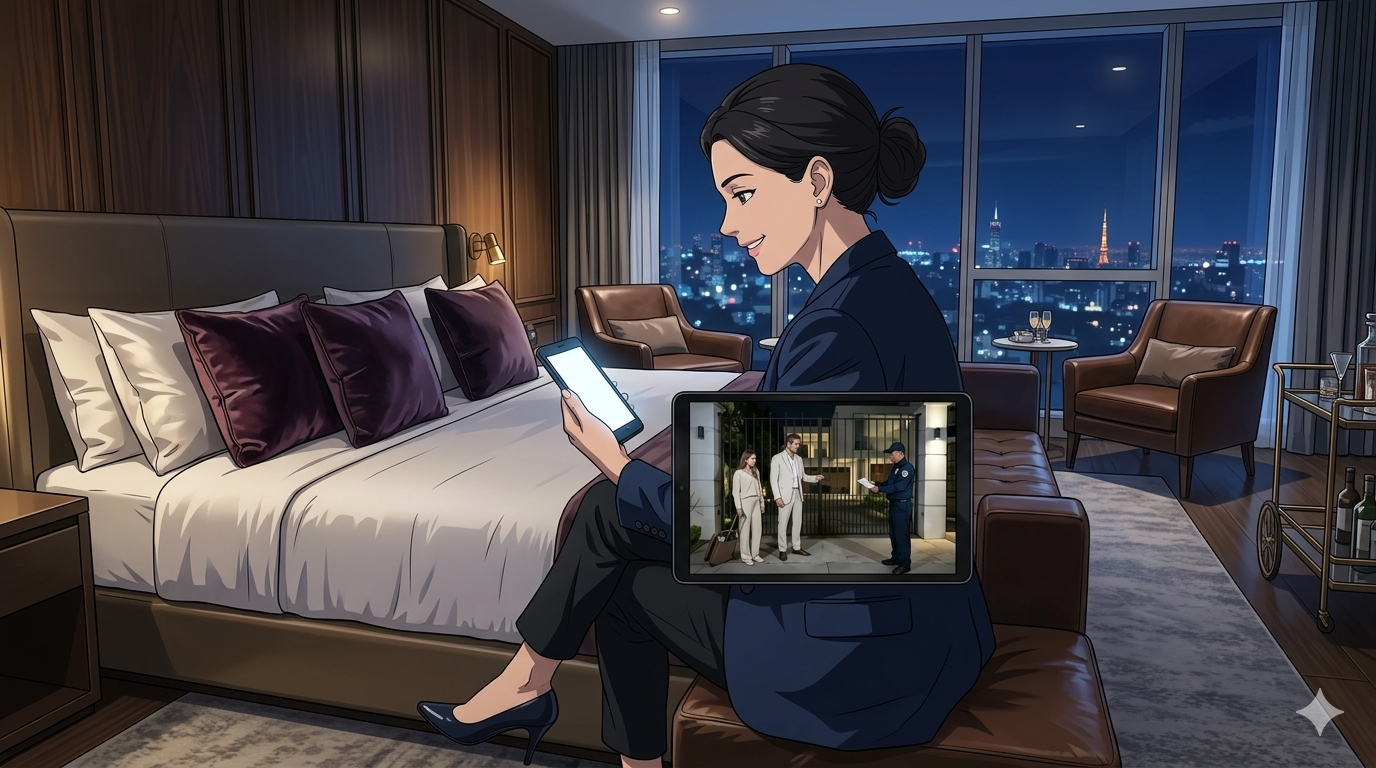
Through the exterior security feed on my phone, I saw the taxi pull up at the gate.
Mauricio stepped out first, tanned and smiling, still moving like a man who believed the world existed to absorb his decisions.
Valeria followed, carrying a white handbag and two suitcases, one of them monogrammed.
Mauricio walked to the gate, inserted his key, and frowned when it would not turn.
A new security guard approached with practiced courtesy and handed him a printed notice from Elena’s office.
He read it once, then again.
Valeria let go of her suitcase.
It tipped over and burst open across the pavement.
My phone began vibrating almost immediately.
Mauricio called twelve times in fifteen minutes.
Then he started sending messages from apps, email, and finally an unknown number.
The first ones were angry.
What did you do? Answer me now.
The next ones were incredulous.
There has to be some mistake.
The borrowed-number call was the first moment his voice lost its arrogance.
He sounded breathless, as if embarrassment were a physical injury.
I let him speak for twenty seconds.
He said the house could not have been sold without him.
I told him it had.
He said Valeria was crying in the street.
I told him he should comfort his wife.
Then I informed him that from that moment on, all communication would go through my lawyer and ended the call.
He went, of course, to his mother’s apartment.
That door did open for him, but not into the rescue he expected.
I had stopped the
monthly transfer to Lidia the same night I left for the hotel.
The apartment lease was in her name, but the cushion beneath her life had always been mine.
Within a week, she was behind on bills and calling relatives she normally considered beneath her.
The sports car Mauricio loved more than honesty was reclaimed from the airport garage by the leasing company before he could retrieve it.
For the first time in years, the Ríos family had to confront the difference between appearing wealthy and being wealthy.
They had spent so long confusing my money with their status that they did not know who they were without it.
Valeria lasted four more days at my company, and only because procedure mattered to me more than spectacle.
HR interviewed her with counsel present.
She denied nothing once she saw the expense report laid out in chronological order.
She tried, briefly, to frame it as love making her reckless.
Then she blamed Mauricio.
Then she cried.
The audit found falsified coding on expense submissions, unauthorized access to confidential budgets, and emails in which she joked about waiting until after I signed the Polanco contract to reveal the affair because, in her words, rich women are easier to leave once the quarterly numbers are in.
She was terminated for cause that same afternoon.
My legal team filed for reimbursement and referred the financial misconduct to the proper authorities.
I did not do that for revenge.
I did it because if I excused theft merely because the thief had slept with my husband, I would be calling corruption romance.
The pregnancy turned out to be a lie.
I did not discover it through cruelty; I discovered it through Mauricio’s panic.
Two weeks after he was locked out, Elena told me his attorney had contacted hers, asking whether we would consider a private settlement that kept sensitive personal details out of court.
Sensitive personal details, in this case, meant that Valeria’s supposed pregnancy had vanished the moment money did.
Mauricio himself confirmed it during preliminary negotiations when he complained bitterly that he had ruined his life for a woman who was not even telling the truth.
I remember hearing that through Elena’s speakerphone and feeling nothing resembling triumph.
Only clarity.
The insult that had been used to cut me had been counterfeit all along.
The legal strategy wrote itself.
Mauricio’s secret ceremony had not freed him from our marriage; it had simply documented his deception in high resolution.
Our divorce filing included the public posts, the financial records, and the evidence that he had represented himself as an unmarried man while still living in a house I was paying for.
Elena was careful, precise, and almost unnervingly calm.
She did not need theatrics because facts are devastating when arranged properly.
Mauricio had assumed that once his affair became public, I would be too ashamed to act decisively.
Instead, his own performance created the paper trail that stripped him of every lie he might have preferred to tell later.
He tried every version of himself on me before the process was over.
The offended husband who said I was humiliating him.
The wounded soulmate who claimed he had felt invisible beside my work.
The practical negotiator who suggested we avoid scandal by giving him the
house sale proceeds he called a fair transition.
Once, he appeared in the lobby of my office without an appointment and asked security to tell me he only wanted five minutes.
I watched him on the reception monitor in the same navy jacket I had bought him for our anniversary and realized I no longer recognized the man inside it.
I instructed security to escort him out and sent Elena a note asking her to request that all future exchanges happen in writing.
Discovery was ugly, but useful.
Mauricio’s financial disclosures showed what I had suspected for years without wanting to name: he had not merely depended on my income.
He had built his self-image on spending it.
There were personal loans I had never heard of, balances opened under grand plans that never materialized, gifts bought for Valeria on credit he expected I would eventually clear, and messages to friends bragging that once the baby arrived he would finally get access to the real money.
He truly believed my role in his story was to finance the transition from one woman to another.
The arrogance of that belief destroyed any lingering part of me that might have mistaken mercy for healing.
Lidia asked to meet me a month into the proceedings.
She chose a café in Las Lomas as if geography could flatter her back into power.
When I arrived, she looked smaller than I remembered, though not smaller enough to evoke pity.
She began by crying.
Then she called the whole situation a misunderstanding.
Then she said Mauricio had always been fragile and I should not ruin his future over a mistake made in confusion.
I listened until she reached the sentence that mattered: You know he cannot live the way he is used to living.
I set my cup down and told her that was exactly the point.
For years I had paid her rent, her medical insurance, and often her groceries.
She had repaid me by celebrating my replacement.
There was nothing left to discuss.
I stood, covered my own bill, and walked out before she could convert desperation into performance.
Valeria attempted one final maneuver through her attorney.
She offered to sign a reimbursement agreement if I would refrain from naming her in any public filing connected to the misused funds.
Elena negotiated it tightly.
The repayment schedule was secured, her termination record remained factual, and the company matter was resolved without the theatrical gossip she seemed both to fear and to crave.
By then, Mauricio and Valeria had already separated.
Stripped of the mansion, the travel, the cards, and the illusion of imminent inheritance, their romance shrank to its natural size.
He moved between a cousin’s spare room and cheap furnished rentals.
She returned to live with an aunt in Puebla.
People like to believe dramatic love can survive anything.
In my experience, some affairs cannot survive ordinary electricity bills.
When the divorce settlement conference finally arrived, I wore a cream suit and brought exactly what Elena told me to bring: documents, patience, and no appetite for emotional improvisation.
Mauricio looked older by several years.
Not poorer in the cinematic sense—no torn shirt, no tragic rain—but rearranged by consequence.
His lawyer floated arguments about lifestyle expectations, informal contributions, and the standard of living established
during the marriage.
Elena answered each one with titles, account records, lease documents, and proof of ownership.
The house had been mine.
The vehicles were leased through my company.
The investment accounts were solely mine.
The discretionary cards had been revoked lawfully because they were attached to my credit.
By the time the meeting ended, Mauricio was left with his clothing, a watch collection partly purchased before the marriage, and the debt he had accumulated in his own name.
The final hearing was almost disappointingly quiet.
No dramatic confession, no collapse, no applause from the universe.
Just a judge, paperwork, signatures, and the end of a legal tie that had already died in an Instagram post months earlier.
When it was over, Elena squeezed my hand once in the hallway and asked whether I felt relieved.
I thought about the word before answering.
Relief sounded too soft, too temporary.
What I felt was alignment.
My life and the truth were finally standing in the same place.
I drove myself home afterward—not to the old mansion, which by then belonged to someone else, but to a rented apartment in Polanco with tall windows and almost no furniture.
For the first time in years, every object around me answered only to me.
I stayed in that apartment for six months and loved its restraint.
Without Mauricio, silence became clean again.
I slept through the night.
I ate when I was hungry instead of when a shared schedule allowed it.
I went back to therapy and discovered how much energy it takes to remain legible to someone committed to misunderstanding you.
At work, I promoted the analyst Valeria had repeatedly undermined.
I restructured internal approvals so no junior employee could ever again slip personal expenses through vendor channels.
I also stopped treating myself like a machine that had to earn dignity by producing endlessly.
The business grew anyway.
Maybe because I was no longer financing deceit.
Maybe because clarity is profitable in ways chaos never is.
A year after the night I saw that wedding photo, I signed papers for a new home.
Not a mansion this time.
A sunlit penthouse with a terrace, a long dining table I chose because I actually liked it, and a study with shelves that reached the ceiling.
The purchase felt nothing like the grand gestures Mauricio once loved.
It felt better.
Deliberate.
Honest.
I hired no one to impress.
I hosted only people whose presence lowered my pulse instead of raising it.
On the first evening there, one of my closest friends stood in the kitchen with a glass of wine and said the place looked exactly like me.
I realized I had never heard that said about the old house.
That mansion had been a stage set for other people’s appetites.
This home felt inhabited even before the art was hung.
News of Mauricio drifted back occasionally through mutual contacts, each update smaller than the last.
He changed jobs twice.
He tried to launch a consultancy with two former friends and failed within a season.
Lidia moved to a cheaper apartment and, according to a cousin who enjoyed gossip too much, still told people I had been cold and vindictive.
Perhaps in her version I will always be the villain because I stopped subsidizing their
fiction.
I can live with that.
Villainy, I have learned, is often just the name selfish people give a woman who finally locks the door.
The last time I thought seriously about him was not at a court date or a meeting.
It was on an ordinary Thursday evening.
I was cooking pasta in my new kitchen, barefoot, with music low in the background and the terrace doors open to the city air.
My phone lit up with an unknown number.
For a second, the old reflex tightened in my chest.
Then it passed.
I let it ring out, blocked it, and stirred the sauce.
Nothing in the room shook.
Nothing in me reached backward.
The future did not feel like something I was chasing anymore.
It felt like somewhere I already lived.
People sometimes ask whether I regret not seeing the betrayal sooner.
I do, in the way anyone regrets wasting tenderness on people who mistook it for an allowance.
But regret is not where the story ends.
The story ends with paperwork filed, accounts balanced, debts assigned to the people who created them, and a woman standing in a home she chose, no longer auditioning for love by paying for it.
Mauricio married another woman with my money and came back expecting the gate to open for him.
It never did.
I kept the proceeds, kept my company, kept my name, and, most importantly, kept the part of myself they were never entitled to touch.
That is the only ending I needed.
THE END!