My name is Clara Sinclair, and for most of my life, my family treated me like someone who had wandered into the wrong photograph.
Victoria was always centered.
I was always cropped out.
She was two years older, sharper, louder, and endlessly polished in the way people mistake for brilliance when it comes wrapped in confidence.
My parents loved that about her.
They loved her ambition, her language, her ability to turn every family dinner into a performance about luxury developments, market trends, zoning changes, and the kind of people who knew how to win.
When Victoria was hired as a senior acquisitions manager at Vance & Associates, my mother cried at the announcement.
My father opened champagne.
They acted like Victoria had not simply gotten a job but had personally rewritten the American dream and printed our last name across the top.
When I became an elementary school teacher, my mother gave me a smile that never reached her eyes.
My father asked whether I planned to do that forever.
I said yes, because I loved teaching children how to read.
He sighed as if I had confessed to a disease.
That was how things worked in our family.
Money was ambition.
Status was morality.
Care was what people without leverage did because they had no better option.
Grandma Evelyn understood me in a way nobody else in that family ever tried to.
She lived in a Victorian house on Maple Street, three stories tall, painted soft gray with white trim, with a wrap-around porch and a stained-glass landing window that turned afternoon light blue and gold.
Every Sunday, I drove there after church traffic had thinned, and we sat on the porch with sweet tea while the old boards creaked under our rocking chairs.
Her house smelled like lemon polish, lavender sachets, old paper, and sunlight warming antique wood.
She listened when I talked about my students.
She remembered their names.
She asked how Milo’s reading fluency was improving and whether Janie still hid under her desk when thunderstorms rolled in.
She treated my small life as if it was not small at all.
When my mother dismissed me, Grandma would tilt her head and look at me over the rim of her glass.
“Quiet strength terrifies the wrong kind of people, Clara,” she used to say. “Because it doesn’t announce itself before it acts.”
I thought that was something kind grandmothers said when the world had bruised you.
I did not understand it was also a strategy.
The cancer diagnosis came in late winter.
Stage four pancreatic cancer.
The words sounded clinical in the doctor’s office, but inside Grandma’s house, they became something physical.
They became pill bottles lined up near the sink.
They became insurance papers in a folder on the kitchen table.
They became the faint chemical smell of hospital corridors clinging to her cardigan after treatment.
Victoria visited twice.
The first time, she brought flowers so expensive they looked less like comfort and more like a display.
She checked her Rolex three times in the first twenty minutes.
The second time, she stood at the foot of Grandma’s bed and said the room felt depressing.
My parents came in bursts.
My mother cried in doorways.
My father made solemn phone calls in the hall.
Both of them said it was too painful to watch Evelyn decline.
Then they left.
I stayed.
At first, I told myself it would only be for a few weeks.
Then the weeks became months.
Then the months became years.
I took leave from teaching, then arranged part-time work, then built my entire life around medication schedules, oncology appointments, insurance calls, linen changes, and the way Grandma liked her tea when nausea made everything taste metallic.
For five years, I crushed pills every morning at 6:00 a.m.
I held a basin through chemo.
I washed sheets at 2:14 in the morning because sweat soaked through them.
I learned how to read her face when she was lying about pain.
I learned which blanket made her feel less cold.
I learned to keep ginger candies in every room.
I documented medication changes in a spiral notebook with dates, times, dosages, reactions, and questions for the nurse.
Care has a paperwork trail nobody applauds.
It is not sentimental when you are living it.
It is laundry, alarms, pharmacy receipts, bruised sleep, and the sound of someone you love trying not to groan because she does not want to scare you.
My family called occasionally.
They never asked what I needed.
They asked how long the doctors thought she had.
Once, my mother called while I was folding a towel still warm from the dryer.
She told me I was wasting my prime years.
Then she said, almost casually, that it was not like Grandma had any substantial liquid assets to leave me anyway.
I remember staring at that towel in my hands.
It was white, soft, and ordinary.
My fingers tightened around it until the fabric twisted.
That was the moment I understood something about my family I had spent years trying not to know.
To them, love only mattered when it could be converted into advantage.
Grandma died on a Tuesday morning in April.
The sunrise came through her lace curtains and turned the room gold.
Her hand was in mine.
It had grown thin, almost weightless, but her grip still tightened when she opened her eyes.
For a second, she looked like herself again.
Clear.
Present.
Unfooled.
“I’ve prepared everything for you,” she whispered.
I leaned closer because her voice was barely there.
“Don’t let them take it.”
Those were the last words she said to me.
Three weeks later, I sat in a mahogany-paneled law office with my parents and Victoria.
The attorney’s name was Harold Benton, a careful man in his sixties with silver glasses, a navy suit, and a way of laying documents flat as if every sheet deserved respect.
The room smelled like leather chairs and old coffee.
Victoria crossed one leg over the other and glanced around with the bored patience of someone waiting for a formality to end.
My father looked solemn but expectant.
My mother held a tissue she had not actually used.
Mr. Benton opened the will.
He read through the formal language first.
Then he reached the clause that changed everything.
Grandma Evelyn had left the estate on Maple Street to me.
Not to the family.
Not to be sold and divided.
Not in shares.
To me alone.
The room shifted so completely that even the air seemed to pause.
Victoria sat up.
My mother’s face lost color.
My father blinked twice, hard, as if the words might rearrange themselves.
Then Mr. Benton read Grandma’s final explanation.
“To the only one who stayed when everyone else ran away.”
That sentence did not land like grief.
It landed like evidence.
Victoria’s expression changed first.
Not sadness.
Not surprise.
Calculation.
My father asked whether there had been a mistake.
Mr. Benton said there had not.
My mother whispered that Evelyn must not have been in her right mind.
Mr. Benton slid a physician’s capacity statement across the desk, dated March 18, signed by Grandma’s oncologist and witnessed by two nurses.
That was the first forensic artifact my grandmother had left behind.
She knew them.
She knew what they would say.
Before I left, Mr. Benton handed me a sealed envelope.
The wax was deep red, stamped with Grandma’s old signet ring.
“Your grandmother instructed me to give this to you only if you ever felt pressured,” he said.
I turned it over in my hands.
My name was written across the front in her careful script.
Clara.
I put it in my purse and went home to Maple Street.
I lasted three days before they came for it.
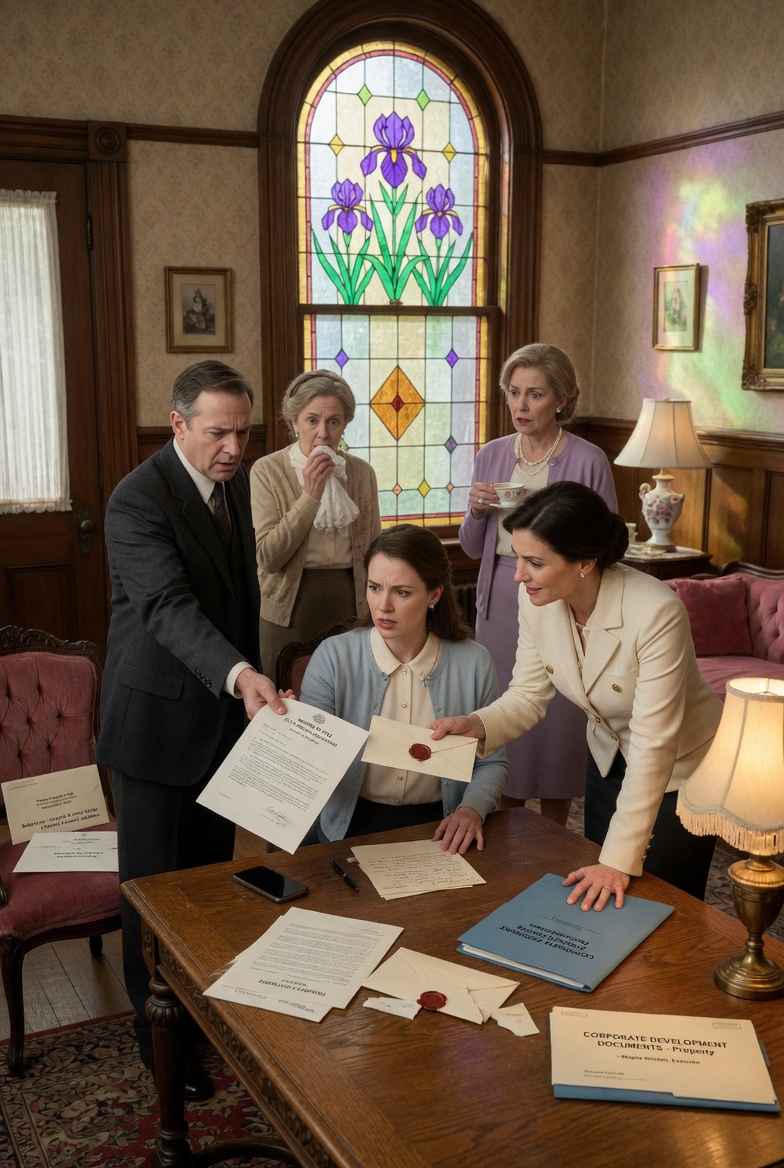
I walked into the front parlor and found my parents and Victoria already inside.
My father had used the emergency key I had once given him when Grandma fell and needed help during a storm.
That was the trust signal I had handed over years earlier.
I gave him access because I thought family meant safety.
He used it to ambush me in the house of the woman he had abandoned.
Victoria sat in Grandma’s favorite chair with a blue leather portfolio on her lap.
My mother stood near the porcelain lamp, touching the shade as if she were already choosing what to keep.
My father had papers spread across the heavy oak table.
The sight of contracts on that table made something in me go cold.
That table was where Grandma and I had sorted pills.
It was where I had filled out insurance appeals.
It was where she had taught me to make pie crust when I was twelve.
Now my family had turned it into a negotiation room.
Victoria opened the portfolio.
She spoke first.
Her tone was smooth, almost bored.
She said the family wanted to avoid unpleasantness.
She said the house was too much responsibility for me.
She said a quick sale would give me liquidity and closure.
Then she slid the quitclaim deed toward me.
They wanted me to sell Grandma’s $750,000 house to Victoria for $250,000.
A quarter of a million dollars.
For a historic house worth three-quarters of a million before any future development was considered.
I asked why I would willingly lose half a million dollars in equity.
My mother smiled.
“Because Victoria is building a real future,” she said. “You’re a single school teacher. You don’t need a house like this.”
There it was.
Not concern.
Not fairness.
Inventory.
They had weighed our lives and decided mine required less room.
Victoria tapped a spreadsheet.
She said the number was generous.
She said maintenance costs would bury me.
She said emotional attachment was clouding my judgment.
My father said I needed to think like an adult.
I said no.
The word sounded small in that big old room.
But it held.
For two weeks, they tried to break it.
My mother left voicemails at 11:38 p.m., crying about how Grandma would hate seeing the family divided.
My father sent messages warning me not to make enemies of the people who had raised me.
Victoria sent emails with subject lines like FAMILY ASSET REALLOCATION and PRACTICAL NEXT STEPS.
She attached spreadsheets, market comparisons, maintenance projections, and a draft deed transfer.
She copied my parents like this was a corporate transaction instead of a theft staged around a dead woman’s table.
I began documenting everything.
I saved every voicemail.
I printed every email.
I photographed the draft deed.
I made notes after each conversation with dates, times, exact phrases, and who was present.
On April 17 at 9:20 a.m., while Victoria was in my kitchen taking a call, she left a blue manila folder on the hallway table.
I noticed the label first.
EAST SIDE REVITALIZATION PLAN.
Below it, in smaller print, was the name Vance & Associates.
I should have walked past it.
Instead, I opened it.
Inside were internal projections, acquisition maps, target parcels, and a confidential timeline showing planned redevelopment corridors through several historic blocks, including Maple Street.
Grandma’s house was marked in yellow.
Not red.
Not gray.
Yellow.
A priority parcel.
There were valuation models attached.
One estimate projected the property could exceed $2.8 million after rezoning and corridor approval.
Another page listed potential private acquisition strategies for owners unlikely to understand future value.
I read that phrase three times.
Owners unlikely to understand future value.
That was what Victoria thought I was.
Not a sister.
Not a caretaker.
A target.
I took pictures while nobody was looking.
Then I put the folder back exactly where she had left it.
My hands were steady by then.
That surprised me.
I had expected rage to shake me apart.
Instead, it made me precise.
That night, I went upstairs to Grandma’s bedroom.
The room had been aired out, but it still held the faint lavender smell of her drawers.
I sat on the edge of the bed with the sealed envelope in my lap.
For several minutes, I could not open it.
Breaking the wax felt like making her death final in a new way.
Then I heard her voice in my memory.
Don’t let them take it.
I broke the seal.
Inside was a letter, an old promissory note, and a business card.
The letter was in Grandma’s handwriting.
She wrote that if I was reading it, someone in the family had probably decided her will was negotiable.
She wrote that she had watched Victoria change over the years, watched my parents reward cruelty when it came packaged as ambition, and watched me confuse endurance with obligation.
Then she told me a story she had never told me before.
Thirty-one years earlier, before Charles Vance became Charles Vance of Vance & Associates, he had been a desperate young developer with one failed deal behind him and no bank willing to extend him credit.
Grandma had known his mother.
She had loaned him money privately so he could complete his first acquisition.
He had repaid the loan years later with interest, but the promissory note contained an additional clause.
If any direct descendant of Evelyn Harper Sinclair ever faced bad-faith acquisition pressure involving property tied to Vance & Associates, Charles Vance agreed to review the matter personally.
It sounded almost unreal.
But the note was there.
Signed.
Dated.
Witnessed.
Notarized.
The business card was heavy cream stock with black embossed letters.
Charles Vance.
Founder and Chief Executive Officer.
A private number was written on the back in Grandma’s handwriting.
I called it the next morning at 7:12 a.m.
I expected a secretary.
I got voicemail.
I left my name, my grandmother’s name, the property address on Maple Street, and one sentence.
“I believe one of your senior acquisitions managers is using confidential internal information to pressure me into selling inherited property at far below market value.”
Then I waited.
At 8:03 a.m., my phone rang.
The man on the other end had a low voice, careful and very calm.
He asked whether I had the promissory note.
I said yes.
He asked whether I had documentation of the pressure.
I said yes.
He asked whether the employee’s name was Victoria Sinclair.
I went still.
Then I said yes.
There was a long pause.
“Ms. Sinclair,” he said, “do not sign anything. Do not warn her. And do not meet with them alone if you can avoid it. If you must meet, keep your phone on you. My office will begin an internal ethics review immediately.”
I asked why he believed me so quickly.
He said my grandmother had saved his company before it existed.
Then he said something I never forgot.
“Evelyn Sinclair was the kind of person who helped before people deserved it. I won’t let her kindness be repaid like this.”
The final meeting happened two days later.
My parents insisted on coming to Maple Street.
Victoria arrived with another folder, a fresh contract, and a smile that told me she believed this was the day I would fold.
My father sat at the oak table.
He slid the contract toward me.
“Sign this,” he said, “or you are no longer part of this family.”
My mother looked down at her teacup.
Victoria watched me like she was waiting for the crack.
I did not touch the pen.
My father leaned forward.
“And don’t think you can stay here after defying us. I will make sure you are evicted from every place we can touch.”
The room froze.
The stained-glass landing caught the afternoon light and threw blue across the wall.
The refrigerator hummed in the kitchen.
A branch scraped against the window.
My mother’s fingers tightened around her cup.
Victoria’s smile deepened because she mistook silence for surrender.
Nobody moved.
My phone was face-down beside my water glass.
It lit up.
Unknown number.
But I knew who it was.
I answered and put it on speaker.
“Ms. Sinclair,” Charles Vance said, “my counsel is at your front door. Please do not allow anyone to remove documents from the house.”
Victoria’s face changed.
It was subtle at first.
A flicker around the eyes.
A shift in her shoulders.
Then the blood drained from her mouth.
The doorbell rang.
My father stood up so quickly his chair scraped the floor.
My mother whispered, “What is happening?”
I walked to the door.
Outside stood a woman in a navy suit holding a sealed packet.
She introduced herself as Miriam Cole, outside counsel for Vance & Associates’ Ethics and Compliance Committee.
Behind her was a courier with a second envelope.
Victoria whispered my name like it had become a threat.
Miriam stepped into the parlor and placed the sealed packet on the oak table.
She did not look at my parents.
She looked at Victoria.
“Ms. Sinclair,” she said, “you are instructed to preserve all company materials, electronic communications, printed projections, acquisition maps, and personal notes related to the East Side Revitalization Plan. Effective immediately, you are suspended pending internal investigation.”
My father said there had been a misunderstanding.
Miriam did not blink.
She opened the packet and removed copies of the photos I had sent.
The East Side maps.
The confidential valuation projections.
The internal acquisition timeline.
The draft quitclaim deed.
The emails Victoria had sent me with pressure language and pricing justifications.
Each page landed on the table like a stone.
Victoria tried to speak twice and failed both times.
Then she said, “Clara stole confidential documents.”
Miriam turned one page.
“From your sister’s private residence? After you brought them into the house during a meeting intended to pressure her into signing over property?”
Victoria’s mouth shut.
My mother began crying then, but it sounded different from her voicemails.
Those had been theatrical.
This was fear.
My father demanded to know who Charles Vance thought he was interfering in family matters.
Miriam slid the promissory note across the table.
“Mr. Vance considers this both a corporate ethics matter and a personal debt to Evelyn Sinclair. He also asked me to tell you that any attempt to intimidate Ms. Clara Sinclair further will be documented through counsel.”
That was when my father finally looked at me.
Not through me.
At me.
For the first time in my life, he seemed unsure what I might do next.
I did not yell.
I did not cry.
I gathered the contract, the draft deed, the printed emails, and Grandma’s letter.
Then I told them to leave my house.
My mother said I could not mean that.
Victoria said I was ruining her career.
My father said I would regret choosing a dead woman’s house over my living family.
I looked at him and thought of Grandma’s hand in mine at sunrise.
Then I said, “She was more family to me dying than you have been alive.”
The silence after that was complete.
Miriam remained near the table while they left.
Victoria paused at the door and turned back as if she wanted one last line that would restore her power.
Nothing came.
She walked out.
The investigation moved quickly.
Vance & Associates retrieved Victoria’s company laptop, phone records, email archives, and access logs.
They confirmed she had downloaded internal acquisition maps and valuation models before approaching me with the $250,000 offer.
They confirmed she had not disclosed a conflict of interest.
They confirmed she had used confidential information for personal gain.
She was terminated for cause.
Her professional licensing complaint came later.
So did the letter from a state regulatory office asking for documentation.
My parents tried to reframe everything as a family misunderstanding.
I let my attorney answer them.
Mr. Benton helped me place the Maple Street house into a trust with clear protections against coercive sale, unauthorized entry, and family claims.
I changed the locks.
I installed cameras.
I boxed the draft deed, Victoria’s emails, the ethics packet, Grandma’s letter, and the promissory note into a fireproof safe.
Not because I wanted to live in fear.
Because I had finally learned the difference between forgiveness and access.
A few weeks later, Charles Vance called again.
He said there was something I needed to know before it became public.
Vance & Associates was acquiring several properties near Maple Street for a historic mixed-use redevelopment, but my house was no longer targeted for acquisition.
Instead, he wanted to lease the ground-floor parlor and carriage house for a heritage design office tied to the project, if I was interested.
I asked why.
He said the stained-glass landing had become something of a symbol inside the company after Miriam’s report circulated among the executive committee.
A reminder that old promises could outlive new greed.
I almost laughed.
Grandma would have liked that.
The lease was fair, carefully reviewed, and completely under my control.
The house stayed mine.
The first day Victoria walked into what she thought was her fresh start at work, she came with a new consulting firm touring potential collaboration spaces.
She had no idea the meeting had been arranged at Maple Street.
She stepped through the front door in a cream blazer and lifted her eyes toward the stained-glass landing.
I was standing on the stairs.
For one second, she looked confused.
Then recognition hit her.
The parlor had been restored.
The oak table was polished.
A discreet brass plaque near the doorway read Evelyn Sinclair Heritage Office.
Victoria stared at it.
Then she stared at me.
She said nothing.
I did not need her to.
The house spoke for both of us.
I still teach.
I went back to my classroom because it was never the small life they said it was.
Now, when my students read their first full sentence, I still feel the same quiet joy I felt before anyone in my family decided my work made me less deserving of space.
The difference is that I go home afterward to Maple Street.
I unlock my own door.
I pass the stained-glass landing.
I sit at Grandma’s oak table, where the contract once waited for my signature, and I remember the sentence that changed everything.
They were not asking me to be fair.
They were asking me to disappear.
And I did not.
Quiet strength does not announce itself before it acts.
Sometimes it keeps notes.
Sometimes it saves voicemails.
Sometimes it waits until the exact right person answers the phone.

