At 11:00 PM, the kitchen did not feel like a workplace.
It felt like a small, stainless-steel planet where I could still control the laws of gravity.
The commercial refrigerator hummed against the back wall, steady and low, and the air smelled of lemon zest, vanilla, butter, and warm sugar settling into cookies that had taken me two evenings to finish.
Thirty handmade cookie bags sat in rows on the prep table, each one tied with blue ribbon because my son, Zachary, had decided blue was the official color of turning nine.
He had told me it looked like “a superhero sky,” and I had laughed so hard I nearly dropped the piping bag.
For once, everything was ready before midnight.
For once, I was not behind.
For once, I had not said yes to someone else before saying yes to my child.
That should not have felt revolutionary, but in my family, rest was treated like theft.
My mother, Susan, believed usefulness was the highest form of daughterhood.
My sister, Michelle, believed my usefulness belonged to her specifically.
I had been a chef for years, but to them, I was never a professional with invoices, costs, deposits, and fatigue.
I was the emergency cake.
I was the brunch solution.
I was the person who could turn a bare table into a magazine spread if everyone else simply applied enough guilt.
At first, I had mistaken being needed for being loved.
That is an easy mistake to make when the people needing you are the people who raised you.
Susan had been in the hospital room when Zachary was born.
She had held him with one hand under his tiny neck and said he had my chin.
Michelle had cried at his first birthday, not because she was sentimental, but because she said the cake I made was so beautiful it would “look amazing online.”
That was our history in miniature.
My mother knew how to hold what mattered to me, and my sister knew how to turn it into content.
Still, I kept letting them in.
I gave Susan the spare key to my house when Zachary was little because I was a single mother and sometimes I needed help.
I gave Michelle access to my professional kitchen because she said she wanted to understand my world.
I gave them recipes, weekends, holidays, and whole rooms of my life because a part of me still believed that family eventually noticed sacrifice.
They noticed.
They just called it supply.
The first text came as I was tying the twenty-ninth ribbon.
My phone lit up on the stainless steel counter beside a tray of cookie bags, and Susan’s name glowed in the fluorescent light.
I wiped my hands on a towel before I picked it up, mostly because I was still trained to be respectful, even when my body already knew something was wrong.
“I canceled Zachary’s party. Michelle needs you to cater her networking brunch tomorrow. It’s good exposure. Don’t be selfish.”
I read it once.
Then I read it again.
My brain did that merciful thing where it tried to make cruelty into confusion.
Maybe she meant she called one guest.
Maybe she meant she moved the time.
Maybe she meant anything except what the sentence said plainly.
Then Michelle’s message arrived three seconds later.
“Michelle loved the tartlets last time. Bring those. Mom says you canceled the party to help!”
The room seemed to narrow around the phone.
The refrigerator kept humming.
The wall clock clicked.
A thin line of melted chocolate cooled too quickly on the edge of a scraper, turning dull under the lights.
My son’s ninth birthday had been reduced to a scheduling conflict between his joy and Michelle’s networking.
That was when I stopped shaking.
People imagine rage as heat, but the kind that changes your life can feel almost cold.
It arrives clean.
It arrives quiet.
It moves through your chest like a switch being flipped behind a locked door.
I did not call Susan.
I did not call Michelle.
I did not send the long message I had written in my head a hundred times over the years, the one explaining that ingredients cost money, labor costs time, and children remember who shows up.
Explanations are for people who failed to understand.
Susan understood.
Michelle understood.
They had simply decided that understanding was not their problem.
I opened my laptop instead.
The spreadsheet was saved under the name Family Tax.
It had started as a joke with myself after one of Michelle’s holiday parties, when she told a guest I was “basically incapable of relaxing” while I was scraping her burned appetizer trays at 1:30 AM.
I had gone home, added up the ingredients, and stared at the number until it embarrassed me.
Then I kept adding.
Every brunch.
Every birthday cake.
Every “small tray” that became service for forty.
Every holiday dinner where I cooked, transported, set up, served, packed leftovers, and then listened to Susan praise Michelle for hosting so beautifully.
The last twelve months alone came to $12,500.
That number did not include the gas.
It did not include babysitters.
It did not include the work I had turned down because my mother said, “Family comes first.”
There were tabs for receipts, unpaid ingredient lists, declined Venmo requests, delivery screenshots, and time-stamped messages.
There was a photo from two months earlier of Zachary asleep on two folded towels under the prep table because Michelle had moved a “tiny girls’ lunch” from twelve guests to thirty-two at 9:18 PM the night before.
I had taken the photo because I was sad.
Now it looked like evidence.
The most humiliating part of being used is realizing how carefully you helped build the machine.
I had made myself convenient.
I had made myself available.
I had made refusal feel like a betrayal before anyone else even accused me of it.
That night, standing in the kitchen with my mother’s message glowing beside my son’s birthday cookies, I finally understood something simple enough to hurt.
Utilities do not get love.
They get used until they break, and then they get replaced.
So I began to pack.
My knives went first.
I unrolled the canvas case, lifted each Japanese steel blade from the magnetic strip, wiped it clean, and tucked it into its sleeve.
Then the piping tips.
The digital scales.
The silicone molds.
The pastry rings.
The proofing baskets.
The acetate rolls.
The laminated recipe binder with my handwriting in the margins and small butter stains on the corner of the buttercream page.
The industrial stand mixer took two trips and a bruise on my shin.
The fifty pounds of tempered premium chocolate went into a crate labeled dry storage.
I packed the vanilla bean paste, the imported cocoa, the candy thermometer, the professional torch, the good sheet pans, and the box of birthday candles I had bought for Zachary.
I left the dull house knives.
I left the bent whisk that belonged to Susan.
I left the chipped mixing bowl Michelle once called “rustic” because she wanted to borrow it for a photo and never returned it clean.
The building belonged to my parents.
The equipment did not.
That distinction had never mattered to them before, because they had never imagined I would enforce it.
By 12:26 AM, the kitchen looked wrong.
Bare hooks hung over the prep table.
Empty shelves showed pale rectangles where my containers had blocked the flour dust.
The mixer’s absence left a clean square on the counter like a missing tooth.
I stood in the doorway and felt a grief I did not expect.
I had spent so many nights in that kitchen that leaving it should have felt like loss.
Instead, it felt like returning stolen property to myself.
I drove home with the knife roll on the passenger seat and the cookie bags buckled into the back like honored guests.
At 1:00 in the morning, I parked outside my house and sat for a moment with both hands on the steering wheel.
The neighborhood was dark.
The porch light flickered once.
Inside, Zachary was sleeping under a dinosaur comforter, trusting that tomorrow would be what I promised.
That was the part Susan had never understood.
She thought she canceled a party.
She had tried to teach my son that my promises could be overruled by her convenience.
I went inside and knelt beside his bed.
“Hey, buddy,” I whispered, touching his shoulder.
His eyes opened in slow confusion.
“Mom?”
“We’re going on a secret mission.”
He blinked hard.
“Where?”
“To a new fortress.”
His face changed at that word.
Fortress was something we had invented when he was six and overwhelmed by family dinners where adults talked over him and Susan corrected him for being “dramatic” when he covered his ears.
A fortress meant safe.
A fortress meant ours.
A fortress meant no one got to walk in just because they knew where the spare key was.
He sat up without crying.
That trust nearly undid me.
I packed his clothes, sneakers, favorite blanket, toothbrush, school backpack, and three Lego sets into a duffel bag.
I took the little framed photo of him on his first day of kindergarten.
I took his birth certificate folder from the lockbox.
I left my house key under the mat.
I did not leave a note.
Notes are for people who might misunderstand.
I understood Susan perfectly.
I understood Michelle perfectly.
I understood myself at last, and that was new.
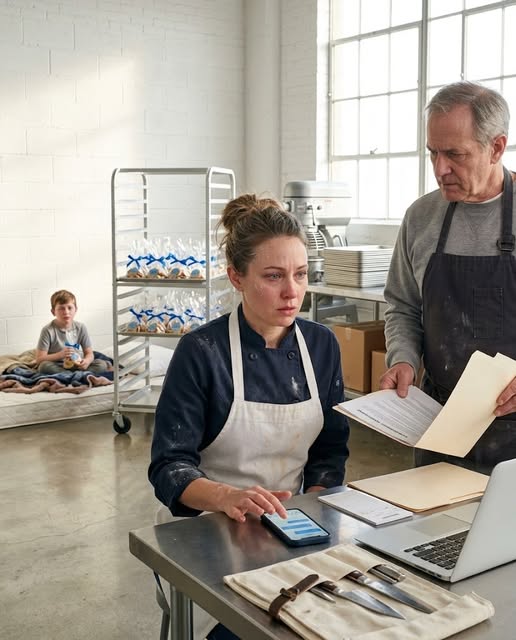
Larry opened the side door of the industrial bakery loft at 2:14 AM.
He was my old mentor, the first chef who had ever told me that speed meant nothing if I let people confuse my skill with servitude.
He had a bakery space in the warehouse district, half production kitchen and half loft, with a little office above the flour storage and a roll-up door that groaned like an old animal.
When he saw Zachary asleep against my shoulder and the boxes stacked in the back of my car, he did not ask for the whole story.
He only said, “You finally leaving the invoice open?”
I almost laughed.
Then I almost cried.
“Yes,” I said.
He handed me the keys.
While Zachary slept on a mattress on the office floor, I carried the cookie bags inside and lined them up on a stainless rack.
The loft smelled like yeast, cardboard, and dish soap.
It did not smell like Susan.
That alone felt like mercy.
I opened the Family Tax spreadsheet again.
I stared at the $12,500 total until the number stopped being accusation and became instruction.
Then I made three copies.
One for myself.
One for Susan.
One for Michelle.
At 6:18 AM, Susan called.
I let it ring.
Then Michelle sent the photo.
It was Zachary’s birthday invitation, the one with the crooked blue rocket, crossed out with black marker.
Under the party time, someone had written, “Mommy is helping Aunt Michelle.”
For a few seconds, the room was perfectly still.
Larry came into the office holding a manila folder.
“Before you answer,” he said, “you should probably know your mother called me last week.”
Inside was a printed commissary usage agreement with my name typed into the client line and Susan’s signature on the authorization page.
She had tried to reserve Larry’s loft for Michelle’s brunch by presenting me as the vendor.
Larry had not processed it.
Larry had kept the paper.
That was the moment the family story stopped being emotional and became administrative.
A canceled party can be called a misunderstanding by people determined to stay innocent.
A forged usage request is harder to decorate.
Zachary woke up while I was reading.
He sat up on the mattress, hair flattened on one side, eyes swollen with sleep, and looked at the cookie bags by the door.
“Did Grandma cancel me?” he asked.
Larry turned toward the shelves like he suddenly needed to examine flour.
I pressed my palm flat against the desk.
My knuckles went pale.
“No,” I said, and my voice sounded like it belonged to someone older. “Grandma canceled a room. She did not cancel you.”
Susan called again.
This time, I answered on speaker.
“Finally,” she said, bright and irritated. “Michelle’s guests arrive at ten, and I need you to stop being dramatic.”
I looked at the crossed-out invitation, the forged agreement, the spreadsheet, and my son’s face.
Then I said, “You canceled your grandson’s birthday for a free brunch, forged my name onto a commissary request, and told a child that I chose it.”
There was a pause.
Not guilt.
Calculation.
“I did not forge anything,” Susan said.
Larry leaned toward the phone.
“Susan, this is Larry Bell. I have the form.”
The silence that followed was the first honest thing she had given me all morning.
Michelle came on the line a few seconds later, breathless and sharper than my mother.
“Are you seriously doing this today?”
“Yes,” I said.
“You’re embarrassing me in front of people who could help your career.”
“No,” I said. “I’m declining unpaid labor in front of people who were never my clients.”
Susan made a sound of disgust.
“After everything we’ve done for you?”
That sentence used to work.
It used to find the little girl in me who wanted to prove she was grateful.
That morning, it found a mother who had spent the night moving knives in the dark because her son deserved one adult who did not fold.
I sent the email while they were still speaking.
The subject line was simple.
Outstanding Family Catering Balance.
Attached were the spreadsheet, receipts, message screenshots, the crossed-out invitation photo, and the commissary agreement Susan had signed.
I copied Michelle.
I copied Larry.
I copied myself.
Then I said, “Your brunch starts at ten. I hope exposure knows how to bake.”
Michelle shouted my name.
I ended the call.
For one full minute, nobody moved.
Then Zachary looked at the cookie bags and whispered, “Can my friends still come?”
“Yes,” I said.
His mouth trembled.
“Here?”
“Here.”
Larry cleared his throat and pointed toward the production floor.
“I have folding tables.”
By 9:30 AM, the loft looked like a birthday party built by people who understood emergencies.
Larry found blue tablecloths from an old wholesale event.
I arranged the cookie bags beside stacks of paper plates and a grocery-store pizza order.
Zachary built a Lego gate beside the cake stand and announced that it was the entrance to the fortress.
At 9:52 AM, the first parent texted to ask if the address had changed.
I sent the warehouse district location and one sentence.
Family emergency, but Zachary’s party is still happening.
No one asked for more.
At 10:07 AM, Michelle called sixteen times.
I did not answer.
At 10:31 AM, a mutual acquaintance texted me a photo from the brunch.
The table was beautiful, but empty in all the wrong ways.
Susan had apparently put out grocery-store croissants on platters beside folded place cards.
Michelle stood in the background with her phone to her ear, smiling the kind of smile people use when they are trying not to look abandoned.
I felt nothing triumphant.
That surprised me.
I had imagined that the moment they finally suffered a consequence, I would feel victorious.
Instead, I felt tired.
Consequences are not revenge.
They are just reality arriving late.
The party began at eleven.
Children ran between flour racks and folding tables, delighted by the fact that the ceiling was high enough to echo.
Zachary wore a paper crown Larry made from a torn bakery box and blue ribbon.
When everyone sang, he looked at me across the cake and watched my face, as if confirming I was really there.
I sang every word.
I did not check my phone.
After the candles, he handed me the first piece of cake, because he said fortress queens ate first.
That was when I had to turn away for a second.
Susan came to the loft at 2:40 PM.
Michelle came with her.
They walked in without knocking, because that was still what they believed they were allowed to do.
Larry met them at the production line.
“Private event,” he said.
Susan tried to step around him.
“I’m her mother.”
Larry did not move.
“That is not a reservation.”
I saw them from across the room.
Zachary saw them too, and the way his shoulders tightened settled the last soft argument inside me.
I walked over slowly.
Susan’s hair was perfect.
Michelle’s eyes were red.
Neither of them looked at the birthday decorations first.
They looked at the racks, the ovens, the boxes, and the equipment they had assumed would be available to them forever.
“You made your point,” Susan said.
“No,” I said. “I made my son’s party.”
Michelle folded her arms.
“Do you have any idea what you cost me today?”
I looked at Zachary.
He was pretending not to listen, which meant he heard every word.
“Yes,” I said. “I finally do understand cost.”
Susan lowered her voice.
“You are being cruel.”
“No,” I said. “Cruel was crossing out a child’s birthday invitation and making him think his mother chose work over him.”
Michelle’s face changed for half a second.
There was shame there, maybe, or simply the fear of being seen clearly.
Susan recovered faster.
“You always exaggerate.”
I took out my phone and opened the photo.
The blue rocket.
The black marker.
The sentence underneath.
Mommy is helping Aunt Michelle.
I held it up between us.
“Which part?”
Susan looked away.
That was as close to an admission as she was capable of giving.
Larry stepped beside me.
“I need you both to leave.”
Michelle stared at him.
“You’re choosing this?”
Larry shrugged.
“I chose the person whose name was forged on my paperwork.”
Susan’s mouth tightened.
She looked at me then, really looked at me, and I watched her understand something she should have understood years earlier.
I was not asking permission.
I was not waiting to be talked down.
I was not useful to her anymore.
She turned and left first.
Michelle followed, but at the door, she paused.
“Fine,” she said. “Send the invoice.”
“I already did.”
That was the last thing I said to her that day.
The email did not make them pay immediately.
People who are used to taking rarely become generous because a spreadsheet arrives.
But it changed the ground.
Two days later, Michelle responded with a long message about how family should not keep score.
I answered with the invoice attached again.
Susan called me ungrateful.
I answered with the commissary form attached.
When they tried to tell relatives I had ruined Michelle’s career opportunity, Larry corrected the story with one sentence.
“She did not cancel work. She refused work she had never accepted.”
That sentence traveled faster than Susan’s version.
The practical changes took longer.
I changed the locks at my house.
I moved the rest of my professional equipment into Larry’s loft.
I opened a separate business account.
I made a policy that no family booking existed without a deposit, contract, and written menu.
Then I made a quieter policy for myself.
No one got to borrow my peace and return it broken.
Zachary asked about Susan a week later.
We were building a Lego tower at the kitchen table, and he asked it softly, as if he already knew the answer might be complicated.
“Is Grandma mad at me?”
I put down the blue brick in my hand.
“No,” I said. “Grandma is upset because I told her no.”
“Because of my party?”
“Because of a lot of things that should have happened before your party.”
He thought about that.
Then he said, “I liked the fortress.”
“So did I.”
“Can birthdays always be fortress birthdays?”
I smiled.
“Absolutely.”
Three months later, Michelle paid part of the invoice.
Not all of it.
Part.
She sent it without apology, which somehow made it cleaner.
Susan sent nothing.
I did not chase her.
The money mattered, but the chasing would have cost more.
What I kept instead was the spreadsheet, the photo of the crossed-out invitation, the commissary agreement, and a picture from Zachary’s party where he is holding up a cookie bag like a trophy.
Those are the artifacts of the day I stopped confusing endurance with love.
People like Susan count on silence to do half their work.
They count on daughters swallowing the insult because naming it would make dinner awkward.
They count on grandchildren being too young to understand when a promise has been stolen from them.
Zachary understood enough.
So did I.
Utilities do not get love, and I had been letting them use me until I broke.
But that night, I did not break.
I packed the knives.
I took the chocolate.
I carried my sleeping son into a new fortress.
And when morning came, I let the people who had treated my life like a free kitchen learn what it felt like when the lights stayed off.

