My son served me dog food at my own seventieth birthday dinner, and for a few seconds, I honestly thought the room had gone silent because people were ashamed.
I was wrong.
Some people were ashamed.
Some people were uncomfortable.
Some people were waiting to see whether I would swallow the insult so they could keep eating my food and pretend it had not happened.
That was the part that changed me.
Not all at once.
Not with shouting.
Something just settled inside my chest like a door closing softly.
My name is Walter Bennett, and I live in the same house my wife Helen and I bought when we were young, exhausted, and certain love could outwork anything.
It is not a mansion.
It is a two-story suburban house with a front porch, a narrow driveway, a mailbox that leans a little after every hard rain, and an oak tree Helen insisted would one day shade the whole yard.
She was right.
She was right about most things.
For thirty-eight years, that house was not just where we slept.
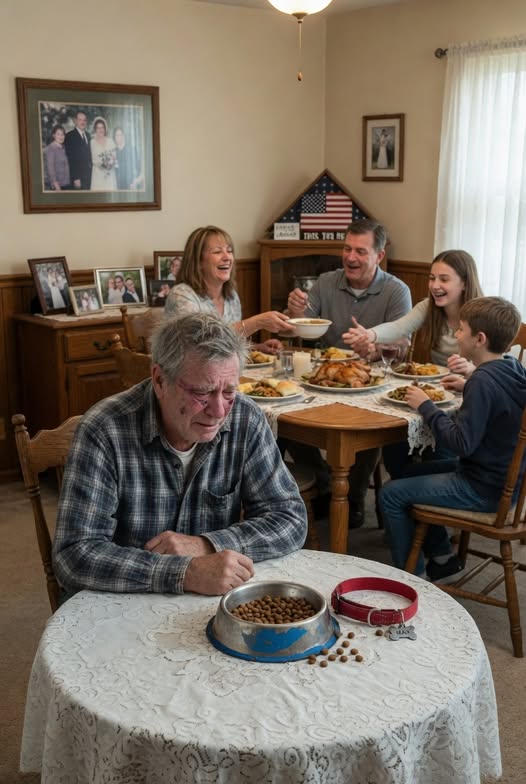
It was where we raised Brian, where Helen packed school lunches at six in the morning, where I balanced checkbooks at the kitchen table, where Christmas ornaments stayed in the same dented cardboard boxes, where Max the dog slept by the back door and waited for Helen like she was the sun.
Helen died nine years ago.
Cancer took her piece by piece, and even after the hospital bed was gone, I kept waking at night expecting to hear her slippers in the hallway.
Brian was all I had left.
That is the sentence I used to excuse too much.
When he struggled with school, I said he needed time.
When he quit jobs, I said he had not found the right fit.
When he borrowed money and forgot to pay it back, I told myself parents do not keep score.
When he asked to move back home four years ago, he stood on my porch with a duffel bag and that same boyish look that used to work on Helen when he broke a lamp or failed a test.
“Just for a little while, Dad,” he said.
I opened the door.
A little while became one month.
Then three.
Then a year.
Then Melissa moved in with suitcases that rolled over my hardwood floors like she was checking into a hotel.
She smelled like expensive perfume and carried herself like someone who had never had to wonder whether the electric bill cleared before buying something pretty.
She called me Mr. Bennett in a tone that sounded respectful from far away and insulting up close.
At first, I tried.
I made room in the hall closet.
I cleared shelves in the pantry.
I put a second towel hook in the guest bathroom.
I told myself Brian deserved happiness, and if Melissa made him feel like a man, maybe he would become one.
That did not happen.
Neither of them paid rent.
Neither of them bought regular groceries.
Neither of them helped with the mortgage, property taxes, insurance, power, water, internet, or the small repairs that keep an old house from giving up.
Brian always had a plan.
He was going to finish a certification.
He was going to start a side business.
He was going to fix up cars.
He was going to help me sell some old tools online.
He was going to pay me back as soon as a check cleared.
The checks never cleared.
The plans never landed.
The requests kept coming.
“Dad, can I use the card for gas?”
“Dad, Melissa had an emergency.”
“Dad, I need one part for the truck.”
“Dad, we will cover groceries next week.”
Next week is a dangerous phrase when you love the person saying it.
It can eat years.
I was seventy that Saturday, and I had not planned anything big.
What I wanted was small enough to embarrass me now.
A quiet dinner.
My son at the table.
Maybe a few decent words.
Maybe one story about his mother.
Maybe a moment where he looked around the room and understood that I was not furniture, not a wallet, not an old man living in his way, but his father.
I woke early because old habits do not care about birthdays.
The house was still gray with morning light.
The kitchen tile was cool under my socks.
I seasoned the chicken, washed the rice, peeled potatoes, cut lettuce, and wiped down the counters the way Helen used to do before company.
I even drove to the bakery she loved and bought a three-milk cake.
The girl behind the counter taped a little packet of candles to the box.
“Happy birthday,” she said.
I almost told her it was mine, then decided that sounded too sad.
Back home, I set the cake on the counter.
Brian came through once, grabbed coffee, and barely looked at the food.
“Big dinner?” he asked.
“It’s my birthday,” I said.
He blinked, then smiled like he remembered because I reminded him.
“Right. Yeah. We’ll do something.”
We.
That word kept me standing for years.
By late afternoon, the chicken was roasted, the potatoes were warm, and the cake was still in its box.
I went upstairs to rest because cooking tired me more than I wanted to admit.
My bedroom still carried traces of Helen no matter how many times I cleaned.
Her small jewelry dish sat on the dresser.
Her blue sweater was folded in the cedar chest.
The house was quiet enough that I fell asleep in my chair.
When I woke, laughter was coming through the floor.
Not one laugh.
A room full of it.
The kind of laughter that belongs to a party already underway.
I checked the clock and sat up too fast.
My knees complained when I stood.
The hallway smelled like roasted chicken, perfume, and something sweet from the cake being opened.
I heard plates clinking, music from someone’s phone, and Brian’s voice carrying above everyone else.
For one foolish second, I thought they had surprised me.
Then I reached the stairs and saw the truth.
No one was waiting for me.
No one was looking up.
More than twenty people filled my dining room and kitchen.
Relatives I saw twice a year.
Neighbors from down the street.
Brian’s friends.
Melissa’s friends.
Two women I did not recognize were standing near the counter with drinks in their hands, eating from plates piled with food I had cooked.
My food.
My table.
My birthday.
And I had not been called.
I stood in the doorway with my hand on the frame and forced my voice to behave.
“You started already?”
The room stumbled into quiet.
A man near the window set his fork down.
One of my nieces looked at me and then looked away.
Then Brian turned from the head of the table.
He was in my chair.
Not just any chair.
The one Helen bought me after my back started hurting from the old wooden one.
The one at the end of the table where I had carved Thanksgiving turkeys, signed school forms, and paid bills.
Melissa sat beside him in Helen’s place.
She had one elbow on the table, her phone beside her plate, her perfume filling the space where Helen used to smell like hand soap and vanilla.
Brian smiled.
“Oh, Dad, we forgot you were upstairs,” he said. “You’re so quiet now, you’re practically dead.”
A few people laughed.
It was not loud.
It was worse than loud.
It was cautious laughter, the kind people offer a bully to avoid becoming the next target.
I looked at Brian.
I saw the man he had become and the boy I kept trying to save, both sitting in the same chair.
That is the hardest thing about family.
Memory argues with evidence.
I could have walked away.
I should have walked away.
Instead, I stepped into the room because some part of me still believed dignity meant enduring quietly.
Melissa picked up her phone.
At first I thought she was checking a message.
Then I saw the camera pointed in my direction.
Brian stood, making a show of it, like he was about to announce a toast.
The room shifted.
People sensed a performance coming.
He disappeared into the kitchen and came back with something in his hand.
At first, my mind refused to name it.
Then I saw the blue rim.
Max’s bowl.
Our old dog had been gone for years, but Helen had never thrown the bowl away.
She used to say some things earned their place in a house.
It had a scratch on the side where Max pushed it along the kitchen floor whenever dinner was late.
Brian carried it like a prop.
He dumped dry dog food into it.
The sound was small and awful.
Hard little pieces hitting metal.
A sound I had heard a thousand times when Max was alive.
A sound that suddenly had my whole marriage attached to it.
Brian set the bowl in front of me.
“There,” he said. “Dinner for freeloaders too. Since everyone here contributes except you.”
No one moved.
The room froze in the way rooms freeze when everyone knows a line has been crossed but no one wants the responsibility of saying so first.
I stared at the bowl.
The dog food sat there beside a plate of roasted chicken and potatoes, ugly and stupid and somehow powerful because my own son had decided the joke belonged in front of witnesses.
Melissa’s phone was up.
She was recording.
She smiled like she could already imagine showing people later.
“Relax, Mr. Bennett,” she said. “It’s only a joke. Besides, Brian’s right. You live here for free.”
For free.
That phrase did something to the air in my lungs.
I thought of Helen clipping coupons at the kitchen counter.
I thought of overtime shifts.
I thought of walking through hardware stores with a list in my pocket, buying only what I needed to fix what I could not afford to replace.
I thought of property tax bills stamped paid.
I thought of the mortgage payment we celebrated when it was finally gone.
I thought of Brian sleeping under a roof he had never once helped protect, calling me the burden in the house I had built my life around.
There are moments when rage begs to be used.
Mine rose fast.
I felt it in my hands, in my teeth, in the hot pulse behind my eyes.
I could have shoved the bowl back.
I could have shouted the truth.
I could have named every charge, every lie, every month of groceries and gas and repairs.
I did not.
Helen used to say that when a person is trying to make you small in public, do not help them by losing control.
So I picked up the bowl.
Carefully.
That seemed to bother Brian more than yelling would have.
I carried it through the dining room while people watched me like I was suddenly the one doing something strange.
At the front door, I opened it and stepped onto the porch.
Evening air touched my face.
The little American flag Helen used to put out every summer stirred beside the railing.
I set Max’s bowl down by the door.
Then I went back inside and walked upstairs.
Behind me, Brian called out, “Keep eating, everybody! I paid for all this!”
The lie followed me up the stairs.
It did not hurt the way the bowl had hurt.
It clarified things.
I locked my bedroom door and stood there for a moment with my hand still on the knob.
Downstairs, the party resumed in pieces.
A laugh here.
A chair scraping there.
Someone asking where the cake knife was.
The ordinary selfishness of people who had decided my pain was not enough to interrupt their dessert.
I sat at my desk.
The laptop was old, but it worked.
So did I.
I had been an accountant for forty years.
People like Brian thought that meant I was boring.
Maybe I was.
Boring men keep records.
Boring men download statements.
Boring men save receipts, label folders, compare dates, and notice when a number appears where it should not.
I opened the first folder.
Then the next.
Bank statements.
Credit card statements.
Grocery receipts.
Screenshots of transfers.
Text messages asking for money.
Screenshots of Brian telling other people he was “supporting Dad” while the charge history showed my card paying for his gas, Melissa’s clothes, their subscriptions, their takeout, their repairs, and every little emergency that seemed to arrive just after payday.
Month by month, the truth organized itself.
That is the mercy of numbers.
They do not shout.
They do not mock.
They do not pretend a joke is only a joke after it wounds you.
They simply sit there and wait for someone honest enough to read them.
At 10:18 p.m., I removed Brian as an authorized user.
At 10:24 p.m., I removed Melissa.
At 10:31 p.m., I canceled the card ending in the number they used most often.
At 10:37 p.m., I changed the banking password.
At 10:42 p.m., I changed the email password too, because trust is not a security system.
Downstairs, someone started singing.
They sang happy birthday without me.
I could hear Brian’s voice leading it.
My own son sang to an empty chair.
That was when I laughed once, quietly, with no humor in it.
I opened the autopay list.
Streaming.
Phone add-ons.
Online purchases.
A few things I recognized.
A few things I did not.
Then I searched by Melissa’s name.
The screen refreshed.
One charge appeared that did not fit the pattern.
It was not perfume.
It was not clothing.
It was not groceries.
It was not one of those little purchases people explain away as a mistake.
It was larger.
Recurring.
Attached to my card.
Tied to a profile I had never authorized.
The billing address was mine.
The account name was Melissa’s.
The email was almost mine, off by one letter, close enough to fool someone who was not looking carefully.
I leaned closer.
The blue laptop glow made my hands look older than I felt.
I clicked into the record.
The details opened slowly, line by line.
Set up three months earlier.
Monthly billing.
Card on file.
Authorized user at time of creation.
I sat back.
There are secrets you discover with a shout, and there are secrets that arrive like a draft under a locked door.
This one came quietly.
That made it worse.
Because it meant planning.
It meant someone had sat somewhere, typed my information, used my card, used my address, and trusted that I was too old, too tired, too grateful for company, or too afraid of being alone to ever check.
A father can forgive weakness.
He can forgive failure.
He can forgive his child needing help longer than he should.
But contempt is different.
Contempt means they know what they are taking and despise you for still having it.
Downstairs, Melissa laughed again.
Her laugh used to irritate me.
Now it sounded like evidence.
I printed the statement.
The printer coughed awake, loud enough that I paused and listened for footsteps.
No one came.
Of course no one came.
They only noticed me when I was useful or in the way.
I placed the printout beside the folder of receipts.
Then I opened the card dashboard and clicked the final confirmation.
Canceled.
The word appeared clean and simple.
For the first time all night, I breathed deeply.
It did not make me happy.
It made me awake.
I thought of Helen then, not in some ghostly way, but in the practical way grief sometimes returns.
I imagined her at the kitchen table, reading the same statement, pressing her lips together, and saying, “Walter, enough.”
Enough is not anger.
Enough is a boundary finally learning its own name.
I stayed at the desk until the noise below began to thin.
Guests left in little waves.
Cars started in the driveway.
The front door opened and closed.
Someone joked too loudly on the porch.
The little flag probably moved when they walked past it, beside the dog bowl my son had set out for me.
After midnight, the house settled.
I heard Melissa in the hall bathroom.
I heard Brian rummaging in the kitchen.
I heard the refrigerator open and close.
Then my phone buzzed.
A bank alert.
Attempted charge declined.
I looked at the screen.
Same merchant.
Same profile.
Same hidden thing.
Downstairs, a drawer slammed.
A few seconds later, Brian’s voice changed.
It lost its party volume.
“Try it again,” he said.
Melissa said something too low for me to catch.
Then clearer: “It says canceled.”
Silence moved through the house.
It was almost beautiful.
Then the footsteps came.
Fast.
Up the stairs.
Stopping outside my bedroom door.
The knob turned once.
Locked.
Brian knocked, but it was not a knock asking permission.
It was a knock asking who I thought I was.
“Dad,” he called. “Open the door.”
I stood and picked up the printed statement.
My hands were still steady.
That surprised me.
Maybe dignity is not something you feel.
Maybe it is something you do while everything inside you is shaking.
I unlocked the door.
Brian stood in the hallway, his face flushed, his jaw tight.
Melissa was behind him, holding her phone, but not filming now.
Her eyes went straight to the paper in my hand.
People tell on themselves before they speak.
Brian tried to smile.
It failed halfway.
“What did you do to the cards?”
I looked at him for a long second.
I could still hear him at ten years old asking me to check under his bed for monsters.
Now he stood outside my bedroom, angry that the monster he had become had been interrupted.
“I canceled access to my money,” I said.
“My money?” he snapped. “Dad, come on.”
There it was.
Not apology.
Not shame.
Complaint.
I raised the statement.
Melissa’s face drained so fast I thought she might sit down.
Brian saw it and turned toward her.
That was the first time all night he looked unsure.
I pointed to the line on the page.
“I found this.”
He swallowed.
Melissa whispered, “Walter, that’s not what you think.”
A strange thing happens when someone says that too quickly.
You realize it is probably exactly what you think.
I stepped into the hallway.
The light above us flickered once, the way it had for years because Brian always promised to fix the fixture and never did.
Behind them, at the bottom of the stairs, someone shifted.
One guest had not left.
A neighbor, I think, or maybe one of Brian’s friends who had come back for a jacket.
His face was pale.
His eyes were on Melissa’s phone.
“Walter,” he said quietly, “you need to see what she posted.”
Melissa lunged for the phone.
Brian grabbed her wrist.
Not hard enough to hurt her.
Hard enough to stop her.
And in that second, the whole shape of the night changed again.
Because the dog bowl had been humiliation.
The cards had been money.
But the post meant there were witnesses beyond my dining room, people laughing from a distance at a version of me Brian and Melissa had edited for their own benefit.
I held out my hand.
Melissa clutched the phone to her chest.
Her mascara had begun to smudge at the corners, not from sorrow, I think, but from panic.
Brian looked from me to her, and then back to the paper.
For once, he did not have a speech ready.
The hallway was quiet enough for me to hear the refrigerator hum downstairs.
I thought of the cake still on the counter.
I thought of the old dog bowl on the porch.
I thought of my wife’s chair, my chair, my house, my money, my name.
Then I said, “Give me the phone.”
Nobody moved.
So I lifted the statement higher, turned toward the stairs, and started down toward the dining room where the last plates still sat on the table, because the one thing Brian and Melissa had not counted on was that the old man they mocked had kept every receipt…

