My parents disowned me years ago.
I sat alone at my sister’s Navy commissioning ceremony until one of her officers looked at me, went rigid, and said, “Ma’am…
SEAL command? Commander Callahan?”
The room froze.
That was the moment my family lost control of the story they had been telling about me for fifteen years.
My name is Erin Callahan.
I am the daughter of a career Navy father, a former military mother, the older sister nobody mentioned, and the woman my family had quietly trained themselves to speak about in the past tense even while I was still alive.
When Caitlyn texted me about her engagement weekend, I almost didn’t come.
The message had no warmth in it.
No sisterly softness.
No apology for the years of silence.
Just the location, the time, and a line at the end that felt more like obligation than invitation.
Still, I booked the flight.
Hope can make smart people do humiliating things.
I had not been home in years.
The last time I stood on that porch, my father had told me that if I could not explain where I had been, then I could stay gone.
He said it with the same hard control he used in command.
I had been twenty.
He had been furious.
I had been carrying secrets I was not allowed to tell and a silence that would eventually become my whole life.
When he opened the door this time, his face didn’t soften.
“You’re still alive,” he said.
Not, I’ve missed you.
Not, where have you been.
Not even, come in.
Just a statement, as cold and flat as a weather report.
The house looked exactly the same.
The porch swing leaned left.
The flag snapped over the mailbox.
Inside, lemon polish and baked ham hung in the air.
Framed uniforms lined the hallway.
My brother Blake’s deployment photo sat on the mantel.
My sister’s Navy portrait had pride of place under a spotlight.
My father’s command photo still ruled the wall above the fireplace.
There was no trace of me.
Not a school picture.
Not a graduation photo.
Not one family snapshot with my face left in it.
It was as if my parents had practiced deleting me long before they admitted they were doing it.
My mother did not hug me.
She told me my old room had been turned into wedding storage and said the garage was clear if I didn’t mind the boxes.
So I dragged my bag past rolls of ribbon, fake peonies, bubble-wrapped lanterns, and plastic bins marked with my sister’s name.
That first night, I slept on a camping cot beside centerpieces and folding chairs.
I lay there staring at the rafters, listening to the hum of the garage fridge and the distant laughter coming from inside the house, and I realized that my family had mastered the art of saying cruel things without ever raising their voices.
At dinner the next night, every formal seat at the main table was taken.
Gold-edged place cards stood in front of relatives, neighbors, old family friends, and two people I was fairly sure had only been invited because they liked posting photos from military events online.
My mother waved me toward a folding table near the corner.
A teenage cousin looked at me and asked if I was one of Caitlyn’s college friends.
Before I could answer, Caitlyn smiled into her wineglass and said, “That’s Erin.
She used to be in the Navy, I think.
Didn’t really finish.
She does yoga or nonprofit stuff overseas or something.
She kind of floats.”
She kind of floats.
Of everything that happened that weekend, those four words hit hardest.
I had spent years in places I could not list on paperwork, carrying clearances that required half my life to disappear from public record.
I had worked under men who trusted me with decisions that could alter rescue windows by minutes and lives by dozens.
I had learned how to keep my pulse steady when everything around me was breaking.
But my sister reduced me to a drifter in one elegant sentence, and nobody corrected her.
Not my father.
Not my mother.
Not Blake.
That was when I understood the lie had become useful to them.
The truth about my life was harder than the version they preferred.
They respected visible service.
Uniforms in frames.
Promotions in local newspapers.
Ceremonies with speeches and photographs.
The kind of military life that fit on a mantel.
My work did not fit there.
Fifteen years earlier, I had started down the path they expected.
I had excelled in language assessment, maritime tactics, intelligence analysis, and the kind of decision-making tests that make people nervous because they reveal what you do under pressure.
Before I even understood what was happening, I was recruited into a pipeline that stripped away the public version of my future.
My records thinned.
My assignments became vague.
My absences lengthened.
My explanations disappeared.
I couldn’t tell my family where I went.
I couldn’t tell them why my phone went dark.
I couldn’t tell them why letters were safer than calls and why even letters had to stay shallow.
They mistook secrecy for shame.
And once that idea settled in, they built a whole family story around it.
The engagement party at the VFW hall made that story impossible to ignore.
At check-in, the woman with the guest list looked for my printed card, failed to find one, and handed me a blank name sticker instead.
It was a tiny humiliation, the kind almost nobody else would have noticed.
But I noticed.
Because the message was obvious.
No place had been set for me.
If I wanted to exist in that room, I would have to write myself in by hand.
So I wrote ERIN in block letters and pressed the sticker onto my dress.
The party glittered with all the usual signs of expensive celebration.
Navy-and-gold balloons.
Catered trays.
A jazz quartet near the wall.
Caitlyn posed by the cake table like she had been waiting all her life to stand in exactly that light.
I found myself at another folding table near the kitchen doors.
When one of her academy friends asked who I was, she laughed softly and said it again.
“Oh, that’s Erin.
She sort of floats.”
The second time turned the first into doctrine.
After the toast, I walked to the display table near the entrance.
My father’s portrait.
My mother’s uniform photo.
Blake in desert camo.
Caitlyn in her whites.
No me.
That empty space was so honest it
almost made me admire it.
I nearly left the next morning.
I had my airline app open.
My thumb hovered over the button.
Then Caitlyn texted: If you’re still around, doors open at 1300.
No greeting.
No sign-off.
Just coordinates.
I went anyway.
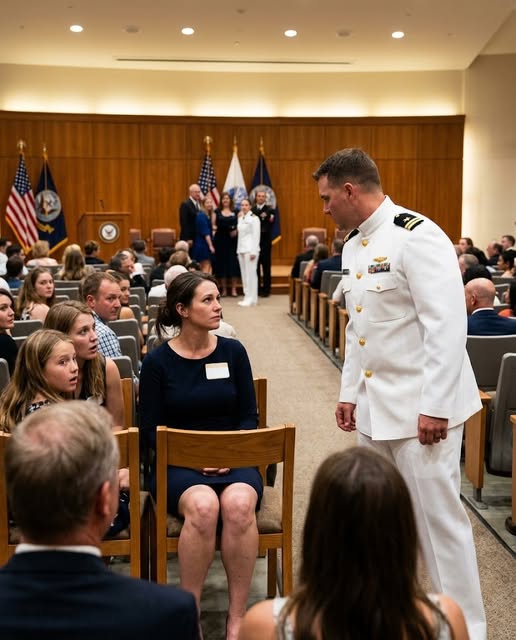
At the auditorium, a young ensign checked the attendee list twice, then looked at the screenshot on my phone as if I were trying to bluff my way into my own bloodline.
Finally he let me in and told me I could sit in the last row, left aisle.
Families filled the room in polished shoes and proud faces.
Cameras flashed.
Dress uniforms gleamed.
The front row belonged to the Callahans, of course.
My father sat as though every stripe in the room bowed in his direction.
My mother wore a smile that looked carefully ironed into place.
Blake leaned back with the easy confidence of the son who had never once risked becoming inconvenient.
I sat alone in the back.
When Caitlyn stepped to the podium, she looked perfect.
Composed.
Precise.
The kind of woman my parents had spent years showcasing to everyone who would listen.
Then she began her thank-yous.
My father, who once commanded ships.
My mother, who served in the Gulf.
My brother, whose deployment had taught her resilience.
She named each one slowly.
She never named me.
Being cut out in private wounds you one way.
Being cut out in public, in front of strangers who will never know the edit was made, wounds you another.
It is colder.
Cleaner.
More deliberate.
I kept my hands folded.
I kept my face still.
I told myself I could survive one more room where my life was translated into something smaller because the full truth made other people uncomfortable.
Then the back doors opened.
A senior officer stepped inside in full dress uniform, broad-shouldered, ribbon rack catching the light.
He moved with the kind of certainty that makes people shift before they know why they are moving.
I knew him instantly.
Commander Marcus Hale.
Years earlier, before he wore senior ribbons and carried command in his posture, he had been a lieutenant assigned to a joint maritime task unit I helped lead.
Smart, calm under pressure, too brave for his own good.
The last time I had seen him, we were both standing on a flight deck at two in the morning, soaked in salt spray, waiting to find out whether a rescue plan I signed off on had reached the hostages in time.
He scanned the room once.
Then he saw me.
He stopped.
The pause was so abrupt that even Caitlyn faltered at the podium.
Marcus changed direction and walked straight down the center aisle toward the back row.
Every head turned.
He stopped beside my seat, came to attention, and said, loud enough for half the auditorium to hear, “Commander Erin Callahan.
Naval Special Warfare.
Ma’am, I didn’t know you were here.”
The silence after that felt almost physical.
My mother stared at him like he had started speaking another language.
My father’s face drained of color in stages.
Blake sat forward.
Caitlyn’s fingers slipped on the edges of the podium.
Marcus saluted me.
Not casually.
Not as a gesture.
A full, formal salute.
“You should be on that stage,” he
said.
I stood because I had no choice.
“I’m here for my sister,” I told him quietly.
His expression changed.
Something like disbelief, then anger, passed across his face as he took in my seat, my distance from the family, the unmistakable architecture of exclusion.
He lowered his voice, but the front rows still caught every word.
“Admiral Sutter is here,” he said.
“Your citation package cleared forty-eight hours ago.
He said if he ever got the chance to thank you in public, he was taking it.”
At the side of the stage, a silver-haired admiral stepped into view carrying a dark presentation folder.
Then Marcus did something that changed the entire day.
He turned toward the audience and said, “For those of you who don’t know Commander Callahan, that’s only because her service wasn’t built for brochures.
Her record was sealed, not absent.
Some of the leadership doctrine taught in this pipeline came out of operations she led.
Some of us are alive because she refused to leave people behind.”
You could hear people breathing.
Admiral Sutter approached the microphone.
He did not give details that remained classified.
He did not need to.
He read the cleared portion of the citation in a measured, ringing voice that carried to the back wall.
He spoke of a maritime extraction in hostile weather.
Of mission control collapsing under bad intelligence.
Of a team leader who rerouted assets in real time, boarded the final vessel after ordering everyone else off it, and stayed until the last civilian and the last injured operator had been evacuated.
He spoke of judgment under pressure.
Of composure.
Of lives saved.
He spoke my name.
Not once.
Again and again, each time restoring another piece of what had been taken.
By the time he finished, the room had gone from silence to the kind of stunned applause people give when they realize they have been standing inside the wrong story.
I walked to the stage because there was nowhere else to go.
As I took the folder from the admiral, I could feel my family’s eyes on me.
But I did not look at them.
I looked at the polished wood beneath my feet and tried to steady the part of me that wanted to laugh and cry at the same time.
After the ceremony ended, chaos broke out around me.
Cadets and officers I had never met came over to shake my hand.
One instructor said he’d studied a redacted case file for years and never imagined the woman behind it would be sitting in the last row of a commissioning ceremony.
Marcus stood close enough to block half the room from swallowing me.
My family waited until the crowd thinned.
Then my father said the first thing he could think of.
“Why didn’t you tell us?”
I turned to him for the first time that day.
“Because I couldn’t,” I said.
“And because somewhere along the way, none of you needed proof.
You were perfectly happy with the worst version of me.”
He opened his mouth, then closed it.
My mother’s composure finally broke.
She pressed her fingers to her lips and started crying the way people cry when they realize the story they told to protect themselves has become evidence against them.
“We didn’t
know,” she whispered.
“No,” I said.
“You didn’t know where I was.
That’s different from what you did next.
You erased me.
You let people talk about me like I was lazy, unstable, unfinished.
You gave my room to centerpieces.
You put me in the garage.
You left me off the table twice.
Caitlyn introduced me like a cautionary tale.”
Caitlyn flinched as if I’d struck her.
For a second, the only sound was the distant scrape of folding chairs being moved for the reception.
Then she said, very quietly, “I said that because I was angry.”
I looked at her.
She looked younger suddenly, smaller without the podium and uniformed poise.
“You left,” she said.
“And nobody would tell me why.
Dad acted like your name was something dangerous.
Mom cried whenever it came up.
Blake copied Dad.
I learned fast that the easiest way to survive this family was to be the easy child.
The loyal one.
The visible one.” She swallowed hard.
“And when you came back, I hated how much space you still took up just by walking in.
So I made you sound small before anyone else could make me feel small instead.”
It was the most honest thing she had said to me in years.
Blake exhaled and scrubbed a hand over his mouth.
“I should’ve checked Dad’s version of things a long time ago,” he said.
“I didn’t.
I repeated it because it was convenient.”
My father stood there like a man who had commanded thousands and still could not manage his own apology.
When it came, it was stripped bare.
“I thought if you had done something honorable, you would have found a way to tell us,” he said.
“That is exactly the problem,” I replied.
“You only knew how to honor what could be displayed.
You couldn’t handle uncertainty, so you filled it with contempt.”
That landed.
For the first time in my life, my father had no rank to hide behind.
My mother whispered, “I took your photos down because people kept asking questions.
At first it hurt too much to answer.
Then it got easier not to.
Then I was ashamed to put them back.”
There it was.
Not malice alone.
Cowardice.
Vanity.
Pride.
The small, ordinary failures that do the deepest damage because they happen gradually and then calcify.
I could have walked away then.
Part of me wanted to.
But being publicly erased had created a debt, and I was no longer willing to let the repair happen in private.
“If you want to start fixing this,” I said, “then the truth goes where the lie went.
Out loud.
In front of people.
Not just in a hallway after you’ve been caught.”
Caitlyn stared at me for a long second, then nodded.
An hour later, at the small reception for the new officers, she stepped to the microphone again.
The room quieted.
Her voice shook the first time she said my name.
Then she started over.
She told them she had left someone out.
She told them her older sister had served in ways most of the room would never fully hear about.
She said the family version of my life had been wrong for years and that she had helped keep that lie alive because it
was easier than admitting she was hurt, jealous, and afraid.
Nobody moved.
My father stood beside my mother, both of them pale and utterly without defense, while Caitlyn did the one thing I had needed all weekend.
She put me back in the story in public.
Afterward, people approached me differently.
Not with curiosity sharpened by gossip, but with the plain respect that comes when a lie has been stripped away.
Marcus squeezed my shoulder once before he left and said, “About time.”
My family wanted me to come to dinner that night.
I didn’t.
An apology is not a time machine.
One good hour does not undo fifteen years of practiced exclusion.
I told them I needed distance and that whether we had a future would depend on what happened after the uniforms were hung up and the guests went home.
Three weeks later, a package arrived at my apartment.
Inside was a framed photo of me at seventeen in my first dress whites, grinning so hard I looked almost reckless.
On the back, my mother’s handwriting trembled across a single line: You should never have been taken off the wall.
A second envelope held a formal place card for Caitlyn’s wedding.
Not a blank sticker.
Not a handwritten patch.
A printed card.
Commander Erin Callahan.
I stared at it for a long time.
I almost didn’t go.
Then I did.
The morning of the wedding, I walked into my parents’ house and stopped in the foyer.
My photo was back on the hallway table between Blake’s deployment portrait and Caitlyn’s commissioning picture.
Not hidden.
Not tucked in.
Centered.
My father saw me looking at it.
“I should’ve put it back years ago,” he said.
I turned to him.
He looked older than he had a month earlier, as if truth had a way of stripping polish from people too.
“You should’ve defended me when you were unsure,” I said.
“Pride after proof is easy.
Kindness before proof is what mattered.”
He nodded once.
He did not argue.
At the ceremony, my seat was in the front row.
At the reception, Caitlyn thanked me by name in her toast.
Not performatively.
Not because the room expected it.
Because she meant it.
We were not magically healed.
Families are not movies, and betrayal does not evaporate because somebody finally tells the truth into a microphone.
But for the first time in fifteen years, I was not being asked to shrink so other people could feel comfortable.
That was enough to begin.
Later that night, after the music ended and the lights softened, I stood near the edge of the dance floor and watched my family move through a version of itself that was finally honest.
Not perfect.
Not innocent.
Honest.
And I kept thinking the same thing.
The most painful part had never been that they didn’t know what I had done.
It was how quickly they decided not knowing gave them permission to think the worst.
Maybe that is the real red flag in a family.
Not ignorance.
Not even distance.
But the speed with which love disappears the moment pride loses its paperwork.
I got my name back that day.
Whether forgiveness would ever fit as cleanly was another question entirely.

