For one crazy second I thought she’d slap me. Instead her face collapsed inward. Not grief. Not quite. Something meaner and smaller. The expression of a woman discovering that social power has no exchange value when badges are in the room.
They walked Bradley out.
He kept talking all the way to the door.
“This is temporary.”
“My father will fix this.”
“Megan, call my lawyer.”
“Don’t let her do this.”
But the last thing I saw before the doors closed was not anger on his face.
It was fear.
Pure, clean fear.
Good.
Diane left a minute later without another word. Her heels struck the tile with a sharp, diminishing rhythm and then the room was quiet except for Megan’s breathing.
She did not cry right away.
That is another thing nobody tells you. When reality breaks, tears are often late to the scene. First comes vacancy. Then the mind trying to organize falling debris.
She sat there staring at the doorway through which Bradley had been taken. The spring light shifted across the table and touched the deed, the empty water glasses, the edge of the folder where Rivera had rested his warrant.
Finally she said, “You knew before the shower.”
“Three weeks before.”
“And you didn’t tell me.”
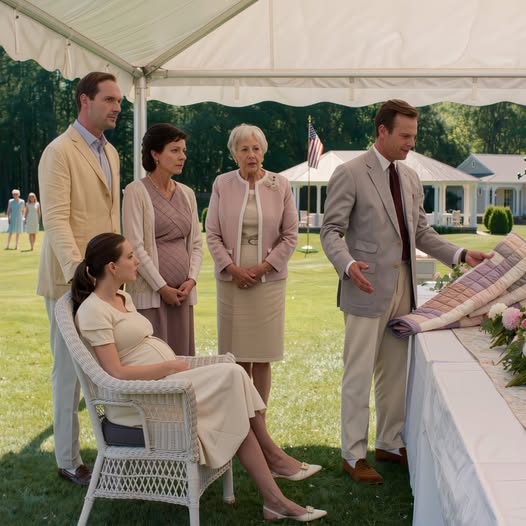
I pulled out the chair across from her and sat down. “I was still deciding what kind of truth would reach you.”
She laughed once, hollowly. “You think I wouldn’t have believed you.”
“I think you wouldn’t have wanted to.”
That landed. She looked away.
“I loved him,” she said.
“I know.”
“I thought…” She stopped, pressed her lips together, tried again. “I thought if I could make it work there, with his family, then everything hard about growing up the way we did would mean something. Like maybe I’d won.”
There it was. Not greed, exactly. Not in the beginning. Hunger. Social hunger. The terrible American belief that if people with money let you sit at their table, the hunger you came from must have been your fault after all.
“Megan,” I said, “you were never supposed to win people. You were supposed to build a life.”
She looked around the empty club. “I don’t even know what mine is anymore.”
“Then we start there.”
That was when she cried.
Not delicately. Not with the contained, beautiful tears women in advertisements are allowed. She bent forward and sobbed the kind of sob that rearranges your ribcage. I let her. I did not rush in with tissues and absolution. Some pain needs room. Some shame needs air before it can leave the body.
When it eased enough for her to breathe, I slid a glass of water toward her.
“Is the baby okay?” she asked.
“Yes.”
“How do you know?”
“Because if something were wrong right now, your body would tell you. Drink.”
She drank.
After a while she looked at me with swollen eyes and said the sentence I had been waiting on for years, though not like this.
“Why didn’t you tell me who you were?”
I almost answered quickly. But the truthful answer deserved its full weight.
“Because after your father died, I made a promise to myself. That you would never confuse money with character. That you would learn what work feels like before you learned what leverage feels like. I wanted you to choose who you were without a safety net made of my secrets.”
She stared at the table. “That was arrogant.”
“Yes.”
That surprised her. Good. Truth should surprise people when they’ve spent years around defensive adults.
“It was also hopeful. I thought if I kept money out of the equation, you’d learn to recognize dignity in people no matter what they did for a living. I thought you’d look at me in my apron and remember I was the woman who fed you, clothed you, stayed up with you when you were sick, paid tuition late but still paid it, and built a life one check at a time.”
I paused.
“Instead you looked at me and saw someone who made you nervous in front of rich people.”
Her eyes filled again.
“Mom, I’m sorry.”
“I know.”
“No. I mean really. The shower. The engagement party. The times I didn’t correct Bradley. The times I made you smaller so I could feel bigger. I see it now. I see all of it.”
I believed her.
That didn’t mean the damage evaporated. Insight is not repair. But it is the first honest tool in the box.
I reached into my bag and took out Philip’s rendering tube. Rolled the plans across the table.
She wiped her eyes and leaned forward.
The site plan spread between us in shades of green, cream, and gray.
“Hollowell Commons,” she read.
“One hundred twenty units of affordable senior housing. Medical clinic. Community center. Community kitchen. Garden.”
She looked up at me. “You’re tearing down the club.”
“Yes.”
“This place makes money.”
“So did Bradley.”
A weak laugh escaped her before she could stop it. Then she covered her face. “God.”
I pointed to the largest building on the plan. “Named after Patricia Hollowell. She’s eighty-one. She paid for long-term care coverage that never existed. There are sixty-one others like her.”
Megan traced the printed courtyard with one finger. “And you’re doing this because of them.”
“I’m doing it because I spent thirty years feeding people who were one medical bill away from terror. Because this land should house human beings, not social aspiration. Because if I let your husband humiliate me in a venue I own and then did nothing with that power but prove I was rich, I’d be exactly the kind of person he assumed I wanted to be.”
She looked at the plans for a long time.
Then she said, “What can I do?”
That is the question that matters after ruin.
Not Can you save me.
Not Who’s to blame.
What can I do.
“That depends,” I said. “Are you willing to work without applause?”
She nodded too fast. Then slowed it down and nodded again, more honestly.
“Yes.”
“Good. Because I don’t need a daughter who feels sorry. I need an adult who can rebuild.”
Bradley’s arrest hit the papers on Monday.
Ashworth & Klein Insurance issued a statement calling it an internal betrayal. Edmund Ashworth, mortified and gray-faced in the one television clip I saw, pledged full cooperation with authorities and promised restitution for all affected policyholders. Diane vanished from public view for forty-eight hours, then resurfaced through a lawyer claiming the family’s name had been exploited by “complex financial misunderstandings.”
Money teaches people the most ridiculous euphemisms.
There were no misunderstandings in the documents Rivera had shown me.
There was theft.
There were old people.
There was greed.
Megan moved out of the Ashworth house on Thursday.
I did not help her pack.
That was deliberate.
Some exits should be witnessed only by the person who chose the wrong room.
Philip met her there with two maintenance men and a rented truck. They loaded maternity clothes, books, a crib she had not yet assembled, kitchen things, a framed sonogram, two suitcases, and a box of baby shower gifts still wrapped in tissue paper and performance.
She came to my building on 31st Avenue, not my apartment. One of my two-bedroom units had just become vacant on the second floor. Clean walls. Old hardwood. Good light. Rent-free, but not condition-free.
“You’ll sign a lease,” I told her when I handed over the keys.
She blinked. “A lease?”
“One dollar a month. Automatic payment. I want you to know what it feels like to put your name on paper and mean it.”
So she signed.
Then I handed her another set of papers.
Employment paperwork for Garrett Property Management, entry-level administrative assistant. Twenty-two dollars an hour. Forty hours a week, beginning the following Monday. Maternity leave protected. Position contingent on punctuality, discretion, and willingness to take instruction from people who did not care whose daughter she was.
She read every page before signing.
That was new.
At Brookhaven, nobody knew the details, only that my daughter was having “trouble” and might need some support. Mrs. Okonkwo clicked her tongue and said, “Children have to fall down their own stairs, Rose. We just hope the stairs don’t kill them.”
Mr. Patterson said, “As long as she hasn’t joined a cult, there’s time.”
I laughed so hard at that I had to sit down.
Megan started at Philip’s office on a rainy Monday in April.
The first week she wore expensive shoes and learned quickly that expensive shoes are useless in property management. By Friday she’d bought cheap sneakers and a notebook. Philip put her on phones, rent roll updates, maintenance scheduling, and vendor invoices. She made mistakes. Mixed up apartment numbers. Forgot to confirm an exterminator appointment. Once filed Bronx receipts under Brooklyn and stayed an extra two hours fixing it without being asked.
She never used the word beneath.
That was also new.
About three weeks into the job, I picked her up after work and drove without explanation.
She sat in the passenger seat with a manila folder on her lap and baby-name websites still open on her phone from lunch.
“Where are we going?” she asked.
“Queens.”
“That narrows it down.”
We crossed under the Van Wyck and wound into Jamaica on side streets she had not seen in years. The neighborhood had changed the way neighborhoods do when time works on them unevenly. One storefront polished, the next boarded. A new coffee place next to an old barber shop with the same faded sign.
I parked in front of a narrow brick row house with a patched cornice and two flower boxes under the second-floor windows.
Megan looked up at it, then at me. “Why are we here?”
“This was the first one.”
She turned fully in her seat.
“The first property?”
“Yes.”
We got out. The sidewalk was warm from the sun. A little boy bounced a basketball two houses down. Somebody was frying onions nearby. The smell hit me with such force I was twenty-seven and tired again for a second.
The current tenant on the first floor, Marisol, let us in after I texted ahead. She was used to my visits and only raised one eyebrow at seeing Megan.
The front hall was narrow. The banister still had the small gouge I’d made with a borrowed sander the first summer. The tile in the entryway was not original; I had laid it myself one November while Megan napped on a coat pile in what would become the downstairs bedroom.
“This place was a wreck,” I said.
Megan ran her fingertips over the bannister. “It doesn’t look like a wreck.”
“It doesn’t now.”
We went room by room.
In the kitchen, I showed her the cabinet I’d rebuilt because I couldn’t afford new ones. In the bathroom, the subfloor I had ripped out after that contractor tried to swindle me. In the upstairs hallway, if you looked closely behind the paint on the inside frame, you could still see pencil marks where I had tracked Megan’s height when she was little because she liked pretending the house itself was watching her grow.
She touched the marks very gently.
“I don’t remember this.”
“You were four when I started. Nine when I stopped marking the wall because you said it was for babies.”
She smiled through her nose, sad and embarrassed.
In the backyard, I showed her the little patch of concrete where Gene had taught me to cut pipe. She laughed when I told her how I once burst a section of old line and sprayed myself from chin to knees.
“You never told me any of this.”
“I told you pieces.”
“No,” she said quietly. “You told me results. Not the work.”
That was fair.
We stood in the backyard while Marisol’s daughter practiced cartwheels on the grass. The siding needed fresh paint next year. The roof would probably last another eight. I knew every inch of that house the way some women know their wedding china.
“I used to think rich people were just born knowing things,” Megan said. “How to choose investments. How to manage money. How to own buildings. Like there was some language of wealth they all spoke and we didn’t.”
“There is a language of wealth,” I said. “It just isn’t glamorous. It’s contracts. Interest rates. Roof warranties. Deferred gratification. Learning not to panic. Learning when to say no. Learning how not to look rich while you are getting rich.”
She looked at me then, really looked.
“I was ashamed of you because I thought you were small.”
“Yes.”
“And the whole time you were…” She gestured to the house, then somewhere outward beyond it. “This.”
“The whole time I was working.”
We got back in the car, but I did not drive home yet. Instead I took her to three more buildings.
A six-family in Astoria where the super still sent me Christmas cards.
A Bronx property where a boiler replacement had nearly bankrupted me in 2008.
A mixed-use building in Manhattan whose upstairs tenant had once been a violinist who paid half her rent in cash and half in lesson vouchers until her career recovered.
At each stop I told her some piece of the story I had kept to myself:
the bad loan terms I refinanced my way out of,
the contractor who disappeared with a deposit,
the winter I slept in my coat because I chose a down payment over a new furnace,
the year I could have sold everything for a neat profit and didn’t because selling would have been easier than becoming the kind of woman who could keep it all standing.
By the time I dropped her back at her apartment, the folder on her lap was untouched.
At the door she said, “Mom?”
“Yes?”
“I thought your silence meant you didn’t trust me.”
“It did,” I said. “Later. At first it meant I was trying to teach you something. Then it meant I realized you weren’t learning it.”
She nodded.
“I think maybe I’m starting now.”
“Good. Because I’m tired.”
That made her laugh, and there was the old sound again, the unpolished one.
It hurt a little. It helped more.
By June, Megan was useful enough that Philip stopped softening his assignments.
He sent her to oversee leak remediation in Jackson Heights. To sit in on vendor negotiations. To field angry calls from a commercial tenant whose freezer had failed on a Sunday night. She came home smelling like dust, copier toner, and occasionally bleach. Some nights I heard her through the floor, pacing with her phone pressed to her ear while she arranged plumbers or calmed tenants or tried to keep her voice steady through another contraction of grief when she remembered who she had been married to.
One Saturday she knocked on my door carrying three garment bags and a box.
“Can I come in?”
I looked at the bags, then at her face. “What is all that?”
“My closet,” she said.
We spread everything across my couch and coffee table.
Designer handbags. Two pairs of red-soled shoes. Jewelry Bradley had given her. A silk robe still with tags. A stack of gift cards from the baby shower. The Pottery Barn registry printout with half the items highlighted where Diane had circled “must keep” for the nursery photos. It was like an autopsy of a personality.
Megan stood over the pile with both hands on her hips.
“I don’t want any of it,” she said.
I picked up a handbag that cost enough to cover a tenant’s rent for months and set it back down.
“Then sell it.”
“Can I?”
“You’re asking a woman who made a fortune flipping kitchens.”
A reluctant smile. “Fair.”
So that is what we did.
We drove to three consignment places over two days. The first clerk nearly purred over the bags. The second tested the jewelry with a loupe and announced values like a priest naming sins. Megan said almost nothing. She just signed receipts and watched pieces of her old life become dollar amounts on forms.
When it was over, she had just over eighteen thousand dollars after commissions.
She sat in my kitchen with the check in her hand and said, “I don’t want to use this for me.”
“For what, then?”
“I was thinking…” She looked embarrassed. “Maybe a fund at Hollowell Commons. Something small. For residents who need things insurance doesn’t cover. Dentures. Grab bars. Medications. Winter coats. The things that make daily life less humiliating.”
For a moment I could not speak.
Not because the idea was brilliant. Though it was good.
Because it was hers.
Not borrowed from me. Not performed for my approval. Hers.
“How much?” I asked finally.
“Half,” she said. “The other half goes into a college account for the baby.”
I nodded. “That’s sensible.”
She squinted at me. “Sensible sounds like your version of praise.”
“It is.”
So we opened both accounts the following week.
The residents’ assistance fund at Hollowell Commons began with nine thousand dollars raised from designer things purchased with stolen money. That may be the only conversion more satisfying than turning a country club into senior housing.
The divorce filed in July.
Bradley’s attorney tried several pathetic angles. That Megan had benefited from his income. That she should delay filing for the sake of stability during pregnancy. That the timing would prejudice public perception while the criminal case was pending. Arthur cut all that down in two meetings and one letter that made even me feel slightly sorry for anyone reading it on the receiving end.
Bradley himself tried writing Megan from jail.
The first letter said he loved her.
The second said he was under pressure.
The third blamed me.
The fourth blamed his father.
The fifth accused Megan of abandoning him when he needed loyalty most.
She read only the first two.
Then she brought the rest upstairs and slid them across my kitchen table.
“What do I do with these?”
“Do you want them?”
“No.”
“Then shred them.”
She fed them through my little office shredder one page at a time while baby kicks rolled visibly under her shirt. The machine jammed halfway through the fourth letter and we both stood there yanking strips of accusation from the teeth of the blades until we ended up laughing helplessly.
Sometimes healing arrives dressed as ridiculous manual labor.
The criminal case moved slowly, the way white-collar cases do when everybody involved can afford tailored suits and procedural patience. But the facts were ugly and the paper trail uglier. Bradley eventually accepted a plea deal. Less dramatic than trial. More efficient. Restitution, prison time, permanent licensing bans.
Megan attended the sentencing alone.
She asked me the night before if I thought she should go.
“Yes,” I said.
“Why?”
“Because some endings shouldn’t be outsourced.”
She went in a navy coat and low heels, pregnancy softness nearly full term by then, hair pulled back, no jewelry. She sat through the whole hearing and came home quieter than she’d left.
“What did he say?” I asked when she came upstairs to my apartment that evening.
She stood at my sink, staring out the window at the tracks.
“He said he never meant to hurt anyone.”
“And do you believe him?”
She took a long time answering.
“I believe he never meant to stop himself.”
That was close enough to wisdom for me.
The night before she went into labor, she came upstairs with a takeout container and sat at my table while I hemmed a kitchen towel.
“I’ve been thinking about something,” she said.
“That usually gets people into trouble.”
She smiled a little. “At the shower, when he said you were a lunch lady…”
“I remember.”
“I used to hear that as proof you were less than the people around him. Now I hear it and think, You were a lunch lady. So what? You fed people. You worked. Why did that ever seem shameful to me?”
Because shame is contagious.
Because America worships polished suffering and hates visible labor.
Because rich people teach you their hierarchy long before they teach you their rules.
Because I made silence look too easy.
I only said one sentence aloud.
“Because you wanted distance from where you started.”
She nodded. “And now all I want is not to become the kind of woman my daughter would have to recover from.”
That line stayed with me.
It stayed with me when the phone rang at two in the morning and she said, “Mom.”
One word, thin and frightened.
“Are you in labor?”
“I think so. The contractions are seven minutes apart and I can’t tell if I’m panicking or dying.”
“Good. That means it’s probably labor. I’m on my way.”
I was dressed and in the car in four minutes.
Labor peels people down to truth fast. All the posturing disappears under that kind of physical demand. At the hospital Megan clung to my hand hard enough to bruise it and apologized three different times between contractions, which I ignored because I am not sentimental enough to take contrition over cervical dilation.
“You can yell at me later,” I told her. “Right now breathe.”
“I was horrible to you.”
“Push when they say push.”
“Mom.”
“I heard you the first thousand times.”
She laughed mid-contraction, then cursed me, then cried, then laughed again. By dawn she had sweated every defense out of herself. When the baby finally arrived—seven pounds, loud, furious, perfect—Megan looked at her the way I had once looked at Megan and perhaps for the first time understood that love makes a person terribly vulnerable to who their child chooses to become.
The nurse asked, “Name?”
Megan looked at me before she answered.
“Rose,” she said.
I had to turn away for a second because some emotions are too sharp to feel with witnesses.
Baby Rose had Megan’s chin and Eddie’s serious little frown. Newborns all look like philosophers or potatoes, but this one seemed to arrive already suspicious of the world, which I took as a promising sign.
Motherhood changed Megan more in the first six weeks than Bradley had in three years.
Not magically. Not prettily. She was exhausted, sore, overwhelmed, lonely, learning how to keep a small body alive while her divorce filings thickened in Arthur’s office and Bradley’s preliminary hearings made the local news. But the work of caring for someone who cannot give you status back stripped away vanity like sandpaper.
At three in the morning, while reheating formula or burping a crying infant or scrubbing spit-up from a shirt, there is no audience. Only love or resentment. Only service or scorekeeping.
She chose service.
That mattered to me more than any apology letter ever could.
By February, she was back at Philip’s office part-time, baby Rose in daycare three mornings a week and with me two afternoons. I kept the baby in a portable bassinet behind the cafeteria office at Brookhaven on those days because residents lit up when she came in. Mrs. Alvarez knitted her a hat. Mr. Patterson sang Irish drinking songs softly enough to turn them into lullabies. Mrs. Okonkwo called her “the little landlord.”
“Got her grandmother’s eyes,” she announced to anyone who’d listen.
One Tuesday in March, Brookhaven was short two kitchen hands because one had the flu and the other had a husband in the emergency room. I was up to my elbows in biscuit dough when Megan walked in carrying baby Rose in a sling.
“I can take her upstairs,” she said.
I looked at the prep board, the trays, the clock.
“Can you stay for ninety minutes?”
She blinked. “Here?”
“In the kitchen. Not with your manicure, obviously.”
She looked at her bare hands. “I don’t have a manicure.”
“Then you’re already improving. Wash up.”
I handed her an apron and a hairnet.
She tied both on clumsily. Baby Rose dozed against her chest while Megan wiped tables, portioned fruit cups, and learned how fast breakfast service moves when eighty people want hot coffee at once and some of them think seven-thirty is an insult if their tray arrives at seven-thirty-two.
The residents loved her instantly because residents love anyone willing to carry toast without looking offended by the task.
Mrs. Okonkwo pointed at her and said, “So this is the famous daughter. You better keep up, girl. Your mother runs this place like the Navy.”
Mr. Patterson squinted. “You got Rosie’s nose. Condolences.”
Megan laughed. Real laugh. Then she helped Mrs. Alvarez cut pancakes into neat little squares and carried a tea cup to Walter Givens, who peered up over his newspaper and said, “Well, if it isn’t the next generation of management.”
I saw Megan glance at his hands then—the old man’s liver spots, the careful way he folded his napkin, the slight tremor when he reached for his spoon—and something in her face softened into grief.
After service, when the steam tables were empty and the last tray had gone back to dish, she stood beside me at the sink rinsing ladles.
“I know his name,” she said quietly.
“Givens.”
“I know. I remember. He was on the list.”
“Yes.”
She looked through the little wire-window in the kitchen door toward the dining room where he sat finishing his coffee.
“He still says hello to me.”
“That is what good people do when they’ve been wronged,” I said. “They continue being themselves. It unnerves everyone else.”
She swallowed.
“I used to think your job made you invisible.”
“My job makes me useful.”
She set the ladle down and looked at me in a way she never had before. Not as mother only. Not as caution. Not as obligation. As a professional. As a woman inside her own domain.
“I didn’t understand that difference,” she said.
“No,” I said. “But you might now.”
Later that day, as we loaded baby Rose into the car, Walter Givens shuffled over with his cane.
“Young lady,” he said to Megan, “your mother tells me you’re learning the property business.”
Megan nodded.
He pointed the cane at the Hollowell Commons brochure sticking out of my work bag. “Then listen to me. If you ever manage a place where old people live, remember two things. Fix the heat first and never serve watery soup. Everything else is negotiable.”
“Yes, sir,” she said, smiling.
He tipped an imaginary hat to baby Rose and walked away.
Megan watched him go.
Then she said, “I get it now.”
I buckled the car seat.
“Get what?”
“The insult.”
“What insult?”
“‘Lunch lady.’”
I shut the passenger door and looked at her across the roof of the car.
“It was never about what you do. It was about how much he needed to believe service meant weakness.”
“Yes.”
“And he was wrong.”
“Catastrophically.”
By spring, Megan could read a rent roll without blinking, spot a contractor’s padded invoice, and calm a tenant with a leaking ceiling while simultaneously rescheduling a failed inspection. Philip started trusting her with site visits.
I watched her the first time we walked a building together.
Queens. Six-unit brick on a quiet street. Boiler issues in the basement. Two late-paying tenants. One elderly woman on the third floor afraid her window lock was loose. Megan listened. Took notes. Asked questions. Did not pretend to know what she didn’t know.
Afterward, Philip said, “She may actually be good at this.”
I said, “Don’t tell her yet. It’ll go to her head.”
He grinned. “There’s my Rose.”
Construction on Hollowell Commons began in earnest that summer.
The club went down in stages.
First the east wing.
Then the ballroom.
Then the tennis structures.
Finally the clubhouse itself.
I stood with Philip and the demolition foreman on the morning they brought the big equipment in. The air smelled like dust and gasoline and damp earth. The excavator’s arm rose against the sky like something prehistoric.
Baby Rose was six months old by then and sat on Megan’s hip chewing a rubber giraffe.
“You sure?” Philip asked. “Last chance. Once they start, they start.”
I looked at the club.
I remembered the shower. The laughter. The way Bradley had let my quilt fall like it was worthless. I remembered Diane’s fingers pinching the fabric like contamination. I remembered every elderly name in Katherine’s file. Every resident at Brookhaven who counted pills. Every widow who mailed premiums faithfully because being careful was the only power she thought she had left.
“I’m sure,” I said.
The machine drove forward.
Wood cracked.
Glass shattered.
Dust rose.
Baby Rose startled and then settled when Megan rocked her.
There is a particular satisfaction in watching a building lose its authority.
When the chandeliers came down, nobody clapped. But I felt something in my chest unclench anyway.
Months later, when the first walls of Hollowell Commons rose out of that same ground, I brought Patricia Hollowell to see the site.
She came in a cream cardigan and sensible shoes, using a cane more for confidence than necessity.
The buildings were half finished then. Framing up. Roofing in progress. Blueprints pinned to a temporary office wall. The wind carried sawdust and cold.
“This is all because of you?” she asked.
“No,” I said. “It’s because of men like him. You just happened to give me the right name for the answer.”
She laughed softly. “I don’t know what that means.”
“It means sometimes people show you what’s rotten, and the only decent response is to build something cleaner in the same place.”
She reached for my hand and squeezed it.
Nobody with money had ever made me feel as rich as that old woman in a cardigan did in that muddy lot.
The opening of Hollowell Commons happened eight months after the arrest.
Ribbon.
Podium.
Press.
Residents moving in with boxes full of their lives.
But the part nobody saw first was the kitchen.
I insisted the cafeteria open two hours before the formal ceremony so the first residents could have coffee and warm breakfast before speeches turned them into audience members. There are people who believe ceremonies make a place real. Those are usually not the people who have ever needed one. The first hot meal is what makes a place real.
So at six-thirty that morning I was standing in a brand-new industrial kitchen in my hairnet, apron tied, checking steam wells and tray lines while three newly hired staff members tried not to look nervous.
Megan came in at seven wearing a Hollowell Commons staff jacket and carrying baby Rose in one arm.
“I can put her in the office,” she said.
I looked at the line of coffee urns, the trays of scrambled eggs, the biscuit pans, the fruit cups. Then I looked at her.
“You know what to do?”
She smiled. “Yes, chef.”
I rolled my eyes. “Don’t get theatrical on me.”
She laughed and tied on an apron.
When the first residents came in—some with walkers, some with canes, some with family members holding elbows—Megan was beside me at the service line. She poured coffee. She carried trays. She remembered names from the leasing files. She tucked napkins into shaky hands and knelt to speak to one woman eye to eye because the woman was hard of hearing and embarrassed by it.
By eight-fifteen the room was warm with voices and toast smell and the good chaos of people beginning to belong somewhere.
Mrs. Hollowell came through the line last, wearing a pale green suit for the ceremony.
“Well,” she said, accepting her oatmeal, “I knew if there was a kitchen involved, Rosie would find a way to boss it.”
Megan smiled. “She does it very well.”
Mrs. Hollowell looked from Megan to me and said, “You must be proud to be her daughter.”
It was a simple sentence.
But I saw it hit Megan like a bell.
Not because anybody had ever said her mother was successful.
Because somebody had said it while I was standing in an apron with oatmeal on the line and meant it as honor, not apology.
Megan’s eyes went bright. She took a careful breath and said, “I am.”
That may have been the moment I finally believed she was coming all the way back.
We held the formal ceremony in the new courtyard under a bright September sky. One hundred twenty units completed. Community garden already planted with tomatoes and herbs by volunteers from the neighborhood. Medical clinic ready to open on the ground floor. Cafeteria gleaming, stainless and warm, because I designed that kitchen myself and I know exactly how many feet there should be between a steam table and a service counter.
Patricia Hollowell cut the ribbon.
She cried before she got through the first sentence of her remarks and so did half the audience, including, to my immense irritation, me.
Megan stood off to one side in jeans, boots, and a Hollowell Commons staff jacket, baby Rose on her hip. Philip had promoted her to assistant site manager two months earlier. Not because she was my daughter. Because she’d earned it. I made sure of that.
After the ceremony, families and seniors started moving through the buildings, touching counters, opening closet doors, testing faucets, standing at windows with that stunned look people get when safety stops being theoretical and becomes an address.
A retired bus driver hugged me and cried into my shoulder because his rent wouldn’t eat his pension alive anymore.
A widow from Yonkers said, “I haven’t had a new stove in twenty years.”
One man just kept repeating, “It’s quiet. It’s so quiet.”
That’s what wealth should sound like when used properly. Not champagne glasses. Relief.
Late in the afternoon, after the crowd thinned, Megan came to stand beside me near the courtyard bench engraved with Patricia Hollowell’s name.
Baby Rose was asleep against her shoulder.
We watched residents carry in lamps and framed photos and cardboard boxes labeled winter clothes or kitchen or Frank’s medals. Lives, in other words. Unpacked carefully.
“You built all this,” Megan said quietly.
“I had help.”
“No. I mean from the beginning. All of it. The buildings. The money. The jobs. This.” She looked around. “You built this from lunch trays and pipe wrenches.”
I smiled a little. “Mostly from being too stubborn to quit.”
She shifted baby Rose higher and said, “I keep thinking about the quilt.”
So did I.
After the shower, I’d washed it by hand, dried it flat, and eventually had it mounted behind conservation glass. It hung above my kitchen table where the late afternoon light caught the butterfly square and the little embroidered dates. Not because I was sentimental beyond repair. Because I wanted to remember exactly how easy it is for people to mistake handcrafted love for something disposable if they have been trained to worship labels.
“It’s still in my apartment,” I said. “On the wall.”
“I know. I’ve seen it.”
She had, once or twice, dropping off baby Rose when she stayed with me. She’d always looked at it and then away.
She swallowed.
“Can I ask you something?”
“You already are.”
A weak smile. Good.
“Can she have it someday?”
I turned to look at my daughter.
She had lost the manicured perfection.
Lost the soft contempt.
Lost the reflex of glancing around to see who might be judging her.
In their place were new things:
fatigue,
competence,
humility,
and the kind of love that arrives only after life has stripped you down to what remains useful.
“When you’re ready,” I said.
Her eyes filled.
“How will I know?”
“When you stop wanting it as proof that I’ve forgiven you.”
The tears spilled then, but she was smiling too.
“That’s fair.”
“It usually is.”
We stood there a little longer in the new sunlight on new brick and watched Patricia Hollowell show another resident the garden beds like she owned the place. Which, in a way, she did. More than any club member ever had.
That night I went home to Astoria.
Same apartment.
Same train noise.
Same narrow kitchen.
I could have lived anywhere in the city by then. A penthouse on Central Park West. A lake house year-round. A brownstone with a staircase wide enough for drama. I had the money.
I chose the apartment.
Not because I thought deprivation was morally superior. I had outgrown that kind of vanity too. I stayed because home is not the most expensive place you can afford. It is the place that still tells the truth about you when nobody is looking.
Above my kitchen table hung the quilt and a photograph of Eddie standing outside P.S. 117 on my first day working the cafeteria there. He had one hand raised against the sun and a grin that made you feel like whatever came next might not beat you after all.
I made tea and sat beneath them both.
The quilt glowed softly behind glass.
Thirty squares.
Thirty memories.
Thirty proofs that love can be made from scraps if the hands are willing.
My phone buzzed.
A text from Megan.
Good night, Mom. Thank you for not giving up on me. Philip says I might be ready to manage Building B on my own by spring. Baby Rose kicked like crazy all through the ribbon cutting. I think she liked the applause.
I smiled and typed back:
Good night, sweetheart. Buildings are easier than people. Start with the boilers and work up.
A moment later she sent:
And Mom?
Yes?
I looked at the Pottery Barn blanket tonight. It’s still in the hall closet. Still in the box. Your quilt is the only one that ever felt like family.
I stared at that message for a while before answering.
Good. Then maybe you’re getting close.
The train thundered past. The glasses in my cabinet rattled. Somewhere downstairs a neighbor laughed too loudly at a television show. Life went on in all the ordinary ways that have always mattered more than the expensive ones.
People spent thirty years looking at me and seeing an apron.
A hairnet.
Dish soap hands.
The woman who served oatmeal.
A lunch lady.
They were not wrong.
I was a lunch lady.
I was also a landlord, an investor, a widow, a mother, and eventually the woman who turned a country club into a home for people everyone else had priced out of comfort.
None of those identities canceled the others.
That was the lesson.
Work is work.
Dignity is dignity.
Hands that smell like onions can sign deeds.
Hands that stitch quilts can dismantle empires.
Hands that feed strangers can build kingdoms if they stay steady long enough.
If I regret anything, it isn’t that I reported Bradley. I would do that again before breakfast.
I regret that I mistook secrecy for wisdom with Megan.
I thought silence would teach character.
Sometimes silence only leaves room for the loudest lie in the room.
If I had it to do over, maybe I would’ve shown her more of the work.
Not the numbers.
The work.
The first house with the broken pipes.
The ledgers.
The late nights.
The tenants whose rents I didn’t raise.
The years of saying no to almost everything shiny so I could say yes to something solid later.
Maybe then she would’ve understood sooner that wealth isn’t what you display. It’s what you can repair. Protect. Build. Refuse.
Or maybe not.
Children do not become who we instruct them to become.
They become who they choose, until life takes a harder hand than ours and tutors them in consequences.
Megan got that tutor.
It was brutal.
It worked.
Some nights now, when baby Rose sleeps over, I hold her in the rocking chair by the window and tell her stories about her mother’s childhood.
How Megan once tried to bury crackers in a flowerpot because she thought they’d grow into cookies.
How she cried when her goldfish died and insisted on a funeral with hymns.
How she believed quilts were magic.
I tell her about Eddie too.
About the way he whistled when he fixed things.
About the way he kissed my forehead before early shifts.
About how he would’ve adored her.
When she’s older, if she ever asks me whether her mother was selfish or foolish or lost, I won’t lie.
I’ll tell her the truth.
That her mother got dazzled.
That she mistook performance for security.
That she hurt people she loved.
That then she worked. Really worked. And working changed her.
Because that is another thing I believe with a holiness almost as stubborn as the one Eddie and I started with: people can change if pain humbles them before bitterness hardens them. Not everybody. But enough.
And when baby Rose is old enough, when Megan is no longer asking for the quilt like a verdict and can accept it as what it was always meant to be, I will take it down from the wall and unfold it.
I will show them both the squares.
“This was your mother’s first blanket.”
“This was the butterfly costume.”
“This was the dress from her fifth birthday.”
“This was the cloth I held onto because memory sometimes needs a body.”
And maybe by then the quilt will finally leave my hands the way I intended all along: not as a gift tossed onto a table for approval, but as a legacy passed between women who finally understand its price.
Until then, it hangs above my kitchen table where I can see it every day.
A reminder.
A warning.
A blessing.
Not garbage.
Never garbage.
A life stitched together from what other people might have thrown away.
And if you ask me, that’s the finest kind of wealth there is.

