“This Quilt Is Garbage” — My Daughter Let Her Husband Toss My Handmade Gift at Her Baby Shower — …
AT MY DAUGHTER’S BABY SHOWER, I GAVE HER A QUILT I STITCHED FOR 9 MONTHS. HER HUSBAND DROPPED IT LIKE TRASH: “YOUR MOM’S JUST A LUNCH LADY, BABE.” I PICKED IT UP AND LEFT. THE NEXT MORNING, I CALLED MY ATTORNEY. HIS SECRETARY WENT PALE: “MR. HARMON… YOU NEED TO COME OUT HERE. NOW.”
“This Quilt Is Garbage” — My Daughter Let Her Husband Toss My Handmade Gift at Her Baby Shower
At my daughter’s baby shower, I handed her a quilt I’d stitched by hand over nine months.
That sentence by itself sounds soft, domestic, ordinary. It does not sound like the beginning of a war. But that is how most wars start in families, not with screaming, not with slammed doors, not with police lights. They start with some small, sacred thing placed in the wrong hands.
The shower was held at the Ashworth Country Club in Westchester County, the kind of place with white clapboard facades, manicured lawns, and employees who opened car doors as if everybody arriving had inherited the moon. Sixty guests drifted across the terrace under cream-colored tents. A string quartet worked through Vivaldi near the rose garden. Waiters in white jackets offered sparkling cider and tiny cucumber sandwiches stacked so neatly they looked like museum pieces instead of food.
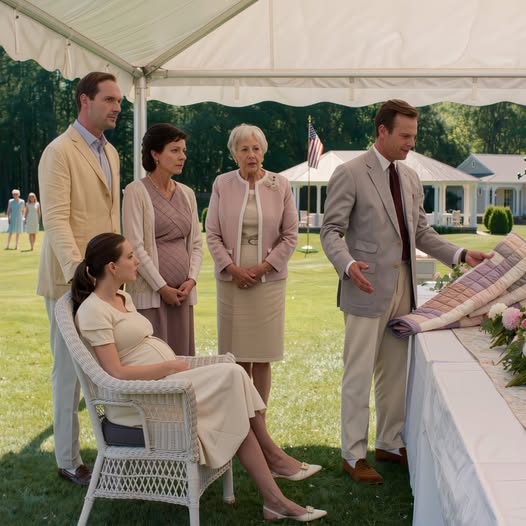
My daughter, Megan, moved through that crowd like she’d been born to it.
She was seven months pregnant, all glow and cream silk and careful smiles. Her hand kept resting on the underside of her belly as if she were presenting it, like a jewel, like proof. Her hair was twisted into a low chignon. Diamond studs glinted at her ears. The women around her leaned in with hands on forearms and voices full of breathy admiration.
“Oh, Megan, you look radiant.”
“You two are going to be the most beautiful parents.”
“That nursery theme you chose is divine.”
Every now and then she laughed, and I heard the girl she used to be for half a second, the little girl who used to sing to herself while coloring on my kitchen floor in Queens. Then the laugh would flatten into something polished, and she’d angle her chin a little toward Bradley or his mother, Diane, and I would remember where I was.
I had been “included,” which was Diane’s word.
Not invited. Included.
Three days earlier she’d called and said, “Rose, we’d love to include you, of course. It’s just a very curated day, you understand. A certain sort of guest list. But family is family.”
Family is family is one of those sentences people say when they want credit for doing the bare minimum.
I arrived with my gift wrapped in brown kraft paper and tied with butcher’s twine. Not because I couldn’t afford fancy paper. Because I liked the honesty of it. No glitter. No lie. Just the gift.
I had stitched the quilt over nine months, starting the week Megan told me she was pregnant.
Every square came from something real.
A piece of her baby blanket, yellow with tiny ducks.
Fabric from the costume she wore when she was four and insisted on being a butterfly because princesses were “too bossy.”
The blue cotton dress she wore on her fifth birthday, the one with the crooked hem because I had sewn it myself after seeing a version in a store window that cost half a week’s pay.
Part of the flannel pajamas she practically lived in the winter after Eddie died, because they still smelled faintly like the laundry soap we used when he was alive.
Her first Halloween costume. Her kindergarten concert blouse. The curtains from her childhood bedroom. Thirty squares. Thirty memories. I embroidered each one in the corner with tiny lettering and the year.
I did that work at my kitchen table after my shifts at Brookhaven Senior Center. After breakfast service. After lunch prep. After unloading boxes of frozen vegetables and scrubbing industrial pots big enough to bathe a child in. I’d come home, make tea, open the tin where I kept my needles, and sew under the yellow light while the 7 train rattled past my apartment every fourteen minutes and made the walls tremble like they were remembering something.
I didn’t bring the quilt to impress anyone.
I brought it because I thought, stupidly, that when Megan held it, some part of her would come back to me.
The gift opening started at two-thirty. Diane gathered the women into a half-circle of white wicker chairs and insisted everybody sit where the photographer could “capture the joy.” I took a seat at the edge, where people who don’t belong are always gently placed. Far enough to be present, far enough to blur if necessary.
Megan sat in a throne-like chair beneath a balloon arch in pale sage and gold. On the table beside her, gifts rose in gleaming towers: a Bugaboo stroller, an imported bassinet, monogrammed cashmere blankets, gift boxes from Bergdorf’s, Tiffany’s, Pottery Barn Kids. Everybody ooohed and aahed at the right moments. Every gift was another offering to the new life Megan was building with Bradley’s family name draped around it like velvet.
Then she picked up mine.
I saw it happen in her face before her fingers even touched the twine.
A flicker.
That quick calculation she always made now when I was present in a room with people she wanted to impress.
Who’s watching?
How bad can this get?
Can I make it smaller before it gets on me?
Still, for one second, I let myself hope. I let myself imagine she’d unfold it, see the yellow ducks, see the butterfly wings, see the little hand-stitched dates, and something in her would break open.
She pulled the twine loose. The brown paper slid away. She lifted the quilt, and it caught the afternoon light.
People went quiet.
That silence wasn’t awe. It was confusion. Wealthy people do not know what to do when confronted with labor you can feel. The quilt was too intimate for the room. Too real. It wasn’t a luxury object. It was evidence.
Diane leaned forward first, her lips thinning.
“Oh my,” she said. Then, after pinching one corner between two fingers, “Is this… homemade?”
Homemade.
People can make that word sound like an insult with almost no effort.
“It’s a memory quilt,” I said. “Every square is from something of Megan’s when she was little. Her baby blanket, her birthday dress, her—”
“Mom.” Megan laughed. It was a short little sound, bright and brittle. “We registered at Pottery Barn.”
A few women smiled into their champagne flutes.
I kept my voice steady. “I know. I wanted to give you something else. Something the baby could have from our family.”
Bradley was standing behind her chair with one hand on the backrest, grinning the way handsome men grin when they’ve never had to earn the benefit of the doubt.
He bent, took the quilt right out of Megan’s hands, and let it drop onto the gift table.
Not tossed hard. That would’ve been too honest.
Just dropped, casually, like it had no weight.
“Your mother’s a lunch lady, babe,” he said, smiling around the room as if inviting everybody into the joke. Then he shrugged toward the quilt. “Come on. This thing is garbage compared to what’s in the nursery. What did you expect?”
The laughter that followed was the most expensive sound I had ever heard.
Not loud. Not vulgar. The soft, civilized kind. The kind people use when they want to pretend nobody’s being hurt because nobody raised their voice.
Megan didn’t defend me.
That was the part that mattered.
If Bradley had said it and she had flinched, if she had reached for the quilt, if she had said, “Don’t,” or even, “Mom worked hard on this,” I could have built a bridge from that. A narrow, shaky bridge maybe, but something.
Instead she adjusted the hem of her dress and reached for the next box.
“Let’s do Diane’s gift next,” she said.
Diane beamed.
Someone opened a monogrammed diaper bag and everybody clapped.
I sat there for another ten minutes. Long enough for the insult to cool and settle into my bones. Long enough to realize nobody in that room was coming to save me from it. A woman in pearls asked me if I’d parked in the service lot because the front circle was “reserved for guests.” Another one asked if I worked at the club and was only there because Megan was “sweet like that.”
I looked across the lawn and saw Diane whispering to another woman, both of them glancing at me. I caught the word cafeteria.
I stood up.
No announcement. No scene.
I walked to the gift table, picked up the quilt, folded it the way I fold everything that matters, once lengthwise, then widthwise, tucking the corner with the butterfly square inward so it wouldn’t snag. My hands were very steady. That surprised me a little.
Bradley saw me and shrugged, as if to say suit yourself.
Megan looked up finally, but only for a moment. Her eyes met mine, then flicked away.
I put the quilt into my tote bag and walked out through the side doors, past the terrace, through the gravel lot lined with imported cars.
My Honda Civic was parked near the service entrance, next to the delivery trucks.
Of course it was.
I sat behind the wheel with the quilt on the passenger seat and watched waiters in white jackets carry trays back and forth through the kitchen doors. I could hear faint laughter from the lawn. Somewhere inside, my daughter was opening a silver rattle shaped like a moon and being told how blessed she was.
I did not cry.
I had done enough crying for Megan years earlier.
I cried when she was nineteen and accused me of embarrassing her because I came to a college event wearing orthopedic shoes after a twelve-hour shift.
I cried when she met Bradley and slowly began sanding down every part of herself that had once been real.
I cried when she told me not to come to her engagement party because Bradley’s family might feel uncomfortable. I went anyway. She pretended I was a friend of the family.
That party was on a rooftop in Williamsburg, all Edison bulbs and expensive flowers, with a bar serving cocktails that had rosemary sprigs in them and a catering spread nobody really ate because everybody was too busy performing how effortlessly delighted they were to be there. Megan texted me the afternoon before and said, “Mom, maybe just skip this one. It’s mostly his father’s clients and some family friends from Connecticut. The vibe is going to be… different.”
“The vibe,” I said.
“You know what I mean.”
I knew exactly what she meant. I ironed my best floral dress anyway, bought a bakery box of lemon bars because Megan used to love them, and took the train in.
At the check-in table, my name wasn’t on the list.
The young woman with the clipboard smiled the way people do when they think maybe you’ve just wandered in by mistake. “I’m sorry, ma’am. Are you with the caterer?”
Megan saw me before I could answer. She came over too fast, all bright panic and champagne breath.
“Mom,” she said through clenched teeth, kissing the air beside my cheek. “You came.”
“You said it started at six.”
“It does. It’s just—listen—please don’t take this the wrong way, but maybe don’t mention Brookhaven tonight, okay? Bradley’s grandmother is here and she’s very traditional about… presentation.”
“Presentation.”
“Mom, please.”
Then she turned, smiled at a cluster of women in silk dresses, and said, “This is Rose, a family friend from Queens.”
Family friend.
I stood there holding the lemon bars in a bakery box with blue string around it while three women nodded at me like I’d delivered flowers.
Diane floated over a minute later in a cream sheath dress and gold cuffs thick as handcuffs.
“How lovely you could make it,” she said, kissing the air somewhere near my temple. “Straight from work?”
I had changed clothes, done my hair, and put on lipstick. But what she meant was not whether I had changed. What she meant was whether she could still smell my class standing on me.
Later that evening I carried the lemon bars to the dessert table myself because nobody had taken them from me. I set them down between a croquembouche and miniature éclairs. Forty minutes later, the pastry chef boxed them back up untouched.
When I left, I saw Bradley on the far side of the rooftop with two men in tailored jackets. He had one hand in his pocket, drink in the other, and was saying, “Her mom works in school food service. Sweet woman. Very blue collar, obviously, but Megan’s good about managing all that.”
Managing all that.
As if I were not the woman who had kept Megan alive on a widow’s wages and overtime hours. As if I were not the one who had sat by her bed every time she was sick and taken city buses in snowstorms so she could have new sneakers before the school year started. As if I were clutter.
I cried in the subway home that night and never told Megan I had heard him. Some betrayals are so small in the moment that speaking them aloud feels like making them too real. But that was the evening I began to understand that whatever hunger Bradley fed in my daughter, it was bigger than romance. He gave her access to rooms where she thought nobody could smell where she’d come from. And that kind of access can rot a person if they have not made peace with themselves first.
I cried anyway and went. She pretended I was a friend of the family.
That was the day I stopped bleeding where she could see it.
So I didn’t cry in the parking lot.
I drove home to Astoria with the quilt beside me and my hands at ten and two on the steering wheel, like discipline could hold a life together if you were stubborn enough.
My apartment was on the fourth floor of a rent-stabilized building on a block where half the storefronts changed every eighteen months and the laundromat owner still called me Rosie even after twenty years. One bedroom. Galley kitchen. Window over the sink that looked out at the elevated tracks. Eleven hundred a month. The train made the glasses in my cabinet hum.
I unlocked the door, stepped inside, set the quilt on my kitchen table, and put water on for tea.
Then I opened the hall closet.
Behind the winter coats and my extra aprons was a fireproof filing cabinet bolted to the floor. I’d bought it in 2001 after watching smoke devour the lower skyline on television and understanding, in some animal way, that the world was not obligated to leave your life intact just because you loved it.
The top drawer held property deeds arranged alphabetically by borough.
Queens.
Brooklyn.
The Bronx.
Manhattan.
Westchester.
Thirty-four in all.
Purchase records, LLC papers, insurance documents, corporate accounts, bond statements, stock certificates, trust paperwork. Neat tabs. Clean labels. A life built in silence leaves a very orderly paper trail.
I pulled out one folder and laid it on the table beside the quilt.
Ashworth Country Club.
Forty acres.
Acquired in 2021 through RMD Holdings LLC.
Purchase price: $3.8 million.
Current appraised value: $6.2 million.
My daughter had just been humiliated at a baby shower hosted at a venue her mother owned.
The irony wasn’t the point. The ownership was.
I sat down, smoothed the quilt with my palm, and stared at the butterfly square until the kettle screamed.
That night I did not sleep much. I made tea. Then more tea. At midnight I stood at the sink and looked at the city reflected darkly in the window and thought about the first time I ever bought real estate, which is not a sentence anybody from my neighborhood ever expected to say.
In 1997 I was thirty-five, widowed, and working the school cafeteria at P.S. 117.
Eddie had died two years earlier from a heart attack at forty-one, the kind that takes a man in the kitchen between Sunday dinner and the football game and leaves his wife kneeling on linoleum with dish soap still on her hands. He had no life insurance because when money is tight, the future is always the first thing you convince yourself can wait.
He left me Megan, four thousand two hundred dollars in a savings account, and the sort of grief that makes even breathing feel like expensive labor.
I had a three-year-old daughter and a paycheck that vanished into rent, groceries, bus fare, and whatever emergency had decided to bloom that week.
One Tuesday, while spooning mashed potatoes onto lunch trays, I overheard two teachers talking about a foreclosed row house in Jamaica. The bank wanted sixty-two thousand. The roof leaked. The plumbing was shot. Everybody said it was a terrible idea.
Terrible ideas are often just opportunities dressed in work clothes.
I bought it with every dollar I had and a loan I should not have qualified for. The loan officer looked at my pay stubs, looked at Megan’s photograph in my wallet, and pushed the paperwork through anyway. Pity is not an ideal financing strategy, but I was not proud back then. I was just hungry.
Weekends, I learned to fix a house.
There was a retired contractor at the hardware store on Hillside Avenue named Gene who would explain plumbing if you bought pipe from him. I learned drywall from library books. Tiling from a VHS tape borrowed from a neighbor. Megan would sit on the floor in whatever room I was working on with her dolls and crackers while I tore out rot and patched walls and swore under my breath.
The first Saturday I walked into that row house with the keys, rain was leaking through the second-floor ceiling into a bucket somebody had left behind. The kitchen smelled like mold and old grease. A cabinet door hung on one hinge. There were stains on the wall shaped like old arguments.
I remember standing in that mess with Megan on my hip and thinking, very clearly, I have made a terrible mistake.
Then Megan patted my cheek and said, “Fix it, Mommy.”
So I did.
Gene at the hardware store became my unofficial professor. He was seventy if he was a day, with nicotine-yellow fingers and a pencil always tucked behind one ear. He would draw pipe diagrams on brown paper bags and say things like, “Don’t trust any house built by a man in a hurry,” or, “If the wall is damp, the problem is never where you first see it.”
I listened.
At home, after work, I made lists in a spiral notebook. Roof patch. Copper pipe. Paint. Sandpaper. Outlet covers. Nails. Caulk. Light fixtures. I learned to stretch every dollar until it cried.
I also learned that men hear widow and think helpless. One contractor quoted me triple for replacing a bathroom subfloor. Another told me, kindly, that maybe I should sell and move on because construction wasn’t “really a woman alone sort of thing.”
I bought a pry bar, watched two more instructional tapes from the library, and did the subfloor myself.
Megan grew up around the work the way other kids grow up around television. She sorted screws into muffin tins. She used fat crayons to draw floor plans on scrap paper. At five, she could hand me a Phillips-head screwdriver without being asked twice. Sometimes I tucked a portable radio on the windowsill and we’d listen to old songs while I painted trim and she sang the wrong words.
The night I finished the first bedroom, I carried her in asleep and laid her on an air mattress because the apartment we’d been renting was between leases and I had decided we were camping in our future. She woke up at dawn and said, “Our house looks less sad now.”
That may still be the finest compliment I’ve ever received.
I rented both units to women like me.
A nurse’s aide with two boys.
A school secretary caring for her mother.
The rent covered the mortgage.
Then the rent covered repairs.
Then the rent covered the next down payment.
The first month both tenants paid on time, I sat in the bathroom with the deposit slips in my hand and cried so hard I scared myself. Not because I was overwhelmed. Because for the first time since Eddie died, the future had stopped looking like a hallway with all the lights out.
I bought a second house in Brooklyn in 2000.
A third in the Bronx in 2003.
Then a six-family building in Queens.
Then a mixed-use property in Manhattan when everybody told me I was insane.
I never stopped being the woman in non-slip shoes who smelled like coffee and onions by two in the afternoon.
I just became that woman with deeds.
I did not buy jewelry.
I did not vacation.
I did not replace furniture unless it broke beyond repair.
I drove used Hondas and wore the same winter coat for thirteen years.
Every dollar went into the next thing.
By 2010, I owned twelve properties.
By 2020, twenty-eight.
After the pandemic, thirty-four.
When COVID hit, some of my tenants lost jobs, lost health, lost spouses, lost the ability to believe tomorrow would resemble anything they’d planned. I did not raise rent. I let some people pay late. I forgave months entirely for others. One tenant in the Bronx sent me fifty dollars and an apology letter written on notebook paper. I mailed it back with a grocery gift card and told her to keep the heat on.
Money, when you understand it, is not status.
It is shelter. Time. Leverage. Mercy if you still have a soul.
By the time Megan met Bradley Ashworth, my portfolio was worth more than twenty-eight million dollars and produced enough annual income that I could have retired, moved into a penthouse, and spent the rest of my life drinking expensive coffee from beautiful mugs.
Instead I stayed at Brookhaven Senior Center, where I cooked breakfast and lunch for eighty residents whose children visited on holidays if the weather was good and their calendars allowed it.
Why?
Because my work had never embarrassed me.
Because I liked being needed in a way that had nothing to do with my bank balance.
Because every morning at five-thirty, when I cracked eggs into industrial bowls and laid out trays, I was reminded that dignity is not a theory. It is oatmeal served hot. It is coffee refilled before someone has to ask. It is knowing Mrs. Okonkwo likes extra cinnamon and Mr. Patterson cannot chew apples unless you stew them first.
I never told Megan about the money.
At first because she was young and I wanted her to learn what Eddie and I had believed in with a kind of stubborn holiness: that you earn your place. You do not drift into adulthood on the inflatable raft of someone else’s portfolio.
Later I kept quiet for a different reason.
Shame feeds on perception. I wanted to see what Megan would value if she believed I had nothing to offer but myself.
Now I knew.
The next morning I showered, pinned my hair back, packed the quilt into a tote bag, gathered the documents I needed, and went to Arthur Harmon’s office.
Arthur had been my attorney since 2003, when I was terrified by the words limited liability company and convinced I’d sign the wrong paper and lose everything. He was seventy now, soft-spoken, half-retired, still wore cardigans with elbow patches like a man who believed legal advice should be delivered in a library even if you were sitting in a conference room.
His office smelled like paper, coffee, and the sort of old wood nobody bothers installing anymore because it costs too much to do beautifully.
His secretary, Linda, was at the front desk when I arrived. She was pouring coffee from a stainless carafe into a mug that said WORLD’S BEST NANA.
I set the leather folder on her desk.
“Morning, Rose.”
“Morning.”
She glanced down at the top document, and I watched her expression change.
First recognition.
Then confusion.
Then the kind of alert stillness you see in people who realize ordinary business has just stepped sideways into something else.
She set down her coffee. “Mr. Harmon,” she called toward the back, her voice lower than usual. “You need to come out here now.”
Arthur appeared in his doorway, reading glasses halfway down his nose.
He saw the folder.
He saw my face.
He stopped pretending this might be routine.
“Rose,” he said, “what happened?”
“My daughter had her baby shower yesterday.”
He waited.
“And her husband called me a lunch lady like it explained everything.”
Arthur looked at the quilt in my tote, then at the deed folder, then back at me.
“Come into my office.”
He closed the door behind us. I sat in the chair opposite his desk and laid everything out in clean stacks: the country club deed, the account statements, corporate papers, copies of my LLC structure, a summary of my liquid assets, and finally the quilt.
Arthur did not touch the quilt.
He never touched evidence that mattered until you invited him to.
“What do you want from me?” he asked.
“A full asset review. Every property. Every account. Every entity. And I want you to put me in touch with the best investigator you know. Financial fraud. White collar. Someone who can tell me whether my son-in-law’s life makes sense on paper.”
Arthur leaned back slowly.
“You think he’s stealing?”
“I think his salary doesn’t support his house, his car, his vacations, or his wife’s handbags. I think his father retired eighteen months ago and suddenly the son started living like a managing partner instead of an employee. I think men who laugh while humiliating a pregnant woman’s mother at a baby shower are usually overcompensating for something expensive.”
Arthur almost smiled. “That last sentence isn’t legally actionable, but it’s good instinct.”
“Is my instinct usually bad?”
“No. That’s why you own half a zip code.”
He made two calls while I sat there. One to his accountant for the asset review. One to a woman named Katherine Voss.
“Former forensic accountant,” he told me after he hung up. “Now private investigator. Charges like sin. Worth every cent.”
“Good.”
“Rose.” He steepled his fingers. “Are you looking to punish your daughter or protect her?”
“Those aren’t the same thing.”
“They can be.”
I looked at the quilt folded on his desk. “I’m looking for the truth. What I do with it depends on how ugly it is.”
Katherine Voss came that afternoon.
She was in her mid-fifties, compact, dark blazer, silver hair cut close to the jaw, eyes like somebody who’d made a career out of noticing where the numbers started lying. She didn’t waste time performing sympathy.
“Mrs. Delgado,” she said, opening a notebook. “Tell me the concern.”
I laid out Bradley’s known salary, his role at Ashworth & Klein Insurance, the house in Westchester, the Range Rover lease, the watches, the travel, the quiet way Megan stopped talking about budgets the minute she married him.
Katherine took notes without interruption.
“Does your daughter work?”
“No.”
“Any trust on his side?”
“Nothing significant. His mother performs wealth. That’s not the same as having it.”
That did earn me a tiny nod.
“When do you need answers?”
“As soon as possible.”
She clicked her pen shut. “Give me two weeks.”
I gave her one week of retainer up front. She left with three folders, public records authorization, a copy of Bradley’s corporate bio, and my blessing to pry until the floor cracked.
Then I went to work the next morning and made scrambled eggs for eighty people.
That’s one thing nobody tells you about disaster.
You can suspect your son-in-law is committing fraud at ten in the morning and still spend noon slicing peaches for residents who take their medicine with lunch. Life does not pause because your heart is leaning forward toward a cliff.
For the next week, Megan called twice.
Then three times.
Then texted:
Mom, can we talk about yesterday?
Bradley was joking.
You know how he is.
I know you’re upset.
Please don’t do that thing where you disappear.
That thing where you disappear.
As if silence were my cruelty instead of my refuge.
I did not answer.
At Brookhaven, I kept my rhythm.
Oatmeal. Coffee. Lunch trays.
Mrs. Okonkwo wanted extra pepper in her soup.
Mr. Patterson complained the mashed potatoes were too smooth and then ate two servings.
Mrs. Alvarez asked me if I thought she’d ever dance again after her hip surgery. I told her yes because sometimes hope tastes better if it’s served by someone in an apron.
But at night I sat with the quilt spread over my table and remembered all the points where Megan had taken one more step away from me.
The first time she met Diane Ashworth, she called me after and said, laughing, “Mom, you should see their dining room. It looks like a magazine.”
The first Christmas with Bradley’s family, she brought back a candle that cost eighty dollars and spent an hour telling me how “people like that” entertain.
By the time she got engaged, she had started correcting my grammar in public.
By the time she got married, she had started dressing like apologies cost money.
By the time she got pregnant, she had begun to look at me the same way wealthy people look at utilitarian objects they cannot quite justify throwing out.
Katherine called on the eighth day.
“Are you somewhere private?”
“I’m at home.”
“Good. Sit down.”
I already was.
“Bradley Ashworth has been diverting client premiums for approximately two years,” she said. “Total confirmed so far: seven hundred and twenty thousand dollars.”
The number hit the room like a dropped pan.
I did not speak.
“He created a shadow account through a shell entity linked to a vendor name similar enough to an internal processing account that it avoided scrutiny during routine review. Premiums from selected clients were deposited there instead of forwarded to the carriers.”
“Selected clients?”
“The vulnerable ones.” Her voice sharpened. “Mostly elderly policyholders. Retirees. Widows. Couples on fixed income. People unlikely to notice there was a problem until they needed to file a claim.”
I gripped the phone harder.
“How many?”
“Sixty-two confirmed. Average age: seventy-four.”
She sent the encrypted file while we were on the call. I opened my laptop and watched folders populate.
Client names.
Premium histories.
Policy numbers that were never activated.
Bank transfers.
Personal expenditures.
Katherine continued, “He’s been using the money for car payments, travel, credit card balances, club dues, and a down payment on a Hamptons property still under negotiation. I found no evidence your daughter is on the fraudulent accounts. She benefits from the spending, obviously, but I don’t see operational involvement.”
“What about his father?”
“Edmund Ashworth turned over day-to-day management eighteen months ago. The scheme starts shortly after. He may have been negligent. I don’t yet have evidence he participated.”
I clicked open the first client file.
Mrs. Patricia Hollowell.
Age eighty-one.
Yonkers.
Long-term care premiums paid monthly for four years.
Policy status: never funded.
The second.
David and Elaine Chen.
Seventy-six and seventy-four.
Joint life insurance.
Annual premium paid in full, two years running.
Policy status: void.
The third.
A retired bus driver.
A widow from New Rochelle.
A man in assisted living who thought his burial policy was secure.
I knew these people even without knowing these exact people. They had Brookhaven hands. Medication hands. Coupon hands. Hands that counted pennies at pharmacy counters and still tipped five dollars at Christmas because dignity has its own arithmetic.
“Send me everything,” I said.
“I already have.”
“Katherine.”
“Yes?”
“If I turn this over, criminal charges are possible.”
“Probable.”
“My daughter is seven months pregnant.”
Katherine was quiet for a beat. “I know.”
I looked at the quilt. At the square from Megan’s baby blanket. “Then I need to be very clear about something. I am not trying to destroy my daughter.”
“No?”
“No. I’m trying to make sure the wrong person gets destroyed.”
After we hung up, I read until my eyes burned.
Every transfer.
Every fake policy.
Every elderly name.
At midnight I closed the laptop and went to the hall closet again. Not for documents this time. For Eddie’s old toolbox. It still smelled faintly of machine oil and cedar. I sat on the floor with it open and thought about what my husband would have said if he’d lived long enough to see the kind of man our daughter married.
Not much, probably. Eddie had not been a man of speeches. He would have gone quiet, then practical. He would have fixed the immediate leak before discussing the architecture of the whole house.
So that is what I did.
The next morning, before I called anybody in government, I went to Brookhaven and printed the client list from Katherine’s report in the tiny staff office behind the industrial dishwasher.
I do not know why I did that. Maybe I needed to confirm for myself that the names in the file belonged to people with breathing bodies and pill organizers and favorite soups. Maybe I needed to see whether evil had reached any closer than abstraction.
Halfway down page three, I found a name I knew.
Walter Givens.
Age seventy-nine.
Supplemental long-term care rider.
Premiums diverted for sixteen months.
Mr. Givens lived in the independent wing at Brookhaven for part of the year and stayed with his daughter in Florida during winter when his arthritis flared. He liked his toast dry, no butter, and told anybody who stood still too long that he had driven city buses for thirty-eight years without a single preventable accident.
That morning he was in the dining room in his cardigan, tapping the edge of his coffee cup with a spoon while he read the newspaper through a magnifier.
I stood there in my apron with the printout folded in my pocket and had to make myself walk toward him normally.
“Morning, Mr. Givens.”
“Rosie.” He looked up and smiled. “Tell your cook the oatmeal’s respectable today.”
“I’ll pass it along.”
He chuckled. “You hear from my insurance man yet? That Ashworth kid? Nice haircut on him. I left a message because my daughter wants to make sure the paperwork’s in order before she heads back to Florida. Told her not to fuss. Young man said I was fully covered.”
Something in my face must have changed because he lowered the paper.
“What’s wrong?”
“Nothing’s wrong,” I said too quickly.
He studied me for a moment and then, because old people have spent their whole lives reading tiny emotional weather shifts nobody younger notices, he set down the paper.
“My wife used to make that face when bad news was at the door and she was trying to answer it politely,” he said.
I pulled out the chair opposite him and sat down.
I still could not tell him the full truth. Agent Rivera had not even opened the formal investigation yet. But I also could not leave him sitting there believing a thief was taking care of him.
“Mr. Givens,” I said, “I need you to do me a favor. Today. Not next week.”
“That sounds expensive.”
“It isn’t. I want you to call your daughter and have her make copies of every insurance document you have from Ashworth & Klein. Every bill. Every statement. Put them in an envelope. Do not throw anything out. Do not sign anything new if anybody asks. And if Bradley Ashworth calls you, you tell him you are waiting to hear from your daughter before discussing anything.”
His eyes sharpened.
“Rosie.”
“I’m serious.”
He did not smile. “Am I in trouble?”
“No,” I said, and that part at least was true. “But I think somebody may be in trouble around you, and I want your paperwork safe.”
He leaned back. His old bus-driver hands flattened on the table, broad and worn and steady.
“I knew that boy’s tie was too shiny,” he muttered.
Despite everything, a laugh escaped me.
He pointed his spoon at me. “Don’t laugh. It’s true. Honest men wear scuffed shoes and forget birthdays. Crooks are the ones with polished teeth.”
Then he sobered. “If this is something bad, Rosie, tell me one thing. Am I going to be left hanging?”
That question almost undid me.
Not because of the fear in it.
Because of the restraint.
He wasn’t asking for justice. Not even yet. Just not to be left hanging.
I put my hand over his for one second.
“No,” I said. “You are not.”
When I got back to the kitchen, I went straight to the sink and stood with both hands on the stainless edge until the steam from the dish machine wet my face.
Then I took off my gloves, went to the office, and called the New York State Department of Financial Services.
The intake officer transferred me twice. Then I got Agent Rivera.
His voice was level, weary, like he’d seen enough fraud to stop being surprised but not enough to stop being angry.
I walked him through the evidence. Katherine sent her files directly. He asked precise questions. I gave precise answers.
When I finished, he said, “Mrs. Delgado, this is substantial.”
“It should be.”
“You’re the complainant?”
“Yes.”
“And your daughter is married to the subject.”
“Yes.”
He exhaled slowly. “If the documents verify, this could lead to criminal charges. Insurance fraud. Grand larceny. Potential elder exploitation enhancements.”
“I understand.”
“You need to prepare yourself for what this means.”
“I am prepared,” I said. “I don’t think he is.”
He didn’t laugh. Professionals rarely laugh when you most want them to. But I heard something like respect enter his silence.
“We’ll open the case immediately.”
After I hung up, I called Philip Garrett.
Philip had managed seven of my larger properties since 2015. Reliable, broad-shouldered, practical. The kind of man who could negotiate with a boiler contractor, a city inspector, and a panicking tenant in the same hour without losing his pulse.
“Rose,” he said. “Everything okay?”
“I need a feasibility study on Ashworth Country Club.”
“For what?”
“I’m converting it.”
He went quiet.
“Rose,” he said eventually, “that property is profitable. Eight hundred thousand a year in membership fees, minimum. The land value alone—”
“I know exactly what it is worth.”
“So what are you converting it into?”
“Senior housing. Independent units. Some assisted living. Medical offices. Community kitchen. Garden space. If the zoning won’t support one hundred twenty units, we’ll fight the zoning.”
There was another silence.
Then Philip said, very carefully, “This is about something.”
“Yes.”
“Do I need the long version?”
“No. Just the work.”
He inhaled through his nose, a sound I had learned meant he was reorganizing his objections into logistics. “All right. I’ll get architects and land use counsel on it. When do you need preliminary plans?”
“Three days.”
“Three days?”
“Philip.”
“I heard you. Three days.”
“And I want the project named Hollowell Commons.”
He didn’t ask why.
The good ones rarely do.
Megan called fourteen times over the next week.
At work, I left my phone in my locker while I served breakfast and lunch. On break, I listened to the voicemails in order.
“Mom, I know you’re upset, but Bradley didn’t mean it like that.”
“Mom, please call me. Something’s weird. He’s been on the phone nonstop.”
“Mom, two men came to Bradley’s office today and he says it was a compliance review, but he looks scared.”
“Mom, I’m seven months pregnant. I need you.”
Then, two days later:
“Mom, what did you do?”
That one came in shaky and furious.
“I heard him yelling. Something about missing premiums. His father is screaming. Bradley says someone’s trying to destroy him. Did you do something? Mom, answer me.”
I leaned against the locker room wall with the phone to my ear and listened to her panic.
The worst thing about becoming a parent is that your body never stops answering your child, even when your mind knows better. Some primitive part of me moved toward her voice automatically. I had to physically press my shoulder against the cold metal locker to keep from calling back.
The soup kettle buzzed from the kitchen. My fifteen-minute break was over.
I put the phone away and went back to work.
On Thursday, Agent Rivera called.
“We’ve confirmed the shell account. We’ve matched diverted premium payments to Bradley Ashworth’s personal expenditures. We can move.”
“When?”
“Early next week. We still need signatures on the warrant package.”
“I want five days.”
Silence.
“Mrs. Delgado, this is not a restaurant reservation.”
“Hear me out.”
I laid it out plainly. Megan was pregnant. Still loyal. Still half blind. If Bradley was arrested in some anonymous office on a Tuesday, his version of events would have room to live. Confusion would protect him. Shock would protect him. Pride would protect him.
But if he was arrested in a place tied to the life he’d built, in front of the wife he’d lied to, at the exact moment the illusion was stripped away, there’d be nowhere for the lie to go.
“And where is this place?” Rivera asked.
“The Ashworth Country Club.”
“Why there?”
“Because he thinks it belongs to his family,” I said. “It doesn’t.”
The pause stretched.
“You want us to execute an arrest on property you own.”
“Yes.”
“With your daughter present.”
“Yes.”
“Why?”
“Because she needs to see what kind of man she married before she puts his last name on a birth certificate and calls it destiny.”
I expected him to refuse.
Instead he said, “We’re not staging anything. If we do this, it’s because the warrant is ready and we have lawful cause to approach him wherever we locate him.”
“Understood.”
“And if he is there on Saturday?”
“He will be. Diane is convening a private family meeting there. Damage control. I have a source.”
The source was Katherine. She’d kept digging. Diane thought a discreet luncheon at the club would calm nerves, get stories straight, reassure Megan, maybe even position Rose the lunch lady as the unstable force behind an unfortunate misunderstanding.
I had been invited, reluctantly.
I accepted.
Rivera said, “Five days. After that, we move with or without your country club theatrics.”
“That’s all I need.”
He hung up.
I circled Saturday on my wall calendar in red ink and sat for a long time at my kitchen table with the quilt in my lap.
When Megan was little, she used to believe quilts were magic.
Not all quilts. Just ours.
I’d patch old blankets when money was tight, and once when she had the flu and couldn’t sleep, I tucked her under a faded blue quilt Eddie’s mother had made and told her every stitch held the warmth of the hands that made it. She took that completely seriously. Children still know how to believe without irony. She slept with that thing until it practically dissolved.
Now here I was, holding a quilt stitched from her whole childhood, and wondering how much of a person can be recovered once they’ve taught themselves to laugh at love if it isn’t expensive enough.
Saturday arrived bright and cool.
I got to the country club just after noon, two hours early.
The parking lot was mostly empty except for the landscaping crew trimming hedges along the drive. Spring had brought the property into one of its prettier moods. Dogwoods in bloom. The lawns rolled green and arrogant under the sun. White columns. Shuttered windows. The sort of place designed to flatter people who already believed they deserved flattery.
I walked through the main building alone.
The front hall with its polished stone floor.
The lounge where men drank bourbon and talked about municipal taxes as if they were moral insults.
The ballroom with crystal chandeliers and pale gold walls.
The dining room with tall windows overlooking the back terrace.
Every inch of it belonged to me.
Three days earlier, Philip had delivered preliminary renderings. Hollowell Commons. One hundred twenty units of affordable senior housing. Garden paths. A small clinic. A cafeteria that opened onto a courtyard so residents could eat in daylight. Benches. Trees. Accessible bathrooms. Wide doorways. Dignity designed on purpose.
I had the renderings rolled in a leather tube in my car.
At one-thirty, Megan arrived.
She stepped out of her car slowly, one hand bracing her lower back. Pregnancy had widened her a little by then, softened the angles in her face, made her look closer to the girl she’d once been and farther from the woman Bradley liked to display.
She looked terrible.
Not physically. She was still beautiful. But beauty under stress becomes something haunted. Her eyes had shadows beneath them. Her hair was tied back any-old-way. She wasn’t wearing makeup. She spotted me by the entrance and stopped walking.
“Mom.”
Her voice cracked on the word.
“You said to come alone.”
“I did.”
“What’s going on?”
“Come inside.”
She followed me into the dining room. No music. No guests. No flowers. Just sunlight on polished wood and the faint smell of lemon oil.
“Sit,” I said gently.
She lowered herself into a chair. Her hands went automatically to her belly.
“Did you report Bradley?”
I looked at her. “Would it matter if I lied?”
Her face twisted. “So you did.”
“I reported criminal activity.”
“You could have come to me.”
“Could I?”
She opened her mouth. Closed it. Looked at the floor.
That answer was enough.
At one-forty-five, Bradley arrived in his black Range Rover, followed ten minutes later by Diane in a pearl-colored Mercedes. Bradley came in first, still handsome in that practiced way, but the polish had cracked. His shirt was wrinkled. His jaw was unshaven. He looked like a man sleeping badly on expensive sheets.
Diane, on the other hand, had gone in the opposite direction. She was lacquered to the point of brittleness. Perfect blowout. Cream suit. Pearls at her throat. Fury under everything.
The minute she saw me she stopped.
“You,” she said.
“Me.”
Bradley looked around the empty room. “What is this? Why are we here?”
“Sit down,” I said.
He laughed once. Short and ugly. “I’m not taking instructions from—”
“Sit.”
Something in my tone must have landed because he did. Reluctantly. Diane remained standing.
Megan stared from one face to the other like she was trying to read an invisible language.
I let the silence gather until they were uncomfortable enough to stop filling it with themselves.
Then I said, “This club belongs to me.”
Diane actually smiled. “Don’t be absurd.”
I reached into my tote and laid the deed on the table.
“Rosemary Delgado. Sole beneficial owner through RMD Holdings. Purchased in 2021. Forty acres. All buildings and fixtures included.”
Nobody moved.
Bradley leaned forward first. Read the name. Read it again.
His face lost color so quickly it was almost elegant.
“That’s not possible.”
“It is.”
Megan looked from the deed to me as if the room had tilted. “Mom.”
“I own this club,” I said. “I own thirty-three other properties across New York. Portfolio value just over twenty-eight million dollars as of last quarter. I still work at Brookhaven because I choose to. Not because I have to.”
Diane’s laugh was thin now. “This is some kind of stunt.”
“No. The stunt was hosting a baby shower for my grandchild in a venue owned by the woman you let your son call a lunch lady.”
Bradley shoved back his chair and stood. “If you think showing off some real estate papers changes anything, you’re out of your mind.”
“Sit down,” Megan whispered.
He didn’t.
He turned to her instead. “This is what she does. She manipulates. She wants you feeling sorry for her.”
I watched my daughter’s face.
Shock first.
Then hurt.
Then calculation.
Then, finally, a very small and terrible flicker of memory.
The engagement party.
The wedding.
The shower.
Every time she’d let him speak for both of them.
Every time she’d chosen ease over truth.
“I didn’t know,” she said to me, but she was really saying it to herself.
“I know,” I said.
The front doors opened.
Agent Rivera walked in with two other investigators and a uniformed officer behind them. He wore a dark suit, badge visible at his belt. Businesslike. Calm. The kind of calm that exists because the outcome has already been determined elsewhere in paperwork.
Bradley turned at the sound and went completely still.
He knew.
That was the satisfying part.
Not the surprise. The recognition.
“Mr. Bradley Ashworth?” Rivera said.
Bradley’s voice came out rough. “You need a warrant.”
Rivera held up the folder. “We have one.”
Diane stepped forward. “This is outrageous. My family has done business in this county for thirty years.”
“That’s nice,” Rivera said. “Mr. Ashworth, we are executing a warrant based on evidence of insurance fraud, grand larceny, and elder financial exploitation involving diverted client premiums at Ashworth & Klein.”
Megan made a small sound in the back of her throat.
Bradley looked at her fast. “Megan, listen to me. This is temporary. This is an accounting issue. Somebody misread internal transfers.”
Rivera opened the folder and began reading specific figures. Specific dates. Specific client names.
Mrs. Patricia Hollowell.
Four years of long-term care premiums.
No active policy.
David and Elaine Chen.
Two years of joint life insurance payments.
No funded coverage.
Others followed. One by one. A litany of theft. Not abstract money. Human money.
Megan put both hands over her mouth.
“You said the review was routine,” she whispered.
“It was,” Bradley snapped. “Until your mother decided to go digging.”
I said, “Your mother decided elderly people shouldn’t fund your vacation house.”
He turned on me then, really turned, the mask finally gone.
“You vindictive old woman,” he hissed. “You think because you bought some buildings you’re better than everyone else? You waited for this. You set this up because we hurt your feelings at a party.”
There it was. The whole man in one sentence. Theft rebranded as my sensitivity. Crime made secondary to his inconvenience.
Agent Rivera stepped closer. “Mr. Ashworth, put your hands behind your back.”
“No.”
Two investigators moved in.
Bradley jerked away, not fighting exactly, but full of useless motion, the flailing arrogance of a man who still believed outrage counted as a defense.
“Megan,” he said, twisting toward her as they caught his wrists. “Say something. Tell them. Tell them I was doing this for us.”
That line will live inside me longer than maybe anything else from that day.
For us.
As if crime committed in luxury is just devotion with a better tailor.
Megan was sitting in her chair, frozen, one hand on her belly, mascara beginning to streak.
“For us?” she repeated.
Bradley swallowed hard. “I was trying to keep up. My father left a mess. You like the house, don’t you? The car? The life? You think that comes from thin air? I was fixing things.”
“You stole from old people,” she said.
He looked at the floor.
He didn’t deny it because the numbers were in the room now. There was no language large enough to cover them.
The handcuffs closed.
Metal makes a very final sound when it clicks around someone’s wrists.
Diane lunged forward then. Not at the agents. At me.
“This is your fault,” she said. Her voice cracked so hard on the word fault it almost turned childish. “You poisonous woman. You’ve destroyed my son’s life.”
I held her gaze. “No. He did that when he stole from widows and retirees to finance handbags and club dues.”
“This could have been handled privately!”
“Fraud against the elderly doesn’t become private because the napkins are linen.”……………………………….

