The folder appeared on the screen like a life sentence.
Karla stopped smiling, but only slightly. “What is that?” she asked. Ethan didn’t respond immediately. Sometimes he took a while to answer because he ordered his words like someone arranging very fragile pieces. I had learned to wait. Karla’s lawyer leaned forward. “Young man, if you have something to say, you must do so through a responsible adult.” Ethan looked at him. “I’m sixteen. I’m not invisible.”
The silence stretched across the room. Karla let out a nervous little laugh. “Oh, honey, no one is saying that. We’re just trying to help you.” Ethan tapped another key. A video opened.
The image was old, recorded with a cell phone camera. It showed our old kitchen back in Chicago, with peeling walls and a pot of rice on the stove. A younger Karla appeared, hair pulled back, bag in hand. I was seen from behind, holding a five-year-old Ethan, who was crying with his ears covered. Karla was screaming: “I can’t handle this kid! I don’t want to live my life taking care of someone who won’t even look at me!”
My heart tightened. I remembered that night. I had buried it in a place where memories hurt less if you don’t touch them. On the screen, my voice said: “He’s your son, Karla.” She replied: “Then you keep him. I wasn’t born to be a nurse for a defective child.”
The word hit the room like a stone. Defective.
Karla stood up. “That is taken out of context!” Ethan paused the video. “No.” His voice didn’t tremble. “It is complete.”
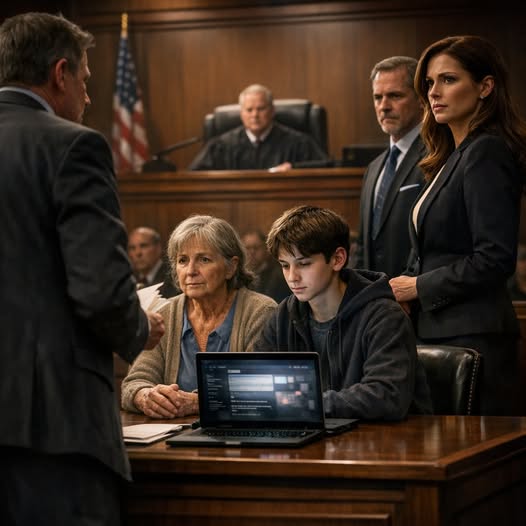
Mr. Mendez approached the TV, his face pale. “Ethan… how long have you had this?” “Since forever.” I looked at him. “Son…” He took a deep breath. His fingers moved quickly over the edge of the tablet, the way they did when he was trying not to have a meltdown. “I recorded a lot of things. I didn’t talk much. But I understood.”
I felt something break inside me. For years, I thought I had protected him by hiding the pain—speaking softly when he cried, silencing arguments, hiding papers in cookie tins. But he had seen it all. He had kept it all.
Karla pointed at the screen. “Mom, tell him to turn that off. This is manipulation. You programmed him against me.” Ethan opened another file. This time it was an audio recording. Karla’s voice was clear and annoyed: “I’m not signing anything, old woman. If you sign for me at school, even better. I don’t want that kid ruining another relationship for me.” Then another: “Mom, don’t call me if he gets sick. Take him to the clinic or do whatever you want.” Then another: “If that kid is ever worth anything, let me know.”
Karla’s lawyer closed his eyes. It was only for a second, but I saw it. Even he realized his client hadn’t come for a son. She had come for a bank account.
Karla breathed heavily. “I was depressed. No one knows what I went through.” “I do,” Ethan said. She turned toward him, searching for tenderness, pity, a crack. “Son…” “Don’t call me ‘son’ just to ask for money.”
Tears streamed down my face. Not just from sadness, but from fear. Ethan wasn’t raising his voice, but his body was speaking. His shoulders were tense, his jaw clenched, and his eyes were fixed on a spot on the wall to avoid looking too closely at anyone. Before a crisis, he always got like this as a child. Very still. As if the world had become too big and he was trying not to drown.
I took a step closer. “Ethan, breathe with me.” He raised a hand again. He didn’t want me to interrupt. The screen changed. A folder appeared titled: “Money.”
Karla took a step back. Ethan opened a spreadsheet. There were dates, transfers, screenshots of messages, receipts. For years, Karla had used my name to request support, donations, and supposed fundraisers for “her autistic son’s treatment.” I knew nothing about it. I felt shame, then rage. There were months when I couldn’t afford full occupational therapy. Months when I sold tamales in the early dawn, my hands swollen from the steam, while my daughter posted photos at expensive restaurants.
On the spreadsheet, deposits appeared: $500, $1,000, $1,500. Descriptions: “For Ethan,” “Child’s treatment,” “Single mom support.” Single mom. Karla had dressed herself in my exhaustion to collect pity.
“That doesn’t prove I stole it,” she said. “I had expenses too.” Ethan opened a screenshot. It was a conversation between Karla and a friend. “My mom thinks I’m suffering, but the kid is useful for getting money. As long as she takes care of him, I collect.” The friend replied: “What if she confronts you one day?” Karla: “By then the old lady will probably be dead or the kid won’t even realize.”
I grabbed the back of the sofa. Not because of the phrase “old lady”—that didn’t hurt as much anymore. It hurt imagining Ethan reading that alone. Without telling me. Without crying. Storing it away like one stores knives.
Our lawyer suddenly regained his composure. “This changes the situation.” Karla’s lawyer picked up his briefcase. “I need to speak with my client in private.” “No,” Ethan said. We all turned. He tapped another key. The TV showed a digitally signed document. “Before you came in, I sent copies to three places. To Mr. Mendez. To the notary. And to the District Attorney’s office.”
Karla gasped. “What did you do?” “Backups.” He said it simply. Like he was explaining how to save a photo.
Mr. Mendez whispered, “Good God.” Ethan corrected him: “It wasn’t God. It was automation.” At any other time, I would have laughed. Not today.
Karla approached him with open arms. “Honey, you’re confused. Your grandmother filled you with hate. I left you because I had no options. I was young. I was alone. No one helped me.” Ethan looked at her. For the first time, he looked at her directly. That was hard for him. I knew it. “Grandma was fifty-eight years old. She did laundry. She sold tamales. She took me to therapy on the bus. She slept three hours. You were twenty-seven. New phone. New boyfriend. New life.”
Karla opened her mouth. She couldn’t find anything to say. He continued: “I don’t hate you. I classified you.” “What?” “As a risk.”
Those three words were louder than any insult. Karla looked down at her heels. Her lawyer closed his briefcase. “Ms. Gomez, I recommend we leave.” “No!” she screamed. “He can’t manage that money! He can’t even talk like a normal person!”
The scream bounced off the walls. Ethan covered his ears. I ran to him. “Lower your voice!” Karla pointed her finger. “See? See? He can’t do it. He needs a guardian. He needs his mother.” Ethan was breathing fast. His tablet fell onto the sofa. Mendez stood up. “Ma’am, leave.” But Karla saw her chance. She smiled again. “There it is. Unstable. Vulnerable. Incapable of deciding.”
Then Ethan did something I will never forget. He took his hands off his ears. Slowly. With effort. His face was pale, but his eyes were alive. He took the tablet. He tapped a key. His own voice, recorded days before, came out of the speaker: “Hello. My name is Ethan Gomez. I am autistic. I am not incapable. I communicate better in writing and with technological support when there is too much noise. If my biological mother attempts to provoke a crisis to prove incapacity, this video should be considered context.”
Karla stood frozen. On the screen, Ethan was seen sitting in his room with soft light and his headphones on. “Eleven years ago, I was abandoned by Karla Gomez. My grandmother, Teresa Lujan, assumed my care, my therapies, my education, and my de facto representation. I formally request that she be recognized as my legal guardian until I reach adulthood and as the administrator of a protected trust. I also request that Karla Gomez be denied access to my accounts, residence, medical data, and personal decisions.”
The video continued: “I don’t want to punish her. I want security.”
Security. That word pierced me. Because that was all I had tried to give him since the morning he was left with a backpack. Not luxury, not inheritance, not millions. Security.
Mr. Mendez cleaned his glasses. “Ethan prepared this with me three days ago,” he said quietly. “He asked me not to tell you so you wouldn’t worry.” I looked at him. “Did you know she was coming?” Ethan nodded. “Monitoring.” Karla let out a laugh. “Monitoring? You were spying on me?” “You posted a photo outside our gated community. With geolocation.” My grandson opened another image. Karla, smiling next to the white SUV. The caption said: “Time to get back what’s mine.”
I felt nauseous. What’s mine. Not “my son.” Not “my family.” What’s mine.
Karla’s lawyer approached her. “We’re leaving.” “Don’t touch me,” she snapped. Then she looked at me with the hatred I had known since she was a child—the kind she used when she broke something and blamed someone else. “You took my son from me.”
For the first time in eleven years, I felt no guilt. Not a drop. “No, Karla. You left him in my arms because he was in your way. What you didn’t calculate was that he was going to grow up.”
She wanted to say something more, but at that moment the doorbell rang. Mendez opened it. It was two people from the court accompanied by a social worker. Karla’s lawyer turned pale. “What is this?” Mendez held up an envelope. “Provisional measures. We filed the request this morning with advance evidence. The judge granted preventive asset protection and an urgent evaluation of the family environment.”
Karla looked at me as if I had pulled a gun. But the weapon was the truth. The social worker approached Ethan with a calm voice. “Hi, Ethan. I’m Laura. I’m not going to touch you. I just need to confirm if you’re comfortable talking here.” He shook his head. “Too much noise.” “Do you want to write?” He nodded. She offered him a notebook, but he pointed to the tablet. “There.”
For several minutes, he wrote. No one spoke. Karla moved restlessly, crossing and uncrossing her arms. She no longer looked like an indignant mother. She looked like someone waiting for a trapdoor to open beneath her feet. When Ethan finished, he turned the tablet toward Laura. She read in silence. Then she looked at me. Her eyes were moist. “He says he wants to stay with you. That you don’t demand hugs, you don’t change his food without warning, you don’t scream when he freezes up, and you always tell him the truth even when it’s hard.”
I covered my mouth. Eleven years of love were reduced to small things. Not screaming. Not lying. Not moving the rice. And it was enough.
Karla exploded. “I am his mother!” Ethan wrote another sentence and played it through his app. The electronic voice said: “Mother is not a password.”
Karla froze. So did I. Mr. Mendez lowered his head to hide his tears. After that, everything moved fast. Karla was summoned. Her accounts were audited. The fake donations came to light. Something even worse appeared: she had contacted a journalist to sell the story of “the grandmother who stole the money from her millionaire autistic grandson.” The draft of the article was in her email. There were photos of our house. Of Ethan in the garden. Of me buying vegetables at the market. I felt terror. Not for me. For him. The world was already too invasive for Ethan without cameras outside the door.
The judge ordered protection measures. The money from the app sale went into a trust. Ethan would have gradual access, accompanied by advisors chosen by him and legal supervision until he turned eighteen. I was recognized as the primary caregiver and provisional guardian.
Karla tried to cry at the hearing. She said poverty had forced her hand. The judge asked her to explain the trips, the expensive bags, the deposits, and the messages where she called Ethan a “late investment.” She couldn’t. Her lawyer stopped talking much after that.
At the exit, Karla caught up with me in the hallway. “Mom, please. I’m your daughter.” I stopped. For eleven years I dreamed of hearing her say that without venom. But it came too late. And it came looking for money. “Yes,” I told her. “You are my daughter. And that is what hurt me the most.” Her face changed. For a second, I saw the girl she used to be—the one who got angry if she didn’t win, the one who broke other people’s dolls and then cried louder than the owner. “I need help,” she whispered. “Then ask for it without using Ethan as a key.” She didn’t respond. I kept walking.
Ethan was waiting on a bench with his headphones, staring at a pattern in the floor tiles. Seeing me, he raised his hand. Not to wave, but to show me four fingers. Our signal. Four meant: “I’m overwhelmed, but I can keep going.” I sat next to him. I showed him three fingers. “I’m with you.” He leaned his shoulder against mine. For Ethan, that was a full hug.
Months later, life became quiet again. Not like before—better. The house in Phoenix stopped feeling threatened. We put in cameras, yes, but also planters. Ethan chose lavender because he said the smell was “predictable.” I kept making tamales, though I no longer needed to sell so many. Once I asked him why he didn’t want me to close the business if we already had money. He replied: “Because your hands get sad when they aren’t cooking.”
That was who he was. He didn’t say “I love you” like other grandsons. He said exact things. Things that went deeper. With part of the money, Ethan created a small foundation called “Clear Routine” to support families with autistic children who couldn’t afford therapy, diagnoses, or communication devices. I wanted it to be named after him. He said no. “I’m not a product. I’m a person.”
I learned a lot from him. I learned that independence doesn’t mean doing everything alone. I learned that speaking isn’t the only way to have a voice. I learned that some people don’t need to be cured, they need to be respected.
Karla received a penalty for fraud related to the donations and was left with no legal access to Ethan or his estate. Later, she requested a supervised meeting. Ethan read the request for a long time. Then he wrote: “Not yet. Maybe when you can listen without asking me for things.” He didn’t hate her. That surprised me. I did hate her some nights. Then less. Eventually, I understood that my hate could serve as an alarm, but not as a home. Ethan needed peace. So did I.
On the day he turned seventeen, we had a simple meal. White rice separated from the beans. Tamales. Cake without too much frosting. Low lights. Few guests. Mr. Mendez was there, wearing an ugly tie that Ethan described as a “visual assault.” We all laughed, even Mendez. Before cutting the cake, Ethan gave me a box. “It’s your gift,” he said. “But it’s your birthday.” “Modified social rule.”
I opened the box. Inside was an embroidered apron. It said: “Teresa Lujan. Founder.” I stared at the letters. “Founder of what?” Ethan pointed to the kitchen. “Of me.”
That’s when I broke down. I cried like I didn’t cry when I saw the 3.2 million. Like I didn’t cry when Karla arrived with a lawyer. Like I didn’t cry in court. I cried because my grandson, the boy the world tried to reduce to a diagnosis, had just put a name to eleven years of love.
He waited for me to finish. Then he offered me a napkin. “Expected crying,” he said. “High intensity.” I laughed through the tears. “Very high, son.”
That night, after everyone left, I found Ethan in the garden. He was looking at the small lights I had installed on the fence. “Grandma,” he said. “Yes?” “When Karla left me, were you afraid?” I sat beside him. “Very much.” “Of me?” “No. Of not being enough for you.” He thought for a while. “You were enough.”
The sentence fell softly, but it changed my whole life. I had carried guilt for years. Guilt for not having money. Guilt for not knowing about therapies at the start. Guilt for getting tired. Guilt for losing my patience sometimes and locking myself in the bathroom to cry with a towel in my mouth. You were enough. Not perfect. Not a hero. Enough.
The next year, when Ethan turned eighteen, he signed his own documents. The trust remained protected by his decision, not by anyone’s order. Karla sent a message: “Now that you’re an adult, we can talk without your grandmother interfering.” Ethan read it. Then he archived it. He didn’t delete it. “Historical evidence,” he said. Then he wrote a brief response: “When you want to know me, and not my money, you can send a letter. Do not come without notice.”
She never sent the letter. Maybe one day she will. Maybe not. I stopped waiting.
One afternoon, while I was preparing dough in the kitchen, Ethan walked in with his tablet. “Grandma, I need to say something difficult.” My body froze out of habit. “Tell me.” “I want to live on my own when I turn twenty. Nearby. Not far.” I swallowed hard. My first impulse was to say no. To protect him. To close doors. To put myself between him and the world again. But I looked at him. He was no longer the boy under the table. He was a tall young man with headphones, routines, fears, talent, rights, and a life that shouldn’t belong to me just because I had saved him. “Then we’re going to learn how,” I said. He nodded. “Step by step.” “Step by step.” He smiled slightly. That was his way of celebrating.
Sometimes people still ask me if it doesn’t hurt that my own daughter did what she did. Of course it hurts. There are wounds that don’t close because they share the same blood. But then I watch Ethan explain his app to other children, or I see him carefully arrange my pots by size, or I hear his electronic voice saying “I need a break” instead of suffering in silence, and I understand that life didn’t give me back the daughter I lost. It gave me the chance not to lose the grandson she abandoned.
Karla arrived thinking that being a biological mother was a master key. She thought money opened everything. She thought Ethan was still that quiet child with a note pinned to his chest. But my grandson wasn’t quiet. He was recording. He was learning. He was waiting for the exact moment to say: “Let her talk.”
And she talked. She talked so much she condemned herself. Now, every morning when I steam the tamales, Ethan comes down to the kitchen and checks his schedule for the day. Sometimes he touches my shoulder with two fingers. Two fingers means: “Good morning, I love you.” I respond the same way. Because in this house, we learned another language. One where love doesn’t scream. It doesn’t abandon. It doesn’t demand payment. It doesn’t appear eleven years later with a lawyer and high heels to collect on motherhood. In this house, love cuts tags, separates rice from beans, respects silences, and keeps backups. In case someone confuses patience with weakness again. In case someone knocks on the door saying: “I came for my son.”
Then I look at Ethan. And he, without raising his voice much, remembers the truth that saved us: “I am not property. I am a person.”

