The tray hit the marble floor before Lina’s cry reached my ears.
Even now, when I think about that afternoon, I still hear the same sequence in my head.
The soft footsteps.
The pause at the doorway.
The sharp crash of glass.
Then that terrible sound from her throat, as if something inside her had torn open.
I had expected panic.
I had expected confusion.
I had even expected silence.
I had not expected grief.
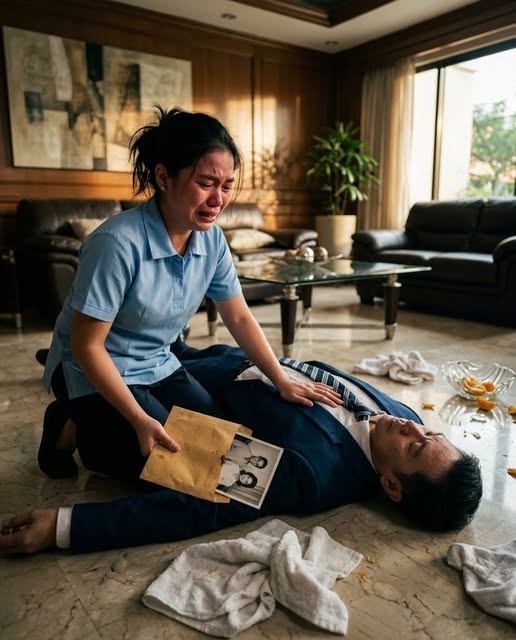
Lina dropped to her knees beside me so fast she nearly slipped on the polished floor of my living room.
Her hands were trembling as they touched my face, then my neck, then the center of my chest.
She was trying to find a pulse, but her fingers shook too hard to stay steady.
She kept whispering under her breath.
At first I couldn’t make out the words.
Then I heard them clearly.
Please, not like this.
Not before I tell you.
I was lying on the floor of my own house in Quezon City, pretending to be dead, and for the first time since I came up with the plan, I felt something close to shame.
My name is Alejandro Reyes.
I was forty-one years old then, and from the outside my life looked exactly the way people in business magazines like to describe success.
CEO.
Clean suits.
Private driver.
A house large enough to echo.
A reputation that made junior executives straighten their backs when I walked into a room.
People thought a man in my position lived above fear.
The truth was the opposite.
I had money, but money had taught me the ugliest lesson possible: the richer I became, the harder it was to know who loved me, who respected me, and who was simply waiting for access.
A cousin had used my name to secure loans and disappeared.
A former business partner had siphoned money through shell suppliers for months before I caught him.
A woman I once thought I would marry had leaked confidential information to a competitor while telling me she only wanted a future together.
After enough betrayals, suspicion stopped feeling like a flaw and started feeling like armor.
That was the condition of my heart when Lina entered my life.
She came through a household staffing agency two years before the day of my stupid test.
She was twenty-two, small-framed, soft-spoken, and almost impossibly discreet.
She kept her dark hair tied back in the same plain way every day.
She wore simple uniforms without complaint.
She answered everything with a respectful nod or a quiet yes, sir.
But what made her unforgettable was not her silence.
It was her care.
She noticed things no one else did.
If my migraines were starting, my medicine would appear beside a glass of water before I asked.
If I came home after midnight, there would be warm food waiting beneath a covered dish and the lights in the foyer would be dimmed exactly the way I preferred.
If the weather shifted and I forgot an umbrella, one would appear in the back seat of the car.
She learned the house faster than anyone who had ever worked for me, but she moved through it like she wanted credit from no one.
And yet there was one thing about her that unsettled me from the beginning.
She never looked me in the eyes.
Not once.
When I gave instructions, she looked at the floor or at the tray in her hands or at some fixed point over my shoulder.
When she said good morning, her gaze stayed lowered.
When I thanked her, she looked briefly startled, then nodded without meeting my face.
At first I told myself she was just shy.
But suspicion is greedy.
It feeds on what it does not understand.
The more I noticed Lina’s goodness, the more I began to question it.
Was she genuinely loyal, or was she simply more patient than the others? Was the silence humility, or was it calculation?
The thought became an obsession.
So I designed a test.
I told the staff they could leave early except for Lina, who still had laundry to finish.
I made sure the security guard at the gate had an errand.
I loosened my tie, lay down on the living room floor, twisted my arm awkwardly, and rehearsed the stillness of a man whose heart had stopped.
Then I waited.
When Lina entered and saw me, the reaction was immediate and violent in a way no performance could have produced.
The folded towels slid from her arms.
The side tray clipped her hip and the crystal bowl on it shattered.
She rushed to me, dropped to her knees, and began calling my name in a voice I had never heard before.
Sir Alejandro.
Sir Alejandro, please.
Then she broke.
She bent over me, clutching my shirt, and said something that froze my blood.
I tried, Ma.
I really tried to stay quiet.
There was the rustle of paper.
An envelope came out from inside her apron, its edges softened by years of being handled.
Something hard and metallic knocked gently against it.
Her tears fell on my cheek.
And then she whispered a name that reached twenty-two years into my past and dragged it into the room.
Marisol.
I sat up so fast Lina screamed and fell backward on the marble.
For a second neither of us moved.
Her face had drained of color.
She was staring at me as if I had risen from a grave.
Then horror gave way to a different emotion entirely.
Betrayal.
You’re alive, she said, her voice cracking.
You… you were pretending?
There was no defense I could offer that did not make me sound monstrous, because the truth was monstrous.
I told her it was a test, and the moment the words left my mouth I saw exactly what they were.
Cruel.
Arrogant.
Pathetic.
A test, she repeated.
Her hands were still shaking, but now with anger.
You made me think you were dead.
I stood, then stopped when I saw what was in her hand.
A faded photograph.
Even before she turned it toward me, something in my chest had already recognized it.
The photo showed a younger version of me standing under an acacia tree beside a girl in a yellow blouse.
Marisol Mendoza.
Nineteen.
Laughing.
My arm around her shoulders.
The image had been taken on a cheap camera outside the university canteen the week before I left for Singapore on an internship my father insisted would change my future.
I looked from the photo
to Lina.
Who is Marisol to you?
Lina swallowed once.
Tears were still running down her face, but she had gone strangely calm.
She was my mother.
The room seemed to tilt.
I heard myself ask another question before I had fully understood the first.
Why do you have that picture?
Because you’re in it, she said.
And because she kept everything.
She placed the envelope on the coffee table between us and stepped back as though she wanted the furniture to stand in for all the distance she no longer trusted me with.
When she spoke again, her voice was quiet but steady.
My mother told me your name when I was old enough to ask why other children had fathers at school programs and I didn’t.
She didn’t call you cruel.
She didn’t call you a coward.
She only said life had pulled you away before she could tell you the truth.
The truth.
I didn’t want to say the word out loud.
I didn’t want to force the room to hear it before I was ready.
But Lina did.
I’m your daughter.
Nothing in my life—not hostile takeovers, not courtroom fights, not headlines, not funerals—had prepared me for how those four words could hollow a man out from the inside.
I stared at her, and for the first time I understood why her face had always felt strangely familiar.
The shape of her brows.
The line of her jaw.
The way her mouth tightened when she was frightened.
It was like seeing pieces of myself arranged into another human being and realizing I had walked past them for two years without allowing my own heart to see.
Old reflexes rose up anyway.
Suspicion does not die with one revelation.
It claws for survival.
How do I know this isn’t a lie?
The pain that crossed her face then was so clean and immediate that I hated myself before she even answered.
You don’t, she said.
Not yet.
She opened the envelope and emptied it onto the table.
Letters folded and refolded until the creases had gone white.
A hospital bracelet with her mother’s name.
A copy of her birth certificate.
A tiny silver Saint Michael pendant.
My pendant.
I had given it to Marisol on the night we said goodbye before my trip abroad.
I remembered fastening it into her palm and promising I would come back in three months.
I remembered her smiling through tears and telling me she would wait.
I had come back.
But by then my father had already lied to me.
He told me Marisol had left town.
He told me she had found another man.
He told me she had said I would only drag her down.
I searched for weeks, then months.
Every attempt hit a wall of missing addresses and closed doors.
Pride did the rest.
I convinced myself she had made a choice, and I buried the wound inside work.
Lina’s hands closed around the hospital bracelet.
She did try to reach you, she said.
She wrote letters.
She went to your old apartment.
She called a number that had been disconnected.
By the time she found where your family had moved, your father’s driver told her never to come back.
The image of my father hit me
with sudden, blinding clarity.
His belief in status.
His contempt for inconvenience.
His ability to turn other people’s lives into neat strategic decisions.
I sank into the sofa because my knees no longer trusted me.
Lina went on, but each word sounded as if it had traveled a long distance to find me.
My mother raised me in Camarines.
She sewed uniforms, cooked food to sell, did whatever work she could.
She never married.
She never asked anyone for help.
She only said that one day, if I wanted to find you, I should find you with dignity.
Not to beg.
Not to accuse.
Just to know.
She looked around my living room then, at the expensive furniture, the paintings, the polished surfaces of a life built on control.
I tried to go to your office first after she died, she said.
Your assistants never let me get past reception.
They looked at me and decided before I opened my mouth that I didn’t belong there.
So I found a staffing agency.
It was the only way into your world.
I finally understood.
You became my househelp just to get close to me?
At first, yes, she said.
Then her voice softened.
After that… I didn’t know how to tell you anymore.
I asked the question that had haunted me for two years.
Why wouldn’t you ever look at me?
Her answer broke something in me that had needed breaking for a long time.
Because every time I tried, she said, I saw my own face staring back at me, and I was afraid that if you didn’t recognize me, I wouldn’t survive it.
There are moments when a man can feel his entire self-image split open.
That was mine.
I had staged a test to expose a servant’s loyalty.
Instead, I had discovered that the person whose loyalty I doubted was my own child.
I asked for a DNA test that same night, and I hated myself while asking.
Lina did not argue.
She only nodded once, like someone who had prepared herself for the possibility that blood would have to speak where the heart had failed.
Then she said she was resigning.
She packed before dawn.
The silence she left behind was unbearable.
Every room in the house seemed to accuse me.
The medicine on my bedside table.
The neatly folded shirts in the closet.
The container of ginger tea in the kitchen she had prepared because she knew I drank it on difficult mornings.
I had called all that service.
But now I saw what it really was: care offered by someone who owed me nothing and still wanted, desperately, to be near me.
I spent the next three days reading Marisol’s letters.
The first ones were full of hope.
She wrote about morning classes, about a rainstorm that flooded the street where we used to eat fish balls, about how she missed my laugh.
Then the letters changed.
She wrote that she was pregnant.
She wrote that she had tried to reach me.
She wrote that she did not know whether the silence came from indifference or something she could not see.
The final letter was dated months after Lina’s birth.
In it, she did not ask me for money.
She did not curse my name.
She only wrote that our daughter had my stubborn mouth and that she hoped, if we never met again, life would at least make me kinder than the world had been to us.
I had to stop reading after that because I could no longer see through the tears.
When the DNA results came back, there was no dramatic surprise left to stage.
Probability of paternity: 99.9999 percent.
Science merely confirmed what guilt had already told me.
I did not summon Lina to my office.
I did not send a driver with a message.
I took my own car and drove to the small boarding house in Cubao where she had rented a room after leaving my home.
The hallway smelled faintly of rice and soap.
Children were playing outside.
It was the first time in years I had entered a place where no one cared who I was.
She opened the door and just looked at me.
This time she met my eyes.
There was no fear in them anymore.
Only caution.
Hurt.
And something I did not think I deserved: patience.
I told her I was sorry.
Not with the polished language of a CEO trying to manage damage.
Not with excuses about my past.
I told her the ugly truth.
I said I had become a man who trusted tests more than tenderness.
I said I had mistaken distance for intelligence and suspicion for strength.
I said that while she was trying to find a father, I had reduced her to an employee I needed to verify.
She listened without interrupting.
Then she said something I will carry for the rest of my life.
I was loyal to you before you ever paid me, she said.
That was the tragedy.
I asked her if she hated me.
She thought about it before answering.
I hated what you didn’t see, she said.
I hated how easy it was for you to let me stay invisible.
But I never hated you the way I wanted to.
My mother loved you too honestly for that.
Then she handed me her phone and pressed play on a voice recording.
Marisol’s voice filled the small room, thinner than I remembered, worn by illness but unmistakably hers.
She spoke slowly, as if saving strength.
If you are hearing this, Alejandro, then Lina found you.
I don’t know what kind of man time made you.
I only know the boy I loved was gentle before the world taught him to be hard.
Don’t punish her for my pride.
Don’t punish yourself forever either.
Just don’t waste what is left.
I sat there in my pressed shirt, in a plastic chair in my daughter’s rented room, and cried harder than I had cried at my own mother’s funeral.
I offered Lina money first, and she refused it so quickly I felt ashamed for the instinct.
I don’t need to be purchased into your life, she said.
So I asked what she did need.
The answer changed everything.
Truth, she said.
Respect.
Time.
And the chance to finish nursing school without having to scrub someone else’s floors at night.
That, at least, I could give without turning it into a transaction.
I legally acknowledged her as my daughter.
I set up an education fund in her
name with no conditions attached.
I apologized to the staff for the lie I staged.
I ended Lina’s employment immediately—not as punishment, but because she would never again stand in my house as my servant.
She kept her mother’s surname and added mine only when she was ready.
The first time I saw her sign Lina Mendoza-Reyes on a school document, she laughed nervously and asked if it looked strange.
I told her it looked like a lost piece of my life had finally come home.
We did not become a perfect family overnight.
Real life is not kind enough for that.
There were awkward breakfasts.
There were long silences.
There were days when she called me Sir by accident and blushed, and days when she tried the word Papa and both of us had to look away because it hurt in a beautiful way.
But we built something true.
I drove her to classes when my schedule allowed.
She taught me how to eat in the tiny lugawan near her boarding house without making everyone nervous.
I showed her photo albums from my youth.
She showed me her mother’s sewing box, still full of thread in careful colors.
We visited Marisol’s grave together on a gray afternoon, and I knelt there with flowers in my hands and apologized to a woman who could no longer answer.
A year later, at my birthday dinner, business partners and relatives filled the house with their usual polished smiles.
In the middle of the evening, I called for everyone’s attention.
My voice shook more than it had during any corporate speech I had ever delivered.
I introduced Lina as my daughter.
Not a scholar I was helping.
Not a distant relative.
Not a family friend.
My daughter.
Some faces turned pale.
Some looked confused.
A few older relatives had the decency to look ashamed.
Lina stood beside me in a simple blue dress, shoulders straight, eyes steady on mine.
For the first time, there was no lowering of her gaze, no shrinking, no careful retreat into the background.
She belonged in the light.
So did the truth.
What happened that day in my living room still haunts me.
Not because I almost got caught pretending to be dead, but because of what the moment revealed about the man I had allowed myself to become.
The biggest red flag in my house was never Lina’s silence.
It was my own emptiness.
I had become someone who believed loyalty had to be trapped before it could be believed.
The cruelest part is that the person I tested had already been loving me in the only way she knew how.
I can never recover the years I lost with Marisol, and I can never give Lina back the childhood I missed.
Some wounds do not close; they simply become places you learn to protect.
But every time my daughter looks me in the eye now, I understand what forgiveness really costs.
And I still ask myself the question that follows me into every quiet room:
If I had been less proud, less suspicious, less eager to test love instead of trusting it, how much of our life together would I have found before it was too late?