My husband humiliated me on Instagram and called me his slobby wife four weeks after I gave birth to triplets.
Not one baby.
Three.
Three daughters born small, fierce, and furious, with red faces and clenched fists like they had already decided the world owed them room.
I remember lying in the hospital bed afterward, numb from pain and exhaustion, staring at their tiny hats lined up beside me and thinking Sam would cry when he saw them all together.
He did cry once, but only when the nurse told him he could not sleep in the recliner with his shoes on the blanket.
Still, I told myself he was overwhelmed.
I told myself new fathers panicked in strange ways.
I told myself a lot of things in that hospital because I was too tired to admit the truth sitting quietly in the corner of the room.
Sam was not overwhelmed by fatherhood.
He was annoyed by it.
By the time the doctors discharged me, I could barely walk without moving like my bones belonged to someone else.
My stomach still ached.
My back pulsed with a dull, deep pain.
Every two hours, one of the girls needed milk, a diaper, or the kind of rocking that made my arms tremble.
I had been in the hospital for weeks because the delivery had been complicated.
Sam had gone home most nights.
He said he needed proper sleep so he could prepare the apartment.
Prepare.
That was the word he used.
So when the taxi pulled up outside our building that afternoon, I let myself picture something gentle.
Maybe a grocery bag on the counter.
Maybe soup.
Maybe fresh sheets.
Maybe the faint smell of disinfectant instead of hospital air.
I did not need a grand gesture.
I needed proof that I was not coming home to another child in a grown man’s body.
Sam opened the door before I could knock.
He stood there in gray sweatpants, his hair messy, his arms folded across his chest.
For one brief second, I thought he was going to smile.
Instead, his eyes moved over me with irritation.
He did not look at the car seats.
He did not bend down to see our daughters.
He did not say their names.
He said, “You could’ve given birth faster.
The apartment is filthy.
It’s all because of you.”
At first, I honestly thought I had misheard him.
My brain was still slow from lack of sleep and pain medication.
I stood in the doorway with one carrier in each hand while my mother, who had helped me upstairs, held the third.
“What?” I asked.
Sam sighed like I was being difficult.
“Don’t start.
Just look around.”
My mother’s mouth tightened, but she did not speak.
She had warned me about Sam before.
Quietly.
Carefully.
In the way mothers warn daughters when they know the daughter is not ready to hear it.
I stepped inside.
The smell hit me first.
Old food.
Sour milk.
Trash left too long in a warm room.
It wrapped itself around my throat so hard I almost gagged.
Then I saw the living room.
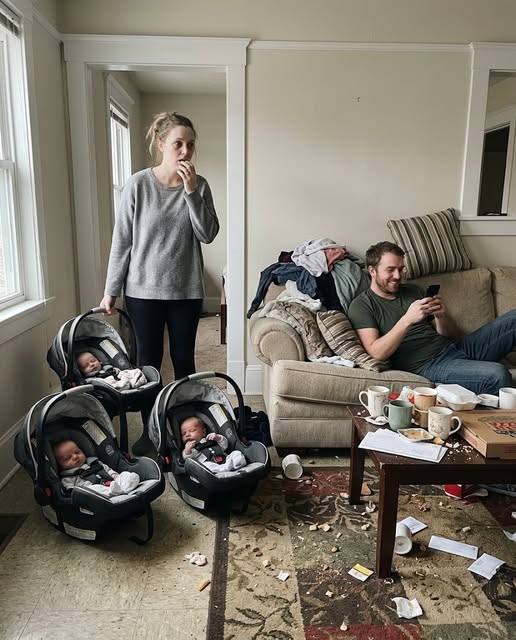
Plates covered with dried food were scattered over the coffee table, the couch, and the floor.
Pizza crusts had gone hard beside an open laptop.
Takeout containers leaned in a greasy pile near the television.
There were crumbs crushed into the carpet, soda cans on the windowsill, dirty socks beside the baby swing I had assembled before the hospital.
And there, on the coffee table, beside a half-empty bottle of beer, sat used toilet paper.
For a moment, the apartment went silent except for the tiny sleepy sounds coming from the carriers.
Then my mother whispered, “Nicola.”
I turned toward Sam.
“What is all this?”
He had already walked past me and dropped onto the couch.
He picked up a dirty T-shirt with two fingers, made a face, and tossed it toward the hallway.
“This is the mess you made,” he said.
I stared at him.
“I’ve been in the hospital.”
“Exactly.
Nobody was here cleaning.” He leaned back, completely calm.
“I told you I can’t do everything.”
Everything.
The word almost made me laugh.
He had not attended the birth classes because they were boring.
He had forgotten the hospital bag.
He had complained when I asked him to bring clean pajamas.
He had visited the babies for exactly twenty minutes at a time and posted selfies from the hospital cafeteria with captions about becoming a girl dad.
But apparently, he had been doing everything.
My mother set down the third carrier very gently, like if she moved too fast she might throw something at his head.
“I’m staying,” she said.
“No,” Sam snapped.
“We don’t need your mother hovering.”
I watched his face.
The speed of his anger told me everything.
He did not want help.
Help would come with witnesses.
Before I could answer, one of the babies began to cry.
Then another joined in.
The third made a small hiccuping sound that cracked my heart open.
My mother looked at me, waiting.
I wanted to say yes.
I wanted to let her stay.
I wanted to hand her all three babies, curl up on the cleanest corner of the bed, and sleep until my body belonged to me again.
But Sam’s stare pinned me in place.
It was not fear exactly.
It was habit.
Years of calculating his moods before I calculated my own needs.
“I’ll call you later, Mom,” I said softly.
Her eyes filled with disappointment, but she nodded.
She kissed each baby’s forehead, then pressed her hand against my cheek.
“You call me for any reason,” she whispered.
Sam waited until the door closed before he spoke again.
“Great,” he said.
“Now she thinks I’m the bad guy.”
I looked at the room around us.
“You left the apartment like this while I was in the hospital with your daughters.”
“Our daughters,” he corrected, annoyed.
“And don’t make this dramatic.
You’re home now.
You can handle it.”
A strange calm passed through me then.
Not peace.
Not acceptance.
Something colder.
The kind of calm that comes when your heart finally stops begging someone to become decent.
I took the babies to the bedroom.
The nursery smelled better because the door had been closed, but dust had settled on the dresser and the diaper pail was still in its box.
The tiny pink blankets I had washed before labor were folded exactly where I had left them.
Sam had prepared nothing.
I changed diapers with shaking hands.
I fed them
one after another.
I moved through the motions while the apartment outside the nursery seemed to pulse with his carelessness.
Then my phone buzzed on the dresser.
At first, I ignored it.
Then it buzzed again.
And again.
And again.
I picked it up, expecting my mother.
It was Instagram.
Sam had tagged me in a post.
The photo was our living room.
The worst angle possible.
The dirty plates.
The stained carpet.
The toilet paper on the table.
The caption sat beneath it like a slap.
MY SLOBBY WIFE HASN’T CLEANED THE APARTMENT IN A MONTH.
DOES ANYONE KNOW WHEN THIS IS GOING TO STOP?
For several seconds, I could not breathe.
Then I opened the comments.
People I did not know were laughing.
Some were women telling him he deserved better.
Some were men posting jokes about wives getting lazy after babies.
A few people asked whether I was okay, but their comments were buried under the cruel ones.
Lazy.
Disgusting.
Poor guy.
Triplets or not, no excuse.
I looked down at my daughters.
Three sleeping faces.
Three mouths slightly open.
Three lives depending on me to become someone stronger than I felt.
My eyes burned, but I did not cry.
Not because it did not hurt.
Because something else was finally louder.
I walked into the living room.
Sam was smiling at his phone.
“Take it down,” I said.
He did not even look up.
“Why? It’s true.”
“It’s not true.”
He shrugged.
“Looks true.”
That was when I understood his game.
It was not just laziness.
It was staging.
He had let the apartment rot while I was gone, then framed me for it publicly.
He wanted the world to see me as the problem before I had a chance to tell anyone what home really looked like.
He wanted witnesses who would laugh with him.
So I decided to give him witnesses.
I stood there for a moment, letting my face soften.
Then I crossed the room and wrapped my arms around his shoulders from behind.
He stiffened at first, probably expecting a fight.
When I rested my cheek against him, he relaxed.
“I’m sorry, honey,” I whispered.
His thumb stopped moving on the screen.
“For what?”
“For letting things get this bad.” The words tasted like metal, but I kept my voice sweet.
“You’re right.
We’ve both been under stress.
Tomorrow night, I want to take you out.
A celebration dinner.
For the babies.
For us being together again.”
He turned enough to look at me.
Suspicion flickered across his face, then vanity smothered it.
“You want to take me out?”
“Yes.”
His smile grew.
“Somewhere nice?”
“Very nice.”
He laughed.
“Well, okay.
I guess you’re learning.”
I smiled back.
He had no idea.
That night, after he fell asleep on the couch with his phone on his chest, I did not clean the apartment.
That was important.
I did not touch a plate.
I did not remove a crumb.
I did not rescue him from his own evidence.
Instead, I took photos.
Not dramatic photos.
Clear ones.
Time-stamped ones.
The hallway.
The kitchen.
The living room.
The trash bags he had left by the back door.
The laundry he claimed was mine, full of his gym clothes and work shirts.
The beer bottles.
The takeout receipts dated throughout the weeks I had been hospitalized.
Then I checked our baby monitor camera.
Sam had installed it months ago because he liked buying gadgets.
He never remembered that it recorded motion when connected to the apartment Wi-Fi.
I opened the app with no real expectation, just a bitter curiosity.
The recordings were all there.
Three weeks of clips.
Sam entering the nursery once, looking around, and leaving.
Sam eating on the couch.
Sam dropping a plate on the floor and stepping over it.
Sam tossing dirty laundry into the hallway.
Sam bringing two friends into the apartment, laughing, drinking, and pointing at the mess.
In one clip, his friend Greg said, “Dude, Nicola’s gonna lose it when she sees this.”
Sam laughed and said, “That’s the point.
She needs to remember what happens when she disappears.”
I played that clip three times.
Then I saved it.
My hands were no longer shaking.
By morning, Sam acted like nothing had happened.
He slept until ten while I fed the girls, changed them, washed bottles, and finally cleaned only the nursery and the kitchen sink because my babies deserved sanitary bottles no matter what lesson their father needed to learn.
The rest of the apartment remained exactly as he had left it.
Around noon, my mother arrived.
This time, I let her in.
Sam scowled from the hallway.
“I thought we said no visitors.”
“We didn’t say that,” I replied.
“You said that.”
His eyes narrowed.
My mother looked from him to me, sensing the shift.
I handed her my phone.
She watched the clips in silence.
Her face changed slowly, grief first, then fury, then the focused expression she got when she was about to become very useful.
“What are you planning?” she asked.
“A dinner,” I said.
Her mouth pressed into a thin line.
“Good.”
Sam spent the afternoon choosing an outfit.
He posted a story of himself in the mirror with the caption, Date night with the wife.
Maybe she’ll make it up to me.
I watched it from the nursery chair while one baby slept against my chest.
He had no idea that I had already called the restaurant.
It was a place called Marlow’s, the kind of restaurant with dim lights, white plates, and windows facing downtown.
Sam loved it because his boss went there and because the prices made him feel important.
I booked a private room under the excuse that I wanted to surprise him.
Then I made a few more calls.
To my mother.
To his mother.
To his sister, who had once pulled me aside at Thanksgiving and said, “Sam can be mean when he feels small.”
To Greg’s wife.
And finally, to Sam’s boss, Melissa, because Sam had not just humiliated me to strangers.
He had also used his public account, where coworkers followed him, to create a story about his postpartum wife.
I did not ask Melissa to come.
I simply sent her the post and the clip where Sam bragged about teaching me a lesson.
She replied twelve minutes later.
Nicola, I’m so sorry.
I’ll be there.
When we arrived at Marlow’s that evening, Sam looked pleased with himself.
He held the door open for me with theatrical sweetness, probably imagining everyone around us saw
a generous husband forgiving a flawed wife.
“You look tired,” he said as we walked in.
“I am.”
“You should’ve napped instead of whatever you did today.”
I looked at him.
“I had things to arrange.”
He smirked.
“For me?”
“Yes.”
The hostess led us toward the private room.
Sam’s expression sharpened with interest when he saw the closed doors.
“Wow,” he said.
“You really are sorry.”
I touched his arm.
“I wanted this to be unforgettable.”
When the doors opened, his smile vanished.
My mother sat at the long table.
So did his mother, his sister, Greg’s wife, and Melissa from his office.
There were no balloons.
No cake.
No cute centerpiece.
Just five women sitting in silence with phones placed face down in front of them.
Sam stopped so abruptly I nearly walked into him.
“What is this?” he asked.
His mother stood first.
“Sit down, Sam.”
He looked at me.
“Nicola.”
I walked past him and took the chair at the end of the table.
“You wanted people to discuss my housekeeping,” I said.
“So I thought we should include people who actually know us.”
His face flushed.
“This is insane.”
Melissa’s voice cut cleanly through the room.
“No.
Posting that about your wife four weeks postpartum was insane.”
Sam turned toward her, startled.
“Melissa, this is personal.”
“You made it public,” she said.
The waiter came in, sensed the air, and quietly left water before disappearing.
For the first time since I had known him, Sam did not know where to put his hands.
He shoved them into his pockets, pulled them out, checked his phone, then looked at the door as if he might leave.
His sister spoke next.
“Did you really leave the apartment like that while she was in the hospital?”
“No,” Sam said quickly.
“She’s twisting things.”
I unlocked my phone and placed it in the center of the table.
The first video played.
Sam on the couch, dropping a plate onto the carpet and nudging it under the coffee table with his foot.
The second.
Sam walking past an overflowing trash bag, opening a beer, and sitting down.
The third.
Greg laughing in the living room.
Then Sam’s own voice filled the private room.
“That’s the point.
She needs to remember what happens when she disappears.”
No one moved.
His mother covered her mouth.
Greg’s wife stared at the screen like it had burned her.
Melissa leaned back slowly, her expression unreadable.
Sam lunged for the phone, but my mother picked it up before he could grab it.
“Don’t,” she said.
It was one word, but he stopped.
“Nicola,” he said, turning on me now, his voice lower.
“You recorded me?”
“You recorded yourself,” I replied.
“On the baby monitor you installed.”
His face twisted.
“You had no right to bring everyone into our marriage.”
I almost smiled then.
Not because any of it was funny, but because the hypocrisy was so clean it sounded rehearsed.
“You brought strangers into our marriage,” I said.
“You invited them to laugh at me while I was bleeding, feeding three newborns, and recovering from surgery.”
“I was frustrated.”
“You were cruel.”
“I made a joke.”
“You built a lie.”
His sister looked down at her hands.
“Sam, why would you do that?”
For a
moment, he tried the old face.
The wounded one.
The one that had worked on me in quieter rooms.
“Because no one sees what I deal with,” he said.
“Everyone acts like Nicola is some hero because she had babies.
I was alone too.
I came home to silence.
I had to work.
I had to manage everything.”
“You managed nothing,” his mother said.
He flinched as if she had slapped him.
She looked older than she had when we walked in.
Smaller, somehow.
“I raised you better than this.
Or I thought I did.”
The words seemed to drain him.
Not with remorse.
With embarrassment.
That was the only pain Sam recognized as real.
He turned to Melissa.
“This doesn’t affect my job.”
Melissa folded her hands.
“It affects my understanding of your judgment.
Especially since you’ve been telling the office you needed flexible hours because your wife wasn’t coping and you were carrying the household.”
I went still.
That part, I had not known.
“What?” I said.
Sam’s eyes flicked toward me, then away.
Melissa looked at me gently.
“He requested remote days.
Said he was the primary caretaker during a medical crisis at home.”
The room changed again.
The humiliation on Instagram had been bad enough.
The apartment had been bad enough.
But this was something colder.
He had not only framed me as lazy online.
He had used my pain as a ladder.
I felt my mother’s hand settle on my shoulder.
Sam raised both hands.
“Okay, fine.
Maybe I exaggerated.”
His mother whispered, “Sam.”
“No,” he snapped.
“Everyone is acting like I committed a crime.
I posted a messy room.
That’s all.”
I stood up.
My legs were still sore.
My whole body protested the motion, but I stayed upright.
“You posted a lie,” I said.
“You let people insult me while I was caring for your daughters.
You let our home become unsafe for newborns because you wanted to punish me for being in the hospital.
Then you used that lie at work to make yourself look devoted.”
He looked at me, and for the first time, I saw fear behind his anger.
Not fear of losing me.
Fear of losing the version of himself he sold to everyone else.
I opened Instagram on my phone.
My hands were steady.
“What are you doing?” he asked.
“Answering your question.”
I posted the screenshots first.
Then the receipts.
Then a short clip from the baby monitor, the one with his voice saying he wanted me to remember what happened when I disappeared.
I did not call him names.
I did not exaggerate.
I wrote one sentence.
I was hospitalized after delivering triplets; this is what my husband did while telling people I was the problem.
Sam stared at his phone as notifications began to rise.
One.
Five.
Twenty.
Then too fast to count.
His face went pale.
“Take it down,” he said.
I looked at him across the table.
“Why? It’s true.”
The silence that followed was the cleanest sound I had heard in a month.
He left before dessert.
He shoved his chair back, muttered that we were all crazy, and walked out of the restaurant alone.
Nobody followed him.
I sat there shaking after the door closed.
My body finally understood that the
performance was over.
My mother moved to my side.
His sister began crying quietly.
His mother apologized to me in a voice so broken I almost felt sorry for her.
Melissa paid the bill before I noticed.
“You shouldn’t have to worry about this tonight,” she said.
When I returned home, Sam was not there.
His gaming console was gone, along with two bags of clothes.
The apartment was still disgusting, but it no longer felt like a trap.
My mother stayed.
So did his sister.
We opened windows.
We wore gloves.
We cleaned until midnight while the girls slept in their nursery, safe behind a closed door with fresh sheets and full bellies.
The next morning, Sam texted me seventeen times.
First angry.
Then pleading.
Then angry again.
He said I ruined his reputation.
He said I embarrassed him.
He said a good wife would have handled it privately.
I read that message while feeding my smallest daughter, who had finally learned to curl her fingers around mine.
Then I replied with one sentence.
A good husband would have protected us privately before I had to defend us publicly.
I filed for separation two weeks later.
It was not clean.
Nothing with Sam ever was.
He fought over furniture he did not use, photos he had never framed, and a marriage he had treated like a stage where only he got applause.
But the evidence made certain arguments very short.
The Instagram post he made about me disappeared.
Mine stayed up just long enough for the truth to reach everyone he had invited into the lie.
Then I archived it, not because I regretted it, but because I did not want my daughters growing up inside their father’s humiliation either.
That was the difference between us.
I wanted safety.
He wanted an audience.
Months later, the apartment is smaller, cleaner, and louder than I ever imagined one home could be.
There are bottles on the counter sometimes.
Laundry waits longer than I want.
Some nights, all three girls cry at once and I stand in the middle of the room with milk on my shirt and tears in my eyes.
But the mess is honest now.
It comes from living, not punishment.
Sam still tells people I overreacted.
Some believe him.
Some always will.
But the people who sat in that private room know exactly what happened, and so do I.
The part that still divides everyone is not whether Sam deserved to be exposed.
It is whether I should have done it at dinner, in front of the people whose respect he cared about most.
Some say I went too far.
But after he handed strangers a dirty room and called it proof of my failure, I decided the truth deserved a table of its own.

