Daniel folded the paper slowly. “Why only milk?”
Annie looked down at Noah. “Because one glass is enough for him.”
“And you?”
She shrugged, but it was too tired to be brave. “I can fight it better.”
The sentence landed in the foyer like a dropped stone.
Behind Daniel was a kitchen with a refrigerator full of food. A pantry full of things he had not noticed in months. A house with rooms no one used and lights kept on because darkness was inconvenient, not dangerous.
In front of him stood a child who had learned to measure need in half glasses.
Clare lowered her voice. “Daniel, we should call the authorities or the hospital. We can’t just—”
“She’s coming in,” Daniel said.
Clare stared at him. “Daniel.”
He turned slightly, but his eyes stayed on Annie. “There is milk in the refrigerator.”
Annie did not move. “I can wait outside.”
“No.”
“I won’t touch anything.”
“I said no.” His voice softened. “Come inside. Noah will have milk. You’ll have something too.”
“I don’t have money.”
“I didn’t ask for money.”
“Are you going to call somebody to take us away?”
“No,” Daniel said. “I’m going to call the hospital. But first, you’re going to sit down.”
Annie stepped over the threshold as if crossing into a museum where one wrong move could set off alarms. She kept Noah close. She avoided the walls. She glanced at the marble floor beneath her shoes and tried to place each step where she would leave the least evidence.
Daniel saw it and said nothing.
Some kinds of dignity grew smaller when pointed out.
In the kitchen, Annie climbed onto the edge of a stool, holding Noah in her lap. Clare stood near the entrance with her arms folded tightly, watching as if usefulness might protect her from emotion.
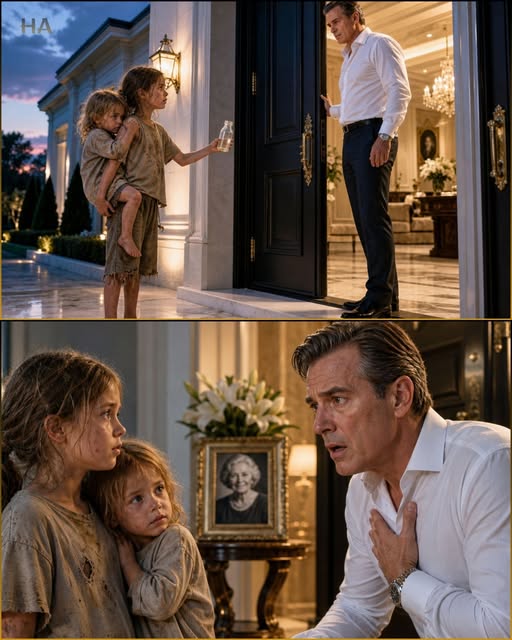
Daniel warmed milk in a small saucepan. The act felt strange in his hands. He could negotiate a nine-figure acquisition without looking down at his notes, but he had not warmed milk for a child once in his life.
Clare opened a cabinet and took out a clean mug.
Daniel glanced at her.
She avoided his eyes. “It’s better than a glass. Easier for him to hold.”
Annie watched everything with a worried expression. “That’s too much.”
“It’s milk,” Daniel said.
“Noah doesn’t need all of it.”
“There’s more.”
That seemed to confuse her more than anything else.
When he placed the warm milk in front of her, Annie touched the side of the mug first, testing it like an adult. Then she lifted it to Noah’s mouth. The baby drank slowly at first, then with weak hunger. Both his little hands wrapped around the mug while Annie supported most of its weight.
Color returned faintly to his face.
Daniel watched in silence.
After a few sips, Annie tried to pull the mug away.
“He can have more,” Daniel said.
“He had some.”
“There’s more in the carton.”
Annie looked at him as if trying to decide whether he meant it.
Clare turned away, opened the refrigerator, and began taking out food. Chicken soup. Turkey. Bread. Cheese. Strawberries from a glass bowl she usually kept for breakfast.
Annie’s eyes widened. “Ma’am, I didn’t ask for food.”
“I know,” Clare said, briskly. “That’s why I’m giving it to you before you get stubborn.”
Daniel glanced at his wife, surprised.
Clare met his look with one of her own. It said, very clearly, Do not make this a moment.
He almost smiled.
While the soup warmed, Daniel called St. Mary’s.
The operator transferred him twice. His name made the third person listen faster, and that annoyed him more than it should have.
“This is Daniel Whitaker,” he said. “I’m calling about a patient named Lillian May Johnson. She was brought in by ambulance around 6:20 this evening. I have her granddaughter Annie and a baby named Noah with me.”
There was a sharp pause.
“You have Annie?”
Daniel looked at the child. She had stopped eating.
“Yes.”
“Oh, thank God,” the nurse said. “Security has been looking. The neighbor called twice. The man who was supposed to bring her said she was gone when he got there.”
“Is Mrs. Johnson alive?”
“She is. She’s in emergency cardiac evaluation. I can’t give details over the phone unless you’re family.”
“I understand. I’m bringing the children in.”
“Please do. And Mr. Whitaker?”
“Yes?”
“Tell Annie her grandmother has been asking for her every time she’s awake enough to speak.”
Daniel closed his eyes briefly. “I’ll tell her.”
He hung up.
Annie was staring at him with the terrible stillness of a child bracing for punishment before any sentence had been spoken.
“She’s there,” Daniel said. “Your grandmother is at St. Mary’s.”
Annie’s chin trembled once. “Is she mad?”
The question struck him harder than “Is she alive?” would have.
“No,” Daniel said gently. “The nurse said she’s been asking for you.”
Annie looked down at Noah, then back at Daniel. “Can we go now?”
“Yes.”
She slipped off the stool too quickly and nearly lost her balance. Daniel reached out, then stopped himself before touching her.
“I can carry him,” he said.
Annie held Noah tighter.
Daniel nodded. “All right. You carry him.”
Clare wrapped the unfinished bread in a napkin. “For later,” she said, a little awkwardly.
Annie accepted it with both hands. “Thank you, ma’am.”
Clare’s face shifted.
Perhaps it was the “thank you.” Perhaps it was the way Annie said it as if food were a favor too large to name.
“I’ll come,” Clare said.
Daniel looked at her. “You don’t have to.”
“I know.” She tied her robe tighter, then shook her head at herself. “That’s exactly why I should.”
Ten minutes later, the black SUV rolled through the gate.
As Daniel drove past the warning sign, the headlights washed over the words.
NO TRESPASSING. VIOLATORS WILL BE REPORTED.
In the rearview mirror, Annie whispered to Noah, “We’re going to Nana now.”
Daniel gripped the wheel a little tighter.
The hospital was only twenty minutes away, but the road felt longer because he was seeing it through Annie’s night. The quiet intersections. The closed gas stations. The bus stops where a child could step off into the wrong part of the city and no one would know what it cost her to keep walking.
Atlanta at that hour looked stripped down, less like a city of ambition and more like a place where only the desperate and necessary things remained awake.
Clare sat beside Annie in the back, leaving space, not crowding her. Every so often she adjusted the blanket around Noah without making a performance of it.
“You okay back there?” Daniel asked.
“Yes, sir,” Annie said quickly.
Clare’s voice softened. “You can lean back if you’re tired.”
“I’m not tired.”
No one believed her.
No one said so.
When St. Mary’s Medical Center came into view, Annie leaned forward. The emergency entrance glowed beneath a wide awning. Ambulances stood in the bay. People moved in and out with urgency that never quite became panic.
“This is it,” Daniel said.
Annie’s eyes fixed on the building. “Will they let me see her?”
“We’ll make sure they do.”
Inside the ER, the air was cold and sterile. Daniel went first, spoke to the desk, and watched recognition flicker across the nurse’s face.
“You’re Mr. Whitaker.”
“Yes. The children are outside. I didn’t want them waiting until I knew where to go.”
“Bring them in. Mrs. Johnson has been asking for Annie whenever she wakes.”
Daniel returned to the curb.
Annie was already standing beside the car with Noah in her arms, scanning the hospital as if she might find her grandmother through the walls.
“They’re expecting you,” Daniel said.
She did not wait for anything else.
They moved through the emergency department together, past tired families, a man holding a towel to his head, a woman crying quietly into her phone. Annie stayed close to Daniel without touching him.
At the cardiac unit, the nurse slowed.
“She’s just ahead.”
Annie stopped.
Daniel looked down at her. “You ready?”
“What if she doesn’t wake up?”
He chose his words carefully. “Then you’ll still be there. And she’ll know that.”
Annie nodded as if that answer gave her something to carry.
Through the glass panel, Daniel saw an older woman lying in a hospital bed, pale against the sheets, silver hair pressed to the pillow, machines tracing her fragile claim on the world.
Annie stepped forward.
“Nana,” she whispered.
The woman’s fingers twitched.
Annie saw it as if it were a shout.
“I’m here,” she said quickly. “I came. I got lost, but I came.”
Daniel stepped into the room last.
And then the past opened beneath him.
It came back in pieces at first.
Rain on asphalt.
A guardrail split open like a broken rib.
The smell of gasoline.
His own blood in his mouth.
A woman’s voice cutting through the dark.
Don’t you close your eyes. Stay with me. You hear me? Stay.
Daniel inhaled sharply.
Clare noticed. “Daniel?”
He did not answer.
The woman in the bed opened her eyes slowly. They found Annie first.
“Baby,” she whispered.
Annie’s face broke with relief. “Yes, ma’am. I’m here. Noah’s here too.”
Lillian May Johnson exhaled.
Then her eyes moved toward Daniel.
At first there was only confusion. Then searching. Then recognition, slow and impossible.
“You,” Daniel said quietly.
Lillian stared at him.
“The road,” he said.
Her brow furrowed.
Then her eyes widened just enough.
“You made it,” she whispered.
Daniel stepped closer, unable to stop himself. “Because you didn’t let me die.”
The room went still.
Annie looked between them. Clare’s hand rose to her mouth.
Daniel’s voice dropped. “Twelve years ago. Service road behind the old hospital annex. My car went through the guardrail. You pulled me clear before the engine caught. You stayed with me until the ambulance came.”
Lillian looked at him for a long moment.
“You were bleeding bad,” she said.
“Yes, ma’am.”
“I told you not to sleep.”
“You did.”
A faint smile touched her tired face. “You didn’t listen too good.”
Daniel almost laughed, but the sound caught in his chest.
“I looked for you,” he said. “After. I sent people.”
Lillian’s gaze shifted toward Annie, then back to him. “Rich people send people. Poor people move.”
The words were not bitter. That made them worse.
“I should have found you.”
“Looks like you did.”
Annie stepped closer to the bed. “Nana, we got milk.”
Lillian blinked. “Milk?”
“Noah was hungry. I knocked on doors. Mr. Daniel gave us milk and soup, and he brought us here.”
Lillian looked at Daniel again. Not with surprise exactly. More like she recognized a circle closing.
“You didn’t have to do that.”
Daniel shook his head. “Yes, ma’am. I did.”
A nurse entered quietly. “We need to let Mrs. Johnson rest soon. Her heart is under stress, and we’re moving her to a monitored unit.”
Annie took Lillian’s hand. “I’ll stay close.”
“You better,” Lillian murmured. “And don’t go wandering again.”
“I won’t.”
As they stepped into the hallway, Dr. Marcus Harris approached with a tablet. He was tired but alert, the kind of doctor who carried urgency without letting it spill.
“Mr. Whitaker?”
“Yes.”
“Mrs. Johnson is stable for the moment, but she suffered a serious cardiac episode. We’re still running tests. There may be a significant blockage.”
Clare asked, “What does she need?”
“Further imaging. Possibly a procedure. We’re consulting cardiology.”
Daniel understood the careful tone. “Does she have coverage?”
Dr. Harris hesitated.
Daniel’s eyes sharpened. “Doctor.”
“There are gaps in her file. Certain approvals can take time.”
Annie sat nearby, holding Noah, her eyes fixed on the closed door. She did not understand insurance. She did not understand authorization. She understood waiting.
Daniel looked back at the doctor. “Don’t wait.”
“Mr. Whitaker, I can’t—”
“I can.” Daniel pulled a card from his wallet. “Run every test. Bring in every specialist. If there’s a decision between waiting and acting, you act.”
The doctor studied him. “You’re not family.”
Daniel glanced at the room where Lillian lay.
“No,” he said. “I’m alive because she decided a stranger was worth saving. That makes this my business.”
Dr. Harris took the card. “I’ll notify the team.”
When he left, Clare turned to Daniel. “That was a lot.”
“It was necessary.”
“You don’t know how complicated this will get.”
Daniel looked at Annie.
She was sitting on the edge of the chair, not leaning back, still ready to be told she was in the way.
“Yes,” he said. “I do.”
Hours passed.
Hospitals stretched time until it lost shape. Nurses came and went. Machines hummed. Voices lowered. The hallway outside cardiac care became its own small world of waiting.
Annie ate the bread Clare had brought, one careful piece at a time. Noah slept against her chest. Clare sat beside them, no longer guarded, no longer performing distance.
Daniel stood for most of it.
At one point, Clare said, “Sit down.”
“I’m fine.”
“You’ve been standing for over an hour.”
“I’ve done worse.”
Annie looked up. “Do they tell you if something changes?”
Clare answered before Daniel could. “Yes. They’ll come tell us.”
“Even if it’s bad?”
Clare hesitated only a second. “Yes. Even then.”
Annie nodded.
Daniel watched her. She did not cry. She did not ask the same question over and over. She sat still with the patience of someone who had learned early that making noise did not guarantee help.
That was not natural.
It was learned.
Dr. Harris returned close to two in the morning.
“She’s stable,” he said, crouching slightly so Annie could see his face. “But her heart has been under strain for some time. We need to move her upstairs and prepare for a procedure in the morning.”
“Will it fix her?” Annie asked.
“It will give her the best chance.”
Annie held on to that phrase.
Best chance.
When Lillian was moved to the cardiac floor, Annie walked beside the bed and held her grandmother’s hand until the elevator doors opened. Daniel and Clare followed behind.
In the quieter room upstairs, Lillian’s monitors were reconnected. The lighting was softer. The urgency became more controlled, more precise.
Annie sat beside the bed with Noah in her lap, her hand resting over Lillian’s.
Lillian opened her eyes and looked at Daniel. “You still here?”
“Yes, ma’am.”
“You always this stubborn?”
“Only when it matters.”
Her gaze moved to Annie. “It matters now.”
“Yes.”
For a while, no one spoke.
Then Lillian looked at Clare. “You his wife?”
Clare nodded. “Yes.”
“You picked a hard man to live with.”
Clare let out a small breath that almost became a laugh. “I’m starting to understand that.”
Lillian’s eyes softened. “Hard ain’t always bad. Depends what he hard about.”
Daniel looked away.
Later, when Annie finally drifted to sleep with Noah against her chest, Clare adjusted the blanket around both children. The gesture was so gentle Daniel almost did not recognize his wife.
Lillian noticed too.
“She’s been carrying too much,” Lillian whispered.
Daniel stepped closer. “She has.”
“You see it?”
“Yes.”
“Most people don’t.”
Daniel thought of the houses Annie had described. The curtain closing. The porch light going dark. The man telling her to leave.
“They didn’t look long enough,” he said.
Lillian’s eyes stayed on him. “Or they looked and didn’t want to see.”
He had no answer.
Clare stepped out to find coffee, leaving Daniel and Lillian in the room with the sleeping children and the steady sound of machines.
“You built yourself a big life,” Lillian said after a while.
“I tried.”
“People like you don’t usually have time to look back.”
“Maybe I should have made time.”
“Looking back doesn’t fix anything.”
“No,” Daniel said. “But it can change what you do next.”
Lillian studied him. Even weak, she had the kind of gaze that did not let people hide behind polished words.
“You’re not doing this just because of that night.”
“No.”
“Then why?”
Daniel looked at Annie asleep in the chair.
“Because she shouldn’t have had to knock on my door at all.”
Lillian’s mouth tightened.
“The world isn’t kind to kids like her,” she said.
“I’m starting to see that.”
“You should have seen it sooner.”
Daniel accepted the blow because it was true. “I should have.”
Most people would have softened then. Lillian did not.
“You think this is your second chance?”
“I think it’s an opportunity.”
“To do what?”
“To make sure this doesn’t happen again. Not to her. Not if I can help it.”
“That’s a big promise.”
“I’m not afraid of big promises.”
“You should be,” Lillian said. “Big promises don’t come easy.”
“Neither does walking away when you shouldn’t.”
For the first time, something like approval moved through her expression.
“Don’t make it about guilt,” she said.
“I won’t.”
“Make it about what comes next.”
Daniel nodded. “All right.”
By morning, the cardiologist arrived.
Dr. Reynolds was calm, direct, and serious. He explained that Lillian had a significant blockage affecting blood flow to her heart. The procedure was not without risk, but without it, the situation could worsen quickly.
Annie listened with both hands wrapped around Lillian’s fingers.
“You should do it,” Annie said.
Lillian turned her head. “You always this bossy?”
“Yes, ma’am.”
Clare laughed softly.
Daniel asked, “Timeline?”
“We’d like to proceed today,” Dr. Reynolds said. “Sooner is better.”
Daniel looked at Lillian. “Do it.”
Lillian raised an eyebrow. “You giving orders now?”
“No, ma’am. I’m making sure they don’t wait.”
She studied him. “And you’re sure?”
“Yes.”
Her eyes moved to Annie, then Noah, then Clare, then back to Daniel.
“All right,” she said.
When they wheeled Lillian toward the procedure area, Annie walked beside her until the nurse stopped at the double doors.
“This is as far as you can go.”
Annie held Lillian’s hand for one last second.
“I’ll be right here,” she said.
Lillian nodded. “I’ll be right back.”
It was a promise neither could guarantee, but both needed to hear.
The doors closed.
Annie stood staring at them.
Daniel stepped beside her. “She’s in good hands.”
“How long?”
“A couple of hours. Maybe less.”
Annie sat because Clare guided her down, but her body remained tense, ready to spring up at the slightest movement.
Time passed with sharp edges.
A nurse came out once, then disappeared. Another passed by without stopping. Clare walked ten steps away and came back. Daniel remained still, but stillness was not calm. It was control.
Finally, Dr. Reynolds emerged.
Annie stood before anyone spoke.
The doctor looked at the three of them.
“The procedure went well.”
The tension broke.
Annie did not cry. She simply exhaled as if she had been holding her breath since the night before.
“She’s okay?”
“She’s stable. We addressed the blockage. She’ll need time to recover, but this was the right step.”
Daniel closed his eyes for one second.
Clare’s hand landed on Annie’s shoulder without hesitation now.
Annie looked up at Daniel. “She’s coming back.”
“Yes,” Daniel said. “She is.”
But stability was not an ending.
It was only a place to stand.
Two days later, Lillian was sitting up longer, talking more, and arguing with everyone enough to convince Annie that recovery was real.
“She’s talking more,” Annie announced one afternoon.
“That’s because you don’t let me stay quiet,” Lillian said.
“If you’re quiet too long, I think something’s wrong.”
“That’s fair.”
Clare stood by the window, smiling faintly. In forty-eight hours, she had changed in ways Daniel had not expected. She no longer checked her watch. She no longer asked how long they would stay. Staying had become the decision.
Daniel set his tablet aside. “I spoke with the discharge coordinator.”
Lillian narrowed her eyes. “Already planning to get rid of me?”
“Planning to make sure that when you leave, you don’t return to the same situation.”
“And what situation is that?”
Daniel did not soften it. “One where Annie has to choose between school and caring for Noah. One where a medical emergency becomes a navigation problem for a child.”
Annie looked down.
Lillian’s face tightened, but she did not deny it.
Clare stepped forward. “We’ve been discussing home care, transportation, medication management, and school support.”
“That sounds expensive,” Lillian said.
“It’s handled,” Daniel replied.
Lillian shook her head. “You say that like money being easy for you makes accepting it easy for me.”
Daniel paused.
That was the first time she had said something he had not already anticipated.
“You’re right,” he said.
Lillian looked surprised.
Daniel moved closer. “Then tell me how to help without taking your dignity.”
The room became very quiet.
Lillian studied him.
Most powerful people Daniel knew preferred gratitude. Lillian was not offering that. She was offering terms.
“I raised Annie to stand on her own feet,” she said. “Not to wait for somebody rich to fix what hurts.”
“I understand.”
“Do you?”
“Yes. That’s why I’m not offering to replace what you built. I’m offering to support it.”
“What does that mean?”
“It means Annie goes to school every day. It means Noah is cared for by someone safe while you recover. It means your medicine is paid for, your appointments are kept, and your home is not one bad week away from falling apart.”
“And after that?”
“We reassess. Together.”
The word mattered.
Together.
Lillian leaned back against the pillow.
Annie spoke softly. “Nana, I can still help.”
“I know you can.”
“I don’t mind.”
“I know that too.”
Annie hesitated. “But I wouldn’t mind going to school every day either.”
That sentence did more than Daniel’s entire plan.
Lillian closed her eyes.
When she opened them, she looked tired in a new way. Not physically tired. Tired from recognizing what pride had cost a child she loved.
“You should be in school every day,” she said.
Annie nodded.
Lillian looked at Daniel. “You move fast.”
“I do.”
“You don’t ask for much in return.”
“I’m not asking for anything.”
“That worries me.”
Daniel let out a quiet breath. “Then let me ask for one thing.”
Lillian raised an eyebrow. “All right.”
“Let me help.”
The room held still.
It was not grand. It was not polished. It was just the truth.
Lillian looked at him for a long time.
“You already are.”
“Then don’t stop me.”
Another silence.
Then slowly, Lillian nodded.
“All right,” she said. “We’ll try it your way for a little while.”
Annie’s eyes brightened. “That means yes.”
Lillian gave her a tired smile. “That means we see what happens next.”
What happened next arrived faster than Annie expected.
Daniel’s assistant found a private recovery residence near Buckhead, not a mansion and not a facility, but a quiet, accessible house with a nurse’s suite, a small garden, and enough room for Annie to sleep without listening for every sound in the night. Clare arranged clothes, school supplies, and a proper car seat for Noah. Daniel made calls to St. Mary’s, to a pediatric clinic, to a school liaison, to legal counsel.
He did not announce these things dramatically. He did them because unfinished responsibility needed action.
On the day Lillian left the hospital, there were no grand speeches. Just papers signed, medications explained, follow-up appointments scheduled, and Annie standing close enough to help but no longer carrying everything alone.
As Lillian slowly shifted her legs over the side of the bed, Annie whispered, “You don’t have to rush.”
“I’m not rushing,” Lillian said. “I’m going home.”
Annie glanced at Daniel.
He met her eyes. “One step at a time.”
They stopped first at Lillian’s apartment.
The building was worn but clean. Inside, the apartment was small, organized, and full of pride. Folded blankets. Stacked dishes. A framed church photo on the shelf. A child’s homework folder on the table. Noah’s little socks lined up by the heater.
Annie moved quickly, packing only what she thought they needed.
Clare quietly added more. Extra clothes. Shoes. The framed photo. Annie saw her and frowned.
“We don’t need all that.”
Clare smiled gently. “You might.”
Annie considered this, then nodded.
Lillian stood near the doorway, looking at the apartment that had held her family together with less than it should have had.
“This place did what it could,” she said.
Daniel stood beside her. “It did.”
“But it’s not enough anymore.”
“No, ma’am.”
She looked at him. “Then we don’t come back the same way.”
“No,” Daniel said. “We don’t.”
As they left, Mrs. Alberta Palmer came down the stairs in a faded cardigan, worry and relief tangled across her face.
“Lillian!”
Lillian smiled. “Don’t fuss.”
“I will fuss if I want to fuss.” Mrs. Palmer hugged Annie carefully, then touched Noah’s cheek. “I told you to wait for Mr. Lewis.”
Annie looked down. “I know.”
Mrs. Palmer’s eyes filled. “But you found help.”
Annie glanced at Daniel.
“Yes, ma’am,” she said. “I knocked twice.”
Mrs. Palmer looked at Daniel then. “You take care of them?”
Daniel did not bristle at the challenge. He respected it.
“Yes, ma’am.”
Mrs. Palmer studied him, then nodded. “Good. Because that girl has had too many grown folks make promises they didn’t keep.”
Daniel’s face hardened slightly, not with offense, but with commitment.
“I won’t be one of them.”
The recovery house stood on a quiet street lined with oak trees. It was modest by Daniel’s standards and enormous by Annie’s. When they pulled into the driveway, she saw one light on inside the front hall.
“You left it on,” she said.
Daniel turned off the engine. “I told you I would.”
Annie smiled.
Not wide. Not loud.
Real.
Inside, the house smelled faintly of lemon cleaner and new bedding. Clare had stocked the refrigerator herself. Soup, milk, fruit, vegetables, food for Noah. Not as a display of generosity, but as evidence that someone had thought ahead.
Lillian paused in the foyer.
“This is too much.”
“No,” Clare said softly. “It’s recovery.”
Lillian looked at her.
Clare did not look away. “And maybe a beginning.”
For the first week, the beginning was practical.
A nurse came each morning. Daniel’s driver took Annie to school and brought her back. Noah saw a pediatrician. Lillian took her medicine under protest but took it. Clare learned how Annie liked her eggs. Annie learned that in this house, asking for seconds did not require an apology.
The first time Annie returned from school with a library book in her hands, she stood in the kitchen doorway and said, “They said I can bring it back Friday.”
Clare looked up from the counter. “That’s how libraries work.”
“I know,” Annie said quickly. “I just never had one from that school before.”
Daniel was sitting at the table reviewing a report. He closed the folder.
“What’s the book?”
Annie held it up. “About space.”
Noah reached for it with sticky hands.
Annie pulled it away. “No, sir. This is library property.”
Daniel almost laughed.
Lillian watched from her chair near the window, wrapped in a blanket, eyes sharp as ever.
“She needs a desk,” Lillian said.
Annie turned. “I don’t need a desk.”
“You need a place that tells you your work matters.”
Daniel looked at Clare.
By evening, a simple desk stood near the window in Annie’s room.
Not gold. Not extravagant. Just sturdy wood, a lamp, pencils, notebooks, and a chair the right height.
Annie stood in front of it for a long time.
Then she turned to Daniel and Clare.
“Do I have to share it?”
Clare’s eyes softened. “No. It’s yours.”
Annie touched the edge of the desk carefully. “Mine?”
“Yes.”
She sat down slowly, as if the word needed proof.
For Daniel, the second week brought the real twist.
Not the emotional one. The practical one. The kind hidden in paperwork.
His assistant, Tom, came to the house with a folder and the expression of a man bringing bad news in organized form.
Daniel met him in the study.
“What did you find?”
Tom placed the folder on the desk. “Mrs. Johnson’s apartment building is owned by a subsidiary of Whitaker Urban Holdings.”
Daniel went still.
Tom continued carefully. “It was acquired eight months ago as part of the East Corridor redevelopment package. The building is scheduled for renovation and partial tenant displacement.”
Daniel opened the folder.
Notices. Tenant complaints. Maintenance delays. Medical hardship forms. One name appeared more than once.
Lillian May Johnson.
His jaw tightened.
“Who oversaw this?”
“Regional property management. But final policy approval came through corporate.”
“Meaning me.”
“Technically, your office.”
Daniel looked at the documents. The words blurred for a moment.
He had not turned Lillian away twelve years ago because he had been unconscious.
He had nearly turned Annie away at his door because he had been cautious.
But on paper, months before she ever knocked, his company had already been pushing Lillian’s family toward the edge.
Tom spoke quietly. “There’s more.”
Daniel looked up.
“Mrs. Johnson filed a complaint three months ago about heat failures, stairwell lighting, and elevator outages. She mentioned caring for two minors and a heart condition. The complaint was marked low priority.”
Daniel stood so suddenly the chair moved back.
“Who marked it low?”
Tom hesitated. “A manager named Paul Mercer.”
“Bring him in.”
“Daniel—”
“Today.”
The confrontation happened at Whitaker headquarters that afternoon.
Paul Mercer arrived with a legal counsel, a gray suit, and the defensive confidence of a man who believed bad decisions became acceptable if buried under policy language.
Daniel did not sit behind his desk.
He stood by the window overlooking Atlanta.
“Tell me why Lillian Johnson’s complaint was marked low priority.”
Mercer cleared his throat. “Mr. Whitaker, with respect, the East Corridor properties generate hundreds of tenant requests. We triage based on immediate structural risk.”
“No heat in winter?”
“It was intermittent.”
“Stairwell lights out?”
“Scheduled for repair.”
“Elevator down in a building with elderly tenants?”
“Awaiting vendor availability.”
Daniel turned.
Mercer stopped talking.
Daniel held up Annie’s folded note, now sealed in a plastic sleeve because Clare had insisted something that mattered should not be lost.
“A child carried this across the city because the adults and systems around her failed. My systems are part of that failure.”
Counsel began, “Mr. Whitaker, I would advise—”
Daniel cut him off. “Do not advise me into cowardice.”
The room went silent.
Mercer’s face paled.
Daniel continued, voice low. “Effective immediately, East Corridor displacement stops. Every tenant complaint involving heat, power, accessibility, medical hardship, or minors gets emergency review. Every building gets inspection within seventy-two hours. Every family facing medical disruption gets assigned support. And you are removed from this project.”
Mercer looked stunned. “Sir, redevelopment timelines—”
“People are not obstacles to timelines.”
“This will cost millions.”
Daniel stepped closer. “Then it will cost millions.”
That evening, he returned to the recovery house later than usual.
Annie was at her desk, reading her space book aloud to Noah. Clare was in the kitchen. Lillian sat near the window.
She looked at Daniel once and knew.
“What did you find?”
He sat across from her.
“My company owns your building.”
Lillian’s face did not change, but Annie stopped reading.
Daniel continued. “Your complaints were ignored. The redevelopment plan would have displaced you. I didn’t know.”
Lillian’s voice was quiet. “But your name was on it.”
“Yes.”
Annie looked between them, confused but sensing danger.
Daniel did not hide from the truth.
“I’m sorry,” he said.
Lillian studied him for a long time. “That’s a clean sentence. Hard to say clean if you mean it.”
“I mean it.”
“What are you doing about it?”
He told her.
All of it.
The paused displacement. The inspections. The tenant support. The firing. The medical fund he was restructuring, not as charity for publicity, but as emergency infrastructure attached to housing, transportation, and child care.
When he finished, Lillian was quiet.
Then she said, “Good.”
Daniel looked up.
“That’s all?”
“No. That’s not all.” She leaned back, tired but fierce. “You don’t get to fix one family and call yourself changed. You fix the door that stayed closed for all the other Annies too.”
Daniel nodded slowly. “That’s the plan.”
“Plans are paper.”
“Then I’ll make it policy.”
“Policy can go cold.”
“Then you’ll help me keep it honest.”
Lillian raised an eyebrow.
Daniel said, “I want you on the advisory board.”
Annie’s eyes widened. “Nana on a board?”
Lillian gave Daniel a dry look. “You trying to kill me after the doctors saved me?”
“No, ma’am. I’m trying to make sure I don’t confuse money with wisdom again.”
Clare appeared in the doorway, listening.
Lillian looked at her. “You hear this man?”
“I do,” Clare said.
“He always this dramatic?”
“Unfortunately.”
Lillian’s mouth twitched.
Then she turned back to Daniel. “I’ll advise. But I won’t be decoration.”
“I wouldn’t dare.”
“No, you probably would once. Not now.”
Daniel accepted that too.
Months passed.
Not perfectly. Real change did not move like a montage. It moved like paperwork, resistance, calls not returned, meetings that went too long, policies revised, people hired, budgets challenged, and old habits dragged into the light.
But things did change.
The East Corridor buildings were repaired before redevelopment continued. Tenants received relocation options instead of eviction threats. A transportation program connected families to clinics. Emergency food support was added through local stores, including Mr. Lewis’s corner market, where Annie was now greeted by name and never allowed to pay for Noah’s milk.
Lillian recovered slowly, then steadily.
She did become an advisor.
At the first meeting, she sat across from executives who used words like “community impact” and “resource allocation” until she raised one hand.
“Let me say it plain,” she told them. “If a child has to knock on a billionaire’s door for milk, your system already failed before she got there.”
No one argued.
Daniel wrote it down.
Clare changed too.
She began spending two afternoons a week at St. Mary’s family support office, not posing for photographs, not hosting galas, but sitting with parents who needed forms translated into decisions. She learned how many people did not need inspiration. They needed someone to answer the phone.
One evening, Annie found her in the kitchen packing food containers.
“Are those for the hospital?”
“Yes.”
“For people waiting?”
Clare nodded. “Waiting makes people hungry.”
Annie thought about that. “You used to not like people coming to the door.”
Clare stopped.
The old Clare might have defended herself. The new one did not.
“I was afraid,” she said.
“Of me?”
“Of what letting people in might change.”
Annie considered the answer seriously. “It did change things.”
“Yes,” Clare said. “It did.”
Annie picked up one of the containers and placed it into the bag. “Good.”
Clare smiled. “Yes. Good.”
A year after the night Annie knocked, St. Mary’s opened the Whitaker-Johnson Family Access Center.
Daniel had argued against the Whitaker name being first. Lillian had told him to leave it there.
“You need your people to know your name is tied to the work,” she said. “Makes it harder for you to hide.”
At the opening, Annie wore a navy dress Clare had helped her choose. Noah, now stronger and louder, tried to escape every adult who held him. Lillian stood with a cane, refusing the wheelchair.
Daniel spoke briefly because Lillian had warned him not to “turn a good thing into a rich man’s sermon.”
He looked at the crowd—doctors, nurses, tenants, families, executives, neighbors, people who had once been names in reports and were now faces he knew.
“Twelve years ago,” Daniel said, “a woman I did not know stopped on a dark road and saved my life. One year ago, her granddaughter knocked on my door and asked for a glass of milk. I have thought about that sentence every day since. Not because the request was large, but because it was small. A child should not have to beg for something small. A family should not have to depend on luck to survive a crisis. This center exists because we were late. Now we are trying to be on time.”
He stepped back.
Lillian leaned toward Annie. “Not terrible.”
Annie whispered, “That means good?”
“For him, yes.”
After the ceremony, Annie wandered to the lobby where a wall of soft lights had been installed beside the family waiting area. Not decorative chandeliers, but warm lamps, low enough to make the space feel less like an institution and more like someone had expected you.
Daniel found her standing there.
“You okay?” he asked.
She nodded. “I like the lights.”
“I thought you might.”
She looked up at him. She was taller now. Still serious. Still careful in some ways. But not as if the world could take everything if she blinked.
“Do you remember when I asked if your light would stay on?”
“Yes.”
“You said yes.”
“I did.”
“You kept it on.”
Daniel looked at the lamps, then at the families moving through the center. A mother with a sleeping toddler. An older man asking for directions. A nurse guiding someone toward the transportation desk.
“I’m trying,” he said.
Annie studied him, then gave one firm nod.
“That counts.”
Across the lobby, Lillian watched them with Clare beside her.
“You know,” Clare said softly, “he almost closed the door that night.”
Lillian smiled. “I know.”
“You don’t seem surprised.”
“I’ve known a lot of people who almost did the right thing.” Lillian’s eyes stayed on Daniel and Annie. “What matters is whether they stop almost.”
Clare nodded.
Outside, evening settled over Atlanta. Windows began to glow across the city. In houses, apartments, hospitals, and shelters, lights came on one by one.
Some were only bulbs.
Some were warnings.
Some were invitations.
And some, if left on long enough, became promises.
That night, when Daniel returned home, he paused in the foyer before going upstairs. The house was quieter now but not empty in the way it had once been. There were children’s drawings on the refrigerator. A spare backpack near the bench. A blanket Noah liked folded over the sofa. A note from Lillian on the counter reminding him not to “work so much you forget to be useful.”
Daniel looked at the front door.
He remembered Annie standing outside it, small and exhausted, asking for half a glass of milk as if kindness had to be negotiated down to something affordable.
Then he reached for the switch beside the hall.
The porch light was already on.
He left it that way.
Not because he expected another knock.
Because now he understood that a light did not matter only when someone arrived.
It mattered because someone lost in the dark might see it and believe, for one more minute, that the world had not completely turned away.
And sometimes, one more minute was enough to change a life.
Sometimes, it was enough to change several.
THE END