A taxi driver who had been watching from across the street suddenly stepped out of his car.
He did not say much.
He simply opened the back door and said, “Get in. I’ll drive.”
They lifted the mother dog with a cardboard sheet from the deli shop, moving as slowly as possible so her thin body would not hurt more.
The puppies made tiny sounds against the warm fabric, searching blindly for the smell of their mother.
The smallest one barely moved.
Marissa kept him pressed against her chest, feeling for every weak breath like she was counting seconds on a broken clock.
The taxi moved through traffic with its lights flashing, not because it was allowed to, but because the driver kept honking like the whole city owed this family a road.
People turned their heads.
Some looked annoyed.
Some looked curious.
But for the first time that afternoon, the city seemed to notice the pain it had almost stepped over.
At the clinic, the young veterinarian named Dr. Nolan met them at the door.
His face changed the moment he saw the mother dog.
“Bring her in now,” he said.
No paperwork.
No questions about payment.
No delay.
They placed her on a warm table under bright white lights, and the puppies were carefully set beside her in a heated box.
The fourth puppy was placed under a small towel with a soft lamp above him.
Dr. Nolan checked his chest, his mouth, his paws, then gave a quiet breath.
“He is still here,” he said. “But only barely.”
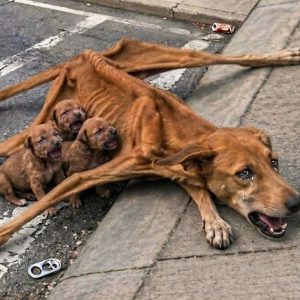
Marissa covered her mouth with both hands.
The taxi driver stood near the wall, staring down at his shoes as if he did not want anyone to see his eyes.
The mother dog kept turning her head toward the heated box.
Even while the doctor cleaned her wounds, even while he gave her fluids, she searched for the smallest puppy.
“She used all of her warmth on him,” Dr. Nolan murmured.
Then he looked at the old tag Marissa had placed on the counter.
“Where did this come from?”
Marissa explained the sidewalk, the towel, the message, and the address on the back.
Dr. Nolan’s expression tightened.
He reached for his phone and searched the clinic’s old records.
After a few minutes, he froze.
“I know this dog,” he said softly.
Marissa felt her stomach drop.
“Her name is Daisy.”
The name sounded too gentle for the way she had been found.
Dr. Nolan turned the screen toward Marissa.
There was a photo of the same cinnamon-colored dog, healthier, brighter, sitting beside an elderly man in a wheelchair.
The man had one hand resting on her head.
Both of them were smiling in the strange way only a lonely person and a loyal animal can smile together.
“Her owner was named Mr. Elias Hart,” the doctor said.
“He brought her here every year.”
“He passed away almost two months ago.”
The room went quiet.
Even the machines seemed softer.
Marissa looked down at Daisy, who had closed her eyes but still kept one paw stretched toward the box of puppies.
Dr. Nolan continued.
“After he passed, I heard his house was cleared out by relatives.”
“I thought Daisy had been taken by one of them.”
Marissa looked at the tag again.
He came back here for a reason.
But now she understood.
It was not about a man coming back.
It was about Daisy.
She had come back.
Back to the last place that still smelled like home.
Back to the street near the old address.
Back to the corner where someone might recognize the message tied around her neck.
Marissa asked the taxi driver to take her to the address while Daisy and the puppies stayed under care.
He nodded immediately.
Neither of them spoke during the short drive.
The address led them to a narrow brick building behind the closed laundromat.
The windows were dusty.
The mailbox was full.
A faded blue ribbon still hung on the front gate.
Marissa pushed it open, and it gave a low rusty cry.
In the small backyard, there was an old wooden doghouse under a dead lemon tree.
Beside it sat an empty bowl.
And next to the bowl, half-hidden beneath wet leaves, was another dirty towel.
Marissa stepped closer.
Her throat tightened.
Inside the doghouse were scraps of newspaper, an old blanket, and a small framed photo turned face down.
She lifted it.
It was Mr. Elias Hart again.
This time he was younger, standing in front of the same house with a brown puppy in his arms.
On the back, written in shaky blue ink, were the words:
“If Daisy ever returns here, please help her. She always finds her way home.”
Marissa could barely breathe.
The taxi driver removed his cap and held it against his chest.
“He knew,” he whispered.
Marissa looked around the abandoned yard, trying to understand the quiet story left behind.
Maybe Mr. Hart had known his relatives would not love Daisy.
Maybe he had feared she would be thrown away after he was gone.
Maybe the tag had been his last small attempt to protect the only family that had never left him.
They searched the back porch and found an old plastic container near the door.
Inside were more notes, a vet card, and a folded letter sealed in a cracked envelope.
The letter was not long.
But every word felt heavy.
“To whoever finds my Daisy, she is not just a dog.”
“She stayed beside me when my legs stopped working.”
“She barked until neighbors came when I fell in the kitchen.”
“She slept beside my chair every night after my wife left this world.”
“If she has come back here, it means no one kept their promise.”
“Please do not leave her alone.”
Marissa folded the letter with shaking hands.
For a moment, anger rose in her chest, hot and sharp.
Not because Daisy had been lost.
But because she had been forgotten by people who had once promised an old man they would protect her.
They returned to the clinic with the letter and the photo.
By then, the sun had gone down.
Main Street had changed into a river of headlights and shadows, but the clinic windows glowed like a small island of mercy.
Dr. Nolan met them in the hallway.
Daisy was alive.
The three stronger puppies were nursing again.
The fourth puppy had been warmed, fed drop by drop, and placed close enough for Daisy to see him.
“He made it through the first hour,” Dr. Nolan said.
“That is not everything.”
“But it is something.”
Marissa went into the treatment room.
Daisy opened her eyes when she heard the door.
Her tail did not move.
She had no strength for that.
But her gaze followed Marissa all the way across the room.
Marissa placed the photo beside her.
Then she placed the old letter near Daisy’s paw.
“I found your home,” she whispered.
“I found him.”
Daisy looked at the photo for a long moment.
No one could say whether dogs understand pictures the way people do.
But everyone in that room saw her breathing change.
Saw her eyes soften.
Saw her stop fighting the hands that were trying to help.
The next morning, Marissa wrote the story for the newspaper.
But she did not write it like another sad column.
She wrote it like a promise.
She wrote about the mother dog who refused food because she was using every last bit of strength to hide her weakest baby.
She wrote about the tag that carried an old man’s final request.
She wrote about the city that almost passed by, and the few strangers who finally stopped.
By noon, the article had spread farther than anyone expected.
People arrived at the clinic with blankets, puppy milk, small donations, and quiet apologies they did not know where else to place.
Some stood outside just to ask if Daisy was still alive.
Others cried when they saw the photograph of Mr. Hart taped to the waiting room wall.
Then, on the third day, a woman in her late sixties arrived with a shaking voice and red eyes.
Her name was Clara.
She had been Mr. Hart’s neighbor for twelve years.
“I thought Daisy had gone with his nephew,” she said.
“I asked once, and he told me she was fine.”
Then Clara saw Daisy through the glass.
She pressed both hands to her mouth.
Daisy lifted her head.
It was small.
It was weak.
But it was enough.
Clara began to cry so hard that Dr. Nolan had to bring her a chair.
“She used to come to my porch every morning,” Clara whispered.
“Elias would say she was checking whether I was still alive.”
Marissa asked the question everyone was afraid to ask.
“Would you take her?”
Clara did not answer right away.
She looked at Daisy.
Then at the four puppies curled beside her.
Then at the old photo of Mr. Hart.
“I should have looked harder,” Clara said.
Her voice broke.
“So yes.”
“I will take all of them.”
Weeks passed.
Daisy did not heal quickly.
There were days when she refused to stand.
Days when she watched the door as if still waiting for the sound of a wheelchair rolling across old wooden floors.
But her puppies grew.
The three stronger ones became round and loud.
The fourth, the tiny one from beneath the towel, stayed smaller than the rest but fought harder than all of them.
Clara named him Hope.
Not because the story was pretty.
But because he was proof that even a life hidden under dust, fear, and cold concrete could still reach morning.
Marissa visited every Sunday.
Sometimes she brought food.
Sometimes she brought toys.
Sometimes she brought nothing at all, only herself.
Daisy always recognized her.
She would place her head against Marissa’s knee, quiet and heavy, as if thanking her without needing words.
One afternoon, almost two months after Main Street, Clara called Marissa to the backyard.
The old doghouse had been cleaned and painted.
The dead lemon tree had been trimmed.
A small wooden sign hung above the entrance.
It read:
“Daisy’s Home.”
Under it, Clara had nailed the old metal tag.
Not polished too brightly.
Not made new.
Just clean enough for the words to be seen.
HE CAME BACK HERE FOR A REASON.
Marissa stood in the yard with tears in her eyes.
Because now the message meant something different.
Mr. Hart had not come back.
Daisy had.
The puppies had.
Kindness had.
And maybe, in the strange secret way love survives after loss, the old man had come back too.
Not as a ghost.
Not as a miracle anyone could prove.
But in a tag, a letter, a neighbor’s regret, a reporter’s hands, a driver’s silence, and a mother’s body wrapped around one tiny breathing life.
That evening, Marissa walked once more past Main Street and 2nd Avenue.
The deli lights still blinked red and green.
Cars still rushed by.
People still moved too quickly.
The city had not become gentle overnight.
But at the edge of the sidewalk, where Daisy had once lain on the burning concrete, someone had placed a small bowl of water.
Beside it was a folded note.
“For the ones we almost don’t see.”
Marissa bent down and touched the note.
Then she smiled through her tears.
Because sometimes a story does not change the whole world.
Sometimes it only changes one corner.
One stranger.
One hungry animal.
One hidden life beneath a dirty towel.