Part 2: The Door Opens
The sound of the front door opening did not feel like a sound anymore.
It felt like a verdict sliding into the house.
Lucy pressed one hand over Tommy’s mouth before he could gasp.
His little body trembled against her chest, hot with fear and weakness.
From the hallway came Steven’s voice, low and strained.
“Just stay behind me. Don’t touch anything.”
A woman answered him.
“I told you this was moving too fast.”
Lucy’s mind froze.
She knew that voice.
Not well. Not as a friend. But she had heard it before, soft and polite,
floating across parent-teacher conferences and school fundraisers.
Mara Lewis.
Tommy’s substitute teacher.
Lucy closed her eyes for half a second, and everything inside her rearranged itself painfully.
This was not just betrayal.
This had been standing near her son for months.
Steven’s footsteps crossed the living room. Then stopped.
“They’re gone,” he whispered.
Mara’s voice sharpened.
“What do you mean, gone?”
“They were right here.”
Lucy felt Tommy’s fingers dig into her sleeve.
The bathroom door was thin. Too thin.
The lock was old, loose, the kind Steven had always promised to replace.
The operator was still on the phone, faintly asking something.
Lucy lowered the phone against the folded towel beside the sink, hoping the line stayed open.
Steven moved closer.
“Lucy?”
His voice changed instantly.
It became the voice he used in public.
Concerned. Gentle. Almost believable.
“Lucy, honey? Tommy?”
Mara whispered something Lucy could not catch.
Then Steven tried the bathroom handle.
The knob twisted once.
Twice.
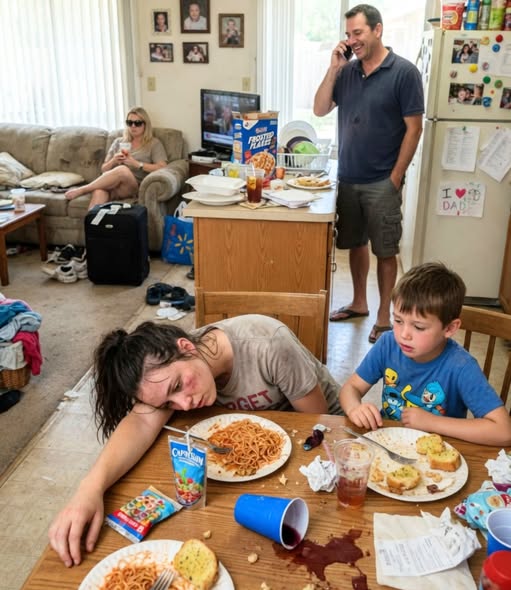
Tommy squeezed his eyes shut.
Lucy leaned toward his ear and breathed, almost without sound.
“Do not move.”
Steven knocked.
“Lucy, open the door. I know you’re in there.”
No answer.
The sirens were louder now, but still distant enough to feel uncertain.
Lucy could hear them cutting through the neighborhood streets.
Steven heard them too.
His breathing changed.
“What did you do?” he said through the door.
Lucy did not answer.
“What did you do, Lucy?”
Mara hissed behind him.
“We need to leave. Now.”
“No,” Steven snapped. “If they talk, we’re finished.”
For one terrible second, Lucy understood the choice in front of her.
Stay silent and wait for help.
Or speak, stall him, and risk making him desperate.
Then Tommy’s knees buckled slightly, and his forehead dropped against her shoulder.
That decided it.
Lucy lifted her head.
“The police heard everything.”
Silence landed on the other side of the door.
Steven did not speak.
Mara did.
“You said they would be unconscious.”
Lucy’s throat burned, but she forced the words out.
“You chose the wrong amount, Steven.”
It was a lie.
She had no idea what he had used or how much.
But she needed fear to do what strength could not.
Steven hit the door with his palm.
Tommy flinched.
“You always thought you were smarter than me,” Steven said.
Lucy stared at the old lock.
“No. I just never thought you were capable of this.”
Another pause.
That one was different.
Not angry.
Wounded.
And somehow, that made it worse.
Outside, a car door slammed. Then another.
A voice shouted from the front yard.
“Police! Open the door!”
Mara began to cry.
Not loudly. Not from guilt.
From being caught.
Steven backed away from the bathroom door. Lucy heard hurried steps,
then a crash from the kitchen, as if someone had knocked into a chair.
“Steven!” Mara shouted.
“Shut up,” he barked.
“Police!” the voice outside shouted again. “Open the door now!”
Lucy grabbed Tommy under the arms.
“Stay with me. Look at me.”
“I’m tired,” he whispered.
“I know, baby. I know. But you can be tired later.”
The front door burst open with a heavy crack.
Men shouted. Steven yelled something back. Mara screamed.
For a moment, the house became nothing but footsteps and commands.
Lucy crawled to the bathroom door and unlocked it with fingers that barely worked.
The door opened before she could pull it fully.
An officer crouched in front of her.
“Ma’am, are you Lucy?”
She nodded.
“My son,” she said. “Please. My son first.”
The officer’s face changed when he saw Tommy.
“Paramedics! Bathroom!”
Lucy did not remember being lifted.
She remembered the hallway ceiling moving above her, the old light fixture, the crack near the vent.
She remembered seeing Steven pinned near the kitchen island, his face pale,
his mouth moving as if he could still explain himself.
And she remembered Mara standing by the front door with both hands raised,
mascara running down her cheeks, looking smaller than Lucy expected.
Their eyes met.
Mara looked away first.
At the hospital, time broke into pieces.
A needle in Lucy’s arm.
Tommy behind a curtain.
A nurse asking when they had eaten.
A doctor saying they were lucky.
A police officer asking if she could answer questions.
Lucy kept asking one thing.
“Is Tommy going to be okay?”
Everyone answered carefully.
“We’re doing everything we need to do.”
That was not enough.
Nothing was enough until Tommy opened his eyes at 1:17 in the morning
and whispered, “Mom?”
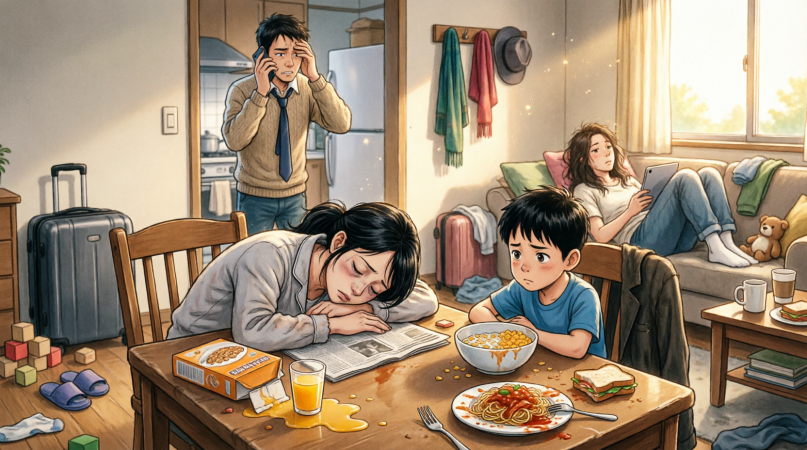
Lucy broke then.
Not loudly. Not dramatically.
She just folded over his hospital bed and cried into the blanket,
trying not to shake him, trying not to scare him.
Tommy lifted his hand weakly and touched her hair.
“Did Dad really do that?”
There it was.
The question no mother could answer without breaking something sacred.
Lucy looked at her son’s face.
Nine years old. Too young for this truth. Too old for a lie.
She wanted to say no.
She wanted to say his father had made a mistake, that something had gone wrong,
that adults sometimes did terrible things without meaning to.
But the phone call still rang in her head.
“It’s done.”
“We’re finally going to stop hiding.”
“Now I’m finally going to be free.”
Lucy swallowed.
“Yes,” she whispered. “He did.”
Tommy turned his face toward the window.
For a long time, he said nothing.
Then he asked, “Was it because of me?”
Lucy felt something inside her go cold with rage.
“No.”
He did not look convinced.
She took his hand carefully, mindful of the IV.
“Listen to me. This was not because of you.
Not because you talked too much, not because you needed things, not because you loved him.”
Tommy’s lip trembled.
“Then why?”
Lucy did not know how to explain selfishness to a child
without making the whole world seem unsafe.
So she told him the only truth she trusted.
“Because something in him was broken, and he chose to hurt us instead of facing it.”
Tommy closed his eyes.
Lucy stayed awake all night.
By morning, the detectives returned.
They told her what they had found in the trash.
A small pharmacy bag.
A receipt.
A torn instruction sheet.
And a disposable glove with Steven’s fingerprints inside.
The unknown message had saved them from losing proof.
Lucy asked the question immediately.
“Who sent it?”
The detective, a woman named Harris, exchanged a glance with her partner.
“We’re still confirming.”
Lucy sat straighter despite the dizziness.
“Tell me.”
Detective Harris exhaled.
“It appears the message came from Mara Lewis’s phone.”
Lucy stared at her.
“That doesn’t make sense.”
“We believe she sent it while your husband was outside loading the bag.”
Lucy’s first instinct was disbelief.
Mara had been in her house.
Mara had stood behind Steven while he tried the bathroom door.
Mara had known.
Detective Harris continued carefully.
“She is claiming she didn’t know your son was supposed to eat.”
Lucy laughed once.
It sounded nothing like laughter.
“She was his teacher.”
“I know.”
“She stood outside that door.”
“I know.”
“She came back with him.”
Detective Harris lowered her voice.
“Lucy, people involved in crimes often tell partial truths.
Sometimes to save themselves. Sometimes because one piece of them panicked too late.”
Lucy looked through the glass at Tommy sleeping.
Too late.
Those words stayed with her.
That afternoon, Lucy’s sister Rachel arrived, furious and crying,
with a duffel bag of clothes and a face full of questions.
Lucy could not answer most of them.
Rachel sat beside her and whispered, “You’re coming home with me.”
Lucy nodded.
There was no argument left in her.
But leaving the hospital did not mean escaping.
News spread fast.
By the next evening, neighbors had heard enough to stop pretending they were not looking.
People sent messages that sounded kind but felt hungry.
I’m so sorry.
Were there signs?
Did you know about the other woman?
Is Tommy okay?
Lucy stopped reading.
Then came Steven’s mother.
Evelyn arrived at the hospital carrying a beige purse and righteous disbelief.
She did not hug Lucy.
She looked past her toward Tommy’s room.
“I need to see my grandson.”
Lucy stepped in front of the door.
“No.”
Evelyn stiffened.
“Lucy, this is not the time for bitterness.”
The word almost made Lucy smile.
Bitterness.
As if she had been denied a holiday invitation, not nearly erased from her own life.
“You need to leave.”
“My son would never do this.”
Lucy’s hands curled.
“He did.”
“You don’t know what was happening in his mind.”
“I know what happened in my kitchen.”
Evelyn lowered her voice.
“Men don’t just snap for no reason.”
Lucy felt Rachel shift behind her, ready to step in.
But Lucy lifted one hand.
“No. Let her finish.”
Evelyn’s face tightened.
“You two had problems. Everyone knew that.”
Lucy took one step closer.
“We had bills. We had silence. We had distance.
What we did not have was a reason for him to hurt a child.”
For the first time, Evelyn looked uncertain.
Only for a second.
Then she said the sentence Lucy would remember for years.
“Maybe he knew you would take Tommy from him.”
Lucy’s vision narrowed.
Rachel moved fast, placing herself between them.
“Get out,” Rachel said.
Evelyn pointed at Lucy with a shaking finger.
“You will regret turning my grandson against his father.”
Lucy answered quietly.
“His father did that himself.”
Security escorted Evelyn out.
Tommy had heard enough from the hallway to ask later,
“Does Grandma think I should forgive him?”
Lucy sat beside him, exhausted beyond words.
“I think Grandma is trying to protect the version of him she can survive loving.”
Tommy frowned.
“Is that wrong?”
There it was again.
No clean answer.
Lucy thought of Evelyn holding Steven as a baby.
Of every mother who believed love could explain what truth could not.
Then she thought of the bathroom door shaking under Steven’s hand.
“It’s human,” Lucy said. “But it can still hurt people.”
Three days later, Lucy and Tommy moved into Rachel’s spare room.
The room had yellow curtains, a narrow bed, and boxes stacked against one wall.
Tommy slept with the light on.
Lucy slept on the floor beside him.
Every creak in the house woke them both.
At night, Tommy would ask questions in the dark.
“Did Dad love us before?”
“Was he pretending the whole time?”
“Will he come here?”
Lucy answered what she could.
Sometimes the truth was too heavy, so she held his hand instead.
Then the prosecutor called.
Steven wanted a deal.
Lucy sat at Rachel’s kitchen table while the coffee went cold in front of her.
The prosecutor explained it gently.
Steven’s lawyer claimed emotional instability, pressure, manipulation by Mara,
and financial desperation.
Lucy listened without blinking.
Then came the part that changed everything.
“There is one complication,” the prosecutor said.
“What complication?”
“Mara is willing to testify against him.”
Lucy gripped the phone.
“In exchange for what?”
“A reduced charge.”
Rachel mouthed, no.
Lucy looked toward the living room, where Tommy was building a small Lego house
with a crooked roof and no doors.
“No,” Lucy said.
The prosecutor paused.
“Lucy, without her testimony, the case is still strong.
But with it, we can prove intent much more clearly.”
“She was there.”
“Yes.”
“She knew.”
“Yes.”
“She came back with him.”
“Yes.”
“And you want me to accept that she walks away lighter because she got scared?”
The prosecutor did not argue.
He simply said, “I want you to understand the choice.”
There it was.
The choice.
Not between good and bad.
Between two kinds of damage.
Refuse the deal, and Steven might twist the story.
Accept it, and Mara would stand in court as a helper instead of what she had been.
Lucy asked for time.
That night, she told Rachel.
Rachel slammed a cabinet door.
“That woman should be buried under the courthouse.”
“Rachel.”
“I mean it emotionally,” Rachel snapped. “Don’t look at me like that.”
Lucy almost laughed, but she was too tired.
Rachel sat across from her.
“You cannot let Mara become the hero.”
“I know.”
“Then say no.”
Lucy watched Tommy in the next room.
He was placing tiny Lego people behind the window of the roofless house.
“What if saying no gives Steven room to escape the truth?”
Rachel’s anger softened.
“Lucy.”
“What if the thing that protects Tommy most is letting one person get less than she deserves?”
Rachel had no answer.
Neither did Lucy.
The next morning, Detective Harris brought Lucy a copy of Mara’s statement.
Lucy read it in silence.
Mara claimed she had met Steven at school during a pickup issue.
He had seemed sad, lonely, trapped.
She said he told her Lucy was controlling.
That Lucy threatened to keep Tommy away. That Lucy was unstable.
Lucy read those lines twice.
Not because they surprised her.
Because she could hear Steven’s voice in them.
Mara said the plan had originally been only to make Lucy “sick enough”
that Steven could file for emergency custody.
Then, according to Mara, Steven changed.
He became colder.
More final.
She said she realized too late that Tommy’s plate had also been served.
Lucy stopped reading there.
Her hands shook.
Too late.
Again.
On the last page, Mara had written one sentence by hand.
I know I do not deserve forgiveness, but I sent the message because I saw his lunchbox on the counter
and understood Tommy had eaten too.
Lucy stared at that sentence until the words blurred.
She wanted to hate it.
She wanted it to be fake.
But the lunchbox detail was true.
Tommy had left it there after school, blue with a broken zipper pull.
That was the moment Mara had understood.
Not when Steven planned it.
Not when Lucy fell.
Not when Tommy collapsed.
Only when proof of the child became impossible to ignore.
Lucy folded the statement and placed it on the table.
“What are you going to do?” Rachel asked.
Lucy looked at her sister.
“I don’t know.”
But she did know one thing.
She could not decide alone.
That evening, after dinner, Lucy sat with Tommy on the porch.
The air smelled like wet leaves and distant barbecue.
For a while, neither of them spoke.
Then Lucy said, “There’s something about the case I need to tell you.”
Tommy looked at her carefully.
He had become careful about everything.
She explained as gently as she could.
Mara had helped Steven.
Mara had also sent the message.
Mara might testify.
Tommy listened without moving.
When Lucy finished, he asked, “So she saved us?”
Lucy closed her eyes.
“She helped put us in danger. Then she helped us get found.”
Tommy looked down at his shoes.
“That’s confusing.”
“Yes.”
“Do you hate her?”
Lucy wanted to say yes.
It would have been easy.
Clean.
A word strong enough to hold all her fear.
But her son was watching her, learning what truth sounded like
when it did not come wrapped in certainty.
“I don’t know what I feel,” she said.
Tommy nodded slowly.
“Do I have to forgive her?”
“No.”
“Do I have to forgive Dad?”
Lucy’s throat tightened.
“No.”
“Will people tell me I should?”
“Yes,” she said. “Some will.”
“What do I say?”
Lucy reached for his hand.
“You say forgiveness is not homework.”
Tommy leaned against her.
For the first time since the hospital, he cried without trying to hide it.
The hearing took place two weeks later.
Lucy wore a gray dress Rachel ironed for her.
Tommy stayed home with Rachel’s husband.
The courthouse hallway was colder than it needed to be.
Steven looked thinner.
His hair was neatly combed. His suit was dark.
He looked like a man attending someone else’s disaster.
When he saw Lucy, his face changed.
For one absurd second, she expected apology.
Instead, he mouthed, please.
Lucy looked away.
Mara sat on the opposite bench with her lawyer.
She did not wear makeup. Her hands were clasped so tightly her knuckles had gone pale.
The prosecutor met Lucy outside the courtroom.
“We need your final position on the cooperation agreement.”
Lucy looked through the small window in the courtroom door.
Steven was whispering to his lawyer.
Mara stared at the floor.
Lucy thought of Tommy asking whether he had to forgive.
She thought of Evelyn protecting a son who no longer existed
in the way she needed him to exist.
She thought of herself, months earlier, pretending not to notice Steven’s strange silences
because noticing would require action.
That was the truth she had not wanted to face.
Not that she caused it.
Never that.
But that part of her had protected the life she wanted
long after the life itself had become unsafe.
The prosecutor waited.
Lucy took a breath.
“Use her testimony.”
Rachel, standing behind her, whispered, “Lucy.”
Lucy kept her eyes on the courtroom.
“But I want the record clear. She is not brave.
She is not innocent. She does not get to become the reason we survived.”
The prosecutor nodded.
“We can make that clear.”
Lucy turned to him.
“No. I will make it clear.”
Inside the courtroom, when Lucy was asked whether she wanted to speak,
her legs nearly failed her.
But she stood.
Steven did not look at her at first.
So she spoke to the room.
“My son asked me if forgiveness is required after someone breaks your life.”
The judge grew still.
Lucy continued.
“I told him no. And I am saying that here too.
We are not here because of a mistake. We are here because of choices.”
Steven lowered his head.
“Mara Lewis made choices. Steven made choices.
And I am making one now.”
She turned toward Mara.
“I will not pretend your message did not matter.
My son is breathing because you sent it.”
Mara began to cry silently.
Lucy did not soften.
“But I will also not let anyone call that message goodness.
Goodness would have been stopping him before dinner.”
The courtroom was silent.
Lucy turned to Steven.
“And you.”
Her voice almost broke.
“You were supposed to be the person Tommy ran to when he was scared.”
Steven finally looked up.
His eyes were wet.
Lucy hated that they still looked familiar.
“You do not get to use tears now as proof of love.
Love was the door you tried to open after we called for help.”
Steven flinched.
Lucy placed one hand on the wooden rail.
“I wanted to protect my son from the truth.
I wanted to tell him his father was sick, confused, manipulated, anything softer.”
She breathed in.
“But I will not build his healing on a lie.”
Then she said the sentence that ended her old life completely.
“Steven chose to hurt us. And Tommy deserves a world where that truth is spoken plainly.”
Afterward, Lucy sat in the restroom stall and shook so hard Rachel had to hold her upright.
But something had shifted.
Not healed.
Not fixed.
Just shifted.
Like a locked window finally cracked open.
Months later, Tommy started therapy.
Lucy did too.
They moved into a small apartment with noisy pipes and sunlight in the kitchen.
Tommy chose blue curtains for his room.
On the first night, he asked if they could eat cereal for dinner.
Lucy said yes.
They sat on the floor, bowls in hand, surrounded by unopened boxes.
Tommy looked around.
“It’s smaller than our old house.”
Lucy nodded.
“It is.”
“But it feels quieter.”
Lucy smiled sadly.
“Quiet can be good.”
He thought about that.
“Can we make pancakes on Saturday?”
“Of course.”
“Can I help?”
“Yes.”
He hesitated.
“Can we throw away Dad’s old recipe book?”
Lucy had packed it by accident.
It sat in a box near the door.
For a moment, she saw Steven standing in the kitchen, smiling that rehearsed smile.
Then she saw Tommy on the rug.
The choice was small.
And it was everything.
Lucy stood, picked up the book, and handed it to Tommy.
“You decide.”
Tommy held it like it weighed more than paper.
Then he walked to the trash can, opened the lid, and dropped it in.
No dramatic music.
No perfect ending.
Just a soft thud.
Lucy pulled him close.
That Saturday, they made pancakes from a recipe online.
They burned the first batch.
Tommy laughed for the first time without stopping himself halfway.
Lucy laughed too.
And when the smoke alarm chirped, they both froze for one second.
Then Tommy grabbed a towel and waved it under the ceiling.
“It’s okay,” he said, almost to himself.
Lucy looked at him.
At the boy who had survived a truth no child should carry.
At the life they had not chosen but still had to live.
And she understood something simple, painful, and saving.
The night of the dinner had not been the end of their family.
It had been the end of the lie.
What came after would be harder than pretending.
But it would be real.

