Your Son Begged You to Cut Off His Arm—You Thought He Was Losing His Mind, Until the Nanny Broke the Cast and Exposed Your New Wife’s Revenge
You tie your son’s healthy wrist to the bed.
Even as you do it, some part of you knows it is wrong. Diego is crying so hard his voice breaks, twisting beneath the sheets, begging you not to leave him trapped inside his own body. But Valeria stands behind you in her silk robe, whispering that this is love, that discipline is sometimes mercy, that a father must be strong when a child becomes dangerous.
So you believe her.
Or maybe you choose to believe her because the alternative is unbearable.
“Daddy, please,” Diego sobs. “Please, it hurts. They’re moving. They’re biting me.”
You tighten the belt around the bed frame.
Not enough to cut him.
Enough to stop him.
Enough to silence the banging.
Enough to make you hate yourself.
“You need to rest,” you say, but your voice sounds like a stranger’s.
Diego looks at you with terror so pure it should have stopped your heart.
“You don’t believe me.”
You cannot answer.
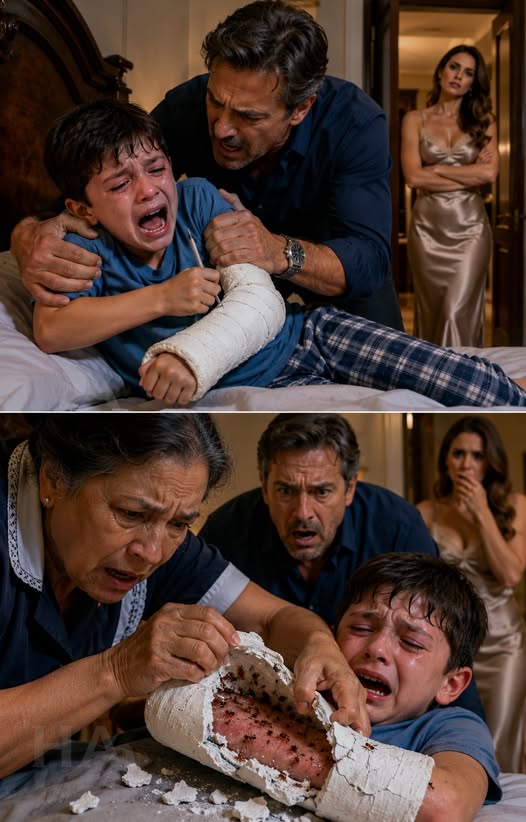
Valeria steps forward and places a hand on your shoulder.
“He’ll understand one day,” she murmurs. “When he’s stable.”
From the hallway, Elvira watches without blinking.
The old nanny has been in your house since before Diego learned to walk. She held him when his mother died. She sang to him through fevers. She knew the difference between a tantrum, grief, fear, and real pain.
And right now, her face says she knows you are making the worst mistake of your life.
You ignore her.
Because if you listen to Elvira, you will have to admit you have failed your son.
By dawn, the house is quiet.
Not peaceful.
Quiet the way a house becomes after it has swallowed a scream.
You sit in your study with a glass of whiskey untouched beside your hand. Your eyes burn from four sleepless nights. Your phone is full of messages from Valeria’s psychiatrist friend, recommending evaluation, medication, observation, possible inpatient care.
Words that sound clean.
Words that make a terrified child look like a case file.
You replay Diego’s voice in your head.
Cut it off.
They’re eating me alive.
You press both hands against your face.
A knock comes at the door.
Before you answer, Elvira enters.
She does not ask permission.
That alone makes you look up.
“Patrón,” she says, voice low, “I need you to come upstairs.”
“Elvira, I can’t do this again.”
“You need to come now.”
Her tone is different.
Not pleading.
Commanding.
You stand slowly.
“What happened?”
She holds out her palm.
In the center of it lies a tiny red ant.
Dead.
Your stomach tightens.
“Elvira.”
“There were three more on his sheet.”
You stare at the insect.
Then at her.
“Maybe from the garden.”
“No,” she says. “They were coming from the cast.”
The room goes cold.
For one second, Valeria’s voice rises in your mind.
Manipulation.
Paranoia.
Attention.
Then another voice comes.
Diego’s.
They’re getting in.
They’re biting me.
You move before you fully understand.
When you reach Diego’s room, he is half-conscious, skin damp, lips dry. The leather belt still holds his left wrist to the bed frame. His right arm lies across his chest inside the cast, swollen at the fingers, the skin near the edge red and raw.
The smell hits you now.
How did you miss it before?
Sweet.
Rotten.
Wrong.
Your knees almost buckle.
“Elvira,” you whisper.
She is already at the nightstand, pulling out scissors, towels, and the small emergency kit she keeps for everything from fevers to scraped knees.
“We need a doctor,” you say.
“We need the cast open first.”
“No. We can’t. If the bone—”
“If we wait,” Elvira says, eyes blazing, “there may not be a child to save.”
That shuts you up.
Diego stirs.
“Daddy?” he whispers.
You rush to him and unfasten the belt with trembling hands.
His left wrist is red where the leather pressed against it.
The sight destroys you.
“Diego, I’m here.”
He tries to pull away.
From you.
Not from the cast.
From you.
That hurts more than any accusation.
“Elvira,” he whimpers. “Please. Please.”
The nanny bends over him, pressing a cool cloth to his forehead.
“I’m here, mi niño. I’m going to help you.”
You reach for your phone.
Valeria appears in the doorway.
“What are you doing?”
Her voice is sharp now.
Not sweet.
Not concerned.
Sharp.
Elvira does not even look at her.
“We’re opening the cast.”
Valeria steps inside. “Absolutely not. The doctor said—”
“The doctor did not smell this,” Elvira snaps.
You look at Valeria.
For the first time since the nightmare began, you see something flash across her face.
Not worry.
Fear.
Your chest tightens.
“Valeria,” you say slowly, “why are you afraid of us opening it?”
Her expression changes instantly.
Tears fill her eyes.
“You’re accusing me now? After everything I’ve done for this family?”
A week ago, that would have worked.
A day ago, maybe.
But not with the smell in the room.
Not with the ants.
Not with your son’s fingers swollen and shaking.
“Move,” you say.
Her eyes harden.
Just for a second.
Then she steps aside.
Elvira takes the cast cutter from the emergency bag.
You do not ask why she has one.
Later, she will tell you that when she realized no one would believe Diego, she called an old friend from a clinic and begged for help.
Right now, all you hear is the small grinding sound as she begins cutting through the plaster.
Diego screams.
Not because the cutter touches him.
Because the vibration wakes whatever is inside.
“They’re moving!” he cries. “Daddy, they’re moving!”
You grab his shoulders gently, tears already blurring your vision.
“I’m sorry. I’m sorry. I’m here.”
He looks at you with pure panic.
“You didn’t believe me.”
The words are worse than any curse.
“No,” you whisper. “I didn’t.”
Elvira cuts faster.
The room fills with dust, heat, and that terrible smell.
Valeria stands near the door, too still.
Then the cast cracks.
Elvira pries it open.
For one second, nobody moves.
Then she gasps.
You see red first.
Not blood exactly.
Irritated skin.
Swelling.
Dark spots.
Small moving bodies.
Ants.
Dozens of them, trapped beneath the cast, crawling through sticky brown residue smeared along the inner padding. Some are dead. Some are alive. Some disappear into folds of gauze where the skin has been rubbed raw.
Your vision narrows.
Diego’s screams become distant.
Elvira shouts for towels, water, alcohol, gloves.
You cannot move.
Because your son was telling the truth.
Your son was telling the truth.
Your son begged you to cut off his arm because something was literally eating at him under the cast.
And you tied him to the bed.
Elvira slaps your arm.
“Move, Alejandro!”
That brings you back.
You run for water.
You call the ambulance.
You call the orthopedic surgeon.
You call emergency services and can barely speak.
“My son,” you say. “His cast. There are insects inside. Infection risk. He needs help now.”
Valeria backs toward the hallway.
You see her.
“Elvira,” you say without looking away, “lock the front door.”
Valeria freezes.
“What?”
You step toward her.
“Where are you going?”
She laughs, but it is thin. “To get dressed. We need to go to the hospital.”
“No.”
Her face changes.
You have seen Valeria angry before.
Elegant anger.
Polished anger.
The kind of anger that makes staff disappear and waiters apologize for things they did not do.
This is different.
This is trapped anger.
“Do not look at me like that,” she says.
You stare at her.
“What did you do?”
Her mouth opens.
No sound comes.
Behind you, Diego sobs while Elvira cleans the exposed skin as gently as she can. He is shaking. He is feverish. He is alive.
And every second makes the question louder.
“What did you do to my son?”
Valeria’s eyes fill again.
“You’re insane.”
“No,” you say. “That was your word for him.”
The ambulance arrives fourteen minutes later.
Paramedics rush in. Elvira gives a fast, precise explanation, far calmer than you deserve. The exposed arm is covered, treated, stabilized. Diego is lifted onto a stretcher, still crying, still begging not to let Valeria near him.
That is when one paramedic pauses.
He looks at you.
Then at Valeria.
Then back at Diego.
“Sir,” he says carefully, “we’re required to report suspected child abuse.”
The room goes silent.
Valeria explodes.
“Child abuse? He broke his arm at school! His own paranoia made this worse!”
Diego turns his face into Elvira’s hand.
The paramedic does not argue.
He simply says, “We’re required to report it.”
For the first time in your marriage, Valeria looks at you not as a husband, but as a man who might become useless to her.
“Tell them,” she says.
You look at your son.
His eyelids flutter. His lips are gray. His body is exhausted from days of torture you dismissed as madness.
Then you look back at your wife.
“No.”
Her face drains.
The hospital becomes a blur.
Emergency care.
Orthopedic consult.
Infectious disease consult.
Antihistamines.
Antibiotics.
Wound cleaning.
Pain control.
Bloodwork.
Photographs.
Reports.
Doctors speak in low, controlled voices that make everything sound even worse.
Chemical irritant.
Insect contamination.
Deliberate introduction possible.
Cast tampering.
Prolonged distress.
Psychological trauma.
You stand beside Diego’s bed while he sleeps under medication, his arm cleaned and bandaged, the broken bone stabilized again.
He looks small.
Too small.
Ten years old.
Your son.
Your little boy who once asked if clouds got tired from moving all day.
You press your hand against the bed rail because you are afraid if you touch him, he will wake and recoil.
Elvira sits on the other side of the bed, humming an old song from Oaxaca.
She has not looked at you in two hours.
You deserve that.
A doctor named Dr. Herrera enters with a serious face.
“Mr. De la Vega?”
You straighten. “Yes.”
“We removed organic material from inside the cast. There was sugar residue, honey or syrup-like substance, and evidence of red ant activity. The inner padding appears to have been deliberately contaminated after the cast was placed.”
Your mouth goes dry.
“After?”
“Yes. The exterior cast was punctured in several spots. Small holes. Possibly made with a needle or fine tool. Enough to inject or introduce sweet liquid under the padding.”
The hallway seems to tilt.
You remember Diego screaming the first night.
It burns.
You remember Valeria telling you not to remove the cast.
It burns deeper.
Dr. Herrera continues, “The skin damage is painful but treatable. Infection risk is being managed. The greater concern is the delay. He was in severe distress.”
Delay.
A clean word for your failure.
You close your eyes.
“He told me,” you whisper.
The doctor says nothing.
That silence is mercy and judgment together.
Child Protective Services arrives before noon.
So do the police.
Valeria tries to enter Diego’s room wearing a cream dress and perfect makeup, carrying a stuffed bear from the hospital gift shop like a prop. Elvira stands in the doorway.
“You do not pass.”
Valeria’s smile tightens. “You are the nanny.”
“And you are the woman he fears.”
The police officer nearby hears that.
So does CPS.
Valeria notices too late.
She turns to the officer with tears ready. “This woman has always hated me. She is poisoning Diego against me.”
Elvira lifts her chin.
“I did not put ants in a cast.”
The sentence lands like thunder.
Valeria’s eyes flash.
You step between them.
“Leave,” you say.
She stares at you.
“Alejandro, you cannot be serious.”
“I said leave.”
“You’re choosing a servant’s lies over your wife?”
Elvira flinches at the word servant, but only slightly.
You do not.
“I’m choosing my son’s body over your performance.”
Valeria’s face goes blank.
Then cold.
“You will regret humiliating me.”
That is not something an innocent woman says.
The officer writes it down.
Valeria sees the pen move and immediately softens.
“I’m under stress,” she says.
No one answers.
She leaves escorted by security.
For the next two days, Diego barely speaks.
Not to you.
Not to doctors.
Only to Elvira.
You do not force him.
Your therapist friend, Dr. Marín, tells you over the phone that trust, once broken by a parent, does not return because the parent is sorry.
“You want him to forgive you quickly so you can stop feeling like a monster,” Dr. Marín says.
The words hurt because they are true.
“What do I do?”
“You sit in the discomfort. You tell the truth. You do not ask him to comfort you.”
So you sit.
You read beside his bed.
You bring water.
You step out when he asks.
One afternoon, Diego wakes and sees you sitting near the window.
He looks at you for a long moment.
Then whispers, “Did you send her away?”
“Yes.”
“Forever?”
You swallow.
“I’m trying.”
His eyes fill.
“She smiled when it started.”
Your hands go cold.
“What do you mean?”
He looks toward Elvira.
She nods gently.
Diego’s voice trembles.
“The day after the cast. She came into my room when you were at work. She said if I kept being rude to her, I would learn what patience means. Then she put something in the top.”
You stop breathing.
“What did she put?”
“I don’t know. It was sticky. She said it was medicine because the cast smelled bad. Then the ants came that night.”
Your vision darkens at the edges.
You grip the chair until your knuckles whiten.
“Why didn’t you tell me?”
Diego’s face twists.
“I did.”
That destroys you.
He did.
He told you with every scream.
You were the one who demanded he say it in a way your poisoned mind would accept.
You get up and walk into the hallway before you break in front of him.
Elvira follows.
The moment the door closes, you put your hand against the wall and bend forward like someone punched you in the stomach.
Elvira’s voice is quiet.
“Now you know.”
You look at her through tears.
“I tied him down.”
“Yes.”
“I threatened to send him away.”
“Yes.”
“I believed her.”
“Yes.”
You almost wish she would soften it.
She does not.
Then she adds, “And now you will fix what can be fixed.”
You laugh bitterly. “How?”
“First, stop crying where he can hear you.”
You straighten.
She hands you a tissue.
“Second, find out why that woman hated a child enough to do this.”
The investigation begins in your own house.
You do not return alone.
Police execute a search warrant after the hospital report, Diego’s statement, and Elvira’s testimony. They search Valeria’s dressing room, bathroom, private office, and the small locked cabinet she said contained skincare samples.
Inside, they find syringes.
Small bottles of honey-thick liquid.
Insect bait.
A fine metal awl.
A printed article about fire ant reactions under medical dressings.
Your stomach turns when the officer shows you.
But the worst item is a notebook.
Valeria’s handwriting.
Pages of dates.
Complaints about Diego.
Plans.
Not openly criminal at first.
Just resentment dressed as strategy.
Diego interrupts dinners.
Diego manipulates Alejandro with grief.
Alejandro still keeps Mariana’s portrait in the study.
Diego must be removed before pregnancy.
You stop reading.
“Pregnancy?” you ask.
The officer looks uncomfortable.
“There are several references to wanting a child with you.”
Your throat tightens.
Valeria had spoken of children twice.
Both times vaguely.
You said it was too soon.
Diego was still adjusting.
She smiled and said of course.
Apparently, that smile hid a plan.
Then the final pages become darker.
If Diego is unstable, custody can shift.
Psychiatric record necessary.
Alejandro must see him as dangerous.
Pain makes children confess or break.
You stagger backward.
Elvira crosses herself.
The officer closes the notebook gently.
“I’m sorry,” he says.
You barely hear him.
Pain makes children confess or break.
Valeria had not snapped.
She had designed this.
Your son’s agony was not revenge in the heat of anger.
It was architecture.
Valeria disappears for six hours.
Then police find her at her sister’s house.
She claims she is being framed by jealous domestic staff and a disturbed child. She says the notebook is creative writing. She says the supplies were for garden pests. She says Diego hated her from the beginning and would do anything to destroy the marriage.
Then officers show her the security footage.
A small camera in the hallway outside Diego’s room captured her entering at 1:42 p.m. the day after the cast was placed, carrying the small silver case from her dressing room.
She stays inside for nine minutes.
Diego was asleep.
When she leaves, she is smiling.
Valeria stops talking after that.
Her attorney arrives.
You do not see her again until the first hearing.
Before then, another truth emerges.
Mariana’s portrait.
Your first wife.
Diego’s mother.
You kept her photo in the study, not in the bedroom, not in public spaces, but there. One framed photo beside your bookshelf. Mariana laughing in a blue dress, holding baby Diego against her chest.
Valeria hated it.
You knew that.
You thought it was insecurity.
You thought time would help.
Instead, she began visiting an online forum under a fake name, writing about “widow ghosts” and “spoiled stepchildren” and how men with dead wives never fully belong to the living.
Then investigators find messages between Valeria and her cousin.
He’ll never give me a child while Diego is in that house.
Make the boy look unstable.
If he goes away, Alejandro will need a new family.
A new family.
The phrase makes you physically sick.
Because you remember Valeria telling you exactly that after the school accident.
“Maybe Diego needs a therapeutic boarding program,” she said gently. “Somewhere structured. Then we can finally breathe.”
You thought she meant healing.
She meant removal.
At home, the first night without Diego, the house is unbearable.
His room smells like hospital disinfectant because Elvira cleaned it until her hands turned red. The headboard is dented from where he slammed the cast. The belt you used is gone because police took it as evidence.
You stand in the doorway for a long time.
Then you walk to the study.
Mariana’s photograph looks back at you.
For years, you told yourself you were honoring her by keeping the house intact, by making sure Diego had tutors, safety, structure, a future. You told yourself grief had softened into responsibility.
But you did not protect her son.
Not from Valeria.
Not from yourself.
You sit on the floor beneath the portrait and cry like a man who finally understands that money cannot purchase the right to be forgiven.
Elvira finds you there at dawn.
She does not comfort you.
She places a cup of coffee on the desk.
Then says, “He will come home. The question is what kind of father will be waiting.”
Diego is discharged after eight days.
He comes home in a smaller, removable brace and with a wound care plan. He also comes home with a therapist, a CPS safety plan, and a court order keeping Valeria away from him.
When he enters the house, he stops at the stairs.
His face turns pale.
You kneel several feet away.
Not blocking him.
Not reaching.
“I moved rooms,” you say. “You don’t have to sleep in the old one unless you want to.”
He looks at you.
“Where?”
“Your mother’s old studio.”
His eyes widen.
Mariana used to paint there. After she died, you locked the room because grief made you selfish. Diego had asked about it many times, and you always said later.
Later became years.
Now the studio is clean.
Sunlit.
Soft blue walls.
A bed near the window.
His books.
His telescope.
Mariana’s old easel in the corner, covered but not hidden.
Diego enters slowly.
He touches the windowsill.
Then the easel.
Then he sits on the bed.
“Can Elvira sleep nearby?”
You nod.
“She already chose the room next door.”
He looks down at his brace.
“Can I lock the door?”
Your chest aches.
“Yes.”
“From the inside?”
“Yes.”
He nods.
Then, after a long silence, he says, “You can say goodnight from the hallway.”
It is not forgiveness.
It is a door left slightly open.
You accept it like grace.
The trial becomes a media storm because your family is wealthy, Valeria is beautiful, and the crime is too horrifying for people to ignore.
Headlines call her the “Cast Stepmother.”
You hate the nickname.
Not because it is unfair to Valeria.
Because it turns Diego’s suffering into entertainment.
Your attorneys advise you to say nothing publicly.
For once, you agree.
The evidence speaks.
The hospital photographs.
The insects collected from the cast.
The puncture marks.
The chemical residue.
The notebook.
The messages.
The video.
Diego’s testimony is recorded privately to spare him the courtroom. He sits with a child psychologist and tells the story in a small voice that will haunt you forever.
She said Daddy would think I was crazy.
She said nobody believes bad children.
She said my mom was dead and couldn’t help me.
You leave the viewing room before you collapse.
Elvira stays.
She watches every second.
Later she tells you, “He looked brave.”
You say, “He looked hurt.”
She answers, “Both.”
Valeria’s defense is ugly.
Her lawyers claim Diego was disturbed after his mother’s death. They claim he placed substances in the cast himself. They claim Elvira manipulated him out of jealousy. They claim you are blaming your wife because you feel guilty.
That last part has some truth.
Not enough to save her.
But enough to burn.
During cross-examination, the prosecutor asks Valeria why she researched insect reactions under casts.
She smiles faintly.
“I was curious.”
The prosecutor asks why she bought bait and syringes.
“For garden pests.”
“In a locked skincare cabinet?”
“I have a large house.”
Then they show the message.
Make the boy look unstable.
Valeria’s face changes.
Just slightly.
The jury sees it.
Your son’s pain becomes impossible to dismiss.
When Elvira testifies, the courtroom shifts.
She walks slowly to the stand, dressed in a simple black dress, silver hair pinned back, eyes sharp as broken glass.
Valeria watches her with hatred.
Elvira does not look at her.
The prosecutor asks, “How long have you cared for Diego?”
“Since he was born.”
“Did you believe his complaints?”
“Yes.”
“Why?”
Elvira looks toward the jury.
“Because children do not invent pain that makes them beg to lose an arm.”
The room goes silent.
Then the prosecutor asks what she saw.
The smell.
The ants.
The swelling.
The father’s refusal.
The belt.
Your shame becomes public.
You do not hide from it.
When your turn comes, you take the stand and tell the truth.
All of it.
That you believed Valeria.
That you threatened Diego with psychiatric admission.
That you tied his wrist.
That you ignored the smell.
That you thought grief had made him difficult, dramatic, unstable.
Valeria’s lawyer seizes on it.
“So you admit you abused your son that night.”
The courtroom holds its breath.
You close your eyes once.
Then open them.
“Yes.”
Your lawyer stiffens.
Valeria’s lawyer looks surprised.
You continue.
“I did something terrible because I believed a lie that was easier than my son’s pain. That does not make Valeria innocent. It makes me responsible for my failure and her responsible for her crime.”
No one speaks.
The defense loses rhythm after that.
Because men like you are expected to protect reputation first.
You do not.
You protect the record.
Valeria is convicted of aggravated child abuse, poisoning-related assault, evidence tampering, and attempted coercive confinement through false psychiatric claims.
The sentence is long.
Not long enough, Elvira says.
Maybe she is right.
At sentencing, Valeria asks to speak.
She wears a gray dress, no makeup, hair pulled back, face pale and controlled.
She says she loved you.
She says Diego rejected her.
She says living in the shadow of a dead woman destroyed her mental health.
She says she never meant it to go that far.
You listen.
Then the judge allows you to speak.
You stand with Diego’s written statement in your pocket, though you do not read it. Some words belong to children and should not be used as weapons twice.
“My wife did not live in the shadow of a dead woman,” you say. “She lived in the presence of a child who still needed his mother remembered.”
Valeria looks at the table.
You continue.
“She did not attack a memory. She attacked a living boy. She used his grief, his pain, and my exhaustion as tools.”
Your voice almost breaks.
“And I let her get close enough to do it.”
The judge listens.
Diego is not in the courtroom.
He is at home with Elvira, watching a movie about space because he decided courts are boring and adults are exhausting.
Good.
Let him have popcorn instead of proceedings.
After Valeria is taken away, you walk outside into sunlight and feel no victory.
Only consequence.
Months become years.
Diego heals physically first.
The scars on his arm fade but never vanish completely. For a long time, he refuses casts, sleeves, bracelets, anything that wraps around skin. He sleeps with his door locked and a flashlight under his pillow.
You never ask him to unlock it.
Trust is not a command.
You attend therapy too.
At first, you do it for the court, for CPS, for custody documentation. Then one day, your therapist asks, “When did you learn that being obeyed was safer than being loved?”
You laugh.
Then you do not stop crying for twenty minutes.
You talk about your father.
His belt.
His silence.
His rule that boys should not cry, wives should not question, and children should not make noise unless spoken to.
You realize with horror that the night you tied Diego’s wrist, you were not only believing Valeria.
You were repeating a language you thought you had forgotten.
That nearly destroys you.
Then it becomes the beginning of change.
You sell the San Pedro mansion.
Diego asks for that.
At first, you resist.
The house is secure. Valuable. Familiar. Full of staff and systems.
Then Diego says, “That house believed her.”
You sell it within a month.
You buy a smaller home with a garden, a messy kitchen, and a room Diego chooses himself. He paints one wall dark blue and sticks glow-in-the-dark stars across the ceiling. Elvira moves with you because she says retirement is for people with boring families.
You give her legal guardianship authority in emergencies.
She cries when she sees the papers.
Then pretends dust got in her eyes.
You place Mariana’s photograph in the living room, not hidden in the study.
Diego chooses the frame.
At first, he talks to the photo when he thinks nobody hears.
Then he stops hiding it.
One evening, you find him sitting on the floor beneath it.
“Dad?” he asks.
“Yeah?”
“Would Mom have believed me?”
The question takes your breath away.
You sit beside him.
“Yes,” you say.
Then, because you are done lying to protect yourself, you add, “And I should have too.”
He nods.
Not forgiving.
Recording.
Children are historians of what adults do.
At twelve, Diego joins a robotics club.
At thirteen, he breaks his finger during soccer and refuses treatment until the doctor promises no cast. They use a removable splint. You sit beside him and let him make every choice the doctor can safely give him.
At fourteen, he tells a school assembly about medical neglect and listening to children.
You sit in the back and cry silently.
Elvira hands you a tissue without looking.
Diego says, “Sometimes adults think kids exaggerate because believing us would make them responsible. But pain doesn’t become fake because it is inconvenient.”
The room applauds.
You cannot move.
Afterward, he walks over and says, “You cried again.”
“Yes.”
“Hydrate.”
Elvira laughs so hard she has to sit.
Your relationship does not become perfect.
Perfect is for stories people tell when they skip the hard years.
There are arguments.
There are nights when Diego’s anger returns like weather. There are days when he says, “You didn’t protect me,” and you do not defend yourself. There are birthdays where he misses his mother so badly he refuses cake.
You learn to stay.
Not fix.
Not explain.
Stay.
On Diego’s sixteenth birthday, he asks for something unexpected.
“I want to visit her.”
You freeze.
“Valeria?”
He nods.
“No.”
He looks at you.
You breathe.
Old instinct.
Command.
Protect.
Control.
You try again.
“Why?”
“I don’t know. To see if she still looks scary.”
You discuss it with his therapist for weeks.
Eventually, under strict supervision, with legal approval and the therapist present, Diego visits Valeria in prison.
You are not in the room.
That is his choice.
You wait outside, sick with fear.
When he comes out, he looks older.
Not broken.
Just clear.
“What happened?” you ask.
“She cried,” he says.
You tense.
“She said she loved you.”
You close your eyes.
“She said I ruined her marriage.”
Your hands curl.
Diego shrugs.
“I told her ants ruined it.”
You stare at him.
Then he starts laughing.
Not because it is funny.
Because sometimes survival develops sharp teeth.
You laugh too, then cry, and he groans because you are embarrassing.
Later, he says the visit helped.
“She’s smaller now,” he tells his therapist. “Not in size. In my head.”
That is worth something.
You never visit Valeria.
There is nothing you need from her.
No apology she could give would belong to Diego.
No explanation could undo the smell of that room.
Your work changes too.
You step back from your company for a year, then restructure leadership. You fund a pediatric patient advocacy program, but you refuse to put your name on it. Elvira insists it should be called “Listen First.”
Diego approves.
So that is the name.
The program trains parents, teachers, and doctors to recognize when children’s pain is dismissed as behavior. It provides second opinions for families. It funds advocates for children in contested medical or custody situations.
At the opening, reporters want a dramatic quote.
You give a simple one.
“My son told the truth before any adult deserved it.”
That becomes the headline.
For once, a headline gets close.
Years later, people still tell the story.
They say your ten-year-old son begged you to cut off his arm, screaming that something was eating him alive. They say you thought he was crazy because your new wife convinced you he was jealous and unstable. They say the nanny broke the cast without permission and discovered the horrifying revenge hidden underneath.
All of that is true.
But it is not the whole truth.
The truth is that Valeria did not only put ants under a cast.
She planted doubt inside a father.
She fed it with exhaustion, grief, and arrogance until you looked at your own child’s agony and called it manipulation.
The truth is that Elvira did not save Diego because she had medical equipment.
She saved him because she believed him.
And the truth is that your son should never have needed a nanny to do what his father failed to do.
Years later, when Diego is taller than you and his scars have faded into thin pale marks, he sometimes lets you touch his right arm.
Not always.
Only sometimes.
You never take it for granted.
One evening, while the two of you sit in the garden watching Elvira scold the sprinkler system like it has personally insulted her, Diego leans his shoulder against yours.
“I was really mad at you,” he says.
“I know.”
“I still am sometimes.”
“I know.”
“But you stayed.”
You swallow.
“I should have believed you first.”
“Yeah,” he says. “You should’ve.”
The honesty hurts.
It also heals.
Then he adds, “But you believe me now.”
You look at him.
“Yes.”
He nods toward Elvira, who is still arguing with the sprinkler.
“She believed me then.”
You smile through tears.
“She did.”
“So don’t get cocky.”
You laugh.
He laughs too.
And in that ordinary sound, under a quiet sky, you understand that forgiveness is not a door swinging open all at once.
Sometimes it is a boy leaning against his father years after the father failed him.
Sometimes it is a scar touched without fear.
Sometimes it is a house where a child can scream in pain and every adult runs toward the truth.
Not away from it.

