Vivian’s face tightened. “Gabriel, you can’t be serious. You’re going to trust some street kid over your own family?”
Gabriel looked at her.
“She is the only person in this cathedral who told me the truth.”
Ava did not understand power, not the way adults in suits understood it. But she understood hunger, fear, and lies. She knew when a room was pretending. She knew when kindness was real.
And Caroline Whitaker had been real.
Three days earlier, Ava had been sitting outside a South Side pharmacy with her knees pulled to her chest, trying not to cry.
Her grandmother, Rosa, needed heart medication. The bottle had been empty for almost a week. Ava had spent the afternoon begging strangers for change, but people had a way of not seeing children like her. A man in a Cubs jacket had told her to get lost. A woman had crossed the street clutching her purse.
Then a black town car stopped near the curb.
A woman stepped out wearing a cream coat and soft leather gloves. She looked like she belonged in a magazine, not on a cracked sidewalk beside a closed laundromat.
But she did not walk past Ava.
She knelt.
“Hi, sweetheart,” she said gently. “Are you hungry?”
Ava stared at her. Adults did not kneel in front of her. Adults looked down, looked away, or looked angry.
“My grandma needs medicine,” Ava whispered before she could stop herself.
The woman’s expression changed—not pity, but concern. Real concern.
“What’s your name?”
“Ava.”
“I’m Caroline.”
Fifteen minutes later, Caroline paid for three months of Rosa’s heart medication, bought Ava a sandwich, and gave her a pair of warm socks from a nearby store.
Outside the pharmacy, Caroline touched the silver butterfly bracelet on her wrist.
“I come through here every Friday,” she said. “If you ever need help, you find me, okay?”
Ava nodded, holding the medicine bag like treasure.
That was when she noticed Caroline’s other hand resting over the slight curve of her belly.
“You have a baby?” Ava asked.
Caroline smiled. “Not yet. Soon.”
For the first time in longer than Ava could remember, the world did not feel completely cruel.
Two days later, Ava returned to that same pharmacy, hoping to thank her properly. She hid in the alley because she was shy and because the streets had trained her never to stand too openly in the light.
Caroline’s car arrived just before dusk.
But Caroline was different. She stepped out quickly, looking over her shoulder. Her hand stayed on her belly. Fear moved through her body like cold wind.
Then the black SUV screamed around the corner.
Two men jumped out.
Caroline ran.
One caught her by the hair. The other pressed a cloth over her mouth. She fought like a woman fighting for two lives. Her bracelet snapped and fell. Her eyes found Ava in the alley for one terrible second.
Help me.
Then the door slammed.
The SUV vanished.
Ava stood frozen until the street went quiet. Then she picked up the bracelet and ran home.
For two nights she said nothing. She was poor. She was small. She had no proof except a bracelet and a memory. People like her did not accuse powerful men.
But on the morning of the funeral, the tiny television in Rosa’s apartment announced that Caroline Whitaker had died in a car accident.
Ava knew then that silence would bury a living woman.
So she walked barefoot across Chicago.
Now, in the locked cathedral, Gabriel Whitaker learned that his wife’s death had been staged, his funeral had been a lie, and his enemies might have her.
In a back room behind the altar, Father Paul broke quickly.
“It was supposed to be fake,” he sobbed, tied to a wooden chair while Gabriel stood over him. “Judge Whitmore arranged it. Caroline’s father. He wanted her away from you.”
Gabriel’s face did not change, but Ava saw his eyes darken.
“Her father planned this?”
Father Paul nodded miserably. “She agreed. She was scared. Not of you, exactly. Of your world. Of what your enemies might do when they found out she was pregnant.”
Gabriel looked as if someone had driven a nail through his chest.
“She was going to leave me?”
“She thought she was saving the baby,” Father Paul whispered. “There was supposed to be a fake accident. A closed-casket funeral. A body from the morgue. Afterward, she would disappear under a new name.”
Gabriel turned away.
For a moment, he looked less like Chicago’s most dangerous man and more like a husband trying to understand how the woman he loved had been lonely enough to run.
Then he turned back.
“What went wrong?”
Father Paul’s voice shook. “Someone else got to her first. The men who took her weren’t ours. We lost contact with her before the plan could begin.”
Gabriel’s gaze shifted to Ava.
“The SUV,” he said. “The tattoo.”
Ava nodded.
“Cole Ramsey has that tattoo,” one of Gabriel’s men said.
Cole was dragged in next. He denied everything. He said snake tattoos were common. He said he had served Gabriel for ten years and would never betray him.
But a trace on the license plate led to a shell company tied to Vincent Calder, Gabriel’s largest rival. Calder had been trying to seize South Side territory for years. Kidnapping Caroline would give him leverage no amount of money could buy.
Mrs. Harlan admitted she had shared Caroline’s schedule with someone, but she refused to name the person who paid her.
“They showed me pictures of my son,” she cried. “Outside his school. At baseball practice. I couldn’t say no.”
Gabriel wanted answers, but time had become more precious than revenge.
He called Caroline’s father, Judge Samuel Whitmore, from the cathedral office.
The two men hated each other.
Samuel Whitmore had spent his life putting criminals behind bars. Gabriel Whitaker had spent his life becoming too powerful for prison. Samuel believed Gabriel had ruined Caroline. Gabriel believed Samuel had never trusted his daughter to choose her own life.
But hatred became useless when Caroline was in danger.
“We tracked Calder’s men to an old packing warehouse near the river,” Samuel said, his voice strained. “Twenty guards at least. Maybe more.”
“A frontal assault gets her killed,” Gabriel said.
“Yes.”
Ava, standing near the doorway, spoke before fear could stop her.
“I know those tunnels.”
Both men looked at her.
Ava pointed toward the map spread across the desk. “There are storm drains under those warehouses. Kids use them to hide when it’s cold. Some lead inside.”
Vivian, who had been standing silently near the window, turned sharply.
“You are not taking a child into a war zone.”
For once, Gabriel agreed.
“No,” he said. “She’s done enough.”
Ava stepped forward. “Without me, you’ll get lost.”
Gabriel looked down at her.
She was too small for the room, too young for its violence, too thin beneath the oversized coat. But she had crossed half the city to stop a funeral full of armed men. Courage did not always arrive in armor. Sometimes it arrived barefoot.
“Please,” Ava said. “Caroline saved my grandma. Let me help save her.”
Gabriel was silent for a long moment.
Then he nodded once.
“You guide us in. The second we’re inside, you hide. Do you understand me?”
Ava nodded.
That night, Gabriel Whitaker entered the underbelly of Chicago behind a seven-year-old girl.
The tunnels smelled of rust, mold, and old water. Gabriel’s men moved quietly, but Ava moved better. In the darkness, she was no longer a frightened child in a cathedral. She was a survivor reading the city by memory—the broken pipe, the low arch, the place where the bricks gave way near the left wall.
They reached the warehouse through a rusted grate.
Then everything went wrong.
Ava slipped on a patch of slime and fell into shallow water with a splash that echoed like a gunshot.
A guard shouted above them.
Gabriel moved first. His men followed, bursting through the grate into gunfire.
The warehouse exploded into chaos.
Ava crawled behind a stack of rotting crates, hands over her ears, tears burning her eyes. She had thought she knew fear. She had known hunger, cold, sickness, and men who shouted in alleys.
But bullets were different.
Bullets made the air itself seem angry.
Through a gap in the crates, she saw a steel door near the rear of the warehouse. Two guards had abandoned it to join the fight.
Something in her chest tightened.
She grabbed the radio clipped to her vest.
“The back door!” she shouted. “The steel one! She’s there!”
Gabriel heard her.
He ran through open gunfire toward the door.
A bullet tore across his shoulder. He did not stop. He kicked the door once, twice, and on the third kick the lock broke.
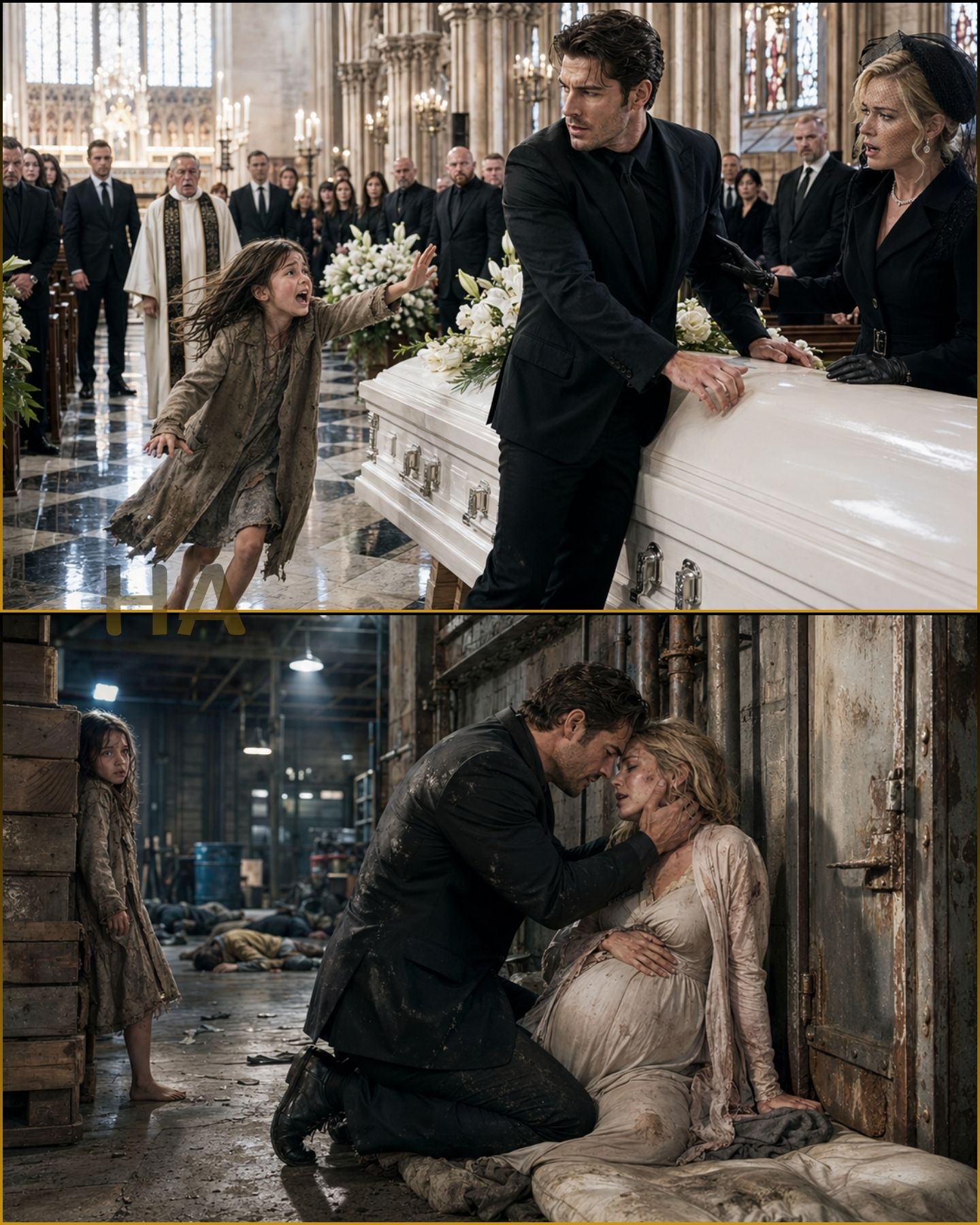
Inside, Caroline Whitaker lay tied to a pipe on a filthy mattress, bruised, dehydrated, but alive.
“Gabe?” she whispered.
Gabriel dropped to his knees beside her.
His hands trembled as he cut the ropes.
“I’m here,” he said, his voice breaking. “I found you.”
Caroline began to cry. “I was going to leave you.”
“I know.”
“I was scared for the baby.”
“I know.”
“I thought you would hate me.”
Gabriel pressed his forehead to hers. “I hated the coffin. I hated the lie. I hated every second I thought I had lost you. But I never hated you.”
Outside, the gunfire died.
Vincent Calder was captured before dawn. His empire collapsed by sunrise. Men who had sworn loyalty to him suddenly remembered other obligations. His warehouses were raided, his accounts emptied, his allies scattered.
Gabriel never told Caroline what happened to Calder.
Caroline never asked.
For two weeks, she recovered in a private medical suite inside the Whitaker mansion. Doctors monitored the baby and treated her injuries. Gabriel slept in a chair beside her bed, waking at every small sound.
Ava and Rosa were brought into the mansion too. Rosa cried when she saw the room they were given. It had clean sheets, a real heater, and windows that looked out over a garden.
“We can’t accept this,” Rosa told Caroline.
Caroline squeezed her hand. “Your granddaughter saved my life. Let me do this.”
For a while, everyone tried to believe the worst was over.
It wasn’t.
There was still a traitor inside the house.
Gabriel hunted the leak relentlessly. Cole remained imprisoned but refused to confess. Mrs. Harlan admitted to giving away Caroline’s movements but insisted she had never spoken to Calder directly. She had received instructions through notes, burner phones, and threats.
“Who frightened you more than me?” Gabriel demanded.
Mrs. Harlan sobbed until she could barely breathe.
“I don’t know how to say it.”
The answer was close, but Gabriel could not see it.
Ava did.
She noticed things adults ignored.
Vivian visited Caroline every afternoon with flowers, tea, and homemade soup. She spoke softly and touched Caroline’s hair. She called the unborn baby “our little miracle.” She smiled whenever Gabriel entered the room.
But when no one was watching, Vivian’s eyes went flat.
Not sad. Not worried.
Cold.
Ava had seen that kind of look before, on people who kicked stray dogs and smiled at police officers afterward.
One afternoon, Ava passed the small kitchen beside Caroline’s suite and saw Vivian standing over a pot of broth. The door was open only a crack.
Vivian removed a tiny glass vial from her sleeve.
Three clear drops fell into the soup.
Then Vivian smiled.
It was not a sister’s smile.
It was a victory smile.
Ava waited until Vivian left, then slipped into the kitchen and poured what remained in the pot into a clean jar. She brought it to Rosa, who had once worked as a hospital cleaner and knew the sharp, bitter smell of certain chemicals.
Rosa sniffed the soup and went pale.
“Where did this come from?”
“Vivian made it for Caroline.”
Rosa gripped Ava’s shoulders. “Tell Mr. Whitaker. Now.”
Ava found Gabriel outside his study.
He looked exhausted, older than he had at the funeral, as if grief had carved new lines into his face.
“Mr. Whitaker,” she said. “Vivian is putting something in Caroline’s food.”
His expression hardened immediately.
“My sister has been caring for Caroline every day.”
“I saw her.”
“Ava—”
“You didn’t believe me at the funeral either,” she said.
That stopped him.
Ava held out the jar with both hands. “Test it. If I’m wrong, I’ll apologize. But please test it before Caroline eats anything else.”
Gabriel stared at the jar.
He had known Ava for only weeks. Vivian had been his sister for twenty-eight years. He had raised her after their parents died. He had protected her, trusted her, forgiven her sharp moods and possessive silences because family was supposed to mean loyalty.
But Caroline was alive because Ava had told the truth when everyone else called her crazy.
Gabriel took the jar.
Two hours later, a laboratory report lay on his desk.
The soup contained a compound designed to induce miscarriage over time.
Gabriel read the report once.
Then again.
Then he closed his eyes.
When Vivian entered his study that evening, she wore a black silk dress and a look of gentle concern.
“Gabe, you wanted me?”
Gabriel slid the report across the desk.
Vivian glanced at it.
For three seconds, she was silent.
Then she laughed.
It was a thin, ugly sound.
“That little rat,” she said. “I knew I should have dealt with her sooner.”
Gabriel rose slowly. “Did you poison my wife?”
Vivian tilted her head. “I protected you.”
“Did you leak Caroline’s location to Calder?”
“She was going to leave you anyway.”
“Answer me.”
“Yes,” Vivian snapped. “Yes, I told them where she would be. I thought Calder would keep her long enough for the funeral to finish. I thought once you believed she was dead, you would finally be free of her.”
Gabriel stared at her as if he were looking at a stranger wearing his sister’s face.
Vivian’s composure cracked. Years of resentment poured out of her.
“You don’t understand what she took from me. Before Caroline, we were a family. You needed me. You listened to me. Then she came into this house with her soft voice and her saintly little smile, and suddenly I was a guest in my own life.”
“She is my wife.”
“And I was your sister!” Vivian shouted. “I was there first. I buried our parents with you. I kept your secrets. I stood beside you while you built everything. Then she got your name, your home, your child.”
Gabriel’s voice dropped. “That child is innocent.”
“That child would have replaced me completely.”
The sentence landed in the room like poison.
Gabriel understood then. It was not love, not in any healthy shape. It was ownership. Vivian had mistaken dependency for devotion and control for family.
“You tried to kill my baby,” he said.
Vivian’s face crumpled. “I tried to bring you back to yourself.”
“No,” Gabriel said quietly. “You tried to destroy everyone I love so there would be no one left but you.”
He pressed the intercom.
The guards came in.
Vivian looked shocked when they took her arms, as if consequences were something that happened only to other people.
“Gabe,” she whispered. “You can’t choose them over me. I’m your blood.”
Gabriel walked toward her, stopping close enough that she had to look up at him.
“You are alive because you are my blood,” he said. “That is the last gift you will ever receive from me.”
Vivian began to cry.
He did not soften.
“You will leave this country tonight. New name. New papers. You will never contact Caroline, Ava, Rosa, or me again. If you come back, blood will not save you twice.”
The guards dragged Vivian away screaming that he would regret it, that Caroline would leave him, that Ava had poisoned his mind.
When her voice finally faded, the mansion seemed to exhale.
The rest of the conspiracy fell apart.
Cole confessed that Vivian had blackmailed him by threatening his mother and younger sister. Mrs. Harlan admitted Vivian had used the same tactic with her son. The snake tattoo had been a deliberate trap; Vivian had made sure one of Calder’s men had the same tattoo as Cole so suspicion would fall on him.
Gabriel punished the guilty, dismissed the compromised, and burned away every rotten piece of his organization.
But the greater reckoning happened behind Caroline’s closed door.
He told her everything.
Caroline listened in silence, one hand resting protectively over her belly.
When he finished, she said, “I trusted her.”
“I know.”
“She used my fear.”
“I know.”
Caroline looked at him then, and tears filled her eyes.
“But I did fear your world, Gabriel. Vivian twisted it, but she didn’t invent it.”
That truth wounded him more deeply than anger would have.
Gabriel sat beside her bed.
“I can’t promise I was ever a good man,” he said. “But I can promise I won’t make our child grow up in the shadow I built.”
Caroline searched his face.
“For years, I thought power meant making everyone afraid to touch what was mine,” he continued. “But fear brought Calder to you. Fear helped Vivian hide. Fear made you think you had to run instead of telling me the truth.”
His voice thickened.
“I want out.”
Caroline’s breath caught.
“You can’t just leave that life.”
“No,” Gabriel said. “But I can dismantle it piece by piece. I can turn legitimate holdings into real businesses. I can put men with choices into honest work and send men without conscience far away from us. I can spend the rest of my life becoming someone our child doesn’t have to fear.”
Caroline cried then, not because everything was fixed, but because for the first time, the future had a door.
Ava stood in the hallway, listening without meaning to. When Gabriel opened the door and found her there, she expected him to be angry.
Instead, he knelt.
Again, always at her level.
“You saved them,” he said.
Ava shook her head. “Caroline saved me first.”
Gabriel’s eyes softened. “Then maybe that’s how saving works. Someone starts, and someone else keeps it going.”
Six months later, Caroline gave birth to a healthy baby girl.
They named her Lily Rose Whitaker.
Lily had Caroline’s warm eyes and Gabriel’s serious frown, which made the nurses laugh because no newborn had ever looked so suspicious of the world.
Ava, now eight, held her for the first time with trembling arms.
Caroline sat beside her. “Lily, this is your big sister Ava. She stopped a funeral for you.”
Ava looked down at the baby and felt something inside her loosen, something old and painful.
For most of her life, she had belonged nowhere. She had been a child people stepped around. A problem. A shadow. A pair of hungry eyes on a cold sidewalk.
Now she had a room with sunlight. Rosa had doctors. Caroline kissed her forehead every night. Gabriel taught her chess with the same seriousness he once used to run half of Chicago. Lily grabbed Ava’s finger and refused to let go.
Family, Ava learned, was not always the people whose blood matched yours.
Sometimes family was the woman who knelt on a dirty sidewalk.
Sometimes it was the man who believed a child when no one else would.
Sometimes it was the baby who held your finger like a promise.
One year after the funeral, a new building opened on Archer Avenue, not far from the pharmacy where everything had begun.
A silver butterfly hung above the entrance.
The Caroline Whitaker Foundation served hot meals, medical care, temporary housing, and legal help to families who had fallen through the cracks. Rosa helped in the garden. Caroline ran the programs. Gabriel funded it quietly and kept his name off the front door.
Ava helped hand out sandwiches on opening day.
Near the back of the line stood a little boy with shoes too big for his feet and a face too guarded for his age. He watched the food but did not come closer.
Ava walked over and knelt in front of him.
“Hi,” she said gently. “I’m Ava. Are you hungry?”
The boy stared at her for a long moment.
Then he nodded.
Ava held out her hand.
After a pause, he took it.
Across the room, Caroline watched with tears in her eyes. Gabriel stood beside her with Lily asleep against his shoulder.
“You know,” Caroline said softly, “one act of kindness did all this.”
Gabriel looked at Ava leading the boy toward a warm meal.
“No,” he said. “One act of kindness gave courage somewhere to land.”
That night, Ava placed the silver butterfly bracelet in a small glass box beside her bed. Caroline had given it to her after Lily was born.
“It belongs to you now,” Caroline had said. “You carried the truth when no one else would.”
Ava touched the glass gently.
She thought of the cathedral, the coffin, the men with guns, the terrible silence before Gabriel listened. She thought of the alley where Caroline’s eyes had begged for help. She thought of Vivian’s poison, Rosa’s trembling hands, Lily’s tiny fingers.
Then she thought of the little boy at the foundation, eating soup like he could not believe it would not be taken away.
Ava understood something then.
Kindness did not erase darkness.
But it gave someone a reason to walk through it.
And sometimes the smallest voice in the room was the only one brave enough to speak the truth.
THE END

