By the time the last song ended at my company’s year-end party, my cheeks hurt from smiling.
I had spent three hours under string lights making polite conversation with people who only ever saw the organized version of me: the department head who never missed deadlines, the woman whose heels did not wobble, the mother who somehow balanced everything.
I smiled for photos.
I laughed at the vice president’s jokes.
I accepted congratulations on a strong year and a larger-than-expected bonus that would hit before New Year’s.
And the whole time, a small knot of unease sat under my ribs.
My parents were at my house that night.
So was my older brother, Mark.
My mother had called twice that week insisting they could handle bedtime for Eli so I could attend the party without guilt.
She said I needed one good evening.
My father said I worked too hard to throw opportunities away.
Mark was only there, according to them, because he was “between places” and sleeping in the guest room for a few days.
Nothing about that arrangement had felt right.
But when you grow up in a family like mine, your instincts get trained to apologize for themselves.
So I went.
The last song was still thumping inside my chest when I unlocked my front door just after eleven.
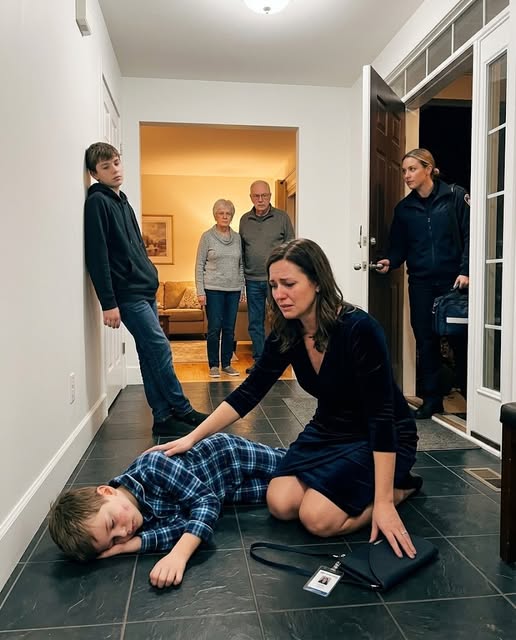
I remember the music because it made the silence in the house feel obscene.
I still had my company badge around my neck.
My hair was pinned up.
One wrist carried a gold ribbon someone had tied there as a joke.
I stepped into my hallway still wearing the remains of a harmless night.
Then my heel caught on something soft.
I looked down and saw my son.
Eli was sprawled on the tile by the front door, one cheek pressed flat, one hand curled against his ribs.
His pajamas were twisted.
There was a bruise already rising along his jaw and another beneath his shirt.
For a second I couldn’t understand what I was seeing because no mother ever expects the worst scene of her life to be waiting twelve inches inside her own home.
Then I dropped my clutch, fell to my knees, and touched his shoulder.
Warm.
Breathing.
Barely.
“Eli, baby, look at me.”
His eyelashes trembled.
He made a small, wounded sound.
And that was when I felt eyes on me.
My brother leaned against the hallway wall, ankle crossed, arms loose, like he had been waiting for me to calm down and overreact in private.
“About time,” he said.
I stared at him.
“What did you do?”
He shrugged.
“Just disciplined him.”
Behind him, my parents stepped out of the living room.
My mother was holding a mug of tea.
My father wore the expression he used when he wanted to pass for the reasonable man in the room.
“He deserved it,” my mother said.
“The boy mouthed off,” my father added.
“Don’t start dramatizing.”
If you were raised by people like mine, you know how quickly time can fold in on itself.
In one instant I was thirty-six, on my own hallway floor in a velvet dress and ruined lipstick.
In the next, I was twelve again with a split lip while my mother explained that boys played rough.
I was fifteen again while Mark denied shoving me into a dresser hard enough to bruise my spine.
I was nineteen, being told that family matters stayed in the family.
The script never changed.
Deny.
Minimize.
Blame.
Shame.
Only now the person on the floor was my son.
I called emergency services before any of them could stop me.
Mark moved first.
“Hang up.”
Eli flinched at the sound of his voice without even opening his eyes.
That tiny movement burned away the last of my hesitation.
I put myself between my son and every other person in the room and told the dispatcher, in the steadiest voice I could manage, that my child had been assaulted and the man who hurt him was still in the house.
That changed everything.
The dispatcher told me officers were on the way with the ambulance.
My father thundered about humiliation.
My mother kept repeating that Eli had only fallen.
Mark paced once and then went still, his jaw tight.
In the middle of that nightmare, I noticed one more thing.
The door to my home office was cracked open.
I always closed it when I left because Eli sometimes wandered in to draw on my legal pads.
That night one of the desk drawers was pulled out by an inch.
It was such a small detail that I almost missed it.
Later, I would understand it was the whole reason my son had been hurt.
The ambulance arrived within minutes.
Two paramedics entered with an officer right behind them.
The older paramedic, a broad man with tired eyes and an even voice, knelt beside Eli while his partner began asking questions.
“What happened tonight?” she asked.
“He fell,” my father said instantly.
“No,” I said.
“He was hit.”
Mark gave a dry laugh.
“You don’t know that.”
The paramedic examining Eli looked up sharply.
“Everyone except Mom, step back.”
My mother bristled, but he didn’t repeat himself.
He checked Eli’s pupils, felt along his ribs, examined the bruising on his wrist and jaw, and asked in a gentle voice, “Can you tell me who hurt you?”
Eli’s eyes shifted to Mark.
Then he whispered, “Don’t let him touch me again.”
Silence hit the room so hard it felt physical.
The paramedic rose slowly and looked straight at my brother.
“What’s your name, sir?”
“Mark Bennett.”
Something changed in the man’s face.
Recognition.
Not vague familiarity—certainty.
He stepped closer to me and lowered his voice.
“Ma’am, is that really your brother? Because actually, I know him as Michael Hart.
There’s a child-endangerment alert attached to his file.
My partner is notifying police now.
Do not let him leave.”
For a second I forgot how to breathe.
Michael Hart was not a stranger’s name.
Hart was my mother’s maiden name.
Mark’s legal name, the one he only used on paperwork when it benefited him, was Michael Hart Bennett.
No one outside the family ever called him Michael.
Hearing it in that house, from a medic who recognized him on sight, turned my blood to ice.
My mother made a choking sound.
My father said, too loudly, “You’re mistaken.”
But the officer near the door had heard enough.
“Mr.
Hart,” he said, “keep your hands where I can see them.”
Eli tugged weakly at my sleeve.
I bent
close.
Tears had gathered in the corners of his eyes.
“Mom,” he whispered, “he was in your office.
I told him to get out.
Grandma said I was ruining everything.”
That sentence split the whole night open.
Mark bolted toward the hallway.
Toward the guest room.
My father shouted, “Don’t let them open that bag—”
The officer caught Mark before he made it three steps.
What followed was ugly, fast, and loud—my mother crying that everyone was misunderstanding, my father demanding respect, the second paramedic radioing for backup, Mark swearing he had done nothing wrong while Eli lay bruised on my floor.
I rode in the ambulance with my son.
At the hospital they confirmed a concussion, bruised ribs, and a badly sprained wrist.
Nothing was broken.
I cried in a plastic chair when the doctor said that, the delayed kind of crying that happens when terror finally loosens its grip enough for relief to hurt.
A social worker sat with us.
Then a detective.
They spoke to Eli gently, never pushing, letting him tell the story in pieces.
He had woken up after I left because he wanted water.
When he passed my office, he saw light under the door.
Mark was inside with my desk drawer open, my laptop on, and my folder of financial papers spread across the desk.
My year-end bonus statement was there.
So was a copy of my license and the notebook where I had written reminders to myself about bills, tax documents, and account deadlines.
Eli had asked what he was doing.
Mark told him to go back to bed.
Instead, Eli said he was calling me.
That was when Mark slapped him.
When Eli tried to run, Mark grabbed his wrist, shoved him into the coat bench by the front hall, and hit him again when he started yelling.
My parents came out.
Not to stop it.
To stop Eli from making noise.
My mother told him he was being dramatic.
My father told him to apologize for snooping.
Mark said if Eli told me anything, I would lose the house because I “didn’t know how much family had done” for me.
The words were so absurd and so familiar that I had to close my eyes while Eli spoke.
They were the words of a man who believed access to other people’s lives was his birthright.
The detective asked whether Mark had been alone with Eli before.
Too many memories rearranged themselves at once.
The times Eli said Uncle Mark made him uncomfortable.
The way my mother always insisted I was overprotective.
The fact that Mark had somehow known I was getting a bigger bonus before I had told anyone except my parents at breakfast that week.
He hadn’t been just drifting.
He had been waiting.
The search of my house confirmed it.
In the guest room police found a duffel bag filled with printed copies of my license, my bonus paperwork, my checkbook, a portable scanner, envelopes addressed to a mailbox service, and a page in my father’s handwriting listing my old security questions—the street I grew up on, my first school, my mother’s maiden name.
They also found court papers in Mark’s legal name, Michael Hart Bennett.
That was how I learned the rest.
The paramedic recognized him because,
eight months earlier, he had responded to another house where Mark had assaulted his then-girlfriend’s eleven-year-old son after the boy caught him trying to steal cash and jewelry from the woman’s bedroom.
The child had needed stitches.
A restraining order followed.
Mark had ignored it.
He had also failed to appear in court on related charges of assault and witness intimidation.
My parents knew.
They knew all of it.
Texts recovered from my mother’s phone showed she had been speaking to Mark for weeks about “getting hold of Hannah’s paperwork” before the bonus hit.
My father had written down the answers to my security questions because he believed, in his words, that “she owes the family after all these years.”
When the detective told me that, something inside me went very still.
This wasn’t a sudden loss of control.
It was a plan.
My son had been beaten because he interrupted it.
Mark was arrested that night at my house.
My father was taken in for questioning and later charged with conspiracy to commit identity theft, obstruction, and child endangerment.
My mother was charged with obstruction and child endangerment after officers pulled deleted messages from her phone and recovered audio from the smart speaker in my office.
That audio was the part I could barely bear to hear.
It had activated when voices got loud.
Mark cursing.
Eli saying, in his small furious voice, “That’s my mom’s.”
A slap.
My mother saying, “Enough, Eli, stop making this worse.”
My father saying, “Take him to the door before she gets back.”
No one who heard that recording ever used the word discipline again.
The morning after the hospital, while Eli slept under warm blankets and hospital lights, I sat with a detective and finally told the truth I had spent most of my adult life trimming down so it would sound survivable.
Mark had always been violent.
He was six years older than me and had been protected from consequences with a devotion that shaped the architecture of our family.
If he shoved me, I had provoked him.
If he stole money, he was struggling.
If he lied, I was too sensitive for noticing.
I left home at eighteen and spent years believing distance was enough, that I could manage contact on holidays, that I could keep Eli safe by never leaving them alone too long.
The ugliest revelation of that night was not that Mark was dangerous.
I had known that in my bones since childhood.
It was that a part of me had still believed my parents would draw the line at my child.
They had not.
Eli came home two days later with discharge papers, pain medication, and a habit of checking the lock twice before bed.
For weeks he startled if footsteps moved too quickly down the hall.
He asked me once, in a whisper, whether he had been bad.
I sat on the floor beside his bed and held his face in both my hands.
“No,” I told him.
“You were brave.
The adults were wrong.”
He cried then, finally and fully, and so did I.
The legal process moved faster than I expected because the evidence was overwhelming.
Mark—Michael in the courtroom, Mark only in the language of my nightmares—took a plea.
Felony child abuse.
Attempted identity theft.
Violation of a restraining order in the earlier case.
Witness intimidation.
He went to prison.
My father received a suspended sentence, probation, and mandatory financial-crimes counseling.
My mother received probation, mandatory counseling, and a court order barring unsupervised contact with any minor children.
Both of them tried, in different ways, to reach me afterward.
My father wrote that blood should matter.
My mother wrote that she had only wanted to help her son.
Neither letter mentioned Eli by name until the final paragraph.
I never answered.
Months later, when the bruises had faded from Eli’s jaw and the weather had started warming again, he asked whether Grandma and Grandpa were still family.
I told him the truth in the only form I trusted anymore.
“Some people share your blood,” I said.
“Some people protect your heart.
The ones who hurt you don’t get to choose what they’re called.”
He thought about that for a long time, then nodded like he understood more than any child should.
I changed the locks, closed every shared account, replaced my documents, and took the ribbon from that party out of the pocket of the coat I had worn that night.
It was still crushed and metallic and absurdly festive.
I held it for a while before throwing it away.
What stayed with me wasn’t the party or even the ambulance lights.
It was my mother’s voice saying, He deserved it.
That was the true shape of everything I had survived.
Not only the violence.
The permission around it.
The cold little courtroom people built in their own homes where the guilty were protected and the injured were told to lower their voices.
Sometimes I still wonder what the biggest red flag was.
Mark’s smirk in the hallway? My father shouting about humiliation while Eli lay on the floor? The office door cracked open? Maybe it was much earlier than that.
Maybe it was every time I was taught that keeping peace mattered more than telling the truth.
I don’t wonder about forgiveness.
My son lived.
He told the truth.
And I finally did too.
That was enough to end the story they had been writing over us for years.

