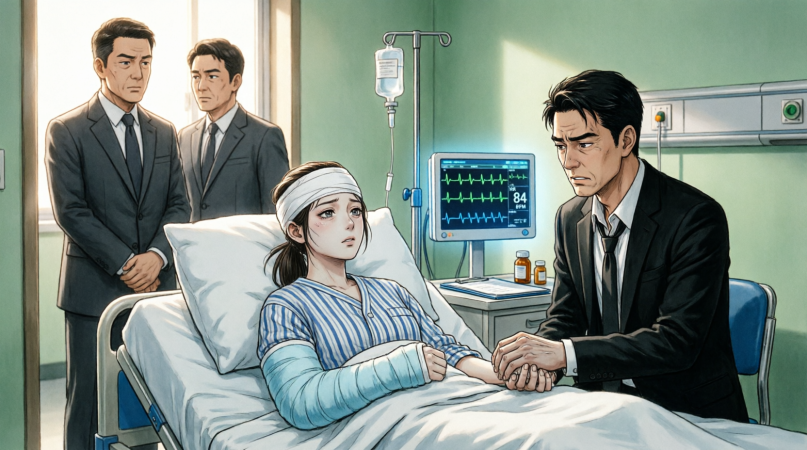
The day Claire Donovan was hit by a car began like every other Tuesday she had spent trying to hold together a life that looked polished from the outside and quietly punishing on the inside. She left her apartment that morning in a navy blazer, sensible heels, and the kind of tired determination that comes from sleeping beside a man who could turn tenderness on and off like a lamp. Ryan had kissed the air near her cheek while scrolling through emails on his phone. He had reminded her not to forget that his mother’s birthday dinner was that evening. He wanted the roast done the way Patricia liked it, the table set with the cream candles, and the dessert plated before seven because Patricia hated waiting. Claire had said she remembered. She always remembered. She remembered Patricia’s preferences, Patricia’s allergies, Patricia’s opinions about flowers, china, music, and whether a woman who worked in marketing should really call herself ambitious when she was already married. She remembered Ryan’s habit of defending his mother with a smooth smile and the same line every time Claire objected: She means well. Patricia never meant well. What Patricia meant was control, and Ryan had been raised to see control as love. For six years Claire had tried to make peace with the shape of that family. She told herself she was being mature. She told herself all marriages had difficult in-law dynamics. She told herself Ryan’s sharpness came from stress, from deadlines, from money worries, from his impossible need to please a woman who treated him like a son only when he obeyed. The lies had become habits by then. She wore them the way other people wore perfume. Her client meeting downtown went longer than expected. By the time she left the office tower, the afternoon traffic had swollen and the sky had gone bright and metallic with spring glare. She stood at the corner with a cluster of strangers, waited for the signal, and stepped into the crosswalk when the pedestrian light changed. She never saw the car until it was already there. A black sedan blasted through the red light, clipping another vehicle and veering into the crossing lane. Someone screamed. Claire turned just enough to catch a flash of dark paint and a windshield reflecting the sun. Then the impact slammed into her hip and ribs and sent the whole world sideways. The sound came first. Metal. Brakes. A crack she later learned was her body striking the pavement. Then came the taste of blood and the strange disbelief of being fully awake while lying flat on the street, unable to draw a complete breath. Voices rushed over her in fragments. Don’t move her. Call 911. Oh my God, she’s bleeding. Claire tried to speak but only managed a thin, broken gasp. Her left arm burned. Her temple felt wet. She could not tell whether the shaking in her body came from fear or shock. When the paramedics arrived, one of them knelt beside her with calm eyes and a steady voice. He told her his name was Luis. He told her to keep looking at him. He asked if she knew her name, the date, whether she could feel her legs. She answered through pain that seemed to pulsefrom every direction at once. At the hospital they moved quickly. X-rays. Imaging. Questions. Paperwork. A doctor with kind hands explained that she had two fractured ribs, a severe sprain in her right knee, a concussion they needed to watch carefully, stitches above her temple, and extensive bruising that would likely darken over the next two days. Lucky, he called her. Claire had stared at the ceiling and wondered what counted as unlucky. She called Ryan from triage, and when he did not answer she texted him. Car accident. I’m at St. Mary’s. Please come. He arrived nearly three hours later. Claire heard him before she saw him. Fast footsteps. A sigh. The door opening hard enough to tap the wall. She expected a face she knew, maybe pale with worry, maybe softened by fear. Instead she saw irritation. Ryan took in the room with one sweeping glance. The IV. The sling. The brace on her knee. The monitor beeping above her shoulder. Then he said, “Drop the drama.” The sentence floated for half a second as if it belonged to someone else’s marriage. Claire blinked. “What?” “My mother’s birthday dinner is tonight,” he said. “Do you have any idea how humiliating this is? She already thinks you look for excuses to avoid family events.” Claire stared at him, too stunned to form anger before disbelief. “I was hit by a car.” He gave a short, contemptuous laugh. “And you survived. Clearly. So get discharged, get dressed, and let’s go.” She felt the tears before she felt the heat behind them. “The doctor said I can’t even walk on my knee.” Ryan’s face hardened, as if her pain was an accusation. “People get hit every day, Claire. You’re lying here acting like you’re on your deathbed because you love the attention.” There it was. The private Ryan. The one who measured every inconvenience by how much of his comfort it cost him. He stepped closer to the bed and lowered his voice, not out of kindness but calculation. “I’m not spending money on your little hospital production because you decided to make tonight all about you.” He grabbed the blanket and yanked it down. Pain tore through Claire’s side so sharply she cried out. Before she could recover, Ryan seized her right wrist, the one arm that wasn’t immobilized, and pulled. “Get up.” “Ryan, stop.” “Stand.” He dragged harder. Claire slid toward the edge of the mattress, panic overtaking the fog of medication. Her injured leg touched the floor, buckled instantly, and she nearly collapsed under the force of his pull. Instead of catching her, Ryan hissed, “Unbelievable. Now you’re pretending you can’t stand.” Something inside Claire changed in that second. For years she had moved through her marriage like someone half-asleep. She knew Ryan could be cruel, but she kept searching his cruelty for explanations that made staying possible. Stress. Childhood wounds. Pressure from Patricia. Career frustration. She had built an entire scaffold of excuses around behavior that had never deserved them. But there, in a hospital room, with stitches in her scalp and pain blazing through her ribs while the man who vowed to love her treated her body like an obstacle, the excuses dropped away all at once. What remained was clarity. Ryan was still gripping her wrist when the door opened.
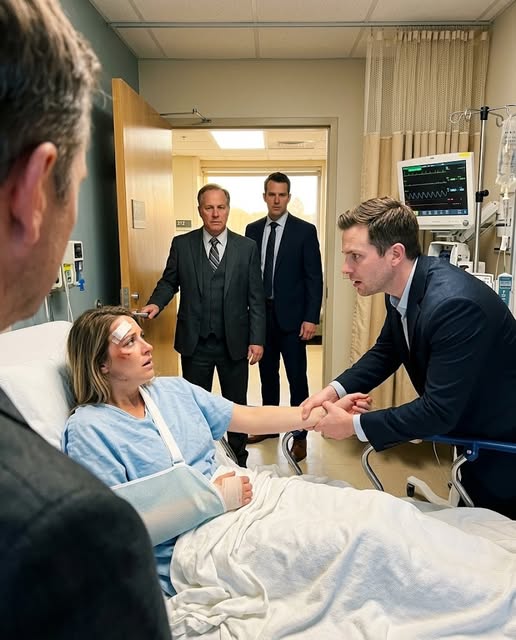
He turned, annoyance already on his face, and then all the color drained from it. Detective Marcus Hale stood in the doorway in a charcoal suit with a badge clipped to his belt. He had visited once earlier while Claire drifted in and out of evaluation, introducing himself as the lead investigator on the hit-and-run case. Beside him now was Claire’s older brother, Evan Carter, who looked like he had arrived at the hospital at a sprint. Evan was a criminal defense attorney, polished and controlled almost to a fault, but there was nothing controlled in his expression when he saw Ryan’s hand on Claire. Ryan let go immediately. Evan crossed the room in three long steps and positioned himself between them. “Take one more step toward my sister,” he said in a voice so calm it was more frightening than shouting, “and I promise you that tonight becomes the worst night of your life.” Ryan’s mouth opened. Closed. “You don’t understand what happened.” “I understand enough,” Evan said. Detective Hale turned to Claire first. “Ms. Donovan, are you okay? Do you need a nurse?” Claire nodded, suddenly shaking so hard her teeth nearly clicked. Hale stepped into the hall and called for assistance. A nurse and security officer arrived within seconds. The nurse looked from Claire’s face to the marks on her wrist and then to Ryan with instant comprehension. She moved directly to Claire’s side. The security officer positioned himself by the door. Ryan’s composure began to fray. “This is absurd. She’s my wife.” The security officer said, “And right now you need to step back.” Evan did not take his eyes off Ryan. “You are going to leave this room.” Ryan looked toward Claire, expecting rescue, apology, maybe the old reflex where she rushed to smooth over his temper. He found none. She met his stare and said, quietly but clearly, “Leave.” For the first time in their marriage, Ryan looked afraid of her. He tried one last angle. “Claire, don’t make a scene.” The nurse let out a dry breath that might have been a laugh if the situation had been any less ugly. The security officer escorted Ryan into the hallway. Patricia arrived almost at the same moment, draped in cream cashmere and outrage, having apparently come straight from the restaurant where she expected her birthday celebration. She took in the sight of security, Ryan’s expression, Evan’s stance, and Claire in bed, and somehow still landed on indignation. “What on earth is going on?” Patricia demanded. “Ryan said Claire was overreacting.” Evan turned to her with a level, devastating politeness. “Mrs. Donovan, your son just tried to physically pull my concussed sister out of a hospital bed with fractured ribs because your dinner reservation mattered more to him than her condition.” Patricia’s lips parted. “I’m sure there’s been a misunderstanding.” Detective Hale spoke then, his tone clipped. “There is also the matter of your son’s vehicle.” Ryan went still. Claire noticed it at once. So did Evan. Hale looked from Ryan to Patricia. “A witness gave us a partial plate on the black sedan involved in the hit-and-run. Traffic camera footage filled in the rest. The registered owner is Patricia Donovan.” Silence spread through the corridor like spilled ink. Patricia’s face changed first, then Ryan’s.
Not confusion. Recognition. Evan turned slowly. “What did you just say?” Hale kept his eyes on Ryan. “The driver who struck Ms. Donovan fled the scene. We traced the vehicle. We came here to ask some questions after learning the car had been reported parked at the Donovans’ family home this afternoon with fresh front-end damage.” Claire felt every sound in the hallway recede until all she could hear was her own pulse. “Ryan,” she said, and his name felt foreign in her mouth, “what is he talking about?” Ryan looked at Patricia. That told Claire everything before he spoke. Patricia’s birthday dinner, she realized, had never been the real emergency. The emergency was control. The emergency was keeping her quiet and compliant before the police started connecting dots. Evan’s voice went flat. “Answer her.” Ryan swallowed. “It wasn’t supposed to happen like that.” Claire went cold all over. Detective Hale lifted a hand, signaling the security officer to stay where he was. “Mr. Donovan, I’m advising you to be very careful with your next sentence.” But Ryan had already begun unraveling. He looked at Claire with a strange mixture of resentment and desperation. “You weren’t answering my calls after the meeting,” he said. “I knew you’d gone downtown. I went to talk to you because we were already late on everything and my mother kept saying you were making excuses again.” Claire frowned through the pounding in her head. “What calls?” Evan picked up Claire’s phone from the bedside tray where the nurse had placed her belongings. The screen was cracked from the accident but still functional. He checked the recent log. “There are no missed calls from you today,” he said to Ryan. Ryan spoke faster, louder. “Because I deleted them when I got here.” Even Patricia looked startled. Claire stared. “You went after me?” Ryan’s hands shook once, then clenched. “I saw you leaving the building. I pulled up beside the crosswalk. I wanted you to get in so we could settle this. You ignored me.” “I didn’t see you.” “You saw me,” he snapped, then seemed to hear himself and recoiled from the sound of it. “You had to have seen me.” Detective Hale’s expression hardened. “Did you accelerate the vehicle toward your wife?” Ryan did not answer. Patricia finally found her voice. “Ryan, say something.” He rounded on her with sudden fury. “You’re the one who kept saying she needed to be taught a lesson. You’re the one who said she humiliated us every time she put work first.” Patricia stepped back as if struck. “How dare you blame me for your recklessness.” Claire watched them both and felt a terrible, clarifying grief rise inside her. Not grief for the marriage she had, because that had been rotten for a long time. Grief for the years she had spent trying to earn basic kindness from people who treated compassion like weakness. The nurse squeezed her shoulder. The touch, gentle and human, nearly undid her. Detective Hale asked Ryan again, slowly, “Did you intentionally drive into the crosswalk where your wife was walking?” Ryan’s eyes darted to Claire. He must have seen then that whatever power he once held over her had gone. There would be no smoothing over this, no private apology followed by public performance, no flowers, no promises, no manipulative collapse into tears.
“There was another car,” he muttered.
“I swerved.”
Hale said, “That is not an answer.”
Ryan slumped.
“I wanted to scare her.
Just scare her.
She turned at the wrong second.”
Patricia made a sound like all the air had been punched from her chest.
Claire did not cry.
The horror was too large and too clean for tears.
She simply looked at the man she had married and understood that somewhere along the line he had crossed from cruelty into something far darker, and he had done it while still expecting dinner.
Detective Hale informed Ryan he was under arrest on suspicion of felony hit-and-run, assault with a vehicle, tampering with evidence, and attempted coercion at the hospital.
The security officer stepped in to assist as Hale cuffed him.
Ryan protested immediately, then angrily, then pathetically.
“Claire, tell them it wasn’t like that.”
She held his gaze and said, “It was exactly like that.”
Patricia started to cry then, but even her tears sounded offended rather than broken.
She tried to follow as they led Ryan away.
Evan stopped her with one sentence.
“Do not come near my sister again.”
When the hallway finally emptied, the room fell into a silence so complete Claire could hear the soft hum of the air vent.
Her whole body trembled with delayed shock.
Evan sat carefully in the chair beside her bed, took her uninjured hand, and bowed his head for a moment before speaking.
“I’m sorry,” he said.
“I should have seen this sooner.”
Claire looked at her brother’s face, at the controlled anger still burning there, and gave the smallest shake of her head.
“I hid it well.”
“You shouldn’t have had to.”
That cracked something open.
Not the frozen clarity from before, but the hurt beneath it.
Claire began to cry in exhausted, uneven waves that pulled at her ribs and made the nurse adjust her pain medication.
Evan stayed through all of it.
He dealt with forms, spoke to hospital administration, and called a friend who specialized in family law.
He asked for a social worker.
He made sure Ryan’s visitor access was revoked.
By the time night settled over the windows, Claire had given a formal statement to Detective Hale.
She told him everything she remembered from the crosswalk, from the hospital room, from the pattern of Ryan’s behavior over the years: the financial control, the insults disguised as jokes, the isolation, the way Patricia fed the cruelty and Ryan delivered it.
The detective listened without interruption.
“People think abuse has to look one way,” he said when she finished.
“It doesn’t.
The details matter.
What you’ve described matters.”
The next morning, Evan brought a legal pad, fresh clothes, and Claire’s closest friend, Naomi, who took one look at Claire’s bruised face and cried openly before composing herself into a fury so pure it almost made Claire smile.
Naomi leaned over the bed and said, “You are never going back there.”
Claire answered, “I know.”
And for the first time, she meant it completely.
The days that followed were painful in ways both physical and administrative.
Claire remained in the hospital for observation, then transferred briefly to outpatient care with strict instructions
to rest, avoid stairs when possible, and keep weight off her injured knee.
Evan arranged for her to stay in the furnished guest suite above his garage until she recovered, a bright little space with slanted ceilings and windows that opened onto a row of maples.
From there, with Naomi and Evan taking shifts beside her, Claire began dismantling the life she had built with Ryan.
She filed for divorce within a week.
She also filed for a protective order.
The attorney Evan recommended, Lila Monroe, was direct and unsentimental in the way Claire suddenly found comforting.
Lila reviewed photos of Claire’s injuries, hospital records, the police report, the witness statement from the crosswalk, and the surveillance images showing Patricia’s sedan entering the intersection.
She nodded once and said, “He’s not walking away from this cleanly.”
Ryan tried, of course.
From jail, then later through counsel after his release on strict conditions, he sent messages that cycled through rage, apology, blame, and self-pity.
He said he was under unbearable pressure.
He said Patricia had poisoned him against Claire.
He said he had never intended real harm.
He said Claire was ruining both their lives by involving the police.
He said marriage meant standing by each other in difficult times.
Lila had each communication preserved and routed properly.
Claire answered none of them.
Patricia attempted a different route.
She sent flowers to Evan’s house with a note about family, forgiveness, and private suffering.
Evan left the arrangement on the porch until the petals browned, then threw it away unopened.
Patricia then called Naomi, who told her in language memorable enough that Patricia never called again.
Recovery gave Claire far too much time to think, and that turned out to be a kind of mercy.
Immobility stripped away distraction.
She replayed old scenes with new understanding: Ryan mocking her promotion because it meant she traveled without him; Ryan insisting they combine accounts, then monitoring her purchases; Patricia claiming Claire was too independent to be nurturing; Ryan standing beside his mother and smiling while Claire apologized for offenses she had not committed.
The car had not created the truth.
It had exposed it.
Months passed.
Bruises faded from purple to yellow to memory.
The stitches dissolved.
Physical therapy strengthened Claire’s knee and restored motion to her shoulder and side.
The concussion symptoms receded slowly, leaving behind a caution around headaches and bright light but no lasting damage.
She returned to work part-time, then full-time, welcomed by colleagues who had known only fragments of the story until then.
Her boss, a woman named Helena with silver hair and a talent for cutting through nonsense, called Claire into her office on the day she resumed full schedule.
Claire braced for pity.
Instead Helena handed her a revised client portfolio and said, “We kept your best accounts.
You’re too good to lose.”
Claire almost cried again, not from pain this time but from the unfamiliar relief of being valued without conditions.
The criminal case moved steadily.
Detective Hale remained in contact, never overpromising, always clear.
The traffic footage was stronger than anyone had first hoped.
One witness had captured the aftermath on a phone, including the sedan’s damaged front quarter panel and enough of the license plate to corroborate the camera record.
The hospital had security
footage of Ryan deleting calls from Claire’s phone while she was asleep under medication.
The nurse’s report documented the marks on Claire’s wrist and his attempt to force her up.
Combined, the evidence formed a pattern the prosecutor called persuasive and the defense could not easily explain away.
Ryan rejected an early plea offer, convinced perhaps by arrogance or habit that reality would bend for him the way Claire once had.
It did not.
At the preliminary hearing, Claire saw him for the first time since the arrest.
He looked thinner and far less polished, as if panic had finally taken up permanent residence under his skin.
Patricia sat behind him in a severe navy suit, her face arranged into wounded dignity.
Claire expected fear when she entered the courtroom.
What she felt instead was distance.
Ryan watched her take the stand.
He waited, she realized, for softness.
For a tremor of old loyalty.
For some sign that privately he still existed to her as husband instead of defendant.
He found none.
Claire testified clearly.
She described the crosswalk, the impact, the hospital room, the deleted calls, the years of escalating emotional abuse, and Ryan’s own words in the hallway: I wanted to scare her.
The defense attorney tried to chip away at intention.
Stress.
Marital conflict.
A tragic overreaction.
Claire answered each question with the same steady precision she brought to work presentations.
By the end of cross-examination, even Patricia’s posture had begun to sink.
Outside the courthouse, reporters waited because a hit-and-run involving a spouse, a socialite mother, and a hospital confrontation had become local news.
Claire did not speak to them then.
She had spent too many years performing for other people’s narratives.
She saved her voice for the courtroom.
Eventually Ryan accepted a plea agreement that included felony convictions, probation conditions so strict they bordered on ceremonial humiliation, mandatory counseling, restitution, and a period of incarceration.
The prosecutors were frank with Claire: trial always carried risk, but the plea guaranteed accountability and spared her months more of uncertainty.
She reviewed the terms with Lila and Evan, thought carefully, and agreed.
The day the plea was entered, Ryan turned halfway toward her as if to say something.
The bailiff guided him forward before he could speak.
Patricia attempted to leave by a side door and found reporters there too.
The civil side concluded more quietly.
Claire received the divorce she wanted, along with full financial disentanglement and the sale of the apartment.
Standing in the empty living room one last time before closing, she felt almost nothing.
The place had once seemed like proof that adulthood had arrived properly: marriage certificate in a drawer, matching furniture, framed vacation photos, polished kitchen, expensive coffee machine.
Now it looked like a staged set after the actors had gone home.
She kept very little.
A bookshelf she had bought before Ryan.
Her grandmother’s quilt.
A box of journals.
A ceramic bowl Naomi had made in a night class and declared uneven but soulful.
Everything else could go.
The year after the accident, Claire moved into a smaller apartment across town with tall windows, bad closet space, and morning light that hit the floor in wide gold bands.
She painted one wall a soft green Ryan would have mocked.
She bought
mismatched dishes because she liked them.
She learned how quiet a home could feel when no one was waiting to punish joy.
She also began therapy with a counselor who specialized in coercive control.
During one session, after Claire recounted a memory she had always minimized, the counselor asked, “Why did you think you had to earn gentleness?”
Claire sat with that question for weeks.
In time she built new habits instead of old explanations.
She stopped apologizing automatically when someone else was rude.
She let voicemail go unanswered if she needed rest.
She celebrated her promotion with friends at a restaurant Patricia would have hated.
She spent Thanksgiving with Evan and Naomi, who made terrible pie and laughed through the entire meal.
She slept.
Really slept.
Nearly eighteen months after the accident, Detective Hale called one last time to let her know that Ryan had violated part of his probation by trying to route a message through a former mutual friend, and the court had responded swiftly.
Claire thanked him.
When she hung up, she felt no spike of fear, only a faint sadness for the life she had escaped before it closed over her entirely.
That evening she walked home from work under a pale blue sky, crossing carefully at the light, feeling the healed pull in her ribs whenever the wind turned cold.
Scars remained.
So did caution.
But caution was different from captivity.
She stopped at the bakery on her corner and bought a small lemon cake for no reason except that she wanted one.
In her apartment she cut a slice, opened the windows, and let the spring air drift in.
Her phone buzzed with a message from Evan: Dinner Sunday? I promise no Patricia.
Claire laughed out loud and wrote back: Only if Naomi brings the terrible pie.
A minute later Naomi replied to the group thread: Rude.
Accurate.
I’m in.
Claire set the phone down and looked around the room she had chosen, the life she had rebuilt, the peace that no longer felt borrowed or fragile.
The crash had nearly broken her body.
Ryan had tried for years to break her sense of self.
He had failed at both.
At last, the story ended not with a courtroom, or an arrest, or even a divorce decree, but with something far more difficult for people like Ryan to understand.
It ended with Claire safe, believed, and entirely free.

