The day Natalie Richards graduated from Berkeley summa cum laude, she thought she had finally outrun the shadow of her father. She was wrong. Matthew Richards had flown from Chicago to California with his wife, his two sons, and a smile polished so clean it looked almost fatherly. He sat through the commencement ceremony in a navy suit, clapping only when everyone else clapped, checking his watch whenever the speeches ran long. Natalie saw him from the stage. Her mother, Diana, was crying into a folded tissue. Her brothers, James and Tyler, stood beside her like two men waiting for a train instead of watching their sister cross one of the most important thresholds of her life. And her father looked exactly the way he had always looked when Natalie succeeded outside of his design. Unimpressed. Still, when her name was called, she walked across the stage with her chin lifted. University of California, Berkeley. Summa cum laude. Pre-law. Four years of surviving without his money, his approval, or his permission had ended in a single handshake and a diploma holder pressed into her palm. For a few minutes, she let herself feel happy. The California sun was bright. Students were laughing. Parents were shouting names from the bleachers. Natalie’s robe stuck to the back of her dress, and her feet hurt from the heels she had bought secondhand, but none of it mattered. She had done it. When she reached her family near the edge of the crowd, her mother wrapped both arms around her before anyone else moved. “I am so proud of you,” Diana whispered so quietly that only Natalie could hear. The words landed in Natalie’s chest with a force that almost broke her composure. Then Matthew cleared his throat. Diana let go immediately. “Congratulations,” he said. It sounded less like affection and more like a receipt being acknowledged. “Thank you,” Natalie replied. James leaned in for a stiff hug and said, “Berkeley looks good on a resume, I’ll give you that.” Tyler hugged her longer than James did. “You did good, Nat,” he murmured. Matthew’s eyes shifted to him. Tyler stepped back. “We have dinner at seven,” Matthew said. “I reserved a private room. Dress appropriately.” Natalie almost laughed. After four years of paying rent with library shifts, after surviving midterms on instant coffee, after arguing eviction cases during a legal aid internship while her father pretended she no longer existed, he still believed he had the right to instruct her on how to dress. But she nodded. She wanted one peaceful night for her mother. That was the first mistake. The second was believing the dinner was for her. Matthew had chosen an expensive restaurant near the water, the kind of place where the lighting was low, the wine list arrived like a leather-bound thesis, and the waiters spoke in voices soft enough to make every table feel important. Their private room had glass walls. That detail bothered Natalie the moment she walked in. A private room should have offered privacy. This one offered display. Anyone in the main dining area could look through the glass and see the Richards family arranged around a long table like a portrait. Matthew sat at the head. Of course he did. Two men Natalie did not recognize were already seated near him, both in expensive jackets, both rising when she entered.
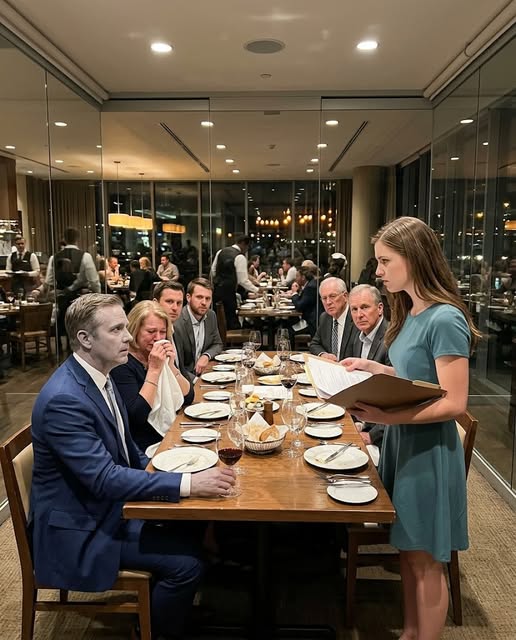
Matthew introduced them as business associates who happened to be in San Francisco. “Martin Cole,” one said, shaking her hand. “Your father speaks highly of your determination.” Natalie heard the careful phrasing. Not intelligence. Not accomplishments. Determination. The other man, Victor Haines, smiled without warmth. “Berkeley is quite a place these days.” “It is,” Natalie said. Matthew ordered wine before she sat down. For the first course, he talked about James. James had been promoted again at his consulting firm in Chicago, and Matthew described the news with a glow Natalie had never seen on his face during any of her achievements. James accepted the praise with the modesty of a man who expected it. For the second course, Matthew talked about Tyler. Tyler had joined a new division at the financial firm and was already proving useful, according to Matthew. Tyler’s jaw tightened at the word useful, but he nodded when their father glanced at him. Natalie sat between her mother and a glass wall that reflected her own face back at her. Her mother’s hand rested in her lap, twisting a napkin. “Natalie worked very hard too,” Diana said once, barely above the table noise. Matthew cut into his fish. “Yes,” he said. “She has always been committed to her chosen path.” Chosen path. The phrase landed like a warning. Natalie looked at him across the candles and remembered another table, another meal, another night when she had told him she was going to Berkeley. She had been seventeen then. Her acceptance letter had arrived in a thick envelope that made her hands shake. She had opened it alone in her room because she already knew joy was dangerous in that house. The scholarship offer had been generous enough to make Berkeley possible, but not easy. That night, she had called a family meeting after dinner. Matthew had listened without interrupting. That was always how he punished people. He let them speak until their courage looked childish. “I’m going to Berkeley,” Natalie had said. “I’m studying pre-law.” Her mother’s eyes had filled. James had scoffed. Tyler had stared at the floor as if he could disappear into the grain of the hardwood. Matthew repeated the name of the school like it tasted bad. “Berkeley.” Then he said, “Without my support.” No argument. No raised voice. No slammed hand against the table. Just a decision delivered like a quarterly forecast. “I allocated funds for your education based on certain expectations,” he said. “If you choose to disregard those expectations, those funds will be reallocated.” “You’re cutting me off because I want to study law?” Natalie asked. “I am investing where the return is most likely.” She remembered the heat in her throat. She remembered looking at her mother, hoping for one sentence of defense, one interruption, one crack in the family script. Diana had looked down. Later that night, her mother came to her room and handed her an envelope with five thousand dollars in cash. “He can’t know,” Diana whispered. Natalie had taken it with shaking hands. It was the first money that ever felt like love and fear at the same time. But that was not the only thing she took from the house before leaving.
Two days before her flight to California, Natalie went into Matthew’s home office looking for her Social Security card and birth certificate. The office smelled of leather, printer ink, and the sharp cedar blocks he kept in the drawers. Everything was arranged with military neatness. In the bottom cabinet, behind old tax records, she found a black file box. It should have been locked. The small silver key was taped beneath the desk drawer, exactly where a man like Matthew would hide something because he trusted everyone in the house to be too afraid to look. Inside were documents she did not fully understand at first. Settlement agreements. Confidentiality clauses. Printed emails. Internal memoranda. Names of employees she had never heard at the dinner table. There was a woman named Elise Marlow who had reported that revenue had been booked early to inflate quarterly numbers before an investor presentation. There was a compliance analyst named Joanna Price who had warned that audit dates were being altered. There was another employee, Carla Reyes, who had been pushed out after refusing to sign off on figures she believed were false. The documents used clean language. Separation payment. Mutual non-disparagement. No admission of wrongdoing. But the emails were different. One from Matthew said, “Handle this before legal creates a record.” Another said, “She signs by Friday or she becomes unemployable.” Natalie was seventeen, but she understood the shape of the thing. Her father had helped bury complaints. He had used money to silence women who saw something they were not supposed to see. He had built his spotless reputation on documents hidden in a box in a room nobody dared enter. She copied what she could. At a drugstore near school, she fed page after page into an old copier with a cracked plastic lid. Her hands shook every time the machine flashed. She expected Matthew to appear behind her, calm and furious, asking what she thought she was doing. But he never came. She mailed one set of copies to herself in Berkeley. She hid digital scans in an encrypted folder. She left the originals exactly where she found them. For four years, she told no one. Not because she forgave him. Because she was learning. At Berkeley, Natalie learned how power sounded in court filings. She learned how people with money wrapped threats in polite words. She learned how retaliation worked, how settlement language protected institutions more often than victims, and how silence could be purchased but never made clean. She also learned hunger. She learned which campus buildings stayed open late enough to study in after her shift at the library. She learned how to stretch one grocery trip across nine days. She learned to smile when classmates complained about parents who called too often because her own father had stopped calling entirely. Her mother called sometimes. The conversations were careful. “Are you eating enough?” Diana would ask. “Yes, Mom.” “Are your classes going well?” “Yes.” “Do you need anything?” Natalie always paused before answering that one. She needed a mother who could speak freely. She needed someone to say her father was wrong. She needed a home that did not charge admission in obedience. “I’m okay,” she would say. Sometimes, in the background, Matthew’s voice would cut through.

Diana would go quiet.
“I have to go,” she would whisper.
The line would end.
By graduation week, Natalie had almost convinced herself the past could stay folded away.
Then Matthew raised his wine glass.
The dessert plates had just arrived.
A thin slice of chocolate torte sat untouched in front of Natalie.
Her mother had not eaten more than three bites of anything.
James was checking messages under the table.
Tyler was staring at the candle flame.
Matthew tapped his knife gently against his glass.
The sound was delicate.
Every head in the private room turned toward him.
Through the glass wall, a few diners in the main restaurant glanced over as well.
Matthew stood.
Natalie felt her stomach tighten.
“I want to thank everyone for joining us tonight,” he began.
“Family moments deserve witnesses.”
Witnesses.
There it was.
He looked at Natalie, and for one second his expression almost resembled pride.
Almost.
“Natalie has completed her degree,” he said.
“And while that is an accomplishment, tonight is also an opportunity to clarify certain family matters.”
Diana whispered, “Matthew.”
He did not look at her.
“For years, Natalie has chosen ideology over gratitude.
Defiance over wisdom.
She rejected the guidance of the family that raised her and pursued a path built on resentment.”
Heat climbed Natalie’s neck.
The business associates lowered their eyes, but they did not interrupt.
James leaned back slightly, as if preparing to enjoy the scene.
Tyler’s face had gone pale.
Matthew continued, calm and surgical.
“As of tonight, I am making it clear that Natalie will receive no financial support from me, now or in the future.
No inheritance.
No position through family connections.
No claim on the Richards legacy.”
Diana’s hand flew to her mouth.
Natalie heard a waiter stop moving near the doorway.
Matthew lifted his glass higher.
“I wish her luck surviving on principles.”
The silence after that sentence was so complete that Natalie could hear the faint clink of silverware from the other side of the glass.
For most of her life, humiliation had made her small.
This time, it made her still.
She looked at her father and finally saw the whole design.
He had not come to celebrate her.
He had come to perform judgment.
He had invited colleagues so they could watch him discipline the daughter who refused to become a trophy.
He wanted her frightened.
He wanted her grateful for whatever scraps he had once offered.
He wanted her mother to see what happened to women who stepped out of line.
Natalie placed her napkin on the table.
Slowly.
Matthew’s smile weakened.
“Natalie,” her mother whispered.
But Natalie was already reaching into her bag.
The folder inside was not thick.
Just enough pages to matter.
She had not planned to use it that night.
She had carried it only because being near her father made old instincts wake up in her body.
Proof, she had learned, was a kind of oxygen.
She stood.
The chair legs scraped against the floor.
Every person in the room looked at her.
“If we are clarifying family matters,” Natalie said, her voice steadier than she felt, “then we should clarify what the Richards legacy actually is.”
Matthew set his glass down.
“Sit down.”
“No.”
The word was not loud, but it changed the air.
James laughed once under his breath.
“Natalie, don’t embarrass yourself.”
She opened the folder.
“I was seventeen when I found these,” she said.
“In Dad’s office.
Copies of settlement agreements involving employees at Harrington Vale Capital.
Women who reported falsified revenue entries, altered audit records, and retaliation after they raised concerns.”
Martin Cole’s head snapped up.
Victor Haines stopped breathing through his mouth.
Matthew’s eyes hardened.
“You have no idea what you’re talking about,” he said.
Natalie looked down at the first page.
“Elise Marlow,” she read.
“Senior accounting manager.
Settlement amount: four hundred seventy-five thousand dollars.
Confidentiality provision.
No admission of wrongdoing.”
Her father moved toward her.
Tyler stood so fast his chair hit the wall.
“Dad,” he said.
Matthew froze, not because Tyler frightened him, but because every person in the room had seen him move.
Natalie continued.
“Here is the email chain where Elise questioned revenue booked before contracts were finalized.
Here is the response from Matthew Richards stating, ‘If she continues documenting this, remove her from the reporting cycle.’”
Diana was crying silently now.
James no longer looked amused.
“You stole confidential documents,” Matthew said.
“You hid evidence of fraud,” Natalie replied.
His jaw flexed.
The glass walls of the private room had become a theater.
Diners were no longer pretending not to listen.
A woman at a nearby table had turned fully in her chair.
One of the waiters stood by the service station with a phone in his hand.
Natalie turned to the business associates.
“I don’t know what he told you about me.
Probably that I’m dramatic.
Ungrateful.
Radical.
Difficult.”
Neither man spoke.
“But difficult is what he calls women who keep records.”
Matthew’s face had gone a dull gray.
“Enough,” he said.
Natalie pulled out the second document.
“Joanna Price,” she said.
“Compliance analyst.
She warned your firm that audit timestamps had been changed.
Three weeks later, she was terminated for ‘departmental restructuring.’ Six weeks after that, she signed a settlement.”
Victor Haines pushed back from the table.
“Matthew,” he said slowly, “what is this?”
Matthew’s composure flickered.
“An unstable accusation from a resentful child.”
Natalie almost smiled.
That was when she reached into the back pocket of the folder and removed the one page she had never fully understood until her junior year at Berkeley.
A memo.
Not from a victim.
From her father.
It summarized exposure risk, potential reporting obligations, and reputational consequences if the complaints reached regulators before the investor presentation.
At the bottom was Matthew’s signature.
Natalie held it up.
“This is not an accusation,” she said.
“It is your handwriting.”
The room went dead quiet.
Matthew stared at the page like it had risen from a grave.
Diana whispered, “Oh my God.”
James said, “Dad?”
The word cracked in the middle, and for once he sounded less like Matthew’s heir and more like a son realizing the throne was made of rot.
Tyler looked at Natalie.
His eyes were wet.
“You knew?” she asked him.
He shook his head.
“Not this.”
But the shame on his face said he had known enough.
Maybe not the files.
Maybe not the names.
But he had known their father’s world required people to disappear quietly.
Matthew reached for control the way he always did.
“You
will give me those papers,” he said.
“No.”
“You have no standing.
No credibility.
No understanding of corporate settlement structures.”
“I understand threats,” Natalie said.
“You taught me.”
That landed harder than she expected.
For the first time all night, Matthew looked away.
Martin Cole stood.
His face had lost all color.
“I’m calling counsel.”
Victor was already stepping toward the door.
Matthew turned on them.
“This is a private family matter.”
“No,” Natalie said.
“That is what you call things when you want women to stay quiet.”
The words carried through the glass.
Someone in the restaurant began recording openly.
Matthew saw the phone.
The mask broke.
Not completely.
Men like him rarely shattered in one dramatic instant.
But Natalie saw the crack.
A twitch near his eye.
A tremor in his hand.
The sudden awareness that the room was no longer under his control.
Diana stood slowly.
Everyone looked at her.
For twenty-five years, Natalie had watched her mother fold herself smaller to fit inside Matthew’s life.
She had watched Diana excuse cruelty as pressure, domination as concern, humiliation as high standards.
Now Diana looked at the folder in Natalie’s hand, then at her husband.
“Is it true?” she asked.
Matthew exhaled sharply.
“Diana, sit down.”
“No.”
The word was soft.
It was also the bravest thing Natalie had ever heard from her mother.
Matthew blinked.
Diana’s voice trembled, but she kept going.
“Is it true?”
He did not answer.
And that was the answer.
Diana took one step back from him.
The movement was small, but Natalie knew what it cost.
Within forty-eight hours, the video from the restaurant had traveled farther than anyone expected.
Natalie had not posted it.
She did not need to.
Someone from the dining room uploaded a clip of Matthew telling his daughter she had no claim to the family legacy, followed by Natalie reading the first name from the settlement file.
By Monday morning, Harrington Vale Capital had issued a statement saying it had opened an internal investigation.
By Wednesday, Matthew Richards was placed on leave.
By the end of the month, he resigned.
Natalie gave copies of the documents to regulators and an attorney representing two former employees.
She spent long hours in conference rooms telling the same story again and again.
Where she found the files.
When she copied them.
Why she kept them.
No one had to ask why she finally used them.
The answer was in the video.
Matthew had mistaken public cruelty for power.
He had taught his daughter to survive without him, then acted surprised when she did.
The legal consequences unfolded slowly, as they always do.
Investigations took months.
Statements were revised.
Executives distanced themselves.
Men who had toasted Matthew’s judgment began describing him as a former colleague they had not known well.
But some things changed immediately.
Elise Marlow contacted Natalie through an attorney.
Her message was only three sentences long.
You do not know what it meant to hear my name said out loud.
I thought they had buried all of us.
Thank you.
Natalie read it in her apartment and cried so hard she had to sit on the floor.
Her mother left Matthew six weeks after the graduation dinner.
Not dramatically.
Not with a speech.
One morning, while he was
meeting with lawyers, Diana packed two suitcases, took the paintings she had bought before their marriage, and moved into a small apartment near the lake.
The first time Natalie visited, there were no perfect flower arrangements, no polished silver, no portraits chosen for status.
There were canvases leaning against the wall.
Diana had enrolled in an art history seminar.
“I don’t know who I am without him,” she admitted, standing in the tiny kitchen with two mugs of tea between them.
Natalie looked at her mother’s hands.
They still trembled sometimes.
“Maybe that’s a good place to start,” she said.
James did not speak to Natalie for nearly a year.
When he finally called, his voice was clipped and tired.
“You destroyed the family,” he said.
“No,” Natalie replied.
“I stopped lying for it.”
He hung up.
Tyler called more often.
At first, he apologized in fragments.
For not defending her.
For Spain.
For becoming quiet because it was easier than becoming brave.
Natalie did not forgive him all at once.
Some apologies have to be lived before they can be accepted.
But he tried.
He left the firm.
He started therapy.
He met Natalie for coffee in Chicago and admitted that he had spent years confusing obedience with loyalty.
Their relationship did not heal like a movie.
It healed awkwardly, unevenly, with long pauses and careful honesty.
Matthew never apologized.
He sent one letter through an attorney accusing Natalie of theft, defamation, and emotional instability.
Her attorney responded with a packet of dates, documents, and witness statements.
No lawsuit followed.
Two years later, Natalie stood outside a courthouse in Chicago after being sworn in as an attorney.
She wore a navy dress, low heels, and her mother’s pearl earrings.
Diana stood beside her, crying openly this time.
Tyler brought flowers.
James did not come.
Matthew sent nothing.
For a moment, Natalie felt the old ache of it.
Not regret.
Not guilt.
Just the strange grief of knowing a parent could watch your life from a distance and still choose pride over love.
Then her phone buzzed.
It was an email from Elise Marlow.
The subject line read: Today mattered.
Attached was a photo of three women standing together outside a federal building, all former employees who had once signed papers promising silence.
Beneath the photo, Elise had written one line.
Some legacies are built when someone finally says the names out loud.
Natalie looked at the message for a long time.
Her father had tried to disown her in public because he believed family was something he controlled.
He believed money was the final language.
He believed shame worked best with witnesses.
He was right about one thing.
Witnesses mattered.
They mattered when he tried to humiliate her.
They mattered when she opened the folder.
They mattered when women who had been paid to disappear heard their own names spoken in a room where powerful men could no longer pretend not to listen.
Natalie did not get the father she wanted.
Her mother did not get back the twenty-five years she lost.
The women in those files did not get back the jobs, reputations, or peace that had been taken from them.
But the silence broke.
And once it broke, no amount of money could make it whole again.
Years later, people still argued about what Natalie did in that restaurant.
Some said she should have handled it privately.
Some said family humiliation did not justify public exposure.
Others said Matthew Richards chose the stage himself, then hated the performance when his daughter finally spoke her lines.
Natalie never argued with them.
She knew exactly what had happened that night.
Her father raised a glass to end her.
She raised the truth instead.

