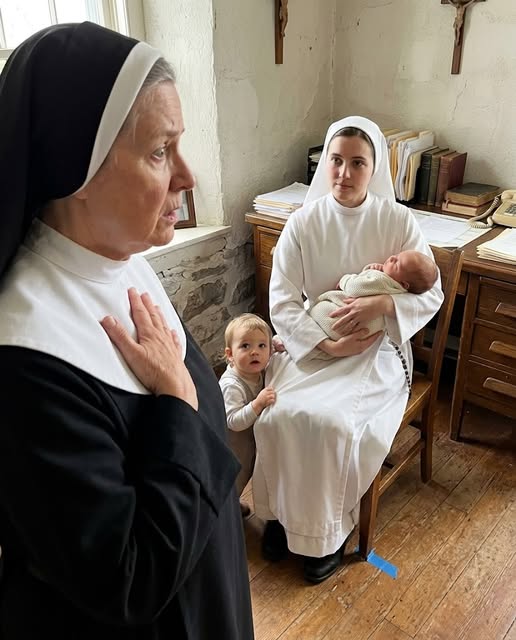
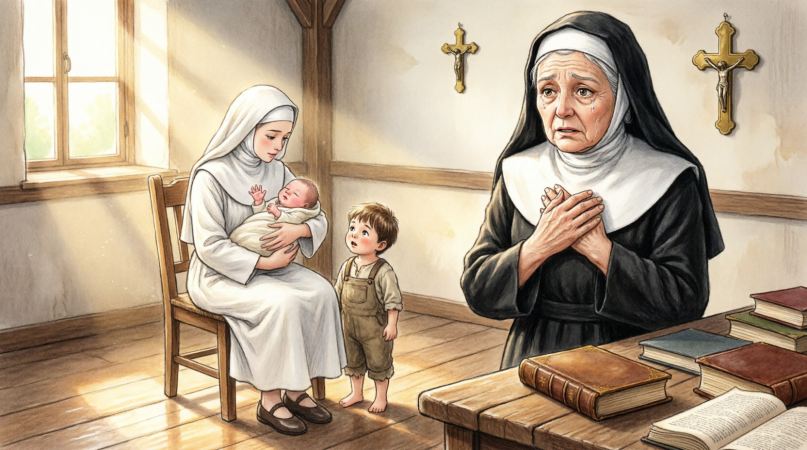
By the time Sister Esperanza whispered that she was pregnant again, Mother Caridad had already buried two years of sleepless prayer under forced composure. The third confession landed harder than the first two because now there were children in the room to prove the impossible had already happened. A baby slept against Esperanza’s chest. A toddler clung to her white habit. The scene looked gentle enough to hang in a chapel, but to Mother Caridad it felt like standing at the mouth of a well and hearing something breathe below. She tried to answer like a superior, but the woman inside the veil answered first. Her hand flew to her chest. Her knees weakened. She stared at the young nun’s calm face and searched for shame, confusion, even a flicker of guilt. She found none. Esperanza looked almost luminous, as if the words had lifted a burden from her instead of placing one on everybody else. Within an hour, Doctor Paloma was inside the convent examining her for the third time in three years. Rain tapped against the narrow windows, and the old building carried every sound: the squeak of leather gloves, the click of metal instruments, the quiet humming Esperanza did when she was nervous. When Paloma finally straightened, she removed her glasses and spoke with eerie calm. The pregnancy was real. Mother Caridad expected surprise. She expected outrage, or at least professional confusion. Instead, the doctor merely repacked her bag and said they would monitor the pregnancy closely, the way they had before. That was the first moment something cold settled at the base of Mother Caridad’s spine. Most people reacted to the impossible with questions. Paloma reacted to it with routine. After the doctor left, Mother Caridad stood alone in the hallway and remembered the first pregnancy. Esperanza had collapsed in the vegetable garden with dirt on her palms and tears on her face after hearing a heartbeat at the clinic. The second had come before the first child was even walking properly. There had been no broken locks, no footprints outside the cloister, no frightened confession from a man, no witness, no rumor that could survive daylight. Only another swelling belly and another infant wrapped in white blankets while the town whispered miracle and scandal in the same breath. The convent had rules older than any of them. Men did not cross the inner gate. Deliveries came to the outer door. Repairs were handled with the sisters watching from behind grilles. At night, the iron latch was checked twice. Mother Caridad knew every window, every corridor, every place where a secret could hide, and still she could not explain what had happened twice already and was happening again. That evening, she went to Esperanza’s cell after compline. The room smelled of soap, baby milk, and lavender. Miguel slept in a cradle made from an old wooden fruit crate polished by careful hands, while little Tomás lay curled on a blanket on the floor, one fist tucked beneath his chin. Esperanza sat on the edge of the bed with a softness on her face that made the conversation harder before it even began. Mother Caridad asked her gently to think beyond faith and tell the truth exactly as it happened. Had anyone touched her. Had she ever awakened disoriented.
Had she been anywhere she could not remember. Esperanza lowered her eyes and pressed her hands together. She said no to the first question immediately, but the rest took longer. Then, in a voice that had gone thin, she admitted there were blank spaces. After each visit from Doctor Paloma, especially the ones after childbirth, she slept heavily. Not ordinary sleep. It was the kind that swallowed sound and time. She would wake with a bitter taste at the back of her tongue, soreness low in her belly, and a strange feeling that bright lights had been shining through her eyelids while someone spoke just outside her reach. She had told herself it was medicine, exhaustion, nerves. She had wanted to believe that. When Mother Caridad asked whether anything like that had happened before she entered the convent, Esperanza hesitated for so long the silence changed shape. At last she said there had once been another name. Before her vows, she had been Elena Ruiz. Before the veil, before the cloister, before she became the woman everyone called Sister Esperanza, she had been engaged to a man named Mateo. He had been kind, serious, and determined to build a family with her. Then there had been an accident, and after that her memories came back in pieces, like shards lifted from dirty water. She did not remember everything from the months before taking vows. She remembered a hospital corridor. She remembered Mateo squeezing her hand. She remembered signing papers she did not fully understand while both of them were exhausted and frightened. Then came sirens, grief, and the sudden terrible relief of a convent gate closing behind her. She had never wanted to go back and look at that part of her life too closely. It hurt less when it stayed blurred. That night Mother Caridad barely slept. Before dawn she went to the archives room, a narrow space that smelled of candle smoke, dust, and damp paper. She pulled Esperanza’s admission file from the cabinet and found little beyond baptism papers, letters of recommendation, and the formal petition to enter. But tucked inside the back cover, folded so many times it had nearly turned to cloth, was an invoice from a private fertility clinic in town. At the bottom was a signature she knew: Doctor Paloma Salvatierra. Mother Caridad read it three times before the words settled into sense. Patient: Elena Ruiz. Embryo preservation. Consent on file. Her hands began to shake. She sat down very slowly, as if the wooden chair might move away from her. She had expected sin, blackmail, secret lust, maybe even madness. She had not expected medicine. When Paloma returned the following week for a routine check, Mother Caridad met her in the parlor instead of the infirmary. She placed the old invoice on the table between them and watched the doctor’s face. Only one thing changed: not her expression, but the way her fingers stopped moving for half a second before becoming still. Then Paloma looked up and asked where she had found it. Mother Caridad said she wanted the truth. Paloma replied with the polished chill of someone used to holding power through information. Elena Ruiz, she said, had once pursued treatment with her fiancé. Those were private medical matters from before religious life.
Nothing in that file explained the current pregnancies, and stirring old pain would only harm a vulnerable woman. She reached for the paper, but Mother Caridad drew it back first. It was not the answer that unsettled her most. It was the absence of indignation. A woman falsely accused of something monstrous might have snapped, protested, stormed out. Paloma only adjusted the cuff of her coat and asked for tea. So Mother Caridad watched. She watched Paloma’s visits begin with concern and end with drowsiness. She watched Esperanza grow quiet after drinking whatever tonic the doctor insisted would help her weakness. She watched Miguel cry from his cradle while his mother slept through the sound as if she were underwater. One afternoon, when Paloma turned to wash her hands, Mother Caridad switched the cups on the tray. She lifted the one meant for Esperanza and touched a drop to her tongue. Beneath the honey, there was something sharp and medicinal that did not belong. Paloma turned back too quickly. For the first time, her calm cracked. She took the cup from Mother Caridad’s hand and said the herbs were stronger than usual. Then she smiled, but it was a smile with no warmth in it. Please leave these things to professionals, Mother. Not every mystery is spiritual. That sentence stayed with her. Not every mystery is spiritual. It was not something a believer said when faced with the impossible. It was the sentence of someone defending a mechanism. Mother Caridad began moving through the convent differently after that, listening for what had always blended into the building’s ordinary sounds. In the old west wing, once used as an infirmary decades earlier, she heard metal sometimes after midnight. A drawer sliding. Glass touching glass. Footsteps measured and careful. The door was usually locked, and Paloma was the only outsider with permission to carry keys inside the enclosure. She nearly confronted her then, but the proof she had was still too thin, and scandal without evidence would destroy Esperanza long before it reached the person responsible. So she waited, prayed, and kept her fear folded inside her sleeves. The waiting ended on a night of heavy wind. Esperanza’s labor began two weeks early, just after vespers. By the time the first strong contraction bent her forward in the chapel corridor, thunder was rolling over the hills. The sisters hurried her to the old birthing room and lit extra lamps because the electricity had started flickering. Tomás cried in Sister Inés’s arms. Miguel, too young to understand, only whimpered and rooted against an empty bottle. Doctor Paloma arrived soaked from the rain, black bag in hand, eyes bright with a focus that looked almost like anticipation. She checked Esperanza quickly, then turned to the room and told everyone except one assistant to leave. Mother Caridad refused. This is my convent, she said. I stay. For a second the doctor held her gaze so steadily that the storm outside seemed quieter than the silence between them. Labor sharpened. Esperanza gripped the sheet, sweat darkening her hairline. Between contractions she muttered fragments that made no sense at first. Not the light again. Please, not sleeping. No more needles. Mother Caridad bent closer, but Paloma cut in at once, saying women in pain speak nonsense.
Then she reached for a syringe.
Mother Caridad caught her wrist.
What is that.
A sedative, Paloma answered.
She is exhausted.
No, Mother Caridad said.
Not this time.
Paloma stared at her for a long second, then placed the syringe back in the tray with controlled precision.
In that small act, something hidden became visible.
The doctor had expected to use it.
Not considered it.
Expected it.
The next contraction tore a cry from Esperanza’s throat, and as Mother Caridad helped hold her, the fabric of the young nun’s gown shifted high along one thigh.
There, against pale skin, were two fresh puncture marks side by side.
Below them, older faint scars traced a pattern like echoes.
Mother Caridad felt the air leave her lungs.
Those marks were not from tonight.
They were a map.
At that same moment, Paloma’s bag tipped slightly as she reached for fresh linens.
A slim sterile packet slid halfway out of an inner pocket and landed against the leg of the table.
Mother Caridad looked down and saw the printed label before Paloma could snatch it back.
Transfer catheter.
Patient sticker attached.
Paloma grabbed it, but not before another small square of paper loosened from the packet and fluttered to the floor.
Mother Caridad bent first.
The wet edge stuck to her fingers.
She read only a few words before folding it into her palm: Elena Ruiz.
Cycle 3.
The room narrowed to a single point.
But the child was coming, and no truth, however monstrous, would stop a birth once it had begun.
Esperanza pushed through pain and terror without understanding why the faces around her had changed.
Minutes later, a baby girl entered the world in a rush of blood, breath, and storm-trembling light.
She cried immediately, fierce and thin, and for one wild second the sound cut through everything else.
Mother Caridad wrapped the newborn while Paloma dealt with the rest.
As she drew the blanket around the baby, she saw the infant’s eyes open for the briefest instant.
Gray.
The same unusual pale gray as the young man in the photograph she had found tucked into Esperanza’s file beside the clinic bill.
Mateo.
It was enough.
Not the full truth, but enough.
Before dawn, while the sisters settled Esperanza and the baby, Mother Caridad took the patient sticker, the invoice from the archive, and a lantern, then crossed to the locked west wing.
The storm had broken a shutter there months earlier, and the latch never sat quite flush.
With a screwdriver from the tool drawer and hands steadier than she felt, she forced it open.
The old infirmary was colder than the rest of the convent.
Cabinets lined the walls.
A portable examination lamp stood in one corner under a sheet.
In a locked refrigerator unit, she found labeled hormone vials, empty sedative ampoules, and a metal case that smelled of frost and chemicals.
Inside a drawer were forms stacked with clinical neatness.
Embryo transfer one.
Embryo transfer two.
Embryo transfer three.
Patient: Elena Ruiz.
Physician: P.
Salvatierra.
Her stomach turned so violently she had to grip the counter.
The dates told the whole story.
Each transfer happened weeks before each pregnancy was discovered.
Each one followed a visit for weakness, postpartum recovery, or routine checkup.
Beside the forms was a consent packet years old, signed by Elena Ruiz and Mateo Álvarez before the accident.
Three fertilized embryos had been created and frozen during his cancer treatment.
Three.
No man had entered the convent.
None had needed to.
Mother Caridad understood then why Esperanza’s face had held that strange certainty when she said she was not like other women.
Somewhere deep inside, her body remembered a past her mind had locked away.
The pregnancies were not immaculate.
They were planned once, by another version of her life, then stolen back into existence without her knowledge.
She copied everything she could with the convent’s old office phone, which still had a camera Sister Inés barely knew how to use.
Then she placed the patient sticker and one photograph in an envelope and wrote only this on the front: If anything happens to me, give this to Esperanza and the bishop.
She handed it to Sister Inés before sunrise and told her not to ask questions, only to promise.
The older nun, frightened by the look on Mother Caridad’s face, promised immediately.
Paloma came to the dispensary at noon, fresh clothes, composed expression, as if the night had been nothing more than another delivery.
Mother Caridad was waiting for her beside the shelves of bandages and holy water.
The door was shut.
Rainwater still dripped from the eaves outside.
She placed the copied forms on the table one by one.
For the first time since entering the convent, Doctor Paloma looked truly afraid.
At first she denied only the parts she could not save.
She said Esperanza had once wanted children more than anything.
She said Mateo had been dying and the embryos were all that remained of their future.
She said trauma had erased memory but not desire, and that every time she looked at Esperanza walking those cloisters she saw a woman burying a life she had once begged for.
Then the restraint fell away, and something rawer took its place.
Years earlier, Paloma told her, Elena and Mateo had come to her desperate and hopeful at the same time.
Mateo’s treatment would likely leave him sterile.
They made embryos because they were trying to outrun loss.
Then the accident happened before any transfer could be done.
Mateo died.
Elena survived, but her grief shattered her memory and her will.
She vanished into religious life.
The clinic eventually contacted Paloma about the stored embryos and the legal deadline to dispose of them.
Paloma could not accept it.
She had lost a daughter herself, years before.
She had spent her career watching chances vanish, families collapse, wombs empty, cribs stay bare.
She told herself that she was protecting life.
Then she told herself she was honoring Elena’s old consent.
By the time she began visiting the convent, the lie had hardened into a private theology.
Esperanza’s body, she believed, still belonged to the woman who had signed those forms.
She had simply helped that promise continue.
Mother Caridad listened with horror so complete it almost felt clean.
You drugged her, she said.
You entered her body without permission.
You used her faith and her confusion as cover.
Paloma’s jaw tightened.
And she loved them, did she not.
The moment she held them, she loved them.
Would you
rather those children had died in a freezer because grief made a different choice possible.
They were not yours to save, Mother Caridad said.
They were not yours to make.
When she reached for the papers, Paloma blocked her path.
Panic had finally stripped the doctor down to what she truly was: not calm, not rational, not merciful, only desperate to keep control of the story she had built.
If you tell the authorities, she said, those children become evidence first and children second.
They will tear open every part of her life.
They will call her unstable.
They may take the babies while they investigate.
Is that what you want.
Mother Caridad’s hand moved to her chest.
She had lived for years with a heart that sometimes stumbled under strain.
The pressure blooming there now was sudden and brutal.
She reached into her pocket for the small tin of tablets she carried.
One slipped.
Then another.
They rattled across the floorboards.
Paloma looked down.
The moment stretched.
All she had to do was kneel and pick one up.
Instead she put her shoe over the nearest tablet as if pinning an insect and said, almost pleading with herself as much as with the nun, Please do not make me lose all of them.
Mother Caridad stared at her, understanding everything at once.
The confession.
The fear.
The choice.
Not only what Paloma had done in the dark, but what she was willing to do in the light to keep it hidden.
She collapsed before she could call for help.
By the time Sister Inés broke open the dispensary door, Mother Caridad was on the floor, her face turned toward the table where the records still lay.
Doctor Paloma was kneeling beside her then, shouting for water, for blankets, for air, performing panic for an audience that had arrived too late to see the stillness that came first.
The convent heard only that Mother Caridad’s heart had failed after a difficult night and too little sleep.
She was buried three days later in the small cemetery behind the chapel, under a gray sky that seemed too low for anyone to breathe beneath it.
Esperanza stood there holding her newborn daughter while Miguel fussed and Tomás pressed himself against Sister Inés’s skirts.
She cried openly, not only for the mother superior she loved, but because something in the house had changed since the birth.
A warmth was gone.
The convent no longer felt protective.
It felt guarded.
After the mourners left, Sister Inés found Esperanza in the nursery and placed an envelope in her hands.
Mother Caridad told me to keep this only until I was certain, she said.
If anything happened to her, it was meant for you.
Esperanza opened it expecting a letter of blessing.
Instead she found copies of medical records, the old clinic invoice, a photograph of herself years earlier beside a smiling dark-haired man with pale gray eyes, and a page in Mother Caridad’s careful handwriting.
The note did not soften anything.
It said simply that the children were hers in blood, that the man in the photograph was Mateo, that the pregnancies had been created through procedures done without her knowledge, and that whatever love she felt for her children did not erase the crime committed against her.
Esperanza sat down so suddenly the cradle rocked.
For several seconds she made no sound at all.
Then a low, breaking noise came from somewhere so deep it frightened Sister Inés to hear it.
Memory did not return in one generous wave.
It returned like lightning through darkness: Mateo laughing in a clinic hallway, signing forms with a bandaged hand after chemo, promising they would survive the treatment and give those children a home.
Then the crash.
Then white light.
Then years of missing pieces that suddenly had edges.
She looked at her daughter, at Miguel, at Tomás, and began to shake.
Love did not leave her.
That would have been simpler.
The children were still the center of her body and the ache of her days.
What changed was the ground under every miracle she had been asked to believe.
She asked for Doctor Paloma at once.
The confrontation happened in the bishop’s reception room the next afternoon because Sister Inés, unlike Mother Caridad, told no one only half the story.
She took the envelope straight to the bishop, then to the police, then brought Esperanza where the doctor could no longer hide inside convent walls.
Paloma arrived expecting a complaint.
She found officers, the bishop, Sister Inés, and a young nun holding three children and looking at her as if seeing a stranger climb out of a familiar face.
At first Paloma tried to speak to Esperanza softly, using the same measured tone that had kept everyone around her calm for years.
But the moment Esperanza asked one question, the tone died.
Did you do this while I was asleep.
The doctor said nothing.
Did you use Mateo’s embryos without asking me who I was after he died.
Silence again.
Then Esperanza asked the one question that made Paloma’s shoulders finally cave.
When I said yes to God, why did you think that yes still belonged to you.
Paloma wept then, not beautifully, not nobly.
She wept like someone watching the private story that had protected her rot in public air.
She said she believed she was preserving love.
She said she could not bear to destroy the last living trace of a man who had wanted children and a woman who had once wanted them too.
She said the babies were alive because of her.
The police took her statement and arrested her before evening.
The investigation that followed confirmed what Mother Caridad had uncovered: sedatives, forged follow-up forms, unauthorized procedures, falsified entries in clinic storage logs, and the three embryo transfers carried out inside the convent’s abandoned infirmary.
A medical board stripped Paloma of her license.
Charges followed, including assault, fraud, and responsibility for Mother Caridad’s death after witnesses described the pills scattered on the floor and the doctor’s delay.
None of it brought Mother Caridad back.
None of it made the pregnancies feel simple.
Esperanza left the convent two months later, not because her faith disappeared, but because she no longer wanted to live inside choices made during the years she had been broken open by grief.
She rented a small house near the edge of town with help from the church, planted rosemary by the window, and learned how to raise three children without bells telling her when to pray.
Some
mornings she still touched the veil she had folded into a drawer and cried before breakfast.
Other mornings she laughed so hard at Tomás or Miguel that the sound surprised her.
She named the baby Lucía Caridad.
On the wall above the crib, she hung Mateo’s photograph beside Mother Caridad’s rosary.
One was the life she lost.
The other was the woman who tried to return her to herself and paid for it with her own.
Esperanza refused to let either vanish.
People in town never agreed on what to call the story.
Some said the children were miracles because life had found a way back through ruin.
Others said miracle was the cruelest word of all, because it dressed violation in velvet and asked everyone to kneel before it.
Esperanza never argued with the first group and never fully forgave the second.
She only said one thing whenever anyone grew too certain.
My children are innocent.
The theft was the choice.
And that was the part no one could settle.
Whether love for what was born could ever soften the horror of how it began.
Whether Doctor Paloma had been a grieving woman who went mad trying to preserve a promise, or a predator who hid behind that grief because it sounded nobler than control.
Whether Mother Caridad died a martyr to truth or a victim of the moment she believed truth alone would be enough.
In that town, years later, people still lowered their voices when they passed Esperanza’s gate, not because the mystery remained, but because the answer did.
And on the quietest nights, when Lucía cried and the boys finally slept and the house grew still, Esperanza sometimes held all three children close and wondered which demanded more courage: calling them the last gift Mateo left her, or admitting they were also the proof that some violations arrive wearing the face of mercy.