The Party That Looked Normal—Until It Wasn’t
The backyard was bright with decorations that tried their best to convince everyone this was a happy day. Balloons floated lazily in the warm air, brushing against one another with soft taps, while a long table stretched across the lawn, covered in paper plates and slices of cake that were already beginning to melt at the edges. Adults laughed in clusters, holding plastic cups and talking about everyday things—work, bills, school plans—as if nothing in the world could possibly be wrong.
It was my nephew’s sixth birthday, and I had shown up because that’s what you do. You show up for family. You smile, you make small talk, and you tell yourself it matters.
But something didn’t feel right.
I hadn’t seen my daughter, Lila, in a while. At first, I told myself she was probably playing somewhere, maybe hiding with the other kids or chasing bubbles across the yard. But the longer I stood there, the more a quiet unease crept into my chest. There’s a certain kind of silence that follows a child, and it isn’t peaceful. It’s the kind that makes your instincts wake up before your thoughts catch up.
I stepped inside the house, trying to stay calm.
“Lila?” I called softly, walking down the hallway.
No answer.
I checked the living room. Empty. The kitchen. Just dishes and laughter drifting in from outside.
Then I noticed the bathroom door, slightly closed.
I pushed it open.
The Moment That Broke the Illusion
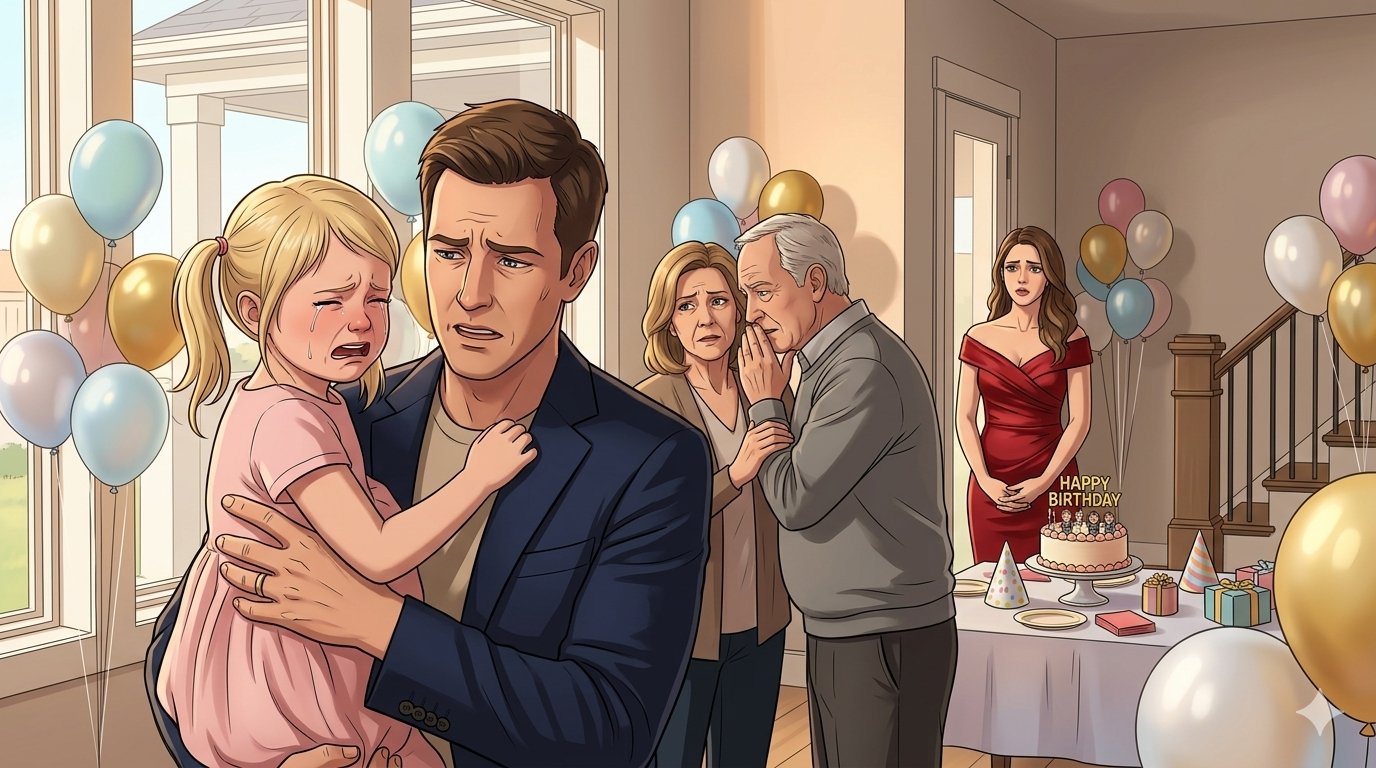
Lila was crouched behind the toilet, pressed tightly into the corner like she was trying to disappear into the walls. Her small body was trembling so hard it looked like the floor itself was shaking beneath her. Her eyes weren’t focused on anything—they were distant, lost somewhere far away from that room.
She didn’t cry out when she saw me.
She didn’t run into my arms.
She just stared.
I knelt down slowly, keeping my voice as gentle as I could, even though my heart was pounding so loud it felt like it might echo off the tiles.
“Hey… it’s me. It’s Dad,” I whispered. “You’re safe, okay? Come here.”
For a second, she didn’t move.
Then, slowly, she reached toward me.
Her arms felt stiff when I lifted her, like she wasn’t sure if it was really okay yet. When I pulled her close, I felt how tightly she clung to my shirt, her fingers gripping like she was afraid I might disappear.
That’s when I saw her face.
The swelling was unmistakable.
Not an accident.
Not something small.
Something done.
A cold, sharp clarity settled over me.
I gently adjusted her sleeve, just enough to check her arm—and what I saw made the world narrow into something quiet and focused. There were marks. Small, round, too similar to each other to be random.
I didn’t ask her what happened.
Not yet.
She was shaking, exhausted, overwhelmed. Whatever answers existed could wait.
Getting her out of there couldn’t.
The Line That Couldn’t Be Ignored
I carried Lila out of the bathroom and into the main part of the house, walking past the decorations, past the food, past the smiling faces that suddenly felt unreal.
In the center of the room, I stopped.
Everyone turned.
I looked directly at my sister, Marissa Cole, who sat comfortably on the couch, a glass in her hand like she was hosting something elegant instead of attending a child’s party.
My voice came out steady.
“Who did this?”
She blinked, then let out a short laugh, like I had just said something mildly inconvenient.
“Oh, come on,” she said, waving her hand dismissively. “It was just a joke. She was being difficult.”
The words didn’t make sense.
Or maybe they did—and that was worse.
I stepped closer, not raising my voice, not making a scene. I just needed to make one thing clear.
“You don’t get to call that a joke,” I said quietly. “And you don’t get to touch my child again.”
Her expression hardened.
“You’re overreacting,” she replied.
I didn’t argue.
I didn’t explain.
I adjusted Lila in my arms and turned toward the door.
That’s when my mother’s voice cut through the room.
“Don’t you dare walk out like that,” she snapped.
A glass shattered somewhere behind me.
I didn’t turn around.
Some situations don’t deserve another second.
The Drive Toward Something Better
The moment we were in the car, I locked the doors.
Lila stayed curled against me for a second before I gently helped her into her seat. She didn’t let go of my hand until the last possible moment.
I drove straight to urgent care.
No hesitation.
No second thoughts.
The waiting room was quiet, filled with the kind of calm that feels almost surreal after chaos. A nurse handed Lila a blanket, and she wrapped herself in it like it was the first time she had felt warmth all day.
I sat beside her, my hand resting gently on her back.
“I’m right here,” I told her softly. “I’m not going anywhere.”
She leaned into me, just a little.
And that was enough.
The Morning That Revealed Everything
The next morning, the pounding on my front door came fast and sharp.
When I opened it, my mother stood there, her expression already filled with emotion—but not the kind I expected.
She dropped to her knees.
“Please,” she said, grabbing onto my arm. “Don’t do this. Don’t ruin your sister’s life.”
I stared at her.
Not once did she ask how Lila was.
Not once did she ask if Lila was okay.
It was all about Marissa.
I pulled my arm back gently.
“You need to leave,” I said.
Her face twisted.
“She didn’t mean it,” she insisted. “You know how she is. She just went too far, that’s all. Don’t make this bigger than it needs to be.”
I felt something inside me settle into place.
A decision.
Clear. Final.
“You’re asking the wrong thing,” I replied. “If you care about fixing anything, start by thinking about Lila.”
Her expression hardened instantly.
“She’s your sister,” she said sharply.
I nodded once.
“And Lila is my child.”
I closed the door.
Not loudly.
Just firmly.
The Cost of Telling the Truth
In the days that followed, everything moved forward whether anyone was ready or not.
Doctors documented what they saw. Statements were taken carefully, without assumptions, just facts. I answered every question honestly, even when it felt heavy, even when it meant saying things out loud that I wished had never happened.
Messages started coming in.
My father left voicemails filled with frustration.
“You’re taking this too far,” he said. “Think about what you’re doing to the family.”
My mother texted repeatedly.
Not once asking about Lila.
Only reminding me of consequences for someone else.
I didn’t argue.
I didn’t respond beyond what was necessary.
Some things don’t need discussion. They need boundaries.
And boundaries don’t require permission.
The Truth That Couldn’t Be Rewritten
When everything finally reached the courtroom, the atmosphere felt completely different from that backyard party.
There were no decorations.
No laughter.
Just quiet, careful words.
Marissa maintained her version of the story.
“I was trying to teach her,” she said.
But evidence doesn’t change to match a story.
It stays the same.
And slowly, piece by piece, the truth became undeniable.
I sat there, not feeling victorious, not feeling relieved—just focused.
Because this wasn’t about winning.
It was about making sure Lila would never feel that kind of fear again.
Afterward, in the hallway, my mother found me again.
Her voice was sharp.
“I hope you’re satisfied,” she said. “Look what you’ve done.”
I met her gaze.
Calm.
Steady.
“I’m making sure my daughter is safe,” I replied. “That’s all I’ve ever done.”
She shook her head.
“You’ve changed,” she said.
I didn’t argue.
Because she was right.
The Life We Chose to Build
Healing didn’t happen overnight.
It wasn’t dramatic.
It wasn’t easy.
But it happened.
Slowly.
Lila started therapy with someone who understood how to move gently, how to rebuild trust step by step. We created routines—simple ones—that made her world feel predictable again.
Over time, the fear in her eyes softened.
The tight grip in her hands loosened.
Her laughter came back.
Not all at once.
But enough.
We found support in unexpected places—neighbors, friends, people who didn’t ask for anything in return, who showed up simply because they cared.
And I realized something I hadn’t understood before.
Family isn’t defined by who stays when things are easy.
It’s defined by who stands with you when doing the right thing becomes uncomfortable.
Some evenings, after Lila fell asleep, I would sit quietly and think about everything we had lost.
But more often, I thought about what we had gained.
Peace.
Safety.
Truth.
And the kind of strength that only comes from choosing what’s right, even when it costs you something.
Because in the end, protecting your child isn’t a decision you debate.
It’s a line you draw.
And once it’s drawn, you don’t step back.
THE END!

