I expanded it into a fuller emotional suspense story with a stronger setup, public humiliation, reveal, and aftermath.
For more than twenty years, I let my family believe I was nothing special.
That was not the same as lying.
At least, that was what I told myself every time I sat at a folding table in someone’s backyard while one cousin or another made a joke about my “little government job,” or my mother introduced me as the daughter who “does paperwork for the Army,” or my uncle leaned back with barbecue sauce on his fingers and said, “Sarah, you’ve been doing that office thing forever. Don’t they ever promote people over there?”
I would smile.
I always smiled.
Smiling was easier than explaining. Explaining was impossible most of the time anyway. In my line of work, the truth came wrapped in nondisclosure agreements, classified briefings, need-to-know restrictions, and a habit of silence so deep that eventually it became part of the body.
My family thought silence meant failure.
They thought I had taken some small administrative job in the military years ago and simply never grown out of it. They thought I rented office space under fluorescent lights, stamped forms, typed schedules, and fetched coffee for men with real authority.
They thought that because I let them.
And because, honestly, it suited them better.
Some families want to know the truth about you. Mine wanted a version of me they could manage. A version they could laugh at. A version they could place neatly beneath the louder, shinier people at the table.
So at home, I was not Major General Sarah Whitmore.
Advertisements
I was just Sarah.
Sarah in faded jeans.
Sarah with the old blue sedan.
Sarah who never brought anyone to family gatherings because my work did not leave much room for explaining myself to strangers.
Sarah who smiled when my cousins joked that I had “classified staplers.”
Sarah who was “probably still waiting on a promotion.”
Sarah who, at forty-six years old, had learned that being underestimated could be painful and useful at the same time.
The useful part had kept me alive.
The painful part had kept me quiet.
That Fourth of July began the way my sister’s cookouts always began: too loud, too hot, and too full of people pretending old resentments were just family humor.
My sister Melissa lived in a two-story house outside Fredericksburg, with a big fenced backyard, a brick patio, and a porch that faced west toward a line of maple trees. Every summer, she hosted the annual family cookout because she liked being known as the dependable one. She liked planning. She liked matching paper napkins to the flag bunting on the porch rail. She liked standing at the center of a crowded yard with a serving spoon in one hand and the satisfaction of knowing everyone had come to her house.
By noon, the backyard smelled like charcoal, cut grass, sun-warmed plastic, and barbecue sauce burning along the edge of the grill. Kids ran through the sprinkler near the fence, shrieking whenever the water swung their way. Two teenagers lounged in lawn chairs with their phones low in their laps, pretending not to record their younger cousins slipping on wet grass. A small American flag snapped from a bracket near the back door, bright against the white siding.
The tables were already loaded when I arrived. Ribs under foil. Corn in metal trays. Potato salad in a yellow bowl that had belonged to our grandmother. Deviled eggs sweating slightly in the heat. Watermelon slices shining red on paper plates. Someone had opened three coolers, and every time a hand reached inside, ice clinked against glass bottles and soda cans.
I pulled into the driveway at 3:52 p.m.
I know the exact time because my dash camera recorded everything from the moment I turned onto the street.
That was not paranoia. That was habit.
I had spent too many years in places where memory was less valuable than a timestamp. Cameras did not get embarrassed. Cameras did not love anyone enough to soften the truth. Cameras did not look away because the person causing trouble was family.
I parked at the far edge of the driveway, leaving plenty of room for my sister’s SUV, my uncle’s truck, and the folding dessert table Melissa always set up under the carport. The spot was legal. Practical. Unremarkable.
At least, it should have been.
I took the fruit salad from the passenger seat, locked my car, and walked toward the backyard.
My mother saw me first from her chair beneath the maple tree.
“There’s Sarah,” she called, waving one hand. “Finally.”
“I’m not late,” I said.
“You’re always later than you think you are,” she said.
It was said lightly.
Everything in my family was said lightly until someone got hurt.
I kissed her cheek, handed the fruit salad to Melissa, and moved into the familiar rhythm of surviving a family event. I filled a plate for my mother because she hated standing too long. I helped my sister move the coleslaw into the shade. I listened while Uncle Ray complained about property taxes. I laughed politely when Aunt Denise asked whether the Army had finally upgraded my “cubicle situation.”
“Still in the same chair?” she asked.
“Something like that,” I said.
My cousin Brad heard that from near the grill and laughed too loudly.
Brad had been a deputy sheriff for eight years, and he had found a way to make those eight years sound longer than most wars. He wore the badge like a wound that had never healed right. Every conversation with him eventually became a speech about disrespect, criminals, politics, or how ordinary people had no idea what men like him dealt with.
That day, he had arrived in uniform even though he was off duty.
Pressed shirt. Duty belt. Cuffs visible. Badge polished. Sidearm clipped at his hip.
Nobody asked why he wore it to a backyard cookout.
That was the way Brad liked it.
He liked questions only when he could answer them with authority. He liked silence better because silence let him assume everyone understood his importance.
As children, Brad had been the boy who shoved smaller cousins off the tire swing, then cried first when an adult appeared. As teenagers, he had been the one who started fights and somehow became the victim by the time our parents got involved. As an adult, he had discovered that a badge gave his old instincts a cleaner uniform.
I had watched him lecture waitresses for calling him “hon” instead of “sir.”
I had watched him stop a card game at Thanksgiving to explain that nobody understood “real pressure” unless they had worn a vest.
I had watched him correct a twelve-year-old nephew on “compliance” because the boy did not immediately hand over a football Brad had claimed was going to break a window.
Most people in the family laughed when Brad performed.
Not because he was funny.
Because laughing was easier than challenging him.
That afternoon, I saw him watching me before I had finished my first glass of lemonade.
He was standing near the grill, one thumb hooked in his belt, sunglasses pushed up on his head, jaw working around a piece of gum. His eyes moved from me to the driveway, then back again.
I knew that look.
It was the look of a man searching for a reason.
I did not give him one.
I helped Melissa carry a tray of buns outside. I checked on my mother. I spoke to my niece Chloe, who was sitting on the porch steps with a paper plate balanced on her knees. At nineteen, Chloe had grown into the kind of quiet girl adults underestimated because they mistook observation for shyness. She was pale, thoughtful, and always listening harder than anyone realized.
When she was sixteen, before I left for an operation I could not discuss, I had given her a matte black card sealed inside a thin plastic sleeve.
There was one number on it.
No logo.
No title.
No explanation that would have made sense to her.
She had laughed at first.
“Aunt Sarah, is this like a movie?”
I remember looking at her for a long moment. She stopped laughing before I said anything.
“No,” I told her. “That is exactly why you take it seriously.”
“What is it?”
“An emergency number.”
“For what kind of emergency?”
“The kind where you cannot trust the person standing closest to you.”
Her eyes had widened slightly.
“Why are you giving it to me?”
“Because you listen before you react.”
That was the only trust signal I had ever given anyone in my family.
I did not give one to my sister. I did not give one to my mother. I did not give one to any cousin who spoke louder than they thought.
I gave it to Chloe because she knew how to be scared and useful at the same time.
That day, as Brad began circling closer, I saw the black card tucked behind the clear case of her phone.
I looked away before anyone noticed.
Brad’s first comment came while I was setting a stack of paper plates near the food table.
“Nice parking job, Sarah.”
I glanced toward the driveway.
“My car is fine.”
“It’s crowding the truck.”
“It’s not.”
Brad smiled.
Not a friendly smile.
A smile built for witnesses.
“It’s not crowding the truck if you don’t understand spacing,” he said.
A few people laughed.
I let the laugh pass.
“Move it if you need more space,” I said.
That irritated him.
He wanted resistance, not permission.
He stepped closer, boots heavy against the patio stone.
“Don’t give me attitude.”
The yard continued moving for two more seconds, but the temperature had changed. My sister’s shoulders tightened near the dessert table. Uncle Ray looked down into his cup. My mother turned her head slightly but did not speak. A child yelled near the sprinkler, then stopped as if even he sensed the adults had gone still in a different way.
“I’m not giving you attitude,” I said.
Brad lowered his voice, but not enough to make it private.
“You government pencil-pushers always think rules don’t apply to you.”
There it was.
The old family joke, sharpened into something official.
I turned to face him fully.
“Brad, this is not the place.”
His eyes flashed.
Men like Brad hear calm as disrespect.
He stepped into my space and put his hand on my arm.
I looked down at it.
He should have let go then.
If he had, the whole day might have turned into another ugly family memory filed under Brad being Brad. People would have rolled their eyes later in kitchens and told each other he got carried away. Melissa would have apologized without really apologizing. My mother would have said, “You know how he is.”
But Brad did not let go.
He tightened his fingers.
“You need to learn how to respect authority,” he said.
Something old and cold moved through me.
Not fear.
Recognition.
“I strongly suggest you remove your hand,” I said.
My sister said, “Brad, come on,” but her voice had already backed away from him.
He heard that retreat.
He loved it.
Men like Brad do not need everyone to agree with them. They only need everyone to decide peace is worth more than truth.
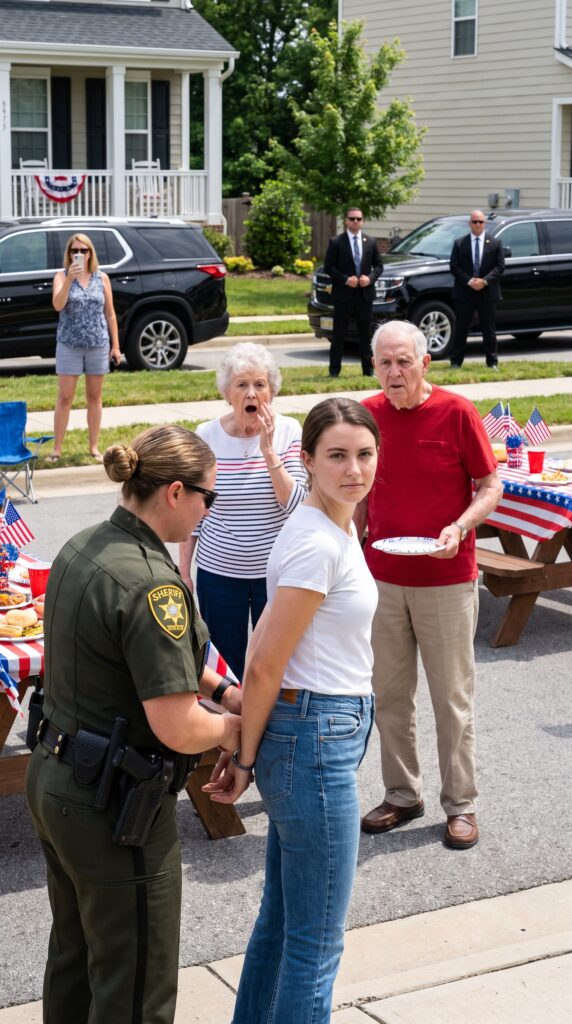
Then he jerked me toward the picnic table.
It happened fast enough to shock the yard, but not fast enough to surprise me.
My hip struck the edge of the table. A paper plate slid off and landed upside down in the grass. The yellow bowl of potato salad wobbled violently, then steadied. Someone gasped. My shoulder twisted as Brad drove my upper body forward.
My cheek hit the rough wood hard enough for splinters to scrape my skin.
For one second, all I could smell was old pine, sunscreen, smoke, and the sour tang of mayonnaise warming in the heat.
“Stop resisting!” Brad shouted.
I had not resisted.
That did not matter.
He needed the sentence because the sentence turned violence into procedure.
His knee pressed into my lower back. His hand yanked my right arm behind me. Pain flared across my shoulder, bright and immediate. The first cuff clicked around my wrist.
Then the second.
He pulled the chain tight enough for the metal to bite into my skin.
Blood makes steel honest.
It turns a prop into evidence.
The backyard froze.
My aunt held a lemonade cup halfway to her mouth.
Uncle Ray stared at the patio as if the concrete had suddenly become fascinating.
Melissa stood by the dessert table with both hands over her stomach.
My mother’s face went blank in the way it always did when someone else’s cruelty entered the room and she needed time to decide whether comforting me would cost too much.
The teenagers near the fence lifted their phones.
They did not press record.
Not yet.
Nobody moved.
Brad hauled me upright.
His breath smelled like beer and mint gum. His face was flushed with something that was not duty. It was satisfaction.
“Who’s the boss now, Sarah?” he said.
A few people looked down.
A few looked at him.
Most looked anywhere except my wrists.
I saw every face.
That is what training does.
Pain narrows some people. It widens others.
I could feel the cuffs. I could feel where the skin had torn beneath the right one. I could feel the bad angle of my shoulder. I could feel Brad’s balance, too far forward because he expected submission, not skill. I could feel where his radio sat on his belt. I could feel the weight of his sidearm. I could feel the exact route my body would need to take if I chose to end it myself.
One step.
One turn.
One shift of weight.
He would hit the grass before he understood the movement had started.
My body knew the path.
My anger wanted it.
I did not take it.
Because the second I used skill in that yard, Brad would have a story. He would say I attacked him. He would say I was unstable. He would say he had no choice. He would turn fear into paperwork and paperwork into a shield.
I had seen men survive worse by writing first.
So I breathed through my nose, tasted copper from where my cheek had scraped, and looked for Chloe.
She stood near the porch, half behind the screen door, her face pale and her eyes locked on mine.
I gave her one sharp nod.
Small.
Precise.
The way I had taught her when she was sixteen.
For a second, she did not move.
Then her hand slipped into her pocket.
She stepped backward, out of Brad’s line of sight.
At 4:17 p.m., Chloe made the call.
Brad did not notice.
He was too busy performing.
“You think because you work in some federal office, you can talk to me however you want?” he said, loud enough for the whole yard. “You think rules are optional? Maybe today you learn something.”
My wrists burned.
My sister whispered, “Brad, that’s enough.”
He ignored her.
That was the moment I knew he had crossed from family bullying into something else. He had heard a boundary and treated it as applause.
“I’m the law here,” he said.
I turned my head slightly, enough to look at him.
“No,” I said. “You’re a countdown.”
He frowned.
“What?”
“I strongly recommend you enjoy that feeling,” I said.
He laughed once, hard and ugly.
“What feeling?”
“Being in control.”
His grip tightened on my arm.
“It expires in about five minutes.”
That made him laugh harder.
The family did not.
They did not know what I meant, but they knew my voice had changed.
Not louder.
Not angrier.
Colder.
The first sound was almost too low to notice under the summer noise.
A distant roll of tires.
Then brakes.
Then doors.
Three black SUVs pulled up outside the house in a synchronized line.
They did not screech. They did not arrive like a movie. They arrived like a decision that had already been made somewhere far above Brad’s understanding.
For the first time since he had grabbed me, Brad looked away.
Men and women in plain dark suits stepped out.
No shouting.
No running.
No drawn weapons.
They moved with the clean economy of people who knew exactly why they were there and did not need the neighborhood to understand before they acted.
That frightened Brad more than chaos would have.
Chaos was his language.
Discipline was not.
Chloe stood near the porch rail, crying silently, the black card crushed between both hands.
Her phone was still on speaker.
A woman’s voice came through it, calm and clear.
“Confirm visual on Major General Sarah Whitmore. Confirm unauthorized restraint by local law enforcement personnel.”
My aunt made a small sound.
My sister covered her mouth.
My mother stood.
Brad’s fingers loosened on the chain between the cuffs.
Not enough.
The lead man crossed the grass and stopped ten feet away. He was tall, square-shouldered, dark-haired, with an expression so controlled it made Brad’s flushed anger look childish.
His eyes went to my wrists.
Then to Brad’s badge.
Then to the sidearm.
Then to Brad’s face.
“Deputy,” he said, “take your hands off the major general.”
The silence that followed was not the same as the silence before.
The first had been fear.
This one was recognition.
Brad blinked.
“What did you say?”
The lead man opened a leather credential case and held it where Brad could see.
He did not raise his voice.
“Now.”
Brad’s hand fell away from the cuffs as if the metal had burned him.
Someone behind us whispered, “Major general?”
My sister said, “Sarah?” like she had never heard my name before.
I did not answer her.
If I spoke to the family first, the moment would become emotional, and Brad would try to swim in the confusion.
So I looked at the lead man.
“Remove these, please.”
One of the women from the second SUV stepped behind me.
She was careful.
That nearly broke me more than the pain had.
She did not yank. She did not rush. She used a small key, documented the cuff placement with two quick photos, and lowered my arms slowly so the injured shoulder would not take another shock.
The skin around both wrists was red and broken.
Not dramatic.
Not catastrophic.
Enough.
Enough for a report.
Enough for witnesses.
Enough for Brad’s face to change as he realized the backyard was no longer his stage.
“Do you need medical attention, ma’am?” the lead man asked.
“I need documentation first,” I said.
He nodded once.
That was why he was good at his job.
He understood that pain can wait for evidence when the person in pain knows what comes next.
A second security officer began asking for the names of every adult present. A third photographed the picnic table, my car, the driveway, the paper plate in the grass, the cuff marks, the visible scrape on my cheek, and Brad’s position relative to the family.
Chloe handed over her phone with shaking fingers.
The speaker call had recorded the last part.
My dash camera had more.
The backyard that had been willing to look away now found itself being cataloged.
Names.
Times.
Positions.
Statements.
Brad tried to talk at 4:29 p.m.
“She was resisting,” he said.
His voice sounded smaller without the crowd beneath it.
I looked at him.
“Brad, you put your hands on me because you wanted an audience.”
He swallowed.
“You parked illegally.”
“No,” I said. “I parked where you could invent a reason.”
Uncle Ray looked away.
Aunt Denise began crying.
My mother whispered, “We didn’t know.”
That sentence has always bothered me.
It is what people say when they mean they knew enough to stay quiet but not enough to feel responsible.
I wanted to say that.
I did not.
Not then.
I looked at Chloe instead.
She was still crying silently, shoulders drawn tight, face blotchy with fear and adrenaline.
“You did exactly right,” I told her.
Her mouth trembled.
“I didn’t know if they’d answer.”
“They did.”
“I thought maybe I was making it worse.”
“You made it stop.”
That was when she broke.
She stepped toward me, then stopped because the security team was still working and she did not know whether she was allowed to cross the invisible line that had appeared around my life.
I crossed it for her.
I walked to my niece and let her hug me.
The whole backyard saw that too.
They saw the girl they had treated like dramatic.
They saw the aunt they had treated like ordinary.
They saw Brad standing alone with his hands empty.
In some families, the truth does not arrive as a confession.
It arrives as consequence.
Brad’s supervisor was contacted through proper channels. I did not know the man personally, and I did not need to. The phrases were enough to change the air around my cousin: unauthorized restraint, use of force, off-duty conduct, recorded call, federal security response, injured senior officer, witness statements.
He kept glancing at me like I had betrayed him by being someone he had not known.
That was almost funny.
I had never hidden myself to trick Brad.
I had hidden myself because my work required it, because my safety required it, and because my family had never been curious enough to ask one honest question without turning the answer into a joke.
They had preferred the small version of me.
The harmless version.
The version they could laugh at over ribs and lemonade.
Brad had simply believed the joke too deeply.
The team did not arrest him in front of the children.
That mattered to me.
They separated him, secured his duty weapon through the local chain of authority, and made sure every step was handled properly. No spectacle. No hand on the back of his head. No dramatic announcement. No performance for the yard he had tried to own.
Brad hated that more than he would have hated a show.
He wanted dominance or martyrdom.
He got procedure.
Procedure is humiliating to people who only respect power when it is loud.
Before he was escorted away from the backyard, Brad looked at me once.
There was anger in his face.
There was fear too.
But beneath both, I saw the thing I expected.
Embarrassment.
Not remorse.
Embarrassment because the audience had changed sides.
That was Brad’s real injury.
My sister’s Fourth of July cookout never recovered.
The ribs went cold.
The children were taken inside.
The cooler sat open in the grass until the ice melted into gray water.
Relatives who had not moved when my face was against the table suddenly wanted to explain where they had been standing, what they had seen, why they had been about to step in.
I listened to none of it.
I gave my statement.
I let the marks on my wrists be photographed.
I watched Chloe sign her witness note with a hand that shook so badly the officer told her to take her time.
Then I went inside and washed the blood from my cheek in Melissa’s downstairs bathroom.
The mirror above the sink was spotted with toothpaste. A child’s towel shaped like a shark hung from a hook. Someone had left a plastic dinosaur on the back of the toilet tank. It was such an ordinary bathroom that the sight of my own face in it felt absurd.
I looked like myself.
That was the strange part.
Faded jeans.
Plain shirt.
Gray beginning near my temples.
A scrape across my cheekbone.
Red marks around both wrists.
No one looking at me in that mirror would have seen briefing rooms, secure facilities, late-night calls, operations planned under fluorescent light, decisions that never appeared in newspapers, or young soldiers whose names I still carried in silence.
They would have seen an ordinary woman.
That was the part my family never understood.
Ordinary was not fake.
Ordinary was what I had fought to protect.
When I came back outside, Brad was gone.
The SUVs were still there.
My mother sat in her chair beneath the maple tree, crying quietly into a napkin. Melissa stood near the grill with her arms wrapped around herself, staring at the picnic table like it had betrayed her. Uncle Ray kept opening his mouth, then closing it again.
Chloe sat on the porch steps with the black card on the step beside her.
I sat next to her.
For a while, neither of us spoke.
Then she asked, very softly, “Are you really a major general?”
I almost laughed.
Not because it was funny.
Because after everything, she asked it like a child asking whether the moon was real.
“Yes,” I said.
She nodded slowly.
Then she looked toward the yard.
“They were so mean to you.”
I followed her gaze.
My family stood in scattered groups, no longer comfortable in their own backyard.
“They were careless,” I said. “Brad was mean.”
“Is that different?”
“Sometimes,” I said. “Not enough.”
The official fallout came quietly, then all at once.
Brad’s department opened an internal investigation before the weekend ended. I gave one statement. Only one. I did not embellish. I did not add emotional detail where fact was stronger. The dash camera timestamp, Chloe’s call record, the wrist photos, and nearly fifty witnesses did the work without me needing to decorate it.
I had learned long ago that when truth is strong enough, adjectives only get in the way.
Brad was placed on administrative leave. Then came the review. Then a formal finding that his use of restraints had been unauthorized, unjustified, and inconsistent with departmental policy. There were other words too, careful words chosen by people trained not to say “abuse” until the legal department approved it.
Misconduct.
Excessive escalation.
False articulation of resistance.
Off-duty misuse of authority.
He resigned before the hearing that would have made it worse.
My family told that part in whispers.
They told everything in whispers after that.
For two weeks, my phone rang constantly.
Melissa called first.
I let it go to voicemail.
Then my mother.
Then Aunt Denise.
Then Uncle Ray.
Then relatives who had not bothered to ask whether my wrists were healing but wanted to know whether Brad was “really going to lose everything over one mistake.”
One mistake.
That phrase told me who they were still protecting.
Chloe texted me the next morning.
I’m sorry nobody moved.
I stared at the message longer than I expected.
Then I wrote back.
You moved.
That was enough.
My mother finally came to my house three weeks later.
She did not call first. That was her way. She had never understood boundaries as anything other than invitations she had not yet decided to accept.
I found her standing on my porch at 9:08 on a Saturday morning, holding a plastic container of banana bread like baked goods could do the work of accountability.
She looked smaller than she had on the Fourth of July.
Not older exactly.
Less certain.
“Can I come in?” she asked.
I let her.
We sat at my kitchen table. The same table where I had read intelligence reports, signed letters to families, reviewed briefings, and eaten too many silent dinners after days I could never discuss.
She placed the banana bread between us.
“I didn’t know,” she said.
I looked at her.
“Didn’t know what?”
Her hands twisted in her lap.
“That you were… all that.”
I leaned back.
“All what?”
Her eyes filled.
“You know what I mean.”
“I do,” I said. “That’s the problem.”
She looked down.
“I thought you just didn’t want to talk about work.”
“I didn’t.”
“But I thought…”
She stopped.
I waited.
That was another thing training gives you: comfort with silence. People reveal themselves when you refuse to rescue them from it.
My mother swallowed.
“I thought if it mattered, you would say something.”
I looked at the banana bread.
Then at her.
“Every time I tried to say something mattered, someone made a joke.”
Her face crumpled.
“That’s not fair.”
“No,” I said. “It wasn’t.”
She flinched, because for once I did not hand her comfort after naming the wound.
I thought of every family gathering where I had been assigned the smallest version of myself. Every joke about my office job. Every eye roll when I missed holidays for reasons I could not explain. Every time Brad puffed himself up while everyone gave him the respect they had never thought to give me.
“You let them laugh at me because it kept things easy,” I said.
My mother pressed her lips together.
“I didn’t know you were important.”
There it was.
The sentence beneath all the others.
I felt the old ache rise.
Not sharp.
Deep.
Tired.
“I was your daughter,” I said. “That should have been enough.”
She started crying then.
I did not.
Maybe that sounds cold.
It was not.
It was simply the result of finally understanding that some apologies come too late to reach the place where they were needed. They can still matter. They can still be accepted. But they do not rewrite the years that required them.
My mother apologized badly at first.
She talked about confusion.
About how private I had been.
About how Brad had always been difficult.
About how nobody wanted to make things worse.
I let her talk until she ran out of cushions to place under the truth.
Then I said, “Nobody moved.”
She closed her eyes.
“I know.”
“No,” I said. “I need you to hear it. He put cuffs on me in front of the whole family, and nobody moved.”
Her shoulders shook.
“I was scared.”
“So was Chloe.”
That sentence did more than anything else.
My mother looked at me then, and I saw the moment she understood that fear had not been the difference between action and silence.
Choice had been.
Chloe had been scared and moved anyway.
Everyone else had waited for someone else to become responsible.
That was the quiet rot in families like mine. Cruelty rarely needed universal agreement. It only needed a room full of people who preferred comfort to courage.
After my mother left, I cut one slice of banana bread and threw the rest away.
Not because I hated her.
Because I no longer accepted food in place of truth.
The next summer, Melissa invited me to the cookout again.
I almost did not go.
For three days, the invitation sat unanswered in my inbox. I opened it twice. Closed it twice. Told myself I was too busy, which was true enough to pass as a reason. Told myself nobody would blame me if I stayed away, which was also true.
But then Chloe called.
“You don’t have to come,” she said immediately.
That made me smile.
“Hello to you too.”
“I mean it. Mom asked me to call, but not like that. I’m calling because I want to say you don’t owe anybody a normal Fourth of July.”
I sat back in my chair.
“When did you get so wise?”
“Trauma,” she said dryly.
That startled a laugh out of me.
Then she added, quieter, “But I’d like to see you.”
So I went.
I arrived at 3:50 p.m.
This time, everyone noticed the car.
Not because it was fancy. It was the same old blue sedan. But my parking had become mythological in the family by then, the tiny practical act that Brad had tried to turn into a crime.
I parked in the driveway.
No one said a word about it.
Chloe met me before I reached the porch and hugged me tightly. She had cut her hair shorter and looked older in that way young people do after seeing adults fail publicly. Not hardened. Clearer.
Melissa came next.
She stood in front of me with both hands pressed together.
“I’m glad you came,” she said.
“I almost didn’t.”
“I know.”
There was no defense in her voice.
That helped.
The yard looked nearly the same. Same grill smoke. Same flag. Same folding tables. Same yellow bowl for potato salad. Same sprinkler near the fence. But the picnic table had been replaced.
I noticed immediately.
Melissa saw me notice.
“I couldn’t keep it,” she said.
I nodded.
The day moved carefully around me.
People greeted me with too much politeness at first. Aunt Denise asked if I wanted lemonade like she was offering water to visiting royalty. Uncle Ray called me “General” once, then looked so embarrassed I almost felt sorry for him.
“Sarah is fine,” I said.
He nodded too quickly.
“Right. Sarah.”
My mother watched from beneath the maple tree.
When our eyes met, she did not wave me over. She did not call attention to me. She simply nodded once.
That was better.
At the food table, one cousin started to say, “You know how government jobs are,” then stopped so suddenly he nearly choked on the sentence.
I looked at him.
He looked at me.
Then he said, “Nice weather.”
It was absurd.
It was also progress.
Brad was not there.
Nobody said his name for the first hour.
Then, near sunset, Chloe and I sat on the porch steps with paper plates in our laps while fireworks started popping somewhere down the street.
“Do you miss when they didn’t know?” she asked.
I watched smoke drift above the fence.
Sometimes young people ask the questions adults spend years avoiding.
“Yes,” I said.
She turned to me, surprised.
“Really?”
“Being underestimated has uses.”
“Did it hurt?”
“Yes.”
“Both can be true?”
“Most important things are.”
She nodded like she was putting that somewhere safe.
Then she said, “I still have the card.”
“I know.”
“I don’t know if I should keep it.”
I looked at her.
“Do you feel safer with it?”
She thought about that.
“Not exactly. But I feel like someone trusted me with something real.”
“Then keep it.”
Her eyes shone a little, but she did not cry.
Neither did I.
The fireworks grew louder after dark. Children ran across the grass with sparklers. Adults pulled chairs into loose circles. The flag on the porch snapped in the warm wind, briefly lit red, then blue, then white by the bursts overhead.
Everything looked like family.
For once, it almost felt like it too.
Not perfect.
Not repaired.
Not innocent.
But more honest than it had been.
That was enough for one evening.
People often ask, when they hear parts of the story later, why I let my family treat me that way for so long.
The question is usually asked by people who imagine truth as something simple. As if disclosure is just a door you open. As if identity is just a name tag you forgot to wear.
They do not understand that some lives are built around silence for reasons larger than pride.
They do not understand that secrecy can protect people who resent it because they do not know it exists.
They do not understand that sometimes the hardest thing about power is not using it when someone small tries to hurt you.
For more than twenty years, I hid my real identity while my family mocked me like I was a total failure.
At our annual Fourth of July cookout, my cousin Brad decided to turn that family joke into a public lesson.
He believed he was teaching me respect.
He had no idea the lesson was about to become his.
Because the thing about restraint is this: from the outside, it looks a lot like weakness.
Until the countdown ends.

