Nine-year-old Caleb Miller had learned early that some doors in a house were not just doors.
Some doors were rules.
Some doors were threats.
The back bedroom in the Miller home was one of those doors, though Richard Miller never called it that.
He called it storage when neighbors asked why nobody used that room.
He called it private when Allison stood too long in the hallway and listened.
He called it grown-up business when Caleb was small enough to believe grown-ups were allowed to have secrets that made people cry.
The Millers lived in a beige ranch house in Akron, Ohio, on a quiet street where the maple trees leaned over the sidewalks and every porch light came on before dark.
From the outside, it looked like a safe house.
It had a basketball beside the driveway, a small American flag near the front steps, and a cartoon decal stuck to Caleb’s bedroom window.
Richard kept the lawn neat.
Allison brought cupcakes to school functions.
Caleb always said thank you when adults handed him things, and his teachers described him as gentle, quiet, and unusually observant.
No one wrote “terrified” in a school note.
They wrote “reserved.”
Adults often choose cleaner words when the truth would require them to act.
For seven years, Richard and Allison had built a life that looked almost painfully normal.
Richard worked in home repair and small contracting jobs, the kind of work that let him explain away tools, locks, plywood, screws, and bruised knuckles.
Allison worked part-time at a local office and volunteered when the school needed someone to arrange paper plates and juice boxes.
They were the kind of couple people nodded to in grocery stores.
They were not close enough to be known.
That difference mattered.
Caleb had once told his second-grade teacher that he was not allowed to go into the back bedroom because “someone bad was in there.”
The teacher, trying to be gentle, had asked if he meant a monster.
Caleb had nodded, but not because he believed it.
He nodded because monster was easier than woman.
By the time he was nine, he understood more than his parents knew.
He knew the back bedroom smelled different when the door opened, even for a second.
He knew his mother washed towels separately on certain mornings.
He knew his father got angriest when Caleb asked simple questions.
He knew that some nights the floor under his bed vibrated with a sound that was not thunder.
At 11:42 p.m. on a stormy Thursday night, Caleb finally picked up the phone.
Rain slapped the windows hard enough to rattle the glass.
The living room was dark except for a blue strip of light from the kitchen clock.
His bare feet made no sound on the carpet because he had practiced walking that way without meaning to.
Children in frightening houses learn skills no child should need.
They learn which floorboards complain.
They learn which cabinet hinges squeak.
They learn how to breathe without being heard.
Caleb carried the cordless phone into the narrow space between the couch and the side table and dialed 911 with both thumbs.
Dispatcher Denise Rowe answered on the second ring.
“911, what’s your emergency?”
For two seconds, she heard only static, rain, and the fragile rhythm of a child trying not to sob.
Then Caleb whispered, “My parents are doing something in the room.”
Denise had worked enough late shifts to know the difference between a prank call and a child who was afraid of being overheard.
Her posture changed immediately.
“What room, sweetheart?”
“The back bedroom,” Caleb breathed. “The one I’m not supposed to go into.”
Denise opened the call card and began typing.
The first artifact in the case would later be that dispatch entry: 11:42 p.m., juvenile caller, possible adult female in distress, locked interior room.
The second would be the recording of Caleb’s breathing.
The third would be the moment a dull thud came through the line.
Not thunder.
Not a dropped toy.
Something inside the house.
Caleb inhaled so sharply Denise heard the phone shift against his cheek.
“My mom told me to stay in bed,” he said. “But I heard someone crying.”
“Who’s crying, Caleb?”
“I don’t know,” he whispered. “A woman.”
Denise did not tell him to investigate.
She did not tell him to be brave.
She kept her voice calm and gave him something small to do, because small instructions can keep a frightened child anchored to the world.
“Can you stay where you are and keep the phone close?”
“Yes.”
“Are your parents near you?”
“No. They’re down the hall.”
“Is the front door locked?”
“I can open it.”
“Good. When the officers arrive, you open it only for them, okay?”
“Okay.”
A pause came next, and in that pause Denise heard a house around him.
Rain.
A faint scrape.
A man’s voice too far away to understand.
Then Caleb whispered, “My dad said if I ever called the police, I’d ruin everything.”
Denise’s fingers stopped for half a second.
Then she typed faster.
Less than six minutes later, Officers Marcus Hill and Jenna Cole pulled onto the Millers’ street with their lights cutting red and blue through sheets of rain.
Hill had been with the department long enough to distrust houses that looked too calm after a child called for help.
Cole was younger, but she had the kind of attention that noticed what people tried to hide in the first three seconds.
The porch light was on.
The mailbox was wet.
No one was standing at the window.
Caleb opened the door before they knocked.
He looked smaller than nine in the yellow porch light.
His dinosaur pajamas hung crooked from one shoulder.
His brown hair was smashed flat on one side, and his face had the drained look of a child who had been awake for hours in a house where adults controlled the oxygen.
“My dad said if I ever called the police, I’d ruin everything,” Caleb whispered again.
Cole crouched in front of him.
“You did the right thing.”
The sentence seemed to confuse him.
No one in that house had said those words to him in a long time.
A man’s voice came from the hallway.
“Caleb?”
Richard Miller stepped into view in jeans and a sweatshirt.
He did not look sleepy.
That would matter later.
His hair was damp at the temples, and his right hand flexed once before disappearing into his pocket.
Behind him stood Allison Miller in a robe, arms crossed tight enough to wrinkle the sleeves.
Her smile trembled at the corners.
“What is this?” Richard demanded.
Hill stepped just inside the threshold.
“Your son called 911. We need to make sure everyone here is safe.”
Allison laughed softly, but the laugh had no air in it.
“He has nightmares. He makes things up.”
Caleb moved closer to Cole.
Richard noticed.
His mouth tightened.
“Caleb, go to your room.”
Cole did not move.
“He’s staying with me.”
Richard’s eyes went flat for one instant before he remembered he was supposed to be an ordinary father speaking to police officers in an ordinary hallway.
Then the cry came from the back of the house.
It was faint.
It was female.
It was not Allison.
It lasted less than two seconds, but two seconds can be enough to destroy a lie that took years to build.
Hill turned his head toward the hallway.
Cole did the same.
Caleb closed his eyes.
Richard’s face changed before he could stop it.
Not shock.
Not confusion.
Calculation.
That detail appeared later in Hill’s written report in plain language, which somehow made it more chilling.
Subject reacted to audible female distress before officers stated source.
“Sir,” Hill said, “step aside.”
Richard moved into the hallway instead.
“You need a warrant.”
Cole’s hand went to her radio.
“We heard someone in distress.”
Allison’s eyes snapped toward Richard, not toward the sound.
That told Cole almost as much as the cry.
In crisis, people look toward danger, unless they already know where it is and who controls it.
For one awful second, the house froze.
Rain hammered the roof.
The officers stood with wet boots on the entry floor.
Caleb gripped the hem of his pajama shirt with both hands.
Allison stared toward the back bedroom like a person watching a grave open from the inside.
Richard planted himself in the hallway and smiled as if procedure would protect him.
Nobody moved.
Then Richard lunged.
Hill caught him before he made it three steps.
Richard was stronger than he looked, but panic makes people clumsy, and guilt makes them predictable.
Hill twisted one arm behind his back and drove him against the wall.
Richard shouted, “Get out of my house!”
Allison screamed, “No, don’t open it!”
Cole ran past her.
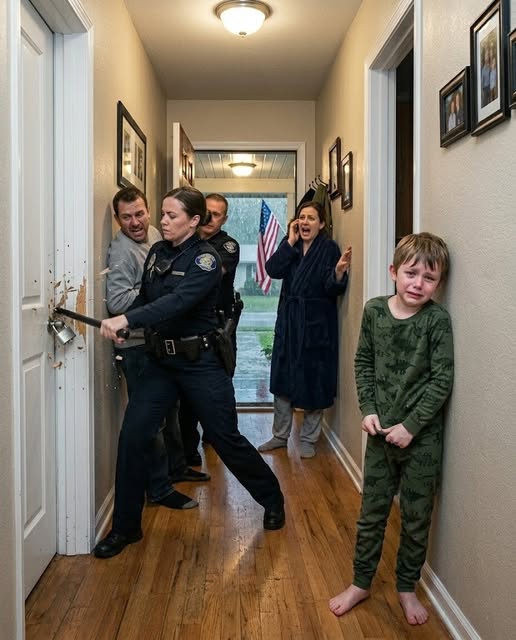
At the end of the hallway, the back bedroom door had a padlock fastened on the outside.
Not a privacy lock.
Not a broken knob.
A padlock.
Cole raised her baton.
Caleb sobbed behind her and whispered, “I knew she wasn’t a monster…”
The first blow cracked against the lock.
Richard stopped fighting for half a second.
The second blow made the metal jump.
The third split the hardware loose.
The door opened only a few inches before something inside caught it.
Cole aimed her flashlight through the gap.
A chain scraped across the floorboards.
The sound was low and heavy and impossibly real.
Allison made a noise that was almost a prayer and almost a confession.
Caleb pressed his forehead against the hallway wall and whispered, “I left crackers under the door sometimes.”
Cole looked back at him, and the sentence hit her harder than the lock had hit the floor.
He had known someone was in there.
He had been feeding her.
Not enough.
Not safely.
But with the only mercy he could smuggle through a crack in a door.
“Dispatch,” Cole said into her radio, her voice controlled but changed, “we need medical, detectives, and a supervisor at the Miller residence. Now.”
Hill tightened his grip on Richard.
“What’s in that room?” he asked.
Richard said nothing.
The woman inside answered for him.
“Caleb?”
Her voice was raw, thin, and human.
That one word rearranged the hallway.
Caleb lifted his head.
“She knows my name,” he whispered.
Cole found the second lock bolted lower near the floor.
It had been placed where an adult walking by would not easily notice it, but where someone trapped inside would understand the point every hour of every day.
She used the baton again.
When the lower lock broke, the door opened wide enough for the flashlight to enter.
At first, Cole saw blankets.
Then a mattress.
Then a plastic water jug.
Then a woman sitting against the far wall with one wrist chained to a bracket fixed into the floor.
Her hair had been cut unevenly.
Her skin was pale in the flashlight beam.
Her eyes were open, but for a moment she did not look at the officers.
She looked at Caleb.
“Hi,” Caleb said, crying so hard the word barely came out.
The woman’s mouth trembled.
“You were real,” she whispered.
Those three words would stay with every person in that hallway.
The missing woman was later identified as Mara Ellis, thirty-one, reported missing years earlier after she vanished on her way home from work.
Her case had gone cold in the way cases go cold when there are no witnesses, no body, and too many ordinary explanations.
Maybe she had left.
Maybe she had run.
Maybe she wanted a different life.
The world often finds a way to blame the missing for being difficult to find.
Mara had not left.
She had been taken.
The first hours after the door opened were a blur of controlled chaos.
Paramedics entered with a stretcher.
Detectives photographed the room before anything was moved.
A crime scene technician placed evidence markers beside the chain bracket, the padlocks, the water jug, the stained blankets, the boarded interior window, and the small pile of cracker wrappers near the door.
The notebook on the dusty dresser became one of the most important pieces of evidence.
It was Caleb’s.
The handwriting was uneven and childlike.
Dates.
Times.
Crying.
Dad angry.
Mom says don’t ask.
One page had a drawing of the hallway with an arrow pointing to the back bedroom.
Under the arrow, Caleb had written: lady not monster.
Detectives later learned he had started the notebook after a school safety lesson where a teacher told the class that writing things down could help adults understand.
He had not known what evidence meant.
He had only known he wanted someone to believe him.
Richard Miller refused to speak after he was handcuffed.
Allison spoke too much.
At first, she said she knew nothing.
Then she said Mara had been “sick” and “staying there.”
Then she said Richard had scared her.
Then she said Caleb misunderstood everything.
Detectives listened, recorded, and asked the same questions again in a different order.
Lies often change shape when they are tired.
By sunrise, Allison’s story had collapsed under the weight of the room itself.
There were receipts for hardware purchased years earlier.
There were boards cut to match the window frame.
There were cleaning supplies stored in a hall closet.
There were old prescription bottles with labels peeled off.
There was the dispatch recording where a child whispered the truth before any adult in that house dared to say it out loud.
Mara was transported to the hospital under police guard, not because she was suspected of anything, but because the department refused to let Richard’s family near her.
At the hospital, she asked three times whether Caleb was safe.
She did not ask about Richard.
She did not ask about Allison.
She asked about the boy who had slipped crackers under the door and whispered apologies through wood.
“He told me about dinosaurs,” she told a nurse later.
The nurse thought Mara was confused from exhaustion.
Mara shook her head.
“No. At night. He sat outside the door sometimes. He told me facts about dinosaurs because he thought it would make me less scared.”
That detail made Officer Cole cry in the parking lot after her shift ended.
Not in front of Mara.
Not in front of Caleb.
In the parking lot, with rainwater still dripping from the edge of her patrol jacket and the smell of wet asphalt rising around her.
Marcus Hill found her there and stood beside her without speaking.
Some cases make noise.
Some make silence.
This one made both.
The investigation widened quickly.
Detectives revisited Mara Ellis’s missing person file.
They interviewed old neighbors, former coworkers, delivery drivers, school staff, and anyone who had spent more than five minutes inside the Miller home.
Several people remembered small things.
A neighbor remembered Richard pouring concrete behind the house at night.
A delivery driver remembered hearing a woman scream once and being told the television was too loud.
A former coworker remembered Allison quitting a job abruptly after someone asked too many questions about a locked room she had mentioned by accident.
Individually, the details had seemed like nothing.
Together, they became a map.
Caleb was placed with a relative approved by child services while detectives worked with trauma specialists to interview him carefully.
They did not ask him to be a hero.
They did not ask him to repeat the worst parts again and again.
They let him draw.
They let him answer slowly.
They let him stop.
In one interview, he said he had first heard Mara crying when he was six.
He had asked his father about it.
Richard told him the room was haunted.
Allison told him some people cried because they were bad.
Caleb believed that for a while, because children believe what they must in order to survive their parents.
Then one night, he heard the woman say, “Please.”
Monsters did not say please like that.
That was when Caleb began leaving food.
Crackers.
Half a granola bar.
A small box of raisins.
Once, a cookie from a school party that Allison had put in his lunch.
He slid them under the door when he thought everyone was asleep.
Sometimes the food disappeared.
Sometimes it did not.
Sometimes a whisper came back.
Thank you.
He never saw Mara’s face until the night the police opened the door.
That fact changed the way detectives understood the case.
Caleb had not called because he found a stranger in a room.
He called because he finally trusted his own mercy more than his father’s fear.
Months later, Richard Miller sat in court in a pressed shirt and showed no emotion while prosecutors described the room.
Allison sat separately.
Her attorney argued that she had been controlled too.
The prosecutor did not dismiss the possibility that Richard had frightened her.
But fear, the prosecutor said, did not explain cupcakes at school while Mara starved behind a locked door.
Fear did not explain smiling at neighbors while a woman begged inside the house.
Fear did not explain telling a child he was imagining the sound of another human being crying.
When Mara testified, the courtroom was silent.
She did not dramatize.
She did not perform.
She spoke in a careful voice about days measured by footsteps, meals measured by what was pushed through the door, and hope measured by a little boy’s whispers.
“I did not know his name at first,” she said.
Then she looked at Caleb, who sat with a counselor near the back.
“But he told me one night. He said, ‘I’m Caleb. I’m not allowed to talk to you, but I don’t think you’re bad.’”
The judge paused after that.
Even the court reporter looked down.
Caleb did not testify in open court.
His recorded forensic interview was admitted under protections arranged by the court, and the jury heard his small voice describe the hallway, the locks, the crying, and the night he called 911.
At one point, he said, “I was scared I would ruin everything.”
The interviewer asked what he meant.
Caleb answered, “My dad said our family would be over.”
The interviewer asked, “What made you call anyway?”
Caleb was quiet for a long time.
Then he said, “Because maybe her family was waiting too.”
That sentence traveled through the courtroom like a physical thing.
Richard’s confidence did not survive the trial.
Allison’s trembling explanations did not survive the evidence.
The padlocks were shown.
The chain bracket was shown.
The notebook was shown.
The 911 call was played.
When Caleb’s whisper filled the courtroom, no one moved.
My parents are doing something in the room.
The jury took less time than anyone expected.
Richard Miller was convicted on multiple charges tied to kidnapping, unlawful restraint, assault, and related offenses.
Allison Miller was convicted for her role in concealing the crime, assisting the confinement, and endangering the child who had been forced to live around the secret.
The judge called the case “a failure of conscience inside a house designed to look normal.”
He also said Caleb Miller had done what several adults had failed to do.
He listened to a cry and treated it as real.
Mara’s recovery was not simple.
Stories like this often want healing to be clean because readers want to believe rescue ends suffering.
It does not.
Rescue opens the door.
Healing is what happens after, slowly, with doctors, counselors, safe rooms, patient relatives, and mornings when the body finally understands that no one is coming to lock the door again.
Mara struggled with light at first.
She slept with the door open.
She cried when hospital staff changed shifts without telling her.
She kept crackers in the drawer beside her bed for months, not because she needed them, but because some part of her still remembered Caleb’s small acts of proof.
Eventually, she met him again in a supervised setting.
Caleb brought a plastic dinosaur.
He did not know what else to bring.
Mara held it in both hands like it was fragile.
“I used to hear you talk about these,” she said.
Caleb nodded.
“This one is a stegosaurus.”
“I remember.”
He looked at the floor.
“I’m sorry I didn’t call sooner.”
Mara’s face broke.
She reached for his hand only after the counselor nodded that it was okay.
“You called,” she said. “That’s what matters.”
Caleb cried then, not like he had cried in the hallway, but like a child whose body had finally been given permission to set down something too heavy.
Years later, people in Akron would still talk about the Miller house when they passed that street.
The porch light was gone.
The flag was gone.
The cartoon decal had been peeled from the window.
Another family eventually moved in after renovations stripped the back bedroom to studs and rebuilt it into something ordinary.
A guest room.
A painted wall.
A door without a lock.
But for the people who had stood in that hallway, the memory never became ordinary.
Denise Rowe kept dispatching calls, but she never forgot the sound of Caleb’s breathing.
Marcus Hill kept writing reports, but he never forgot Richard’s face when the lock cracked.
Jenna Cole kept answering calls in houses that looked safe from the outside, but she never again dismissed a child’s strange sentence as confusion.
And Caleb grew up with help, with distance, and with adults who told him the truth until he believed it.
He had not ruined everything.
He had ended something.
Perfect families are sometimes only perfect from the sidewalk.
Distance can make any window look warm.
But a child heard crying through a locked door, trusted what his heart already knew, and whispered into a phone when every adult around him had chosen silence.
That whisper opened the room.
That whisper found Mara Ellis.
And that whisper proved that sometimes the smallest voice in the house is the only one brave enough to tell the truth.