Part 3: The Will That Froze the Room
My father stared at the document as if the paper had bitten him.
For the first time in my life, I saw true fear crawl across his face. Not anger. Not irritation. Fear.
My mother snatched the pages from his hand, her eyes racing over the words. “This is ridiculous,” she hissed. “Dorothy, you don’t understand what you signed.”
Grandma Dorothy did not flinch.
She stood in my living room with her blue cardigan buttoned to her throat, her silver hair pinned neatly back, and her small hands folded in front of her. She looked fragile, yes. But there was something in her eyes I had never seen before.
Freedom.
“I understand perfectly,” she said. “I removed you both as beneficiaries. I removed you as medical decision-makers. And I revoked the power of attorney you pressured me into signing last year.”
My mother’s mouth opened, but no sound came out.
My father took one step forward. “Mom, don’t do this. We were tired. We made a mistake.”
“A mistake,” Grandma repeated softly.
The room went still.
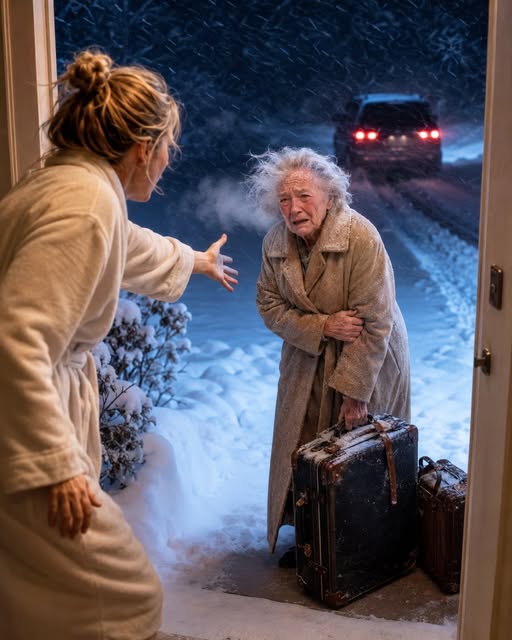
“You left me outside in thirty-eight degrees below zero,” she said. “With two suitcases and no medicine. You told me Megan would take me because I was too much work. That was not a mistake, Daniel. That was a decision.”
My father’s face reddened. “You’re letting her poison you against us.”
“She didn’t have to,” Grandma replied. “You did that all by yourself.”
My mother turned on me then, her eyes sharp enough to cut glass. “This is your fault. You always hated us.”
I almost laughed. Hated them? No. For years, I had done the opposite. I had excused them. Explained them. Forgiven things they never apologized for. But standing there beside Grandma, I realized forgiveness without boundaries is just permission for people to hurt you again.
Uncle Raymond stepped forward. “You both need to leave.”
My father shook the papers. “We’ll fight this.”
The lawyer, Mr. Ellis, adjusted his glasses. “You can try. But we have porch footage, bank records, medical neglect documentation, and Mrs. Dorothy Halden’s sworn statement.”
My mother froze. “Bank records?”
That was when I understood. The will was not the only thing they were afraid of.
Grandma looked at Raymond, then at me.
“There’s more,” she whispered.
My father’s expression changed instantly.
“Mom,” he warned.
Grandma’s lips trembled, but her voice stayed clear. “For three years, Daniel and Claire have been taking money from an account your grandfather left in my name. They told me it was for bills.”
Raymond’s jaw clenched. “How much?”
The lawyer answered for her.
“Approximately $186,000.”
The number landed like thunder.
My knees nearly gave out.
My father lunged toward the hallway. “This conversation is over.”
Two police officers stepped through the front door before he made it three feet.
My mother screamed his name.
Grandma closed her eyes.
And I realized the call I made two weeks ago had not changed everything.
It had only opened the door to what had been hidden for years.
Part 4: The House of Receipts
The police did not arrest my parents that day.
Not yet.
They took statements. They copied documents. They spoke gently to Grandma, as if every word she gave them was something delicate enough to break in their hands.
My parents left my house without Grandma, without the papers, and without the confidence they had carried in with them.
But they did not leave quietly.
My mother stopped at the bottom of the porch steps, turned back, and pointed at me. “You think you won,” she said. “You have no idea what you just started.”
For a moment, the old version of me wanted to shrink.
Then Grandma’s hand slipped into mine.
It was cold, but steady.
“No,” Grandma said from behind me. “I think we finally ended something.”
That night, none of us slept.
Raymond sat at my kitchen table with his sleeves rolled up, sorting through documents Grandma had hidden in an old sewing basket. Bank statements. Pharmacy receipts. Letters from my grandfather. A yellowed envelope with my name written on it in handwriting I didn’t recognize.
“What is that?” I asked.
Grandma looked away.
Raymond paused.
The lawyer, who had stayed far past any hour a lawyer should, gently opened the envelope.
Inside was a letter dated fifteen years earlier.
My grandfather had written it two months before he died.
To Megan, when she is old enough to understand.
My chest tightened.
Grandma touched the edge of the paper. “Your grandfather adored you. He wanted you protected.”
I read the first line, and the kitchen blurred.
Megan, if this letter has found you, it means someone finally told the truth.
I stopped breathing.
Raymond’s chair scraped back. “Mom… what truth?”
Grandma’s face crumpled with a kind of pain that seemed older than me, older than the house, older than the winter outside.
“Daniel and Claire never wanted Megan to know,” she whispered.
I felt myself go cold.
“Know what?”
Grandma reached for me, but I stepped back. Not because I didn’t love her. Because suddenly every familiar thing in my life felt like a door with something terrible behind it.
Mr. Ellis unfolded another paper from the envelope. It was a copy of a legal document.
Guardianship Petition.
My name.
My birthdate.
And beside the line marked biological mother was a name I had never seen before.
Elaine Porter.
I stared at it until the letters twisted.
“What is this?” I asked.
Grandma covered her mouth.
Raymond looked as stunned as I felt.
Finally, Grandma spoke.
“Your mother, Claire… she did not give birth to you.”
The room tilted.
I gripped the counter.
Grandma sobbed once, small and broken. “Your real mother was my daughter.”
Raymond whispered, “Elaine.”
My whole childhood flashed in pieces: my mother’s coldness, my father’s resentment, the way Grandma always held me like she was afraid someone might take me away.
I looked at my father’s name on the papers.
Guardian.
Not father.
Grandma reached for my hand again.
“Megan,” she said, crying now, “you were never their burden.”
The letter shook in my hand.
“You were their inheritance.”
Part 5: The Daughter They Buried Twice
Elaine Porter.
The name haunted the house like a ghost after midnight.
Grandma told the story slowly, stopping often, as though each memory had thorns.
Elaine had been her firstborn. Bright, stubborn, wild-hearted Elaine, who played piano by ear, rescued injured birds, and once drove three hours through a snowstorm because Raymond had forgotten his asthma inhaler at school.
“She was nothing like Daniel,” Grandma said. “She felt everything.”
When Elaine was twenty-six, she fell in love with a man named Thomas Reed, a quiet paramedic with kind eyes and no family wealth. Daniel hated him immediately. Claire—then Daniel’s girlfriend—called Elaine reckless, dramatic, embarrassing.
Then Elaine became pregnant with me.
Grandpa was thrilled. Grandma cried happy tears. Raymond bought a tiny yellow blanket.
But Daniel became strange.
“He said Elaine was stealing what belonged to him,” Grandma whispered.
“What belonged to him?” I asked.
“The family trust.”
I learned the truth piece by piece.
My grandfather had created a trust years before his death. It was meant to support his children and grandchildren, but with one condition: the largest portion would pass through the line of his firstborn child.
Elaine.
And then me.
Daniel, the son who believed he deserved everything, would receive far less.
Unless Elaine was gone.
My throat tightened. “What happened to her?”
Grandma’s face lost color.
“She died three weeks after you were born.”
The room fell silent except for the ticking clock above the stove.
I had heard many family stories growing up. Stories about my father’s hard work. My mother’s sacrifices. My supposed difficult infancy. But never Elaine. Never Thomas. Never a firstborn daughter erased from every wall, every album, every holiday.
“They said it was an accident,” Raymond murmured. “A car crash.”
Grandma nodded, tears slipping down her cheeks. “Thomas died at the scene. Elaine lived long enough to ask for Megan.”
My hands went numb.
“What did she say?”
Grandma closed her eyes.
“She said, ‘Don’t let Danny take her.’”
The words cut through me.
“And you did?” I whispered.
Grandma flinched as if I had struck her.
Raymond bowed his head.
Grandma’s voice broke. “Your grandfather was already sick. Daniel and Claire came with lawyers. They said they were married now, stable, prepared. They said if I fought them, I’d lose access to you entirely. And I was afraid.”
I wanted to be angry. Part of me was angry. But looking at her trembling in the chair, I saw a woman who had spent twenty-eight years punishing herself.
“They took me for money,” I said.
Mr. Ellis nodded gravely. “The trust began releasing funds for your care. Daniel and Claire controlled those funds as your guardians.”
I laughed once, hollow and bitter. “Care?”
My childhood had been secondhand coats, missed birthdays, school lunches I learned to pack myself. Meanwhile, money meant for me had paid for my parents’ vacations, cars, and renovations.
Then Mr. Ellis pulled out one final page.
“There is another condition in your grandfather’s trust,” he said.
I looked up.
“If abuse, fraud, or abandonment by appointed guardians is proven, control of the remaining estate transfers immediately to the biological heir.”
My pulse roared in my ears.
Grandma whispered, “You, sweetheart.”
Raymond looked at me with wet eyes. “Megan, do you understand?”
No. I didn’t. Not fully.
Because my parents had not only abandoned Grandma.
They had stolen my mother, my childhood, my money, and my name.
And now, for the first time, every lie they built was beginning to collapse.
Part 6: The Courtroom Where Silence Died
The first hearing took place on a gray Tuesday morning, the kind of morning that made the courthouse windows look like slabs of ice.
My parents arrived dressed like victims.
My mother wore pearls and a navy coat. My father carried a folder and kept patting my mother’s shoulder whenever anyone looked their way, as if performing grief for an invisible audience.
Grandma arrived in a wheelchair because Raymond insisted she conserve her strength, though she grumbled the entire time that she could walk just fine.
I walked beside her.
For once, I did not feel like the youngest person in the family.
I felt like the witness they had failed to silence.
Inside the courtroom, my mother cried before the judge even spoke.
“We love Dorothy,” she said, dabbing her eyes. “This is a misunderstanding caused by Megan’s resentment. She has always been unstable, always jealous of our bond with her grandmother.”
I stared at her.
Unstable.
Jealous.
The words were familiar weapons.
For years, she had used them whenever I questioned anything. If I remembered being left alone after school, I was dramatic. If I asked why Grandma wasn’t invited to Christmas, I was sensitive. If I wondered why my baby pictures began at four months old, I was imagining things.
But this time, she wasn’t speaking inside our kitchen.
She was speaking under oath.
Mr. Ellis rose calmly. “Your Honor, we would like to submit porch camera footage from the morning of January twelfth.”
A screen rolled into place.
The courtroom watched my parents’ SUV pull up in darkness.
They watched my father remove two suitcases from the trunk.
They watched my mother help Grandma out, not gently, but hurriedly, glancing toward the road as if ashamed only of being seen.
Then came the audio.
My mother’s voice crackled through the speakers.
“Don’t start crying. Megan will take you.”
Grandma’s voice, faint and confused. “But did she say yes?”
My father answered. “She doesn’t need to.”
Then they drove away.
The courtroom went completely silent.
My mother stopped crying.
The judge leaned forward.
Next came the bank records.
Then medical records showing missed appointments.
Then signed checks.
Then documents transferring funds into my parents’ accounts.
By the time Mr. Ellis introduced Elaine’s guardianship papers, my father’s face had turned a sickly shade of gray.
The judge looked at him. “You represented to the trust administrator that Megan’s care required these disbursements?”
My father swallowed. “Yes.”
“And you spent those disbursements on personal expenses?”
“No,” he said quickly.
Mr. Ellis clicked a remote.
A luxury cruise receipt appeared on the screen.
Then a kitchen remodel.
Then my mother’s jewelry purchase.
Then their SUV.
My mother whispered, “Daniel…”
But the worst moment came when Grandma took the stand.
She looked tiny beneath the courtroom lights.
The clerk asked if she swore to tell the truth.
Grandma looked straight at my parents.
“I should have told it years ago,” she said.
Then she told them everything.
Elaine.
Thomas.
The trust.
The threat.
The years of fear.
The judge listened without interruption.
When Grandma finished, she turned toward me.
“I was wrong,” she said, voice trembling. “I thought keeping quiet meant keeping Megan close. But silence fed the people who hurt her.”
My eyes burned.
My father slammed his palm on the table. “That’s enough!”
The bailiff moved instantly.
But my father was not looking at the judge.
He was looking at me.
“You ungrateful little—”
The judge’s voice cracked like a whip. “Mr. Halden, sit down.”
He sat.
And for the first time, he looked smaller than Grandma.
Part 7: The Last Secret in the Snow
The investigation widened after that hearing.
Fraud. Elder neglect. Financial exploitation. Possible conspiracy surrounding the guardianship. The words sounded too large, too legal, too cold to describe what had happened inside my family.
But my life did not become easier just because the truth came out.
Truth is not a sunrise.
Sometimes it is a demolition.
Reporters called. Distant relatives appeared with sudden concern. People who had ignored Grandma for years sent messages full of prayer emojis and curiosity disguised as love.
My parents’ house was searched.
Boxes of old files were removed.
And one afternoon, Raymond arrived at my home holding a small metal lockbox.
“They found this in Daniel’s attic,” he said.
Grandma was sitting by the window knitting a crooked scarf she claimed was for me, though it was wide enough to be a blanket.
At the sight of the box, her needles slipped from her hands.
“Where did you get that?” she whispered.
Raymond set it on the coffee table. “Dad’s old lockbox.”
Grandma’s face went pale.
Mr. Ellis had given Raymond permission to bring it because my name appeared on the contents list taped inside the lid.
The key was missing, so Raymond opened it with a small tool while Grandma stared as if the dead had come knocking.
Inside were photographs.
Letters.
A tiny hospital bracelet.
Elaine’s wedding ring.
And a cassette tape labeled in my grandfather’s handwriting:
For Megan. When the truth is safe.
No one moved.
I found an old cassette player online the same day. It arrived the next morning, and we gathered around my kitchen table like people waiting for a verdict.
The tape hissed.
Then a man’s voice filled the room.
Warm. Weak. Loving.
My grandfather.
“Megan,” he said, “if you are hearing this, then I am sorry. It means I failed to protect you while I was alive.”
Grandma covered her mouth.
He explained everything he feared.
Daniel’s obsession with the trust. Claire’s manipulation. Elaine’s worry that Daniel had been following her. Thomas’s report that someone had tampered with their car two weeks before the crash.
My skin turned cold.
The official story had always been icy roads.
But Grandpa’s voice trembled as he said, “I cannot prove what I suspect. Not yet. But I have placed copies of everything with Martin Ellis. Dorothy knows where the rest is, though she may be too frightened to act. Forgive her if she is. Fear can make good people quiet.”
Grandma sobbed.
Then came the part that changed the room.
“Megan, there is a property in your mother’s name that Daniel never knew about. Elaine bought it before she married Thomas. A small farmhouse near Silver Lake. She called it the house of second chances. I kept it outside the trust. It belongs to you.”
I looked at Grandma.
She was crying too hard to speak.
Raymond wiped his face.
The tape crackled.
“If you ever feel unloved, go there. Your mother painted stars on the ceiling of the nursery. She said every child should fall asleep under a sky that belonged only to them.”
The tape ended.
For a long time, nobody said anything.
Two days later, Raymond drove Grandma and me through miles of white fields until we reached a narrow road lined with frozen pines.
The farmhouse stood at the end.
Weathered. Quiet. Waiting.
Inside, dust covered everything. Sheets draped the furniture. The air smelled of cedar and time.
At the end of the hall was a small room.
Grandma held my hand as I pushed open the door.
The ceiling was dark blue.
Covered in hand-painted stars.
I broke then.
Not softly.
Not gracefully.
I collapsed to the floor beneath the sky my mother had made for me, and Grandma lowered herself beside me, crying into my hair.
“I’m sorry,” she whispered over and over.
For the first time, I let myself say the words I had swallowed all my life.
“I missed her, and I didn’t even know her.”
Grandma held me tighter.
Outside, snow began to fall.
And beneath those painted stars, I understood something strange.
My parents had stolen so much from me.
But they had not stolen everything.
Part 8: The House of Second Chances
Spring came slowly that year.
It began with water dripping from the roof, then pale grass pushing through the snow, then Grandma Dorothy standing on the porch of Elaine’s farmhouse with sunlight on her face.
The criminal case against my parents became unavoidable.
My father accepted a plea deal after investigators found forged signatures, hidden transfers, and old correspondence proving he had known exactly who I was and what money belonged to me.
My mother fought longer.
She always did.
She claimed she had been manipulated by my father. Then she claimed Grandma was confused. Then she claimed I had invented the entire story for money.
But fraud leaves footprints.
So does cruelty.
In the end, both of them lost the house they had built with stolen funds. Restitution was ordered. Their accounts were frozen. My father served time. My mother avoided prison only because she cooperated at the last moment, naming people who had helped hide the trust abuse years before.
I thought I would feel triumphant.
I didn’t.
Victory, I learned, is sometimes just silence after years of noise.
The real healing happened elsewhere.
It happened in the farmhouse.
Raymond fixed the porch steps. I painted the kitchen yellow because Grandma said Elaine loved yellow flowers. We cleaned out the nursery but kept the stars. Not as a shrine, but as a promise.
Grandma moved in permanently by June.
“Only if I pay rent,” she insisted.
“You can pay in pie,” I said.
She narrowed her eyes. “That is elder exploitation.”
Raymond laughed so hard he nearly dropped a toolbox.
For the first time in my memory, our family meals were warm.
Not perfect. Warm.
Grandma told me stories about Elaine every Sunday evening. How she sang off-key in the car. How she hated olives. How she once punched a boy for making fun of Raymond’s stutter. How, when she was pregnant with me, she stood in the nursery with one hand on her belly and whispered, “This baby is going to know love so loudly she’ll never doubt it.”
I did doubt it.
For many years, I doubted everything.
But slowly, love became louder.
One afternoon in late August, a letter arrived from my mother.
I recognized the handwriting immediately, sharp and slanted like her voice.
Megan,
You have destroyed this family. I hope the money comforts you, because people like you always end up alone.
There was no apology.
No remorse.
Just one final attempt to plant poison in soil I no longer lived in.
I folded the letter and carried it to the backyard, where Grandma was watering tomatoes in a sunhat too big for her head.
She read my face before I spoke.
“Claire?” she asked.
I nodded.
Grandma held out her hand. “May I?”
I gave her the letter.
She read it once.
Then, without a word, she tore it in half. Then quarters. Then tiny pieces that fluttered into the trash bag beside the garden fence.
“She does not get to speak over your life anymore,” Grandma said.
I cried then, but not like before.
These tears were clean.
In September, Mr. Ellis called with the final trust decision.
The remaining estate transferred to me legally and completely. More money than I had ever imagined. Enough to change my life, Raymond’s life, Grandma’s care, and the future of people I had never met.
That night, I sat beneath the painted stars in the nursery and thought about what my mother Elaine had wanted.
Not revenge.
Not luxury.
Love, loud enough to be believed.
So I made a decision no one expected.
I used part of the estate to restore the farmhouse and the land around it. Then I opened the Dorothy and Elaine House, a safe home for abandoned elderly people and young adults escaping abusive families.
Raymond helped run it.
Grandma became its heart.
She sat with frightened women at kitchen tables, held shaking hands, and said, “You are not too much work. You are a person.”
Every time she said it, I heard the echo of that frozen morning.
Two years later, on the first anniversary of the house opening, we hosted a dinner in the yard. White lights hung from trees. Children chased each other across the grass. Elderly residents sat wrapped in blankets, laughing over coffee and pie.
Grandma stood slowly, tapping her spoon against her glass.
Everyone quieted.
She looked at me, then at the house, then at the sky.
“I was left on a porch once,” she said. “I thought that was the end of my story.”
Her voice trembled, but her smile did not.
“But my granddaughter opened the door.”
People turned toward me, clapping.
I shook my head, already crying.
Grandma continued. “And because one door opened, many more did too.”
That was when Raymond stepped onto the porch carrying a small framed photograph.
He handed it to me.
It was Elaine, young and glowing, standing in front of the farmhouse, one hand on her pregnant belly. On the back, in her handwriting, were words I had never seen before.
For Megan. If the world is ever cruel, build a kinder one.
I pressed the photo to my chest.
The crowd blurred.
Grandma reached for my hand, and I held it carefully, the same hand I had warmed in blankets on the coldest morning of my life.
I had once believed family was something you were born into, something that could wound you and still demand your loyalty.
But standing there beneath the lights, surrounded by people who had been discarded and then gathered back into love, I finally understood.
Family was not the SUV disappearing into the dark.
Family was the door that opened.
The hand that stayed.
The truth that arrived late but still arrived.
And sometimes, the people thrown away by the world become the ones who build the safest place in it.
Grandma squeezed my hand and whispered, “Elaine would be proud.”
I looked up at the farmhouse, at the glowing windows, at the painted stars visible through the nursery glass.
For the first time, I believed her.
THE END