Part 2: Dr. Robert Wright had spent thirty-two years teaching himself not to react.
He had stood beside mothers who screamed, fathers who fainted, babies who arrived too early, too quiet, too blue. He had delivered children during storms, during blackouts, during nights when every hallway smelled of antiseptic and fear. People trusted him because he did not tremble. He did not panic. He did not let the emotions in the room become his own.
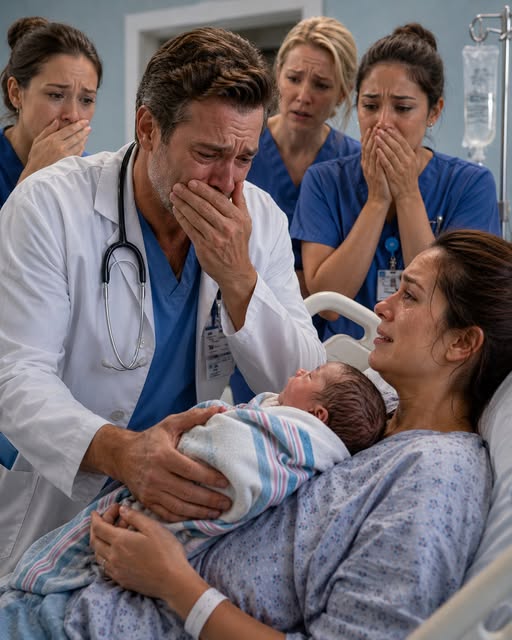
But now, in Delivery Room Four, with the winter light pressing gray against the windows, Robert Wright stared at Joanna’s newborn son and felt the floor vanish beneath him.
The baby was small, wrinkled, furious at the cold, his tiny fists curled near his cheeks. A nurse had tucked him into a white blanket with blue stripes. His skin was flushed from crying. His dark hair lay damp against his head.
But it was not the hair.
It was not the face.
It was the mark.
Just beneath the baby’s left collarbone, where the blanket had slipped, there was a birthmark shaped like a broken crescent. Pale at the edges, darker at the center, almost like a small moon split by shadow.
Robert’s breath caught.
For a moment, he was no longer in the hospital.
He was standing in another room, decades earlier, holding another newborn with that same mark beneath the left collarbone.
A child who had disappeared.
A child he had believed was gone forever.
“Doctor?” the nurse asked quietly.
Her voice brought him back, but not completely.
Joanna noticed then. She was exhausted, pale, her hair damp at her temples, her body still trembling from labor. But a mother sees everything when it comes to her child.
“Is something wrong?” she whispered.
Robert opened his mouth.
No sound came out.
The nurse drew the baby closer to her chest. “Dr. Wright?”
Robert wiped quickly at his eyes, as though ashamed of them. His hand shook so badly that he tucked it into the pocket of his coat.
“No,” he said at last, but the word sounded too fragile. “No, nothing is wrong with the child.”
Joanna’s expression tightened. “Then why are you crying?”
The room went quiet.
Outside in the hallway, someone laughed. A cart squeaked past the door. Somewhere, another baby began to cry. Ordinary hospital sounds, careless and distant, while Joanna’s entire world balanced on Robert Wright’s answer.
He looked at her chart again.
Joanna Ellis. Twenty-eight. No emergency contact listed. No spouse present. Father of child: not provided.
His eyes moved back to her face.
“May I ask,” he said carefully, “the father’s name?”
Joanna’s fingers curled into the sheets.
The question struck harder than it should have. She had spent seven months learning how not to flinch at his name. She had spoken it to landlords, nurses, government forms, and strangers who assumed there was a man somewhere waiting to arrive. Every time, it left a small cut.
“Why?” she asked.
Robert swallowed. “Because I need to know.”
The nurse shifted uncomfortably. “Doctor, perhaps this can wait.”
“No,” Joanna said, her voice still weak but firm. “If you’re asking because something is wrong with my baby, then you tell me now.”
Robert’s face changed. Not into the calm doctor’s mask everyone knew, but into the face of an old man suddenly carrying a weight too heavy to hide.
“Nothing is wrong with him,” he said again. “But I believe…” He stopped. “I believe I may know his family.”
Joanna stared.
His family.
For months, that word had meant only her. Her hands over her stomach. Her voice in an empty room. Her body standing for hours at the diner until her ankles swelled. Her alone, always alone.
“The father’s name,” Robert repeated gently.
Joanna looked toward the baby, still cradled in the nurse’s arms.
“Logan,” she said.
Robert closed his eyes.
The nurse’s face went still.
“Logan Wright?” Robert asked.
Joanna’s heart slammed once against her ribs.
She had never told the hospital Logan’s last name. She had refused, not out of pride, but because writing it down felt like giving him a place he had abandoned.
“How do you know that?” she whispered.
Robert opened his eyes.
Because he is my son.
The words should have been simple.
Instead, they came from him like a confession.
Joanna did not move.
For a second, she thought the exhaustion had finally broken something inside her. Perhaps she had misheard. Perhaps there was another Logan Wright somewhere, another man with the same careless hands and the same soft way of leaving.
But Robert’s expression confirmed everything.
“My son,” he said. “Logan is my son.”
The nurse inhaled sharply.
Joanna’s lips parted, but no words came.
Robert took one step closer, then stopped, as if afraid she might tell him to leave. “I didn’t know,” he said. “I swear to you, I did not know about the pregnancy.”
Something inside Joanna, something buried deep beneath months of hunger, rent notices, back pain, fear, and loneliness, lifted its head.
“You didn’t know,” she repeated.
“No.”
“He left me,” she said.
Robert looked as though she had struck him.
“He left when I told him. Seven months ago. He said he needed air. He packed a bag. He told me it was complicated. He said he would call.” Her voice broke, but she refused to let the tears take over. “He never did.”
Robert’s jaw tightened. His eyes lowered to the floor.
“I’m sorry,” he said.
The apology was soft, sincere, and useless.
Joanna gave a bitter laugh. “You’re sorry?”
He accepted it. He did not defend Logan. Did not ask if she had misunderstood. Did not search for excuses. That, somehow, made her angrier.
“Where is he?” she demanded. “Since you know him. Since he’s your son. Where is Logan?”
Robert’s face drained again, but this time not from shock.
He looked toward the baby.
Then back at Joanna.
“I don’t know.”
The answer landed between them with a strange, hollow sound.
Joanna stared. “What do you mean you don’t know?”
“I haven’t seen him in seven months.”
The room seemed to shrink.
The nurse finally placed the baby into Joanna’s arms. Instinct overpowered everything else. Joanna pulled him close, inhaling the warm, milky scent of his skin. Her son quieted almost immediately, pressing his tiny mouth against the blanket, his eyelids fluttering.
For one small second, the world became simple.
Then Robert spoke.
“The night he left you,” he said, “he came to me.”
Joanna looked up slowly.
Robert’s eyes remained fixed on the baby’s birthmark.
“He was terrified. I had never seen him like that. He said he’d made a mistake, that he needed to leave town, that people were looking for him.” Robert’s voice roughened. “I thought he was talking nonsense. Logan had always been impulsive. He was charming, reckless, always running from responsibility. I assumed he owed money. I assumed he had gotten into some stupid trouble.”
Joanna’s fingers tightened protectively around the baby.
“He told you about me?”
Robert shook his head.
“No. He didn’t mention you. He didn’t mention a child.” His face twisted with regret. “If he had…”
The unfinished sentence was worse than any promise.
“What happened after he came to you?” Joanna asked.
Robert looked older with every breath.
“I told him to stop running. I told him whatever he’d done, he could face it. He got angry. Said I didn’t understand. Said I had never understood anything about blood.” Robert’s eyes flicked again to the birthmark. “Then he left.”
“And?”
“Three days later, his car was found abandoned near Blackwater Bridge.”
Joanna’s breath vanished.
The baby stirred against her chest.
“No,” she whispered.
“There was no body,” Robert said quickly. “No sign of a crash. No blood. Just the car. His phone was inside. His wallet too.”
Joanna stared at him, unable to decide whether hope or horror was worse.
“The police thought he ran,” Robert continued. “They said it looked staged. I wanted to believe he was alive. Part of me still does.”
Joanna looked down at her son.
All this time, she had imagined Logan somewhere else, free of her, free of them. She had pictured him in another city, laughing too easily, telling some new woman that his past was complicated. That image had been poison, but it had kept her upright. Anger was easier than grief.
But now?
Now there was a bridge, an abandoned car, a father who had vanished from more than one life.
“Why did you ask about the birthmark?” Joanna said.
Robert’s whole body became still.
He did not answer immediately.
The nurse glanced toward the door. “Dr. Wright, should I give you two a moment?”
“No,” Joanna said quickly.
She did not want to be alone with him. Not yet.
Robert nodded faintly, accepting the boundary. Then he pulled a chair closer, but he did not sit until Joanna gave the smallest nod.
“My wife and I had two sons,” he said. “Logan… and another boy. His name was Elias.”
Joanna had never heard the name.
Robert’s eyes softened, not with comfort, but with a grief so old it had become part of his face.
“Elias was born first. Logan came three years later. Elias had a birthmark under his left collarbone. Exactly like your son’s.”
Joanna looked down.
The blanket had shifted. The mark was visible again, tiny and strange against newborn skin.
“When Elias was five,” Robert continued, “he disappeared.”
The nurse crossed herself without meaning to.
Robert kept speaking, as though stopping would destroy him.
“It happened during the county fair. One minute he was beside my wife. The next, gone. We searched for months. Police, volunteers, divers in the river, dogs in the woods. Nothing. No ransom note. No body. No witness who could agree on anything.”
His fingers pressed into his knees.
“My wife never recovered. She kept his room exactly the same for ten years. His shoes by the bed. His drawings on the wall. His little red coat hanging behind the door.” His voice nearly failed. “She died believing he was still alive.”
Joanna felt her anger falter.
Not vanish.
But shift.
Pain recognized pain, even when it did not forgive.
“What does that have to do with my baby?” she asked.
Robert looked at her directly.
“Elias had that mark. My father had it. His mother before him. It appears in my family sometimes. Not every generation. But when it does, it appears almost exactly the same.”
Joanna’s mouth went dry.
“So this baby…”
“My grandson,” Robert said.
The word trembled.
Joanna shut her eyes.
Grandson.
She had spent months building a wall around herself and her child. She had accepted that he would come into the world with no father’s family, no family name that mattered, no one waiting outside the delivery room. And now a stranger in a white coat, with Logan’s last name and Logan’s haunted eyes, was telling her the baby belonged to a history full of disappearance.
Robert leaned forward slightly. “Joanna, what did Logan tell you about his family?”
She laughed once, quietly. It held no humor.
“Almost nothing. He said his mother died. He said you were strict. He said you and he didn’t get along.”
“That part was true.”
“He said he hated hospitals.”
Robert’s eyes flickered.
“He did.”
“And he said…” Joanna hesitated.
“What?”
She looked down at the baby, then back at him.
“He said there were things in his family nobody talked about. I thought he meant money. Or divorce. Or some old scandal.”
Robert’s expression darkened.
“What else?”
Joanna tried to remember. The last months with Logan had blurred after he left. She had pushed the memories away because they were sharp. But now they returned, small and glittering.
“He had nightmares,” she said. “Not often. But sometimes he’d wake up sweating. Once, he said a name.”
Robert barely breathed. “What name?”
“Elias.”
The nurse made a small sound.
Robert stood so fast the chair scraped the floor.
Joanna flinched, pulling the baby closer.
“I’m sorry,” he said quickly. “I’m sorry.”
But he was looking toward the window now, not at her. His face had gone distant, calculating, afraid.
“What aren’t you telling me?” Joanna asked.
Robert turned back.
For a long moment, he seemed to argue with himself.
Then he said, “Three months before Logan disappeared, he came to my house. He had been drinking. He went into Elias’s old room.”
Joanna waited.
“I had kept it locked after my wife died. I couldn’t bring myself to clear it out. Logan broke the lock.”
“Why?”
“He said he remembered something.”
The hospital room seemed to grow colder.
Robert’s voice dropped.
“He said he remembered the fair. He remembered Elias being taken. He remembered a woman in a green coat holding Elias’s hand.”
Joanna’s pulse thudded in her ears.
“A woman?”
Robert nodded. “But that wasn’t the strange part.”
“What was?”
“He said Elias wasn’t crying. He said Elias looked back at him and smiled.”
Joanna glanced instinctively at the baby.
The newborn slept now, one tiny hand resting against his cheek.
“Logan was three years old,” Robert said. “For years, he remembered nothing. We were told trauma erased it. Then suddenly, after nearly twenty-five years, the memory returned.”
“Why then?”
Robert’s gaze dropped to the chart.
“Because someone sent him a photograph.”
Joanna went still.
“What photograph?”
“I don’t know. He refused to show me. He said if I saw it, I would try to stop him. He said he knew where Elias was.”
The words struck like a match in a dark room.
Alive.
The missing child might have grown into a man.
A man with a birthmark.
A man Logan went looking for.
“What happened after that?” Joanna asked.
Robert’s throat moved.
“We fought. I thought it was a cruel hoax. Families like ours attract them. People claimed to be Elias before. People called asking for money. People sent false tips. Each time, my wife broke a little more. I couldn’t endure it again.” He looked toward the baby. “But Logan believed it.”
“And then he met me,” Joanna murmured.
Robert nodded slowly.
“And then he vanished.”
The nurse, who had been quiet too long, finally spoke. “Dr. Wright, this sounds like something the police should know.”
“They know parts of it,” Robert said. “Not all.”
“Why not?” Joanna asked sharply.
Robert’s shame was visible.
“Because I didn’t believe him. Because after the car was found, I told myself Logan had done what Logan always did. Run. I told myself if I handed the police some story about a missing brother and a photograph I’d never seen, they would waste time chasing ghosts.”
“And now?”
Robert looked at his sleeping grandson.
“Now I am looking at proof that Logan had more to lose than I ever knew. And I’m wondering whether he ran at all.”
Joanna felt the room tilt.
For seven months, she had survived by making Logan the villain of a simple story. He left. She stayed. He failed. She endured.
But now the story had opened under her feet, revealing hidden rooms, locked doors, a missing brother, an abandoned car, a photograph, and a man who might have been fleeing something far darker than fatherhood.
It did not absolve him.
But it changed the shape of the wound.
A knock came at the door.
Everyone froze.
The nurse turned. “Yes?”
Another nurse stepped inside, holding a clipboard. “Sorry. Dr. Wright, there’s someone at the front desk asking about a Joanna Ellis.”
Joanna’s blood chilled.
Robert’s face sharpened. “Who?”
The nurse checked the paper. “A man. He says he’s family.”
Joanna’s arms locked around the baby.
“I don’t have family here,” she said.
Robert stepped closer to the bed, all trace of trembling gone now. The calm doctor had returned, but beneath it was something harder.
“What name did he give?” he asked.
The nurse looked confused.
“He said his name was Michael.”
Joanna shook her head. “I don’t know a Michael.”
The nurse hesitated. “He said Joanna would know him by another name.”
Robert’s eyes narrowed.
“What other name?”
The nurse glanced at Joanna.
“He said… Logan sent him.”
The baby woke then, as if pulled by the sound of his father’s name.
His cry cut through the room, thin and sudden.
Joanna’s heart pounded so hard she could feel it in her teeth.
Robert moved toward the door. “Do not let him up here.”
The nurse stiffened. “Doctor?”
“Call security. Now.”
The nurse hurried out.
Joanna stared at Robert. “Who is Michael?”
“I don’t know.”
But he said it too quickly.
Joanna heard the lie.
“Dr. Wright.”
He turned back slowly.
“I just gave birth alone,” she said, her voice low, shaking with exhaustion and fury. “Your son left me. My baby is ten minutes old. And now strangers are asking for me downstairs. So do not lie to me.”
Robert held her gaze.
Then he reached into the inside pocket of his coat and took out a folded piece of paper, worn soft at the edges.
“I received this five months ago,” he said.
He handed it to her.
Joanna did not want to take it. She did anyway.
Inside was a photograph printed on cheap paper.
It showed a man standing outside a gas station at night, half-turned from the camera. The image was grainy. The man had dark hair, a narrow face, and a scar near his jaw.
Joanna did not know him.
But on the back, written in black marker, were six words:
ASK LOGAN WHAT MICHAEL DID TO ELIAS.
The room became impossibly silent.
Joanna stared at the message until the letters blurred.
Robert spoke carefully. “There was no return address.”
“Why didn’t you go to the police?”
“I did.”
“And?”
“They said it could be connected. They said it could be another cruel person exploiting an old case. They took a copy. Nothing came of it.”
Joanna handed the photograph back as though it burned.
“And now he’s here.”
Robert folded the paper with controlled precision, but his fingers shook again.
A second knock came, urgent this time.
The first nurse reentered, breathless. “Security is on the way, but the man left before they reached him.”
Joanna exhaled, but relief did not come.
The nurse held out something small.
“He left this at reception.”
It was a white envelope.
No stamp. No address.
Just one word written across the front.
JOANNA.
Robert took it before anyone else could.
“No,” Joanna said.
He stopped.
“It has my name on it.”
“Joanna—”
“My name.”
Robert looked at the baby, then at her. Slowly, unwillingly, he handed it over.
The envelope felt too light.
Inside was a photograph.
This one was not old.
This one was clear.
Joanna’s breath stopped.
It showed Logan.
He was thinner than she remembered. His cheekbones were sharp, his beard untrimmed, his eyes hollow with fear. He stood in what looked like a basement or cellar, one hand raised toward the camera as if telling the person behind it to stop.
But that was not what made Joanna’s vision go white.
Beside Logan stood another man.
Older by a few years, maybe early thirties. Same dark hair. Same shape of the mouth. Same eyes.
And beneath his open collar, just visible against his skin, was the broken crescent birthmark.
Robert made a sound like a man being wounded.
“Elias,” he whispered.
Joanna turned the photo over.
There was writing on the back.
Not in marker this time.
In Logan’s handwriting.
She knew it instantly. The slanted letters. The pressure of the pen. The way he never closed his O’s.
He’s not dead.
Don’t trust my father.
Protect the baby.
Joanna looked up.
Robert Wright stood beside her hospital bed, tears running silently down his face.
For a moment, neither of them spoke.
Then, from somewhere down the hallway, the hospital lights flickered once.
Twice.
And went out.
The baby began to cry again.
In the dark, Robert whispered, “Joanna… listen to me very carefully.”
But before he could say another word, the door to the delivery room slowly opened.
Part 3 — The Name That Split the Room Open
For a moment, the delivery room became so quiet that Joanna could hear the smallest sounds: the soft crackle of the baby’s blanket, the nervous shifting of a nurse’s shoes, the uneven breathing of the doctor standing frozen beside the bed.
Dr. Robert Wright stared at the newborn as if the child had carried a ghost into the world.
Joanna’s arms tightened around her son.
“Doctor?” she whispered.
Robert blinked, but the tears remained in his eyes. He looked older suddenly — not like the calm, respected physician everyone knew at Mercy Creek Medical, but like a man who had been struck by a memory sharp enough to draw blood.
“What is the father’s name?” he asked.
The question landed strangely.
Joanna glanced at the nurse, then back at him. “Why?”
Robert swallowed. His voice was barely steady. “Please.”
She hesitated. After everything Logan had done, saying his name still felt like pressing a bruise.
“Logan,” she said. “Logan Wright.”
The doctor’s face collapsed.
The nurse gasped softly.
Joanna’s heart gave a violent jolt.
“What?” she demanded. “What is it?”
Robert stepped back as though the floor had shifted beneath him. One trembling hand covered his mouth. His eyes moved from Joanna to the baby, then to the chart again, searching for proof that he had misheard.
“Logan Wright,” he repeated.
Joanna’s throat tightened. “Do you know him?”
Robert closed his eyes.
When he opened them, there was no way to hide the truth.
“He is my son.”
Joanna stared at him.
The words made no sense at first. They floated above her, impossible and cold. Logan had told her his parents were dead. He had said he grew up in foster homes, that he had no family, no history worth speaking of. He had spoken of the past like a locked room.
“You’re lying,” Joanna whispered.
Robert flinched, not in anger, but in pain.
“I wish I were.”
The baby stirred in Joanna’s arms, making a tiny sound, unaware that the adults around him were standing at the edge of a truth that would change everything.
Robert took a careful step closer. “Logan disappeared when he was six years old.”
Joanna’s breath caught.
“No,” she said immediately. “No. That can’t be right.”
“We searched for him for years,” Robert continued, voice breaking. “My wife never stopped. Police, newspapers, private investigators. Every birthday, she baked a cake. Every Christmas, she left one gift under the tree.”
Joanna looked down at her baby. A small crescent-shaped birthmark rested near his left shoulder, pale brown against the pink newborn skin.
Robert pointed at it with a trembling finger.
“Logan had that same birthmark,” he said. “So did I.”
The room seemed to tilt.
Joanna remembered Logan turning away when she once touched his shoulder. She remembered him dressing in darkness. She remembered the careful way he avoided mirrors when his shirt was off.
At the time, she thought it was shame.
Now she wondered if it had been fear.
“Where is he?” Robert asked.
Joanna laughed once, a broken sound with no humor in it.
“He left me,” she said. “Seven months ago.”
Robert’s expression changed again — not disappointment, not anger, but recognition.
As though he had feared this.
As though he had known the wound might spread from one generation to the next.
“He doesn’t know who he is,” Robert murmured.
Joanna shook her head. “He knew enough to abandon us.”
Robert lowered his eyes. “Maybe. But there may be more.”
“There’s always more,” Joanna said, tears spilling down her temples. “That doesn’t change what he did.”
The baby began to fuss. Joanna held him closer, pressing her lips to his forehead.
Robert looked at the child with an ache so raw that even Joanna’s anger faltered.
“What is his name?” he asked.
Joanna looked down at the little face tucked beneath the blanket.
For months, she had whispered one name in the dark.
“Eli,” she said softly. “His name is Eli.”
Robert’s eyes filled again.
“Eli Wright,” he whispered.
Joanna stiffened. “No. Eli Bennett. My name.”
Robert nodded quickly. “Of course. I’m sorry.”
The apology was instant, sincere, and it caught Joanna off guard.
He was not trying to claim the child.
He was trying not to lose another one.
Then the nurse, who had been silent, stepped forward.
“Dr. Wright,” she said gently, “you should sit down.”
But Robert didn’t move. He looked at Joanna with a desperation that terrified her.
“There is something you need to know,” he said.
Joanna stared at him.
“About Logan?”
Robert’s jaw tightened.
“About the night he disappeared.”
The monitors hummed. Snow tapped lightly against the hospital window. Joanna’s newborn son slept against her chest, warm and fragile.
And Dr. Robert Wright spoke the sentence that would drag the past out of its grave.
“Logan was not lost.”
He drew in a shaking breath.
“He was taken.”
Part 4 — The Boy Who Vanished in the Rain
Robert led Joanna into a small recovery room two hours later, after Eli had been checked, cleaned, fed, and placed in a clear bassinet beside her bed.
Outside, evening pressed against the windows, the sky bruised purple with winter clouds.
Joanna should have been sleeping. Her body was exhausted, her hands still weak, her mind fogged from labor and shock. But every nerve inside her was awake.
Robert stood near the foot of the bed, holding a folded photograph he had taken from his wallet.
He placed it gently on the blanket.
Joanna looked down.
A little boy with bright eyes stared back from the old picture. Dark hair. A crooked smile. One front tooth missing. His small hand rested on the shoulder of a younger Robert Wright, who looked impossibly happy.
The boy had Logan’s face.
Not exactly. Logan’s face had been sharpened by years of hiding and hunger. But the eyes were the same.
Haunted blue.
“This was taken three weeks before he vanished,” Robert said.
Joanna touched the edge of the photo.
“What happened?”
Robert leaned against the wall as if he needed it to stand.
“It was raining,” he began. “A hard summer storm. Logan was six. My wife, Margaret, took him to the town fair. I was on call at the hospital. She said he begged to ride the carousel one more time.”
His voice thinned.
“She turned around for only a moment to pay the vendor. When she looked back, he was gone.”
Joanna looked at Eli, sleeping peacefully beneath the hospital light.
“Did no one see anything?”
“Someone saw a green station wagon leaving the fairgrounds. Another witness saw a man carrying a crying child toward the parking lot. But by the time police understood what they were looking for, the trail was cold.”
Robert pressed his fingers against his eyes.
“Margaret blamed herself. I blamed myself. We blamed the world. Then eventually… we stopped speaking of blame because there was nothing left of us except grief.”
“What about Logan?” Joanna asked. “Where did he go?”
Robert shook his head. “We never found him.”
Joanna’s stomach twisted.
“But he must have had records. Foster homes. School. Something.”
“Maybe under another name,” Robert said. “Maybe whoever took him changed everything.”
Joanna remembered Logan’s restless sleep. The way he used to wake up drenched in sweat. The way he once shouted, “Don’t lock the door,” while trapped in a nightmare.
She had asked him about it.
He had kissed her forehead and said, “Some memories aren’t memories. They’re just shadows.”
At the time, she believed him.
Now she wondered what those shadows had been hiding.
Robert pulled another item from his coat pocket — a small silver bracelet, tarnished with age.
“It was Logan’s,” he said. “He wore it the day he disappeared. It had his name engraved inside. The police found it two years later near an abandoned farmhouse forty miles away.”
Joanna shivered.
“That’s why we thought…” Robert’s voice cracked. “That’s why some people told us to accept he was gone.”
“But you didn’t.”
“My wife wouldn’t.” He smiled faintly, painfully. “Margaret said she would know if her child had left this world. She said a mother’s heart keeps listening.”
Joanna looked down at Eli.
Her heart squeezed.
“Where is Margaret now?”
Robert went still.
“She died five years ago.”
Joanna closed her eyes.
The answer hurt more than she expected.
“She never knew,” Joanna whispered.
“No,” Robert said. “She never stopped waiting.”
Silence stretched between them.
Joanna thought of Logan. The man who had laughed quietly while cooking eggs at midnight. The man who brought home bruised flowers from the grocery store because they were cheaper but “still deserved a vase.” The man who had kissed her stomach once before fear swallowed him whole.
Then she thought of the door closing.
Her expression hardened.
“Pain explains things,” Joanna said, “but it doesn’t erase them.”
Robert nodded slowly. “No. It doesn’t.”
Eli stirred. Joanna reached into the bassinet and rested two fingers against his tiny fist. He curled around them immediately.
That small grip undid her.
Robert watched, and something in his face softened.
“I’m not asking you to forgive him,” he said. “I’m not even asking you to see him. But there is one thing I must ask.”
Joanna looked up.
Robert’s voice lowered.
“Do you have any way to contact Logan?”
Joanna almost said no.
Then she remembered the envelope.
The one Logan had left behind.
She had thrown it into a drawer the night he left, unopened, because she hated him too much to read his goodbye.
Her pulse quickened.
“There might be something,” she said.
Robert stepped forward.
“What?”
Joanna swallowed.
“He left me a letter.”
Robert’s eyes sharpened.
“What did it say?”
“I don’t know,” she admitted. “I never opened it.”
Robert looked at her as if the air had just left the room.
Joanna turned toward the window, where snow had begun to fall in quiet flakes.
For seven months, she had believed that letter contained excuses.
Now, for the first time, she wondered if it contained a warning.
Part 5 — The Letter Behind the Drawer
Joanna returned to her rented room two days later with Eli bundled against her chest and Robert Wright walking silently beside her.
She had not wanted him there at first.
Then she realized she was afraid to go alone.
Her room sat above a closed bakery on Maple Street, small enough that one lamp lit nearly all of it. A narrow bed, a chipped dresser, a hot plate, two mugs, and a rocking chair she had bought secondhand for eight dollars.
Robert paused in the doorway.
Joanna saw him notice everything.
The frayed blanket. The stack of unpaid bills. The tiny row of baby clothes folded with military care because folding was the only way she could control her fear.
His face tightened.
She lifted her chin.
“Don’t pity me.”
“I wasn’t,” he said quietly. “I was admiring you.”
That silenced her.
Eli made a sleepy sound against her chest.
Joanna crossed to the dresser and opened the bottom drawer. Beneath an old scarf and a stack of diner uniforms lay the envelope.
It had yellowed at the edges.
Her name was written on the front in Logan’s handwriting.
Jo.
Not Joanna.
Jo.
The name he used when he was gentle.
Her fingers trembled as she opened it.
Inside were three pages and a photograph.
The photograph fell first.
Joanna picked it up and froze.
It showed Logan as a child, perhaps ten years old, standing beside a woman with hard eyes and a man whose smile looked more like a threat. On the back, written in block letters, were the words:
You belong to us.
Robert took one look and gripped the dresser.
“I know that man,” he whispered.
Joanna looked at him sharply. “Who is he?”
Robert’s voice turned cold.
“Evan Crowe. He worked at the fair the year Logan disappeared.”
Joanna’s blood chilled.
She unfolded the letter.
At first, the words blurred.
Then Logan’s voice seemed to rise from the page.
Jo,
I am a coward for leaving this instead of saying it to your face. I know that. But if I stay, they will find you. If they find you, they will find the baby.
Joanna covered her mouth.
Robert stood utterly still.
She kept reading.
I don’t remember everything from when I was little. I remember rain. Music. A horse with blue glass eyes. A woman screaming my name, but I was told that was a dream.
Robert made a sound like a man struck in the chest.
The people who raised me were not my parents. They told me they saved me from a family that didn’t want me. When I was sixteen, I found an old bracelet with another name on it. Logan Wright. They beat me for asking questions.
Joanna’s tears began to fall.
I ran when I was eighteen. I changed towns, jobs, everything. But Crowe kept finding me. He said I owed him. Said blood doesn’t matter. Said he made me.
Robert’s face hardened with fury.
When you told me you were pregnant, I was happy for exactly one minute. Then I saw him outside the diner that night. Crowe. Watching you through the window.
Joanna’s knees weakened.
She remembered that night. Logan had gone pale. He had said he felt sick. By morning, he was gone.
I left because I thought distance would protect you. I know you’ll hate me. Maybe you should. But I’m going to end this before our child is born.
Joanna clutched the page so tightly it crumpled.
The final line was written harder than the rest, the pen nearly tearing the paper.
If I don’t come back, tell our baby I tried to be brave too late.
The room swayed.
Robert grabbed the back of the chair.
“Where would he go?” Joanna asked, voice shaking.
Robert stared at the photograph.
“Crowe owned land outside Mercy Creek,” he said. “An old farmhouse.”
Joanna looked at him.
“The one where the bracelet was found?”
Robert nodded.
Eli began to cry, his small voice rising into the cold room.
Joanna held him close, but her eyes remained fixed on the letter.
For seven months, she had thought Logan abandoned her because he didn’t love her.
Now she understood something far worse.
Logan had walked back into the nightmare that stole him.
Robert pulled out his phone.
“I’m calling the sheriff.”
Joanna looked down at her son.
Eli’s tiny hand pressed against her collarbone, warm and alive.
She thought of Logan as a little boy in the rain. Logan as a man outside the diner, seeing his past return. Logan writing a letter with shaking hands, choosing danger because he believed absence was love.
Her anger did not vanish.
But it cracked.
And beneath it, something terrified and tender began to breathe.
“Find him,” she whispered.
Robert looked at her.
Joanna’s voice broke.
“Please find him.”
Part 6 — The Farmhouse Where the Past Waited
The old Crowe farmhouse stood beyond a line of dead trees, hunched beneath the snow like something ashamed of surviving.
By dawn, two sheriff’s cars, an ambulance, and Robert’s dark sedan had gathered near the rusted gate. Joanna had been ordered to stay behind at the hospital with Eli.
She refused.
“I gave birth three days ago,” she told Sheriff Hale, standing pale but unyielding beside Robert. “I am tired, not helpless.”
The sheriff looked ready to argue, but one glance at her face stopped him.
So Joanna waited in the ambulance with Eli asleep in her arms, while officers moved toward the farmhouse with weapons drawn.
Every second stretched.
The wind hissed through the trees.
Robert stood beside the ambulance, his gaze locked on the farmhouse.
“Logan used to be afraid of storms,” he said suddenly.
Joanna looked at him.
“When he was little,” Robert continued, “he would crawl into our bed during thunder. Margaret would tell him thunder was just the sky moving furniture.”
Despite herself, Joanna smiled through tears.
“He told me that once,” she whispered.
Robert turned.
“What?”
“When thunder woke me, he said, ‘Don’t worry. The sky is just moving furniture.’ I thought he made it up.”
Robert pressed his hand over his mouth.
For a moment, father and almost-daughter stood together in the snow, holding the same memory from opposite ends of a broken life.
Then a shout came from the farmhouse.
Robert stiffened.
Sheriff Hale emerged from the doorway minutes later, face grim.
Robert moved toward him. “Did you find him?”
The sheriff hesitated.
Joanna’s heart stopped.
“Alive,” Hale said quickly. “He’s alive.”
Joanna nearly collapsed.
Robert caught the side of the ambulance.
“But he’s hurt,” the sheriff added.
Two paramedics rushed inside.
Joanna clutched Eli, whispering, “Thank you, thank you, thank you,” though she did not know who she was thanking.
Then they brought Logan out.
He was thinner than she remembered. Bruised. Unshaven. One eye swollen, his lip split, his wrists marked with deep red abrasions. But he was breathing.
His head turned weakly as they loaded him onto the stretcher.
For one suspended second, his eyes found Joanna.
Then they dropped to the baby in her arms.
His face changed completely.
All the pain, fear, and exhaustion broke open beneath one expression.
Wonder.
“Jo…” he rasped.
Joanna stepped closer, trembling.
Logan’s eyes filled.
“Is that…”
“Yes,” she whispered. “This is Eli.”
The name struck him like sunlight.
“Eli,” he repeated.
His gaze moved over the baby’s face with reverence and heartbreak.
Then he saw Robert standing behind Joanna.
Logan went rigid.
Robert did not move. He seemed afraid that one wrong breath might scare his son away.
Logan stared at him, confusion flickering through fevered eyes.
“I know you,” Logan whispered.
Robert’s face crumpled.
“Yes.”
Logan shook his head faintly. “From dreams.”
Robert stepped closer, tears freezing on his cheeks.
“From home.”
Logan looked at him for a long time.
Then his breath hitched.
“Dad?”
The word was barely audible.
But it broke Robert Wright completely.
He fell to his knees beside the stretcher, taking Logan’s battered hand in both of his.
“My boy,” he sobbed. “My little boy.”
Logan began crying too — not loudly, not dramatically, but like a person whose body had forgotten how and was learning again.
Joanna watched them, her own tears falling onto Eli’s blanket.
She had imagined confronting Logan a thousand times. She had imagined shouting. Slamming doors. Demanding answers.
But nothing in her imagination had prepared her for this.
For a father kneeling in the snow.
For a stolen son whispering a name he had buried.
For a newborn sleeping through the impossible restoration of a family.
Then Sheriff Hale approached.
“We found Evan Crowe inside,” he said. “Dead.”
Everyone turned.
The sheriff’s expression darkened.
“Looks like he died weeks ago.”
Joanna frowned. “Weeks?”
Hale nodded.
“Then who kept Logan there?” Robert asked.
The sheriff hesitated.
Before he could answer, Logan grabbed Joanna’s wrist with sudden panic.
His voice was hoarse, frantic.
“Crowe wasn’t the one who came back.”
Joanna’s blood turned cold.
Logan’s fingers tightened.
“It was her.”
Robert went pale.
“Who?”
Logan’s eyes filled with terror.
“The woman who raised me.”
A branch cracked somewhere beyond the trees.
Everyone turned toward the woods.
But there was nothing there.
Only snow.
Only silence.
Only the feeling that someone had been watching all along.
Part 7 — The Woman Who Refused to Let Go
Her name was Mara Crowe.
She had been Evan Crowe’s wife, though wife was too soft a word for what she had been. Mara did not love people. She collected them. Controlled them. Folded them into her life like stolen letters hidden beneath a floorboard.
She had taken Logan when he was six because, as she later told him, “some children are wasted on the wrong mothers.”
For decades, she had taught him fear as if it were a language.
And now she had returned to speak it one last time.
Logan told them everything from his hospital bed in broken pieces.
Mara had found him two weeks after he left Joanna. He had gone to the farmhouse to confront Crowe, but Evan was already dying, half-mad and sick. Mara was there instead, waiting.
“She said she knew about the baby,” Logan whispered. “She said if I didn’t come with her, she would take him like she took me.”
Joanna’s arms wrapped around Eli instinctively.
Robert stood beside the bed, one hand on Logan’s shoulder, as if afraid his son might vanish again.
Sheriff Hale listened carefully.
“Where is Mara now?”
Logan closed his eyes.
“I don’t know.”
That answer was not good enough for anyone.
Security was placed outside Joanna’s hospital room. Officers searched the woods, the highway, the farmhouse, the abandoned motel near the interstate. Nothing.
Mara Crowe had disappeared into winter.
That night, Joanna sat awake with Eli against her chest while Logan slept in the room across the hall under watch.
Robert entered quietly with two paper cups of coffee.
“You should rest,” he said.
“So should you.”
He smiled faintly. “Doctors are terrible patients. Worse grandparents.”
The word hung there.
Grandparents.
Joanna looked up.
Robert seemed to realize what he had said. “I’m sorry. I didn’t mean to assume.”
Joanna studied him. This man had lost his son, found him, and still asked permission before claiming anything.
Her voice softened.
“You can be his grandfather.”
Robert’s eyes shone.
“Thank you.”
Then the lights flickered.
Once.
Twice.
The room went dark.
Eli startled awake and began to cry.
From the hallway came a shout.
Then another.
Joanna stood too quickly, pain flashing through her body.
“Stay behind me,” Robert said.
But before he reached the door, it opened.
A nurse stepped in.
At first, Joanna relaxed.
Then she saw the woman’s eyes.
Cold. Pale. Familiar from the photograph.
Mara Crowe smiled.
“Hello, Joanna.”
Robert moved instantly, but Mara lifted a syringe.
“Don’t,” she said calmly. “This will drop him before he takes two steps.”
Joanna’s blood roared in her ears.
Mara looked at the baby.
“My, my,” she whispered. “He does look like Logan.”
Joanna backed away, holding Eli tight.
“You won’t touch him.”
Mara laughed softly. “That’s what Margaret said.”
Robert’s face twisted with fury.
Mara glanced at him. “Oh, don’t look so wounded, Robert. You got him back, didn’t you? Eventually.”
“You destroyed my family,” Robert said.
“No,” Mara replied. “I improved what you failed to protect.”
Then a voice came from the doorway behind her.
“You didn’t improve anything.”
Mara turned.
Logan stood there, barely upright, one hand braced against the doorframe. His hospital gown hung loose over his bruised body. A security guard lay groaning behind him, not hurt badly but disarmed.
Mara’s smile changed.
“There’s my boy.”
Logan’s eyes were steady.
“I was never yours.”
For the first time, Mara’s face cracked.
“You ungrateful little thing.”
“I was a child.”
“I fed you.”
“You starved me.”
“I gave you a name.”
“You stole mine.”
Mara’s hand tightened around the syringe.
Joanna saw it happen before anyone else did — the quick shift of Mara’s wrist, the sudden intention.
She was going to lunge for Eli.
Joanna turned away, shielding the baby with her body.
But Logan moved first.
With a cry of pain, he threw himself between them.
Robert seized Mara’s arm. The syringe fell, skittering across the floor.
The hallway flooded with officers.
Mara screamed — not in fear, but in rage, an animal sound that seemed too large for her thin body.
As they forced her to the ground, she looked at Logan with pure hatred.
“You’ll come back to me,” she spat. “You always do.”
Logan stood shaking, blood seeping through one of his bandages.
Joanna stepped toward him.
He looked at her, ashamed and afraid.
“I’m sorry,” he whispered. “I thought leaving was the only way to keep you safe.”
Joanna’s eyes burned.
“You don’t get to decide that alone,” she said.
He nodded, tears spilling over. “I know.”
“You broke my heart.”
“I know.”
“You missed everything.”
His face crumpled. “I know.”
Joanna looked down at Eli, then back at Logan.
“But you came back.”
Logan shook his head.
“I was brought back.”
“No,” Joanna said softly. “Part of you kept fighting. That matters.”
Behind them, Mara was dragged down the hall, still screaming Logan’s stolen childhood into the walls.
But this time, nobody followed her voice.
Not Logan.
Not Robert.
Not Joanna.
Not the baby she would never touch.
Part 8 — The Birthmark That Became a Beginning
Three months later, Mercy Creek looked different in spring.
The snow had melted into silver streams along the sidewalks. The bakery beneath Joanna’s room reopened, filling the mornings with the smell of warm bread and cinnamon. Sunlight touched the hospital windows instead of frost.
And in the small chapel behind Mercy Creek Medical, a family gathered where grief had once stood alone.
Not a wedding.
Not yet.
Joanna had made that clear.
“I’m not marrying a man because tragedy made him poetic,” she told Logan one morning, and for the first time in months, he laughed hard enough to cry.
It was a naming ceremony for Eli.
Joanna stood at the front in a blue dress, Eli sleeping against her shoulder. Logan stood beside her, thinner still but healing, his hand never far from the child yet never reaching without asking.
Robert stood behind them.
In his hands, he held Margaret’s old locket.
Inside was a photograph of six-year-old Logan, grinning with his missing tooth, and a blank space where Robert had placed a new picture of Eli.
When Robert opened it, his hands trembled.
“Margaret waited for this day without knowing it,” he said.
Logan lowered his head.
Joanna touched his wrist.
The gesture was small.
But to Logan, it felt like mercy.
Sheriff Hale had uncovered the full truth in the weeks after Mara’s arrest. Evan and Mara had abducted Logan after losing their own child. They moved him between towns, changed his name, kept him isolated, and used fear to make him believe his real family had abandoned him.
But the final shock came from Mara herself.
During questioning, she revealed that Logan had not been chosen at random.
She had worked once as a temporary aide at Mercy Creek Medical. She had seen Robert with Margaret and little Logan in the hospital cafeteria. She had watched their happiness and hated it with such precision that it became a plan.
She had not stolen a child because she wanted a son.
She had stolen Logan because she wanted to punish joy.
The revelation sickened everyone.
But it also freed Logan from one last lie.
He had not been unwanted.
He had not been thrown away.
He had been loved so visibly that someone cruel had tried to erase it.
And failed.
Now, in the chapel, Robert stepped forward and placed the locket gently into Joanna’s hand.
“This belonged to Eli’s grandmother,” he said. “I would like him to have it one day.”
Joanna looked at the tiny photographs inside.
Margaret’s absence filled the room, not as emptiness, but as warmth arriving late.
“Thank you,” Joanna whispered.
Logan looked at his father.
“I wish I remembered her better.”
Robert’s smile trembled.
“I’ll tell you everything.”
“Even the embarrassing things?”
“Especially those.”
A soft laugh moved through the chapel.
Then Eli woke.
His little face scrunched. His mouth opened. A cry rose — loud, offended, magnificent.
Everyone laughed again.
Joanna rocked him gently. “I know, sweetheart. Too many speeches.”
Logan watched them with an expression so open it hurt.
Joanna noticed.
“What?” she asked.
He shook his head. “I never thought I’d see something good and believe it was real.”
Joanna’s eyes softened, though she kept her voice steady.
“Then keep looking.”
He did.
After the ceremony, Robert took Eli outside into the garden while Joanna and Logan remained in the chapel.
Sunlight poured through the stained glass, scattering colors across the floor.
Logan stood a careful distance away.
“I don’t expect forgiveness to happen all at once,” he said.
“It won’t.”
“I don’t expect trust just because I suffered.”
“Good.”
He nodded. “I’m going to earn what I can. And accept what I can’t.”
Joanna looked at him for a long moment.
This was not the Logan who had vanished without explanation.
This was not the frightened man who thought love meant running alone into danger.
This was someone broken, yes — but no longer hiding from the broken places.
“I read your letter again,” she said.
Logan winced.
“I hated parts of it.”
“I did too.”
“But one line stayed with me.”
He looked up.
Joanna’s voice softened.
“You wrote, ‘Tell our baby I tried to be brave too late.’”
Logan’s eyes filled.
She stepped closer.
“You were late,” she said. “But you were brave.”
He covered his face, shaking.
Joanna let him cry.
Then, after a moment, she reached for his hand.
Not as a promise of everything.
Not as an erasing of pain.
But as a beginning.
Outside, Robert’s voice drifted through the open chapel door as he spoke to Eli in the garden.
“Your grandmother would have adored you,” he said. “She would have said you have the Wright stubbornness. And she would have been correct.”
Joanna smiled.
Logan laughed through his tears.
Then Robert appeared in the doorway, Eli in his arms, looking startled.
“Joanna,” he said. “You need to see this.”
They hurried outside.
In the garden, beneath the old oak tree, sunlight had fallen across Eli’s blanket. The baby had shifted just enough that his tiny shoulder showed.
The crescent birthmark glowed softly in the golden light.
But beside it, almost hidden before, was another mark — faint, delicate, shaped like a small heart.
Robert stared at it.
Logan leaned closer.
Joanna frowned. “What is it?”
Robert’s voice broke into wonder.
“Margaret had a mark like that,” he whispered. “On her shoulder. Exactly like that.”
The garden went still.
A breeze moved through the oak leaves.
Joanna looked at Eli, then at Logan, then at Robert.
No one spoke for several seconds.
It was impossible, of course. Just a mark on a baby’s skin. A coincidence. A trick of light. A tender accident of nature.
And yet Robert began to smile.
Logan touched Eli’s tiny hand.
Joanna felt her eyes fill.
For years, Margaret Wright had waited for a child who never came home.
Now her grandson lay beneath spring sunlight carrying, somehow, both the sign of the son she lost and the echo of the love she left behind.
The ending no one expected was not revenge.
It was not punishment.
It was not even the dramatic return of everything stolen.
It was quieter than that.
Stranger.
Kinder.
A baby born to a woman who walked into a hospital alone had brought a lost son back to his father, a dead mother back into memory, and a broken family back into the world.
Joanna kissed Eli’s forehead.
Logan wrapped one arm gently around them both.
Robert placed his hand over his heart, looking up at the brightening sky.
And for the first time in thirty-two years, the Wright family did not feel haunted by what had been taken.
They felt surrounded by what had survived.
The child who arrived in silence had become the answer to every prayer no one dared to speak aloud.
The End