I tried to leave before the toasts.
That was my plan. Quiet, clean, no scene. I would get my purse from the coatroom, drive back to Charlotte in the dark, take a hot shower, throw the orange dress in a donation bin, and wake up Monday as if the Whitmore wedding had been a bad dream caused by cheap champagne and family trauma.
The coatroom was at the end of a paneled hallway, past oil paintings of horses and dead Whitmore men who all looked disappointed in the future. I found my jacket hanging between fur wraps and tailored coats. My car keys were already in my palm when a voice behind me said, “You’re the engineer.”
I turned.
Eleanor Whitmore sat on a small velvet bench by the window, her ivory cane balanced across her knees. She wore a pale blue suit, pearls, and the calm expression of a woman who had spent eighty years watching people lie badly.
“I’m sorry?” I said.
“You’re Claire Carter,” she said. “Structural engineer. University of North Carolina Charlotte, class of 2017. Licensed in two states. Co-owner of Carter & Lane Structural Consulting.”
My fingers tightened around my keys. “How do you know that?”
“I married into money, dear. I did not marry into stupidity.” Her mouth curved slightly. “And I do not let my grandson bring a woman into this family without learning who raised her, who paid her debts, and who she becomes when nobody is applauding.”
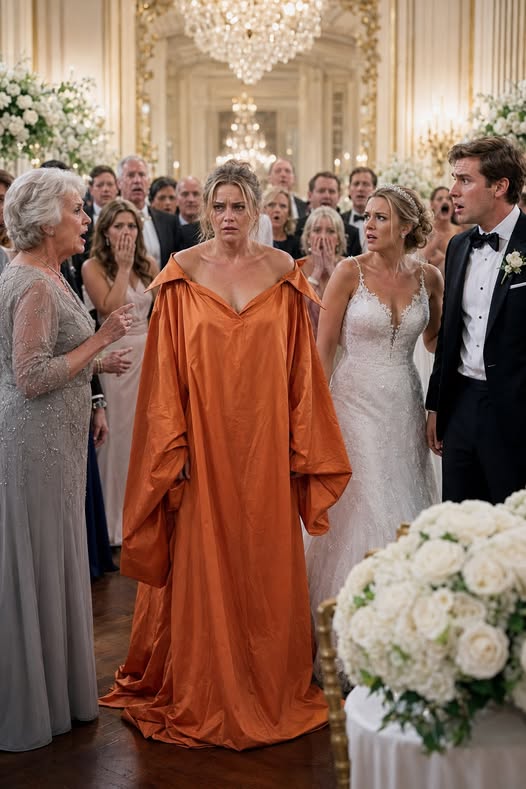
I stared at her, unable to speak.
Her eyes moved down to my dress. Not cruelly. Accurately.
“That is an interesting color.”
“It was the only one left,” I said automatically.
Eleanor’s gaze lifted back to my face.
“No,” she said. “It wasn’t.”
For a second, the hallway seemed to tilt.
She knew.
Not just about the dress. About the staging. About the quiet little humiliations that looked accidental if you didn’t know where to stand.
“I don’t want trouble,” I said.
“Of course you don’t. People who cause trouble often say they want peace. People who have endured trouble often say they don’t want anything at all.”
The words landed somewhere deep.
I looked toward the ballroom. Inside, laughter rose, glasses clinked, music swelled. Madison was probably in the center of it all, glowing beneath chandeliers, wearing ivory silk and my biography.
Eleanor tapped her cane twice on the floor.
“I believe you should stay for the toasts.”
“I should?”
“Yes.” She stood slowly, but nothing about her seemed fragile. “You will want to hear what happens next.”
Then she walked past me toward the ballroom, leaving me in the hallway with my jacket half off the hanger and my chest full of thunder.
I should have left.
Instead, I put the jacket back.
As I returned to the reception, I passed my mother near the bar. She grabbed my wrist.
“What did you say to Madison?”
I pulled my hand back. “I asked why she’s telling people she has my career.”
My mother’s mouth tightened. “The Whitmores have certain expectations.”
I stared at her. “So Madison needed my résumé?”
“She needed to present herself well. You know how these families are.”
“These families?” I laughed once, sharp and humorless. “You mean rich?”
“Lower your voice.”
“No.”
My mother’s eyes flashed. “Madison has told them enough about your issues that they understand why the two of you aren’t close. Don’t prove her right tonight.”
My issues.
There it was.
The label they had given me because I remembered things accurately.
“What did she tell them?” I asked.
Mom looked toward the head table, where Madison was laughing with Grant, her hand resting on his sleeve like she had been born there.
“She said you struggled after Grandma Ruth died.”
“I took care of Grandma Ruth while Madison visited twice.”
“She said grief made you difficult.”
“Difficult?”
“Claire, please. This is the most important day of your sister’s life.”
For a moment, I saw the whole architecture of it.
The orange dress wasn’t just an ugly dress. It was evidence planted against me. If I complained, I was unstable. If I left, I was dramatic. If I stayed quiet, Madison got to stand in front of a wealthy Southern family and become the hardworking, self-made, loyal granddaughter she had never been.
And I became the sister with problems.
My mother walked away before I could say anything else.
At table fourteen, near the kitchen doors, I sat alone. Nobody had used the chair beside me all evening. The place card had been removed, or maybe there had never been one. I watched servers move around me with the careful kindness people reserve for visible disasters.
Grant came over once.
He was handsome in a clean, old-money way, with careful manners and a smile that had probably opened every door Madison wanted.
“Claire,” he said, sitting across from me. “I just wanted to say I appreciate you being here. Madison told me the two of you have had a complicated relationship.”
I looked at him. “She did?”
“She said today might be hard for you. Seeing her happy.”
My throat closed.
Grant reached across the table and touched my hand, kindly, horribly. “It takes courage to show up.”
I pulled my hand back.
He thought I was tragic.
He thought Madison was generous for inviting me.
Before I could decide whether to tell him the truth, the band lowered the music. A man tapped a microphone at the front of the room.
“Toasts in five minutes.”
Grant smiled gently and returned to his bride.
I bent to pick up my phone from beneath my chair. My hand closed around a black silicone case identical to mine. But when I lifted it, the screen lit up with a photo of Madison and my mother in white robes at a spa.
My mother’s phone.
A text preview glowed across the screen.
Madison: Did Claire see the dress yet?
My heart stopped.
Then the screen unlocked.
And I saw everything.
I know what people say about privacy.
I know the decent thing would have been to place my mother’s phone on the table, screen down, and pretend I had not seen the preview. I know that in a kinder family, an accidental glimpse would not become a doorway into a basement full of rot.
But my family had spent the entire day building a lie around me.
So I looked.
The group chat had three names: Mom, Madison, Aunt Linda.
Three weeks earlier, Madison had written:
Did the orange clearance dress arrive?
Aunt Linda: It’s awful. Huge.
Mom: Perfect. She’ll look like she doesn’t belong, which she doesn’t.
Madison: Make sure the photographer keeps her in the back.
Mom: Already handled.
I read the words twice because the first time my mind refused them.
Then I scrolled.
There were messages about the seating chart.
Mom: Put her by the kitchen. Safer.
Madison: Grant’s family knows she’s fragile. I told them enough.
Aunt Linda: Smart. If she complains, everyone will understand.
Fragile.
Safer.
Understand.
My hands began to shake, but not with rage. Rage is hot. This was cold. This was clarity arriving late but fully dressed.
I scrolled farther.
Madison: I told Eleanor about taking care of Grandma Ruth. She loved that.
Mom: Good. Old women love sacrifice stories.
Aunt Linda: Claire won’t say anything. She never does.
Madison: Exactly.
The screen blurred.
Grandma Ruth had moved into my spare bedroom after her second stroke. For three years, I arranged my work around her appointments, learned how to change dressings, read aloud when her vision failed, slept in a chair beside her bed when she was afraid of dying alone.
Madison came twice. The first time she took a selfie in the kitchen and left after twenty minutes because the house smelled like medicine. The second time she cried in the driveway because Grandma Ruth didn’t remember her name.
Now she had handed that devotion to the Whitmores like a wedding favor.
I put the phone face down beside my plate.
Across the ballroom, Madison sat beneath a floral arch at the head table, laughing while Grant’s best man adjusted his notes. My mother stood nearby, smoothing her dress, every inch the proud mother of the bride.
My father sat two seats away from her, silent.
That was his role. The quiet witness. The man who saw and swallowed.
A server placed a salad in front of me. I could not remember ordering food.
“Ma’am?” she asked gently. “Are you okay?”
I looked up. “No.”
She gave the smallest nod, as if she had known that for hours.
Then the microphone squealed.
Grant’s best man told a joke about golf. People laughed. Madison tilted her head back, perfect throat, perfect hair, perfect lie.
Then Grant’s aunt, the woman in pearls, stood and toasted Madison’s “grit,” her “professional brilliance,” her “rare devotion to family.”
Every sentence was stolen.
Every compliment was a photograph Madison had cut my face out of.
I did not stand. I did not interrupt. I sat at table fourteen in the orange dress they had chosen to make me look ridiculous, and I looked toward Eleanor Whitmore.
She was watching Madison.
Not with confusion.
With measurement.
When the aunt finished, the room applauded. Madison pressed her fingers to her lips as if overwhelmed. My mother dabbed at her eyes.
The emcee lifted the microphone again. “And now, before the bride and groom say a few words, Mrs. Eleanor Whitmore would like to make a toast.”
A murmur moved through the room.
Eleanor rose.
She did not walk to the stage. She did not take the microphone. She simply stood from the front family table, lifted one hand to refuse assistance, and began walking.
Not toward Madison.
Toward me.
Conversations died in waves. Forks paused. Glasses hovered. The band stopped playing entirely.
Eleanor crossed the ballroom with slow precision, her cane tapping against polished wood like a judge’s gavel. Tap. Tap. Tap.
When she reached table fourteen, she placed her hand on the empty chair beside me.
“May I?”
I could only nod.
The matriarch of the Whitmore family sat beside the woman in the orange dress, and suddenly the worst table in the room became the only table anyone cared about.
She took my hand.
Her fingers were cool and dry. Her grip was exact.
“Claire,” she said, her voice clear enough to carry without a microphone, “I would like to ask you a question. Not for myself. For my grandson.”
Madison’s smile froze at the head table.
Grant turned.
My mother went pale so quickly I thought she might faint.
Eleanor looked at me.
“Did you care for your grandmother Ruth during the last years of her illness?”
The room held its breath.
“Yes,” I said. “For three years. Until she passed.”
“Did your sister Madison participate in that care?”
I heard my mother make a small sound.
I looked at Madison.
Her eyes begged now. Not for forgiveness. For silence.
“She visited twice,” I said.
The room shifted.
Eleanor nodded once.
“And your education?”
I swallowed.
“Structural engineering. UNC Charlotte. I worked nights waiting tables, then interned, then got licensed.”
“And your company?”
“I co-own Carter & Lane Structural Consulting. Six years this fall.”
Grant stood slowly.
The legs of his chair scraped the floor.
“Madison,” he said, voice low. “You told my family that was your company.”
Madison rose from the head table in a cloud of white silk.
“This is ridiculous,” she said.
But her voice cracked on the last word.
And everybody heard it.
For a moment, Madison tried to smile her way out of the truth.
It had always worked before. Smile at Dad, and the dented car became a misunderstanding. Smile at Mom, and the missing money became stress. Smile at teachers, boyfriends, bosses, relatives, and the world rearranged itself around Madison Carter’s version of events.
But Eleanor Whitmore was not smiling back.
“Mrs. Whitmore,” Madison said, placing one hand lightly over her heart, “I think Claire has misunderstood some private family matters.”
Eleanor’s face did not change. “I asked direct questions. She gave direct answers.”
Grant stepped away from the head table. “Madison. Did you tell Aunt Patricia you were a structural engineer?”
Madison laughed softly. “Grant, people exaggerate at weddings.”
“Did you?”
“It was more complicated than that.”
“No,” Eleanor said. “It was not.”
The room went so quiet I could hear the kitchen doors swing behind me.
My mother moved forward. “Mrs. Whitmore, with all respect, Claire has always been sensitive about Madison’s success. The girls have had a difficult history, and tonight has been emotional for everyone.”
There it was again. The family net, thrown wide. Difficult. Sensitive. Emotional.
Eleanor turned her head slowly toward my mother.
“Diane Carter,” she said, “I made three phone calls before this wedding.”
My mother stopped walking.
Eleanor’s voice remained calm. That made it worse.
“I called the nursing agency that assisted Ruth Carter during her illness. I called the licensing board for professional engineers. And I called Mrs. Helen Price, your former neighbor of thirty-two years.”
My father closed his eyes.
The room seemed to lean in.
“Mrs. Price remembered which granddaughter was there every morning before work,” Eleanor continued. “She remembered which granddaughter learned how to lift Ruth without hurting her. She remembered which granddaughter sat on the porch after the funeral because she had forgotten how to be alone.”
My chest tightened until breathing hurt.
Eleanor’s thumb pressed once against my hand.
Then she said the six words I did not know I had waited my whole life to hear.
“You are not the sister described.”
No microphone. No dramatic music. No shouting.
Just a woman who had paid attention.
Madison’s eyes filled with tears. Beautiful tears. Strategic tears.
“This is insane,” she whispered. “You’re all attacking me at my own wedding.”
“Nobody is attacking you,” Grant said. “I am asking whether you lied.”
“You don’t understand the pressure I’ve been under.”
“What pressure?”
Madison looked around the ballroom, as if searching for someone willing to rescue her. Nobody moved.
“The pressure of being perfect,” she said. “Of having your family expect you to marry well, to look right, to be impressive enough for people like this.”
People like this.
Several Whitmores stiffened.
My mother rushed in. “Madison, honey—”
“No.” Madison’s voice rose. “No, I’m tired of pretending. Do you know what it’s like to watch your own sister become everything you were supposed to be?”
I sat still.
Every eye turned toward me, but I had no words.
Madison pointed at me, her diamond bracelet flashing under the lights. “She acts like she struggled so hard, but everything always worked out for Claire. She got the degree. She got the company. She got Grandma’s gratitude. She got to be the serious one, the smart one, the strong one.”
I laughed once, barely a sound.
Madison flinched.
“You think I got Grandma’s illness as a gift?” I asked.
Her mouth trembled.
“I didn’t say that.”
“You think working nights and studying until my eyes burned was effortless?”
“I said it felt that way.”
“To you.”
That landed.
For the first time all day, Madison looked less like a bride and more like a little girl caught with scissors beside a ruined dress.
Then Eleanor spoke again.
“There are also the debts.”
The word moved through the room like smoke.
Madison’s face emptied.
Grant looked from his grandmother to his bride. “What debts?”
Eleanor released my hand and placed both hands on her cane.
“Credit cards. Personal loans. Two unpaid balances sent to collections. Diane and Robert have been covering portions of them, but not all.”
Grant stared at Madison. “You told me you were debt-free.”
“I was going to fix it.”
“How?”
Madison said nothing.
The answer stood in the room wearing a wedding gown.
By marrying him.
By becoming a Whitmore.
By stealing enough of my life to look worthy of the name.
My father finally stood.
“Madison,” he said weakly. “Tell them it got out of hand.”
She turned on him with such fury that several guests recoiled.
“Don’t you dare act innocent.”
Dad sat back down.
Madison’s mascara had begun to run, two perfect black lines down her cheeks.
“You all made me this way,” she said. “You praised Claire for surviving and praised me for being pretty, then acted shocked when pretty wasn’t enough.”
For one second, I felt something close to pity.
Because there was truth in that, buried under all the damage.
Our parents had built a house where I was useful and Madison was adored. I had become the foundation. She had become the chandelier. Nobody asked if either of us wanted those roles.
But pity is not permission.
Madison lifted the skirt of her gown.
“This was supposed to be my day.”
Her voice broke in a way that might once have made me apologize for existing.
Not anymore.
“It was,” I said. “And you used it to erase me.”
Grant removed his wedding ring.
The ceremony had happened, but the paperwork had not been filed yet. The reception had been a celebration of something still wet, still unsigned, still capable of being stopped.
Madison saw the ring in his palm and gasped.
“Grant.”
“I need the truth,” he said.
“You’re choosing her?” Madison screamed.
“No,” he said. “I’m choosing not to marry someone I don’t know.”
She slapped him.
The sound cracked across the ballroom.
Then Madison turned, gathered her white train in both hands, and ran.
Not gracefully.
Not like a bride in a movie.
She ran like a woman fleeing a collapsing building she had designed herself.
The door shut behind Madison with a soft click.
That was the strangest part. Not a slam. Not a crash. Just a clean little sound that ended a wedding.
For several seconds, nobody moved.
Then the room broke into whispers.
Grant stood with his hand against his cheek, the red print of Madison’s palm slowly blooming on his skin. His best man stepped toward him, but Grant raised one hand to stop him.
My mother stared at the side door as if Madison might come back through it restored, radiant, innocent again.
She did not.
Eleanor stood beside my table. “Claire, you may go, or you may stay. Either choice is yours.”
The word yours almost undid me.
So little of that day had belonged to me. Not the dress. Not the story. Not the way people looked at me. Not even the truth, until Eleanor placed it in the center of the room and refused to let anyone move it.
My father approached table fourteen.
He looked older than he had that morning. Smaller, somehow.
“Claire,” he said. “I should have said something years ago.”
I looked at him for a long moment.
I wanted those words to matter. I wanted them to travel backward, into every Christmas dinner where Madison insulted me and he studied his plate, into every hospital room where I begged for help and he said Madison was busy, into every family photo where I stood at the edge because Madison liked the center.
But words do not time travel.
“Yes,” I said. “You should have.”
His face crumpled.
My mother spun toward me. “Don’t be cruel to your father.”
I turned slowly.
“Cruel?”
She lifted her chin. “This family is falling apart tonight.”
“No,” I said. “It fell apart a long time ago. Tonight people noticed.”
For once, my mother had no answer.
Eleanor placed one hand on the back of my chair. “Diane, your daughter was seated by the kitchen in a dress chosen to humiliate her. Your other daughter stood in my family’s home claiming achievements she did not earn. The collapse did not begin with the woman telling the truth.”
My mother’s mouth opened. Closed.
Grant walked toward us then. His face looked stunned, but not weak. There was grief in him, and embarrassment, but also something steadier.
“Claire,” he said, “I owe you an apology.”
“You didn’t know.”
“I should have asked better questions.”
I almost smiled. “That’s what engineers say after bridges fail.”
He gave a broken laugh, then looked toward the side door. “The marriage license wasn’t filed. My attorney will handle it.”
Behind him, his aunt Patricia had one hand over her mouth. Several guests were already gathering purses, whispering into phones. The band members stood awkwardly near their instruments, men paid to play love songs at a party that had become an investigation.
A catering woman leaned close to me as she cleared plates.
“For what it’s worth,” she whispered, “that was the wildest wedding I’ve ever worked.”
I looked down at the orange fabric sagging around my knees.
“It was the only dress left,” I said.
The woman’s expression softened because she understood I wasn’t speaking to her.
I was speaking to the version of myself who had believed that lie at 8:13 that morning because believing it was easier than admitting my mother and sister had planned to make me look small.
I stood.
One safety pin gave up and dropped to the floor.
The waist loosened completely.
I did not fix it.
Let the dress hang. Let everyone see what had been done. Let orange blaze in the chandelier light like a warning flare.
Eleanor touched my elbow. “You are welcome in this house, Claire Carter.”
My throat tightened.
“Thank you, Mrs. Whitmore.”
“Eleanor,” she said.
That almost made me cry.
My family had spent years teaching me that respect had to be earned through silence. Eleanor gave it to me because she had looked.
I picked up my purse. My mother moved into my path.
“Claire, wait.”
I stopped.
Her eyes were wet now, but I knew those tears. They were not for me. They were for the story she could no longer control.
“Madison is in pain,” she said.
“So was I.”
“She’s your sister.”
“I know.”
“She made mistakes.”
I looked around the room, at the guests, the abandoned champagne, the wedding cake still untouched beneath white roses.
“No,” I said. “A mistake is ordering the wrong centerpiece. This was a plan.”
Mom flinched.
I leaned closer, keeping my voice low.
“You helped her.”
Her tears spilled then.
“I was trying to protect her.”
“You were trying to protect the version of her you preferred.”
My father whispered, “Claire…”
I looked at him.
“If either of you calls me tonight to ask me to comfort Madison, I will block your numbers.”
My mother’s face hardened. “You’ll regret being so unforgiving.”
Something in me went quiet.
“No,” I said. “I think I’ll regret how long I confused forgiveness with letting you use me.”
I walked out through the front doors of the Whitmore estate.
The night air hit my face, humid and sharp with magnolia. Behind me, the reception buzzed with scandal. Ahead of me, the gravel driveway curved under oak trees hung with Spanish moss.
I got in my car and sat there for a full minute.
Then I laughed.
Not because it was funny.
Because the dress filled the driver’s seat like a warning sign, because my mascara was still intact, because somewhere inside a mansion my sister’s wedding had ended not with vows, but with a grandmother saying six words everyone should have said years ago.
You are not the sister described.
I drove north in silence.
Somewhere outside Columbia, I pulled into a gas station, took my overnight bag into the restroom, and changed into jeans and an old gray sweatshirt. I folded the orange dress and placed it on the passenger seat.
Under fluorescent lights, without chandeliers or judgment, it looked even uglier.
Good, I thought.
Let it be ugly.
Some truths are.
The marriage never became legal.
Grant Whitmore’s family moved quickly, quietly, and with the kind of precision only rich people and engineers appreciate. The license stayed unfiled. The vendors were paid. The guests were thanked. No public statement appeared, but Charleston is a city where silence can travel faster than gossip when the right families stop inviting you to dinner.
Madison disappeared for nine days.
My mother called me thirty-two times.
I answered none of them.
On Monday morning, I walked into Carter & Lane Structural Consulting wearing black slacks, steel-toed boots, and the calm of a woman who had survived a controlled demolition.
My business partner, Tessa Lane, looked up from a bridge inspection report.
“How was the wedding?”
I dropped the folded orange dress on the conference table.
Tessa stared at it.
“What in the traffic-cone hell is that?”
“My bridesmaid dress.”
She leaned back. “I’m going to need coffee and the whole story.”
So I told her.
Not all of it. Not the childhood parts. Not yet. But enough. The dress. The lies. Eleanor. The debts. Madison running out. Grant removing the ring.
Tessa listened without interrupting. That was one of the reasons I loved her. She knew when a building was still shaking.
When I finished, she said, “You’re not taking calls from your mother.”
“No.”
“Good.”
Then she opened her laptop. “We have the Pine Ridge pedestrian bridge at ten. Concrete cracking doesn’t care about family drama.”
I almost cried with gratitude.
Work saved me that week.
Steel is either corroded or it is not. Loads transfer or they do not. A beam does not tell you it only failed because you were too sensitive. A column does not ask you to keep quiet because today is your sister’s day.
By Friday, I had blocked my mother, father, aunt, and three cousins.
Madison sent one message from an unknown number.
You destroyed my life.
I stared at it for a long time before typing back.
No. I stopped letting you use mine.
Then I blocked that number too.
Two weeks later, a cream envelope arrived at my office. No return address. Inside was a handwritten note on thick stationery.
Claire,
I hope you are well. Grant is wounded but not ruined. That matters. Truth hurts less than a lifetime of deception.
I have enclosed something that belongs to you.
Eleanor Whitmore
Behind the note was a photograph from the reception.
I expected humiliation.
Instead, I saw myself at table fourteen, orange dress blazing, Eleanor seated beside me, her hand holding mine. Every head in the ballroom was turned toward us. Madison stood in the background, white gown ghostly under the lights, her perfect world cracking around her.
I did not look ridiculous.
I looked visible.
I framed the photo and placed it in the small hallway outside my office, where only people who had reason to come that far would see it.
Tessa noticed immediately.
“Powerful,” she said.
“Ugly dress.”
“Sure. But you’re wearing it like evidence.”
That became the word I kept returning to.
Evidence.
For years, I had treated my memories like accusations I had no right to make. The orange dress changed that. It was physical proof. It hung in my closet for one month because I could not decide whether to burn it, donate it, or mail it back to Madison.
In the end, I took it to a tailor.
The tailor, a blunt woman named Marcy who wore red glasses and kept pins in her sleeve, held it up and said, “Who hated you?”
“My sister.”
“Mm.” She examined the seams. “Bad fabric. Worse intention.”
I laughed.
“What do you want done with it?” she asked.
“Can you make it into something else?”
She looked at me over her glasses. “Honey, that’s my entire job.”
Three weeks later, I picked up a small square pillow covered in orange fabric. Marcy had embroidered one line across the front in navy thread:
NOT THE SISTER DESCRIBED.
I put it on the chair in my office where difficult clients sat.
It became a filter. People who laughed understood me. People who looked uncomfortable usually needed watching.
Then, six weeks after the wedding, Madison and my mother appeared in my office lobby.
Tessa knocked on my door.
“There are two women out front,” she said. “They say they’re your family.”
My stomach tightened, but only for a second.
“Put them in the conference room.”
Madison looked thinner. Her hair was shorter, cut bluntly at her shoulders. She wore no engagement ring. My mother sat beside her, purse clutched in both hands like a shield.
I took the chair across from them.
No hugs. No coffee.
Madison stared at the table.
Mom spoke first.
“We need your help.”
I almost admired the efficiency.
“With what?”
“Eleanor Whitmore respects you,” Mom said. “If you could call her and explain that there were misunderstandings—”
“No.”
Madison looked up.
“You didn’t even hear the whole request.”
“I heard enough.”
Mom’s voice tightened. “Your sister is drowning.”
“I know the feeling.”
Madison’s eyes flashed. “You got what you wanted.”
“What did I want?”
“To be right.”
I leaned back.
“No, Madison. I wanted to attend your wedding in a navy dress, take a few photos, eat cake, and go home. You wanted a stage.”
Her face crumpled, but this time I did not move toward her.
Mom reached across the table. “Claire, please. The debts are worse than we thought. Grant’s family is threatening legal action if Madison used any false financial statements during the engagement. Your father and I can’t cover everything.”
There it was.
Not love. Not apology.
Need.
“You want me to repair the bridge you burned,” I said.
Madison whispered, “I’m your sister.”
I looked at her for a long time.
“I know. That used to be enough to make me abandon myself.”
Her tears fell silently.
“I’m sorry,” she said.
The words were small. Maybe real. Maybe not. I could not tell anymore, and I was tired of spending my life inspecting Madison’s emotions for structural integrity.
“What are you sorry for?” I asked.
She blinked.
“For everything.”
“No. Name it.”
My mother stiffened. “Claire—”
I raised one hand without looking away from Madison.
Madison swallowed.
“For the dress.”
“And?”
“For telling people your career was mine.”
“And?”
“For Grandma.”
My throat tightened.
Madison looked down. “For using what you did for Grandma because I wanted Eleanor to like me.”
“And?”
She began crying harder.
“For making you look unstable so nobody would believe you.”
The conference room went silent.
My mother stared at her.
Maybe that was the first time Madison had ever said the whole shape of it out loud.
I stood.
“I accept that you said it. I am not ready to forgive it. And I will not call Eleanor.”
Mom rose too. “So that’s it? You’ll just abandon us?”
I looked at her.
“No. I’m returning the role.”
After they left my office, I sat alone in the conference room for nearly an hour.
Not because I regretted saying no.
Because peace is unfamiliar when chaos raised you.
Part of me expected sirens. Consequences. Punishment. My mother storming back in. Madison collapsing in the hallway. My father calling with that exhausted voice, asking why I had to make everything harder.
None of that happened.
The building stayed quiet.
Outside the glass walls, Tessa reviewed drawings with an intern. Phones rang. Printers hummed. Life continued without requiring me to bleed into it.
That was the first miracle.
The second came in winter.
Eleanor Whitmore called my office directly.
“I hope this is not unwelcome,” she said.
“It isn’t.”
“I have a project. A foundation issue at an old property near Asheville. I would like your firm to inspect it.”
I smiled despite myself. “Is this charity?”
“No, dear. It is a retaining wall. I do not mix the two.”
We took the job.
The property was an old mountain house with stone terraces stepping down toward a frozen creek. Eleanor met me there in a wool coat, ivory cane in hand, her silver hair tucked neatly under a hat.
Grant was with her.
He looked better than he had at the wedding, though sadness had changed his face in small ways. He shook my hand.
“Claire.”
“Grant.”
For a second, the ghost of that ballroom stood between us.
Then he said, “I’m sorry again.”
“You don’t have to keep apologizing.”
“I know.” He looked toward Eleanor, who was already arguing politely with the property manager. “But I’m still grateful.”
We walked the terraces together as I inspected cracks in the stone, drainage failures, soil movement beneath the retaining wall. Grant listened carefully when I explained load paths and water pressure. He did not pretend to understand more than he did. That alone made him better than most clients.
At the end of the inspection, Eleanor invited me to lunch. I accepted.
We ate tomato soup and grilled cheese in the mountain house kitchen, because Eleanor said expensive food was wasted on cold weather. Grant asked about my company. Eleanor asked about Tessa. Nobody asked about Madison.
That was kindness too.
Months passed.
My father sent a letter in March.
Not a text. Not a voicemail. A letter.
Claire,
I have been a coward in ways that damaged you. I thought silence kept peace, but it only protected the loudest person in the room. I am sorry for every time I watched you be pushed aside and called it family harmony.
I do not expect forgiveness. I am working with a counselor. I hope someday I can earn a conversation.
Dad
I read it three times.
Then I placed it in a drawer.
Not because it meant nothing.
Because it was a beginning, and beginnings do not require immediate access.
My mother did not write.
Madison did, once.
Her letter came six months after the wedding, forwarded from my old apartment even though she knew my office address. That was very Madison—choosing drama when directness would do.
Claire,
I am in a debt program. I’m working at a design showroom. Mom says I should not tell you that because it sounds humiliating, but I think the humiliation was the point. I built a person out of pieces of you because I hated how empty I felt next to you.
I don’t expect you to help me. I don’t expect you to answer.
I just wanted to say Grandma Ruth asked for you because you were there. I know that now. I knew it then too.
I’m sorry.
Madison
I cried after reading it.
Then I did not answer.
Some people think healing means reopening the door the moment someone knocks politely. I no longer believe that. A door can stay closed while you wish the person outside becomes better. That is not cruelty. That is a boundary with a heartbeat.
One year after the wedding, I gave a guest lecture at UNC Charlotte about structural failures.
I stood in front of a room of students and showed slides of cracked beams, overloaded balconies, and buildings that looked beautiful until someone calculated what they were hiding.
At the end, a young woman raised her hand.
“How do you know when something can be repaired and when it has to be demolished?”
The room went still.
I thought of Madison’s wedding. The orange dress. My mother’s phone. Eleanor’s hand around mine. My father’s letter unread in a drawer. Madison trying, maybe, to become someone real from the wreckage.
“First,” I said, “you stop judging it by how it looks from the outside.”
The students wrote that down.
“Then you find out what is carrying the weight. If the foundation is sound, repair is possible. If the foundation was built on lies, you don’t patch the cracks and call it safe.”
A few students nodded.
I clicked to the next slide.
A retaining wall in Asheville. Rebuilt. Reinforced. Drained properly. Still old, still scarred, but standing because the hidden pressure had finally been addressed.
After the lecture, I returned to my office. The orange pillow sat in the client chair beneath the window.
NOT THE SISTER DESCRIBED.
I ran my fingers over the navy stitching.
The dress had not vanished. It had become something else.
So had I.
That evening, I drove to the cemetery where Grandma Ruth was buried. I brought yellow flowers because she had hated roses and said people only bought them when they lacked imagination.
I sat beside her grave as the sun dropped behind the trees.
“You would’ve loved Eleanor,” I said. “Tiny woman. Terrifying. Excellent taste in truth.”
The wind moved through the grass.
I told Grandma about the lecture. About the company. About Dad’s letter. About Madison’s apology sitting unanswered on my kitchen counter.
Then I said the thing I had not admitted to anyone.
“I miss having a family.”
The words hurt less outside my body.
A family is not always the people who share your childhood. Sometimes it is a business partner who makes coffee and says, “Concrete cracking doesn’t care about family drama.” Sometimes it is an eighty-year-old woman who makes three phone calls because something feels wrong. Sometimes it is the version of yourself who finally stops standing at the edge of the photograph.
I visited for an hour.
When I left, I did not feel healed.
I felt honest.
That was enough.
Two years after the wedding, I received a small envelope with no return address. Inside was a photograph.
Madison, in a simple blue dress, standing in front of a community college building. On the back, she had written:
Starting over. No borrowed stories this time.
I stared at it for a long while.
Then I placed it in the same drawer as Dad’s letter.
Not forgiveness.
Not yet.
But not hatred either.
Some structures can be rebuilt only if everyone stops pretending the cracks are decorative.
As for the orange dress, people still ask about the pillow in my office. I tell them it came from a wedding.
If they ask whose wedding, I say, “My sister’s almost-wedding.”
If they ask what happened, I smile.
Then I tell them this:
At her wedding, my sister gave me an orange dress three sizes too big because she wanted everyone to see me as the embarrassment.
But she forgot one thing.
There was a grandmother in the third row who knew the difference between a woman wearing a costume and a family wearing a lie.
And when that grandmother finally spoke, the whole room turned around.
THE END

