The dining room smelled like roast beef, red wine, and lemon polish.
My mother used that polish only when she wanted the house to look perfect enough to make people forget what kind of family lived inside it.
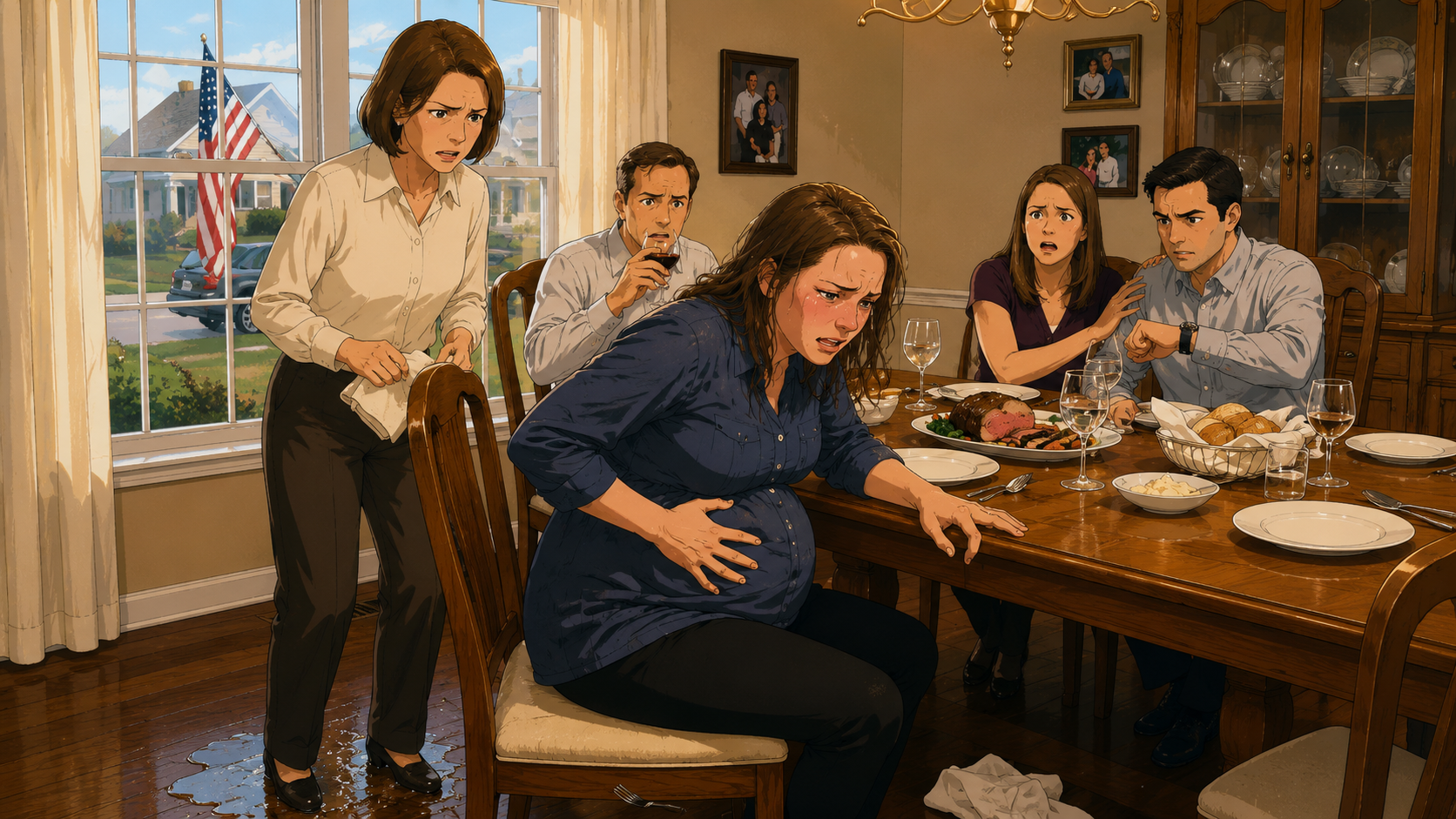
The oak table shone under the chandelier.
Image
The china sat in careful rows.
The white table runner was pressed flat enough to pass inspection.
Outside, the September heat still clung to the windows, and the small American flag on my parents’ porch barely moved in the thick evening air.
Inside, my lower back tightened for the third time in twenty minutes.
I told myself it was nothing.
I was thirty-seven weeks pregnant, and every article, nurse, and older woman in a grocery store had warned me that late pregnancy was one long false alarm.
But this did not feel false.
It felt deep.
It felt rhythmic.
It felt like my body had started a countdown no one else in that room wanted to hear.
My name is Penelope.
For most of my life, I was the daughter people praised because I did not ask for much.
That sounds like a compliment until you realize it usually means no one offered much either.
My younger sister Valerie was the fragile one.
That was the story my parents told until it became the law of the house.
Valerie was sensitive.
Valerie needed support.
Valerie had a hard time with pressure.
Valerie could not be upset.
I was sturdy.
I was understanding.
I was independent.
I was the kind of child teachers called mature while my mother smiled proudly, never noticing that maturity had been forced on me like a job.
When we were young, I packed my own lunches while my mother brushed Valerie’s hair.
I signed my own permission slips because Dad was busy taking Valerie somewhere.
I learned to wait after school without calling home because if Valerie had a problem, everyone else became background noise.
By high school, I knew how to make doctor appointments, argue with insurance billing, and pretend it did not hurt when my parents forgot events they had promised to attend.
A child does not become low-maintenance because she is fine.
She becomes low-maintenance because needing things does not work.
When I found out I was pregnant, I did not expect my parents to transform into warm, dependable people.
I was not naive.
Still, some foolish little part of me hoped a baby might soften them.
Not toward me, maybe.
But toward the child.
I bought a plain notebook and wrote down appointment dates.
I taped the after-hours OB number to my refrigerator.
I packed my hospital bag at thirty-five weeks and put it near my apartment door.
Inside were two nursing bras, a phone charger, a soft gray robe, baby socks, insurance paperwork, and a folded birth plan I had printed even though I knew plans were fragile things.
At my last appointment, the nurse circled three instructions on my discharge sheet.
Monitor contractions.
Call if water breaks.
Go to the hospital if pain intensifies.
I took a photo of the page at 10:12 a.m. in the parking lot because I had learned long ago to document things for myself.
Proof matters when people are good at pretending they never heard you.
That Friday morning, my mother called before I had finished my toast.
“You need to be here tonight,” she said.
No hello.
No how are you feeling.
Just need.
“Tonight?” I asked.
“Yes. Valerie is bringing Dominic to dinner.”
I knew his name because Valerie had mentioned him at least seven times in the family group chat.
Dominic was successful.
Dominic had investors.
Dominic knew people.
Dominic had taken Valerie to a restaurant where the menu did not list prices, which my mother considered a personal achievement.
“Mom, I’m thirty-seven weeks,” I said.
“That is not the same as being in labor.”
“I’ve been tired.”
“Everyone is tired, Penelope. This is important.”
There it was.
The old family scale, placed on the table again.
Valerie’s dinner on one side.
My body on the other.
I should have said no.
Instead, I said, “I’ll try.”
My mother sighed as if I had already disappointed her.
“Don’t try. Be there.”
At 5:18 p.m., I felt the first real pull in my lower back while standing in my apartment kitchen.
I remember the time because I wrote it in my phone.
At 5:41 p.m., another one came.
At 6:03 p.m., I texted my mother: I don’t feel great. Maybe I should stay home.
She answered at 6:05 p.m.
Don’t start. Valerie needs support tonight.
I stood there looking at the message until the screen went dark.
Then I changed into a blue maternity blouse, slid my feet into flat sandals, and drove to the house where I had spent most of my childhood learning not to be a problem.
My parents lived in a neat suburban neighborhood with trimmed lawns, porch lights, and mailboxes painted in colors approved by people who cared too much about curb appeal.
Their driveway was already full.
Valerie’s SUV sat crooked near the garage.
Dominic’s black sedan was parked closest to the front walk.
It looked like a man who had arrived and been told he mattered more than everyone else.
My father opened the door with a wineglass in his hand.
“Hey, kiddo,” he said, distracted already.
He had not called me kiddo since I was twelve unless there was company around.
“Hi, Dad.”
His eyes flicked to my belly.
“Still hanging in there?”
“Trying.”
“Good, good. Your mother’s in the dining room.”
He turned away before I could say anything else.
The dining room looked staged.
Candles.
Good china.
Polished silver.
A roast beef platter steaming in the center of the table.
My mother stood by the sideboard in a cream blouse, hair sprayed into place, carving knife ready like she was hosting a magazine spread instead of dinner with her pregnant daughter.
Valerie sat beside Dominic, laughing too brightly.
Dominic sat at the head of the table.
My father’s seat.
Nobody acknowledged that this was strange.
Dominic had expensive shoes, a sharp watch, and the kind of smile that made every sentence sound like a pitch.
He looked me over quickly, then returned his attention to Valerie.
My mother gave me a tight smile.
“Penelope, finally.”
“I’m sorry. I had to stop twice.”
“For what?”
I placed a hand on my belly.
“Contractions, maybe.”
Her smile vanished.
“Please don’t do this tonight.”
That was my greeting.
Not concern.
Not fear.
Not sit down, let me time them.
Please don’t do this tonight.
I sat at the far end of the table because that was the only chair left.
A ghost at the edge of my own family.
Dinner began with Dominic explaining his company.
The details washed past me.
Seed funding.
Retail partnerships.
Expansion.
Projected rollout.
My father nodded so hard it was embarrassing.
My mother leaned toward Dominic as if his words were scripture.
Valerie kept touching his arm and looking around to see whether everyone noticed she was attached to him.
I took two bites of potatoes and stopped.
The tightening in my back moved around to the front.
It wrapped low across my belly.
I set down my fork.
My mother saw the movement.
“Penelope.”
I looked up.
“Can you please not fidget?” she said. “Dominic is explaining something important.”
“I’m trying not to.”
Dominic gave a polite little chuckle.
“Pregnancy timing, right?”
No one laughed much, but my mother smiled like he had been gracious.
Another contraction came.
This one made the room narrow.
I gripped the edge of the table with both hands, and the fork beside my plate rattled against the china.
The sound was tiny.
It still seemed to cut through everything.
Dominic stopped speaking.
Valerie stared at me with irritation, not worry.
My father sighed.
My mother’s eyes sharpened.
“I think these are real,” I said.
“Real what?” Valerie asked.
“Contractions.”
“You said that already,” my mother said.
“I know, but they’re closer now.”
My father took a sip of wine.
“Should we time them?” he asked, but without moving.
My mother shot him a look.
“No. We are not turning dinner into a spectacle.”
Spectacle.
That word landed in me harder than the pain.
I had spent my whole life making myself small enough not to embarrass them, and even labor was somehow being treated like bad manners.
Dominic cleared his throat.
“As I was saying, the national rollout is projected for Q3.”
Then my body answered for me.
A contraction tore through so hard I gasped out loud.
Not a delicate sound.
Not a controllable one.
A raw sound that came from somewhere below language.
The chair scraped backward.
My mother slammed her hand softly on the table, not loud enough to seem rude to Dominic, just loud enough to warn me.
“Penelope, enough.”
“I can’t stop it.”
“You’re making everyone uncomfortable.”
“I’m in pain.”
Valerie whispered, “Oh my God.”
She said it like I had spilled wine, not like I might be giving birth.
For one ugly heartbeat, I imagined grabbing the gravy boat and throwing it straight into the wall.
I imagined the crash.
The stain.
The perfect room finally looking as broken as it felt.
Then I breathed through my teeth and did nothing.
Because rage would have given them a story they liked better.
They would have talked about my temper instead of their cruelty.
The next sensation was different.
A sudden pressure.
A pop deep inside me.
Then warmth.
Too much warmth.
I looked down as fluid spread across the chair and onto the hardwood floor.
For a second, no one spoke.
The table froze.
My father’s glass hovered halfway to his mouth.
Valerie’s hand stayed on Dominic’s sleeve.
Dominic looked down, then at his watch, as if he had a meeting to reschedule.
A drop of gravy slipped from the serving spoon and stained the white runner.
The chandelier hummed.
The candles kept burning.
My mother looked at the puddle first.
Not at me.
Not at my belly.
At the floor.
“My water just broke,” I said.
My voice shook, but it carried.
“I’m about to give birth. I need to go to the hospital right now.”
My mother’s face tightened with fury.
“Are you kidding me?”
I stared at her.
“Mom.”
“Right now?” she snapped. “During this discussion?”
“I’m in labor.”
Another contraction hit before I finished the sentence.
My knees bent.
I caught myself on the chair.
“I need a ride to the medical center. Please.”
My father leaned back as if distance could make the problem smaller.
“Penelope, calm down.”
“I can’t calm down. The baby is coming.”
Dominic said nothing.
Valerie looked down at her plate.
My mother grabbed a napkin and threw it toward the floor.
“This is exactly what I was afraid of,” she said.
“What?” I asked.
“You always find a way to pull attention.”
The room went so still I could hear my own breath.
Attention.
That was the word.
Not danger.
Not emergency.
Not baby.
Attention.
Some families abandon you loudly.
Mine did it with good china on the table and a roast going cold between us.
“Dad,” I said.
My voice broke on the word, and I hated that it did.
“Please drive me.”
He looked at my mother first.
That was when I knew.
Before he spoke, I knew.
He took one slow sip of wine, set the glass down, and looked at me like I was an inconvenience he had paid for long enough.
“Call a cab, Penelope,” he said. “We’re busy.”
The sentence did not explode.
It settled.
That was worse.
It landed in the room and no one challenged it.
Valerie did not say, Dad.
My mother did not say, Gregory, stop.
Dominic did not offer his car.
They all sat there, waiting for me to become manageable again.
I remember thinking that the baby and I were safer with strangers.
That thought should have terrified me.
Instead, it clarified everything.
I picked up my purse.
My hands were shaking so badly I nearly dropped my phone.
My hospital bag was still at my apartment.
My birth plan was still on my kitchen counter.
My charger, baby socks, robe, and paperwork were all by the door I should never have left.
At 7:41 p.m., I called the hospital intake desk from my parents’ dining room.
The nurse asked me how far along I was.
“Thirty-seven weeks.”
“How far apart are contractions?”
“I don’t know. Close.”
“Has your water broken?”
“Yes.”
“Are you alone?”
I looked at my mother wiping the floor.
I looked at my father staring into his wine.
I looked at my sister pretending not to hear.
“Yes,” I said.
That was the first honest answer I had given all night.
The nurse told me not to drive if I could avoid it.
I almost laughed.
Avoiding it required people who cared.
I made it to the front door during the next contraction.
My mother called after me, “Do not make this dramatic.”
I turned just enough to see her standing in the dining room doorway with a wet napkin in her hand.
“You already did,” I said.
Then I walked out.
The porch flag blurred in my vision.
The air outside was thick and hot.
I lowered myself into my car, pulled the seat belt under my belly the way the childbirth class video had shown, and drove with both hands locked at the bottom of the wheel.
Every red light felt personal.
Every bump in the road sent pain through my hips.
I breathed in counts because the nurse on the phone told me to.
Four in.
Six out.
Again.
Again.
At the ER entrance, I could not stand up straight.
A security guard saw me half-fall out of the driver’s seat and ran for a wheelchair.
“Ma’am, are you in labor?”
“Yes.”
“Anyone with you?”
“No.”
His expression changed.
Not pity exactly.
Recognition.
He had seen enough emergencies to know what it meant when a woman arrived alone, soaked, shaking, and trying too hard not to cry.
Inside, the lights were bright and cold.
Someone put a hospital wristband on me.
Someone else took my blood pressure.
A nurse cut the damp hem of my blouse because I could not lift my arms through the pain.
The hospital intake form asked for an emergency contact.
I stared at the blank line.
My mother’s number had been there for years.
So had my father’s.
I had kept them listed out of habit, the way people keep old keys that no longer open anything.
“Ma’am?” the intake nurse asked gently.
I gave her the name of my neighbor, Mrs. Alvarez, a retired teacher who had brought me soup twice during my pregnancy and once changed a lightbulb in my hallway without making me feel helpless.
The nurse wrote it down.
Then she circled no family present at intake in blue ink because I asked her to document it.
I do not remember every hour after that.
Labor took the room apart and rebuilt it around pain.
I remember a nurse holding my hand through one contraction.
I remember the monitor beeping.
I remember asking once whether the baby was okay.
I remember someone saying, “Baby is doing fine. You’re doing great.”
No one in my family had ever said those words to me with that much certainty.
At 2:36 a.m., my child was born.
The room changed.
Not because everything became easy.
It did not.
I was exhausted, shaking, stitched, and terrified.
But when that tiny body was placed against my chest, warm and furious and alive, a new truth settled over me.
I had spent my life being trained to accept crumbs.
My child would not be raised under the same table.
I did not call my parents.
I did not text Valerie.
I did not send a photo to the family group chat.
By 9:15 a.m., I had spoken to the hospital social worker.
By 10:02 a.m., I had changed my emergency contact form.
By 10:27 a.m., I had asked about visitor restrictions.
The hospital used plain language, which I appreciated.
Approved visitor list.
Restricted access.
Patient request.
No information by phone.
Those phrases felt cold, but they were warmer than my family had been.
On the second day, my phone filled with nothing.
No missed calls from Mom.
No apology from Dad.
No message from Valerie asking whether I had survived the drive.
Dominic, naturally, did not exist outside that dinner.
Mrs. Alvarez came by with a clean robe, my charger, and the hospital bag from my apartment.
She had used the spare key I had given her for emergencies.
Real care is not always dramatic.
Sometimes it is an older woman standing in a hospital doorway holding your slippers and pretending not to cry.
“You should not have been alone,” she said.
“I know.”
“Do they know?”
“No.”
She looked at the baby sleeping against my chest.
“Good.”
That single word gave me permission I had not known I needed.
On day three, a hospital photographer came by.
I declined the family package.
On day four, I signed the discharge papers.
On day five, I slept for almost two hours while Mrs. Alvarez folded tiny onesies on my couch.
On day six, Valerie finally texted.
Mom says you’re being weird. Did you have the baby?
I looked at the message for a long time.
Then I deleted it.
On day seven, my mother knocked on my front door.
I knew it was her before I opened it.
Not because of the knock.
Because my whole body went still.
Some children hear their mother at the door and feel home.
I heard mine and felt evidence arriving.
When I opened the door, Beatrice stood on my porch with her hair done, lipstick perfect, and a small pink gift bag hooked over her wrist.
Behind her, my father stood near their SUV with his arms folded.
He looked annoyed, like he had been dragged to a store return.
My mother smiled past me into the hallway.
“Let me see the baby.”
No apology.
No are you okay.
No I was wrong.
Just access.
I kept one hand on the doorframe.
“What baby?” I asked.
Her smile tightened.
“Penelope.”
I looked at her carefully.
The gift bag swung from her wrist.
Pink tissue paper peeked from the top.
It looked cheerful in a way that made me almost angry.
“Don’t be dramatic,” she said. “Move aside.”
My father stepped closer.
“Come on, Penny. Your mother wants to meet her grandchild.”
There it was again.
Want.
As if wanting had ever been the same as loving.
I reached to the little table beside the door and picked up the discharge folder.
It was not a weapon.
It was better than that.
It was a record.
My name was printed on the label.
My admission time was stamped 8:06 p.m.
The intake note was copied inside.
No family present at intake.
I opened the folder and turned it toward my mother.
Her eyes landed on the circled line.
For the first time that week, she had nothing ready to say.
My phone buzzed in my pocket.
The voicemail transcription from the hospital social worker appeared on the lock screen.
Visitor restriction confirmed.
My mother saw those words before I tilted the screen away.
“What is that?” she asked.
“A boundary.”
My father’s face changed.
“Penelope, don’t start using official words like that.”
“I learned them at the hospital.”
My mother swallowed.
“You kept us from the baby?”
“No,” I said. “You did that.”
Her gift bag slipped from her fingers and hit the porch boards.
Tissue paper spilled out.
A tiny yellow outfit slid halfway into view.
For a second, none of us moved.
Then my father said, “We made one mistake.”
I almost laughed.
One mistake.
A lifetime of being second place, reduced to one mistake because this time there was a witness small enough for them to want.
“You told me to call a cab while I was in labor,” I said.
“We didn’t realize it was serious,” he said.
“My water broke on your floor.”
My mother flinched at the word floor, and that told me everything.
Even now, part of her was thinking about the oak.
“I was upset,” she said.
“So was I.”
“You embarrassed me in front of Dominic.”
I stared at her.
That was the moment any last soft place in me closed.
Not loudly.
Not dramatically.
Just closed.
My baby made a small sound from the bedroom.
My mother’s eyes lit up.
She moved forward without thinking.
I shifted my body into the doorway.
“No.”
She stopped.
“I am your mother.”
“I know.”
“You cannot keep my grandchild from me.”
“I can keep my child from people who left me alone in an emergency.”
My father stepped onto the bottom porch step.
“Watch your tone.”
I turned to him.
For years, that sentence had worked on me.
It had made me smaller in kitchens, hallways, restaurants, and holiday gatherings.
That day, it hit the new version of me and fell straight to the ground.
“No,” I said.
His eyebrows lifted.
“No?”
“No.”
The baby cried again, louder this time.
My mother put one hand over her mouth.
“Please,” she whispered.
It was the first soft word she had given me since before dinner.
I wanted it to matter.
That was the painful part.
Some injured places inside you still lean toward the person who hurt them.
But love without safety is just another trap with better lighting.
“You can write me a letter,” I said.
“A letter?”
“Yes. You can write down exactly what happened that night. Not your version. The truth. You can write what Dad said. You can write what you did. You can write why you thought Dominic’s pitch mattered more than my labor.”
My father scoffed.
“This is ridiculous.”
“Then don’t do it.”
My mother looked between us.
“And if we do?”
“Then I’ll read it.”
“And then?”
“Then I’ll decide what is safe for my child.”
She stared at me as if I had become someone unfamiliar.
Maybe I had.
Maybe the glass child had finally shattered, and what stood in the doorway was not sharp because she wanted to cut anyone.
She was sharp because she had survived being stepped on.
My father muttered something under his breath and turned toward the SUV.
My mother did not move.
The porch was bright.
The little flag near the railing fluttered once in a weak breeze.
My baby cried again from the bedroom, and every cell in my body turned toward that sound.
My mother heard it too.
Her face crumpled.
“Penelope,” she said. “I’m sorry.”
I had imagined those words for years.
I had thought they would feel like rain after drought.
Instead, they felt like a receipt printed after the store had closed.
“I hope you mean that,” I said.
Then I picked up the pink gift bag, handed it back to her, and closed the door before she could use my child’s cry to walk over the line I had finally drawn.
On the other side, my mother sobbed once.
My father told her to get in the car.
I stood with my palm flat against the door until their engine started.
Then I went to my baby.
The room smelled like clean cotton, baby shampoo, and the coffee Mrs. Alvarez had left on my dresser.
My child’s face was red with outrage, tiny fists waving like the world had already disappointed them.
I laughed through tears.
“I know,” I whispered. “I know.”
I picked my baby up and held that small warm body against my chest.
A week earlier, an entire dining room had taught me exactly how alone I was.
But that morning, in my little apartment with laundry on the chair and hospital papers on the table, I finally understood something else.
Being alone with the truth is better than being surrounded by people who only love you when you are useful.
My parents did write the letter.
It came nine days later.
My father’s part was short, defensive, and mostly about stress.
My mother’s was longer.
For once, she wrote the actual sentence.
Gregory told you to call a cab while you were in labor, and I let him.
I read it three times.
Then I put it in the discharge folder with the hospital intake notes, the visitor restriction form, and the paper where the nurse had circled no family present.
Not because I planned to punish them forever.
Because memory has a way of getting edited by people who need forgiveness without accountability.
Months passed.
They met the baby eventually.
Not alone.
Not at my apartment.
Not while pretending nothing happened.
They met my child in a public park on a Saturday morning, with Mrs. Alvarez beside me on a bench and clear rules spoken before they got close.
My mother cried when she saw the baby.
My father looked older than I remembered.
Valerie sent one apology text and then disappeared into her own life, which was probably the most honest thing she had ever done.
Dominic did not become family.
That surprised no one.
The first visit lasted twenty minutes.
The second lasted thirty.
Sometimes my mother slipped and tried to make herself the wounded one.
Sometimes my father acted like a man doing community service instead of repair.
When that happened, I ended the visit.
Calmly.
Every time.
Because boundaries do not have to roar to be real.
They just have to hold.
I still have the dining room in my memory.
The roast beef smell.
The chandelier hum.
The fork rattling against china.
My father’s wineglass halfway raised.
My mother looking at the floor before she looked at me.
For a long time, that scene hurt like an open door to a house I could never make warm.
Now it feels like something else.
A record.
A beginning.
The night my water broke on polished hardwood was the night I stopped begging to be chosen by people who had already shown me their answer.
And when my child is old enough to ask about family, I will not teach them that blood is thicker than water.
I will teach them the truth I learned the hard way.
Water can break.
So can silence.
And sometimes, what is born after that is stronger than the family that refused to show up.
THE PHOTOGRAPH IN THE DISCHARGE FOLDER
Three months after my daughter was born, life finally started to feel quiet again.
Not easy.
Just quiet.
The kind of quiet that comes after a storm has taken everything it wanted and finally moved on.
The hospital discharge folder still sat inside my kitchen drawer.
The same folder.
The same one I carried home from the hospital.
The same one that contained the intake forms, visitor restriction paperwork, and the note that read:
No family present at intake.
I had almost thrown it away a dozen times.
But I never could.
Because some documents aren’t paperwork.
They’re proof.
Proof that what happened actually happened.
Proof that I wasn’t exaggerating.
Proof that memory wasn’t rewriting itself.
My parents and I had settled into something that looked like peace from a distance.
Careful visits.
Public places.
Short conversations.
Boundaries.
Always boundaries.
My mother still hated them.
My father still pretended not to understand them.
But they followed them.
Mostly.
The baby was healthy.
Happy.
Growing faster than seemed fair.
Some mornings I would look at her sleeping in her crib and feel overwhelmed by how much my life had changed because one tiny person existed.
Then there were the moments I remembered that dinner.
The chandelier.
The roast beef.
The puddle on the hardwood floor.
My father telling me:
“Call a cab, Penelope. We’re busy.”
The memory didn’t hurt the way it used to.
Not anymore.
Now it felt like a scar.
Still there.
But healed.
Or so I thought.
Then came the rain.
A slow Tuesday afternoon.
The baby was asleep.
Mrs. Alvarez had taken the day to visit her sister.
And I finally decided to clean the kitchen junk drawer.
The drawer every adult owns.
The one filled with batteries, takeout menus, old receipts, spare keys, instruction manuals, and things too important to throw away but not important enough to organize.
Halfway through cleaning, I found the hospital folder.
I smiled.
Shook my head.
Then pulled it out.
The folder slipped from my hands immediately.
Papers scattered across the floor.
“Perfect.”
I knelt down.
Started gathering forms.
Insurance paperwork.
Discharge instructions.
Emergency contact updates.
Everything exactly where I remembered it.
Then something fell out.
Something that definitely wasn’t supposed to be there.
A photograph.
Small.
Glossy.
Folded between two sheets of discharge paperwork.
I frowned.
Because I had never seen it before.
Slowly, I picked it up.
Then my stomach tightened.
Hard.
Because the photograph showed me.
Asleep.
In my hospital bed.
My newborn daughter resting against my chest.
The hospital blanket pulled up to my waist.
I stared at it.
Confused.
Because I never bought hospital photographs.
Then I noticed something else.
Someone standing beside the bed.
A nurse.
That made sense.
Then I noticed the woman.
The woman standing in the corner.
The woman nobody had mentioned.
Dark hair streaked with gray.
Blue sweater.
Maybe sixty years old.
Maybe older.
Not smiling.
Not posing.
Just watching.
Watching me.
Watching my baby.
My pulse quickened.
Because I had absolutely no idea who she was.
Then I turned the photograph over.
And immediately wished I hadn’t.
Because written across the back in shaky handwriting were seven words.
I found her. Don’t tell Beatrice.
The room disappeared.
Completely.
Because Beatrice was my mother.
And somebody had been in my hospital room.
Somebody who knew who I was.
Somebody who knew my mother.
Somebody who apparently didn’t want my mother to know they had found me.
The rain tapped softly against the kitchen window.
My daughter slept peacefully down the hall.
And suddenly…
For the first time since leaving the hospital…
I didn’t feel alone in that room anymore.
Because somebody else had been there.
Watching.
Waiting.
And somehow…
I had a feeling this photograph wasn’t left in my folder by accident.
Then my phone buzzed.
A text message.
Unknown number.
My heart skipped.
Slowly…
I opened it.
And froze.
Because the message contained only one sentence.
One sentence that made my blood run cold.
THE TEXT MESSAGE
The room disappeared.
Completely.
My heart slammed against my ribs.
The rain tapped softly against the kitchen window.
My daughter slept peacefully down the hall.
And my phone screen glowed in my hand.
One message.
One sentence.
Seven words.
You finally found the photograph.
I stared at it.
Again.
And again.
And again.
Unknown number.
No name.
No profile picture.
Nothing.
Just that message.
The photograph lay on the kitchen table beside me.
The woman in the blue sweater staring silently from the corner of my hospital room.
Watching.
Waiting.
Knowing.
My stomach tightened.
Because suddenly one question became impossible to ignore.
How did they know I found it?
Then another text appeared.
Before I could think.
Before I could breathe.
Before I could decide whether to answer.
The phone buzzed again.
I wondered how long it would take.
The room froze.
Because this wasn’t random.
Whoever sent these messages knew exactly what photograph I was holding.
Then my fingers moved before my brain could stop them.
I typed:
Who is this?
Three dots appeared immediately.
They had been waiting.
Watching.
Then the reply arrived.
Someone who promised to keep watching over you.
My pulse exploded.
What?
Then another message.
Even when I wasn’t allowed to.
The rain suddenly sounded louder.
The apartment suddenly felt smaller.
Because somehow…
I knew.
This wasn’t a scam.
This wasn’t a prank.
This was personal.
Very personal.
Then I typed again.
Who are you?
Long silence.
Thirty seconds.
One minute.
Two.
Then the phone buzzed.
A photograph arrived.
Old.
Very old.
Black and white.
My hands started shaking immediately.
Because the young woman in the picture looked familiar.
Not familiar like someone from television.
Not familiar like a neighbor.
Familiar like family.
Then I looked closer.
And my blood ran cold.
Because the young woman looked exactly like my mother.
Not similar.
Exactly.
Same eyes.
Same smile.
Same face.
Except younger.
Much younger.
Then I noticed something strange.
Written beneath the photograph were two names.
Beatrice Harper
And underneath it…
Eleanor Harper
The world stopped.
Completely.
Because my mother’s name was Beatrice Harper.
But I had never heard the name Eleanor.
Not once.
Not ever.
Then the next message arrived.
Your mother never talks about her sister.
My stomach dropped.
Hard.
Because my mother didn’t have a sister.
At least…
I didn’t think she did.
Then another message.
She told everyone Eleanor died.
The room disappeared.
Because suddenly the woman in the hospital photograph had a name.
Eleanor.
Then the final message arrived.
The message that made my blood run cold.
The message that changed everything.
Eleanor didn’t die.
Silence.
Absolute silence.
Then:
She’s the woman who held you the day you were born.
The room froze.
Because suddenly…
The mystery wasn’t about the hospital anymore.
It was about my mother.
And a sister she had erased from existence.
THE SISTER WHO NEVER EXISTED
The room became silent.
Terrifyingly silent.
The rain tapped softly against the kitchen window.
My daughter slept peacefully in her crib.
And I sat frozen at the kitchen table.
Staring at my phone.
Staring at the photograph.
Staring at the name.
Eleanor Harper.
My mother’s sister.
A woman I had never heard about.
Not once.
Not in childhood.
Not during holidays.
Not during birthdays.
Not during family stories.
Nothing.
It was as if she had never existed.
Then my phone buzzed again.
Another text.
You should ask Beatrice about the lake.
The room froze.
The lake?
What lake?
Before I could type a response, another message appeared.
Ask her what happened when she was sixteen.
My pulse exploded.
Because suddenly this wasn’t just a family secret.
It was a specific memory.
A specific event.
Then another message.
She’ll lie first.
A pause.
Then:
Keep asking.
The screen went dark.
No more messages.
No explanation.
Nothing.
Just silence.
The kind of silence that leaves questions behind.
Then I looked back at the photograph.
The young woman smiling beside my mother.
The woman who supposedly died.
The woman who apparently held me when I was born.
Then a memory surfaced.
Small.
Forgotten.
Buried.
I was ten years old.
Helping my mother unpack Christmas decorations.
A cardboard box slipped from the shelf.
Photographs spilled everywhere.
I remembered picking one up.
A picture of two teenage girls standing beside a lake.
My mother snatched it from my hand immediately.
Immediately.
Then she said something strange.
Something I hadn’t thought about in years.
“Some memories are better left buried.”
At the time it meant nothing.
Now?
Now it meant everything.
Then my daughter cried from the nursery.
The sound pulled me back.
Back to reality.
Back to the present.
Back to the life I’d built.
I picked her up.
Held her against my shoulder.
And suddenly realized something.
If someone erased my daughter from history…
I would tear the world apart looking for her.
Which meant…
Either Eleanor wasn’t dead.
Or my mother had done something so terrible she couldn’t bear to speak about it.
Neither possibility felt good.
Then my phone rang.
My heart jumped.
Unknown number.
Again.
Slowly…
I answered.
“Hello?”
Silence.
Breathing.
Soft breathing.
Then a woman’s voice.
Older.
Gentle.
Shaking.
Then:
“Penelope?”
My stomach dropped.
Because somehow…
I already knew.
Then the woman whispered:
“You have your grandmother’s voice.”
The room froze.
“What?”
A sob escaped the line.
Then:
“Oh God.”
Another sob.
Then:
“I never thought I’d hear your voice.”
My pulse hammered.
Then I whispered:
“Who are you?”
Silence.
Long silence.
Then the woman answered.
The answer that changed everything.
“My name is Eleanor.”
The world stopped.
Completely.
Because the woman my mother claimed was dead…
Was talking to me.
Right now.
Then Eleanor whispered:
“Before you ask your mother anything…”
A pause.
Then:
“There’s something you need to know.”
My stomach tightened.
Hard.
Because every secret started with those words.
Then Eleanor took a shaky breath.
And said the sentence that made my blood run cold.
The sentence that changed everything.
The sentence that guaranteed there was no turning back.
“The baby your mother lost wasn’t hers.”
The room disappeared.
Because suddenly…
The story wasn’t about Eleanor.
It wasn’t about the lake.
And it wasn’t about the photograph.
It was about a baby.
A baby connected to my mother.
A baby connected to me.
A baby nobody had ever talked about.
THE BABY WHO CHANGED EVERYTHING
The room disappeared.
Completely.
My daughter slept against my shoulder.
The rain tapped softly against the windows.
And Eleanor’s voice trembled through the phone.
One sentence echoed inside my head.
Again.
And again.
And again.
“The baby your mother lost wasn’t hers.”
My pulse hammered.
Because suddenly nothing made sense.
“What does that mean?”
Silence.
Long silence.
Then Eleanor sighed.
The sound carried decades of exhaustion.
Decades of secrets.
Decades of regret.
Then she whispered:
“Your mother never told you about me because if she talked about me…”
A pause.
Then:
“She would have to tell the truth.”
The room froze.
“What truth?”
Another pause.
Then Eleanor said something that made my blood run cold.
“The truth about the summer at Lake Ashwood.”
The lake.
Again.
Always the lake.
Then I sat down slowly.
My daughter sleeping peacefully against my chest.
Completely unaware that her mother was discovering an entirely different family history.
Then Eleanor continued.
“I was seventeen.”
A pause.
“Beatrice was sixteen.”
Then:
“And we spent every day at that lake.”
My stomach tightened.
Because suddenly this wasn’t an old family story.
It was the beginning of one.
Then Eleanor’s voice cracked.
“That was the summer everything broke.”
The rain sounded louder.
The apartment felt smaller.
Then she whispered:
“I got pregnant.”
Silence.
Absolute silence.
Then:
“Our parents were furious.”
Another pause.
Then:
“Especially our father.”
The room froze.
Because suddenly I could picture it.
Small-town gossip.
Family shame.
Fear.
Then Eleanor continued.
“When the baby was born…”
A pause.
Then:
“I wasn’t allowed to keep her.”
The world stopped.
Completely.
Because suddenly…
The baby wasn’t my mother’s.
The baby belonged to Eleanor.
Then Eleanor started crying.
Not loudly.
Not dramatically.
The quiet crying of someone remembering the worst day of her life.
Then she whispered:
“They told everyone the baby died.”
My pulse exploded.
What?
Then:
“She didn’t die.”
The room disappeared.
Because suddenly there was another child.
Another missing child.
Another secret.
Then Eleanor said the sentence that made my blood run cold.
“Beatrice took her.”
Silence.
Absolute silence.
I couldn’t breathe.
Because Beatrice wasn’t a child.
She wasn’t a victim.
She wasn’t a bystander.
She took the baby.
Then Eleanor whispered:
“She thought she was helping.”
A pause.
Then:
“At least that’s what she told herself.”
The tears streamed down my face.
Because suddenly…
The mother who ignored me in labor wasn’t the biggest mystery anymore.
Then I whispered:
“What happened to the baby?”
Long silence.
Terrifying silence.
Then Eleanor answered.
The answer that changed everything.
The answer that made my heart stop.
“She grew up believing Beatrice was her mother.”
The room froze.
Because suddenly…
This wasn’t a story about some unknown child.
This was a story about someone alive.
Someone who had spent her whole life believing a lie.
Then I asked the obvious question.
The question anyone would ask.
“Who is she?”
Silence.
Long silence.
Then Eleanor began crying harder.
Then she whispered:
“I don’t know.”
The room tilted.
“What?”
Then:
“I lost track of her years ago.”
Another pause.
Then:
“But I know one thing.”
My pulse hammered.
Then Eleanor whispered the sentence that changed everything.
The sentence that guaranteed there would be no sleep that night.
The sentence that made my blood run cold.
“Your mother sees her every Christmas.”
The room stopped.
Completely.
Because somewhere…
A woman was attending family holidays.
Laughing.
Taking photographs.
Opening gifts.
Believing she belonged.
While having absolutely no idea who she really was.
And suddenly…
I needed to know why.
THE CHRISTMAS PHOTOGRAPH
The room disappeared.
Completely.
My daughter slept peacefully against my chest.
The rain tapped softly against the windows.
And Eleanor’s voice echoed inside my head.
Again.
And again.
And again.
“Your mother sees her every Christmas.”
My pulse hammered.
Because suddenly…
This wasn’t history.
This wasn’t some forgotten secret buried in the past.
This was happening now.
Every year.
Every Christmas.
Then I whispered:
“Who is she?”
Eleanor sighed.
A long, tired sigh.
The kind people make when they’ve spent years wishing they had answers.
Then:
“I don’t know.”
Silence.
Then:
“Not anymore.”
My stomach tightened.
Hard.
Then Eleanor continued.
“The last photograph I saw was twelve years ago.”
The room froze.
A photograph.
Again.
Always photographs.
Then:
“She was standing beside your mother.”
A pause.
Then:
“Smiling.”
The tears filled Eleanor’s voice.
Then:
“She looked happy.”
My heart broke a little.
Because somewhere out there was a woman living an entire life built on a lie.
Then I asked:
“Do you still have the photograph?”
Silence.
Long silence.
Then Eleanor whispered:
“No.”
My stomach dropped.
Then:
“But I know who does.”
The room froze.
“What?”
Then:
“Your mother.”
Of course.
My mother.
Always my mother.
Then Eleanor lowered her voice.
Almost to a whisper.
Then:
“Beatrice keeps everything.”
A pause.
Then:
“Especially the things she doesn’t want anyone to find.”
The room disappeared.
Because suddenly I remembered something.
A room.
A locked room.
My parents’ attic.
Growing up, we weren’t allowed inside.
Ever.
Not even once.
Whenever I asked why, my mother always gave the same answer.
“It’s full of junk.”
But now?
Now I wasn’t so sure.
Then Eleanor said something that made my blood run cold.
“Look for a red photo album.”
My pulse quickened.
Then:
“Leather cover.”
Another pause.
Then:
“Gold corners.”
The description felt oddly specific.
Then Eleanor whispered:
“The Christmas photographs are inside.”
Silence.
Then:
“So is the truth.”
The call ended ten minutes later.
But sleep never came.
Not that night.
Not even for a minute.
Because suddenly all I could think about was the attic.
The locked attic.
The room nobody entered.
The room nobody talked about.
Then Sunday arrived.
Two days later.
Family lunch.
The first one in months.
The invitation came from my mother.
As usual.
Carefully worded.
Polite.
Controlled.
Then I accepted.
For the first time…
Not because I wanted family time.
Because I wanted answers.
The house looked exactly the same.
The same mailbox.
The same porch.
The same front door.
The same flag.
Everything unchanged.
Except me.
Then my mother opened the door.
Smiling.
Practicing normal.
Then her eyes moved immediately to the baby.
Of course they did.
Then:
“There’s my granddaughter.”
I smiled politely.
Nothing more.
Then I stepped inside.
My pulse already racing.
Because somewhere inside this house…
Was the red photo album.
Then lunch passed slowly.
Painfully slowly.
My father talked about golf.
Valerie complained about work.
My mother served chicken.
Everything looked ordinary.
Which made it worse.
Then came my opportunity.
My mother went outside to answer a phone call.
My father followed.
Valerie disappeared into the kitchen.
And suddenly…
I was alone.
The hallway stood empty.
Silent.
Waiting.
Then I moved.
Quickly.
Quietly.
Toward the stairs.
Toward the second floor.
Toward the attic door.
My pulse hammered with every step.
Because I hadn’t stood in front of that door since I was twelve.
Then I grabbed the handle.
And froze.
Because for the first time in my life…
It wasn’t locked.
The room disappeared.
Completely.
Then I slowly opened the door.
The attic smelled like dust.
Old paper.
Forgotten years.
Sunlight filtered through a small circular window.
Boxes everywhere.
Furniture covered with sheets.
And near the far wall…
A shelf.
My stomach dropped.
Because sitting on that shelf…
Exactly where Eleanor said it would be…
Was a red leather photo album.
With gold corners.
The world stopped.
Then I walked toward it.
Slowly.
Carefully.
My hands shaking.
Then I opened the cover.
Christmas 2003.
Christmas 2004.
Christmas 2005.
Page after page.
Family photographs.
Then I reached Christmas 2008.
And my blood ran cold.
Because standing beside my mother…
Beside my father…
Beside Valerie…
Was a young woman I’d never seen before.
Smiling.
Laughing.
Holding a present.
Looking completely at home.
Then I turned the photograph over.
And nearly dropped it.
Because written on the back in my mother’s handwriting were four words.
My beautiful first daughter.
The attic disappeared.
Because suddenly…
The mystery woman wasn’t a stranger.
She wasn’t a family friend.
She wasn’t a neighbor.
She was family.
And somehow…
Nobody had ever told me she existed.
THE DAUGHTER IN THE PHOTOGRAPH
The attic disappeared.
Completely.
My heart hammered so hard I could hear it.
The dust.
The boxes.
The old furniture.
Everything faded away.
Because I was staring at four words written in my mother’s handwriting.
My beautiful first daughter.
My hands started shaking.
Violently.
Because that was impossible.
Impossible.
I was the oldest daughter.
I had always been the oldest daughter.
Valerie was younger than me.
That was the story.
That was the truth.
At least…
I thought it was.
Then I turned the photograph over again.
Hoping the words would somehow change.
They didn’t.
Still there.
Still real.
Still impossible.
Then I looked at the picture again.
The young woman looked about twenty.
Dark hair.
Bright smile.
Standing beside my mother as if she belonged there.
As if she had always belonged there.
Then another detail caught my attention.
My father.
He wasn’t looking at the camera.
He was looking at her.
The way parents look at their children.
The way people look at someone they love.
My stomach dropped.
Hard.
Because nobody looks at a family friend that way.
Then I heard a floorboard creak downstairs.
I froze.
Mom.
Someone was coming back.
Quickly, I slipped the photograph into my pocket.
Closed the album.
Returned it to the shelf.
Then hurried downstairs.
My pulse still racing.
My face trying desperately to look normal.
Then I reached the kitchen.
Just as my mother walked back inside.
For one terrifying second I thought she knew.
But she smiled.
The same controlled smile.
The same practiced smile.
Then:
“Everything okay?”
I stared at her.
At the woman who had raised me.
At the woman who had ignored my labor.
At the woman who apparently had another daughter.
Then I smiled.
“Everything’s fine.”
The lie tasted awful.
But not as awful as hers.
That night, after putting my daughter to sleep, I pulled the photograph from my pocket.
Again.
And again.
And again.
Studying every detail.
Then I noticed something.
A necklace.
The woman was wearing a silver necklace.
Simple.
Oval-shaped.
Very distinctive.
My stomach tightened.
Because I had seen that necklace before.
Recently.
Very recently.
Then the memory hit me.
The hospital photograph.
The woman standing in the corner.
The woman in the blue sweater.
The woman who found me.
My pulse exploded.
Because around her neck…
Was the exact same necklace.
The room disappeared.
No.
No way.
Then I grabbed both photographs.
Placed them side by side.
My hands shaking.
My heart racing.
And suddenly it became obvious.
The same eyes.
The same smile.
The same necklace.
The same woman.
The woman from the hospital.
The woman from Christmas.
The woman my mother called:
My beautiful first daughter.
The world stopped.
Because suddenly Eleanor wasn’t talking about a missing child.
She was talking about a daughter who was still here.
Still alive.
Still connected to my mother.
Then my phone buzzed.
Unknown number.
Again.
Immediately I answered.
“Eleanor?”
Silence.
Then:
“You found the album.”
My stomach dropped.
“Who is she?”
Long silence.
Then Eleanor whispered:
“Her name is Grace.”
The room froze.
Grace.
Then:
“And she has no idea who she really is.”
My pulse hammered.
Because suddenly the mystery wasn’t about finding Grace.
It was about what had been hidden from her.
Then Eleanor took a shaky breath.
And said the sentence that changed everything.
The sentence that made my blood run cold.
The sentence that guaranteed there would be no turning back.
“Grace is the baby your mother took from me.”
The room disappeared.
Completely.
Because suddenly…
The woman standing in my hospital room wasn’t watching a stranger.
She was watching her niece.
And somehow…
My mother had spent twenty years hiding the truth from both of us.
THE DAUGHTER WHO NEVER KNEW
The room disappeared.
Completely.
I couldn’t breathe.
I couldn’t move.
I couldn’t think.
Because Eleanor had just said:
“Grace is the baby your mother took from me.”
My hands trembled so badly the photographs nearly slipped onto the floor.
The hospital photograph.
The Christmas photograph.
Grace.
The woman in both pictures.
The woman who had been standing in my hospital room.
Watching me.
Watching my daughter.
Watching a family she didn’t even know belonged to her.
Then I whispered:
“No.”
The word barely escaped.
Then:
“No.”
Again.
Because somehow that felt worse than everything else.
Worse than the lies.
Worse than the secrets.
Worse than the attic.
Because Grace wasn’t missing.
She was right there.
Living her life.
Trusting the wrong story.
Then Eleanor’s voice cracked.
“I wish I was wrong.”
The tears streamed down my face.
Then:
“But I’m not.”
Silence.
Absolute silence.
Then I asked the question.
The question that mattered most.
“Does Grace know?”
Long silence.
Terrifying silence.
Then Eleanor answered.
The answer I already knew.
“No.”
My stomach twisted.
Hard.
Then:
“She believes Beatrice is her mother.”
A pause.
Then:
“Because that’s what she was told her entire life.”
The room froze.
Because suddenly Grace wasn’t part of the lie.
She was trapped inside it.
Just like everyone else.
Then Eleanor whispered:
“I never stopped looking for her.”
The pain in her voice felt unbearable.
Then:
“Not one day.”
A pause.
Then:
“Not one Christmas.”
My eyes moved back to the photograph.
Grace laughing beside my parents.
Opening gifts.
Smiling.
Belonging.
And somehow…
Never knowing.
Then Eleanor said something that made my blood run cold.
“She was supposed to meet me.”
The room froze.
“What?”
Then:
“At the hospital.”
My pulse exploded.
The hospital.
Then Eleanor continued.
“That’s why I was there.”
Silence.
Then:
“I finally found her.”
Another pause.
Then:
“But she never came.”
The room disappeared.
Because suddenly…
The hospital photograph wasn’t about me.
Not entirely.
Eleanor hadn’t come looking for me.
She had come looking for Grace.
Then I whispered:
“Why didn’t she come?”
Silence.
Long silence.
Then Eleanor answered.
The answer that changed everything.
Again.
“Because your mother got there first.”
The room froze.
Completely.
Then:
“Beatrice found out I was coming.”
A pause.
Then:
“And she stopped Grace from meeting me.”
My stomach dropped.
Hard.
Because suddenly my mother wasn’t protecting anyone.
She was protecting a secret.
Then my phone buzzed.
Another message.
This time from my mother.
The screen lit up.
Only three words.
Call me immediately.
My heart stopped.
Because my mother never used that tone.
Not anymore.
Not since I became a mother myself.
Then another message arrived.
Immediately.
Where is the photograph?
The room disappeared.
Because she knew.
Somehow…
She knew.
Then a third message.
The message that made my blood run cold.
The message that guaranteed everything was about to explode.
Grace wasn’t supposed to find out.
Silence.
Absolute silence.
Because suddenly…
The secret wasn’t hidden anymore.
And somewhere out there…
Grace was about to learn who she really was.
GRACE FINDS OUT
The room disappeared.
Completely.
My mother’s text glowed on my phone screen.
Three messages.
Three warnings.
Three signs that the secret was finally breaking apart.
Call me immediately.
Where is the photograph?
Grace wasn’t supposed to find out.
My pulse hammered.
Because for the first time since discovering Eleanor…
My mother wasn’t trying to control me.
She was panicking.
Then another message arrived.
Immediately.
Penelope, answer your phone.
The room froze.
Because my mother never begged.
Never.
Then my phone started ringing.
Beatrice.
I stared at the screen.
Watching it vibrate.
Listening to the ringtone.
Then it stopped.
Only to start again.
Immediately.
Then again.
And again.
Five missed calls in less than three minutes.
My stomach tightened.
Because something had happened.
Something bigger than the attic.
Bigger than the photograph.
Then my phone buzzed again.
This time from an unknown number.
A text.
Only four words.
She knows everything.
My heart stopped.
Completely.
Then another message arrived.
It’s Grace.
The room disappeared.
Because suddenly…
The moment had arrived.
Then my phone rang.
Unknown number.
My hands trembled.
Slowly…
I answered.
“Hello?”
Silence.
Breathing.
Soft breathing.
Then a woman’s voice.
Shaking.
Broken.
Furious.
Then:
“Penelope?”
My pulse exploded.
Grace.
Then:
“I got your number from Eleanor.”
The room froze.
Because she called Eleanor.
Not “that woman.”
Not “the stranger.”
Eleanor.
Then I whispered:
“Grace?”
A laugh escaped her.
A horrible laugh.
The kind people make when their entire world has just collapsed.
Then:
“I don’t even know if that’s my name anymore.”
The tears instantly filled my eyes.
Because suddenly…
The secret wasn’t a mystery anymore.
It was damage.
Real damage.
Then Grace spoke again.
Fast.
Breathless.
Like she couldn’t stop.
“I confronted her.”
My stomach dropped.
Hard.
Then:
“I showed her the photograph.”
Another pause.
Then:
“And she lied.”
The room froze.
Of course she did.
Then:
“She lied for almost an hour.”
A bitter laugh.
Then:
“Until I showed her the hospital picture.”
Silence.
Then:
“That’s when she started crying.”
The room disappeared.
Because somehow…
I had never imagined my mother crying over this.
Then Grace whispered:
“She admitted everything.”
My pulse hammered.
Everything.
Then:
“About Eleanor.”
Another pause.
“About the baby.”
Another.
“About me.”
The tears rolled down my cheeks.
Because after twenty years…
The truth finally existed outside the shadows.
Then Grace’s voice cracked.
Completely.
Then she whispered:
“She watched me call another woman ‘Mom’ for twenty years.”
The silence that followed felt endless.
Then:
“Twenty years, Penelope.”
Another pause.
Then:
“Do you know what hurts the most?”
I swallowed hard.
“No.”
Grace started crying.
Hard.
Violently.
The kind of crying that comes from losing your past.
Then she answered.
The answer that shattered me.
“I loved her.”
The room froze.
Because that was the tragedy.
Not the lie.
Not the secret.
The love.
Then Grace continued.
“I actually loved her.”
A pause.
Then:
“And now I don’t know what any of it was.”
The tears streamed down my face.
Because suddenly I understood.
Grace wasn’t grieving Eleanor.
Not yet.
She was grieving Beatrice.
The woman she thought she knew.
Then Grace took a shaky breath.
And whispered:
“Eleanor wants to meet me.”
My pulse quickened.
Then:
“Tomorrow.”
Silence.
Then:
“I’m terrified.”
The room became silent.
Because for twenty years Grace had imagined one mother.
Now she had two.
Then I whispered:
“You don’t have to decide everything tomorrow.”
A long pause followed.
Then Grace laughed softly through tears.
Then:
“You’re the first person who’s said that.”
The room disappeared.
Because suddenly…
We weren’t strangers anymore.
We were two daughters trying to survive the same family.
Then Grace whispered:
“Can I ask you something?”
“Of course.”
Silence.
Then the question.
The question that changed everything.
The question that guaranteed there was no turning back.
“If Eleanor is my mother… then why do I look exactly like you?”
The room froze.
Completely.
Because suddenly…
There was another secret.
And somehow…
It was even bigger than the first one.
THE CHRISTMAS LIE
The room disappeared.
Completely.
Grace’s question echoed through my head.
Again.
And again.
And again.
“If Eleanor is my mother… then why do I look exactly like you?”
My heart stopped.
Because suddenly…
I realized something.
She was right.
Not a little right.
Completely right.
The same dark hair.
The same eyes.
The same smile.
The same chin.
The same expressions.
People had been telling me for years:
“You and Grace could be sisters.”
I always laughed.
I always shrugged.
I always assumed it was coincidence.
Now?
Now coincidence felt impossible.
Then I whispered:
“I don’t know.”
Silence.
Then Grace laughed softly.
A broken laugh.
Then:
“Neither do I.”
The call ended a few minutes later.
Neither of us had answers.
Only questions.
Too many questions.
And the biggest one was waiting for both of us.
Tomorrow.
The meeting.
Grace.
Eleanor.
Mother and daughter.
Twenty years late.
The next morning felt unreal.
The sky was gray.
Clouds hung low.
Even the air felt nervous.
Then my phone buzzed.
A text from Grace.
Only three words.
I’m here.
My pulse quickened.
Because after twenty years…
It was happening.
Then another message.
Come inside.
I looked at the address.
A small café on the edge of town.
Neutral ground.
Not Eleanor’s house.
Not my mother’s house.
Safe.
Then I walked inside.
And immediately saw them.
Eleanor sat near the window.
Hands folded tightly together.
A cup of untouched coffee in front of her.
Grace sat across from her.
Neither woman was speaking.
Neither woman knew where to begin.
The sight nearly broke my heart.
Because they looked alike.
So alike.
The resemblance was impossible to ignore.
Then Grace looked up.
Saw me.
And gave a small nod.
Then I joined them.
Silence filled the table.
Nobody knew what to say.
Then Eleanor finally whispered:
“Hello.”
Grace stared into her coffee.
Then:
“Hi.”
The room froze.
Because twenty years of separation had been reduced to one tiny word.
Hi.
Then Eleanor started crying.
Immediately.
Then:
“I’m sorry.”
A pause.
Then:
“For all of it.”
Grace looked down.
Her hands shaking.
Then she whispered:
“Why didn’t you find me?”
The question shattered the room.
Because it was the question.
The question every lost child asks.
Then Eleanor’s face crumpled.
Completely.
Then:
“I tried.”
The tears streamed down her face.
Then:
“I never stopped.”
Another pause.
Then:
“Your grandmother moved us away.”
Another.
“Then Beatrice disappeared with you.”
Silence.
Then:
“By the time I found you…”
Her voice broke.
Then:
“You already loved her.”
The room disappeared.
Because suddenly there were no villains at this table.
Only wounded people.
Then Grace whispered:
“I did love her.”
The words hung in the air.
Heavy.
Painful.
True.
Then:
“I still do.”
The tears instantly filled Eleanor’s eyes.
Because love doesn’t disappear just because truth arrives.
Then the café door opened.
My stomach dropped.
Because I recognized the person immediately.
Beatrice.
My mother.
The room froze.
Completely.
Because somehow…
She had found us.
Then Grace stood up.
Slowly.
Carefully.
The entire café became silent.
Then my mother approached.
Her face pale.
Her eyes red.
Like she hadn’t slept.
Then she whispered:
“Grace.”
Grace didn’t answer.
Then:
“Please.”
Still nothing.
Then my mother looked at Eleanor.
Twenty years of history flashing between them.
Then she whispered:
“I’m sorry.”
The room froze.
Because those words had never existed between them before.
Then Eleanor stood.
Slowly.
And asked the question that had haunted twenty years.
The question nobody could avoid anymore.
“Why?”
Silence.
Absolute silence.
Then my mother began crying.
Not softly.
Not elegantly.
The kind of crying people do when they can no longer survive their own lies.
Then she answered.
The answer nobody expected.
The answer that changed everything.
“Because she wasn’t the only baby.”
The room disappeared.
Completely.
Because suddenly…
There was another child.
Another secret.
And somehow…
The truth was even bigger than any of us imagined.
ELEANOR’S TRUTH
The café disappeared.
Completely.
Nobody moved.
Nobody breathed.
Nobody spoke.
Because my mother had just said:
“Because she wasn’t the only baby.”
My heart stopped.
Grace froze.
Eleanor froze.
Even the waitress carrying coffee near the counter seemed to stop moving.
Then Grace whispered:
“What?”
My mother’s hands trembled.
Violently.
The kind of trembling that comes when a person has carried the same secret for too long.
Then she sat down.
Slowly.
Like her legs could no longer support the weight of it.
Then she whispered:
“There were two babies.”
The room became silent.
Terrifyingly silent.
Then Eleanor stared at her sister.
Twenty years of anger burning in her eyes.
Then:
“What are you talking about?”
My mother closed her eyes.
Immediately.
Then:
“The summer at Lake Ashwood wasn’t just about you.”
My pulse quickened.
Because suddenly we were back there again.
Always the lake.
Always that summer.
Then my mother took a shaky breath.
And finally began telling the truth.
The real truth.
Not the edited version.
Not the family version.
The truth.
Then:
“You got pregnant.”
Eleanor nodded.
Slowly.
Painfully.
Then:
“Everyone knows that part.”
My mother looked down at her hands.
Then whispered:
“What nobody knows…”
A pause.
Then:
“Is that I was pregnant too.”
The world stopped.
Completely.
Grace gasped.
I couldn’t breathe.
Because suddenly everything changed.
Again.
Then Eleanor stared at her sister.
Shock flooding her face.
Then:
“No.”
My mother nodded.
Tears falling freely now.
Then:
“I never told anyone.”
Another pause.
Then:
“Not even you.”
The café disappeared.
Because suddenly the family secret wasn’t one hidden pregnancy.
It was two.
Then my mother continued.
Her voice breaking.
Then:
“Dad would’ve killed me.”
A pause.
Then:
“At least that’s what I believed.”
Silence.
Then:
“So I hid it.”
My stomach tightened.
Hard.
Then:
“Until I couldn’t.”
Another pause.
Then:
“And by then it was too late.”
The tears streamed down her face.
Then she whispered:
“My baby died.”
The room froze.
Nobody spoke.
Nobody moved.
Because grief was sitting at the table now.
Real grief.
Old grief.
Then my mother continued.
Then:
“Three days after he was born.”
The words barely escaped.
Then:
“I buried him.”
Silence.
Absolute silence.
Then:
“And I never recovered.”
My heart broke a little.
Because for the first time…
I saw something different.
Not the woman who ignored me in labor.
Not the woman who lied.
Just a woman.
Broken.
Then Eleanor whispered:
“Why didn’t you tell me?”
My mother laughed softly.
A terrible laugh.
Then:
“Because you had Grace.”
A pause.
Then:
“And I had nothing.”
The room froze.
Because suddenly jealousy entered the story.
Jealousy.
Loss.
Grief.
All tangled together.
Then my mother looked directly at Grace.
Then whispered:
“The first time I held you…”
A tear rolled down her cheek.
Then:
“I couldn’t let go.”
The room disappeared.
Because suddenly…
Nobody had planned to steal a child.
Nobody woke up wanting to become a villain.
It happened one terrible choice at a time.
Then Grace started crying.
Hard.
Violently.
Then:
“You should’ve told me.”
My mother nodded immediately.
Then:
“I know.”
Another nod.
Then:
“I know.”
Silence.
Then Grace whispered:
“I would’ve loved you anyway.”
The café froze.
Because that was the tragedy.
Not the secret.
Not the lie.
The fact that the truth would’ve been enough.
Then Eleanor reached across the table.
Slowly.
Carefully.
And for the first time in twenty years…
Touched her sister’s hand.
Neither woman spoke.
Neither woman cried.
Not at first.
Then Eleanor whispered:
“Why did you come to the hospital?”
My pulse exploded.
The hospital photograph.
Finally.
Then my mother’s face changed.
Immediately.
Then she answered.
The answer we’d all been chasing.
The answer hidden inside the photograph.
Then:
“Because I saw Grace’s name on the visitor log.”
The room froze.
Then:
“And I knew she’d finally found you.”
Silence.
Then:
“I was terrified.”
A pause.
Then:
“Not because I’d lose her.”
Another pause.
Then:
“Because she’d learn who I really was.”
The tears streamed down her face.
Then Grace whispered:
“Who are you?”
Long silence.
The longest silence of the entire story.
Then my mother answered.
The answer that changed everything.
The answer that brought twenty years of lies into a single sentence.
“I’m the woman who loved you… and the woman who stole you.”
The café disappeared.
Because suddenly…
Nobody knew what happened next.
Not Grace.
Not Eleanor.
Not me.
And not Beatrice.
MOTHER AND DAUGHTER
The café disappeared.
Completely.
Nobody moved.
Nobody breathed.
Nobody spoke.
Because my mother had just said:
“I’m the woman who loved you… and the woman who stole you.”
The words hung in the air.
Heavy.
Unavoidable.
Permanent.
Grace stared at her.
Not angry.
Not yet.
Just shattered.
The kind of shattered that happens when two versions of your life collide.
Then silence.
Long silence.
The longest silence any of us had ever lived through.
Then Grace whispered:
“I don’t know what to do with that.”
My mother’s eyes filled with tears.
Immediately.
Then:
“Neither do I.”
The room froze.
Because for the first time in my life…
My mother wasn’t pretending to have answers.
Then Eleanor sat quietly.
Watching.
Waiting.
Not interrupting.
Because this moment didn’t belong to her.
Not yet.
Then Grace asked the question.
The question that had been waiting twenty years.
The question every child asks eventually.
The question that terrified everyone at the table.
“Did you ever love me?”
My heart stopped.
Because suddenly everything depended on the answer.
Then my mother began crying.
Hard.
The kind of crying people do when a question cuts straight through every defense they’ve built.
Then she whispered:
“Every day.”
A pause.
Then:
“Every single day.”
Another pause.
Then:
“That’s what made it so wrong.”
The café became silent.
Because suddenly…
Nobody doubted the love.
Only the choices……………………………………………….

