By sunrise, Lieutenant Ava Reynolds knew the door had not been the only thing broken.
The apartment door could be replaced.
The split frame could be sanded, reinforced, and painted.
The cracked phone could be bagged as evidence and later exchanged for a new one.
The bruises would darken, bloom, ache, and eventually fade according to the slow calendar of the body.
But the truth about her mother did not heal on the body’s schedule.
It sat somewhere deeper.
It waited behind every breath.
Ava lay in a hospital bed on base with her right wrist braced, her shoulder wrapped, and one side of her face swollen enough that her reflection seemed to belong to someone else.
The room smelled like antiseptic, paper sheets, and coffee from the nurses’ station.
A monitor beeped softly nearby, even though she did not need it for anything serious.
She hated the sound.
Not because it was loud.
Because it made the room feel too official.
Too real.
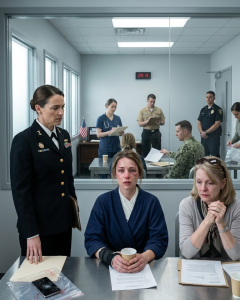
Commander Elise Grant stood beside the window with her arms folded behind her back.
She had arrived before dawn, still in full uniform, face controlled but eyes sharp with something Ava recognized.
Anger under discipline.
The kind of anger that did not waste itself on shouting.
Ava trusted that kind more than any apology.
The investigator, Lieutenant Commander Mark Feld, stood near the foot of the bed with a folder in his hands.
He had already walked her through what they knew.
The distress signal had activated at 2:06 a.m.
The emergency system had sent her location, apartment number, and audio capture to naval response.
Military police arrived within minutes.
The first officer found Richard Lawson standing over Ava.
The phone was still recording beneath the kitchen table.
The doorframe showed forced entry.
Ava’s injuries matched the audio.
Richard’s version did not.
That should have been enough for one morning.
It was not.
Feld turned one page in the folder.
“There’s another issue,” he said.
Ava looked at him.
She knew, before he said it, that the word issue meant a wound with paperwork around it.
“Your phone captured missed-call banners during the recording,” he continued. “Three calls from your mother’s number at 1:58 a.m.”
Ava stared at him.
The hospital room seemed to narrow around the paper cup on the tray table, the folded blanket at the end of the bed, the clock above the door.
Three calls.
Before Richard kicked down the door.
Before the deadbolt snapped.
Before her face hit the tile.
Her mother had called.
Commander Grant’s expression did not change.
“Was Mrs. Lawson contacted?” she asked.
“Yes, ma’am,” Feld said. “At first, she stated she had been asleep. Then she said the calls were accidental. When asked why she called three times minutes before the forced entry, she stopped answering.”
Ava closed her eyes.
For most of her life, her mother had been the soft voice after the violence.
The one who brought ice wrapped in dish towels.
The one who said Richard was under stress.
The one who told Ava not to set him off.
The one who stood in the doorway but never stepped fully into the room.
Ava used to think silence was absence.
That morning, she began to understand it as action.
Commander Grant moved closer to the bed.
“Lieutenant,” she said, “we can pause this.”
Ava opened her eyes.
Her mouth tasted like blood and hospital water.
“No.”
The word hurt her throat.
“Ask her again.”
By 9:40 a.m., Ava’s mother arrived at the base gate.
Her name was Denise Lawson now, though Ava still remembered when she was Denise Reynolds, a younger woman with tired eyes who smelled like vanilla lotion and laundry soap.
Denise wore sunglasses though the morning was cloudy.
A scarf sat high around her throat.
Her hands shook when she signed the visitor log.
She did not ask to see Ava first.
She asked whether Richard had been charged.
That detail reached Ava through Commander Grant, and it settled inside her like ice.
Not how is my daughter.
Not can I see her.
Not is she alive.
Has Richard been charged?
Denise was taken to an interview room.
Ava watched from behind one-way glass, seated in a chair because she refused the wheelchair.
Her shoulder burned.
Her wrist throbbed.
A bruise along her ribs tightened every time she breathed too deeply.
Still, she stayed upright.
Commander Grant stood beside her.
Feld entered the interview room with another investigator and placed a recorder on the table.
Denise folded her hands in her lap.
She looked smaller than Ava remembered.
That made Ava angry at herself because some old part of her still wanted to protect that smallness.
Abuse does not only teach fear.
It teaches sympathy for the people who failed you, because as a child, you need them to remain human enough to love.
Feld began gently.
“Mrs. Lawson, did Richard Lawson tell you he intended to visit Lieutenant Reynolds last night?”
Denise swallowed.
“He was upset.”
“That was not my question.”
“He wanted to talk to her.”
“At 2:00 a.m.?”
Denise looked down.
“He had been drinking.”
The words carried the old rhythm.
Explanation pretending not to be excuse.
Ava heard seventeen years of it in that sentence.
He had been drinking.
He had a bad week.
He did not mean it.
You know how he gets.
Feld placed a printed page on the table.
“Mrs. Lawson, these are call records from your phone. You called Lieutenant Reynolds three times at 1:58 a.m.”
Denise’s fingers tightened.
“I was worried.”
“Why?”
“Richard left angry.”
“Where did he go?”
Denise did not answer.
Feld waited.
Silence can be pressure when the person asking does not rush to fill it.
Finally, Denise whispered, “To Ava’s.”
Ava’s breath caught behind the glass.
Commander Grant’s jaw shifted once.
Feld continued.
“How did he know her current apartment?”
Denise closed her eyes.
“I don’t know.”
Feld slid another page across the table.
“This is a text sent from your phone to Richard Lawson at 1:41 a.m.”
Denise opened her eyes.
She looked at the page.
Ava could not read it from behind the glass, but she remembered Feld’s voice from the hospital room.
Apartment 3B.
She’s alone.
For a moment, Denise became perfectly still.
Not confused.
Not surprised.
Caught.
That was different.
The body knows the difference.
Feld leaned forward slightly.
“Did you send this message?”
Denise started crying.
Ava almost looked away.
Commander Grant did not.
“Mrs. Lawson,” Feld said, “did you send this message?”
“I thought he only wanted to talk sense into her.”
The phrase hit Ava so hard she gripped the armrest.
Talk sense.
Richard had used the same language when she was fifteen and refused to apologize for bleeding on the hallway rug.
Denise had said then, He’s only trying to teach you respect.
Feld placed another document on the table.
“A voicemail was recovered from Richard Lawson’s phone. It was sent from your number at 1:52 a.m.”
Denise shook her head.
“No.”
Feld pressed play.
Denise’s own voice filled the interview room.
“Ava needs to stop acting like she’s above this family. Go make her listen.”
Ava’s entire body went cold.
Not because she had doubted it by then.
Because hearing it removed the final hiding place.
Her mother had not merely failed to stop Richard.
She had directed him.
Maybe not toward the exact violence that followed.
Maybe not toward the broken door, twisted arm, or blood on tile.
But she had given him the address.
She had told him Ava was alone.
She had told him to go make her listen.
That was enough.
Denise covered her mouth.
“I didn’t mean hurt her.”
Feld did not soften.
“Intent does not erase foreseeable danger.”
Denise looked toward the mirror.
For one terrible second, Ava knew her mother could feel her there.
Denise whispered, “Ava?”
Ava did not move.
The child inside her wanted to answer.
The officer inside her knew better.
Commander Grant stepped into the interview room herself.
Ava watched her place a photograph on the metal table.
It was Ava in dress uniform after her first promotion.
Shoulders squared.
Hair perfect.
Eyes tired but proud.
“This is the woman you sent him to punish,” Commander Grant said.
Denise stared at the photo.
Then at the transcript.
Then at the mirror.
Her face folded.
“I was afraid if I didn’t give him the address, he’d come back for me.”
The room changed.
Not into forgiveness.
Into something uglier and more complicated.
Ava’s grip loosened on the chair.
Commander Grant said nothing.
Feld waited.
Denise continued, voice shaking.
“He said if I didn’t tell him where she was, he’d make me sorry. I thought if he talked to her, if she just answered him, maybe he would calm down.”
Ava closed her eyes.
There it was.
The truth beneath the betrayal.
Not malice alone.
Cowardice wearing the mask of survival.
Ava understood fear.
She understood it better than most people.
But understanding why someone handed you to danger does not make the hand less guilty.
Denise had been afraid.
So she passed the danger to her daughter.
That was not protection.
That was transfer.
Feld asked, “Did you contact base security?”
“No.”
“Did you warn your daughter in the voicemail?”
“No.”
“Did you tell Richard she was alone?”
Denise began sobbing.
“Yes.”
The word was small.
It still split something open.
Commander Grant looked at Feld.
“Add accessory and conspiracy review to the referral.”
Denise looked up sharply.
“Conspiracy? No. I didn’t—”
“You provided the address, confirmed isolation, and directed him to confront her after years of no contact,” Commander Grant said. “You can explain intent to investigators.”
Denise turned toward the mirror again.
“Ava, please.”
Ava stood too quickly.
Pain shot through her shoulder.
For a moment, the room tilted.
Commander Grant came back through the observation door just in time to steady her without making it obvious.
Ava hated that kindness nearly undid her.
“Lieutenant,” Grant said quietly, “you do not owe anyone your presence.”
Ava nodded.
But she stayed.
Because leaving then would have felt like running from the truth one more time.
Richard was arraigned first.
He appeared by video from holding.
His face was bruised near one cheekbone where he had slipped on Ava’s tile when officers entered.
He looked angry about that.
As if the floor had betrayed him.
He wore county-issued clothing and the expression of a man who still believed someone would restore the world to his preferred arrangement.
His attorney argued that Richard had been intoxicated, emotional, and concerned for a stepdaughter who had cut off family contact.
The prosecutor played eighteen seconds of audio.
Richard’s voice filled the courtroom.
“You embarrassed me.”
Then Ava’s voice.
“Richard, stop.”
Then the impact.
The attorney stopped using the word concerned after that.
A protective order was issued.
Richard was barred from contacting Ava directly or indirectly.
Denise was questioned separately and later charged in connection with providing information and encouraging the confrontation.
That fact made people uncomfortable.
Some relatives called it too much.
Some said Denise was a victim too.
Some said Ava should have compassion.
Ava learned not to argue with people committed to misunderstanding survival.
Compassion without boundaries is just another door left unlocked.
The Navy moved fast in the ways civilian life often does not.
Base security reviewed access protocols.
Her apartment lease was terminated without penalty.
Her command arranged temporary housing.
A legal assistance officer helped with protective orders, evidence preservation, and victim support.
Her unit showed up quietly.
One sailor left soup at her door.
Another dropped off groceries.
Someone fixed her new door chain without asking.
No one demanded details.
No one said family is family.
No one told her Richard had been drinking like that explained the shape of his boot near her wrist.
Care, real care, does not require the wounded person to make everyone else comfortable.
It simply arrives with soup and leaves room to breathe.
Ava went to physical therapy for her shoulder.
At first, lifting her arm above chest height made her nauseous.
The therapist, a former corpsman named Malik, never pushed without warning.
“Pain or fear?” he would ask.
Sometimes Ava said pain.
Sometimes she said fear.
He treated both as real.
That helped.
The first time an emergency alert tone sounded during a base drill, Ava dropped a coffee mug.
The crash sent her back to the tile for half a second.
A junior officer reached for her automatically.
She stepped away too fast.
Then apologized.
He shook his head.
“No need, ma’am.”
No need.
Two small words.
A mercy.
The legal process stretched over months.
Richard tried several versions of the story.
He said Ava attacked him.
The audio contradicted him.
He said the door was already damaged.
The photos contradicted him.
He said he came to check on her.
The 1:41 text and 1:52 voicemail contradicted him.
He said he had blacked out.
The recording caught him using specific threats and Ava’s name with ownership clear in every syllable.
Evidence did what exhausted victims often cannot do forever.
It stayed consistent.
Denise’s case was quieter.
That somehow hurt more.
Richard had always been loud enough for people to call him the problem.
Denise had been the soft shadow beside him.
The one who explained him.
Softened him.
Translated him.
Warned others how not to provoke him.
At her hearing, she looked at Ava only once.
Ava felt the look before she saw it.
A plea.
A mother’s plea, or what was left of one.
When Denise was allowed to speak, she said she had lived in fear for years.
Ava believed her.
She said she had not wanted anyone hurt.
Ava believed that too, in the narrowest possible way.
Then Denise said, “I never thought he would really do it.”
Ava almost laughed.
Not because it was funny.
Because denial had a sound, and she had heard it her whole life.
Richard had always really done it.
Maybe not always with fists.
Sometimes with doors slammed hard enough to make Ava flinch.
Sometimes with silence at dinner.
Sometimes with a hand around a wrist.
Sometimes with the threat of what would happen if anyone embarrassed him.
Denise knew.
She just called knowing something else.
When the judge asked whether Ava wanted to speak, she stood.
Her shoulder had mostly healed by then.
Her wrist no longer needed the brace.
A faint scar remained near her hairline from where her face had struck the tile.
She wore her dress uniform.
Not to impress the court.
To remind herself that Richard had not followed her all the way out of childhood and taken everything.
“My mother says she didn’t think he would really do it,” Ava said.
Her voice stayed steady.
“I spent my childhood learning what he might do before he did it. I knew his footsteps. I knew his breathing. I knew the difference between silence that meant he was gone and silence that meant he was waiting.”
The courtroom was still.
“She knew too.”
Denise began to cry.
Ava did not look at her.
“She gave him my address. She told him I was alone. She told him to make me listen. She may have been afraid, but fear does not give you the right to hand someone else to danger.”
She paused.
Then she said the sentence she had carried since the interview room.
“My mother’s silence was not empty. It was permission.”
No one spoke.
The judge issued consequences that were not as severe as Ava’s anger wanted and not as light as her relatives had hoped.
Richard took a plea to avoid trial after the audio and medical evidence were ruled admissible.
He received jail time, supervised release conditions, mandatory treatment, and a long protective order.
Denise received probation, mandatory counseling, a no-contact order, and a formal finding that her actions contributed to the assault.
Some people said that was enough.
Some said it was too much.
Ava stopped measuring justice by whether outsiders understood it.
Justice, for her, began the night Richard’s name entered the report.
It continued the day Denise’s text entered evidence.
It grew stronger every time someone said exactly what happened without lowering their voice.
Months later, Ava returned to the old apartment one last time.
The landlord had already repaired the door.
The new deadbolt was brighter than the old wood around it.
The kitchen floor had been cleaned.
The chair was upright.
The closet door was empty where her dress uniform had once hung.
It looked almost like nothing had happened.
That was the disturbing part.
Rooms are excellent liars.
Ava stood where she had fallen.
She looked under the kitchen table.
That was where the phone had been.
Three taps.
Hold.
Transmit.
Such a small motion.
Such a different life on the other side of it.
Commander Grant had offered to send someone with her.
Ava declined.
Not because she wanted to be brave.
Because she needed to stand there without an audience and teach her body that the room no longer owned her.
The tile did not reach for her.
The walls did not close.
The repaired door stayed shut until she opened it herself.
She took one thing before she left.
The paper coffee cup that had been drying by the sink that night was long gone, but the mug from the lower shelf remained.
The heavy one she had imagined using as a weapon.
She picked it up, washed it, wrapped it in a towel, and carried it out.
Not as a trophy.
As proof she had chosen survival over rage and still survived.
Her new apartment was smaller.
Safer.
Closer to base.
The first night, she checked the lock six times.
Then she stopped apologizing to herself for that.
Healing did not look like never being afraid.
It looked like learning fear did not get to make every decision.
She returned to duty slowly.
Paperwork first.
Then briefings.
Then full days.
The first time she put on her dress uniform after the assault, her fingers paused at the buttons.
She remembered the uniform hanging from the closet door while Richard stood over her.
Pressed.
Ready.
Absurdly neat in the middle of the wreckage.
For one second, she thought she might not be able to wear it.
Then she buttoned it anyway.
Not because uniforms make people invulnerable.
They do not.
But that uniform had rules Richard could not rewrite.
It had a nameplate he did not own.
It had a rank she had earned without his permission.
When she walked into inspection that morning, Commander Grant saw her and nodded once.
Nothing dramatic.
No speech.
Just recognition.
Ava preferred that.
Later, a younger sailor came to her office.
She stood in the doorway too long before speaking.
Ava recognized the posture.
People who have something painful to say often look first for the exits.
“Ma’am,” the sailor said, “if someone in your family keeps showing up and you told them not to, is that something security can help with?”
Ava set down her pen.
“Yes,” she said.
The sailor’s eyes filled.
Ava did not rush her.
She did not ask for proof before offering options.
She did not say family was complicated.
She said, “Tell me what you need to be safe today.”
Only after the sailor left did Ava understand the full shape of what had happened.
The distress signal had saved her life.
The audio had exposed Richard.
The phone records had exposed Denise.
But the truth, once written down, did not stop at one case.
It became a door someone else might use to leave.
That mattered.
One year after the assault, Ava woke before sunrise.
For a moment, the dark room pulled at an old memory.
Then she heard the quiet hum of her new refrigerator.
The distant sound of traffic.
The soft click of the base alarm on her phone, scheduled and harmless.
No pounding.
No shouting.
No broken door.
She got up, made coffee, and stood by the window as the sky lightened over Norfolk.
Her phone sat on the counter.
New screen.
Same emergency protocol.
She did not need to touch it.
But she knew it was there.
That knowledge was not fear.
It was a boundary with a signal attached.
Ava sipped the coffee and thought of all the years she had believed distance would protect her.
Distance had given her room.
Training had given her tools.
Evidence had given her a voice when her body was too hurt to keep arguing.
But the thing that saved her first was simpler.
She believed herself fast enough to act.
For anyone who has ever lain awake listening for footsteps, Ava would later say the same thing in every victim-support briefing she gave.
You do not have to wait until someone else agrees it was bad enough.
You do not have to make the story pretty.
You do not have to call it family when what it really is is fear.
At 2:00 a.m., Richard Lawson kicked down the door to her Navy apartment.
At 2:06 a.m., Ava Reynolds sent one military distress signal.
By sunrise, his name was written where silence could not reach it.
And by the time the case closed, so was hers.
Not as his stepdaughter.
Not as Denise’s child.
Not as the woman on the floor.
As Lieutenant Ava Reynolds.
Alive.
Believed.
And finally, unreachable in the only way that mattered.
Three weeks after the case closed, Commander Grant called me into her office.
I thought it was about my next assignment.
I was wrong.
She didn’t say anything at first.
She simply slid a file across her desk.
A thin file.
Brown.
Unmarked.
The kind people try not to notice.
“What’s this?”
Commander Grant looked uncomfortable.
That alone scared me.
She never looked uncomfortable.
Then she said:
“It was found during the investigation.”
My stomach tightened.
“What investigation?”
She held my gaze.
“Yours.”
Silence.
Then she added:
“It wasn’t in Richard’s records.”
The room suddenly felt smaller.
“It was in your mother’s.”
My pulse quickened.
Slowly, I opened the file.
Inside was a photograph.
Old.
Faded.
Taken twenty-one years ago.
A little girl standing beside my mother.
The girl looked about eight.
Dark hair.
Blue jacket.
Big smile.
I stared at it.
Confused.
Because I had never seen her before.
Then I turned the photograph over.
And read the words written on the back.
Katie Reynolds — Summer 2004
The room froze.
Because my mother’s last name wasn’t Reynolds in 2004.
It hadn’t been for years.
Then I looked up.
“Who is Katie?”
Commander Grant didn’t answer immediately.
Then she whispered:
“That’s what we’re trying to find out.”
THE GIRL IN THE PHOTOGRAPH
For a long moment, I couldn’t speak.
I just stared at the picture.
The little girl smiled back at me from twenty-one years ago.
Dark hair.
Blue jacket.
Missing front tooth.
One hand holding a melting ice cream cone.
The other holding my mother’s hand.
My mother’s hand.
Not Denise Lawson.
Not Richard’s wife.
Not the woman from the courtroom.
Just Mom.
The woman who used to braid my hair before school.
The woman who packed lunches.
The woman who stood quietly beside every terrible decision she was afraid to stop.
Then I looked at the name again.
Katie Reynolds.
The room felt suddenly cold.
Because Commander Grant was right.
My mother hadn’t been Reynolds then.
Not for years.
Then why was the girl’s last name Reynolds?
“What is this?”
My voice barely worked.
Commander Grant folded her hands on the desk.
“I don’t know.”
That answer scared me.
Because Commander Grant always knew something.
Then she added:
“Neither does NCIS.”
The room froze.
“What?”
She nodded once.
“The photograph was found in a locked box recovered from your mother’s storage unit.”
My stomach tightened.
Storage unit.
Another secret.
Of course.
There was always another secret.
Then Commander Grant slid a second item across the desk.
A folded sheet of paper.
Old.
Yellowed.
The edges worn.
Like somebody had opened it a hundred times.
I unfolded it carefully.
At first it looked like a receipt.
Then I saw the heading.
My pulse exploded.
MISSING CHILD REPORT
The room disappeared.
I read the first line.
Then the second.
Then the third.
And suddenly I couldn’t breathe.
Because the missing child wasn’t Katie.
The missing child was listed as:
Female. Age 8. Unknown identity.
Unknown identity.
What?
Then I kept reading.
The girl had been found alone at a bus station.
No parents.
No records.
No identification.
Nothing.
The report was dated the same summer as the photograph.
The same summer.
Then I noticed something written in blue ink at the bottom.
Not official writing.
Personal writing.
A note.
A note written by my mother.
My pulse quickened.
Because it said:
“She reminds me of Ava.”
The room froze.
Commander Grant watched my face carefully.
“What does that mean?”
I shook my head.
“I don’t know.”
But deep down…
I wasn’t sure.
Then I noticed another page clipped behind the report.
A school enrollment form.
Half-completed.
Never submitted.
The student name section read:
Katie Reynolds
My heart stopped.
Because suddenly it looked like my mother wasn’t helping a lost child.
She was trying to keep one.
The realization hit hard.
Far too hard.
Then Commander Grant whispered:
“There’s more.”
Of course there was.
There was always more.
Then she handed me the final photograph.
The photograph that changed everything.
At first glance it looked ordinary.
A church picnic.
Families.
Children.
Plastic tables.
Paper plates.
Nothing unusual.
Then I saw her.
The girl.
Katie.
Standing beside my mother.
Smiling.
Happy.
And standing beside Katie…
Was Richard.
The room went silent.
Because Richard looked younger.
Healthier.
Friendlier.
But it was him.
There was no mistake.
Then I flipped the photograph over.
And immediately wished I hadn’t.
Because written on the back was a date.
And beneath it were six words.
Six words that made my blood run cold.
Two weeks before she vanished.
The office disappeared.
Everything disappeared.
Because suddenly one question remained.
One terrible question.
If Katie wasn’t Denise’s daughter…
And Katie wasn’t Ava…
Then who was she?
And why had she disappeared?
Then Commander Grant looked directly at me.
Her face pale.
Serious.
Concerned.
Then she said the sentence that changed everything.
The sentence that made my stomach drop.
The sentence that guaranteed I wouldn’t sleep that night.
“Ava…”
I looked up.
“What?”
Commander Grant slid one final document across her desk.
A DNA report.
Fresh.
Recent.
Completed three days ago.
Then she whispered:
“Katie wasn’t a stranger.”
Silence.
Then:
“She was your half-sister.”
THE SISTER I NEVER KNEW
The room stopped.
Not figuratively.
Actually stopped.
My heartbeat.
My breathing.
My thoughts.
Everything.
Because Commander Grant had just said six words.
“She was your half-sister.”
I stared at the DNA report.
Waiting for it to change.
Waiting for reality to return.
It didn’t.
The paper remained exactly where it was.
Cold.
Official.
Unforgiving.
Then I whispered:
“No.”
My voice barely worked.
“No.”
Because this wasn’t possible.
I was an only child.
I had always been an only child.
Then Commander Grant slid the report closer.
The highlighted section seemed to glow.
Parent-child relationship: Negative.
Sibling relationship: High probability.
My stomach twisted.
Hard.
Then I looked up.
“What happened to her?”
The room became silent.
Commander Grant didn’t answer immediately.
That terrified me.
Because people only hesitate when the answer is ugly.
Very ugly.
Finally she spoke.
“We don’t know.”
The words hit like ice.
“What do you mean you don’t know?”
She folded her hands together.
Then:
“Katie disappeared.”
The room froze.
Immediately.
Disappeared.
The same word.
The same nightmare.
The same story.
Again.
Then Commander Grant continued.
“Two weeks after that photograph was taken.”
I looked back at the picture.
Katie smiling.
Richard standing beside her.
My mother standing beside both of them.
A normal summer day.
A normal family photograph.
Except it wasn’t.
Because two weeks later…
Katie vanished.
Then I whispered:
“Did they report her missing?”
The silence answered before Commander Grant could.
My pulse exploded.
“No.”
Commander Grant slowly shook her head.
Then:
“Nobody reported her missing.”
The room disappeared.
Because suddenly the truth became obvious.
Katie wasn’t lost.
She wasn’t forgotten.
She was hidden.
Then Commander Grant opened another file.
A thin file.
Almost empty.
That alone scared me.
Because every missing child leaves records.
School records.
Medical records.
Neighbors.
Teachers.
Friends.
Something.
Katie had almost nothing.
Then Commander Grant whispered:
“It’s like she never existed.”
Every hair on my body stood up.
Then she handed me a single sheet of paper.
A church attendance roster.
Twenty-one years old.
The final entry on the page read:
Katie Reynolds
Then a handwritten note.
One sentence.
Written by a church volunteer.
The ink had faded but was still readable.
I felt sick the moment I read it.
“The little girl seemed afraid of Richard.”
The office became silent.
Terrifyingly silent.
Because suddenly Richard wasn’t connected to one victim.
He was connected to two.
Then I noticed another note.
Smaller.
Written beneath the first.
The handwriting was different.
My pulse quickened.
Because I recognized it immediately.
My mother’s handwriting.
The note read:
“Please don’t ask questions.”
The room froze.
Then I whispered:
“Mom knew.”
Commander Grant nodded.
Once.
Slowly.
Then:
“We think she knew everything.”
Everything.
The word echoed through my mind.
Then another thought appeared.
Much worse.
If Katie was my half-sister…
Who was her mother?
My pulse exploded.
Then I looked at Commander Grant.
And somehow she already knew what I was about to ask.
Because her face changed instantly.
The answer scared her too.
Then she whispered:
“We found a birth certificate.”
The room disappeared.
Everything disappeared.
Birth certificate.
Proof.
Answers.
Finally.
Then Commander Grant handed me the document.
My hands trembled.
The mother’s name section was visible immediately.
I looked down.
And my heart stopped.
Because it wasn’t a stranger.
It wasn’t someone I’d never heard of.
It wasn’t someone from Richard’s past.
No.
It was a woman I knew.
A woman I’d met.
A woman who had attended family holidays.
A woman who disappeared from our lives shortly before Katie vanished.
Then Commander Grant whispered:
“Ava…”
I couldn’t breathe.
Because I was already reading the name.
Then she finished the sentence.
The sentence that changed everything.
“Katie’s mother was your aunt Sarah.”
Silence.
Absolute silence.
Because Aunt Sarah didn’t leave town twenty-one years ago.
She disappeared.
THE AUNT WHO NEVER LEFT
The room went silent.
Completely silent.
I stared at the birth certificate.
Again.
And again.
And again.
The name never changed.
Sarah Reynolds.
Aunt Sarah.
My mother’s younger sister.
The aunt who supposedly moved away.
The aunt who supposedly cut contact.
The aunt nobody talked about anymore.
The aunt who vanished from every family photograph after 2004.
My stomach twisted.
Because suddenly I remembered something.
Something small.
Something I hadn’t thought about in years.
A Christmas dinner.
I was fourteen.
Aunt Sarah’s name came up.
Only once.
Just once.
Then Richard slammed his fork down.
And the entire table went silent.
Nobody spoke about her again.
At the time I thought it was strange.
Now…
I thought it was terrifying.
Then Commander Grant spoke softly.
“Ava.”
I looked up.
“What happened to her?”
The commander hesitated.
That scared me immediately.
Because Commander Grant wasn’t afraid of facts.
She was afraid of what facts did to people.
Then she whispered:
“Nobody knows.”
The room froze.
“What?”
“We can’t find her.”
My pulse exploded.
No.
No.
No.
Because suddenly this wasn’t one missing person.
It was two.
Katie disappeared.
Then Sarah disappeared.
Then everyone pretended both of them never existed.
Then Commander Grant slid another file toward me.
The thinnest file yet.
Only three pages.
Three pages for an entire human life.
That alone felt wrong.
Then I opened it.
The first page contained a missing persons report.
Filed twenty-one years ago.
The reporting party:
Sarah Reynolds.
The missing person:
Katie Reynolds.
My heart stopped.
Because Sarah did report Katie missing.
She fought.
She searched.
She tried.
Then why had everyone told me Katie was never reported missing?
I flipped to the second page.
And immediately understood.
The investigation had been closed.
Three days later.
Three days.
Not three months.
Not three years.
Three days.
The official reason:
Child believed to have left voluntarily with legal guardian.
The room disappeared.
Legal guardian?
Katie was eight years old.
Eight.
Then I noticed the signature approving the closure.
My pulse exploded.
Because I knew the name.
I knew it instantly.
The signature belonged to:
Richard Lawson.
The world stopped.
Completely.
“What?”
Commander Grant nodded.
Slowly.
Painfully.
Then she whispered:
“Richard was a deputy back then.”
Every hair on my body stood up.
Because suddenly everything connected.
The missing report.
The closed investigation.
The silence.
The lies.
The fear.
Richard wasn’t just part of the story.
He controlled it.
Then I opened the final page.
A photograph.
Old.
Folded.
Creased.
The edges damaged.
At first I didn’t understand what I was looking at.
Then my blood ran cold.
Because it wasn’t a family picture.
It was a surveillance photograph.
Taken outside a bus station.
The date stamp showed it was taken two days after Katie disappeared.
My hands started shaking.
Because Katie was in the photograph.
Alive.
Standing beside a woman.
A frightened-looking woman holding Katie’s hand.
Then I realized something.
The woman wasn’t Sarah.
The woman wasn’t my mother.
The woman wasn’t anyone I recognized.
Then I turned the photo over.
And saw handwriting.
Fresh handwriting.
Not twenty-one years old.
Recent.
Very recent.
Someone had written:
Found alive in Oklahoma, 2025.
The room froze.
Completely.
My pulse hammered.
Katie.
Alive.
Alive.
Alive.
For twenty-one years everyone thought she disappeared.
But she was alive.
Then Commander Grant looked directly at me.
Her face pale.
Serious.
Concerned.
Then she said the sentence that changed everything.
The sentence that made my stomach drop.
The sentence that guaranteed I would never see my family the same way again.
“Ava…”
I looked up.
“What?”
Commander Grant swallowed hard.
Then whispered:
“Katie has been looking for you too.”
THE SISTER WHO WAS SEARCHING TOO
The room stopped.
Not because Commander Grant raised her voice.
Not because of another shocking file.
Not because of Richard.
Or my mother.
Or the lies.
It stopped because of one sentence.
“Katie has been looking for you too.”
My heart stopped.
Completely.
“What?”
The word barely escaped my mouth.
Commander Grant didn’t answer immediately.
She simply slid a photograph across the desk.
A recent photograph.
Only a few months old.
The woman in the picture stood outside a courthouse.
Dark hair.
Blue eyes.
A nervous smile.
Maybe twenty-nine years old.
Maybe thirty.
I stared at her.
And suddenly my stomach dropped.
Because she looked familiar.
Not familiar because I knew her.
Familiar because she looked like me.
Not exactly.
But enough.
The same eyes.
The same jawline.
The same expression people made when they were trying to look brave.
Then Commander Grant spoke softly.
“Her legal name is Katherine Brooks.”
The room felt smaller.
Much smaller.
Then:
“But she was born Katie Reynolds.”
My pulse hammered.
Alive.
After twenty-one years.
Alive.
Then I noticed something in the photograph.
Katie wasn’t alone.
Standing beside her was an older woman.
Gray hair.
Thin frame.
Protective posture.
The woman from the bus station photo.
The same woman.
The woman who disappeared with Katie.
Then I whispered:
“Who is she?”
Commander Grant opened another folder.
“Her name is Martha Brooks.”
Silence.
Then:
“The woman who raised Katie.”
The world tilted.
Because suddenly there was another mother.
Another woman.
Another secret.
Then Commander Grant continued.
“Martha died six months ago.”
My stomach tightened.
Hard.
Because somehow I already knew what came next.
Then:
“Before she died, she told Katie the truth.”
The room froze.
The truth.
The same thing that destroyed my life.
The same thing that rebuilt it.
Then Commander Grant handed me a copy of a handwritten letter.
The handwriting was shaky.
Uneven.
The handwriting of someone running out of time.
I began reading.
Katie,
I promised myself I would never tell you.
But good people don’t take secrets to the grave.
My throat tightened.
Then:
I didn’t kidnap you.
I rescued you.
The room disappeared.
Because suddenly nothing made sense.
Rescued?
From what?
From who?
Then I kept reading.
Your mother Sarah came to me terrified.
She said Richard would never stop.
Every hair on my body stood up.
Richard.
Again.
Always Richard.
Then:
She asked me to take you away.
Silence.
Absolute silence.
Then:
She said if you stayed, one day he would hurt you.
My hands started shaking.
Because suddenly the story wasn’t about a missing child.
It was about a mother trying to save her daughter.
Then I reached the final paragraph.
The paragraph written only days before Martha died.
If Ava Reynolds is still alive, find her.
Your mother loved both of you.
My pulse exploded.
Both of you.
Both.
Then I looked up.
“What does that mean?”
Commander Grant looked pale.
Terrified.
Then she whispered:
“Sarah wasn’t just your aunt.”
The room froze.
No.
No.
No.
Then Commander Grant continued.
“She was protecting both daughters.”
The world stopped.
Completely.
Then I whispered:
“What daughters?”
Commander Grant’s eyes filled with sympathy.
The kind I hated.
The kind that meant pain was coming.
Then she answered.
The answer that changed everything.
The answer that made my blood run cold.
The answer that turned every family memory upside down.
“Sarah Reynolds wasn’t your aunt.”
Silence.
Then:
“She was your mother.”
The office disappeared.
Because suddenly…
The woman I’d spent my entire life searching for…
Had been standing in family photographs all along.
THE MOTHER IN THE PHOTOGRAPH
The world stopped.
Completely.
I stared at Commander Grant.
Waiting for her to correct herself.
Waiting for her to say she misspoke.
Waiting for reality to return.
It didn’t.
Then she repeated it.
Slowly.
Carefully.
Like every word hurt.
“Sarah Reynolds wasn’t your aunt.”
Silence.
Then:
“She was your mother.”
My pulse hammered.
No.
No.
No.
Because that wasn’t possible.
Sarah was Aunt Sarah.
The woman who brought me birthday cards.
The woman who hugged me at Christmas.
The woman who disappeared when I was a teenager.
The woman everyone avoided talking about.
Then another memory surfaced.
A memory so small I had forgotten it.
I was seven.
Sarah was visiting.
I scraped my knee in the backyard.
Before my mother could reach me…
Sarah did.
I remembered her holding me.
Crying harder than I was.
At the time I thought she was emotional.
Now?
Now I understood.
Then I whispered:
“She knew.”
Commander Grant nodded.
Slowly.
Then:
“She always knew.”
The room disappeared.
Because suddenly every family gathering looked different.
Every photograph.
Every holiday.
Every hug.
Everything.
Then I looked back at Martha’s letter.
The words blurred through my tears.
Your mother loved both of you.
Both.
Not one.
Both.
Then I whispered:
“Who was the other daughter?”
The question barely escaped my mouth.
Because somehow…
I already knew.
Then Commander Grant answered.
Quietly.
Gently.
The way people speak when they know they’re breaking your heart.
“Katie.”
Silence.
Absolute silence.
Then:
“Katie was your sister.”
The office became deathly quiet.
My sister.
Not half-sister.
Not cousin.
Sister.
Then another horrifying realization hit me.
If Sarah was my mother…
And Katie was my sister…
Then who was my father?
My pulse exploded.
Because suddenly that question mattered more than ever.
Then Commander Grant looked away.
Immediately.
The reaction terrified me.
Because she knew.
Then she whispered:
“That’s where things get complicated.”
Of course they did.
Nothing in my life had ever been simple.
Then she opened another file.
A file marked:
CONFIDENTIAL
My stomach tightened.
Inside were photographs.
Lots of photographs.
Some old.
Some recent.
Some taken from newspapers.
Some taken from campaign events.
Then I saw him.
My heart stopped.
The governor.
Thomas Whitmore.
Again.
Then I whispered:
“No.”
Because I already knew.
Before she said a word.
Then Commander Grant nodded.
Once.
Slowly.
Painfully.
“Sarah had a relationship with Whitmore.”
The room froze.
Then:
“Years before he entered politics.”
My pulse hammered.
Because suddenly every secret connected.
Sarah.
Katie.
The governor.
The cover-up.
Everything.
Then Commander Grant slid one final photograph across the desk.
My hands started shaking.
Because it wasn’t a campaign photograph.
It wasn’t a news photograph.
It wasn’t public.
It was personal.
Very personal.
Sarah.
Young.
Laughing.
Standing beside Thomas Whitmore.
His arm around her shoulders.
And in Sarah’s arms…
A baby.
A tiny baby wrapped in a pink blanket.
My stomach dropped.
Because on the back of the photograph was a date.
The date of my birth.
Then beneath the date were five handwritten words.
Five words that made my blood run cold.
Our beautiful daughter Ava.
The office disappeared.
Everything disappeared.
Because suddenly there was no doubt.
No uncertainty.
No mystery.
Thomas Whitmore wasn’t connected to my story.
He was my father.
Then Commander Grant whispered:
“There’s one more thing.”
My pulse exploded.
Of course there was.
There was always one more thing.
Then she handed me a sealed envelope.
Old.
Very old.
The paper yellowed with age.
My name written across the front.
Not Ava.
Not Lieutenant Reynolds.
Not Lieutenant Ava Reynolds.
Just one word.
Written in Sarah’s handwriting.
Daughter
The tears came instantly.
Then Commander Grant whispered:
“Sarah wrote it before she disappeared.”
Silence.
Absolute silence.
Then:
“And nobody has ever opened it.”
My hands trembled.
Because after twenty-one years…
After all the lies…
After all the secrets…
My mother had finally left me the truth.
And whatever was inside that letter…
Was the reason she vanished.
THE LETTER SHE LEFT FOR ME
Nobody moved.
Nobody breathed.
Nobody spoke.
The sealed envelope rested in my hands.
Twenty-one years.
Twenty-one years this letter had existed.
Waiting.
Hidden.
Protected.
Forgotten.
And somehow…
It had survived.
The room felt impossibly quiet.
Commander Grant didn’t say a word.
She simply sat across from me.
Waiting.
Giving me the one thing nobody else in this story ever had.
Time.
My fingers trembled as I broke the seal.
The paper crackled softly.
Old paper.
Fragile paper.
The kind that had survived decades only because someone desperately wanted it to.
Then I unfolded the letter.
And saw her handwriting.
My mother’s handwriting.
Sarah’s.
The tears came immediately.
Because suddenly she wasn’t a mystery.
She wasn’t a photograph.
She wasn’t a missing person.
She was a mother writing to her daughter.
And for the first time in my life…
She was speaking directly to me.
Then I began reading.
My sweet Ava,
If you’re reading this, then I failed.
My vision blurred.
Instantly.
Then:
Not because I stopped loving you.
Because I ran out of ways to protect you.
The office disappeared.
Only the letter remained.
Then I kept reading.
You were the best thing that ever happened to me.
The day you were born, I held you for three hours and refused to let anyone take you.
The nurses laughed.
I didn’t care.
A sob escaped before I could stop it.
Because suddenly I could see it.
A young mother.
Holding her baby.
Loving her baby.
Me.
Then I reached the next paragraph.
And my blood ran cold.
Thomas wanted to do the right thing.
I froze.
The governor.
My father.
Then:
At first.
The room became silent.
Terrifyingly silent.
Then:
But people around him were already making plans.
My pulse quickened.
Plans.
What plans?
Then I continued.
His father said a scandal would destroy everything.
His advisors said the same thing.
They told him nobody could know about us.
The office disappeared.
Because suddenly Thomas Whitmore wasn’t acting alone.
Not then.
Not ever.
Then:
They called me a problem.
The words hit like a knife.
Not a person.
Not a mother.
A problem.
Then:
And they called you a risk.
My hands shook.
Violently.
Then I reached the section that changed everything.
The section underlined twice.
The section Sarah desperately wanted me to read.
If anything happens to me, it wasn’t an accident.
The room froze.
Completely.
Then:
There are people who know what happened.
Another line.
Richard knows.
My pulse exploded.
Richard.
Always Richard.
Then:
Denise knows too.
The room tilted.
My mother.
The woman who raised me.
Then:
And one day you’ll learn why they were so afraid.
I couldn’t breathe.
Because suddenly I knew.
This wasn’t about custody.
This wasn’t about politics.
This wasn’t about reputation.
It was bigger.
Much bigger.
Then I reached the final page.
The final paragraph.
The last thing Sarah ever wrote.
And the words nearly stopped my heart.
If Katie is alive, find her.
If Thomas is alive, make him tell the truth.
And if I disappear…
My hands trembled.
Then:
Look beneath the lighthouse.
Silence.
Absolute silence.
I stared at the words.
Again.
And again.
And again.
The lighthouse.
What lighthouse?
Then Commander Grant whispered:
“Ava.”
I looked up.
“What?”
Her face had gone pale.
Completely pale.
Then she answered.
The answer that changed everything.
“Sarah disappeared three days after writing that letter.”
My stomach dropped.
Hard.
Then:
“And the last place anyone saw her…”
She stopped.
Unable to continue.
Then finally whispered:
“Was Norfolk Lighthouse.”
The room went completely silent.
Because suddenly Sarah hadn’t left me a goodbye.
She had left me directions.
THE LIGHTHOUSE
Nobody spoke.
Nobody moved.
The office felt frozen.
One sentence echoed through my mind.
Again.
And again.
And again.
Look beneath the lighthouse.
My mother’s final words.
Not goodbye.
Not I love you.
Directions.
A clue.
A message she somehow knew I would find.
Twenty-one years later.
Then Commander Grant stood.
“We’re leaving.”
I looked up.
“What?”
She grabbed her coat.
“The lighthouse closes at sunset.”
My pulse quickened.
The clock on her wall read 5:17 p.m.
Outside, dark clouds were gathering over Norfolk Harbor.
Then she looked directly at me.
“If Sarah hid something there, we don’t wait until tomorrow.”
Twenty minutes later we were driving through rain.
The windshield wipers moved furiously.
The harbor appeared ahead through sheets of gray water.
And there it was.
Norfolk Lighthouse.
Tall.
Silent.
Watching the ocean exactly as it had for generations.
My stomach tightened.
Because this was the last place anyone had seen my mother alive.
The last place.
Then another thought appeared.
Maybe not.
Maybe this wasn’t where her story ended.
Maybe it was where it began.
The lighthouse keeper met us at the gate.
An elderly man named Walter Briggs.
Eighty-two years old.
Retired.
Thin as a fence post.
The moment he heard Sarah’s name…
His face changed.
Immediately.
That scared me.
Because recognition meant memory.
And memory meant answers.
Then Walter whispered:
“I always wondered if somebody would come looking.”
The world stopped.
“What?”
His eyes moved toward the lighthouse.
Then:
“She told me someone would.”
Commander Grant and I exchanged a glance.
My pulse exploded.
Then Walter reached into his pocket.
And pulled out a key.
Old.
Rusty.
Worn smooth by time.
Then he handed it to me.
“She left this twenty-one years ago.”
The rain seemed to disappear.
Everything disappeared.
Except the key.
My mother’s key.
Then Walter whispered:
“She said if a young woman with her eyes ever arrived…”
His voice cracked.
Then:
“Give it to her.”
Tears instantly filled my eyes.
Because somehow…
Sarah knew.
She knew.
Then Walter led us inside.
The lighthouse stairs spiraled upward.
Narrow.
Cold.
Silent.
The sound of the storm echoed through the stone walls.
At the very top sat the old beacon room.
But Walter didn’t stop there.
Instead he pointed downward.
Toward the basement.
My pulse quickened.
Because suddenly I understood.
Beneath the lighthouse.
Then we descended.
Stone steps.
Dust.
Darkness.
Until we reached a storage room nobody had used in years.
Commander Grant switched on a flashlight.
The beam swept across old equipment.
Rusted chains.
Wooden crates.
Broken tools.
Nothing unusual.
Then I saw it.
A metal hatch.
Hidden beneath a workbench.
My heart stopped.
Because attached to the hatch…
Was a lock.
A lock exactly the size of Sarah’s key.
Nobody spoke.
Nobody breathed.
Slowly…
I knelt.
Inserted the key.
And turned it.
The lock clicked open immediately.
Like it had been waiting.
For twenty-one years.
Then I lifted the hatch.
And found a metal box.
Small.
Black.
Waterproof.
Untouched.
My hands started shaking.
Because this wasn’t a theory anymore.
This wasn’t hope.
This was real.
Then Commander Grant helped me lift it out.
The lid opened slowly.
And inside…
Were dozens of items.
Photographs.
Letters.
Newspaper clippings.
Cassette tapes.
A journal.
My pulse exploded.
Because sitting on top of everything else…
Was a photograph.
A photograph of me.
At age six.
Playing in a school playground.
The date on the back nearly made me collapse.
Because the photograph was taken five years after Sarah supposedly disappeared.
Five years.
Meaning she was alive.
Watching.
Then I noticed a note attached to it.
A note written in Sarah’s handwriting.
The note read:
She still laughs exactly the same.
Tears blurred my vision.
Then another photograph.
Age nine.
Then another.
Age twelve.
Then another.
Every year.
Every milestone.
Every birthday.
My mother had watched from a distance.
The entire time.
Then Commander Grant opened the journal.
And immediately froze.
Completely froze.
My stomach dropped.
“What?”
She didn’t answer.
Instead she turned the journal toward me.
The page was dated three days before Sarah disappeared.
The handwriting looked rushed.
Panicked.
Terrified.
And the first sentence made my blood run cold.
Thomas finally learned what Richard did.
Silence.
Absolute silence.
Then the next sentence.
The sentence that changed everything.
The sentence that made Walter sit down heavily.
The sentence that made Commander Grant go pale.
The sentence that made me realize my mother’s disappearance wasn’t an accident.
It wasn’t voluntary.
And it wasn’t random.
The sentence read:
If anything happens to me, it means Richard found the tapes.
The room froze.
Because buried beneath the photographs…
Were six unlabeled cassette tapes.
And suddenly we all knew.
The truth wasn’t in the journal.
The truth was recorded.
THE FIRST TAPE
Nobody moved.
Nobody breathed.
Nobody spoke.
The metal box sat open on the floor.
The journal remained in my hands.
And six cassette tapes rested between old photographs and faded newspaper clippings.
Twenty-one years.
Twenty-one years these tapes had waited.
Hidden beneath a lighthouse.
Protected by a woman everyone believed was gone.
Then Walter whispered:
“My God.”
The old lighthouse keeper looked pale.
Completely pale.
Because suddenly this wasn’t a mystery anymore.
It was evidence.
Then Commander Grant carefully picked up the first cassette.
A small white label was attached.
Faded.
Almost impossible to read.
Almost.
My pulse exploded.
Because written across it were three words.
Tape One — Richard
The room froze.
Immediately.
Then Commander Grant looked at me.
“Are you ready?”
No.
Not even close.
But I nodded anyway.
Because I hadn’t come this far to stop now.
Walter led us into the old office above the basement.
Dust covered everything.
Except one object.
A cassette player.
Old.
Yellowed.
Ancient.
Yet somehow still working.
Walter stared at it.
Then whispered:
“She made me promise.”
The room became silent.
“What promise?”
Walter swallowed hard.
Then:
“That if someone came for the box…”
His voice cracked.
“The tapes had to be heard.”
Every hair on my body stood up.
Then Commander Grant inserted the cassette……………………………
CONTINUE READ NEXT PART 👉 At 2:00 a.m., my stepfather kicked down the door to my Navy apartment and beat me so badly I could barely stand. The military police officer stood in my broken doorway with one hand near his radio and his eyes moving fast.

