I was barely conscious on the operating table when I heard my husband ask the doctor a question that changed my life forever.
What he said next shattered my marriage before our child even took a first breath.
“Is the baby a boy or a girl?”
That was Ethan’s first question.
Not “Is Madison okay?”
Not “What’s happening?”
Not “Please save them both.”
Just the sex of the baby.
I remember the room in flashes.
Bright surgical lights above me.
The smell of antiseptic.
Blue fabric screens blocking my view below my chest.
The rapid chorus of monitors rising and falling around me.
Nurses speaking in clipped, urgent voices.
Someone squeezing my shoulder.
Someone else adjusting my oxygen mask.
The pressure of hands on my body and the numb heaviness of medication that never quite erased the fear.
I had been in labor for hours when everything changed.
At first, it had been ordinary pain.
Hard, exhausting, frightening, but ordinary.
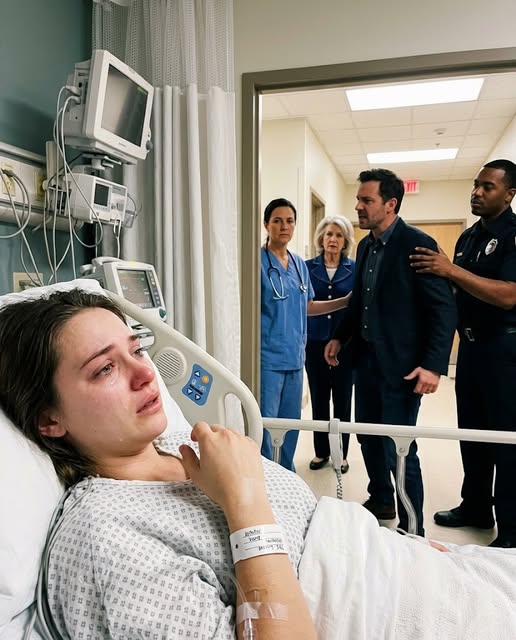
Then it became something else.
The contractions were wrong.
Too sharp.
Too constant.
There was pressure in my chest.
Dizziness.
A horrible sense that my body was slipping away from me while everyone kept telling me to breathe, to stay calm, to trust the process.
I remember telling the nurse, “Something’s wrong.”
She looked at the monitor, called in another nurse, and within seconds the room filled.
A doctor checked me.
Another looked at the baby’s heart tracing.
Someone said, “We’re losing time.”
Someone else said, “Page OR now.”
After that, the memory breaks apart into fragments.
The ceiling lights racing overhead as they pushed my bed down the hall.
The cold blast of air inside the operating room.
A nurse asking my name and date of birth.
A doctor saying, “Madison, stay with us.”
The sound of Ethan’s shoes on the floor as he was brought in behind me.
Even then, some stubborn, hopeful part of me relaxed when I knew he was there.
No matter how frightened I was, I believed my husband’s voice would anchor me.
We had been married three years.
We had painted a nursery together.
We had spent weekends arguing over strollers and laughing over baby names.
I had held onto those small domestic memories like proof that whatever anxieties pregnancy had stirred up in his family, Ethan and I were solid underneath all of it.
I was wrong.
The doctor was focused on my failing vitals when Ethan asked his question.
“Is the baby a boy or a girl?”
The surgeon did not even look at him.
“Your wife is crashing,” he snapped.
“This is not the question right now.”
There was a pause, and for one foolish second I thought shame might stop Ethan from speaking again.
Instead he said, calm and clear, “If it’s my son, save him first.
My wife can wait.”
My son.
Not our baby.
Not the baby.
Not even if it’s a boy.
My son.
As if I were just the vessel meant to deliver him a legacy.
As if my life were negotiable.
Pain has a strange way of sharpening truth.
Even through the medication, even with my body failing beneath the hands trying to save me, I felt something inside me split wide open.
It was not only hurt.
It was recognition.
A hundred moments from the last nine months suddenly rearranged themselves into something ugly and undeniable.
My mother-in-law, Diane, had never hidden what she wanted.
“The family name must continue,” she said the first time we told her I was pregnant.
She had clasped both my hands at dinner as if she were blessing me, but her smile had been fixed too tightly to be warmth.
“You’re giving this family such a gift,” she said.
“Imagine Ethan with a son.”
I laughed awkwardly and said, “Or a daughter.”
Diane’s expression barely changed.
“Of course.
Healthy is what matters.” Then she added, almost as an afterthought, “But Ethan was always meant to have a boy.”
From then on, it became a constant refrain.
She bought blue blankets before we knew the sex.
She sent me links to articles about raising strong boys.
She showed me baby photos of Ethan’s father and grandfather and joked that the next man in line was already on his way.
At family gatherings, she called my stomach “our little heir” and laughed if I looked uncomfortable.
“As long as you give Ethan a healthy boy,” she told me once, placing a hand over my belly without asking, “nothing else matters.”
I looked at Ethan, expecting him to correct her, to tell her that I mattered, that any baby of ours would be loved.
He only smiled weakly and changed the subject.
At the time, I told myself he hated conflict.
Ethan had always been quiet around his mother.
Diane was a woman who managed a room by force of will.
She did not raise her voice often because she did not need to.
She was the kind of person whose approval had become oxygen to everyone around her, especially her son.
I mistook his silence for discomfort.
What I did not understand was that silence can also be agreement.
Back in the operating room, the staff heard it too.
One doctor said, “That is not how this works.”
A nurse near my head muttered, “Oh my God.”
Someone told Ethan to step back.
I tried to speak, tried to say his name or tell them I was still conscious, but my mouth would not cooperate.
My arms felt pinned to the table by gravity.
I could hear everything and do nothing.
The betrayal of that helplessness was almost worse than the fear.
The man who had promised to love me in sickness and in health had announced my worth in front of a room full of strangers.
I ranked beneath a son he did not even know existed.
Beneath a fantasy.
Beneath his mother’s obsession with bloodlines and names and some ridiculous medieval idea of inheritance.
The monitor beside me began to shriek faster.
A nurse leaned close, eyes fierce over her mask.
“Stay with us, Madison.”
And in that instant, a cold kind of clarity came over me.
I would survive.
Not for Ethan.
Not to keep my marriage alive.
Not because I owed anyone grace.
I would survive because if I lived, he would never be allowed to pretend I had misunderstood him.
He would not get to tell me later that he panicked.
He would not soften it into a joke or blame his mother or call it stress.
Every person in that room had heard him.
His own words had witnesses.
The lead surgeon turned toward the door.
“Get him out of this OR.
Now.”
I heard Ethan start protesting.
“That’s not what I meant—”
But no one was listening anymore.
There was a scrape of shoes, a clipped command for security, the swish of the door opening and closing, and then his voice disappeared down the hallway.
I remember nothing after that except fragments of darkness.
When I woke, the room was dim and quiet.
Recovery.
My throat was dry.
My abdomen ached with a deep, brutal soreness.
For a moment I did not know where I was.
Then memory rushed back so hard it made me nauseous.
I turned my head.
The first person beside my bed was not Ethan.
It was the lead surgeon, Dr.
Herrera.
He had removed his cap, and fatigue lined his face, but his eyes were steady.
“You’re awake,” he said.
My lips barely moved.
“Baby?”
A small, rare softness touched his expression.
“Your baby is alive.
Stable.
Healthy.”
I started crying before I could stop myself.
Relief hit me so hard my whole body shook.
Dr.
Herrera handed me a tissue and waited until I could breathe again.
Then I asked, “Boy or girl?”
He gave me the smallest hint of a smile.
“A girl.”
A girl.
The word settled over me with unexpected warmth.
Not because it would wound Ethan, though at that moment part of me was too angry to deny that satisfaction.
But because she was here.
She was real.
She was mine.
And for one suspended moment, the ugliness outside the room could not touch the simple fact of her existence.
“My daughter,” I whispered.
Dr.
Herrera nodded.
“Your daughter.”
Then his face changed again, becoming careful.
“There are some things you need to know before anyone sees you,” he said.
My stomach tightened.
“Ethan?”
He folded his hands.
“Security removed him from the OR.
Your mother-in-law arrived shortly after.
There was an incident.”
I looked at him, waiting.
“A nurse documented what your husband said in surgery,” he continued.
“Standard incident reporting.
More than one staff member corroborated it.
When your mother-in-law arrived, she demanded to know whether the baby was male.
She was informed that both you and the baby were in surgery and that no information would be released until you were stable.”
I could already imagine Diane’s response: outrage disguised as concern.
Dr.
Herrera’s jaw tightened.
“She kept pressing.
Loudly.
Ethan began insisting he had a right to know first because he was the father.
Then he told a nurse that if the baby was a girl, she should ‘focus on my wife and not waste time acting like it’s good news.’”
For a second I thought I had misheard him.
My voice came out hoarse.
“He said that?”
Dr.
Herrera held my gaze.
“Yes.”
Something cold moved through me, colder even than the operating room had been.
It was one thing to hear him choose a hypothetical son over me in a crisis.
It was another to realize that a daughter—our daughter—was already less than a son in his eyes.
The door opened softly and a nurse stepped in holding a bundled newborn.
Everything else vanished.
She placed the baby in my arms with the practiced tenderness of
someone who had witnessed too much pain and knew the importance of gentleness.
My daughter was tiny and warm and impossibly soft.
Dark hair damp against her head.
Rosebud mouth.
One fist tucked under her chin.
I stared at her in silence, overwhelmed by a love so sudden and total it made the room tilt.
“Hi,” I whispered.
“Hi, baby girl.”
Her eyelids fluttered but did not open.
I cried again, quieter this time, from somewhere deeper.
Dr.
Herrera stepped back to give us privacy, but before he left, he said, “There’s a hospital administrator outside who would like to speak with you when you’re ready.
And a social worker.”
That made me look up.
“Why a social worker?”
He did not answer immediately.
“Because of what happened after they learned the baby was female.”
After a few minutes, a woman in a navy suit entered with a badge clipped to her jacket.
She introduced herself as Karen Lowell from hospital administration.
The social worker, Tasha, stood beside her with a folder in her arms and the kind of calm face meant for fragile moments.
Karen spoke first.
“Mrs.
Cole, I need to make sure you hear this clearly.
Your husband is not being allowed into recovery at this time.”
I adjusted my daughter against my chest.
“Because of what he said?”
Karen exchanged a glance with Tasha.
“Because of what he said and because of what he attempted to do afterward.”
The room went still.
Karen opened the folder.
“When nursing staff confirmed that the baby was a girl, your husband became agitated.
According to multiple witnesses, he accused the team of making a mistake and demanded a paternity test.”
The insult hit me with almost comic force.
I laughed once, a broken, disbelieving sound.
“Of course he did.”
Tasha’s expression softened.
“I’m sorry.”
Karen continued.
“Your mother-in-law then stated that the hospital had ‘failed their family twice’ and tried to enter the nursery without authorization.
Security intervened.
During that confrontation, your husband attempted to override your chart restrictions by claiming you would want him to sign whatever was necessary for the baby’s discharge.”
I looked down at my daughter, suddenly nauseated again.
“He tried to take her?”
“Not successfully,” Karen said firmly.
“No forms were processed.
No access was granted.
But given the circumstances, the staff locked down your file and restricted visitors until you could make decisions yourself.”
The enormity of it settled over me in layers.
While I was unconscious from emergency surgery, Ethan had heard his daughter existed and responded not with relief, not with joy, not even with disappointment spoken privately, but with suspicion and control.
He had questioned whether she was his.
He had tried to leverage my medical incapacitation.
And Diane had behaved as if the birth of a healthy baby girl were a personal affront.
The room suddenly made sense in a brutal new way.
This was not about one horrible sentence under stress.
It was not about panic.
It was not about a man saying the wrong thing at the worst possible time.
It was about character.
And character does not suddenly appear in crisis.
Crisis reveals it.
Tasha asked gently, “Do you feel safe having him here?”
I looked at my daughter.
No.
The answer arrived before the question
finished echoing.
“No,” I said.
That single word felt like the first honest thing I had said in months.
They moved quickly after that.
Visitor restrictions were updated.
My room number was hidden.
A note was added to my chart that no information was to be released to Ethan or Diane without my direct consent.
Tasha helped me call my older sister, Claire, because suddenly I could not bear the idea of facing another minute of this alone.
Claire arrived forty minutes later, still in scrubs from her own shift at the dental office, hair falling loose from a rushed ponytail.
The second she saw me in the bed with the baby in my arms, she burst into tears.
Then she saw my face and the tears disappeared.
“What did he do?” she asked.
I told her.
Not all at once.
In pieces.
The question.
The son comment.
The paternity accusation.
Diane.
The attempted paperwork.
Claire stood there listening with both hands over her mouth.
When I finished, she leaned over, kissed my forehead, and said very quietly, “You are never going back to him.”
It was not a question.
“No,” I said.
And somehow saying it to someone who loved me made it real.
The next morning Ethan found a way to call the hospital room phone from an outside line.
Claire answered before I could.
I could hear him anyway, his voice raised and frantic through the receiver.
“She’s turning you against me,” Claire said flatly.
“No, Ethan.
You did that yourself.”
Then she put the call on speaker and looked at me.
I nodded.
“Madison,” Ethan said, shifting instantly into the soft tone he used whenever he wanted to sound reasonable.
“You know I didn’t mean it like that.
I was scared.
My mom was upset.
Everyone’s twisting everything.”
I felt something close to serenity then, the kind that arrives when illusion finally dies.
“Did you ask if I was okay?” I asked.
Silence.
“Did you tell a nurse not to act like it was good news if the baby was a girl?”
Another silence.
“Did you accuse me of cheating because our child is a daughter?”
“Madison, listen—”
I closed my eyes.
There it was.
Not denial.
Not even enough conviction to lie cleanly.
Just the desperate scramble of a man who had counted on me wanting his explanation more than I wanted the truth.
“I heard you in the OR,” I said.
“So did everyone else.”
“Baby, I was panicking.”
“Do not call me baby.”
He inhaled sharply.
For the first time in our relationship, I did not rush to soothe him.
“There is no version of panic that makes a good man say, ‘My wife can wait,’” I said.
“There is no version of fear that makes a father reject his daughter before he sees her face.”
He started crying then, or tried to sound like he was.
Apologies spilled out in frantic waves.
He loved me.
He loved the baby.
Diane had gotten into his head.
He had not slept.
He had been terrified of losing everything.
That line almost made me laugh.
Terrified of losing everything.
He had said that after nearly letting me die for a son who did not exist.
“You already lost everything,” I said.
Then I handed the
phone back to Claire.
I never spoke to him privately again.
In the weeks that followed, the truth traveled faster than Ethan could manage it.
Hospitals document more than people realize.
Staff talk to supervisors.
Incident reports exist.
Security footage exists.
Witness statements exist.
The careful, polished image Diane guarded so fiercely for their family began to crack.
Ethan tried first to say there had been a misunderstanding.
Then he said the hospital staff were biased.
Then he claimed he had been denied access to his child unfairly.
But each version collapsed under the weight of the next fact.
My attorney used the hospital documentation to secure temporary protective terms around visitation until a formal custody arrangement could be evaluated.
Claire moved me into her house for the first month after discharge.
Tasha connected me with a postpartum counselor who helped me untangle the trauma of the birth from the betrayal that followed it.
And my daughter—Lila, because the name fit her the instant I saw her—grew stronger every day.
The first time she opened her eyes and looked right at me, I understood something with absolute certainty: she had arrived in the middle of violence she would never remember, and it was my job to make sure the rest of her life felt different.
Steady.
Safe.
Wanted.
Months later, Ethan saw her in a supervised setting for the first time.
He cried when he held her.
I watched from across the room, not with satisfaction and not with grief exactly, but with the strange distance reserved for people who have become unrecognizable.
Maybe he loved her then.
Maybe he had always been capable of loving her once she was no longer theoretical.
But love after contempt is not redemption.
Regret after exposure is not character.
Diane never apologized.
She sent one letter full of injured pride, explaining that families say unfortunate things under stress and that I should not punish a child by breaking her home.
There was not one line in that letter asking how close I had come to dying.
I shredded it without answering.
Sometimes people ask when I knew the marriage was over.
Not when Ethan chose a son over me, though that was the moment it cracked beyond repair.
Not when he doubted our daughter was his.
Not even when he tried to use my unconscious body to gain control.
I knew for certain when I held Lila in recovery and realized that the smallest person in the room had already shown more innocence, more truth, and more worth than the adults who had built their lives around power and bloodlines.
That was the moment the fear left.
I had almost died giving birth.
What I got back was not the family I thought I had.
It was something better: a daughter who taught me, on the first day of her life, exactly what should never be bargained away.
Even now, when I think back to that operating room, I remember the terror.
I remember the monitors and the oxygen mask and the sharp edge of betrayal cutting through the haze.
But I also remember the nurse who told me to stay with them.
I remember Dr.
Herrera sending Ethan out.
I remember the women who locked my chart, protected my room, and believed
what I heard before anyone had the chance to minimize it.
And sometimes I still wonder what the biggest red flag really was.
Was it Diane’s obsession with a grandson? Ethan’s silence every time she reduced me to a womb? The way he reached for legacy before love? Or was it mine—the instinct to excuse what made me uncomfortable because I wanted harmony more than truth?
I know this much: forgiveness is meaningless when it asks a woman to forget the moment she learned exactly how disposable she was to someone else.
Ethan lost the family he thought he was entitled to.
I left the hospital with the only family I needed.