Valeria’s knees buckled.
I caught her before her head hit the sink.
Her skin burned under my hands, but she was shivering hard enough to make her teeth click together. The bathroom light buzzed overhead while Hector stood in the doorway with his arms crossed like we were inconveniencing him.
“She needs a doctor,” I said again.
“She needs sleep.”
Then Valeria made a sound I had never heard from her before.
Not crying.
Not pain.
Fear.
Pure animal fear.
“Mom…” she whispered.
Her fingers grabbed my wrist with shocking strength. Her nails dug into my skin.
“Please don’t leave me alone.”
Something inside me cracked.
Not loudly. Quietly. Like ice splitting under too much weight.
Hector rolled his eyes and walked away toward the bedroom. “Do whatever you want,” he muttered. “But don’t expect me to waste money on nonsense.”
The bedroom door slammed.
Valeria flinched so violently she nearly fell again.
That was the moment I stopped lying to myself.
Sick children do not react to footsteps like hunted animals unless something deeper is terribly wrong.
I wrapped her in a sweatshirt, grabbed my purse, and led her to the car.
Hector never came out to help.
Rain drizzled across the windshield as I drove through empty streets toward Mercy General Hospital. Valeria sat curled against the passenger door holding her stomach, breathing in tiny shallow gasps.
Every red light felt criminal.
I kept glancing at her.
At first I thought she was trying not to cry.
Then I realized she was trying not to speak.
“Sweetheart,” I said softly, “talk to me.”
She shook her head immediately.
Too quickly.
Like answering itself was dangerous.
My chest tightened.
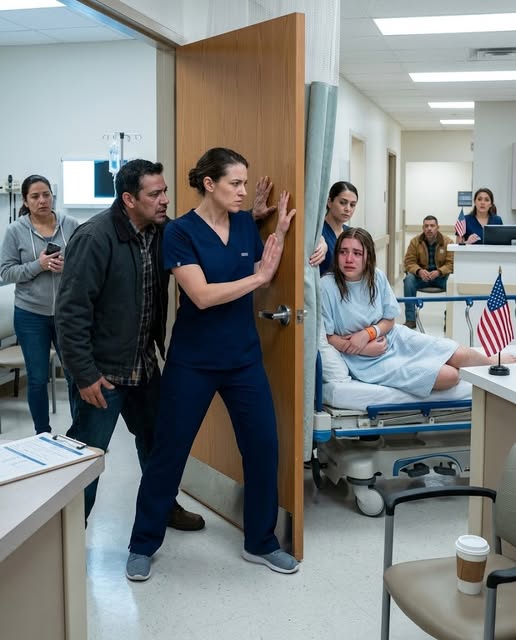
The emergency room smelled like disinfectant, coffee, and exhaustion. A television mounted in the corner played muted news while a toddler cried somewhere behind the intake desk.
The nurse took one look at Valeria and brought us back immediately.
Her fever had climbed higher.
Blood pressure elevated.
Pulse racing.
“How long has she been vomiting?” the nurse asked.
“Three days.”
The woman’s expression changed for half a second.
Not judgment exactly.
Recognition.
She had seen mothers like me before. Women who arrived late because somebody at home kept convincing them they were overreacting.
A doctor pressed gently against Valeria’s abdomen.
The scream that tore out of her made everyone in the room freeze.
She jerked backward so violently the monitor leads snapped loose from her chest.
And then she shouted it.
“He knows why it hurts!”
Silence.
The doctor looked at me.
The nurse looked at me.
Valeria started sobbing instantly after the words left her mouth, as if she wanted to drag them back inside herself.
“Valeria,” I whispered. “What do you mean?”
She covered her face.
“No no no no…”
The doctor’s voice became calm in a way that made my pulse spike. “Mrs. Alvarez, I need you to step outside for a moment.”
“I’m her mother.”
“I know. I just need to ask her some questions privately.”
My stomach dropped.
There are moments when your body understands reality before your mind does.
I stepped into the hallway.
The door closed.
I could still hear muffled voices inside.
Questions.
Long silences.
Then crying.
Not normal crying.
The kind that sounds torn out of someone.
A female social worker appeared beside me twenty minutes later. I had not even seen her arrive.
“Mrs. Alvarez,” she said gently, “is there anyone you trust that you can call?”
My mouth went dry.
“What’s happening?”
She hesitated carefully.
“We believe your daughter may have experienced sexual abuse.”
The hallway tilted.
“No,” I whispered automatically.
Not because I didn’t believe it.
Because suddenly too many things made sense.
The fear.
The silence.
The way Valeria stopped wearing shorts around the house two years ago.
The way she locked her bedroom door even during the day.
The nightmares.
The stomachaches.
The shrinking.
God.
The shrinking.
My knees gave out, and I sat hard in the plastic chair against the wall.
The social worker crouched beside me.
“She disclosed that her father has been entering her room at night.”
I could not breathe.
Everything inside my head began rearranging itself into something monstrous.
Every time Hector insisted I was too emotional.
Every time he sent me to the store late at night.
Every time Valeria suddenly became “difficult” after her thirteenth birthday.
The memories came like shattered glass.
And the worst part was this:
A part of me had seen it already.
Not clearly.
But enough.
Mothers know when something is wrong.
I had simply learned to distrust myself before I learned to protect my child.
“What happened to her?” I whispered.
The social worker glanced toward the room.
“The doctor believes she may have an internal infection related to repeated assault.”
Repeated.
The word nearly stopped my heart.
Not once.
Not a mistake.
A pattern.
A life.
My daughter had been living inside terror while I folded laundry ten feet away pretending our family was normal.
I pressed both hands over my mouth to stop myself from screaming.
The doctor came out an hour later.
Her expression was careful.
“We’re admitting Valeria tonight. She has a severe pelvic infection, and we need additional imaging and blood work. Police officers are also on their way to take a statement.”
Police.
The word cut through the fog.
Hector.
Home alone.
Free.
I stood so fast the chair screeched backward.
“My husband doesn’t know she said anything.”
The social worker nodded once. “Do you believe your daughter is safe if he learns?”
No.
The answer arrived instantly.
Not safe.
Never safe.
How had I not seen it sooner?
Then another horrible thought struck me.
“What if he comes here?”
The nurse at the station immediately picked up the phone. “We’ll notify security.”
I walked back into Valeria’s room slowly.
She looked impossibly small in the hospital bed. IV tubing snaked from her arm, and her cheeks were wet with tears.
When she saw me, panic flashed across her face.
“I’m sorry,” she blurted. “I’m sorry I said it—”
“No.”
I rushed to her side.
“No, baby. No.”
She started crying harder.
“I didn’t want to ruin everything.”
Ruin.
That word.
Children from healthy homes do not think telling the truth ruins families.
Someone teaches them that honesty is destruction.
I sat on the edge of the bed and held her carefully while she shook.
“You didn’t ruin anything,” I whispered into her hair. “He did.”
For a long time neither of us spoke.
Then, very quietly, she asked the question that split me open completely.
“Why didn’t you notice?”
There is no defense against a question like that.
Because she was right.
I should have noticed.
Not every detail.
Not every secret.
But enough.
Enough to ask harder questions.
Enough to stop dismissing the fear in her eyes.
Enough to choose my daughter over my husband’s anger.
Instead I had spent years surviving Hector instead of confronting him.
And survival has a price.
Sometimes your child pays it.
Tears blurred my vision.
“I was scared,” I admitted.
Valeria stared at the blanket.
“He said nobody would believe me because you always take his side.”
I felt physically sick.
Because he was right.
Not completely.
But enough.
Enough times.
Enough silence.
Enough hesitation.
Predators do not only groom children.
They groom entire households.
By dawn, two detectives had arrived.
One spoke gently with Valeria while the other took my statement in a quiet consultation room.
“Has your husband ever been violent with you?”
“Yes.”
The word surprised even me.
I had never said it aloud before.
Not really.
Not honestly.
“He controls money,” I continued shakily. “He monitors our phones. He gets angry if we lock doors. Sometimes he…”
I stopped.
The detective waited.
“Sometimes he breaks things near us.”
Not us.
Me.
Her.
The detective wrote carefully.
“When did you first suspect something inappropriate?”
I opened my mouth.
Nothing came out.
Because suspicion is complicated.
Sometimes it is not a thought.
Sometimes it is a feeling you bury repeatedly because accepting it would destroy your entire life.
“There were signs,” I whispered.
The detective nodded slowly, not unkindly.
“That happens more often than people think.”
Morning light crept through the hospital blinds when my phone began vibrating.
Hector.
Again.
Again.
Again.
Twenty-three missed calls.
Then a voicemail.
“Where the hell are you?”
Another.
“You’re poisoning her against me.”
Another.
“If you don’t bring my daughter home right now, I swear to God—”
I handed the phone to the detective.
He listened quietly.
His expression hardened.
“Do not answer him.”
At 9:14 a.m., officers went to our house.
At 9:42, Hector was arrested.
I expected relief.
Instead I felt grief so heavy it nearly crushed me.
Not grief for him.
For the life I thought I had.
For every year spent adapting myself around cruelty until cruelty felt ordinary.
For every time Valeria looked to me for protection and found hesitation instead.
The social worker arranged temporary housing for us before discharge. Hector was denied contact pending investigation.
Three days later, I returned home with a police escort to collect belongings.
The house looked exactly the same.
That was the horrifying part.
The couch cushions still sat crooked the way Hector liked them.
Coffee grounds remained in the kitchen sink.
His jacket hung over the dining chair.
Normal objects.
Normal rooms.
Meanwhile my entire reality had split open underneath them.
I entered Valeria’s bedroom carefully.
Stuffed animals lined the shelf beside textbooks and dried nail polish bottles. A sweatshirt lay crumpled across the bed.
Fifteen years old.
There should have been dances and homework and arguments about curfew.
Not trauma interviews.
Not pelvic infections.
Not fear of footsteps.
I opened her closet to grab clothes.
And found the lock.
Small.
Silver.
Hidden behind shoe boxes.
A sliding latch designed for the inside of a door.
My hand flew to my mouth.
She had tried to protect herself.
She had been trying to survive inside that house while I kept asking her to “be patient with your father.”
I sank onto the floor holding that tiny lock and cried so hard I could barely breathe.
Later that night, in the shelter apartment, Valeria sat beside the window wrapped in a blanket.
Neither of us knew how to talk normally anymore.
Trauma changes the shape of conversation.
Finally she asked quietly, “Are you mad at me?”
I turned toward her so fast it hurt.
“Mad at you?”
She stared down at her hands.
“He said if anyone found out, you’d hate me.”
I crossed the room immediately and knelt in front of her.
“Listen to me carefully.”
Her eyes lifted slowly.
“The only person responsible for this is him.”
She started crying again, silent tears sliding down her cheeks.
“I tried to tell him to stop.”
Rage flooded me so fiercely I almost shook.
Not at her.
At him.
At the man who taught a child that resistance was useless.
I held her face gently.
“You survived,” I whispered. “Do you understand me? You survived.”
For the first time in days, she leaned into me instead of flinching away.
And I realized healing does not begin with forgiveness.
It begins with finally telling the truth out loud.
Weeks later, detectives uncovered hidden recordings on Hector’s laptop.
There were other victims.
The courtroom months afterward felt cold enough to preserve death itself.
Hector never looked at me during sentencing.
But he looked at Valeria.
One final attempt at power.
She stared back without lowering her eyes.
And that was when I understood something important:
He had not destroyed her.
Wounded her deeply, yes.
Changed her forever, yes.
But not destroyed her.
Because survivors are not the fragile things predators believe them to be.
When the judge announced thirty-two years, Hector’s shoulders finally sagged for the first time since his arrest.
Not from remorse.
From defeat.
Outside the courthouse, reporters waited near the steps.
Valeria squeezed my hand once.
“Can we just go home?” she asked.
Home.
The word hurt.
Because we did not really have one anymore.
Not yet.
But I looked at my daughter standing in sunlight without fear in her eyes for the first time in years, and I realized something else.
A house is not home if terror lives there.
Sometimes home begins the moment terror leaves.