A terrified little girl ran into my cornfield to escape her kidnapper, but he didn’t realize my rescue dog and thirty tons of farm equipment were waiting for him.
Briscoe never growled. My timid, abused rescue bloodhound usually hid behind my legs at the slightest noise, but right now, he was planted like a statue. A deep, vibrating snarl rumbled from his chest as he stared into the unharvested corn.
I dropped my fence tools and ran. The dry stalks violently parted, and a tiny, barefoot girl collapsed into the dirt, gasping for air.
Briscoe didn’t attack. Instead, he bolted forward and laid his heavy body over the shivering child, hiding her beneath his loose skin and floppy ears.
She grabbed him like a lifeline, her eyes wide with absolute terror. Before I could speak, a massive luxury recreational vehicle skidded to a halt on my private dirt road.
A man in a crisp polo shirt stepped out, completely calm. “Lorelei, sweetheart,” he called out, his voice smooth. “I’m so sorry, sir. My niece missed her medication and runs away when she’s confused.”
It was a perfect, practiced lie. But Lorelei let out a primal scream and tried to dig herself deeper into the soil behind my dog.
Briscoe stepped between them. The dog who was afraid of his own shadow bared his teeth, raising every hair on his back, and let out a vicious roar.
Dogs don’t care about polite smiles. They see straight to the core, and my rescue dog was looking at pure evil.
“Step back to your vehicle,” I said, gripping my wrench. “You are trespassing on private property, and this child isn’t going anywhere until the sheriff arrives.”
The man’s fake smile vanished. He threatened to call the police himself, claiming I was interfering with family matters.
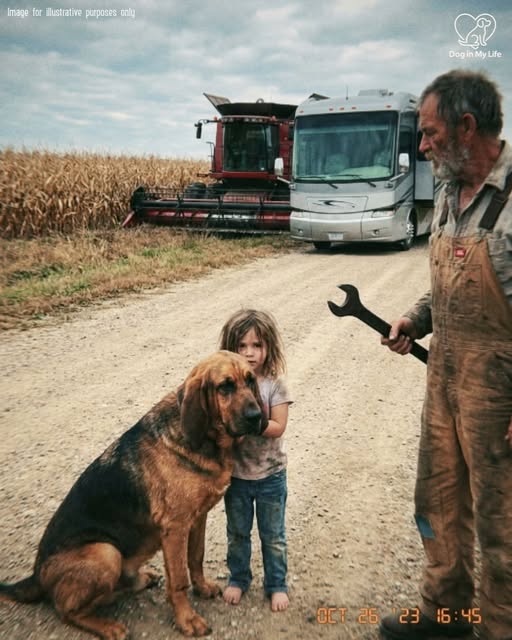
“Good,” I replied, grabbing my CB radio. “Let’s speed them up.”
I keyed the microphone, broadcasting to every farmer in the valley. “This is Gideon on channel nine. I need law enforcement at the north boundary gate, and I need the private road blocked. Now.”
The man cursed and ran for his RV, throwing it into reverse. But he had driven a half-mile down my single-lane farm path, and turning a massive vehicle around took time.
Before he could manage a three-point turn, the ground began to shake. Over the ridge, three massive combine harvesters crested the hill, side by side.
These weren’t regular tractors. These were thirty-ton machines, twenty feet wide, taking up every inch of the path.
My neighbor, Big Dan, parked his combine right at my property line, legally sealing the only exit. Two more tractors pulled up behind him, forming an absolute wall of American steel.
The farmers didn’t yell or threaten. They just climbed out of their cabs and stood peacefully on our side of the property line, waiting for the authorities.
The man was trapped. He locked his doors and paced inside his vehicle, completely cornered by the silent, towering machines.
The sheriff arrived just ten minutes later with lights flashing. Deputies immediately ordered the man out of his vehicle and separated him for questioning.
I wrapped my flannel shirt around Lorelei. She told the female deputy everything—how she was taken from a playground, and how the man lied about her mother.
As the officers ran the man’s information, Briscoe suddenly pulled away from us. He trotted straight over to the RV and crawled underneath the chassis.
He started scratching furiously at the metal undercarriage, whining and barking until his paws were muddy.
“Sheriff,” I called out. “My dog is a rescue. He’s trying to tell you something is under there.”
The sheriff knelt in the dirt with his flashlight. He spotted a hidden seam beneath the floorboards and instantly radioed for the fire department’s rescue tools.
Using legal search protocols, the authorities pried open the custom-built, concealed compartment. The discovery left everyone speechless.
Inside, terrified but alive, were three more missing children.
The man had been using the luxury vehicle to blend in on rural highways, assuming farmers would just mind their own business. He severely underestimated us.
Paramedics arrived to treat the children, and Lorelei rushed back over to me before getting into the ambulance. She threw her arms around my waist, then knelt down to bury her face in Briscoe’s neck.
The vicious protector was gone. He was just a good boy again, gently licking her tears.
That afternoon changed our entire valley. The farmers realized we cover millions of acres that law enforcement simply doesn’t have the manpower to patrol.
We formed a completely legal, volunteer neighborhood watch network using our CB radios. We don’t act as vigilantes; we act as extra eyes and ears for the authorities.
When an alert goes out, the tractors stop. Thousands of eyes turn to the lonely country roads, the rest stops, and the empty highways.
Lorelei is twelve years old now, safe and thriving with her family. Every year, they drive out to my farm with a giant steak from the local butcher.
She feeds it directly to Briscoe—the broken rescue dog who saved four lives because he knew the difference between a friendly smile and a monster.
We are out here every single day. We watch the tree lines, and we let our dogs lead the way.
The second time Briscoe saved a child, the whole valley almost got it wrong.
That is the part people don’t like to hear.
They like the clean version.
They like the brave dog, the trapped monster, the harvesters lined up like a wall, and the sheriff arriving just in time.
They like believing good people always know exactly what to do.
But out here, on these lonely county roads, good and bad do not always arrive wearing name tags.
Sometimes fear pulls into your driveway in a dented old van.
Sometimes the person breaking the rules is not a monster.
Sometimes the child you are trying to save looks you straight in the eyes and begs you not to call the law.
And that is when a man finds out whether he believes in justice, or only in being right.
It happened the following October.
The corn was down by then.
The fields looked shaved and tired, all brown stubble and long shadows, with the smell of diesel still hanging in the air.
Briscoe was older.
His muzzle had gone gray around the edges, and his back legs took a little more time in the mornings.
But he still followed me to the north gate every day.
Slow, steady, faithful.
Like a prayer with paws.
Lorelei was twelve now.
She had grown taller, but she still had the same serious eyes.
The kind of eyes a child should never have to earn.
Every year, her family came back to my farm with a paper-wrapped steak from the local butcher.
Every year, Briscoe acted surprised, like he had not been waiting by the porch since sunrise.
That afternoon, Lorelei sat cross-legged in the grass while he ate from her hand.
She talked to him the way children talk to old dogs.
Soft.
Honest.
Without wasting words.
“You’re still my hero,” she whispered.
Briscoe chewed, blinked, and leaned his giant head against her knee.
I was leaning on the porch rail with a mug of coffee gone cold.
Her mother stood beside me, watching them.
She had the tired look of a woman who had learned that gratitude does not erase fear.
It just teaches fear where to sit.
“Every year,” she said quietly, “I tell myself I won’t cry.”
“Every year,” I said, “you do anyway.”
She laughed once and wiped under her eye.
Down by the barn, my CB radio crackled.
I heard static first.
Then Big Dan’s voice came through.
“Gideon, you on?”
I pushed off the railing.
“Go ahead.”
His voice had no joke in it.
That made me move faster.
“Got a vehicle stopped by the old feed road,” he said. “Gray passenger van. No plates on the back. Driver looks young. Two kids inside, maybe three.”
Lorelei’s mother went still.
Lorelei looked up from the grass.
Briscoe stopped chewing.
That dog had been half asleep one second before.
The next second, he was standing.
Not fast.
Not dramatic.
But certain.
His ears lifted.
His nose turned toward the north tree line.
The old dog heard something none of us heard.
I reached for the radio.
“Dan, do not approach. Repeat, do not approach. Call it in.”
“Already did,” Dan said. “Sheriff is twenty minutes out.”
Twenty minutes.
People in town think twenty minutes is short.
Out here, twenty minutes is a lifetime.
A vehicle can disappear into timber in two.
A child can be moved in one.
A bad decision can happen in half of one.
I grabbed my hat off the hook.
Lorelei’s mother caught my sleeve.
“Gideon.”
I looked at her.
She did not need to finish the sentence.
Her daughter had once crawled out of my cornfield barefoot and shaking.
The past was standing right there in the yard, breathing hard.
“I’ll follow protocol,” I told her.
She nodded, but her hand did not let go right away.
Lorelei stood too.
“I’m coming.”
“No,” her mother said at once.
Lorelei’s face changed.
Not angry.
Wounded.
“I know what scared kids look like,” she said.
That sentence landed harder than any argument.
Her mother closed her eyes.
I should have said no.
Any sensible man would have.
But there are some truths adults only recognize after children speak them.
“You stay in my truck,” I said. “Window up. Door locked. You do not get out unless I tell you.”
Lorelei nodded.
Her mother looked like she wanted to fight me and thank me at the same time.
Briscoe was already at the passenger door.
He looked back once.
Not asking permission.
Giving instructions.
We drove the farm road with the radio hissing between us.
Lorelei sat behind me, both hands folded tight in her lap.
Briscoe took the front seat, nose pressed to the cracked window.
His breath fogged the glass.
The closer we got to the old feed road, the more rigid he became.
But he did not growl.
That worried me.
When Briscoe sensed evil, he became stone.
This was different.
He whined.
Low.
Broken.
Like he was hearing a song only dogs remember.
The old feed road cut between two fallow fields and vanished toward a collapsed grain shed nobody used anymore.
I saw Big Dan’s combine first.
He had parked it in his own lane, not blocking the public road.
That mattered.
We had rules now.
Written rules.
Posted rules.
Sheriff-approved rules.
We observed.
We reported.
We protected property lines.
We did not chase.
We did not threaten.
We did not decide guilt from a window and a bad feeling.
That was the promise we made after Lorelei.
And that day, every one of us almost broke it.
The gray van sat fifty yards ahead.
It was old.
Rust along the wheel wells.
Tape holding part of the rear window.
No back plate.
One brake light hanging loose.
The engine was still running.
The driver’s door was open.
A girl stood beside it.
Not a woman.
A girl.
Maybe seventeen.
Maybe less.
She wore a faded green hoodie two sizes too big and mud on the knees of her jeans.
Her hair was pulled back with a rubber band.
One hand rested on the van door.
The other was wrapped around the wrist of a little boy.
The boy was maybe six.
His face was pale.
His backpack had cartoon planets on it, all scuffed and dirty.
Behind them, through the side window, I saw a smaller child curled under a blanket.
A little girl.
Four, maybe five.
Big Dan stood beside his combine.
His jaw was locked.
Two more neighbors were there already.
Mara Bell from the dairy road.
Cal Timmons from the south ridge.
All of them had radios.
All of them had phones.
All of them had the same look.
The look we wore when we remembered Lorelei crawling through my corn.
The young driver saw my truck and tightened her grip on the boy.
“Stay here,” I told Lorelei.
She didn’t answer.
I looked back.
“Lorelei.”
“I know,” she whispered.
Briscoe pushed his head against the door.
The second I opened it, he climbed down slowly and walked toward the van.
The girl flinched.
“Keep that dog away.”
Her voice was rough.
Not mean.
Exhausted.
I lifted both hands.
“He won’t hurt you.”
“That’s what people say right before something hurts you.”
No one moved.
Briscoe stopped ten feet from her.
He lowered his head.
The little boy stared at him.
Then the boy’s chin trembled.
“Dog,” he whispered.
The girl pulled him behind her.
“Don’t.”
Big Dan stepped forward.
“Miss, sheriff’s on the way. You need to stay right there.”
Her eyes snapped toward him.
“I didn’t do anything wrong.”
“Then staying won’t hurt,” Dan said.
Wrong thing to say.
I knew it the second it left his mouth.
Fear does not hear logic.
Fear hears cages.
The girl shoved the boy toward the open van door.
“I’m leaving.”
Three farmers shifted at once.
Not much.
Just boots in gravel.
Shoulders squaring.
Hands tightening.
But enough.
The girl saw it.
The little boy saw it.
The child under the blanket woke up and started crying.
And Briscoe did something I had never seen him do.
He walked past the girl.
Past the little boy.
Straight to the open side door.
Then he lay down on the gravel.
Not blocking.
Not guarding.
Just lying there.
A tired old bloodhound between the children and the whole frightened world.
The little girl under the blanket stopped crying.
Her tiny hand reached out from the dark of the van.
Briscoe lifted his head.
She touched one floppy ear.
The driver girl began to shake.
“Please,” she said.
One word.
That was all.
But it changed the air.
I stepped closer, slow.
“My name is Gideon.”
“I don’t care.”
“That’s fine.”
“I’m not going back.”
I stopped.
There it was.
Not I didn’t take them.
Not they’re mine.
Not you misunderstood.
I’m not going back.
Big Dan heard it too.
His face darkened.
“Gideon.”
I held up one hand.
“Miss,” I said, “what’s your name?”
She looked at the road behind us.
Counting exits.
There weren’t many.
“Kendra.”
“Those children with you, Kendra?”
Her jaw worked.
“My brother and sister.”
The little boy grabbed her hoodie.
“She is,” he said quickly. “She is. She’s our Kendra.”
Nobody breathed.
That was the first crack in our certainty.
Because monsters do not usually get defended like that.
Not by scared six-year-olds with dirty backpacks.
Mara Bell moved closer to the van window.
“Are you hurt, honey?” she asked the little girl.
Kendra snapped, “Don’t talk to her.”
Mara froze.
Kendra immediately looked ashamed, but shame did not soften her stance.
“She gets scared,” Kendra said. “Strangers make it worse.”
Big Dan muttered, “Convenient.”
Kendra heard him.
Her whole face closed.
The same way a barn door closes before a storm.
I turned to Dan.
“Back up.”
“I’m just saying—”
“I know what you’re saying. Back up.”
He did, but not happily.
That was the problem with our valley watch.
We had built it from goodness.
But goodness, when frightened, can become a hammer.
And to a scared child, even a good hammer looks like a weapon.
My radio crackled.
“Unit is twelve minutes out,” the dispatcher said.
Kendra heard it.
Her eyes filled with panic.
“No. No, no, no.”
She grabbed the little boy and tried to climb into the driver’s seat.
Briscoe did not move.
He just stayed there, body across the open door, heavy and sad.
The little girl inside the van wrapped both hands in his fur.
Kendra tugged at the boy.
“Sammy, get in.”
The boy did not move.
“Kendra,” he whispered, “I’m tired.”
Those three words broke her more than any accusation could have.
She bent over like someone had struck her.
Not from violence.
From the weight of carrying too much for too long.
“I know,” she said. “I know, buddy. I’m sorry.”
I stepped closer.
“Where were you going?”
She shook her head.
“Somewhere they wouldn’t find us.”
“Who?”
She bit her lip.
Then looked at the farmers.
Then at the phones.
One of Cal’s nephews had arrived on an ATV and was standing near the ditch, recording.
I didn’t notice at first.
Lorelei did.
She rolled down my truck window.
“Stop filming them.”
Everyone turned.
The boy with the phone blinked.
“What?”
Lorelei’s voice cut across the road.
“They’re scared kids. Stop filming.”
Cal looked embarrassed.
“Ty, put it down.”
The boy lowered the phone, but not before I saw the red recording light.
Kendra saw it too.
And whatever trust had started to form died right there.
“You’re putting us online?”
“No,” I said.
“She is a child,” Lorelei shouted from my truck. “All of them are.”
“Lorelei,” I warned.
“No,” she said, eyes blazing. “People did that to me too. They wanted my story. They wanted pictures. They wanted to feel good about crying.”
Her mother’s old pain came back through her voice.
Only she was not there to catch it.
Kendra stared at Lorelei.
For the first time, she looked at someone without suspicion.
“You were that girl,” Kendra said.
Lorelei swallowed.
“Yes.”
The little boy looked between them.
“What girl?”
Kendra did not answer.
I walked to Cal’s nephew.
“Delete it.”
He bristled.
“You can’t make me.”
He was right.
That was the hard part.
A man can own land.
He cannot own another man’s conscience.
“No,” I said. “I can’t.”
I looked toward the van.
“But you can decide what kind of person you want to be before the whole world helps you decide.”
The boy’s face flushed.
He stared at the phone.
Cal put a hand on his shoulder.
“Delete it, Ty.”
Ty looked at Kendra.
Then at the little boy.
Then at Lorelei.
His thumb moved.
“It’s gone,” he muttered.
Maybe it was.
Maybe it wasn’t.
That is the new kind of fear nobody warned us about.
A monster in a vehicle is one thing.
A frightened child on a screen is something else.
It can travel farther than any van.
And nobody can block every road it takes.
Kendra’s eyes were wet now, but she still stood like a guard dog.
“I didn’t steal them,” she said.
Nobody spoke.
“I know what everybody thinks. I know how this looks.”
She wiped her sleeve across her face.
“Our mom left us with people who were supposed to help. They didn’t. I called. I told adults. They said wait. They said forms. They said Monday.”
Her voice cracked on the last word.
“Monday is forever when kids are hungry.”
Mara covered her mouth.
Big Dan looked down.
Kendra kept talking, fast now, as if words were leaking out of a dam.
“I had a job at a roadside diner. Cash. Nothing fancy. I saved enough for gas. I knew a woman two counties over who said she could get us a room for a night. Not forever. Just one night.”
She pointed at the little girl.
“Tilly had a fever last night.”
The small child coughed.
Not dramatic.
Just a small, dry cough that made every adult on that road feel useless.
“I tried to buy medicine,” Kendra said. “They said I needed the right kind of permission. So I took them and left.”
Big Dan looked at me.
That was the moral cliff.
Every person there could feel it under their boots.
If she was telling the truth, she had broken rules to protect two children.
If she was lying, she was using compassion like a key.
And we had already seen what a practiced lie could do.
The first man had smiled.
He had said niece.
Medication.
Confused.
Family matter.
The perfect words.
We had learned not to trust smooth stories.
But Kendra’s story was not smooth.
It was jagged.
Messy.
Too specific in the places pain makes specific.
Still, truth is not something a farmer can declare from a ditch.
I looked at Briscoe.
He had his head resting on his paws.
Tilly’s hand remained buried in the loose skin of his neck.
He was not growling.
He was not warning.
He was anchoring.
That old dog was telling me something.
Not that Kendra was innocent.
Dogs do not understand court papers.
Not that every word was true.
Dogs cannot fact-check desperation.
He was telling me the children were not afraid of her.
They were afraid of losing her.
That mattered.
But it was not enough.
I crouched in the gravel so I was lower than Kendra.
“I believe you’re scared,” I said.
Her eyes narrowed.
“That’s not the same as believing me.”
“No. It’s not.”
She almost laughed.
Bitter.
“At least you’re honest.”
“I also believe those children need help beyond what you can carry alone.”
Her face hardened again.
“There it is.”
“Kendra—”
“No. I know that voice. That grown-up voice. The one that says help and means take.”
Sammy started crying silently.
No sound.
Just tears falling straight down his cheeks.
Lorelei opened my truck door.
“Stay in the truck,” I said.
She didn’t.
She walked toward us with her hands visible, like she had learned that from deputies years ago.
Her knees trembled.
But she kept walking.
Briscoe lifted his head.
Lorelei stopped beside him.
“I thought the same thing,” she told Kendra.
Kendra stared at her.
“The day I got found, I thought everyone was going to take something from me. My shoes were gone. My voice was gone. My whole life felt like it belonged to strangers.”
She touched Briscoe’s back.
“This dog gave me one minute where nobody pulled at me.”
Kendra’s face changed.
Just a little.
Lorelei looked at Sammy.
“Your brother looks like he needs more than one minute.”
Kendra covered her mouth.
The siren came faintly then.
Far down the road.
Not loud yet.
But close enough.
Kendra’s whole body reacted.
She reached for Sammy.
“No.”
I stood.
“Kendra, listen to me carefully. Nobody here is going to drag you. Nobody here is going to touch those children unless they need medical help. But if you run now, you turn fear into something that can hurt you in ways you don’t deserve.”
She shook her head.
“You don’t know what they’ll do.”
“You’re right. I don’t.”
“That’s supposed to help?”
“No. It’s supposed to be the truth.”
The siren grew louder.
Big Dan stepped beside me.
For a second, I worried he would say the wrong thing again.
But his voice came out softer than I had ever heard it.
“My wife used to keep a bag in the pantry,” he said.
Everyone looked at him.
Dan swallowed.
“Years ago. Before she met me. She had a little brother. She never told me the whole story. Just that sometimes kids pack bags because adults leave them no other language.”
Kendra’s lips parted.
Dan looked ashamed.
“I’m sorry I came at you like you were already guilty.”
That did not fix anything.
But it lowered the temperature of the road.
Sometimes that is all grace is at first.
A few degrees less heat.
The sheriff’s cruiser pulled up slow.
No tires screaming.
No dramatic dust cloud.
Just Sheriff Harlan stepping out with both hands visible and a female deputy coming around the other side.
They knew our network by then.
They also knew our worst habit.
We were good at showing up.
We were less good at stepping back.
Sheriff Harlan looked at me first.
“Gideon.”
“Sheriff.”
His eyes moved to the children.
To Kendra.
To Briscoe.
Then to the line of farmers.
“Everybody who is not directly involved, take six steps back.”
Big Dan moved at once.
So did Mara.
So did Cal.
That mattered too.
Authority is not only what you do when you lead.
It is what you do when you are told to move.
Kendra backed against the van.
“I didn’t hurt them.”
The female deputy spoke gently.
“My name is Deputy Rhea. I’m not reaching for you. I just want to check on the little ones.”
“No.”
“Kendra,” I said softly.
She looked at me like I had betrayed her already.
And maybe I had.
Maybe calling the sheriff felt like betrayal to a child who had already been failed by adults with clipboards and calm voices.
That is the part people argue about.
They still argue about it under every retelling.
Some say I should have let her go.
Some say I should have grabbed the keys.
Some say the law is the law.
Some say rules are easy to worship when you have never had to choose between a form and a hungry child.
I only know what I knew then.
Three kids were on a dirt road.
One was sick.
One was driving without being old enough to carry the consequences.
And one old dog was lying across a van door like his body was the last soft place in the county.
Sheriff Harlan crouched too.
He did not crowd her.
“Are these your siblings?”
Kendra nodded.
“Full names?”
She gave them.
Fast.
Like she had practiced.
“Your age?”
She hesitated.
“Seventeen.”
The sheriff’s face did not change.
“Are you their legal guardian?”
“No.”
The word fell into the gravel.
Small.
Fatal.
Sammy clung to her.
“She takes care of us.”
“I believe you,” Deputy Rhea said.
Kendra snapped, “Then let us leave.”
“That’s not how safety works,” the deputy said.
Kendra laughed through tears.
“That is exactly how everyone talks right before they separate us.”
Deputy Rhea absorbed that.
She did not get defensive.
That was why I liked her.
Some people listen only long enough to reload their authority.
She actually listened.
“Tilly needs a medic,” she said. “That comes first.”
Kendra looked at the little girl.
Tilly coughed again.
Briscoe licked her wrist.
Kendra’s face crumpled.
“She hates ambulances.”
“Then no siren unless needed,” Deputy Rhea said.
The sheriff nodded.
“No siren.”
Kendra looked like she did not know what to do with a concession.
The ambulance arrived five minutes later.
Generic white box.
No company markings anyone would recognize.
The medic stepped out with a bag and a kind face.
He did not rush.
He did not bark orders.
He asked Tilly if he could sit near Briscoe.
Tilly nodded from inside the van.
Briscoe stayed perfectly still while the medic checked her temperature and listened to her breathing.
The old dog who once shook at dropped buckets now held steady through radios, boots, strangers, and a frightened child’s fingers twisting his fur.
I stood there watching him, and my throat got tight.
People love to say we rescue dogs.
Sometimes that is true.
But sometimes we only open a door.
Then one day, they walk back through it carrying the best part of us in their teeth.
Tilly had a fever.
Not dangerous yet, the medic said.
But enough.
Dehydrated too.
Sammy had not eaten since morning.
Kendra had not eaten since the day before.
When Deputy Rhea said that out loud, Kendra looked offended.
Like hunger was private.
Mara Bell went to her truck and came back with a cooler.
Sandwiches.
Apples.
Bottled water.
Kendra refused at first.
Sammy did not.
He took a sandwich with both hands and looked at Kendra for permission.
She nodded.
That broke something in her.
She slid down the side of the van and sat in the gravel.
Not collapsing.
Not surrendering.
Just finally letting the earth hold what she could not.
Lorelei sat beside her.
Not too close.
Briscoe stayed with Tilly.
I expected Kendra to tell Lorelei to leave.
She didn’t.
After a while, she whispered, “Did they give you back to your mom?”
Lorelei nodded.
“Not right away. They had to ask questions first.”
Kendra flinched.
“But they didn’t punish me for being scared,” Lorelei said.
Kendra stared at her dirty shoes.
“I’m not scared.”
Lorelei looked at her.
Kendra’s mouth trembled.
“I can’t be.”
That sentence went through every adult there.
Because we all knew it.
The child who says I can’t be scared is usually the one who has been scared the longest.
Sheriff Harlan came over to me while Deputy Rhea made calls.
He kept his voice low.
“This is complicated.”
“Most true things are.”
He sighed.
“Records show there was a welfare check requested last month. No active missing child alert yet. Guardian reported them gone this morning.”
“Guardian safe?”
“Unknown.”
That word again.
Unknown.
The heaviest word in rural law enforcement.
Unknown road.
Unknown driver.
Unknown child.
Unknown truth.
People want clean categories.
Victim.
Villain.
Hero.
Criminal.
Out here, sometimes all you get is unknown and a crying kid.
The sheriff looked at Kendra.
“She drove them across county lines.”
“She fed them?”
“Looks like she tried.”
“She sick?”
“Tired. Underage. Terrified.”
He rubbed his forehead.
“I can’t ignore what she did.”
“I know.”
“I also can’t pretend I don’t see why.”
“I know that too.”
He looked at me then.
“You know folks are going to have opinions.”
I almost laughed.
“Folks had opinions when Noah built the boat.”
He didn’t smile.
“Your network is effective because it is trusted. If people think you are hiding kids from law enforcement, it’s over. If people think you are handing desperate kids back into danger, it’s over another way.”
There it was.
The second moral cliff.
Not Kendra’s.
Ours.
The valley watch had been born from one clear evil.
A man with a fake smile.
A hidden compartment.
Four children alive because neighbors acted.
But a community cannot survive on one story forever.
Eventually, it meets a situation that does not fit the legend.
And then it must choose what it really is.
A shield.
A mob.
Or a witness.
I looked at Briscoe.
Tilly had climbed halfway out of the van now and was sitting on the gravel with his head in her lap.
Sammy was feeding him pieces of crust.
Briscoe accepted each piece like it was sacred.
“You need a place to talk to them privately?” I asked.
The sheriff looked toward my barn.
“Warm?”
“Dry.”
“Good enough.”
I turned to the farmers.
“We’re moving to the barn. Nobody follows unless asked.”
Cal nodded.
Mara nodded.
Big Dan nodded.
Ty, the boy with the phone, looked like he wanted to disappear into his own boots.
“Ty,” I said.
His head snapped up.
“You want to make this right?”
“Yes, sir.”
“Run to the house. Tell Lorelei’s mother we need blankets, soup if she’s willing, and no questions shouted from the porch.”
He ran.
Sometimes young people need a job more than they need a lecture.
We moved slowly.
No one touched Kendra.
She walked with Sammy under one arm and Tilly wrapped in a blanket on Deputy Rhea’s other side.
Briscoe followed so close his nose brushed Tilly’s heel.
The barn smelled like hay, oil, and old wood.
I had never been more grateful for ordinary smells.
Ordinary is medicine after panic.
We set the kids near the workbench.
Mara brought a folding chair.
Dan found an old space heater and asked before turning it on.
Deputy Rhea sat on an overturned feed bucket instead of standing over Kendra.
Sheriff Harlan took off his hat.
That one small gesture changed everything.
He was still the sheriff.
But in that barn, he was also a man speaking to a child who had run out of road.
“We’re going to make calls,” he said. “We’re going to check facts. We’re going to get medical care handled. And we are going to keep you informed as much as we legally can.”
Kendra stared.
“Nobody ever tells us anything.”
“I’m telling you now.”
“Can you promise we stay together?”
The barn went silent.
That was the question.
The whole story lived inside it.
Sheriff Harlan did not answer too fast.
I respected him for that.
“I can promise I will tell the people who make placement decisions that separating you may cause harm. I can promise Deputy Rhea will document what she sees. I can promise Gideon and the others will be witnesses to how these children responded to you.”
Kendra’s eyes filled.
“But you can’t promise.”
“No,” he said. “I can’t.”
She looked away.
“I hate honest people.”
Lorelei almost smiled.
“Me too sometimes.”
For the next hour, the barn became something between a station house, a clinic, and a church basement………………………………………………………………

