The notification light on my phone blinked at 11:51 p.m., and for a moment it was the only thing in the cabin that looked alive.
Everything else was still.
The woodstove had burned down to a bed of orange coals.
My mug of tea sat on the side table, cooling beneath a skin of steam that had already started to disappear.
Outside, snow fell hard over the Colorado pines, the kind of thick mountain snow that does not flutter so much as occupy the air.
It swallowed distance.
It softened edges.
It made the world beyond the porch lights look unfinished.
My cabin was five miles above the county road, tucked into land I had bought with twelve years of work, careful saving, and a professional obsession with long-term risk.
People called it isolated.
I called it measurable.
The road was private.
The gate was locked.
The access codes were limited.
Everything about that property had been chosen because I had learned, slowly and expensively, that peace is not a mood.
It is a boundary with maintenance costs.
The phone blinked again.
I looked at it from across the room and felt my body go quiet in that old way.
Not afraid.
Prepared.
The message was from Holly.
Not Mom.
I had changed the contact two years earlier, sitting at my kitchen counter with one finger hovering over the edit button as if renaming her was somehow more disloyal than everything she had done.
Holly was her name.
Mom was a title she had used like a key.
Her text did not say hello.
It did not ask whether I was awake.
It read:
“Code isn’t working. Alexis is freezing. Open the gate.”
I read it once.
Then I read it again, slower, because the first pass gave me the facts and the second gave me the nerve.
Alexis was my younger sister.
Holly’s favorite.
Dad’s project.
The charming one.
The one whose disasters always came wrapped in language like stress, bad timing, unfairness, and family.
I set my tea down, picked up my tablet, and opened the security app.
The night-vision feed took half a second to load.
Static.
A pulse of green.
Then the bottom of my driveway appeared in grainy gray.
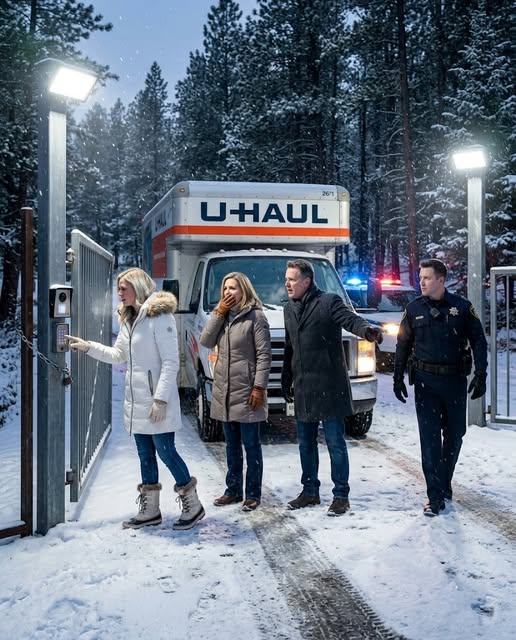
At the gate, five miles below me, Alexis stood hunched in front of the keypad.
She was wearing a fashionable white coat that probably cost more than some people’s monthly rent and had no business on a mountain road in May snow.
Snow had collected on her dark hair and shoulders.
Her boots kept slipping as she stomped her feet.
She leaned into the keypad and punched numbers with her whole hand, not typing so much as accusing.
Behind her sat a twenty-six-foot U-Haul moving truck.
That detail changed the entire room.
Not an SUV.
Not Dad’s pickup.
Not a rental car with two overnight bags and an apology waiting in the back seat.
A moving truck.
Its headlights bored through the snowfall.
Gray exhaust rolled from the rear and drifted into the trees.
The orange side marker lights glowed along the box like small warning signs.
Beside it, Alexander stood with his hands shoved into his coat pockets.
Alexander was Alexis’s husband, and in that camera feed he looked less like a partner than a man who had kept saying yes until yes became a crime scene.
I did not stand up.
I did not rush to the entryway.
I did not grab boots from the mat or a coat from the hook.
I watched.
There are moments when your life offers you a clean sentence.
This was one.
They had not come to visit.
They had come to move in.
My name is Julia Wells, and I work as a data actuary.
Most people hear that and think of spreadsheets, insurance tables, and the kind of math that makes dinner conversations die politely.
They are not wrong.
But the heart of my job is not numbers.
It is pattern recognition.
It is watching small variables become large outcomes because everyone in the room wanted to call them exceptions.
It is learning that risk rarely arrives wearing a name tag.
Sometimes it arrives at 11:51 p.m. in a U-Haul.
The old guest code had belonged to Holly.
Two years earlier, she had called me crying about Dad’s blood pressure.
She said she worried about the road.
She said if something happened and they could not reach me, she needed a way to get onto the property.
She said “emergency” three times.
The third time, her voice cracked.
I gave her a code because I was tired, because Dad really did have blood pressure problems, and because some part of me still believed that if I built enough rules around my family, they would respect the outline.
That was the mistake.
People who treat access as love do not hear “emergency only.”
They hear “mine too.”
On the feed, Alexis tried the code again.
The keypad blinked red.
She swore at the camera.
The audio was muted, but I did not need sound to understand the shape of her mouth.
Holly stepped into frame near the passenger side of the U-Haul.
Her taupe coat was buttoned badly, one side higher than the other.
She held her phone in one hand and kept looking up the road, toward the cabin she could not see, as if my refusal might appear between the pines and apologize.
Dad stood near the front of the truck.
He was talking with his hands.
He always did that when he wanted reality to feel negotiated.
Alexander stayed back.
That mattered.
Guilt has geography.
The person who knows the plan is wrong does not stand at the keypad.
He stands near the truck and hopes the camera cannot read posture.
My phone started ringing.
Holly.
I let it ring out.
Dad.
I let it ring out.
Alexis.
I let it ring out.
Then Holly again.
The sound filled the cabin and died against the wood walls.
I opened the smart-home administration panel.
Security.
Access Codes.
Guest Code: Holly.
The little trash can icon sat beside it, innocent and absolute.
My finger hovered for less than a second.
Then I tapped it.
Delete.
Confirm.
The change moved through the system instantly.
Buried cable under frozen ground.
Control panel at the gate.
Code table updated.
Access revoked.
Alexis typed the same numbers again.
Nothing.
She typed them again, harder.
Nothing.
Then she kicked the metal post so sharply that her boot skidded on the snow and she had to catch herself against the keypad.
I felt my jaw lock.
Not because I was afraid of her.
Because a younger version of me would have opened the gate at that exact second.
She would have opened it because Alexis was cold.
She would have opened it because Holly was crying.
She would have opened it because Dad would later say, “I can’t believe you left your sister in the snow.”
She would have opened it because in our family, discomfort traveled upward until it found Julia.
I had been the quiet one.
The reliable one.
The one with the savings account.
The one with the extra room.
The one who could drive three hours, cover the bill, stay calm, forgive the tone, and act grateful for being needed.
A family role can feel like love when you are young.
Then one day you realize it was a job you never applied for.
I did not open the gate.
Instead, I opened the call log.
Every missed call was timestamped.
I took screenshots.
Then I opened the security clip.
The system had already captured Alexis at the keypad, the U-Haul plate, Holly’s phone in her hand, Dad gesturing, Alexander standing back, and the failed attempts.
Evidence.
That word settled me more than any breathing exercise ever had.
Evidence did not ask whether I was being unkind.
Evidence did not care whether Holly had once packed my school lunch or Dad had taught me to ride a bike.
Evidence recorded who stood where, what they tried, and when they tried it.
On the screen, all four of them paused.
The scene held in the snowfall.
Alexis at the keypad.
Holly near the truck.
Dad facing the road.
Alexander looking down.
The U-Haul idling behind them with its box full of furniture or clothes or whatever version of a life they had decided would fit inside my boundaries.
Nobody moved.
That stillness was the first honest thing they had given me all night.
Then Dad stepped up to the intercom and pressed the button.
Inside my cabin, the chime sounded once.
I did not answer.
It sounded again.
I watched him lean close to the camera, his face distorted by the lens, his eyebrows drawn together in the expression he had used since I was twelve.
Disappointed authority.
The family costume of law.
I turned the intercom volume low enough that his voice became a faint buzz.
I did not need the words.
I knew the script.
Open up.
This is ridiculous.
Your sister is freezing.
We will explain inside.
Do not be dramatic.
After everything we have done for you.
Family helps family.
That last one had always been their favorite.
It sounds noble until you notice who gets helped and who becomes the infrastructure.
I picked up the landline.
The dispatcher answered on the third ring.
“This is Julia Wells,” I said.
My voice surprised me.
It was calm.
“There are trespassers blocking my private access road.”
The dispatcher asked if I knew them.
I looked at the screen.
Holly had one hand over her mouth now.
Alexis was crying in sharp bursts, the kind that involved a lot of looking at the camera.
Dad was pacing.
Alexander had not moved.
“I know who they are,” I said. “They do not have permission to enter. They are at my locked gate with a moving truck.”
That distinction mattered.
I did not say my mother.
I did not say my father.
I did not say my sister.
Those words carried obligations that had been used against me too many times.
I said trespassers.
Because that was the legal shape of what they were doing.
The dispatcher told me a deputy was on the way.
I thanked her and hung up.
Then I sat on the couch with the tablet in my lap and watched my family discover that a locked gate does not become symbolic just because you are related to the owner.
Twenty minutes later, blue and red lights appeared between the trees.
The sheriff’s cruiser came up behind the U-Haul slowly.
Its headlights washed across the road, the truck, the gate, and my sister’s white coat.
Alexis turned toward it first.
Her body language changed instantly.
Less fury.
More performance.
Holly drew herself up and dabbed under her eyes with one glove.
Dad moved toward the cruiser before Deputy Harris even opened the door.
I knew Deputy Harris by sight.
Small county.
Long roads.
He had once come up to my property after a storm knocked a tree across the lower bend.
He was not warm, exactly, but he was precise.
I appreciated precise people.
He stepped out into the snow, adjusted his hat, and looked at the U-Haul.
Then he looked at the gate.
Then at the keypad.
Then at Dad, who had already begun explaining.
I turned the intercom audio back up.
Dad’s voice came through thin and crackling.
“Officer, this is a family matter. My daughter owns the cabin. We’re expected.”
Deputy Harris did not argue.
He asked, “Did she open the gate?”
Dad hesitated.
That hesitation was small.
It was also everything.
“No,” Dad said, “but she knows we’re here.”
“Did she invite you here tonight?”
Holly stepped forward.
Her voice broke on command.
“Her sister is freezing.”
Deputy Harris looked at Alexis, then at the running U-Haul, then at the four adults dressed for winter standing beside a heated truck.
“She has access to the vehicle?” he asked.
Holly blinked.
Alexis folded her arms.
Dad tried again.
“We drove all the way up here. The code malfunctioned.”
From my couch, I whispered, “No, it didn’t.”
Deputy Harris glanced at the intercom camera.
For one strange second, it felt as if he had heard me.
Then he said, “Ms. Wells reported that you are blocking her private access road and attempting to enter without permission.”
Dad’s shoulders lifted.
That was the beginning of anger.
Not loud yet.
Just gathering.
“She is our daughter.”
Deputy Harris said, “That does not grant you access to private property.”
The sentence landed so cleanly that I almost closed my eyes.
There are truths you know intellectually for years before someone in uniform says them where your family can hear.
Alexis started crying harder.
“She deleted the code while I was standing here,” she said.
Deputy Harris looked at the keypad.
Then at her.
“That would indicate the owner does not want you entering.”
Silence.
Beautiful, clean silence.
Then Dad reached into his coat and pulled out a folded document.
I leaned forward.
That paper had not been on the security feed earlier.
He unfolded it under the gate light and handed it to Deputy Harris.
Holly looked away.
Alexander finally lifted his head.
Deputy Harris angled his flashlight over the page.
I could not read all of it through the camera, but I saw my address.
My cabin address.
Printed neatly in the middle of the page.
Below it, I saw Alexis’s name.
Below that, the phrase “temporary household relocation.”
For the first time that night, cold moved through me.
Not fear.
Recognition.
They had not improvised this.
A U-Haul at midnight could be panic.
A document with my address was planning.
Holly whispered, “It was just for a few weeks.”
Alexander said nothing, but his face changed.
The camera was grainy, but shame is not subtle when it finally has nowhere to stand.
Deputy Harris turned a page.
His flashlight stopped near the bottom.
“Who signed this authorization?” he asked.
Dad said, “It’s family authorization.”
“That is not what I asked.”
Holly pressed her lips together.
Alexis looked at the road.
Dad’s confidence thinned.
I opened another tab on my tablet and pulled up the access records.
Three days earlier, Holly had used her guest code at 2:14 p.m.
Not at night.
Not during an emergency.
She had come to the gate, entered the property, and left eight minutes later.
I had missed the alert because I had been in a quarterly risk meeting with my camera off and three spreadsheets open.
Eight minutes.
Long enough to test the code.
Long enough to confirm it still worked.
Long enough to tell a rental company, a husband, a daughter, and herself that the plan was viable.
I exported the log.
Then I exported the video.
Then I took a screenshot of Holly’s text.
Code isn’t working. Alexis is freezing. Open the gate.
Those were her words.
No greeting.
No request.
A command with a hostage attached.
Deputy Harris stepped closer to the intercom.
“Ms. Wells,” he said, “can you hear me?”
I pressed the talk button.
“Yes.”
All four heads turned toward the camera.
Holly’s face changed first.
Not relief.
Betrayal.
As if my voice coming through the speaker was the cruel part, not the truck idling behind her.
Deputy Harris lifted the paper.
“Did you authorize any temporary household relocation to this address?”
“No.”
The word was small through the speaker.
It still cut through the snow.
Dad said, “Julia, don’t do this.”
I did not answer him.
Deputy Harris asked, “Did you give any of these individuals permission to bring a moving truck onto your access road tonight?”
“No.”
Alexis made a sound like I had slapped her.
Holly started crying again.
Dad’s voice sharpened.
“Julia, your sister lost her lease. We were going to explain.”
There it was.
The real sentence.
Not an emergency.
Not Dad’s blood pressure.
Not a stranded daughter.
A lease.
A problem.
A solution they had chosen without including the owner of the solution.
I pressed the intercom button again.
“You were going to move her into my house while I was asleep.”
“No,” Holly said quickly.
But Alexander closed his eyes.
That was the first confession.
Not words.
Better.
A body giving up on the lie before the mouth could finish it.
Deputy Harris folded the paper.
“Sir, you need to move the truck off this road.”
Dad stared at him.
“We can’t turn that thing around here.”
“Then you should not have driven it here.”
I will remember that line longer than I should.
Not because it was dramatic.
Because it was accurate.
For once, someone had said the simplest consequence out loud.
Alexis began sobbing into her hands.
Holly put an arm around her and looked into the camera as if I was supposed to see motherhood and feel ashamed.
I saw strategy.
Dad argued for another minute.
He tried concern.
He tried reason.
He tried age.
He tried the weather.
He tried saying, “This is my daughter’s property,” as if my ownership somehow included his authority.
Deputy Harris let him run out of versions.
Then he pointed down the road.
“Leave.”
The U-Haul’s reverse lights came on.
Alexander climbed into the driver’s seat.
Dad walked beside the truck, waving one arm in useless directions.
Alexis got in the passenger side after one last look at the camera.
Holly stood in the snow a few seconds longer.
She stared up toward the cabin she still could not see.
Then she took out her phone and called me.
I watched my phone ring on the table.
Holly.
I did not answer.
The U-Haul began its clumsy turn on the narrow access road.
Snow fell through the headlights.
The rear tires slid once near the edge, and Alexander stopped so hard the truck rocked.
For one old, sick second, I felt the reflex again.
Help them.
Fix it.
Prevent the consequence.
Then I put my hand flat on the tablet until my own knuckles went pale.
No.
Deputy Harris guided them with his flashlight.
Slowly, dangerously, the truck straightened.
It rolled back down toward the county road, carrying my sister, her husband, my parents, and whatever furniture they had believed would cross my threshold by force of blood.
I watched until the taillights disappeared.
Only then did I release the breath I had been holding.
The cabin returned to silence.
But it was not the same silence as before.
Before, it had been peace.
Now it had edges.
I saved every file to an external drive.
The missed calls.
The text.
The access log.
The security clips.
The image of Dad holding a document with my address on it.
I emailed the folder to myself.
Then I emailed it to a lawyer I had used once for a property easement issue.
It was after 1:00 a.m., and I did not expect a reply.
I did not need one.
I needed the record to exist somewhere outside my shaking hands.
At 3:17 a.m., Holly left a voicemail.
I did not listen to it right away.
At 4:02 a.m., Dad sent a text that said I had humiliated the family in front of law enforcement.
At 4:19 a.m., Alexis wrote one sentence.
Hope you enjoyed your warm cabin.
I stared at that one for a while.
Because the old Julia would have typed back.
She would have explained the road.
The gate.
The lack of permission.
The U-Haul.
The document.
The fact that a warm cabin is not a public utility just because someone else is cold.
But explaining is a form of opening the gate.
So I did not reply.
Morning came pale and hard through the windows.
The snow had stopped.
The pines stood white and heavy.
My driveway was untouched above the gate.
No tire tracks.
No footprints.
No evidence that anyone had reached the cabin itself.
I made coffee strong enough to taste bitter before the mug reached my mouth.
Then my phone lit again.
This time it was not a call.
It was a notification from someone I had not spoken to since college, tagging me under a video.
Alexis had posted herself crying in the passenger seat of the U-Haul.
Her mascara had run.
Her white coat was open at the throat.
The caption said her own sister had left her freezing in the snow after a family emergency.
In the video, Holly’s hand rubbed Alexis’s shoulder.
Dad’s voice came from somewhere off-camera, saying he never thought I could be so heartless.
Alexander did not appear.
Of course he did not.
The comment section was already doing what comment sections do best.
Passing judgment with no documents.
No timestamps.
No gate logs.
No moving truck.
No printed “temporary household relocation” form.
No failed code entries at midnight.
No private road.
No deputy asking the question that mattered.
Did she invite you onto the property tonight?
I watched the video once.
Then I watched it again, not because it hurt less the second time, but because I had learned to study impact before responding.
Alexis cried beautifully.
Holly looked wounded.
Dad sounded noble.
They had taken a trespass attempt and dressed it up as abandonment.
That was when I understood the U-Haul had never been the whole plan.
The truck was for my house.
The video was for my reputation.
I opened my folder of evidence and looked at the files one by one.
Holly’s text.
The security feed.
The access log from three days earlier.
The U-Haul plate.
Dad’s document.
Deputy Harris’s arrival.
Alexis at the keypad.
The gate staying closed.
For years, my family had survived by controlling the story after controlling the room.
But this time, they had never reached the room.
They had never crossed the gate.
And the story had timestamps.
I did not post immediately.
That may have been the most important thing I did.
Rage wanted speed.
Self-respect wanted accuracy.
I called the sheriff’s department and requested the incident number.
Then I forwarded the folder to my lawyer with three sentences.
My family attempted to enter my property without permission using a moving truck.
They presented a document I did not authorize.
They are now posting public claims that omit those facts.
My lawyer replied at 9:08 a.m.
Save everything. Do not engage directly. I will draft a notice.
I read those words three times.
Do not engage directly.
It sounded almost peaceful.
By noon, Alexis’s video had more attention than any truth deserved to lose to theater.
People called me cruel.
Cold.
Rich.
Selfish.
A woman who loved property more than blood.
I looked around my cabin when I read that last one.
At the stacked firewood.
The repaired window seal.
The emergency radio.
The paid mortgage folder in my desk.
The road maintenance invoices.
The pantry I had stocked myself.
The lock I had installed because peace had become something I had to engineer.
This was not just property.
It was proof that I had survived them.
Holly texted again just after lunch.
You need to fix this.
Not apologize.
Not call.
Not please.
Fix this.
I almost laughed.
Then I opened the thread, took one more screenshot, and closed it.
At 2:30 p.m., my lawyer sent the notice.
Formal.
Dry.
Useful.
It instructed them to stop using my address, stop claiming authorization to occupy my property, preserve all documents related to the attempted relocation, and remove any public statements implying I had abandoned them during an emergency.
It was not emotional.
That was its power.
By evening, Alexis’s video was gone.
No apology replaced it.
No correction.
No public confession.
Just absence.
That was fine.
I had stopped needing their honesty to be loud.
Late that night, I stood at the cabin window and looked down toward the invisible line of the road.
The snow reflected moonlight back at the sky.
The pines creaked under their own weight.
The gate was too far away to see, but I knew it was closed.
I had changed every code.
I had disabled guest access.
I had added a note in the system that no family member had permission to enter without written authorization from me.
It felt severe for exactly one minute.
Then it felt accurate.
Families like mine teach you to confuse locked doors with cruelty.
They call boundaries punishment because they were planning to use the opening.
But a locked gate is not an attack.
Sometimes it is the first honest sentence you ever say.
The next morning, Deputy Harris called to confirm the report details.
He told me the U-Haul had made it safely back to the county road.
He told me there would be a record if they returned.
Then he paused.
“Ms. Wells,” he said, “for what it’s worth, you did the right thing calling us.”
I thanked him.
After I hung up, I sat with the phone in my hand for a long time.
The cabin was quiet again.
Not empty.
Quiet.
There is a difference.
The old version of me would have mourned the family I lost that night.
But the truth was colder and cleaner.
I had not lost them at the gate.
I had found the edge of what they believed they could take.
And for the first time in my life, I let the snow, the lock, the law, and my own voice answer for me.
The gate stayed closed.