The drive from Minneapolis to Chicago felt like I was crossing the whole country with a knife pressed under my ribs.
Seven hours.
That was what the GPS said when I first threw my suitcase into the back seat and pulled out of the hotel parking garage without checking out. Seven hours of dark highway, gas station coffee, rain misting across the windshield, and one phone call replaying in my head so many times that the words stopped sounding real.
“James, I don’t know what to do,” Carolyn Sherwood had whispered.
Carolyn was my neighbor. Sixty-four years old, retired school librarian, the kind of woman who brought over zucchini bread in August and complained about people leaving trash cans at the curb too long. She was not dramatic. She did not call after midnight unless something was truly wrong.
“Your daughter is sitting in your driveway,” she said. “Sarah. She has blood on her face. Blood on her clothes. She won’t move. She won’t talk. I tried calling Melissa, but she’s not answering.”
For a second, I thought I had misunderstood.
“What do you mean, blood?”
“I mean blood, James. On her forehead, her arm, her pajamas. I asked her what happened and she just stared at me. Should I call the police?”
The hotel lobby behind me had smelled like lemon cleaner and burnt coffee. I remembered that clearly. I remembered the brass elevator doors sliding open, a couple laughing as they stepped out, a woman in heels dragging a blue suitcase across marble.
My life had still been normal then.
I told Carolyn to stay with Sarah. I told her I was calling Melissa.
Melissa did not answer.
Not the first call. Not the fifth. Not the twentieth.
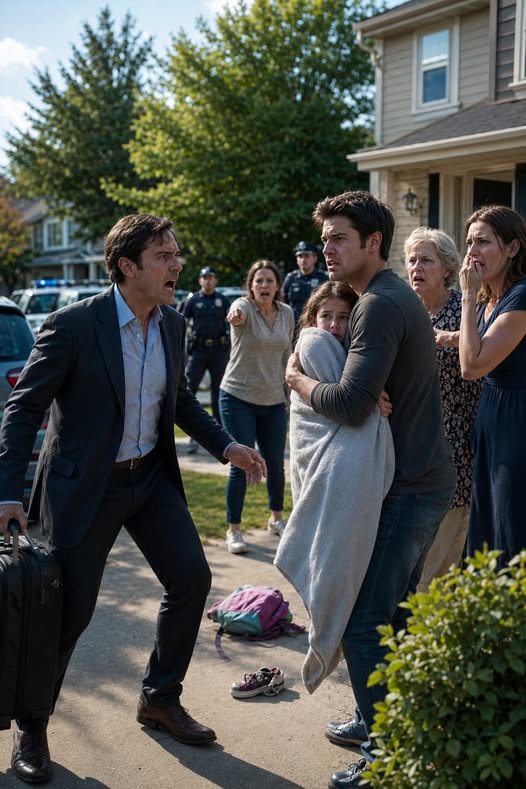
My wife always kept her phone within reach. She slept with it charging on the nightstand. She checked it while brushing her teeth, while making coffee, while pretending to listen to me talk about work. She did not miss calls by accident.
By the time I called Norma Richard, my mother-in-law, my hands were shaking so badly I almost dropped the phone.
She answered on the fourth ring.
“James,” she said, as if I had interrupted her tea.
“Norma, where is Sarah? What happened at my house?”
There was a pause. Not confusion. Not panic. A pause like she was deciding how much I deserved to know.
Then she said, “Oh, James. She’s not our problem anymore.”
The road blurred in front of me.
“She is eight years old,” I said.
Norma sighed. “You should speak to Melissa.”
“Melissa won’t answer.”
“That is between you and your wife.”
Then she hung up.
I do not remember pulling over. I only remember sitting on the shoulder of I-94 with trucks roaring past, the car rocking every time one passed, my phone hot against my palm.
Not our problem anymore.
My daughter was sitting outside in the middle of the night, bleeding, and her grandmother had said she was not their problem.
I called my younger brother next.
Christopher answered half-asleep, but the second he heard my voice, he was awake.
“Go to my house,” I told him. “Now.”
Chris did not ask useless questions. He never had. We grew up on the South Side with a mother who worked three jobs and a neighborhood that taught boys early which sounds meant trouble. Chris became a criminal defense attorney because he understood people at their worst. I became a consultant because I understood systems. Different paths, same training.
Thirty minutes later, he called me back.
“I’ve got her,” he said.
His voice was quiet. Too quiet.
“Is she alive?”
“She’s alive, Jamie. She’s with me. I’m taking her to the ER.”
“What happened?”
A long silence.
“Drive safe,” he said. “Don’t call Melissa again. Don’t call Norma. Don’t call anyone.”
“Chris.”
“When you get here, we need to talk.”
By dawn, Chicago was still too far away, and every mile felt like punishment. I kept seeing Sarah at five, running through sprinklers with her hair stuck to her cheeks. Sarah at six, asleep against my shoulder during a Fourth of July fireworks show. Sarah the morning I left for Minneapolis, standing in the kitchen in unicorn pajamas, asking if I would bring her back a snow globe even though it was April.
I had kissed the top of her head and said, “Of course.”
I had not noticed the way she looked toward the stairs before answering me.
I had not noticed the bruise-yellow light under her eyes.
I had not noticed anything.
When I finally pulled into Chris’s apartment complex in Lincoln Park, the sun was coming up gray behind the buildings. Chris stood near the entrance with two coffees in his hands. He had not shaved. His shirt was wrinkled. There were dark half-moons under his eyes.
“Where is she?” I asked.
“Sleeping.”
I moved toward the door.
Chris stepped in front of me.
“Jamie,” he said, “before you see Sarah, you need to understand something.”
I stared at my brother.
His hand tightened around the coffee cup until the cardboard bent.
“This was not an accident,” he said. “And they tried to clean it up.”
Chris took me upstairs, but he did not bring me to Sarah first.
That was when I started to get scared in a different way.
Not the wild fear from the highway. Not the panicked father fear that makes your chest hollow and your hands cold. This was slower. Heavier. The kind of fear that sits beside you and says, You are about to learn something you cannot unknow.
His apartment smelled like black coffee, antiseptic cream, and the lavender detergent he used because our mother had used it. On the couch, a small pink blanket was folded over the armrest. Sarah’s shoes sat by the door, one tipped sideways, dried mud flaking off the sole.
“She woke up twice,” Chris said. “Nightmares both times. She asked for you.”
My throat closed.
“Where?”
“Guest room. But listen to me first.”
I hated him for stopping me. I loved him for being strong enough to do it.
He opened a folder on his kitchen table.
The first photo was Sarah in a hospital bed.
She looked smaller than eight. Her face was pale under the fluorescent light, a strip of white gauze taped across her forehead. There were scratches along her cheek, dried blood at her hairline, and a bruise blooming purple on her left shoulder in the shape of fingers.
I gripped the back of a chair.
“Who did that?”
“The doctor said the forehead cut needed stitches. Her arm too. She had bruises on both shoulders and one on her hip. Consistent with being grabbed and shoved.”
“Shoved into what?”
Chris swiped to the next picture.
The kitchen tile in my house. Broken ceramic everywhere. A vase I recognized because Melissa had bought it from some gallery and reminded me twice what it cost. Blood on the white grout. A smear where someone had dragged a towel across it.
The next photo was the garage.
Concrete floor. A dark stain near the door leading into the house. Thin reddish lines leading toward the driveway.
Drag marks.
My knees felt weak.
“Carolyn said she was in the driveway.”
“She was. Sitting by the side gate. Barefoot.”
“In April?”
Chris nodded.
The apartment was too quiet. Somewhere outside, a truck backed up, beeping steadily. A dog barked. Life kept moving like nothing had happened.
“I went to your house after the ER,” Chris said. “I still had the spare code from when you went to Dallas last year. The kitchen had been wiped down, but badly. The garage was worse. Whoever cleaned it missed the concrete.”
“Melissa?”
He did not answer right away.
“What did Sarah say?”
“Almost nothing. She kept asking if you were mad.”
I turned away.
Chris’s voice softened. “Jamie, she thinks she did something wrong.”
I wanted to go to her then. I wanted to lift her out of that room and carry her somewhere far away from everyone who had let her sit outside bleeding. But Chris put one more photo in front of me.
A garbage bag.
“What is that?”
“Found it near the docks.”
“The docks?”
“I’ll get to that.” He rubbed his face. “When I saw the house, I realized someone had removed things. Towels. Sarah’s pajamas. Pieces of the vase. I checked the exterior camera.”
“We don’t have exterior cameras.”
“You do now.”
I stared at him.
“After the ER, I installed two temporary cameras outside your place. Legal? Gray. Necessary? Absolutely. I needed to know who came back.”
He played a video on his phone.
The image was grainy, bluish with night. My driveway. My front steps. Melissa’s silver Mercedes pulled in at 3:07 a.m.
She got out first.
She wore black leggings and a long coat, her blonde hair tied back messy. She looked around like someone checking whether neighbors were awake.
Then the passenger door opened.
A man stepped out.
Tall. Athletic. Dark hair. He moved like he belonged in my driveway, like he had been there before.
My stomach turned.
“Who is he?”
“Frederick Drew,” Chris said. “Personal trainer at Melissa’s gym.”
I kept watching.
Melissa and Frederick went inside. Forty minutes later, they came out carrying black garbage bags. Frederick loaded them into a pickup truck parked down the street. Melissa kept wiping her hands on her coat.
“Chris.”
“I followed the truck.”
“You followed him?”
“You called me because you needed me. So yes, I followed him.”
The video ended.
Chris opened another set of photos.
Bloody towels. A torn pajama top with tiny stars on it. Ceramic fragments. Paper towels soaked pink.
My daughter’s life, bagged up like trash.
For the first time since Carolyn called, I made a sound. It was not a word. It came from somewhere low in my chest, raw and animal.
Chris sat across from me. His eyes were wet, but his voice stayed controlled.
“There’s more,” he said. “Money. Messages. Norma. But you need to see Sarah before I show you the rest.”
I walked down the hall on legs that did not feel like mine.
The guest room curtains were half closed. Morning light came through in thin stripes across the carpet. Sarah was awake, sitting up in bed, wearing one of Chris’s old T-shirts like a nightgown. A stuffed bear sat in her lap.
When she saw me, her face crumpled.
“Daddy.”
I crossed the room and gathered her into my arms, careful of the bandage, careful of everything. She shook so hard I felt it in my bones.
“I’m sorry,” she sobbed. “Daddy, I’m sorry.”
“No,” I said. “No, baby. You have nothing to be sorry for.”
“Mommy said you wouldn’t want me anymore.”
The room went silent behind me.
I held my daughter tighter, and over her shoulder, I saw Chris standing in the doorway with his phone still in his hand.
On the screen was one more frozen image: Melissa and the stranger walking back into my house like nothing had happened.
And I realized the blood in my driveway was only the beginning.
Sarah fell asleep against me with her fingers twisted in my shirt.
I sat there for almost an hour, afraid to move. The apartment around us warmed with morning sun. I could hear Chris in the kitchen speaking softly on the phone, his lawyer voice low and sharp. Every now and then Sarah’s breath hitched, as if some part of her was still crying even in sleep.
When I finally eased her back onto the pillow, she whimpered.
“I’m here,” I whispered. “I’m not leaving.”
Her fingers relaxed one by one.
In the kitchen, Chris had spread everything across the table.
Photos. Hospital paperwork. Printed bank statements. Screenshots. Notes in his tight handwriting. My brother had turned horror into evidence because that was how men like us survived panic. We organized it.
“Start with the man,” I said.
Chris pointed to a photo of Frederick Drew from a gym website. Clean smile. Expensive haircut. Arms crossed over a fitted black shirt. The kind of man who sold confidence to bored rich women and called it wellness.
“He works at Meridian Athletic Club,” Chris said. “Or worked. I called in a favor. They fired him yesterday after another husband complained.”
“Another?”
“He targets married women. Wealthy ones. Gets close, gets money, sometimes gets leverage. There are whispers about blackmail, but no one wanted the embarrassment.”
I stared at the photo.
“He hurt Sarah.”
“Yes.”
“Did Melissa know what kind of man he was?”
Chris gave me a look that told me I would not like the answer.
“She knew enough.”
He slid over screenshots.
Messages between Melissa and Frederick. Not just flirtation. Not just betrayal. Plans. Complaints about me being gone. Jokes about my suits, my background, my “South Side ambition.” A photo of my watch with the caption: Provider mode activated.
Then money.
Transfers from an account I barely recognized. Credit cards opened in my name. A home equity loan I had never signed for. Hotel charges. Jewelry. A condo deposit.
“She was using our money,” I said.
“She was draining you.”
My vision narrowed.
“How much?”
“Over two hundred thousand that I can prove.”
I laughed once, not because anything was funny. Because the number was too clean, too obscene. I had missed school breakfasts, field trips, parent-teacher meetings because I was building a life. I told myself the long hours were for Sarah. Stability. Security. A house in Oak Park. Good schools. A college fund. A mother at home.
And while I was gone, Melissa had been buying another man a condo.
Chris did not let the silence settle.
“There’s Norma too.”
I looked up.
He placed another page in front of me.
Texts between Melissa and her mother.
Norma: You deserve someone who understands your world.
Melissa: James is useful, Mother. He pays for everything.
Norma: Useful men should remember their place.
The words sat on the page like insects.
I had known Norma never liked me. She smiled at me at charity dinners and introduced me as “our self-made son-in-law,” the way someone might point out an impressive rescue dog. Melissa came from money. Old Chicago money, though not as old or endless as Norma pretended. I came from a rented two-bedroom with a broken radiator and a mother who watered down soup to make it last.
I thought success would make people like Norma respect me.
Now I understood that success had only offended her.
“She encouraged the affair,” Chris said. “At first, anyway. Thought Frederick would make Melissa feel desirable. Maybe make you jealous. Then things got ugly.”
“Did Norma know about Sarah?”
He hesitated.
“Yes.”
I felt my hand close into a fist.
“When I confronted her,” Chris said, “she said Sarah had always been difficult. Said Melissa had been under pressure. Said the family couldn’t afford scandal.”
I thought of Norma’s voice on the phone.
Not our problem anymore.
“She knew Sarah was outside?”
“I think Melissa called her after it happened.”
“You think?”
“I can prove they spoke for eleven minutes at 12:48 a.m. I don’t have the call content yet.”
Yet.
That was the first moment I noticed the way Chris kept saying things. Not like a brother comforting me. Like an attorney building toward trial.
“What else?”
Chris looked down.
“Three months ago, Melissa increased your life insurance policy. Two million dollars. She made herself sole beneficiary.”
The kitchen clock ticked above the sink.
I had never noticed how loud a cheap clock could be.
“She was planning to leave me?”
“Maybe.”
“Or something else.”
Chris did not answer.
I stood so fast the chair scraped across the floor. Sarah shifted in the bedroom, and both of us froze.
I lowered my voice.
“Where is Melissa now?”
“Home.”
“With him?”
“Yes.”
“After Sarah?”
“Yes.”
The room seemed to tilt.
Melissa was not at a hospital. Not with police. Not sitting in some dark kitchen drowning in guilt. She was home with the man who hurt our daughter, in the house I paid for, breathing my air, standing on floors where Sarah had bled.
“I’m going there,” I said.
Chris stepped toward me.
“Jamie, listen to me. If you go in angry, they’ll use it. Melissa will call the police and say you threatened her. Frederick might provoke you. You need to be controlled.”
“I am controlled.”
“No. You are quiet. There’s a difference.”
I looked through the hallway at Sarah’s door.
For thirty-six years, I had built myself into a man who could sit across from CEOs and tell them calmly where their companies were bleeding money. I could read a room. I could wait. I could smile while someone underestimated me and then take the deal from under them.
I had forgotten that part of myself at home. With Melissa, I had wanted peace so badly I had mistaken blindness for trust.
Not anymore.
“I need a suit,” I said.
Chris blinked.
“What?”
“I’m going to shower. I’m going to dress like I just came back from a business trip. I’m going to let Melissa wonder what I know.”
Chris studied me.
Then he nodded once.
“You call me before you walk in. I’ll be listening.”
An hour later, I parked across from my own house.
Oak Park was waking up. Sprinklers clicked across green lawns. A delivery truck idled near the corner. Somewhere nearby, someone was mowing grass, the cut smell drifting through my cracked window.
My house looked perfect.
White trim. Blue-gray siding. Tulips by the porch because Melissa liked flowers she never planted herself.
I checked my phone.
Chris had texted: Cameras active. Be careful.
I walked up the front path with my briefcase in my hand.
The lock clicked open.
Inside, the house smelled faintly of bleach.
From upstairs came Melissa’s laugh.
Then a man’s voice answered her.
I climbed the stairs slowly, one hand on the rail Sarah used to slide down when she thought no one was watching.
The bedroom door was open.
Melissa stood near the dresser wearing one of my white dress shirts.
Frederick Drew was lying shirtless on my bed.
They both turned, and for one beautiful second, neither of them knew whether to scream or smile.
Melissa said my name like I was the one who had been caught doing something wrong.
“James.”
Her hand flew to the open collar of my shirt. My shirt. The sleeve hung past her wrist, the cuff brushing her thigh. She looked freshly showered. Her hair was damp at the ends. Behind her, the curtains were still closed, and the room smelled of expensive perfume and another man’s sweat.
Frederick sat up slowly.
He did not look ashamed. That was what I noticed first. He looked annoyed, like I had interrupted a reservation.
“You’re home early,” Melissa said.
I set my briefcase by the door.
“Where’s Sarah?”
Melissa’s eyes flicked to Frederick.
That tiny movement told me everything.
“She’s at my mother’s,” she said.
“No,” I replied. “She isn’t.”
The color drained from her face.
Frederick swung his legs off the bed. “Look, man—”
“I wasn’t talking to you.”
He blinked.
I kept my eyes on Melissa.
“Try again.”
She swallowed. “James, I can explain.”
“I didn’t ask you to explain Frederick. I asked where our daughter is.”
At the sound of his name, Frederick’s face tightened.
So he knew I knew something.
Good.
Melissa’s breathing became shallow. She looked around the room as if searching for a script. I had seen her do it before at dinners, when she forgot a donor’s wife’s name, or when Norma corrected her in front of guests. She could recover from almost anything with a laugh and a hand on someone’s arm.
Not this.
“Sarah had an accident,” she said.
I nodded.
“An accident that put blood on the kitchen floor, the garage floor, and the driveway.”
Her lips parted.
“An accident that required stitches.”
Frederick stood and reached for his shirt. “I’m leaving.”
“Sit down.”
The words came out flat.
He paused.
“I don’t take orders from you.”
“This is my house,” I said. “My bedroom. My bed. My wife. My daughter’s blood on the floor downstairs. So today, you take orders from me.”
For a second, I thought he might come at me.
Some part of me wanted him to.
Melissa must have seen it too, because she stepped between us.
“Please,” she whispered. “Don’t make this worse.”
I almost laughed.
“Worse?”
Her eyes filled with tears.
I had loved those eyes once. I had looked into them across a banquet table eight years earlier and thought I had found elegance, warmth, a woman who wanted the same quiet, stable life I wanted. Now the tears looked like tools she had taken out too late.
“It was an accident,” she said. “Sarah came downstairs. She saw us arguing.”
“Arguing?”
Frederick’s jaw shifted.
Melissa hugged herself. “She started screaming. Frederick tried to calm her down.”
“He grabbed her.”
“She was hysterical.”
“She is eight.”
Melissa flinched.
“She attacked him,” Frederick snapped. “Kicking, scratching. I pushed her away. That’s it.”
“You pushed her into the counter.”
No one spoke.
I heard the heater click on. A low hum moved through the vents. The normal sounds of my house seemed disgusting now.
Melissa wiped her face. “She fell. There was blood. I panicked.”
“And then?”
She looked at the floor.
“And then, Melissa?”
“I didn’t know what to do.”
“So you cleaned the kitchen.”
Her shoulders shook.
“You packed her bloody clothes and towels into garbage bags.”
Frederick’s eyes narrowed.
“You put her outside.”
Melissa made a small broken sound.
“She needed air,” she said.
I stared at her.
“She needed a doctor.”
“I was going to call someone.”
“Five hours, Melissa.”
Her face twisted. Not with remorse. With anger at being cornered.
“You were gone,” she said. “You’re always gone. You leave me here with everything, and then you come back acting like Father of the Year.”
There it was. The turn.
I had heard that tone before. Not about Sarah bleeding. About me. About blame. About how she could take anything and polish it until she was the injured party.
“You left our child outside like trash because she interrupted your affair.”
“She ruins everything!” Melissa screamed.
The room froze.
Even Frederick looked at her.
Melissa clapped both hands over her mouth, but the words had already landed.
I felt something inside me go completely still.
“All right,” I said.
She shook her head. “James, I didn’t mean—”
“I want both of you out.”
“This is my house too.”
“No. It is a crime scene you tried to clean.”
Frederick snorted. “You can’t prove anything.”
I pulled out my phone.
“Want to test that?”
His expression changed.
“Hospital records. Photos. Neighbors. Garbage bags. Video of both of you carrying evidence out of my house at three in the morning.”
Melissa grabbed the dresser behind her.
“And,” I said, “your mother’s phone records.”
That broke her.
“Norma didn’t do anything.”
“I didn’t say Norma. You did.”
Frederick cursed under his breath and moved toward the door.
Melissa caught his arm. “Don’t leave me.”
He shook her off.
“I’m not going to prison for your kid.”
Your kid.
Not our daughter. Not Sarah.
Your kid.
Melissa stared at him as if she was seeing him clearly for the first time. It lasted less than three seconds. Then she turned that desperate look back to me.
“You can’t do this,” she said. “My family has lawyers.”
“So do I.”
“I’ll tell everyone you abandoned us. I’ll tell the court you were never home. I’ll make sure Sarah stays with me.”
I stepped closer.
“Sarah will never be alone with you again.”
Her mouth hardened.
“You’ll regret this.”
“No,” I said. “I already regret trusting you.”
Frederick left first, pulling his shirt on as he went down the stairs. Melissa grabbed a coat, her purse, and nothing else. At the bedroom door, she stopped.
“You think you won because you scared me today?” she whispered. “You have no idea what my family can do.”
Then she walked out.
I stayed in the bedroom until I heard the front door slam.
My hands were shaking now. My whole body was.
I called Chris.
“Did you get it?”
“Every word,” he said. “Her admission. His. The threat.”
I sat on the edge of the bed that no longer felt like mine.
“Good.”
“Jamie?”
“Yes?”
“You need to know something else. I just got into more of the financials.”
I closed my eyes.
“What?”
Chris exhaled.
“The life insurance wasn’t the end of it. I found messages about handling the James problem.”
I did not go back to work the next day.
For years, work had been the answer to everything. If my marriage felt cold, I worked harder. If Melissa complained about being lonely, I booked a nicer vacation and then took calls from the balcony. If Sarah asked why I missed her school concert, I promised the next one and gave myself another reason to chase one more client, one more promotion, one more proof that I had made it.
But after Chris told me about those messages, the office became impossible.
I sat in a conference room at Kenneth Whitney’s law firm instead, wearing the same navy suit I had worn into my ruined bedroom. Whitney was in his fifties, gray-haired, neat as a blade, with eyes that moved over documents the way surgeons look at scans.
Chris sat beside me.
The folder between us was now twice as thick.
Whitney read for a long time without speaking. Outside his window, downtown Chicago shone silver in the morning light. People walked below carrying coffee, talking into phones, living in a world where children were not left bleeding in driveways.
Finally, Whitney removed his glasses.
“We file for emergency custody today,” he said. “Based on child endangerment, assault in the home, evidence tampering, and the mother’s failure to seek medical attention.”
“How fast?”
“I’ll push for a same-day hearing.”
“And criminal charges?”
He tapped the folder.
“We refer everything to the state’s attorney. The hospital records help. The photos help. Your neighbor helps. Your brother’s recovery of the discarded items helps, though chain of custody will be challenged.”
“What about Melissa’s confession?”
“Useful in family court. Potentially useful elsewhere.”
“Potentially?”
Whitney looked at me over his glasses.
“James, I know you want certainty. Law does not give certainty. It gives pressure. We apply enough pressure, the truth breaks through.”
I leaned back.
Chris knew that look.
“Jamie,” he warned softly.
I ignored him.
“What about Norma?”
Whitney’s mouth tightened.
“As of now, Norma Richard is a morally repulsive grandmother. That is not the same as being criminally liable.”
“She knew.”
“Prove it.”
“We will.”
He nodded, as if that was the only acceptable answer.
Then he slid another document across the table.
“Melissa’s attorney contacted me this morning.”
I laughed once.
“Already?”
“Her family moves fast. She is claiming you were an absent father whose constant business travel created an unstable home environment. She will argue Sarah’s injury happened during your absence, under circumstances not yet clear, and that you are using the incident to punish Melissa for marital problems.”
The room became very quiet.
Chris swore under his breath.
Whitney continued. “They will try to make you look cold, ambitious, detached. They will say Melissa was overwhelmed and unsupported.”
“My daughter was outside for five hours.”
“I know.”
“She had blood on her face.”
“I know.”
“She thought I wouldn’t want her anymore because her mother told her that.”
Whitney’s expression softened for the first time.
“Then we make the court see Sarah clearly. Not Melissa’s version. Not Norma’s polished version. Sarah.”
He gave us a list.
Teachers. Pediatrician. Neighbors. Texts. Travel calendars. Phone records. School photos. Anything showing I called, checked in, paid attention, showed up when I could.
I hated the list because I understood what it meant.
A good father should not need a binder.
But I would build one anyway.
After the meeting, Chris and I sat in a coffee shop near the courthouse. Rain ticked against the front windows, blurring taxis into yellow streaks. My coffee went cold untouched.
Chris placed a manila envelope on the table.
“Frederick Drew,” he said.
Inside were reports, screenshots, and photos of Frederick with different women. Hotel lobbies. Restaurant patios. Parking lots.
“He runs a con,” Chris said. “Wealthy married women. He becomes their escape fantasy. Then he becomes expensive.”
I flipped through the pages.
“One woman paid him fifty thousand to keep quiet,” Chris said. “Another bought him a motorcycle. Melissa bought him more.”
“The condo.”
“And the car. And cash transfers. She also opened credit cards in your name.”
I stared at him.
“How?”
“Your Social Security number. Your signature scanned from old documents. She got sloppy, but not stupid.”
The rain grew harder.
“What do the messages say?”
Chris took out his phone.
“They’re not explicit enough. But this one was two weeks ago.”
He showed me.
Frederick: He’s the only thing standing between us and the money.
Melissa: Don’t say things like that in writing.
Frederick: Then handle the James problem.
Melissa: After Minneapolis.
I read it three times.
After Minneapolis.
My trip.
My schedule.
My wife had known exactly when I would be away.
Chris lowered his voice.
“Jamie, I think Sarah walked in on more than an affair. I think she interrupted something they were not ready for.”
The coffee shop smelled like cinnamon, wet coats, and burnt espresso. A woman nearby laughed into her phone. A college student shook rain from his backpack.
I stared at the message until the letters blurred.
After Minneapolis.
All this time, I had thought my absence gave them opportunity.
Now I wondered if my absence had been part of the plan.
Sarah moved into Chris’s apartment that week with a backpack, a stuffed bear, and three pairs of pajamas Carolyn had bought because she said every child needed something new after a hospital visit.
I stayed there too.
At night, Sarah slept with the hallway light on and woke if a car door slammed outside. During the day, she became careful. Too careful. She asked before eating cereal. She apologized if she spilled water. She watched adults’ faces before answering simple questions, as if every room had hidden rules and every wrong move might cost her.
That hurt more than the bandage.
The emergency custody hearing lasted less than an hour.
Melissa arrived with Norma and two attorneys in suits more expensive than my first car. Melissa wore cream, no jewelry except her wedding ring, and just enough makeup to look fragile. Norma wore navy and pearls. She did not look at me once.
When the judge granted me temporary full custody, Melissa covered her mouth and cried.
Norma put one hand on her shoulder.
Anyone watching without context would have seen a devastated mother and grandmother.
I saw performance.
Afterward, Melissa tried to approach me in the hallway.
“James, please. Sarah needs her mother.”
I stepped back before she could touch my sleeve.
“Sarah needed her mother five hours before Carolyn found her.”
Her face hardened so quickly the tears looked absurd.
Norma’s eyes finally met mine.
“You are enjoying this,” she said.
“No,” I replied. “I’m documenting it.”
Chris smiled slightly beside me.
That afternoon, he introduced me to Leo Connor, a private investigator he trusted. Former federal agent. Early sixties. Calm voice. Shoes polished. The kind of man who noticed exits before artwork.
“I’m not here to help you get revenge,” Leo said, sitting across from me at Chris’s kitchen table.
“Then why are you here?”
“To help you gather facts. What you do emotionally with those facts is your business.”
“I want the truth.”
“You want them destroyed.”
I did not answer.
Leo nodded like my silence confirmed something.
“Then we do it clean. Public places. Financial trails. Legal recordings where possible. No cowboy nonsense. If this becomes criminal, bad evidence can ruin good justice.”
That was the first smart thing anyone had said to me all week.
So we waited.
Waiting was harder than rage.
Melissa moved into Norma’s penthouse on the Gold Coast. Frederick stayed at his condo. They met in parking garages, hotel bars, and once outside a pharmacy where Melissa cried so hard a woman in a red coat stopped to ask if she was okay. Frederick waited until the woman left, then gripped Melissa’s arm so tightly she stopped crying.
Leo photographed it from across the street.
Money continued to surface.
Melissa tried to access our joint account and failed. She tried two credit cards and found them canceled. She called me seventeen times in one afternoon. I did not answer.
Then the messages changed.
Frederick: I’m not living like this.
Melissa: My lawyer says James is trying to make me look dangerous.
Frederick: You are dangerous to me if you lose.
Melissa: Don’t threaten me.
Frederick: Remember what happened when Sarah got in my way.
When Chris showed me that one, I had to leave the room.
I went into the bathroom, turned on the sink, and gripped the edge until my hands cramped. The mirror showed a man I barely recognized. Same face, same suit, same careful haircut. But my eyes looked like my mother’s had looked when bill collectors called and she still had to make dinner.
Tired.
Angry.
Unwilling to break.
Two weeks later, Leo called just after nine at night.
“Frederick made contact with someone interesting.”
I was sitting on the floor outside Sarah’s room, laptop balanced on my knees, half-working and half-listening to her breathe.
“Who?”
“Ronnie Wolf.”
Chris, sitting at the kitchen counter, looked up immediately.
He knew the name before I did.
“Ronnie Wolf did time with Frederick years ago,” Leo said. “Assault. Extortion. Suspected in two staged robberies that were not robberies.”
My mouth went dry.
“What did Frederick want?”
“They’re meeting tomorrow night in Cicero.”
“About what?”
Leo paused.
“From what I heard, Frederick needs a problem solved.”
I looked toward Sarah’s room.
Her nightlight glowed soft yellow against the wall. On Chris’s fridge, she had taped a drawing of the three of us: me, her, and Uncle Chris, all holding hands under a crooked sun.
I had thought the worst thing had already happened.
Then Leo said, “James, I think you might be the problem.”………………………………………….
Click Here to continuous Read Full Ending Story👉THE END-I was 500 miles away on business when I got a call from my neighbor. “Your daughter is sitting in your driveway. She has blood all over her. She’s alone. It’s midnight.” I called my wife. No answer. I called my mother-in-law. “Oh, she’s not our problem.” My daughter was there for 5 hours. I called my brother. He picked her up. When I got home two days later… What my brother did, no one expected. I found the horrifying truth.