The day my grandfather made me hide under his kitchen table, I thought fear had finally found its way into the strongest man I knew
Not old age.
Not forgetfulness.
Fear.
Grandpa Walter had been seventy-four for almost a year, and he was still the kind of man who noticed when the mail carrier changed routes, when the elevator made a new sound, and when a cashier rang up oranges at the wrong price.
He lived in the same Cherry Creek condo he had bought before I was born, in a building with polished brass mailboxes, a slow elevator, and hallways that always smelled faintly like floor wax and someone’s dinner.
That apartment was not just property to me.
It was where my grandmother taught me how to crimp pie crust with the back of a fork.
It was where I slept on the couch the week after my mother died because I could not stand the quiet in my own apartment.
It was where Grandpa Walter sat beside me at two in the morning, pouring coffee neither of us needed, saying nothing until I could breathe again.
So when I knocked on his door that Thursday afternoon and he opened it with his face drained almost gray, my first thought was that his blood pressure had crashed.
“Grandpa?” I said, reaching for him.
He caught my wrist before I could touch his shoulder.
His hand was still strong.
Too strong.
“Samantha,” he whispered, and there was coffee and peppermint on his breath. “Go to the kitchen. Get under the table. Do not make a sound.”
I stared at him because the sentence made no sense.
The hallway behind me was quiet.
A neighbor’s television murmured behind another door.
Sunlight poured through the big windows at the end of the corridor.
“What are you talking about?”
“Now.”
That one word landed harder than if he had shouted.
Grandpa Walter had raised me in the places my parents left empty, and he had never used fear to move me.
He had used patience.
He had used a steady hand.
He had used pancakes on school mornings and rides to dentist appointments and a look across the dinner table that told me he knew when I was lying about being fine.
But that day, he used command.
So I obeyed.
I slipped past him into the apartment, down the hallway lined with framed photos, and into the kitchen I had known since childhood.
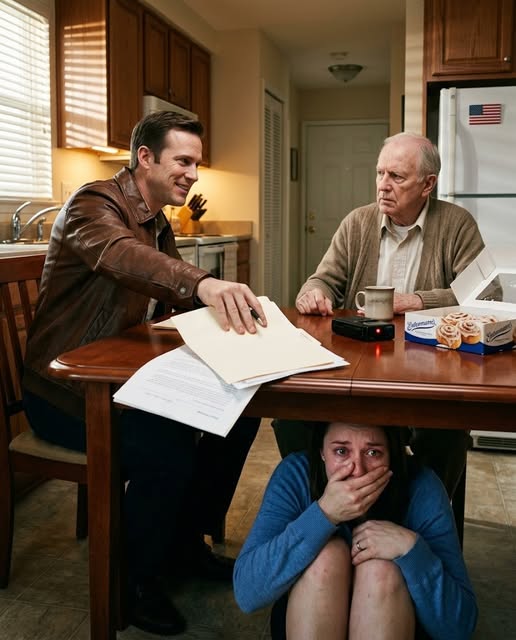
The old mahogany table sat in the center, wide and heavy, its surface polished to a deep reddish shine.
When I was eight, I used to crawl under it with quilts and pretend it was a house.
At forty, I folded myself into that same dark space with my knees pressed to my chest and my shoulder against the cold wall.
The tile chilled through my jeans.
The room smelled like coffee grounds, lemon soap, and the peppermint candies Grandpa kept in a glass dish by the phone.
From the hallway, I heard him move with careful, deliberate steps.
A drawer opened.
Something clicked softly.
Then the drawer closed again.
His slippers shuffled back toward the front door.
The doorbell rang.
I held my breath.
The deadbolt turned.
Then I heard my husband’s voice.
“Walter, good afternoon.”
William sounded exactly the way he always sounded in public.
Warm.
Measured.
Just humble enough to make people trust him.
“I brought you those cinnamon rolls you like,” he said. “The ones from that bakery near your building.”
Grandpa opened the door wider.
“That was thoughtful of you. Come in. I’ll put coffee on.”
William stepped inside.
I could tell by the rhythm of his shoes that he had dressed carefully, even for a casual visit.
He had a way of doing that.
The right jacket.
The right haircut.
The right smile.
The kind that made waitresses refill his coffee before he asked and made bank tellers lean forward when he joked about the weather.
I had once been proud of that charm.
I had once thought it meant he was safe.
Twelve years earlier, I met him at a holiday party downtown, back when grief still made every room feel too bright.
My mother had been gone less than a year, and I was twenty-eight, working as an accounting assistant, trying to make my life look steadier than it felt.
William stood near the drinks with a craft beer in his hand and a quiet expression on his face, as if he noticed everything and judged nothing.
When he asked whether I wanted to step outside for air, I thought he had seen me.
Maybe he had.
Maybe that was the worst part.
Three weeks later, he called.
Four months later, we were exclusive.
Two years later, we were married in a small ceremony with white roses, soft music, and Grandpa Walter walking me down the aisle because my father had disappeared from my life long before that day.
William cried during the vows.
At least I thought he did.
For years, I measured my marriage by the sacrifices I was willing to call normal.
His late nights were stress.
His silences were exhaustion.
His corrections were care.
When he put a hand on my lower back at a dinner party and said, “Sam means well, she just gets emotional,” I laughed because everyone else laughed.
When my best friend Amanda told me, “Something about him feels rehearsed,” I told her she was being unfair.
Love can make a person loyal.
It can also make a person excellent at explaining away the sound of warning bells.
Under Grandpa’s kitchen table, I heard William set the bakery box down.
Cardboard brushed against wood.
A chair scraped.
Grandpa passed the kitchen on his way to the stove, and without turning his head, he lowered his voice so much I almost missed it.
“He doesn’t know you’re here. Stay.”
The kettle filled.
Water hissed into metal.
For the first few minutes, nothing sounded dangerous.
William asked about Grandpa’s blood pressure.
He asked if the new medication made him dizzy.
He mentioned the broken elevator, the cold snap coming in, and whether the building had finally fixed the front lock.
He sounded kind enough to make me feel foolish under that table.
I almost crawled out twice.
The first time was when my hip started to cramp.
The second was when William said, “Samantha worries about you. She doesn’t always show it the right way, but she worries.”
It was such a husband thing to say.
Soft.
Protective.
Believable.
Then Grandpa asked, “Does she?”
The kitchen went still.
William gave a little laugh.
“Of course she does.”
“Then why didn’t you tell her you were coming?”
The question hung between them like a wire pulled tight.
I pressed my palm harder over my mouth.
William’s answer came a beat too late.
“I didn’t want to upset her. You know how she gets about family matters.”
Family matters.
That was one of his phrases.
It meant anything he wanted to discuss without me present.
Grandpa’s voice stayed mild.
“What family matter is that?”
“The condo,” William said.
The word made the air shift.
Not apartment.
Not home.
Not the place where my grandmother’s handwriting still labeled the flour canister.
The condo.
Grandpa set something on the counter with a quiet click.
“I see.”
“You’re alone here, Walter. It’s a lot for one man. Big place. Old building. Maintenance keeps climbing. Property taxes. Assessments. Repairs. You shouldn’t have to keep track of all that.”
“I’ve managed since 1984.”
“That’s my point,” William said. “You’ve managed long enough.”
I stared at the table leg in front of me.
There was a nick near the bottom from the year I rammed a toy truck into it and cried because I thought Grandpa would be mad.
He had touched the scratch and said, “That just means the table lives here too.”
Now my husband was talking about that home like a burden to be handled.
“Samantha doesn’t understand these things,” William continued. “She thinks emotionally. I’m trying to think practically.”
There it was.
The sentence I knew by its shape.
Samantha doesn’t understand.
Samantha gets emotional.
Samantha needs things explained.
He had never said those words all at once in front of me with such contempt, but he had laid them around me for years like bricks.
Grandpa said, “Sam works with numbers every day.”
“She works with invoices,” William replied. “That doesn’t mean she understands wealth.”
My face went hot.
I did not move.
I wanted to crawl out from under the table and ask him whether I had misunderstood every bill I paid, every budget I built, every quiet month when I stretched groceries because he said his consulting checks were late.
Instead, I stayed still.
Sometimes the hardest kind of strength is not answering when someone gives you the perfect reason to scream.
A chair shifted in the living room.
Paper rustled.
Grandpa asked, “What exactly did you bring with you?”
William’s voice changed again.
The softness drained out.
“Documents.”
“What documents?”
“A transfer packet.”
The words seemed to slide under the kitchen table and settle against my knees.
Grandpa did not answer.
William filled the silence.
“It’s simple. You sign the deed over now, we keep everything clean, I manage the property, Samantha stays protected, and nobody has to chase paperwork after you’re gone.”
My pulse pounded in my ears.
After you’re gone.
He said it like a calendar item.
Like Grandpa’s death was an inconvenience he was trying to organize ahead of time.
Grandpa said, “You brought deed papers to a check-in visit.”
“I brought a solution.”
“You brought cinnamon rolls too.”
William chuckled, and the sound made my stomach turn.
“I thought that would make the conversation easier.”
There was a pause.
Then Grandpa asked, “For whom?”
William did not laugh that time.
“Walter, don’t make this emotional.”
“You keep saying that word.”
“Because emotion is exactly why things get messy. Samantha will cry. She’ll say the place smells like her grandmother. She’ll talk about pie crust and old photos and whatever else. Then she’ll put off decisions until there’s a crisis.”
Grandpa’s breathing changed.
I heard it even from under the table.
He was angry now.
Not loud.
Not shaking.
Angry in the old way, the way men get when they have seen too much to waste energy performing it.
“Sam has never asked me for this place,” he said.
“She doesn’t have to ask,” William replied. “Everyone knows where it’s going.”
“And you think that means it belongs to you.”
“I think it means it belongs to our future.”
Our future.
My fingers curled against my jeans.
For twelve years, I had shared a checking account with a man who made me feel guilty for buying new winter boots.
For twelve years, I had listened to him talk about security and long-term planning and what responsible couples did.
For twelve years, I thought we were building a life.
Now, crouched in my grandfather’s kitchen, I realized William had been building a case.
Grandpa asked, “Why now?”
William let out a sharp breath.
“Because I’ve put in enough time.”
The room went so quiet I could hear the clock above the stove tick once.
Then again.
Grandpa’s voice was low.
“Enough time doing what?”
William answered too quickly, which meant the truth had been sitting close to his tongue for a long time.
“Being patient.”
“With Samantha?”
“With all of it,” William said. “The Sunday dinners. The grief. The little office job. The way she clings to every sad thing that ever happened to her. I stood by her. I made myself useful. I made you trust me.”
My chest tightened until I could not take a full breath.
Grandpa said, “Made me.”
William went on as if the words were finally a relief.
“You think men like me don’t have options? I married Samantha because she was your only real family. Because anyone with eyes could see this place, your accounts, everything would eventually flow through her.”
I bit down on the inside of my cheek.
Pain flashed bright and clean.
It kept me quiet.
The man who had held my hand at my mother’s grave had just reduced me to a hallway between him and my grandfather’s money.
The man who had kissed my forehead when I had the flu had called twelve years of marriage patience.
The man who told me I was his home had been waiting for my real home to change hands.
Grandpa asked, “Did you ever love her?”
William did not answer.
That silence told me more than a denial would have.
Then he said, “Don’t make this childish.”
Something inside me split so quietly no one else could hear it.
I had expected anger to feel like fire.
Instead, it felt cold.
Clear.
Almost clean.
Grandpa’s chair creaked.
“What would you call it, William?”
“I would call it being realistic. She needed stability. I gave her that. I needed a future. This is mine.”
“This,” Grandpa said, “is my home.”
“It’s an asset.”
“It is where my wife died.”
“It is a condo in a valuable building,” William snapped. “And if Samantha inherits it without guidance, she’ll sit on it, cry over it, and waste every opportunity it could give us.”
Us.
Even then, he tried to drag me into the word.
Grandpa let the silence stretch so long I wondered if he was looking toward the kitchen.
Maybe he could see the tip of my shoe under the table.
Maybe he knew I was unraveling one breath at a time.
Then he asked the question that changed the temperature of the room.
“So the marriage was an investment?”
A decent man would have flinched.
A guilty man might have backtracked.
William did neither.
“Call it whatever you want,” he said. “I put in twelve years.”
The bakery box shifted.
Paper slid across wood.
“Sign the deed.”
My eyes burned.
I blinked hard, not because I was trying not to cry, but because the tears blurred the floor and I needed to see.
I needed to see where I was.
I needed to remember that I was under my grandfather’s table, not trapped inside my husband’s version of my life.
Grandpa said, “Today.”
“Yes.”
“Without Samantha.”
“She’ll be upset at first.”
“At first.”
“But she’ll come around,” William said. “She always does.”
That was the part that nearly made me move.
Not the greed.
Not the insult.
The certainty.
He was so sure of the path back to my forgiveness that he spoke of it like a road he had driven a hundred times.
Maybe he had.
Maybe every apology, every bouquet from the grocery store, every quiet dinner after a cruel comment had been another trip down that same road.
Love can forgive a mistake.
It should not be asked to finance a pattern.
Grandpa’s voice softened.
“You sound very sure of my granddaughter.”
“I know my wife.”
“No,” Grandpa said. “You know where she bruises.”
The words hit the room like a glass breaking.
William went still.
I could picture his face then, the polite smile gone, the calculation working behind his eyes.
He had not expected Grandpa to name it that plainly.
The kettle clicked off on the counter.
Nobody moved to pour the water.
After a moment, William said, “You’re tired. I came at a bad time.”
“You came at exactly the time you chose.”
“I’m trying to protect her.”
“From what?”
“From herself,” William said.
I almost laughed.
The sound rose in my throat and died against my palm.
For years, protection had been his favorite costume.
He protected me from difficult conversations by having them without me.
He protected me from money stress by keeping accounts vague.
He protected me from embarrassment by correcting me in public before anyone else could.
Under that table, I saw the costume for what it was.
Control, dressed up in a clean shirt.
Grandpa asked, “And what happens if I do not sign?”
William’s voice dropped.
“Then things get harder.”
“For me?”
“For everyone.”
That was not a shout.
It did not need to be.
Threats are sometimes more dangerous when they arrive wearing manners.
I heard the folder open.
A pen clicked.
William moved closer to the kitchen.
His shoes appeared near the threshold, polished brown, familiar from weddings and office parties and Sunday brunches where he smiled at my grandfather across the table.
For one wild second, I thought he would see me.
I held my breath until my lungs hurt.
He stopped beside the table.
The deed packet slid onto the mahogany above my head with a soft scrape.
“Just sign,” he said.
Grandpa’s slippers came into view on the other side.
He sat down slowly.
The chair legs groaned.
My grandfather, who had taught me to check oil levels and balance a checkbook and never buy a couch I could not lift one end of, sat at his own table with my husband standing over him.
I saw Grandpa’s hand.
It looked older from that angle.
Thin skin.
Blue veins.
One tremor at the thumb.
Then I saw something else in his other hand.
Small.
Black.
A tiny red light pulsed once against his palm.
The drawer.
The click.
The careful walk to the door.
My heart slammed against my ribs.
Grandpa set his empty hand on top of the deed packet.
William leaned closer.
His voice was almost pleasant again.
“There we go. It’s better this way.”
Grandpa did not pick up the pen.
Instead, he turned his wrist just enough that the little red light pointed toward the room.
“You should choose your next words very carefully,” he said.
William laughed once.
Not because it was funny.
Because he was nervous.
“What is that supposed to mean?”
Grandpa’s gaze dropped, just briefly, toward the edge of the table where I was hidden in the dark.
Then he looked back at my husband.
“It means,” Grandpa said, “that before you ask an old man for his home, you ought to know who is listening.”
The red light blinked again.
William stopped breathing.
So did I.
And then Grandpa reached beneath the table, his fingers searching for mine, while William slowly turned his head toward the shadow where I had been sitting the entire time…

