Marisol used to believe danger announced itself with broken glass, shouting neighbors, and police lights against the windows. In her house, danger was quieter. It folded clean towels, paid bills when it wanted praise, and corrected everyone’s version of reality.
Héctor had always been the kind of man people excused because he worked, because he showed up to family events, because he knew how to smile at teachers and shake hands at church. Outside the house, he looked responsible.
Inside, Marisol measured the weather by his footsteps. Heavy footsteps meant silence. Quick footsteps meant accusations. No footsteps at all meant the worst kind of waiting, because it meant he was listening from some doorway.
Valeria learned the same language too early. At fifteen years old, she could tell from the way her father placed a glass on the table whether dinner would end with a lecture, a slammed cabinet, or worse.
For years, Marisol told herself she was protecting her daughter by keeping the house calm. She lowered her voice. She apologized quickly. She explained Héctor’s anger away as pressure, money, pride, tiredness.
That was the trust signal she gave him: permission to be believed over the women in his own house. Héctor used it like a key. Every time Marisol doubted her instincts, he walked farther in.
The first day Valeria vomited, it looked ordinary enough to be dismissed. She came home from school pale, left her backpack near the door, and said she had eaten something bad during lunch.
Marisol touched her forehead. It was hot, but not terrifying. She made tea, gave her paracetamol, and laid a cool cloth across her daughter’s neck. Valeria slept with her knees drawn toward her stomach.

By the second day, the bathroom smelled sour and metallic. Valeria could not keep soup down. She stopped answering texts from classmates. When she walked, one hand slid against the wall as if the hallway had become a cliff.
Héctor watched from the kitchen doorway and said she was performing. “She always gets sick when there’s a test,” he said, loud enough for Valeria to hear from the bathroom.
Marisol wanted to argue. Instead, she wrote Valeria’s temperature on the back of a grocery receipt at 2:36 a.m., because the numbers felt like proof. Fever, vomiting, abdominal pain, nearly three days.
Proof matters when someone has trained a family to mistrust its own eyes. A thermometer becomes evidence. A grocery receipt becomes a record. A mother’s shaking handwriting becomes the first witness.
On the third night, Valeria spit blood-streaked saliva into the sink. Marisol saw the thin red lines in the porcelain basin, and her fear changed shape. It stopped being worry and became decision.
“We have to take her to the ER,” she told Héctor. He took the thermometer from her hand and called the whole thing pampering. Then he warned her about paying a single peso.
Marisol waited because she was frightened. That was the truth she would later repeat in a hospital office with her hands wrapped around a paper cup. She waited until Héctor’s snoring traveled through the bedroom wall.
Before dawn, she found Valeria collapsed beside the shower. The tile had left a red mark against her cheek. Her phone was trapped against her chest, clenched in both hands like it was something sacred.
“Mom… don’t tell dad,” Valeria whispered. Marisol would remember those words longer than she remembered the fever, because they named the real emergency before any doctor did.
My daughter wasn’t afraid of the pain. She was afraid that her father would wake up. That sentence became the hinge of Marisol’s life, the before and after that never closed again.
She took the hidden bills from between the towels, pulled a jacket around Valeria’s shoulders, and opened the back door slowly. The hinge scraped once. Both of them froze, listening for Héctor.
The taxi driver glanced at them in the mirror but asked no questions. Valeria leaned against Marisol’s shoulder, breath hitching whenever the car jolted over broken pavement. The city outside looked washed gray by early morning.
At the General Hospital emergency entrance, a nurse saw Valeria hunched over and moved immediately. There are moments when professional urgency feels like kindness because it tells a mother she was not imagining the danger.
The Emergency Intake Form listed the facts plainly: abdominal pain, vomiting, fever, blood-streaked saliva, three days. The nurse’s pen paused only once, when Marisol admitted how long they had waited.
The doctor examined Valeria’s abdomen. When his fingers pressed the lower right side, she screamed so sharply the waiting room stopped. The vending machine hummed, a baby went silent, and an old man lowered his newspaper.
“I need an ultrasound and lab tests immediately,” the doctor said. The words were medical, but his face was already measuring time, infection, risk, and the distance between delay and tragedy.
Marisol answered every question she could. Tea. Paracetamol. Nothing else. No substances. No other medication. When Valeria squeezed her hand at the mention of being alone, the doctor noticed the grip.
“I need to speak to her alone,” he said. Marisol resisted because fear makes a mother hold tighter. Valeria cried and begged, “No, please,” but the nurse guided Marisol into the hallway.
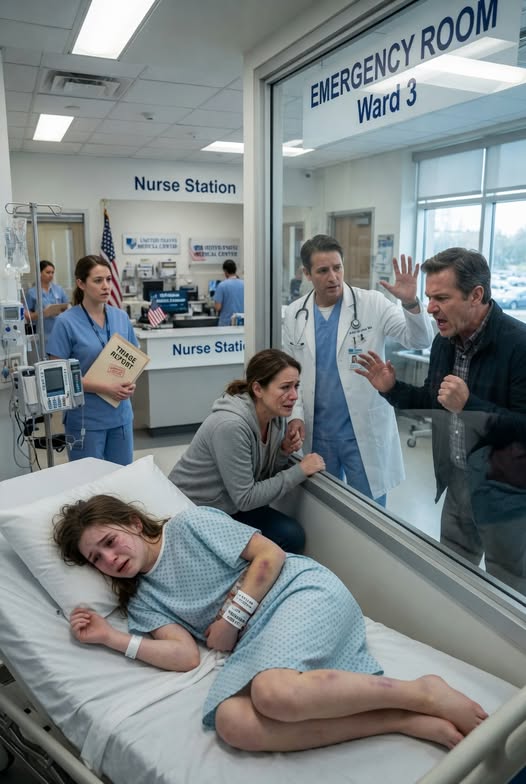
That hallway became a second waiting room, one built out of phone vibrations. Fifteen missed calls from Héctor. One message asking where she was. Another promising regret if she had taken Valeria to the hospital.
Marisol stared at the screen and felt something unfamiliar rise through her fear. Not courage exactly. Not yet. Disgust first. Cold disgust, because the threat looked different under hospital lights.
Twenty minutes later, the doctor came out. The ultrasound note and lab requisition were clipped together in his hand. His voice stayed calm, but his eyes did not.
“Mrs. Marisol, your daughter needs emergency surgery,” he said. He explained complicated appendicitis, advanced infection, and the danger of waiting longer. Marisol covered her mouth as the hallway tilted.
Then he added the sentence that split the night open. They had found signs of blows. Some recent. Bruising on the arms, tenderness not explained by the appendix alone, marks that needed documentation.
Marisol asked if it could be from a fall. The doctor did not answer quickly. That pause told her more than a lecture would have. Professionals choose silence carefully when children are listening.
Then Héctor arrived at reception, demanding to see his daughter. His voice filled the hallway the way it filled the house, certain that volume could rearrange facts.
The doctor asked the question Marisol had spent years refusing to form. “Is Valeria safe if he comes in?” Before she could answer, Valeria screamed from behind the curtain.
“Don’t let him in! He knows why it hurts me!” The sentence struck everyone differently. The nurse froze. The guard lifted his head. Héctor stopped mid-step as if the floor had caught him.
His confidence drained from his face because he knew the words did not sound like fever. They sounded like memory. They sounded like a girl who had finally stopped protecting the person hurting her.
The phone on the tray began ringing, then lit up. The nurse reached to silence it and saw the screen open to a voice memo labeled 2:14 a.m. Marisol recognized the phone Valeria had clutched beside the shower.
The doctor asked permission before playing it. Valeria nodded through tears. The recording began with a muffled thud, then Héctor’s voice, low and furious: “You better not tell your mother why you’re really bent over like that.”
There was another sound, smaller and worse, Valeria trying not to cry. Then his voice again, warning her that hospitals asked questions and that dramatic girls ruined families.
Nobody in that room moved for several seconds. The security guard called for hospital security. The nurse began an incident report. A social worker was paged before Valeria was taken to surgery.
Héctor tried to talk over the recording. He said Valeria was confused. He said Marisol had poisoned her against him. He said appendicitis had nothing to do with him, which was the first true thing he had said.
The doctor answered with precision. The infection needed surgery. The bruises needed investigation. The delay needed explanation. None of those facts erased the others. Together, they formed a pattern.
Valeria was wheeled away under bright ceiling lights, still gripping Marisol’s fingers until the last possible second. Marisol bent close and promised she would not let him into the room again.
During surgery, a hospital social worker sat with Marisol. They documented the fifteen missed calls, the threats by message, the grocery receipt temperature note, the Emergency Intake Form, and the 2:14 a.m. voice memo.
Forensic proof did not make the pain less real. It made the truth harder to bury. Marisol learned that night how many forms a mother’s instinct can take when someone finally asks the right questions.
The surgery lasted long enough for dawn to become morning. When the surgeon came out, his mask hung at his throat and his eyes were tired. Valeria had survived. The appendix had ruptured, but they had controlled the infection.
Marisol cried without sound. Relief did not feel clean. It came tangled with guilt, rage, and a terrible awareness that her daughter had been brave long before anyone called her brave.
Héctor was not allowed into recovery. Hospital security kept him outside until police arrived to take statements. When he saw Marisol behind the glass doors, he pointed at her as if she were the betrayal.
For the first time, she did not lower her eyes. She gave the officers the messages. She gave them the recording. She gave them the grocery receipt with the temperature written in the corner.
Valeria spoke later, softly, with a child advocate present. She explained that Héctor had shoved her against the sink when she vomited after dinner, furious that she was “making a scene.” After that, she hid the worst pain.
He had not caused the appendicitis. That mattered medically. What he caused was the silence, the fear, the delay, and the bruise-colored proof that Valeria’s pain had never been treated as something worth believing.
The case did not resolve in one dramatic moment. It moved through reports, protective orders, interviews, and appointments. Héctor denied everything until the recording was played back in a room where his volume meant nothing.
Marisol filed for separation from the hospital parking lot. She signed the first papers with a hand that still smelled faintly of antiseptic. The pen shook, but her signature did not break.
Recovery was slow. Valeria came home thinner, careful with stairs, and startled by sudden noises. Marisol moved them into her sister’s spare room while the legal orders took shape and the house stayed locked behind them.
There were days Valeria apologized for “causing trouble.” Each time, Marisol told her the same thing. Trouble had already been living with them. The hospital had only turned on the lights.
Months later, Valeria returned to school with a small scar and a quieter face. She kept the phone, not because she wanted to replay the recording, but because she wanted to remember she had saved herself.
Marisol kept the grocery receipt in a folder with the incident report and court papers. Not as a shrine to fear. As proof that she had finally believed what her house had been telling her.
A clean home can still hide danger. A respected father can still be the person everyone should have questioned first. And a girl called dramatic can still be the only honest witness in the room.
Marisol’s deepest regret was waiting three days. Her deepest lesson was answering on the fourth. When Valeria whispered not to tell her father, Marisol finally understood the emergency was not only inside her daughter’s body.
My daughter wasn’t afraid of the pain. She was afraid that her father would wake up. Near the end, Marisol said those words to another mother in a hospital hallway, and watched them land.
Valeria survived because one frightened woman stopped asking permission from the man who frightened them. She survived because a doctor listened, a nurse documented, and a child found the courage to press record.