My name is Margaret Whitaker, though almost nobody in Willow Creek, Ohio, has called me that in years.
To most people, I am Maggie.
Maggie from the blue house with the porch swing.
Maggie who brings lemon bars to church suppers.
Maggie who still wears her late husband’s watch even though it slides halfway down her wrist.
At sixty-three, I had learned to measure life in ordinary sounds.
The whistle of the kettle at 6:30 each morning.
The old porch swing creaking under my weight when the mail truck came down the road.
The dryer sheets snapping softly when I folded towels in the laundry room Robert built with his own hands.
After Robert died, those sounds mattered more than people understood.
They were not just routines.
They were proof that the world had not completely disappeared with him.
Robert Whitaker was the kind of man who made lists for everything and never made you feel foolish for needing one.
He kept receipts clipped by month.
He labeled folders by year.
He kept insurance papers in a fireproof box beneath the linen closet shelf.
His passwords were written in a little black notebook he hid inside Betty Crocker’s New Picture Cook Book because, as he always said, “No thief is going to look inside Betty Crocker.”
He said it with that quiet smile of his.
I can still hear it.
Robert handled the bills during our marriage, not because he wanted control, but because numbers made sense to him in a way they never had to me.
He could balance a checkbook while listening to baseball on the radio.
He could remember when the property taxes were due and which insurance premium changed by seventeen dollars without ever sounding proud about it.
He simply took care of things.
That was who he was.
Then one morning, almost four years before everything came apart, he collapsed in our kitchen.
The kettle had just started to rattle on the stove.
He reached for the counter, missed it, and fell so heavily that for one stunned second I thought a cabinet had broken loose from the wall.
By the time the ambulance reached our house, Robert was gone.
A sudden heart attack, the doctor said.
Those words sounded too small for the way my life cracked open.
For months afterward, I wandered from room to room as if I had misplaced him somewhere.
I opened drawers for no reason.
I stood in the garage and stared at his workbench.
I kept buying the coffee he liked even though I had never liked it myself.
Grief makes strange bargains with the living.
It tells you that if you keep enough objects in place, the person might somehow find his way back.
My daughter Emily came over often then.
Emily was thirty-five, pretty in a polished, careful way.
Her hair was always smooth.
Her nails were always done.
Her smile always arrived half a second before her warmth did.
I do not say that cruelly.
I say it because I did not understand it soon enough.
Her husband, Brandon Hale, was louder than any room required.
He shook hands too hard.
He talked about business as if everyone had asked.
He called me “Mom” within a year of marrying Emily, and at the time I thought it was sweet.
Later, I understood that some people use family words like keys.
Emily and Brandon had two children, Ava and Mason.
Ava liked oatmeal cookies with extra cinnamon and would sit cross-legged on my kitchen floor drawing cats with eyelashes.
Mason believed I could fix every broken toy in the world because once I glued the wheel back onto a red plastic fire truck.
I loved those children with the helpless love that makes a grandmother keep snacks in places she pretends are secret.
That love mattered.
It made me easier to manage.
One evening, not long after Robert’s death, Emily sat at my dining room table with his files spread around her.
The chandelier above us made the plastic folder tabs shine.
Her wedding ring clicked against the table as she sorted papers into little stacks.
“Mom, you don’t need to worry about this stuff,” she said.
I was standing by the doorway, holding a mug of tea I had forgotten to drink.
“Dad always took care of it,” she continued. “Let me help.”
That was such a reasonable thing for a daughter to say.
It sounded loving.
It sounded practical.
It sounded like rescue.
I handed her the little black notebook from Betty Crocker.
That was my first mistake.
Emily set up online banking on my phone.
She downloaded the First County Bank app.
She ordered me a debit card and showed me how automatic payments worked.
She told me I would never have to worry about checks, stamps, envelopes, or due dates again.
For a while, I believed her.
Every month, my pension came in.
My Social Security arrived.
Robert’s life insurance had already been deposited.
There was also a modest investment account Robert had built slowly over decades, carefully and quietly, without ever treating it like proof of his worth.
We were not rich.
We were comfortable.
Comfortable enough to pay the property taxes on the house.
Comfortable enough for groceries, heat, medicine, and birthday checks for the grandchildren.
Comfortable enough, I thought, to live without fear.
The first sign that something was wrong came on a Tuesday in March.
I was at Miller’s Market buying chicken breasts, coffee, and a small bouquet of yellow tulips.
I bought tulips every spring because Robert used to say yellow flowers made the kitchen look awake.
The store smelled of roasted deli chicken, wet coats, and floor cleaner.
The fluorescent lights hummed above the checkout lanes.
Linda, the cashier, had known me since Emily was in kindergarten.
She rang up my groceries, slid them into paper bags, and waited while I put my debit card into the machine.
Declined.
“Oh, honey,” Linda said softly, “try it again.”
I tried again.
Declined.
There is a particular shame that comes from a card failing in public.
Nobody says anything.
That is the worst part.
People look at the gum rack.
They examine their phones.
They pretend not to notice the groceries already bagged in front of you, as if politeness can cover humiliation.
“I’ll use another card,” I murmured.
I did not have another card.
Linda lowered her voice.
“Don’t worry about it. Bring me cash tomorrow.”
I thanked her because I had no choice.
I carried the groceries to the car with shaking hands, and by the time I put the tulips on the passenger seat, their stems had bent sideways against the paper.
At home, I called Emily.
“Mom, it’s probably a bank glitch,” she said too quickly.
“I’m not panicking,” I told her. “I just don’t understand. My pension came in last week.”
“Banks do this sometimes. Brandon says digital systems are unreliable.”
Then I heard Brandon in the background.
“Tell her not to go to the branch. They’ll just confuse her.”
They’ll just confuse her.
The sentence stayed with me.
It sounded helpful, but it landed like a hand on the back of my neck.
“I think I’ll call the bank anyway,” I said.
“Mom,” Emily sighed, and suddenly she sounded sixteen again, annoyed that I had asked where she was going, “you know how you get with paperwork. Let me handle it.”
A good mother wants to believe her child.
A lonely widow wants to believe even more.
So I let her handle it.
Two days later, Emily told me everything was fixed.
She said some pending transactions had caused a temporary hold.
She used phrases that sounded official enough to make me feel embarrassed for asking more questions.
Pending transactions.
Temporary hold.
Security flag.
I wrote those words on the corner of an old envelope and stared at them later, trying to make them mean something.
They did not.
Still, the card worked again, so I let myself be relieved.
That relief lasted three weeks.
The next decline happened at the pharmacy.
My blood pressure refill sat in a white paper bag on the counter while the young clerk looked down at the register and asked if I wanted to try another payment method.
I could feel the heat rising up my neck.
The next one happened at the gas station.
The pump clicked silent before a single dollar of gas had gone into the tank.
The screen flashed a message that felt too bright and too public.
Payment declined.
That time I sat in my car with the engine off and cried.
Rain tapped the windshield.
My hands rested uselessly in my lap.
I was not poor.
At least, I did not think I was.
Yet every few weeks, my card stopped working, and every time Emily had an explanation ready.
A subscription renewal.
A transfer delay.
A bank update.
A fraud alert.
Not theft.
Not betrayal.
Just one modern inconvenience after another, each one small enough to swallow.
That is how some people take things from the elderly when they want to keep smiling across a holiday table.
They do not grab your purse.
They teach you to mistrust your own hand when it reaches for it.
By late April, I had started keeping notes.
April 3, pharmacy decline.
April 11, gas station decline.
April 18, Emily says “transfer delay.”
April 22, Brandon says “app issue.”
The notes were not elegant.
They were written on grocery receipts, envelopes, and the back of a church bulletin.
But they were mine.
A mind can be frightened and still be clear.
Then a real letter came from First County Bank.
Not an email.
Not a notification.
Not something Emily could swipe away on my phone and explain before I saw it.
It was folded inside a white envelope, damp at one corner from the mailbox.
I opened it at the kitchen table where Robert had died.
The paper smelled faintly of ink and rain.
My thumb left a pale crescent in the edge because I held it too tightly.
The letter said my account had been overdrawn three times in the last sixty days.
Overdrawn.
I read the word until it stopped looking like English.
Robert and I had gone forty-one years without overdrawing an account.
He once drove back to the electric company in the snow because he thought a check might arrive one day late.
The idea that my name was now attached to overdraft notices felt like someone had written graffiti across his headstone.
The next morning, I woke before the kettle.
At 9:17 a.m., I put the bank letter, my pension deposit notice, my Social Security statement, Robert’s old check register, and the little black notebook into a folder.
Across the front, I wrote “FIRST COUNTY BANK — MARGARET WHITAKER” in blue pen.
Robert always said clear labels saved clear minds.
Then I put on my navy coat.
I fastened Robert’s old watch around my wrist.
It hung too loose, but I wore it anyway.
The rain was steady and gray, the kind that makes Ohio look tired.
Driving to First County Bank, I almost turned around twice.
At the stoplight on Maple, my hands tightened around the steering wheel until my knuckles went white.
At the corner by the post office, I heard Emily’s voice in my head.
You know how you get with paperwork.
Then I heard Brandon’s.
They’ll just confuse her.
I kept driving.
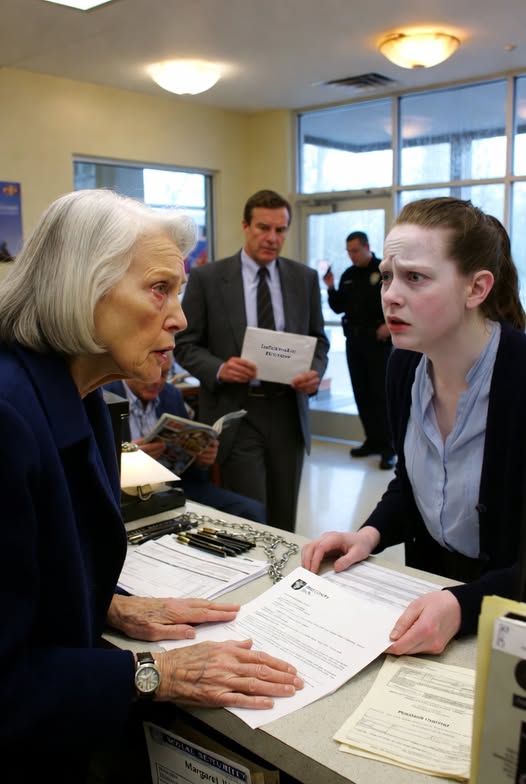
The bank lobby smelled of wet umbrellas, burnt coffee, and old carpet.
A red security camera light blinked above the loan officer’s door.
Pens were chained to the counter.
Two customers sat in the waiting chairs, pretending not to listen to each other’s lives.
The young teller smiled when I stepped up.
“Good morning. How can I help you?”
I slid the letter across the counter.
Her smile softened at first.
Then she opened my account record.
The smile disappeared.
She looked at my driver’s license, then at the screen, then at the letter again.
“Mrs. Whitaker,” she said carefully, “have you authorized anyone else to access this account?”
“My daughter helped me set up the app after my husband died,” I said.
My voice sounded far away.
The teller printed one page.
Then another.
Then a third.
The printer hissed behind her.
Rain tapped the front windows.
On the first page, I saw dates.
March 12.
March 29.
April 8.
On the second, I saw transfer amounts I had never approved.
On the third, I saw an authorization form with my name typed at the top.
The teller called the branch manager.
He came out carrying a sealed internal review envelope and wearing the guarded expression of a man who had seen enough paperwork to know when the paper was telling an ugly story.
“I’m going to need you to tell me very carefully whether this signature is yours,” he said.
I looked down.
The signature was close.
Not perfect.
Close.
My first name leaned wrong.
The W in Whitaker curled too high.
Robert would have noticed immediately.
I heard his voice in my memory as clearly as if he were standing beside me.
Look at the line, Maggie. People reveal themselves in the pressure.
“No,” I said.
The branch manager opened the envelope.
Inside was a First County Bank access-change report dated the same week Emily had told me everything was fixed.
The report listed an online access profile, transfer permissions, and a linked external account.
Then I saw the name.
Authorized Online Access: Brandon Whitaker Hale.
I stared at it for so long that the teller touched the counter lightly, as if she wanted to bring me back without startling me.
“My son-in-law’s last name is Hale,” I said.
The branch manager did not look surprised.
That frightened me more than if he had.
He explained what he could without accusing anyone before the investigation was complete.
Several transfers had been made in increments small enough to avoid certain automatic reviews.
Some payments had gone to a linked account.
Others appeared to be electronic withdrawals.
There were login records.
There were timestamps.
There were device IDs.
Those words should have sounded foreign to me.
Instead, they sounded like doors unlocking one by one.
The teller asked whether I wanted to freeze the account.
“Yes,” I said.
My voice did not shake that time.
The branch manager asked whether I wanted to revoke all third-party access.
“Yes.”
He asked whether I wanted to open a new account in my name only and move the remaining funds.
I looked down at Robert’s watch.
The second hand kept moving.
“Yes,” I said again.
By noon, my old account was locked.
By 12:43 p.m., the new account existed.
By 1:08 p.m., First County Bank had printed copies of every access-change form, every overdraft notice, every transfer ledger, and every linked account record they were allowed to give me that day.
I put the papers into my folder.
Not groceries.
Not gas.
Not an app issue.
Paperwork.
A plan.
A signature pretending to be mine.
When I walked out of the bank, the rain had slowed to a mist.
My phone had seventeen missed calls.
Nine from Emily.
Six from Brandon.
Two from a number I did not recognize.
I did not call back.
I drove home, parked in Robert’s spot in the driveway, and sat there until I could breathe normally.
Then I went inside and made tea.
At 2:16 p.m., Emily called again.
This time I answered.
“Mom,” she said, breathless and sharp, “what did you do?”
Not “Are you okay?”
Not “The bank called me by mistake.”
What did you do?
That told me more than any confession could have.
“I went to First County Bank,” I said.
There was a silence on the line.
Then Brandon’s voice came through, closer than hers.
“You had no right changing things without talking to us.”
I looked at the yellow tulips, still drooping in a glass on the kitchen windowsill.
“My name is on the account,” I said.
“You’re confused,” he snapped.
There it was again.
Confused.
A word people use when they cannot say caught.
Emily came on the line crying, but it was the wrong kind of crying.
It had no grief in it.
Only panic.
“Mom, Brandon was just helping manage things. You don’t understand how complicated money is now.”
“I understand an overdraft letter,” I said.
“I understand my signature when I see it.”
That stopped her.
For three seconds, the house was so quiet I could hear the refrigerator humming.
Then Brandon said, “We’re coming over.”
I hung up.
My hands shook afterward, but I did not regret it.
I called Linda from Miller’s Market and told her I would bring cash for the groceries she had covered.
She asked if I was all right.
I said, “I’m getting there.”
Then I called First County Bank back and asked the branch manager whether I should contact the police.
He chose his words carefully.
He said the bank would complete its internal review.
He said I had the right to file a report.
He said the documents mattered.
Documents matter more than tears when someone is trying to make you sound old.
So I documented everything.
I photographed the overdraft letter.
I placed the printed transfer ledgers in date order.
I wrote down the exact time Emily called.
I wrote down Brandon’s words.
At 3:04 p.m., Emily and Brandon arrived.
They did not knock like family.
They pounded.
The sound went through the front door and into my chest.
I stood in the hallway with one hand on the stair rail and forced myself not to move until I had counted to five.
When I opened the door, Emily’s face was blotchy, and Brandon’s jaw was clenched so hard a muscle jumped near his temple.
“What the hell did you do?” he demanded.
Behind him, Emily looked past me into the house, as if checking whether I had invited witnesses.
I had not.
Not yet.
But the folder was on the dining room table.
Robert’s table.
The same table where Emily had once spread out his papers and told me to let her help.
“Come in,” I said.
Brandon stepped inside first.
Some men think entering a room first means owning it.
Emily followed, twisting her wedding ring around her finger.
In the dining room, Brandon saw the folder.
He saw the bank letter.
He saw the printed transfer ledger.
For the first time since I had known him, he went quiet.
Emily picked up the authorization form.
Her lips parted.
“Mom,” she whispered, “where did you get this?”
“At the bank.”
“You shouldn’t have gone there alone.”
I almost laughed.
Instead, I sat down because Robert had always said never argue standing up when the truth deserves a chair.
Brandon pointed at the papers.
“This is being blown way out of proportion.”
“Then explain it simply,” I said.
He looked at Emily.
Emily looked at the table.
Nobody spoke.
That silence taught me something I should have learned weeks earlier.
People who are innocent rush toward explanations.
People who are guilty circle the room looking for exits.
Brandon finally said they had borrowed some money.
Borrowed.
That was the word he chose.
He said Emily knew I would help if I understood the pressure they were under.
He said Ava’s activities were expensive.
He said Mason needed things.
He said business had been slow.
He said family helps family.
Emily cried harder at that part.
I looked at my daughter, and for a moment I saw her at seven years old with missing front teeth, holding a handmade Mother’s Day card covered in crooked hearts.
Then I looked at the false signature on the bank form.
Both things were true.
That was the cruelty of it.
The child I loved had grown into a woman who let her husband put his hand into my life and call it help.
“How much?” I asked.
Neither one answered.
I opened the transfer ledger and read the total out loud.
Emily covered her mouth.
Brandon’s face hardened.
“You don’t need all that money,” he said.
There are sentences that end a relationship the moment they leave a person’s mouth.
That was one of them.
The room changed after that.
Not loudly.
Not dramatically.
It simply rearranged itself around the truth.
I told them the account had been changed.
I told them all third-party access had been revoked.
I told them the bank had begun an internal review.
I told them I was filing a police report.
Emily began to sob then, truly sob, but I could not tell whether she was crying for what she had done or for the fact that I had finally seen it.
Brandon slammed his palm on the table hard enough to make the papers jump.
“You’ll ruin us,” he said.
I looked down at Robert’s watch.
The second hand kept moving.
“No,” I said. “You did that when you signed my name.”
He stared at me as if I had become someone else.
Maybe I had.
Or maybe I had simply become the woman Robert always believed I could be without him standing beside me.
The police report was filed that evening.
The bank’s review took longer.
There were forms, calls, statements, copies, and questions that made my stomach ache.
I had to say out loud, more than once, that my daughter had access to my financial information because I trusted her after my husband died.
That sentence never got easier.
Trust is not a mistake when you give it.
It becomes a wound only when someone uses it as a weapon.
The investigation showed unauthorized transfers and forged authorization paperwork.
It showed login activity from devices that were not mine.
It showed money moved in amounts designed to look ordinary.
Ordinary was the insult.
They had not stolen from me in one grand act.
They had drained peace from my life in installments.
Emily eventually admitted she had known about some of it.
Not all, she said.
People always say not all when all is too ugly to hold.
Brandon blamed pressure, business trouble, children’s costs, and my supposed inability to understand modern finances.
None of those explanations changed the documents.
First County Bank restored what it could through its fraud process.
The rest became a legal matter.
I will not pretend it was clean or painless.
A family does not break like glass.
It breaks like a bone, with pain that keeps arriving long after the crack.
Ava and Mason were the hardest part.
I refused to make them messengers.
I refused to poison them against their mother.
When they came to visit months later, Mason brought the same red fire truck, the wheel loose again.
“Can you fix it, Grandma?” he asked.
I said yes.
My hands shook when I reached for the glue.
But I fixed it.
The house changed after everything happened.
I changed the locks.
I moved Robert’s little black notebook from Betty Crocker into a locked drawer.
I learned to check my accounts every Friday morning after tea.
I learned that online banking was not magic.
I learned that asking questions is not confusion.
I learned that a widow can be lonely and still be dangerous to people who mistake loneliness for weakness.
Some mornings, I still hear Robert’s voice when the kettle whistles.
Clear labels save clear minds.
So I label things now.
Bank records.
Insurance papers.
Passwords.
Boundaries.
The yellow tulips on my windowsill eventually died, of course.
All flowers do.
But the next spring, I bought another bouquet from Miller’s Market.
My card worked.
Linda smiled when the receipt printed.
I carried the tulips to my car without shaking.
For a long time, I thought being comfortable meant having enough money to keep the lights on.
Now I know better.
Comfort is also knowing no one has a secret key to your life.
And if they do, it is never too late to change the lock.