I did not sleep.
I sat on the bathroom floor until the tiles grew warm beneath me, staring at the photo of Raja like my eyes could drag him through the screen and make him tell me everything.
The red thread around his neck was the kind tied during temple prayers.
The silver key was small.
Not a house key.
Not a cupboard key.
A locker key.
At 5:12 a.m., Karan knocked on the bathroom door.
“Ananya?”
I froze.
“Are you inside?”
I held my breath.
“Ananya, open the door.”
His voice was gentle now.
Too gentle.
Like a man standing over broken glass, deciding which piece to hide first.
I flushed the toilet though I had not used it, splashed water on my face, and opened the door.
He stood there in his white office shirt, hair combed, face calm.
“Why were you sleeping in here?”
“I felt sick.”
His eyes dropped to my handbag on the floor behind me.
Only for a second.
But I saw it.
“You should stay home today,” he said.
“I have work.”
“After police questioned you? Take leave.”
“I said I have work.”
He smiled slightly.
That small, patient smile husbands use when they want wives to feel unreasonable.
“Fine,” he said. “I’ll drop you.”
“No.”
The smile disappeared.
“Why?”
“I need to go early.”
“Then I’ll go early.”
My mouth dried.
Before I could answer, his phone rang.
He looked at the screen, rejected the call instantly, and turned away.
I saw the reflection in the bathroom mirror.
No name.
Only the marigold photo.
At 6:05, I left the flat without breakfast, without waking the maid, without touching the elevator buttons with my bare fingers. I took an auto halfway, changed to a bus, then walked the last lane to our office building from the rear entrance.
The city was still yawning awake.
Tea stalls steaming.
Milkmen balancing crates.
Stray dogs stretching under parked cars.
And above all of it, the memory of Raja’s torn ear burned in my mind.
The back staircase door was locked from outside.
It was never locked.
I pulled once.
Twice.
Then I heard a soft scrape behind me.
I turned.
The paan stall woman stood across the lane, sweeping red betel stains into the gutter. She did not look at me directly.
“Madam,” she murmured, “not from there.”
I walked toward her.
She kept sweeping.
“Go parking basement. Second pillar. Behind blue drum.”
“Who sent you?”
She spat paan juice into the dust.
“Cat.”
For a second, I thought fear had finally broken my brain.
Then she lifted her eyes.
“Cat came to me last night. With thread. With key. And boy came after cat. I hid cat.”
“What boy?”
She only shook her head.
“Go now. Before office girl comes.”
Office girl.
Pooja.
My legs moved before my mind did.
The basement smelled of petrol, damp cement, and old rainwater. Tube lights flickered overhead. Somewhere, a generator coughed like an old man.
Second pillar.
Blue drum.
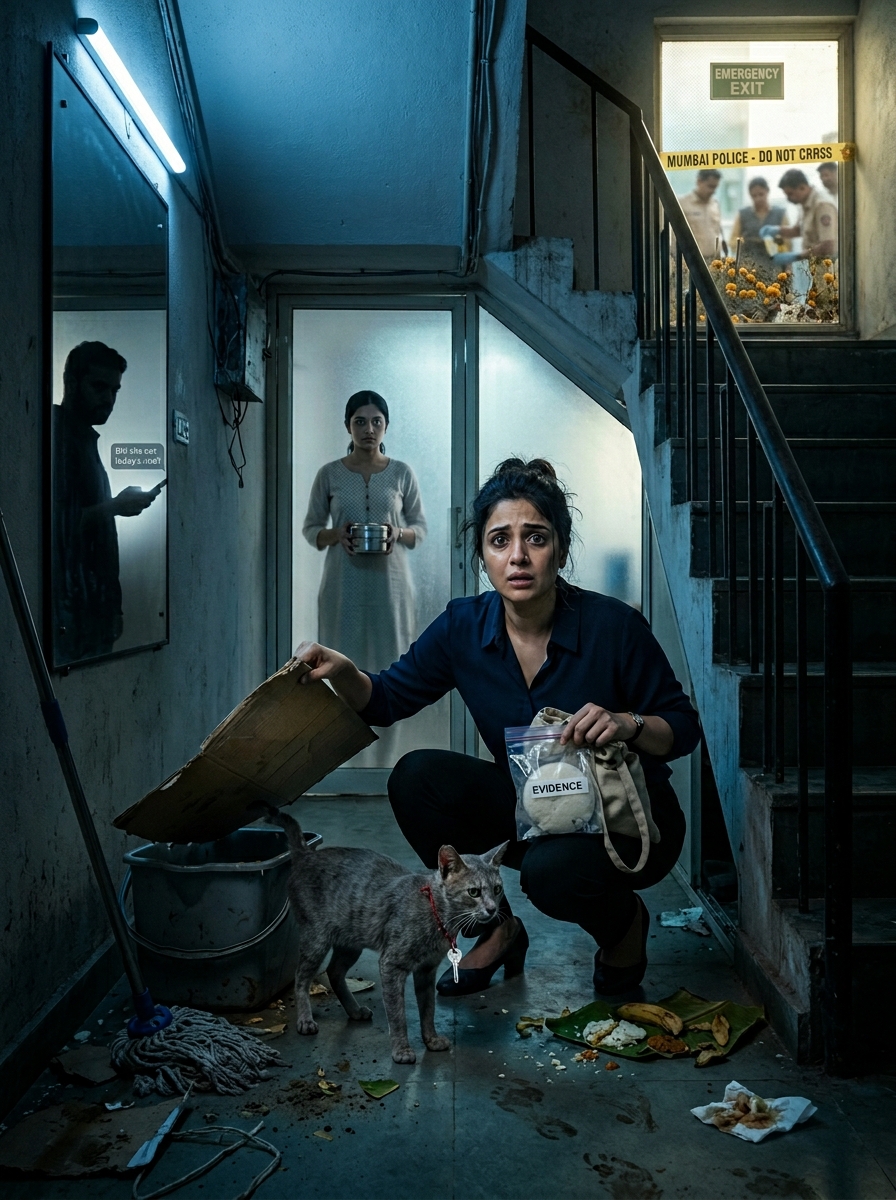
Behind it, curled in a cardboard fruit box, was Raja.
Alive.
His grey fur was dirty. His eyes were half-closed. But when he saw me, he lifted his torn ear.
I dropped to my knees.
“Raja,” I whispered.
He did not run.
That frightened me more than anything.
His body was weak, but around his neck the red thread remained tied, and the silver key tapped lightly against his chest.
I reached for it.
He hissed.
“Sorry,” I whispered. “Sorry, sorry.”
I opened my handbag and took out one piece of plain bread I had grabbed from home. He sniffed it, rejected it, and blinked slowly.
Behind the cardboard box, taped to the wall, was an envelope.
My name was written on it.
ANANYA RAO.
Not in Pooja’s handwriting.
Not in Karan’s.
The letters were shaky, like someone had written them while crying.
Inside was a photograph.
Old.
Faded at the corners.
A young woman in a green salwar stood beside Karan outside a temple. He was younger, thinner, smiling with an ease I had not seen in years.
Beside them stood Pooja.
Not as a coworker.
As a teenager.
Her arm was around the woman in green.
On the back, three names were written.
Karan. Meera. Pooja.
Sisters are not born only by blood.
My fingers trembled.
There was also a folded note.
Do not give the key to police until you open locker 318. Station cloakroom. Ask why Meera’s name was never spoken in your house. Ask why your husband married you three months after she vanished. Ask why Pooja brings you food but never watches you swallow.
The basement tilted.
Meera.
I had heard that name once.
Only once.
During my first year of marriage, when Karan’s mother had visited and, after two glasses of wine, said, “At least this one is respectable.”
Karan had shouted at her so violently she left the next morning.
When I asked, he said Meera was a servant girl who stole money from his family.
A servant girl.
A woman in a temple photograph holding his hand.
A missing woman.
I looked at Raja again.
“Who tied this to you?”
He only blinked.
Then footsteps echoed at the basement entrance.
Soft.
Careful.
I slipped behind the blue drum, pulling Raja’s box with me.
Pooja appeared between the pillars.
She was carrying the steel tiffin.
Even there.
Even in a basement that smelled of fear.
Her braid was neat. Her dupatta pinned. Her face pale.
She looked around once and whispered, “Raja?”
The cat’s ears moved.
Pooja knelt near the pillar.
“Raja, come out. Please. I don’t have time.”
Her voice broke on the last word.
I stepped out.
She jerked back so hard the tiffin fell from her hand.
Idlis rolled across the oil-stained floor.
For the first time since I had known her, Pooja looked like a child.
“You?” she whispered.
“Who is Meera?”
Her face emptied.
“Where did you hear that name?”
“Who was she to Karan?”
Pooja covered her mouth.
Not to hide a lie.
To hold back a scream.
“He told you nothing,” she said.
“No.”
Her eyes filled.
“He told me you were eating them.”
“The idlis?”
She nodded.
“Why were you bringing them? What is in them?”
“Nothing yesterday,” she said quickly. “Today nothing. I swear on my sister.”
“Meera?”
Her shoulders shook.
“She was my cousin. My sister. My everything.”
I bent and picked up one idli from the floor.
“Then why did the police find poison near the divider?”
“Because the poison was never for you.”
My body went cold.
Pooja looked toward the entrance, then lowered her voice.
“The first week, I brought normal food. I wanted to see what you would do. Karan said you were proud. That you threw away anything from lower people. I didn’t believe him. Then I saw you feeding Raja.”
Shame stabbed me, sudden and sharp.
“I didn’t know—”
“I know,” she said. “After that, I kept bringing them because Raja was the only one who could go where we could not.”
I looked at the cat.
“The key?”
“Meera hid evidence before she disappeared. Locker 318. We never found the key. Last month, one municipal worker dug near the divider and saw a silver key tied inside plastic under the marigolds. Before he could report it, he died in a hit-and-run.”
The gardener.
The police.
The sealed divider.
“And the toxic soil?” I whispered.
“Someone poured chemical there to destroy what was buried.” Her voice lowered further. “Not food. Bones.”
I stepped back.
Pooja’s tears finally fell.
“Small bones. Animal bones first. To confuse them. Then cloth. Then one anklet.”
My ears rang.
“Meera?”
“We don’t know. Police won’t say. But that anklet…” She pressed her fist to her chest. “I gave it to her on Raksha Bandhan.”
I thought of Karan watching cricket.
Karan saying procedure.
Karan saying drama.
The marigold display photo.
My husband had not been frightened because police found poison.
He had been frightened because they were finally digging.
“Why warn me?” I asked.
Pooja wiped her face.
“Because you were supposed to be blamed.”
The basement air vanished.
“What?”
“Karan told someone you had become unstable. That you hated me. That you were throwing my food every day. If poison was found, if Raja died, if the police traced food from your hand to that garden…” She swallowed. “Everything would point to you.”
I remembered the inspector’s eyes.
My fingerprints on plates.
My daily staircase route.
My secret.
A perfect chain.
Pooja reached toward Raja, and this time the cat let her touch the red thread.
“He didn’t eat the poisoned one. Cats know. He dragged it away. That is why they tried to catch him.”
“Who sent me the message?”
Pooja looked up.
“My maasi.”
“Your maasi made the idlis?”
“No.” Her mouth twisted painfully. “My maasi has been dead for nine years. I used her name because Karan knew it. He would believe I was too sentimental to be dangerous.”
The sound of a car entering the basement cut through us.
Headlights swept across the pillars.
Pooja grabbed Raja.
I grabbed my handbag.
A black sedan rolled in slowly.
Karan’s car.
Pooja’s face went white.
“He followed you.”
“No,” I whispered. “He offered to drop me. I said no.”
“He knew you would come.”
The sedan stopped near the ramp.
Driver’s door opened.
Karan stepped out.
Not rushing.
Not shouting.
Calm.
Always calm.
“Ananya,” he called, voice echoing. “Come out.”
Pooja pulled me behind the pillar.
Raja trembled against her chest.
Karan took a few steps forward.
“You are making this worse,” he said. “Both of you.”
Both.
So he knew Pooja was here.
Pooja closed her eyes.
From the other side of the basement, another figure appeared.
Sandeep.
Our manager.
Holding office keys.
My lungs locked.
Sandeep had given police full CCTV access.
Sandeep had watched me return to my desk.
Sandeep had smiled with clean-company teeth.
“You should have eaten the idlis, Ananya,” he said softly.
Karan turned his head sharply. “Shut up.”
But it was too late.
The sentence opened something inside me.
I took the frozen idli from my handbag, still wrapped in foil inside the pouch.
Pooja stared at it.
“You kept one?”
“Three days ago.”
Her eyes widened.
Karan saw the pouch.
His face changed.
For the first time, the calm cracked.
“Give that to me.”
I stepped backward.
Sandeep moved left.
Karan moved right.
They were blocking both exits.
Then Raja suddenly tore from Pooja’s arms.
“Raja!” she cried.
He ran between the cars, the silver key flashing at his neck.
Karan lunged after him.
In that one second, I saw the ramp behind him clear.
“Run!” Pooja screamed.
We ran.
Past Sandeep.
Past the blue drum.
Up the ramp into the morning light.
Behind us, Karan shouted my name—not like a husband, but like an owner whose locked cupboard had learned to walk.
We burst onto the street.
A police jeep stood near the divider.
The female constable from yesterday turned as we stumbled toward her.
I held up the pouch.
“Evidence,” I gasped. “And locker key. And my husband is in the basement.”
She did not waste a second.
Her hand went to her wireless.
But before she could speak, a sound rose from below.
Not a gunshot.
Not a scream.
A cat’s howl.
Then metal clanging.
Then Karan’s voice, raw and panicked.
“No! No, don’t open that!”
The constable ran toward the basement with two officers.
Pooja collapsed beside the divider, sobbing so hard her whole body folded.
I stood there with the idli in my hand, watching the police disappear into the dark.
For one impossible moment, Mumbai seemed to stop breathing.
Then my phone vibrated.
Unknown number.
One new message.
The key around the cat’s neck is not for locker 318.
My fingers went numb.
A second message appeared.
It is for the cupboard in your bedroom wall.
I looked across the road.
Through the glass doors of the office building, beyond the police tape and the dead marigolds, I saw Karan standing at the basement entrance between two constables.
His eyes found mine.
And slowly, very slowly, he smiled.
That was when I understood—the truth was not buried under the garden.
It had been sleeping beside me every night.
And if your hands are shaking after reading this, tell me in the comments what you think Ananya will find inside that wall… because the next key may unlock something far worse.

