The first thing I noticed was the sound of Sarah’s truck.
Not the engine.
The rattle.
Her gray pickup had a loose tailgate that made a hollow clank whenever it hit a dip in the gravel road behind my house, and for a second that afternoon, I thought memory was playing one of its cruel tricks on me.
Daniel used to make that same road sing with noise.
He would come around the bend too fast, tap the horn twice, and yell from the driveway that he had brought groceries, even when all he had was a carton of eggs and a paper bag of day-old rolls from the store.
My son had been dead for eight months, but grief does not always remember to be logical.
Sometimes it hears a truck and expects a boy to come home.
I was on the front porch when Sarah arrived, holding a paper cup of coffee that had gone cold enough to taste bitter and metallic.
The afternoon air smelled like wet leaves, lake mud, and the faint dust that always rose from the road when a vehicle came too fast.
A small American flag tapped softly against the porch rail, because Daniel had put the bracket up for me one summer and I had never had the heart to take it down.
Sarah’s truck came around the bend hard.
The tires threw gravel.
The mailbox shook.
She pulled up crooked near the lake instead of coming to the house, and even from the porch I could tell she was not there to visit.
People carry grief in different ways.
Some fold it into silence.
Some turn it into chores.
Some spend months moving paper from one folder to another because a death certificate, an insurance packet, a hospital release form, and a probate notice are easier to hold than the fact that your child is gone.
But Sarah did not look like grief.
She looked hunted.
She shoved the truck door open and jumped down before the engine had even settled.
Her hair whipped across her face.
She looked toward the road first, then toward the trees, then toward my house, where I sat with my hands wrapped around a coffee cup I had forgotten to drink.
For one breath, I waited for her to wave.
She did not.
She ran to the truck bed.
That was when I stood up.
My knees gave the same little complaint they had been giving me every morning since Daniel’s funeral, but I ignored them and moved to the edge of the porch.
“Sarah!” I called.
The wind took part of my voice and dragged it across the yard.
She heard me.
I know she heard me because her shoulders tightened.
She just did not turn around.
Before Daniel died, Sarah had been careful around me.
Not warm, exactly.
Careful.
She used to sit at my kitchen table and stir sugar into coffee she never finished while Daniel talked too much to cover the quiet between us.
He loved her in that earnest, stubborn way good sons sometimes love difficult women, as if devotion could soften every sharp edge if he only kept giving more of himself.
On their first anniversary, he bought her a brown leather suitcase.
He brought it to my house before giving it to her because he wanted me to see it.
“Mom, don’t laugh,” he said, grinning like he was still sixteen and showing me a report card. “She likes nice things.”
I did not laugh.
I made him coffee.
I noticed the tired gray under his eyes.
I noticed the way his phone kept lighting up on the table and how quickly he turned it face down.
I noticed more than he wanted me to notice, because mothers are trained by fear long before anyone calls it wisdom.
After Daniel died, Sarah came by only when there was paperwork.
The hospital release.
The life insurance packet.
The title on his truck.
The probate forms she said she needed signed “before things got messy.”
The last time she sat at my kitchen table, I wrote the date on a sticky note and tucked copies into a blue folder from the county clerk’s office.
Not because I wanted a fight.
Because grief makes people forgetful, and money makes people bold.
That day by the lake, Sarah reached into the truck bed and pulled out Daniel’s suitcase.
The old brown leather looked darker than I remembered, swollen in places, the sides rounded as if whatever was inside had been packed badly and in a hurry.
She dragged it backward with both hands.
It thudded off the metal tailgate.
The sound hit the yard low and heavy.
Not clothes.
Not shoes.
Not paperwork.
Something else.
“Sarah!” I called again, louder this time.
She turned her head halfway.
For one second, I saw her face.
Her eyes were wide, but not with sorrow.
Her mouth was pressed so tight it looked bloodless.
There was a kind of fear in her expression I had never seen on her before, not when Daniel was sick, not when the funeral director asked about burial clothes, not when the hospital intake desk handed her a clipboard and she signed in the wrong place three times.
This fear was not the fear of losing someone.
It was the fear of being caught.
She dragged the suitcase through the weeds.
One wheel caught on a rock, and she yanked so hard the handle snapped against her palm.
I started down the porch steps.
My coffee cup tipped over behind me and rolled against the bottom stair, spilling a thin brown line across the wood.
The yard felt longer than it had ever felt.
“Sarah, what are you doing?”
She looked at me then.
Really looked.
The distance between us was maybe forty yards, but in that moment it felt like a courtroom aisle, like a hospital hallway, like all the months after Daniel’s death had stretched into one thin wire between us.
There was no apology in her face.
No embarrassment.
No explanation waiting.
She lifted the suitcase with a grunt, swung it once, and threw it into the lake.
The splash was not dramatic.
It was worse than dramatic.
It was dull.
Dense.
A sound with weight inside it.
The suitcase struck the water, rolled sideways, floated for half a breath, and began to sink.
I screamed her name.
Sarah was already running back to the truck.
Her boots slipped in the mud.
She caught the open door, hauled herself in, and slammed it so hard the sound cracked across the water.
The truck lurched backward, then forward, tires biting into gravel.
Dust rose behind her.
The gray pickup shot past my mailbox and disappeared around the bend.
For one ugly second, rage asked me to stand there and memorize every curse I had never said to her.
I did not.
I ran to the lake.
At sixty-four, running is not a clean thing.
It is pain bargaining with panic.
My hip burned.
My chest tightened.
My lungs tasted like cold pennies.
The grass near the lake was slick, and I nearly went down before I reached the water.
The suitcase was farther out than I wanted it to be.
Not far for a young person.
Far enough for a grandmother whose knees had been stiff since winter and whose hands still shook when she opened Daniel’s closet.
I stepped into the lake fully clothed.
The cold climbed my legs so fast I gasped.
Mud closed over my sneakers.
The bottom pulled at me with every step, and reeds scratched my palms when I reached through them.
The suitcase dipped again.
Only the handle remained above the surface.
“Please,” I whispered, though I did not know who I was talking to.
Daniel.
God.
The boy I used to carry on my hip.
The man I could not keep alive.
I lunged.
My fingers missed the handle the first time and slapped water.
I tasted mud when I stumbled forward.
The second time, I caught it.
The suitcase was impossibly heavy.
The handle dug into my fingers, slick leather sliding against my palm, and for one awful heartbeat I thought it would pull me down with it.
I braced both feet in the mud and leaned back.
Nothing moved.
I pulled again.
The muscles in my back screamed.
The suitcase shifted an inch.
Then another.
The lake made soft sucking sounds around it, as if it did not want to give up what it had been handed.
I thought of Daniel carrying that same suitcase through my kitchen doorway, proud of himself.
I thought of Sarah sitting across from him, smiling without warmth.
I thought of the blue county folder in my drawer with all those copied forms, all that careful ink, all that tidy proof that death had turned my son into paperwork.
Paperwork can make people feel safe.
It is not the same as truth.
I pulled until my shoulder felt like it tore.
The suitcase scraped over a rock, then came free enough for me to drag it through the shallows.
By the time I got it onto the muddy bank, my jeans were soaked to the thighs, my sweatshirt clung to my arms, and water ran from the suitcase seams in thin brown streams.
I dropped beside it.
For a moment all I could hear was my own breathing.
Hard.
Wet.
Too loud.
The lake settled.
The road went quiet.
A crow called once from the trees and then stopped, like even the woods were listening.
That was when I heard the sound.
It was small.
So small I almost missed it.
A weak little moan came from inside the suitcase.
I went still.
There are sounds the mind refuses at first because accepting them would split the world in half.
A suitcase is not supposed to breathe.
A suitcase is not supposed to cry.
A suitcase is not supposed to make the sound of something alive and trapped in the dark.
I put one shaking hand on the zipper.
The metal teeth were jammed with grit.
My fingers slipped twice.
“Please,” I said again.
This time I knew who I was talking to.
Whoever was inside.
The zipper gave an inch.
Then stuck.
I dug my thumbnail under the tab and pulled so hard the nail split down the side.
Pain flashed white through my hand.
I kept pulling.
The zipper came open with a sound like teeth breaking.
The smell hit first.
Lake water.
Wet leather.
Mud.
Then I saw the blanket.
It was blue.
Tiny.
Soaked through.
For one second my brain tried to make it into something else.
A doll.
A bundle of clothes.
A trick of fabric and fear.
Then the blanket moved.
I peeled it back with both hands.
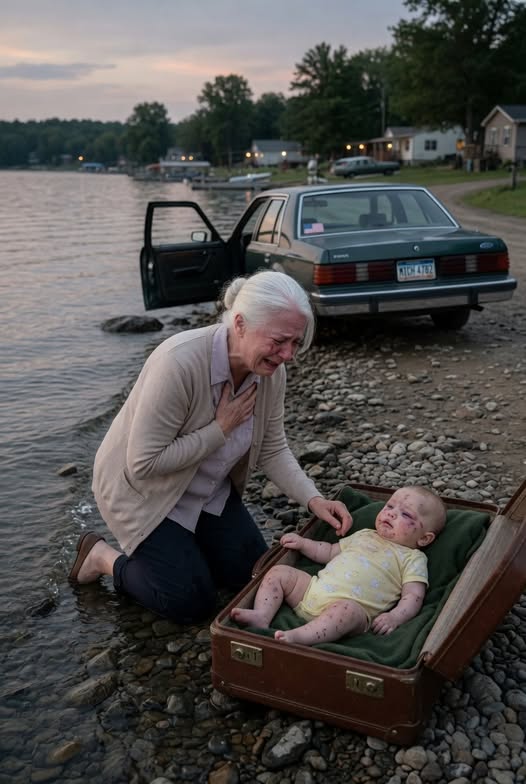
Inside was a newborn baby.
He was smaller than anything alive should be.
His skin looked cold and bluish.
His lips were dark.
His eyes were closed.
His umbilical cord had been tied with a piece of thread instead of a hospital clamp, the knot swollen and wet.
No bracelet.
No receiving blanket from a maternity ward.
No soft cap.
Nothing that said a nurse had ever touched him.
“No, no, no,” I heard myself say.
My voice did not sound like mine.
I lifted him carefully, terrified of breaking him, and pressed him against my chest under my sweatshirt.
He was so cold the shock of it went straight through me.
I leaned my cheek close to his nose.
Nothing.
Then the faintest breath brushed my skin.
Not enough.
But there.
He was breathing.
The run back to the house should have been impossible.
I do not remember climbing the slope.
I do not remember crossing the yard.
I remember the porch flag snapping once in the wind and the coffee cup still lying on its side by the step.
I remember thinking, absurdly, that I had left the front door unlocked.
Inside, I grabbed the phone with one hand and held the baby with the other.
The 911 operator answered before the second ring finished.
“My name is Emma,” I said, though it came out broken. “I found a baby. A newborn. In a suitcase. In the lake. Please send somebody.”
The operator’s voice changed.
Not panic.
Training.
“Ma’am, I need your address.”
I gave it.
She repeated it.
“Is the infant breathing?”
“Barely.”
“Is the infant warm?”
“No.”
“Remove wet material if you can, wrap him in something dry, keep him against your body, and stay on the line.”
I laid a towel on the kitchen counter, then could not bear to put him down.
He made one weak sound, not even a cry, and I nearly dropped the phone.
“Stay with me,” I kept saying.
The operator asked for my name again.
She asked what time I found him.
She asked whether I saw who placed him in the water.
At 2:41 p.m., according to the county dispatch log, I said Sarah’s name for the first time.
“My daughter-in-law threw the suitcase,” I told her. “I saw her with my own eyes.”
The ambulance arrived with its siren low, more vibration than sound until it reached the driveway.
Two paramedics came in fast.
One had a medical bag.
The other already had a thermal blanket open.
They asked questions while their hands moved.
How long in the water.
How long since I opened the suitcase.
Whether he had cried.
Whether I knew the mother.
I answered what I could.
When one of them tried to take the baby from me, my arms tightened without permission.
“Ma’am,” he said softly, “we have to help him.”
That softness broke something in me.
I let go.
At the county hospital, the ER doors swallowed us in a wash of bright light and antiseptic air.
A nurse at the intake desk saw the soaked blue blanket and stopped mid-step.
Her face changed before she could control it.
She covered her mouth with her hand.
The paramedic called out the details for the chart.
“Newborn male. Recovered from lake shoreline. Hypothermic. Respiratory effort weak. Time of recovery reported approximately 2:40 p.m.”
Another nurse wheeled in a warmer.
Someone else took my wet sweatshirt from my shoulders and wrapped a blanket around me.
I did not remember sitting down, but suddenly I was in a plastic chair beside a wall map of the United States and a bulletin board full of hospital notices no one in crisis could read.
My shoes left muddy prints on the floor.
A hospital intake form lay on a clipboard in my lap, the paper spotted where lake water dripped from my sleeves.
Patient name.
Unknown.
Relationship to patient.
Unknown.
How found.
I stared at that line until the letters blurred.
A baby should not enter the world as unknown.
A baby should not have to prove he belongs to the living.
The nurse who had covered her mouth came back to me later.
She had changed her gloves.
Her eyes were red.
“Who put him in there?” she asked.
I looked at her.
“My daughter-in-law.”
The words felt both impossible and obvious.
She lowered her gaze to the clipboard.
“Did you see her?”
“I saw her truck. I saw her hands on the suitcase. I saw her throw it.”
The nurse nodded once, but she did not look relieved.
Nobody looks relieved when a story makes sense for the wrong reasons.
Police arrived after the baby was taken upstairs.
One uniformed officer spoke to the paramedics.
Another took my name.
Then Detective Olivia came in, wearing a dark jacket over a plain blouse, her hair pulled back, her expression careful in the way official people get careful when tragedy has sharp edges.
She asked me to start from the beginning.
So I did.
I told her about the porch.
The cold coffee.
The gray pickup.
The brown leather suitcase Daniel had bought Sarah for their anniversary.
The way Sarah kept looking over her shoulder.
The throw.
The splash.
The mud.
The sound inside.
Detective Olivia wrote everything down.
She did not interrupt much.
When she did, the questions were precise.
“What time did you first see the truck?”
“About 2:20.”
“Could it have been later?”
“Maybe a few minutes.”
“Was there anyone else in the vehicle?”
“I didn’t see anyone.”
“How far were you from the shoreline?”
“From my porch? Forty yards, maybe.”
“Were you wearing glasses?”
“Yes.”
“Were you wearing them at the time?”
That question made me angry, though I understood why she asked it.
“Yes,” I said. “And I know what I saw.”
She nodded.
Her pen moved again.
I told her Daniel had died eight months ago.
I told her Sarah and I had not been close.
I told her Sarah had come to my house several times for paperwork, and that I had kept copies of the death certificate, the insurance forms, and probate papers in a blue county folder at home.
The detective’s pen paused when I said that.
“Why did you keep copies?”
“Because I raised a son who trusted too easily.”
It came out sharper than I intended.
Detective Olivia looked up.
I made myself breathe.
“I kept them because everything after Daniel died felt rushed.”
She wrote that down too.
Methodical people can turn your pain into lines on paper so cleanly that you almost forget how messy it was when it happened.
They process.
They document.
They verify.
Those are good words until they start standing between you and what you know.
Hours passed.
The baby was in intensive care.
No one would tell me much, only that he was alive, that they were warming him, that his breathing was still fragile, that a doctor would come when there was news.
I sat in the waiting area with a hospital blanket around my shoulders and mud drying on my sneakers.
Every time the automatic doors opened, I looked up.
Part of me expected Sarah to walk in.
Part of me dreaded it.
Part of me wanted her to look me in the face while the police asked what kind of person throws a newborn into a lake.
At 5:08 p.m., Detective Olivia returned.
She was not alone this time.
A uniformed officer stood behind her with a folder.
Something in the detective’s face had changed.
Not softened.
Tightened.
“Emma,” she said, sitting across from me, “we need to go over your statement again.”
“I already told you.”
“I know.”
“Then why?”
She folded her hands over the folder.
“Because new information came in.”
The waiting room television murmured above us.
Some family across the room whispered over a vending machine bag of chips.
A hospital monitor beeped somewhere down the hall.
Ordinary sounds kept happening around us, which felt almost obscene.
Detective Olivia opened the folder and slid out a printed still image.
It was grainy, black-and-white, taken from above.
A road.
A gas station entrance.
A gray pickup.
My stomach tightened before she said a word.
“Traffic camera,” she told me. “Same license plate as Sarah’s truck.”
I stared at the image.
The numbers were there.
Not perfectly clear, but clear enough.
“What time?” I asked.
The detective did not answer right away.
“What time?” I said again.
“2:23 p.m.”
The room seemed to tilt.
“No.”
“The camera is across town,” she said carefully.
“No.”
“Emma—”
“No. I saw her.”
“I’m not saying you didn’t see someone.”
“I saw Sarah.”
The officer behind her looked down at the floor.
That small movement scared me more than the photograph.
Detective Olivia slid another page forward.
It looked like a dispatch printout, times lined up in columns, clean and official.
“The timeline is tight,” she said. “If Sarah’s truck was there at 2:23 p.m., it would be difficult for her to be at your lake access at the same time.”
“Difficult is not impossible.”
“With the distance, it may be.”
I pushed the paper back.
“My son’s suitcase was in that lake.”
“We need to confirm that.”
“It was his.”
“We need to confirm that too.”
Her voice was not cruel.
That almost made it worse.
Cruelty you can fight.
Procedure just keeps walking forward.
I looked toward the hallway where they had taken the baby.
A nurse stood near the nurses’ station, pretending not to listen.
Her face had gone pale.
She knew what the detective was saying.
Everyone in that little circle knew.
If the camera was right, then either I had mistaken Sarah for someone else, or someone had wanted me to see exactly what I thought I saw.
Both answers were terrible.
One made me unreliable.
The other made the whole afternoon something colder than panic.
A setup.
Detective Olivia leaned forward.
“Emma, I have to ask some uncomfortable questions.”
“I found a baby in a suitcase.”
“I understand.”
“No, you don’t. You are asking me about timestamps while that child is upstairs fighting to breathe.”
“I am asking because if we get this wrong, we may miss who actually put him there.”
That stopped me.
For the first time since Sarah’s truck tore away from the lake, my anger had nowhere simple to go.
The detective’s eyes did not leave mine.
“You and Sarah had tension after Daniel’s death?”
“Yes.”
“You believed she was after money?”
“I believed she wanted things handled fast.”
“You disliked her?”
“I did not trust her.”
“That is not what I asked.”
The nurse at the desk looked away.
My hands tightened around the edge of the hospital blanket.
I thought of Sarah at my kitchen table, pushing forms toward me.
I thought of Daniel defending her with tired eyes.
I thought of the suitcase sinking.
I thought of the baby’s breath against my cheek, faint as a secret.
Grief changes a person, but it does not make a suitcase moan.
The detective lowered her voice.
“Emma,” she said, “you hated your daughter-in-law, didn’t you?”
For a moment, I could not speak.
Because the question was ugly.
Because it was insulting.
Because, underneath all that, it was not simple.
I had resented Sarah.
I had mistrusted her.
I had blamed her for making Daniel’s last months harder than they needed to be.
But hate is a word people use when they want to turn a witness into a motive.
I looked at the traffic camera still on the table.
I looked at the hospital form in my lap where relationship to patient still said unknown.
I looked toward the hallway where a newborn with no name was fighting for a life someone had tried to sink.
Then I understood the most chilling part was not just what had been inside Daniel’s suitcase.
It was that whoever put him there may have counted on me blaming Sarah first.
And if the camera was telling the truth, then someone else had been close enough to Daniel’s life, Sarah’s truck, and my grief to know exactly where I would be sitting when the suitcase hit the water.