The morning of the crash started like most mornings did in those first blurry weeks after Owen was born: with too little sleep, too much love, and the quiet panic that I was somehow doing every single thing wrong.
My son had a pediatrician appointment for a stubborn rash on his chin, and I had spent the entire drive there replaying feeding times in my head, wondering whether he was eating enough, sleeping enough, breathing too fast, breathing too slow.
New motherhood had turned me into a person whose heart lived outside her body.
On the way home, I remember checking the rearview mirror to make sure Owen had finally drifted off.
His mouth had fallen open the way it always did when he slept in the car seat, and I had smiled even though I was exhausted.
I was thinking about heating up soup, changing into clean clothes, maybe lying down for twenty minutes if he stayed asleep.
Then a pickup truck ran a red light and slammed into the driver’s side of my car.
The impact felt less like a collision and more like being erased.
One second there was a road and a stoplight and my son breathing softly behind me.
The next there was the crack of glass, the violent punch of the airbag, and the sickening metal scream that tells you something solid has just been destroyed.
I remember trying to say Owen’s name.
I remember someone yelling for an ambulance.
I remember the terror of not being able to turn around.
By the time I woke up fully in the hospital, Owen had already been examined and cleared.
He was frightened but uninjured, which felt like the first mercy I had received all day.
The second mercy was a nurse who brought him close enough for me to touch his blanket with my good hand when I started crying because I could hear him but couldn’t reach him.
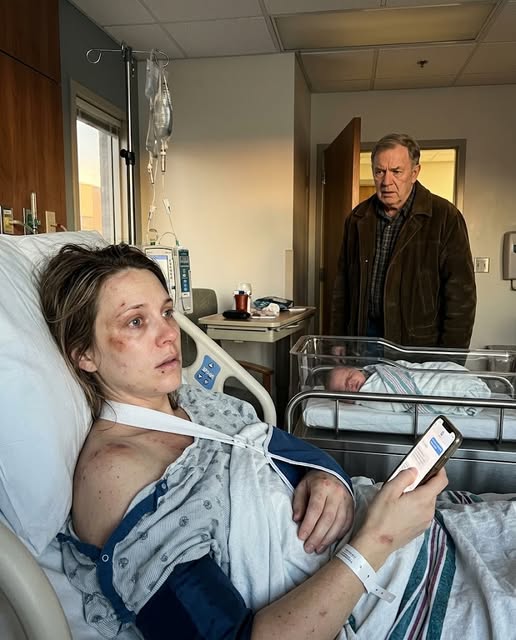
The third mercy came from a doctor who was blunt without being cold.
She told me I had a fractured pelvis and a torn ligament in my shoulder.
I would need several days in the hospital, then weeks of limited movement, physical therapy, and strict instructions not to lift my baby.
She said the last part gently, but it landed like a blow.
Owen was six weeks old.
I had spent every day since his birth carrying him against my chest, memorizing the shape of him, breathing him in like oxygen.
The idea that I could not pick him up felt impossible.
My husband, Jacob, was out of town for a work conference in Denver.
A storm had grounded flights all afternoon, and when I called him, I could hear the helplessness in his voice.
He was doing everything he could to get on any plane, rent any car, take any route back, but there was no version of that night where he reached me before morning.
He kept apologizing even though none of it was his fault.
After we hung up, I lay there listening to Owen cry in the hallway and realized I had one urgent problem that could not wait until dawn.
I needed someone to take my baby for the night.
So I called my mother.
Susan lived twenty minutes from Franklin Memorial.
Twenty minutes.
In my mind, she had already said yes before the phone even rang.
Mothers came when daughters were hurt.
Grandmothers came when newborns needed arms.
That was the logic I had lived on for years, even when the evidence kept trying to teach me otherwise.
For nine years, ever since my father died unexpectedly of a heart attack, I had sent my mother $4,500 a month.
It started because she called me three weeks after the funeral and said she could not keep up with the mortgage alone.
She sounded fragile and frightened, and I was still so deep in grief that I would have agreed to anything that felt like protecting what was left of my family.
I had just gotten a promotion at work.
Jacob and I had savings.
I told myself we could manage.
The arrangement was supposed to be temporary.
That was how she framed it.
Just until things settled.
Just until the paperwork finished.
Just until she got back on her feet.
But the months became years, and every time I asked whether we could reduce the amount, there was another reason she still needed help.
Property taxes had gone up.
The insurance premium had changed.
The furnace needed repair.
Groceries were expensive.
Lauren, my younger sister, had student loans.
There was always a reason.
I never demanded proof because she was my mother, and because questioning her made me feel disloyal.
When Susan answered the phone from her kitchen, she sounded bright enough to be on her way to a party.
She told me she was packing.
I explained that I was in the hospital after a crash, that Jacob was stuck in Denver, that I physically could not stand and that Owen had nowhere to go for the night.
Then she sighed the way she always did when she wanted me to understand that I had become a burden.
Melissa, I can’t do this today, she said.
I thought maybe she hadn’t understood.
I repeated that I could not lift my baby.
Her voice turned sharper.
Your sister never has these kinds of emergencies, she said.
Lauren manages her life.
With you, there is always some kind of drama.
Then she told me she was leaving for a Caribbean cruise that afternoon, that she deserved it, and that I should call somebody else.
She ended with a sentence that still makes my stomach tighten when I remember it: Don’t try to make me feel guilty.
Then she hung up.
There are moments in life that feel loud even when they happen in silence.
That was one of them.
Owen was crying, the nurses were moving around me, machines were beeping, but inside me something went absolutely still.
I stopped expecting anything from her in that instant.
Not because I had finally grown stronger, but because I had finally been shown something so undeniable that even hope could not distort it.
I called a certified overnight postpartum nurse and paid the emergency rate.
Then I called a daytime caregiver for the hours until Jacob could get home and we could figure out a longer plan.
After that, I opened my banking app, found the monthly transfer labeled SUSAN – SUPPORT, and canceled it.
Nine years of automatic obedience disappeared with one
tap of my thumb.
About three hours later, my grandfather Harold walked into my hospital room carrying a manila envelope.
He was seventy-eight, broad-shouldered despite the years, and the kind of man who rarely raised his voice because he never had to.
His face looked carved out of stone.
He shut the door, crossed the room, and said, “Your father paid that house off before he died, Melissa.”
At first I thought the pain medication had made me hear him wrong.
I asked him what he meant.
He sat down beside me and opened the envelope.
Inside were copies of my father’s estate documents, insurance disbursements, and a final loan statement stamped PAID IN FULL.
My father had carried a mortgage protection policy I did not know existed.
Between that and a life insurance payout, the house had been cleared less than three months after his death.
“There has been no mortgage for nine years,” my grandfather said quietly.
“Not one month of it.”
I stared at the papers until the numbers blurred.
He told me Susan had called him an hour earlier from the airport, furious that I had canceled her monthly transfer.
She wanted him to talk sense into me.
Instead, he asked what transfer she was talking about.
When she admitted I had been sending her money, the whole story finally surfaced.
He drove straight to the hospital with the estate binder he kept in his home office.
I do not know whether heartbreak has layers, but if it does, that day peeled back several I did not know existed.
The cruelty of refusing to help me after the crash was one wound.
Learning that the financial emergency I had organized a decade of my life around had never been real was another.
Every overtime shift I had worked.
Every trip Jacob and I postponed.
Every time I bought the cheaper option because Mom needed the money more.
All of it returned to me in a rush that felt like nausea.
My grandfather looked devastated too, but there was steel in him.
He said he should have asked more questions years earlier.
Susan had always insisted her finances were private, and he had wrongly assumed she had been honest with me.
He apologized more than once, though none of this was his fault.
Then he did something my mother had not done all day: he started solving problems.
He had already spoken to the charge nurse.
He paid for the postpartum nurse for the rest of the week before I could protest.
He called a longtime neighbor of his, Irene, a retired labor and delivery nurse, and asked whether she would be willing to help once I was discharged.
He brought me lip balm, a phone charger, fresh clothes from my house after getting the garage code from Jacob, and the one thing I needed most but had not known how to ask for: calm.
Jacob arrived the next morning after a sleepless overnight chain of flights and a three-hour drive from the airport.
He came into my room looking wrecked, kissed my forehead, then went straight to Owen and stood there with both hands on the carrier like he needed to reassure himself our son was truly okay.
When I told him what my mother had
said, his face went white.
When I showed him the estate papers, he sat down very slowly and said, “We are done pretending this is a misunderstanding.”
Those first weeks after I came home were a blur of pain medication, ice packs, physical therapy exercises, and learning how to mother from a position I had never imagined.
I could feed Owen with support pillows and hold him carefully once the doctor allowed it, but I could not scoop him up in a hurry or pace the room with him when he cried.
Jacob took family leave.
Grandpa Harold had us move into the first-floor guest suite of his house for a month because our own bedroom was upstairs and my walker made stairs nearly impossible.
Irene came in the mornings.
The postpartum nurse handled nights for the first several days.
We survived because other people showed up.
My mother did call from the cruise once she realized the transfer was truly gone.
She began the conversation furious and ended it worse.
She accused me of humiliating her.
She said canceling the money without warning was cruel.
When I finally interrupted and told her I knew there had never been a mortgage, there was a silence on the line so complete that I could hear the wind on her side of the phone.
Then came the excuses.
She said the money had still been necessary.
She said I was doing well and she was not.
She said after everything she had gone through as a widow, I owed her support.
She said she had sacrificed for me for years and it was about time someone took care of her.
Not once did she apologize for leaving her injured daughter and newborn grandson without help.
Not once did she ask how Owen was.
I told her that a mother who can leave for a cruise while her child lies in a hospital bed does not get to lecture anyone about sacrifice.
Then I hung up.
Lauren called two days later and repeated, almost word for word, the lines our mother had fed her.
She told me I was overreacting, that Mom had been under a lot of stress, that maybe the mortgage money had become household money and what was the difference after so long.
I asked her whether she knew the house had been paid off.
She said no at first.
Then she hesitated.
It was a small pause, but it told me enough.
I learned later that Mom had used some of my money to help Lauren through the collapse of a boutique she had opened with friends.
Whether Lauren knew the full truth from the beginning or only part of it, I still do not know.
What I know is that she had benefited from my silence.
Jacob urged me not to let rage become the only story.
He was right, but he was also clear that what had happened was not just emotional betrayal.
It was fraud.
I had years of texts and emails from Susan invoking the mortgage specifically: reminders that the bank draft was due, warnings about late fees, even one message saying she was terrified of losing the house if I missed a month.
My grandfather gave sworn copies of the estate records.
We met
with an attorney.
The attorney was careful not to overpromise.
Recovering money given to family can be difficult, he explained, because gifts are often treated as gifts even when everyone knows there was pressure behind them.
But false representations change things.
Repeated lies about a specific debt, backed by written messages, opened a door.
He sent Susan a formal demand letter first.
It laid out the timeline, the estate documents, the bank transfers, and the statements she had made about a mortgage that did not exist.
She ignored it.
So we filed.
That was when her tone changed.
Not morally.
Strategically.
Her attorney requested mediation before discovery moved further.
Apparently the prospect of having her finances examined in detail, including luxury travel and cash withdrawals, had a clarifying effect.
The mediation took place about three months after my crash, in a neutral office with bad coffee, muted carpet, and the kind of fluorescent lighting that makes everyone look older and less certain.
My mother arrived dressed like she was headed to church, in soft beige and pearls, as if looking respectable might change what she had done.
She cried in the hallway before we even sat down.
Inside the conference room, she said she never meant to hurt me.
She said she had simply gotten used to the help and then felt entitled to it.
She said she was lonely after Dad died, overwhelmed, depressed, and afraid of downsizing.
All of that may even have been true.
None of it explained refusing to pick up her six-week-old grandson when I was pinned to a hospital bed.
When the mediator asked why she had continued describing the monthly payments as mortgage support long after the mortgage was paid, she said something I will never forget.
She looked at me and said, “Because you would have stopped if I had told you the truth.”
There it was.
Not confusion.
Not grief.
Not bad communication.
Truth.
The settlement took most of the day.
In the end, my mother agreed to refinance the fully paid-off house and repay $300,000 to me, plus $50,000 directly into a trust for Owen’s future.
She also signed a statement waiving any claim to future support from me and acknowledging that the prior payments had been requested under false pretenses.
My attorney believed we might have chased more if we kept fighting, but it would have meant another year of litigation, more legal fees, and more of my life tied to hers.
I chose closure over total victory.
Grandpa Harold chose clarity too.
A month later he updated his estate plan.
He told us openly, in front of everyone, that he was naming me executor instead of Susan because responsibility belongs to the person who acts like family, not the one who merely claims the title.
Susan called that punishment.
He called it consequences.
My relationship with Lauren changed in a quieter way.
She came by one afternoon without warning, stood on my porch with red eyes, and admitted our mother had always played us against each other.
I had been the dependable one, the one expected to absorb cost and blame.
Lauren had been the one praised for staying light, staying easy, staying on Mom’s good side.
None of that erased her part in the story, and I
told her so.
But it was the first honest conversation we had ever had.
We are not close in the way people imagine sisters should be, though we are no longer pretending either.
Physical healing took longer than legal healing.
My pelvis mended in millimeters and patience.
For weeks I shuffled through my grandfather’s hallway with a walker while Owen watched me from a baby seat, blinking like a tiny supervisor.
Jacob learned how to do almost everything one-handed while holding a bottle in the other.
Grandpa became unexpectedly wonderful with midnight pacing and ridiculous lullabies.
Sometimes I would wake to find him in the living room at dawn, Owen tucked safely against his shoulder, whispering stories about my father as a boy.
That was the part nobody could have bought back with money.
In the wreckage of what my mother destroyed, someone else stepped in and built something better.
Not perfect.
Not painless.
But honest.
I did not speak to Susan for nearly a year after mediation.
She sent a birthday card to Owen with a check tucked inside.
I mailed the check back uncashed.
She sent a Christmas text that said families should move on.
I did not answer.
There are apologies that arrive too late to restore trust, and there are people who confuse access with forgiveness.
I learned the difference.
On Owen’s first birthday, we had a small party in our backyard.
There were blue streamers, a lopsided cake, grass stains on Jacob’s knees, and my grandfather laughing so hard he had to take off his glasses when Owen smashed frosting into his own hair.
The late-afternoon sun hit the fence in thin gold lines, and for the first time in a long time, my body felt like my own again.
Not unchanged.
But mine.
At one point I stepped inside to grab more napkins and caught my reflection in the kitchen window.
A year earlier I had been in a hospital bed believing I was alone while my mother sailed toward turquoise water.
Now my son was safe, my marriage was stronger, my finances were no longer tied to a lie, and the people standing in my yard were the people who had actually shown up.
Grandpa came in behind me and handed me the napkins.
He nodded toward the backyard where Owen was squealing at the sight of more cake.
Then he said, very softly, “Your father would be proud of the way you chose your family.”
I looked out at Jacob holding our son, at the old man who had carried truth into my hospital room in a manila envelope, and I realized the ending I got was not the one I would have chosen at the start.
It was better because it was real.
My mother lost a source of money.
I lost the illusion that love and obligation are the same thing.
In return, I gained something I should never have had to earn but was grateful to finally understand: family is not the person who demands your loyalty from a cruise ship.
Family is the one who hears your child crying in the hallway, walks toward the sound, and stays.