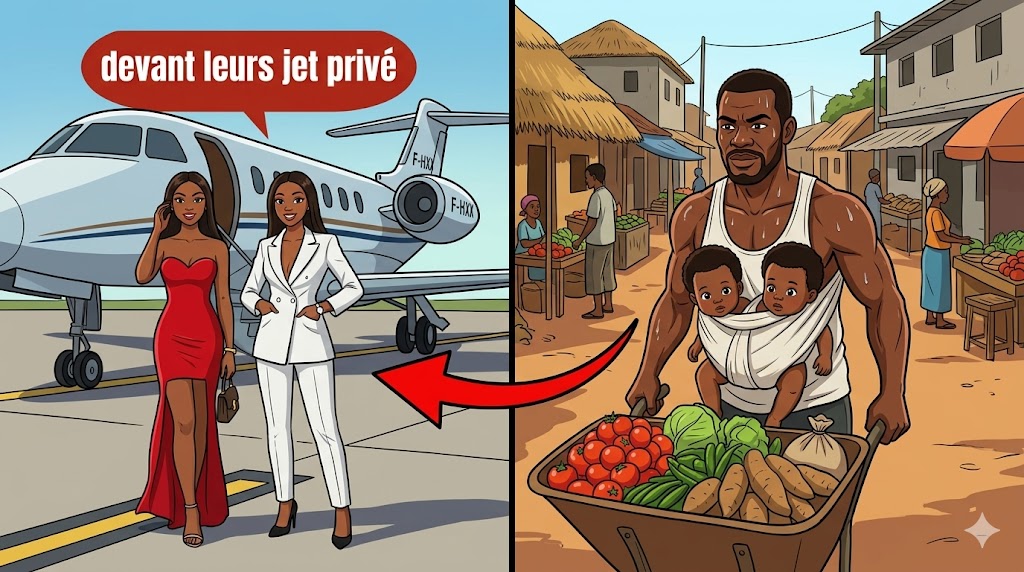
Because shame could not feed his daughters, and wounded pride could not buy milk.
That evening, exhausted and drenched in sweat, he stopped at a small pharmacy and explained his situation to the pharmacist. The man listened quietly, then helped him buy infant formula, basic medicine, and the few things the babies needed most. Peter carried those supplies home like treasure.
Day after day, he returned to the market with the twins tied to his chest.
It was not easy. Some days his shoulders ached so badly he could barely lift his arms. Some days the babies cried under the heat until his heart felt like it would split in two. But still, he kept going. And somehow, slowly, the impossible became routine.
Then one morning, an elderly neighbor changed their lives in a quiet way.
Her name was Mama Caro.
She stopped Peter as he was preparing to leave and said, “Let me keep the babies while you work today. The sun is too harsh for little children.”
Peter hesitated at once.
His daughters were all he had left. Since Linda’s departure, he had grown fiercely protective, almost afraid to let anyone else hold them for too long. But Mama Caro’s face held only kindness.
“I will care for them like they are mine,” she said.
After a long pause, Peter nodded.
That day, for the first time in months, he worked without the twins strapped to his chest. He hated being away from them, but when he returned in the evening, he found both girls washed, fed, and asleep in Mama Caro’s arms.
From then on, she helped whenever she could.
She was not rich. In fact, she was poor herself. But some people carry wealth in their spirit, and Mama Caro was one of them. She bathed the twins, fed them, sang to them, and loved them with the tenderness of someone who understood that blood is not the only thing that makes a family.
Marie and Naomi grew up between two steady hands: their father’s worn, hardworking hands and Mama Caro’s gentle, dependable ones.
They did not attend elite private schools. Their uniforms were simple, their shoes often repaired instead of replaced, their notebooks carefully used from front to back. But Peter made sure they had what they needed. He worked hard enough to keep them in school, and at night, when he was tired to the bone, he still taught them what mattered most: be respectful, work hard, stay honest, and never look down on anyone.
The years passed. The babies became girls. The girls became strong young women.
By eighteen, Marie and Naomi had both graduated from their community school with excellent results. They had studied by candlelight during power cuts. Shared textbooks. Helped each other revise. Prayed together before exams. And when their entrance results came back, the whole house nearly burst with joy.
They had both been admitted to study medicine and surgery.
Peter held those result slips in his trembling hands and smiled so wide the girls thought he might cry from happiness.
“My daughters are going to be doctors,” he said proudly, puffing out his chest and pretending to strut like an important man. “Now I can walk through this city like a king.”
They laughed and hugged and dreamed out loud.
But later that night, when the twins were asleep, Peter sat alone on the edge of his bed, and the smile vanished.
He had no money.
Not even enough to sponsor one child through medical school, let alone two.
For a long time, he sat in silence, staring at the floor.
Then he whispered into the empty room, “After all these years… now that they have made it, I cannot even carry them the rest of the way.”
Still, he refused to surrender.
The next morning, Peter left home earlier than usual, but not for the market. He went instead to the house of a wealthy man in the neighborhood. When the man appeared at the gate in his nightclothes, irritated and suspicious, Peter fell to his knees.
“Please, sir,” he begged. “Take me as your servant. I will wash your clothes, sweep your yard, cook your food, do anything. Just help me send my daughters to university. I will serve you for years if I must.”
The man stared at him, unmoved.
“Training two girls in medicine is not a small thing,” he said. “I can’t do it.”
Peter rose and left.
But he did not stop there.
He went to another house.
Then another.
Then another.
At each gate, he offered the same thing: his labor, his dignity, his time, his body if necessary—anything in exchange for his daughters’ future.
Every answer was no.
When he returned home that day, something in him had gone quiet.
For several days, he hardly spoke. The twins noticed, of course. They had grown up reading the language of sacrifice written all over their father’s face. Finally, one evening, he called them into his room.
“My girls,” he said softly, “forgive me. I have failed you.”
The twins stared at him in shock.
“I promised myself when you were babies that I would send you anywhere in the world to study. But today, I can’t even send you to university.”
His voice broke.
Naomi was the first to move. She knelt beside him and held his arm.
“Papa, you have not failed us.”
Marie joined her, wrapping her arms around his shoulders.
“If money were in your hands, you would send us even to the moon,” she said through tears. “We know that.”
That night, long after he thought the girls had fallen asleep, Peter knelt beside his bed and prayed like a man drowning.
“God, please help me. I have nothing, but You have everything. My daughters deserve this chance. Please, Lord…”
He wept.
Not loudly. Not dramatically. Just the deep, broken crying of a father who had reached the end of himself.
In the other room, Marie and Naomi heard every word.
And something changed in them.
The next week, they made a decision that hurt, but they made it together. They deferred their admission. Then they went out looking for work.
After many rejections, they found jobs in a clean, modest restaurant. They served food, welcomed customers warmly, worked long shifts, and kept their heads high even when some men tried to take advantage of their poverty. They refused to sell their dignity for tips. They saved almost every coin they earned.
At night, the three of them counted money together and prayed.
Seven months later, with discipline, savings, and more determination than fear, the twins opened a tiny restaurant of their own.
It wasn’t large. It wasn’t fancy. But it was clean, bright, and full of heart.
They cooked good food. Treated every customer with warmth. Smiled even when they were tired. Posted little videos and photos on social media. Word spread. Slowly at first, then quickly. People came for the meals and returned for the atmosphere. There was something healing about the place, something honest.
The dream of becoming doctors still lived in them, but life had started writing a different story.
Then one evening, something happened that would change everything.
After closing, Marie noticed a black briefcase under one of the chairs.
The twins opened it carefully and froze.
Inside were thick stacks of U.S. dollars and documents that clearly belonged to someone powerful.
Their father listened in silence when they brought it home.
“You did the right thing,” he said. “The owner will come looking for this.”
The next morning, they took the briefcase back to the restaurant.
Sure enough, a wealthy-looking man was standing outside near a sleek black car, his face tense with worry.
“Have you by any chance seen a black briefcase?” he asked the moment he saw them.
Marie handed it over immediately.
Relief flooded his face. He thanked them quickly, got into his car, and left.
Naomi watched him go and said jokingly, “He couldn’t even leave one dollar behind?”
Marie burst out laughing.
They returned to work, thinking the matter was over.
It wasn’t.
That same afternoon, the man came back.
This time he stepped out slowly, smiling.
“My name is Prince Tony,” he said. “And I came back because honest people are rare.”
The twins exchanged a hopeful glance, half-expecting some cash reward.
Instead, he took them to a large building and placed legal documents in their hands.
“This building is yours,” he said. “The papers in that briefcase were worth far more than the money. By protecting it, you protected something important to my family. I want you to have this place for your business.”
Marie and Naomi stood speechless.
When they finally found their voices, they thanked him with tears in their eyes.
Then they rushed to the market to find Peter.
He was standing beside his wheelbarrow, drinking a cup of cold kunu when his daughters ran into his arms so suddenly that people nearby turned to stare.
“What happened?” he asked, startled and smiling.
“Come with us,” Naomi said.
When they reached the building and told him it was theirs, Peter just stood there, blinking back tears, unable to speak.
This was more than success.
It was an answer.
The new restaurant was fully furnished, beautifully arranged, and ready to grow. The twins poured themselves into it. The business flourished. Soon they had staff, regular customers, social media buzz, and eventually more branches in other cities. The little restaurant became an empire.
Peter retired at his daughters’ insistence.
“You have carried enough,” Marie told him. “Rest now.”
And for the first time in his adult life, he did.
The twins did not forget the people who had loved them when they had nothing. They renovated Mama Caro’s house, paid her medical bills, sent her money each month, and cared for her as if she were royalty.
Then one day, a tired woman came into one of their restaurants asking for work.
She said she could wash dishes, clean floors, do anything.
There were no openings, but something about her brokenness made the twins say yes anyway.
They hired her as a dishwasher.
They did not know her face.
Because Peter, in all his pain, had burned every photo of Linda years ago.
The next day, Peter came by the restaurant and saw the woman in the kitchen.
He stepped back so quietly that she never noticed him.
Then he sat his daughters down and said, with a voice heavy from the past, “That woman is your mother.”
The twins froze.
Their mother?
The woman who had abandoned them as babies? The one who had walked away and never looked back?
When Linda learned who they were, the color drained from her face.
She began to cry at once. “I’m sorry. I’m so sorry, my daughters.”
Marie’s face hardened.
She pulled out money, pressed it into Linda’s hand, and said, “Take this and go. You are not my mother. My mother is Mama Caro.”
Her voice broke on the last word, but the anger in it had waited eighteen years.
Naomi, trembling too, held her sister tightly.
“I know,” she whispered. “I know.”
That night, after many tears and a long, painful conversation with their father, the twins made the hardest choice of all.
They forgave Linda.
Not because she deserved it.
Not because the past stopped hurting.
But because bitterness would have poisoned the peace they had fought so hard to build.
They gave Linda another role in the restaurant, hoping maybe time and grace had changed her.
For a while, it seemed to work.
Then the truth returned.
Little by little, Linda’s arrogance surfaced. She became harsh with staff, rude with customers, controlling, bitter, and entitled. The warmth of the restaurant began to fade. Business dipped. Employees grew afraid of her.
When the twins confronted her, she lashed out.
“I am your mother,” she snapped. “You should respect me. And your father—that man you worship—does nothing while I only get a salary?”
That was enough.
The twins let her go.
Still, they did not abandon her. They opened a small shop for her near her house, giving her a chance to survive with dignity, even after the pain she caused.
After Linda left, the restaurants flourished again.
The twins expanded across the country. They became, in every meaningful way, wealthy beyond what anyone could have imagined when they were babies crying on that old bed. But the richest part of their story was not the money.
It was the peace they built.
The gratitude they kept.
The love they returned to the man who never once returned them to the world.
Years later, when marriage came into their lives, the twins faced one final concern.
Their father was still alone.
One afternoon, they sat him down and spoke gently.
“Papa, not every woman is like our mother,” Marie said.
Naomi smiled. “We found someone kind. A good woman. A widow from one of our restaurants. She has two children. If you marry her, they will be our younger siblings.”
Peter was stunned.
But after meeting Ruth, after talking with her and seeing her gentle heart, he agreed.
In the end, the church was filled with joy.
On the same day, Marie married.
Naomi married.
And Peter married too.
Mama Caro stood proudly among them, not as a guest, but as the true matriarch of a family built not by blood alone, but by sacrifice, loyalty, and love.
And as Peter looked at his daughters in their wedding clothes, he remembered the night he held them as babies and whispered a promise into their tiny ears.
He had said he would be the best father he could be.
He had kept that promise.
He had not given them the easiest life.
He had not given them luxury.
He had not given them the road they first imagined.
But he gave them something greater.
He gave them a future built on courage.
A name they could be proud of.
A love so steady that even abandonment could not break it.
And in the end, that love made them richer than money ever could.