At fifteen, Lily Harper learned that a home could turn on her faster than a locked door.
She was standing barefoot in the front hallway of her parents’ house in Cedar Rapids, Iowa, with her backpack still hanging from one shoulder, when her father pointed at the door and said the words that would divide her life into before and after.
‘Get out.
We believe your sister.’
His voice cracked through the hallway so hard that the little mirror by the coat closet trembled against the wall.
Lily remembered that mirror for years afterward.
She remembered seeing her own face in it, pale and stunned, identical to the face of the girl crying halfway up the stairs.
Serena.
Her twin.
Serena sat on the carpeted step with her knees pulled in, wearing her dance sweatshirt and the expression she used when she wanted the world to move around her pain.
Her mascara had not run.
Her hair was still perfect from practice.
But she was crying loudly enough that Lily’s mother kept glancing between the two girls like the sound itself was proof.
The missing bracelet was gold, thin, and expensive in the way teenage treasures feel expensive.
Serena said she had saved babysitting money for months to buy it.
She said it had been on her dresser that morning.
She said Lily had gone into her room before school.
That was all.
No one asked why Lily would take it.
No one asked whether Serena might have misplaced it.
No one asked whether it could have slipped behind the dresser, into a backpack, under a pile of dance clothes.
Serena cried.
And Lily became the thief.
‘I didn’t touch it,’ Lily said, but her voice sounded small in the hallway.
Her father, Tom Harper, stood between her and the stairs as if she were dangerous.
His work tie was already loosened.
His cheeks were red.
He had that look he got when he had decided anger was easier than listening.
Her mother, Marlene, stood beside the dining room table with both hands gripping the edge.
Lily kept waiting for her to say something reasonable.
Search the house.
Calm down.
Let her breathe.
Instead Marlene whispered, ‘Lily, if you tell the truth now, we can still fix this.’
It was the quietness that hurt.
Her mother was not yelling.
She was not losing control.
She had already chosen what she believed, and she was offering Lily one narrow path back into the family: admit to something she had not done.
‘I am telling the truth,’ Lily said.
Serena made a wounded sound, burying her face in her sleeve.
Lily turned on her.
‘Stop doing that.’
Tom stepped forward.
‘Do not speak to your sister that way.’
‘Why not? She is lying.’
Serena lifted her head.
Her eyes flashed for half a second, sharp and dry, before her face collapsed again.
Lily saw it.
She knew she saw it.
But her parents were not looking for that.
They were looking at Lily.
The whole evening had been wrong from the moment she walked in.
Debate practice had run late, and she had come home hungry, still rehearsing arguments in her head.
The house smelled like pot roast and onions.
The kitchen light was too bright.
Her mother and father were standing
side by side like a school principal and a police officer.
Serena was already on the stairs.
Lily had barely set down her backpack when her father asked where the bracelet was.
At first she laughed, because the question was absurd.
Then she realized no one else was laughing.
‘I do not know,’ she said.
‘Why would I know?’
Because Serena had seen her near the room.
Because Lily had been jealous.
Because Serena had worked hard for it.
Because Lily had been distant lately.
Because Lily always had an explanation for everything.
Each sentence added another stone.
When Lily told them to search her room, her father said they already had.
The words hit like a slap.
Her mother had gone through her drawers while she was gone.
Her father had picked Serena up from dance while Marlene opened notebooks, moved sweaters, checked under Lily’s mattress, searched the desk where Lily kept debate medals and letters from teachers.
They had invaded her room before they ever asked her one honest question.
‘I cannot believe you did that,’ Lily said.
Marlene looked ashamed for one heartbeat, then exhausted.
‘We needed to know.’
‘You needed to know before I got home?’
Tom’s voice hardened.
‘Watch your tone.’
Lily’s eyes burned.
‘You already decided.’
‘Because your sister would not make this up.’
There it was.
The family rule no one ever said out loud.
Serena was dramatic, but she was fragile.
Serena was selfish, but she was sensitive.
Serena lied in little ways, but she was under pressure.
Lily noticed too much, argued too well, remembered every contradiction, and that made her the difficult one.
So when one twin cried and the other defended herself, the crying twin won.
‘I did not take her bracelet,’ Lily said, each word shaking.
Tom pointed at the front door.
‘Get out.
We believe your sister.’
For a moment, Lily thought he meant go cool off.
Walk around the block.
Stand outside until he felt powerful enough to let her back in.
Then he pulled her duffel bag from the closet.
He opened it with a violent jerk and started stuffing clothes inside.

A pair of jeans.
Two T-shirts.
Socks that did not match.
Her old gray hoodie from middle school.
He moved fast, like if he slowed down, he might remember she was his child.
Marlene took one step forward.
‘Tom.’
That was all she said.
Not stop.
Not she is fifteen.
Not this is wrong.
Just his name.
And then silence.
That silence followed Lily out onto the porch.
The cold was immediate.
March in Iowa had not softened yet, and the wind slid under her sweatshirt as she stood beneath the buzzing porch light.
Her duffel bag sagged beside her foot.
Her backpack was still heavy with textbooks.
Inside her geometry book, tucked between chapter notes, she had sixty-three dollars in birthday money.
The door shut.
Lily stared at it.
She could hear Serena crying inside.
She could hear her father’s low voice.
She waited for the click of the knob.
She waited for her mother to open the door and say, come in, this has gone too far.
Nothing happened.
Lily did not cry at first.
Shock held her still.
She could see her breath in front of her face, white and
thin, disappearing into the dark.
Then she pulled out her phone and called her Aunt Diane.
Diane was Marlene’s older sister, four hours away in Madison, Wisconsin.
She was not the fun aunt in a loud way.
She did not buy expensive gifts or tell embarrassing stories at holidays.
She listened.
She asked direct questions.
She remembered things.
She answered on the second ring, her voice sleepy.
‘Diane?’ Lily said.
One word was all she managed before she broke.
Diane’s voice changed instantly.
‘Lily, where are you?’
‘Outside.’
‘Outside where?’
‘Home.’
There was a sharp rustle, the sound of a lamp clicking on.
‘Why are you outside?’
Lily tried to explain, but the sentences came out in pieces.
Bracelet.
Serena.
They searched my room.
Dad told me to leave.
Mom did not stop him.
Diane did not interrupt.
She breathed once, slow and controlled, and said, ‘Listen carefully.
Stay where there is light.
Put on whatever extra clothes are in that bag.
Do not go anywhere with anyone.
I am leaving now.’
‘It is four hours.’
‘Then I will be there in four hours.’
Lily sat on the porch steps until her fingers went numb.
After twenty minutes, the porch light turned off.
She never knew whether it was automatic or whether someone inside flipped the switch.
She moved to the edge of the driveway beneath the streetlamp.
At 1:17 in the morning, headlights turned onto the street.
A small blue car stopped at the curb, and Diane got out wearing a winter coat over pajama pants, her hair pinned up crookedly, her face white with a kind of anger Lily had never seen directed on her behalf.
Diane walked straight to her.
No lecture.
No suspicion.
No demand for the full story before offering warmth.
She pulled Lily into her arms and held her while Lily finally sobbed into the shoulder of her coat.
When Lily could breathe again, Diane looked at the dark house.
‘Your mother knows I am here?’
‘I do not know.’
Diane’s jaw tightened.
‘She will.’
She took Lily’s bag, put her in the passenger seat, turned the heat up until the vents roared, and drove away without knocking on the door.
Half an hour later, Marlene called.
Diane answered through the car speakers.
Marlene’s voice sounded thin and defensive.
‘Diane, you do not understand what happened.’
Diane kept both hands on the wheel.
‘I understand your fifteen-year-old daughter was outside in the cold at one in the morning.’
‘It was not like that.’
‘It was exactly like that.’
Tom came on the line next.
His voice was clipped, embarrassed, angry that another adult had witnessed what he had done.
‘Lily needs to learn accountability.’
Diane glanced at Lily, then back at the road.
‘Accountability starts with adults.’
‘She stole from her sister.’
‘Prove it.’
Silence.
The road hummed beneath them.
Tom said, ‘Serena would not lie about this.’
Diane’s laugh was quiet and cold.
‘Then you better hope you are right.’
She ended the call.
Lily slept in the car for part of the drive, waking whenever the tires hissed over wet pavement.
She arrived in Madison before dawn and slept in Diane’s guest room under a quilt that smelled faintly of lavender detergent.
When she woke, there was a note on the bedside
table.
You are safe here.
Breakfast is in the kitchen.
We will figure out school after you eat.
Lily read it three times.
It was the first time in twelve hours anyone had spoken to her like she had a future.
Diane did not treat her like a temporary problem.
She enrolled her in school.
She bought her notebooks, socks, a winter coat that actually fit, and a used desk from a thrift store.
She sat with her while Lily emailed teachers in Cedar Rapids and asked for missing assignments.
She drove her to counseling even when Lily insisted she did not need it.
At night, Lily would lie awake expecting the rules to change.
She waited for Diane to get tired of her.
Waited for one bad grade, one moody answer, one misplaced dish to become evidence that she was secretly ungrateful or dishonest.
But Diane did not explode.
When Lily flinched at raised voices on television, Diane lowered the volume.
When Lily apologized five times for finishing the milk, Diane bought two cartons.
When Lily asked, months later, whether Diane believed she had taken the bracelet, Diane set down her coffee and looked offended.
‘Lily, I believed you before I got in the car.’
Those words did something no apology could have done.
They gave Lily a place to stand.
Her parents called twice in the first month.
The first call came from Marlene, who cried softly and said everyone was hurting.
Lily held the phone in Diane’s kitchen and waited for the apology.
It never came.
Instead Marlene said, ‘Your father thinks it would help if you just admitted what happened so we can move forward.’
Lily hung up.
The second call came from Tom.
He sounded colder.
‘You are making this worse by refusing to be honest.’
Lily said, ‘I learned that from you,’ and ended the call before her hands started shaking.
After that, there were birthday cards without apologies, holiday texts Diane told her she did not have to answer, and occasional family gossip that drifted through relatives.
Serena was thriving.
Serena made varsity dance.
Serena got a boyfriend.
Serena posted pictures in perfect lighting with captions about loyalty and family.
Lily stopped looking.
She built a new life piece by piece.
At her new high school, she joined debate again because she refused to let that night take her voice.
She worked at a bookstore on weekends.
She studied with the fierce concentration of someone who knew stability could be revoked by people who claimed to love you.
Diane showed up for everything.
She sat in freezing auditoriums for debate tournaments.
She took pictures on the first day of school.
She learned the names of Lily’s teachers.
When Lily won a statewide scholarship, Diane cried so hard in the parking lot that Lily had to drive them home.
‘You act like I cured cancer,’ Lily teased.
Diane wiped her eyes with a fast-food napkin.
‘No.
I act like you survived people who should have protected you.’
College widened the distance but did not soften the truth.
Lily went to the University of Wisconsin on scholarships, worked in the library, tutored freshmen in writing, and called Diane every Sunday.
She majored in political science because arguments still made sense to her when people did
not.
She learned how systems failed people.
She learned how silence protected the wrong person.
She learned that being disbelieved could become a wound or a weapon, depending on what she chose to do with it.
By senior year, she had the highest GPA in her college.
When the dean called to tell her she had been chosen as valedictorian, Lily walked out of the library into the cold and called Diane before anyone else.
Diane did not speak for several seconds.
Then she said, ‘I am so proud of you I could scream in public.’
Lily laughed, but her throat tightened.
That night, after the excitement settled, she opened a blank email to her parents.
She stared at it for almost an hour.
She had not seen them in person since the night they sent her away.
She had not heard Serena’s voice since a distant relative’s wedding video accidentally caught her laughing in the background.
For seven years, Lily had imagined different versions of confrontation.
In some, they begged.
In some, she screamed.
In most, her mother opened the door too late.
But graduation was not about them.
That was what Diane reminded her when Lily finally told her she was thinking about sending invitations.
‘You do not owe them seats in the room,’ Diane said.
‘I know.’
‘Then why invite them?’
Lily looked at the folded cap and gown hanging on her closet door.
‘Because they should see what they threw away.’
Diane was quiet for a moment.
‘Then send them.
But do not hand them the microphone inside your heart.’
So Lily mailed three invitations.
One to Tom Harper.
One to Marlene Harper.
One to Serena Harper.
No note.
No explanation.
Just the date, time, and place.
On graduation morning, the sky was bright and cold.
Lily stood backstage in her black gown with a gold stole across her shoulders, holding the printed copy of her speech in hands that would not quite stay still.
Through the side curtain, she could see rows of families filling the auditorium.
Balloons bobbed near the back.
Parents leaned into aisles to take pictures.
A little boy in a tiny suit kept kicking the chair in front of him until his grandmother caught his ankle.
Diane was in the front row.
She wore a navy dress Lily had helped her pick out and a cream cardigan because auditoriums were always cold.
Her eyes were already wet.
When she saw Lily peek out, she pressed one hand to her heart.
Then Lily’s gaze moved to the third row.
Her breath caught.
Tom was there.
He looked older than she expected.
His hair had thinned, and his shoulders had rounded in a way that made him seem smaller, though Lily remembered him as taking up whole rooms with his anger.
Marlene sat beside him with her purse clutched in her lap.
She looked pale.
Her eyes searched the stage as if she were afraid of what she might see and more afraid of missing it.
Serena sat on Marlene’s other side.
For a moment, seeing her own face in the crowd felt like being fifteen again.
Serena was polished as ever, hair smooth, makeup perfect, posture elegant.
But she was not crying now.
She was watching Lily with an expression Lily could
not read.
The ceremony began.
Names were read.
Applause rose and fell.
Students crossed the stage in waves of relief, pride, and disbelief.
Lily sat with her speech folded in her lap, aware of every breath.
When the dean announced her name, the auditorium erupted.
Diane stood before anyone else.
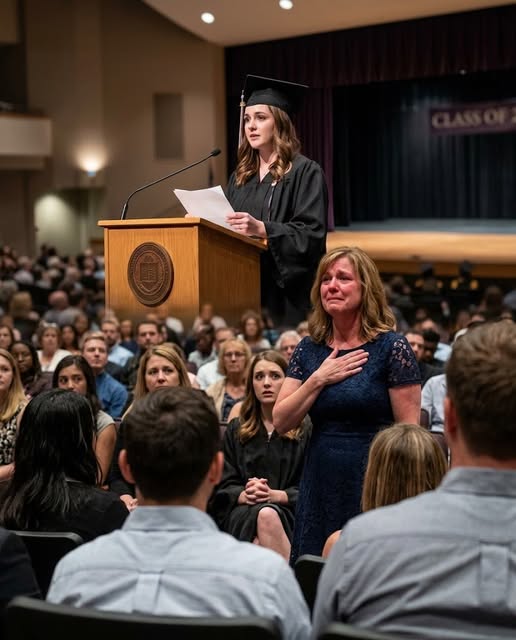
Lily walked to the podium, placed her speech on the wood, and looked out at the crowd.
For one terrible second, she saw the porch.
The duffel bag.
The shut door.
Then she saw Diane.
Lily began.
She spoke first about ordinary beginnings, about how success stories often get polished until the hard parts disappear.
She talked about students who worked two jobs, students who grieved, students who carried family expectations like invisible backpacks.
Her voice strengthened.
‘When I was fifteen, I lost the home I thought I had,’ she said.
A shift moved through the room.
Not loud, but felt.
In the third row, Marlene went still.
Lily did not look directly at her.
‘I learned that sometimes the people who share your blood are not the people who choose you when it costs them something.
I learned that belief can be a form of shelter.
I learned that one adult showing up at the right moment can change the entire direction of a child’s life.’
She paused.
Diane was crying openly now.
Lily let herself smile at her.
‘The woman who gave me that shelter is sitting in the front row.
She drove four hours in the middle of the night when I had nowhere to go.
She fed me, fought for me, believed me, and built a home around me when mine disappeared.’
Her voice wavered, but she did not stop.
‘I would not be standing here without my real mother, Diane Reynolds.’
Diane’s hand flew to her mouth.
Then she stood.
The applause began in the front rows and rolled backward like thunder.
People stood with her, some not knowing the whole story, only understanding the shape of it.
Lily kept her eyes on Diane because if she looked anywhere else, she might fall apart.
But she saw Marlene anyway.
Her birth mother’s hands were trembling in her lap.
She pressed them together, then apart, then together again, unable to still them.
Her face had folded inward with a grief that looked seven years late.
Tom stared straight ahead, jaw locked.
Serena’s smile was gone.
Lily finished the speech.
She did not accuse.
She did not name the bracelet.
She did not say her parents had thrown her out.
She had learned, through years of living with Diane, that dignity could cut deeper than shouting.
Afterward, students hugged her.
Professors congratulated her.
Diane held her for so long that people had to move around them.
‘You called me your mother,’ Diane whispered.
Lily pulled back just enough to look at her.
‘You are.’
Diane pressed her lips together and nodded, too full to answer.
The Harpers approached near the glass doors that led to the courtyard.
Lily saw them before they reached her.
Her body reacted first, shoulders tightening, breath narrowing.
Diane noticed.
‘I am right here,’ she said.
Tom stopped a few feet away.
Marlene stood beside him, eyes red.
Serena lingered half a step behind, looking at the floor.
For a moment, no one
spoke.
Then Marlene said, ‘Lily.’
It was strange hearing her name in that voice again.
Not angry.
Not accusing.
Almost pleading.
‘Congratulations,’ Tom said stiffly.
Lily looked at him.
‘Thank you.’
The silence stretched.
Marlene swallowed.
Her hands trembled again as she clutched the strap of her purse.
‘Your speech was beautiful.’
Diane’s face did not move.
Lily said, ‘It was true.’
Marlene flinched.
Tom’s mouth tightened.
‘We did what we thought was necessary at the time.’
There it was.
Not an apology.
A defense wearing a suit.
Lily felt a strange calm settle over her.
‘You put me outside in March with a duffel bag because Serena cried better than I defended myself.’
Tom’s face reddened.
‘That is not fair.’
Diane stepped forward slightly.
‘Careful.’
One word.
Quiet.
Enough.
Serena lifted her head then.
Her eyes were shiny, but not in the old theatrical way.
She looked frightened.
‘Lily,’ she said.
Lily turned to her twin.
For seven years, she had imagined this moment.
Serena smug.
Serena denying.
Serena pretending none of it mattered.
But Serena looked like someone whose reflection had finally become unbearable.
‘I need to tell you something,’ Serena said.
Tom glanced at her.
‘Not here.’
Serena’s lips parted.
She looked at him, then at Marlene, then back at Lily.
‘No.
It has to be here.’
Marlene went white.
Lily’s pulse began to pound.
Serena reached into her small purse and pulled out a folded envelope, worn soft at the corners.
Her fingers shook as she held it out.
Lily did not take it at first.
‘What is that?’
Serena’s voice dropped.
‘The receipt.’
No one moved.
Lily looked from the envelope to Serena’s face.
Serena continued, words rushing now as if she had been holding them behind her teeth for years.
‘I did not lose the bracelet.
I sold it.’
Marlene made a sound like air leaving her body.
Tom turned sharply.
‘Serena.’
‘I sold it two days before I said Lily took it,’ Serena said, louder now.
‘I needed money for a private dance intensive Mom and Dad had already said no to.
I thought I could replace it before anyone noticed, but Mom asked about it that night, and I panicked.’
The hallway around Lily seemed to blur.
Seven years.
Four hours in the dark.
A porch light shutting off.
All because Serena panicked.
Lily stared at the envelope.
‘You let them throw me out.’
Serena began to cry, but this time the sound did not work on anyone.
‘I was fifteen too,’ she whispered.
‘So was I.’
The words landed cleanly.
Serena covered her mouth.
Tom looked as if he wanted to seize control of the scene, but there was nothing left to control.
The receipt existed.
The confession had been spoken in front of Diane, Marlene, Lily, and three nearby families who had gone quiet without meaning to listen.
Marlene turned to Serena with horror in her face.
‘You told me she was in your room.’
‘I saw her near my room.
I used it.’
‘You watched us pack her bag.’
Serena cried harder.
‘I thought you would just scare her.
I did not think Dad would really make her leave.’
Lily laughed once, but there was no humor in it.
‘You heard the door shut.’
Serena had no answer.
Marlene turned toward Lily, and the apology finally came.
Not polished.
Not elegant.
It broke out of her.
‘I am so sorry.’
Her voice cracked on the last word.
‘I am so sorry, Lily.
I should have opened the door.
I should have stopped him.
I should have believed you.’
Tom stood rigid, shame fighting pride across his face.
For one second, Lily thought he would still refuse.
Then he looked at the envelope in Serena’s hand.
His shoulders dropped.
‘I failed you,’ he said.
It was the first honest thing Lily had heard from him since she was fifteen.
But honesty was not a key that opened the past.
Lily felt Diane beside her, steady and warm.
She thought about the girl on the porch who would have given anything to hear those words.
She thought about how long she had waited for someone to admit the truth.
And then she realized the waiting had ended years ago.
Not because her parents apologized.
Because Diane came.
Lily took the envelope from Serena, opened it, and saw the faded pawn shop receipt dated two days before the accusation.
Serena’s name was printed at the bottom in crooked teenage handwriting.
There it was.
The proof that had arrived seven years too late.
Lily folded it again and handed it back.
‘I do not need to keep that,’ she said.
Serena looked stunned.
‘You do not?’
‘No.
You do.’
Serena’s face crumpled.
Lily turned to her parents.
‘I am glad the truth is finally out.
I am glad you heard it.
But I am not going to pretend this moment repairs what happened.’
Marlene nodded through tears.
‘I know.’
Tom looked down.
‘Can we try? Someday?’
Lily looked at Diane, then back at him.
‘Someday maybe starts with you understanding that I already have a family.
You do not get to walk back in and stand where she stood.’
Diane inhaled sharply.
Marlene covered her face.
Lily expected to feel cruel.
Instead, she felt clear.
She hugged Diane in the crowded hallway while her parents stood a few feet away, finally seeing the distance they had created.
Then she took pictures with friends, met professors for lunch, and walked across campus under bright spring light with her real mother beside her.
That evening, Marlene sent a text with only six words.
You deserved better from all of us.
Lily read it, set the phone down, and did not answer right away.
There would be time later to decide what forgiveness meant, whether Serena’s confession deserved mercy, whether parents who abandoned a child could ever earn back even a corner of trust.
But that night, Lily sat across from Diane in a small Italian restaurant, wearing her graduation stole over her dress while Diane ordered dessert for both of them.
When the waiter brought two slices of chocolate cake, Diane lifted her fork like a toast.
‘To the truth,’ she said.
Lily smiled.
‘To the woman who showed up before it did.’
Some people would say Marlene and Tom deserved a second chance because they finally apologized.
Others would say seven years is too long to wait for truth that should have been demanded the first night.
Lily never claimed to know the perfect answer.
She only knew this: the person who shared her blood shut the door, and the person who became her mother drove through the dark to open one.