Part 1
The moment my father opened his mouth, I smelled the lie before I heard it.
That sounds dramatic, I know. Lies don’t have a smell. But my father’s did. They came with Old Spice, spearmint gum, and the warm metallic scent of coffee that had sat too long in a travel mug. They came with his hand landing too heavy on someone’s shoulder, his laugh a little too loud, his chin tilted like he was about to sell a tractor to a man who came in for a screwdriver.
I had flown from Boston to Ohio the night before with my black dress folded into a carry-on, my hospital badge tucked in the side pocket, and one promise repeating in my head.
Today is Marcus’s day.
Not mine. Not my father’s. Not the day I finally corrected the story he’d been telling for eleven years.
So that morning, in the hotel bathroom, I stood barefoot on cold tile and stared at my reflection under bad yellow lighting. I had circles under my eyes from a delayed flight and a consult that had stretched until nearly midnight. My hair refused to sit flat. My badge lay on the sink beside my earrings, plastic casing scratched, my name clear beneath the logo.
Dr. Claire Callaway
Chief of Cardiothoracic Surgery
Hargrove Boston Medical Center
I picked it up twice.
Then I left it on the counter.
The auditorium at Hargrove University smelled like floor polish, perfume, and nervous flowers. Every other family seemed to be carrying bouquets wrapped in crinkling plastic. Mothers adjusted collars. Grandfathers leaned on canes. Younger siblings complained about their shoes. The graduates were hidden somewhere backstage, but you could feel them in the air, that bright, exhausted electricity of people who had survived something brutal and were about to be applauded for it.
I slipped in through the main doors like a stranger.
That was the first strange thing. I knew this building better than almost anyone in that crowd. I knew the side hallway where the vending machine ate dollars. I knew the back staircase where residents cried quietly between cases. I knew the third-floor conference room where I once presented a paper after sleeping forty minutes in a call room chair.
But today I was just Marcus Callaway’s sister.
I found my parents near the center aisle.
My mother stood with her purse held in both hands against her stomach, smiling that thin church smile she used when she wanted no one to ask how she was. My father was laughing with a heavyset man in a gray suit and a turquoise bolo tie. Dad’s cheeks were red. His hair, once coal black, had gone mostly silver around the temples, but he still stood like he owned whatever room he occupied.
I should have gone straight to my seat.
Instead, I walked over.
My father spotted me when I was about ten feet away. Something flickered across his face. Not surprise. Not joy. More like calculation. A quick inventory.
No badge. No white coat. No title visible.
Then his smile came back wider than before.
“Claire,” he said, spreading one arm as if I had arrived late to Thanksgiving dinner. “There she is.”
My mother’s eyes moved over my face. “You made it.”
“I told you I would.”
She reached like she might hug me, then stopped, probably because Dad had already turned back to the man in the bolo tie.
“This is my daughter, Claire,” he said. “Marcus’s older sister.”
The man offered his hand. “Ted Lawson. My boy’s graduating today too.”
“Nice to meet you,” I said.
“And Claire,” my father continued, with the easy rhythm of a story he had practiced, “she tried the medicine route herself for a while. Couple years of residency, realized it wasn’t for her. Works in healthcare administration now. Very stable. Good benefits.”
The auditorium noise thinned around me.
Ted nodded kindly. “Smart, knowing when to change course. Medicine isn’t for everyone.”
My mother looked down at the program in her hands.
I could have corrected him.
One sentence would have done it.
Actually, I didn’t quit. I’m a surgeon.
But my father’s hand squeezed my shoulder before I could speak. Not affection. Warning. His thumb pressed into the little notch near my collarbone hard enough to hurt.
“Claire’s always been practical,” he said.
I looked at his hand until he removed it.
Then I smiled at Ted because none of this was his fault. “Congratulations to your son.”
“Thank you,” Ted said.
Dad had already turned away.
I walked to a seat near the back wall, sat down, and placed both hands flat on my knees. My palms were damp. My throat felt full of cotton. On stage, a row of empty chairs waited beneath white lights.
I told myself the same thing I had told myself for eleven years.
It doesn’t matter what he says.
But then I opened the graduation program and saw Marcus’s name printed in clean black letters, and beneath it, in the list of scholarship acknowledgments, one line made my stomach go cold.
The Callaway Family Medical Legacy Award.
I read it three times, each time slower than the last.
My family had no medical legacy.
At least, not according to my father. And suddenly I wondered what else he had been telling people while I was gone.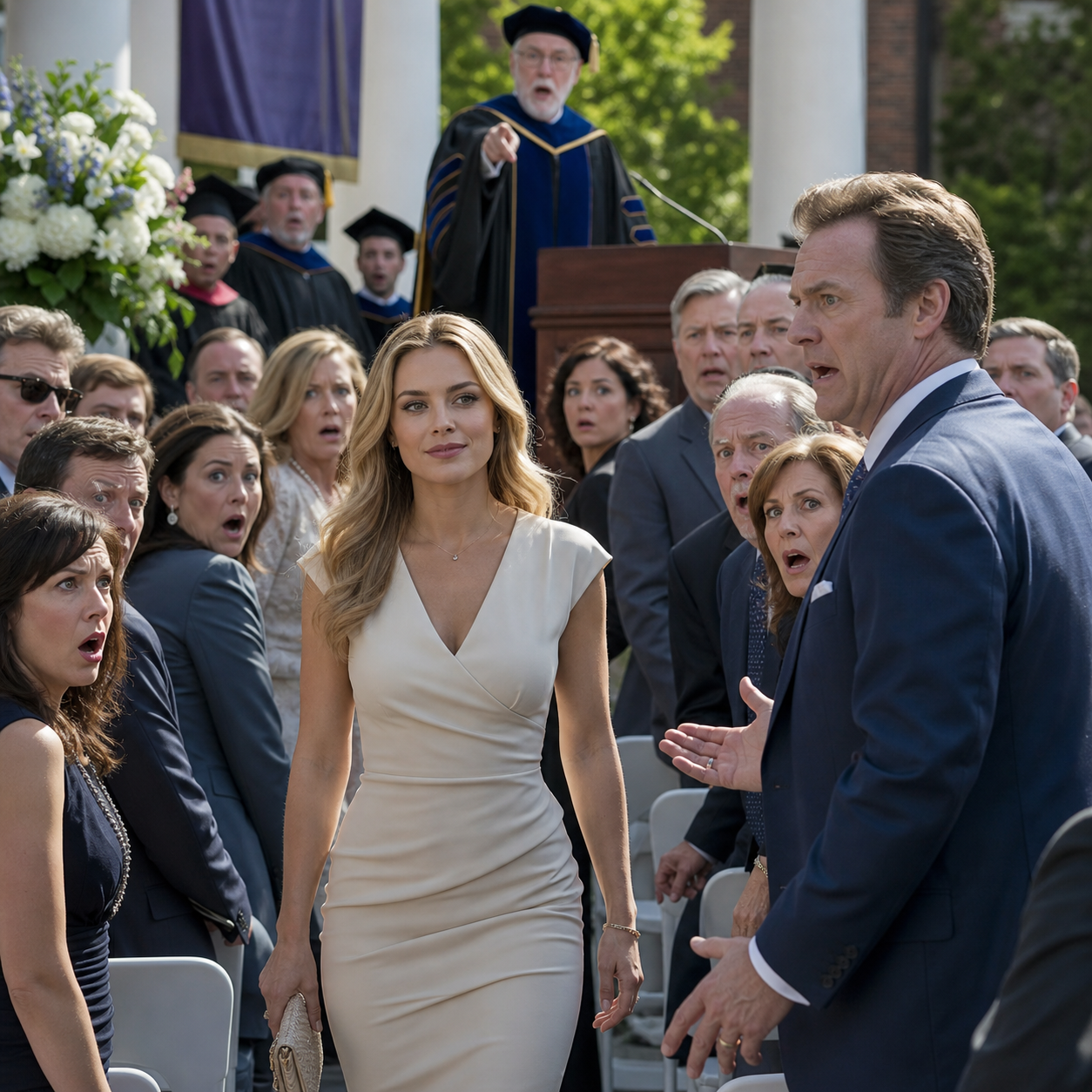
Part 2
The first time I heard that my father had erased me, I was twenty-six and eating vending machine crackers in an on-call room in Chicago.
It was Thanksgiving. Outside the small window, snow slapped against the glass in wet, gray bursts. I had been awake for thirty-one hours. My scrubs smelled like antiseptic and old sweat. Somewhere down the hall, a monitor kept beeping in that high, patient way hospital machines do, like they know they have all the time in the world and you don’t.
My cousin Emily called because my mother had made her.
“Happy Thanksgiving,” she said, too brightly.
“Happy Thanksgiving.”
There was noise behind her. Plates, cousins, football, my uncle pretending he knew how to carve turkey. For one second, I missed it so sharply I had to close my eyes.
Then Emily said, “So… how’s the new job?”
I laughed. “You mean residency?”
“Right. Yeah. That.”
Something in her voice made me sit up.
“What did Dad tell you?”
She hesitated just long enough.
“Nothing bad.”
“Emily.”
“He just said you left medicine. That it didn’t work out, but you were doing something administrative now. Which is fine, obviously. I mean, honestly, probably healthier.”
I remember looking down at the cracker dust on my scrub pants.
“I’m in surgery,” I said. “I’m literally at the hospital right now.”
“Oh.” Her voice shrank. “Maybe I misunderstood.”
She hadn’t.
After that, it came in pieces. A woman from church messaged me on Facebook saying God had different plans for everyone. My high school biology teacher sent a note through my mother saying she was proud of me no matter what path I chose. At Christmas, Aunt Phyllis told Marcus, “Poor Claire gave it her best shot.”
Poor Claire.
I was never poor Claire in the OR. In the OR, I was steady hands and a clear voice. I was the person who knew where the bleeding was coming from. I was the resident who came in early to check chest tubes and stayed late to learn valve repairs. I was tired, terrified, stubborn, and alive in a way I had never been at home.
But in my father’s county, I had quit.
And the worst part was how politely everyone accepted it.
Nobody asked why I never came home. Nobody asked why my mother stopped mentioning my job in her Christmas letters. Nobody asked why my father’s mouth tightened whenever my name came up. People liked tidy stories. Daughter tried medicine. Daughter couldn’t handle it. Daughter found safer work. Father was sad but supportive.
That story fit better than the truth.
The truth was that when I matched into a top surgical residency in Chicago, my father stood at our kitchen counter, looked at the letter in my shaking hands, and said, “So you’re really choosing this.”
I was twenty-two. I still had a suitcase from college sitting by the stairs. My mother had made meatloaf. The kitchen smelled like ketchup glaze and dish soap.
“I worked for this,” I said.
“You worked yourself into thinking you’re better than where you came from.”
“That’s not what this is.”
He leaned back against the counter. “Women in this family make sensible choices.”
I almost laughed because there was nothing sensible about medical school debt, eighty-hour weeks, or crying in your car after anatomy lab. But I didn’t laugh.
“I’m going,” I said.
His eyes went flat.
“Then don’t expect us to clap while you run yourself into the ground.”
I went anyway.
For a while, Marcus was the bridge.
He was fifteen when I left, all elbows and appetite, constantly losing earbuds and forgetting to zip his backpack. He visited me in Chicago during college, sleeping on my lumpy couch, eating Thai food from cartons while I showed him how to read an EKG. He asked questions no one in my family had ever asked.
“What does it feel like to hold someone’s heart?”
“Do you get scared?”
“Do people ever wake up different?”
When he told me he wanted to apply to medical school, he called me before he told Dad.
“Because of you,” he said.
I sat on my kitchen floor in Boston, still in compression socks after a twelve-hour case, and cried so quietly he didn’t hear.
I helped with his essays. I paid for an MCAT prep course he thought was covered by a “department scholarship.” I reviewed his interview answers over video while he paced his dorm room with a towel around his neck.
But I stayed away from my father.
That was the deal I made with myself. I would live the truth. I would not beg him to recognize it.
Now, sitting in the auditorium, staring at that printed line — The Callaway Family Medical Legacy Award — I felt the old deal crack.
My phone buzzed in my lap.
A text from Marcus.
You here?
I typed: Back left wall. I can see everything.
Three dots appeared. Disappeared. Appeared again.
Then: Did Dad say anything weird?
My fingers went still.
Before I could answer, the lights dimmed, and a woman in academic robes stepped onto the stage.
Dr. Eleanor Walsh.
The dean.
The one person in that room who knew exactly who I was.
And when her eyes swept over the crowd, they stopped on me.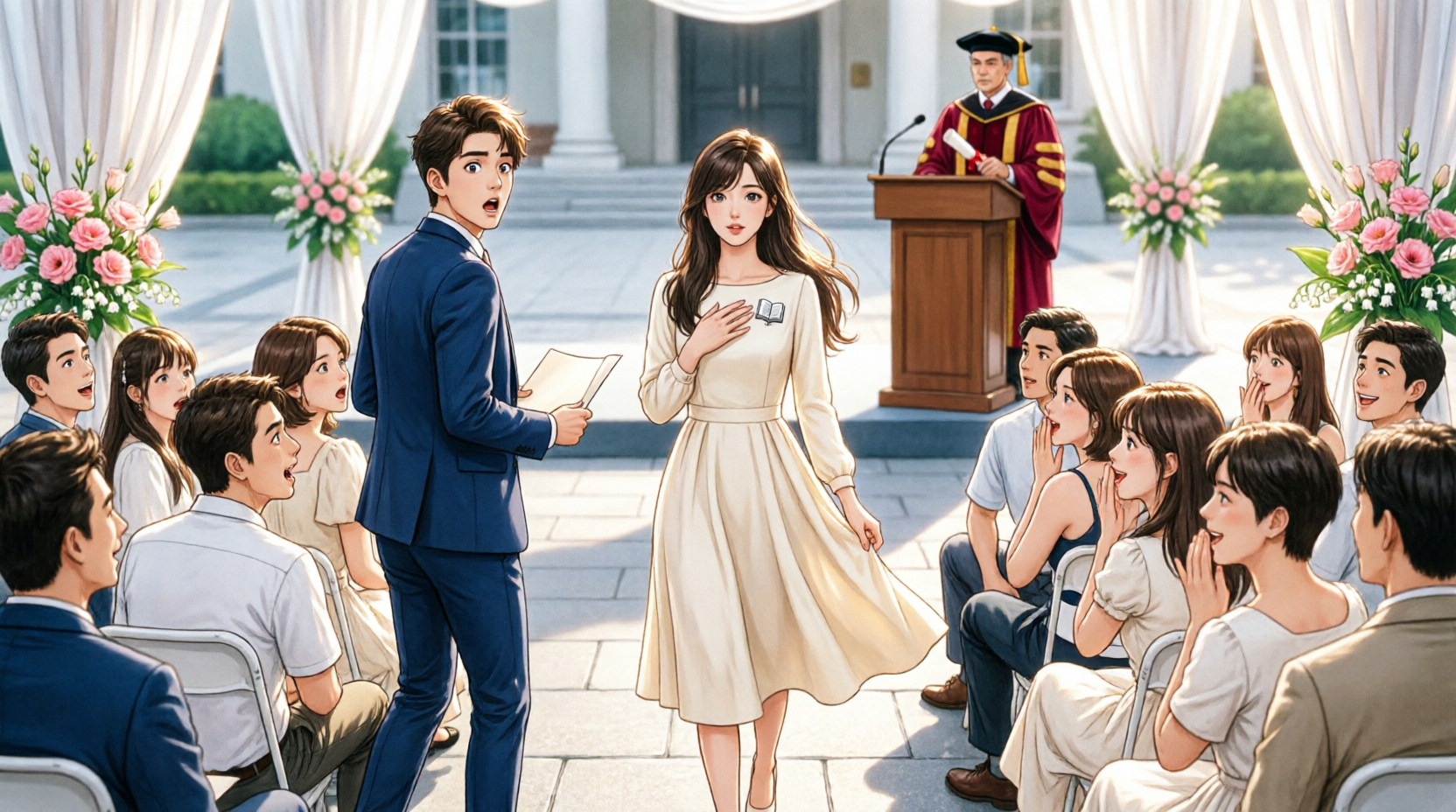
Part 3
Dr. Eleanor Walsh did not smile when she saw me.
That was what made my stomach drop.
She stood behind the podium in her black robe with deep blue velvet panels, silver hair cut close to her head, glasses low on her nose. I had seen her face down donors, residents, surgeons, politicians, and one billionaire who wanted a research wing named after his yacht. She had a smile for every occasion, but this wasn’t one of them.
Her eyes landed on me.
Held.
Moved away.
No expression.
That was worse than surprise.
The dean began her speech in a voice that carried to the back row without effort.
“Today, we gather to honor not only achievement, but endurance.”
The room quieted. Programs stopped rustling. Phones lifted.
She spoke about sleepless nights, first patients, the sacred trust of medicine. She spoke to the graduates like they were already responsible for lives, because they were. Every sentence had weight. I watched Marcus in the third row lean forward, his shoulders tense beneath his gown.
My brother looked happy.
Also nervous.
Also, if I knew him at all, like he might throw up.
I wanted to laugh. Instead, I kept thinking about that award.
The Callaway Family Medical Legacy Award.
Awards don’t appear out of nowhere. Someone funds them. Someone writes the language. Someone agrees to let a family name sit beside the word legacy.
My father owned a hardware store that had been struggling for years. My mother clipped coupons even when we didn’t need them. They were not people who endowed awards.
Unless somebody else had paid.
My phone buzzed again.
This time it was from my mother.
Please don’t make a scene.
I stared at the message until the letters blurred.
Not “Are you okay?”
Not “I’m sorry.”
Please don’t make a scene.
There are families where silence is mistaken for kindness. Mine was one of them. My mother didn’t lie loudly like my father. She folded lies into napkins and tucked them under plates. She avoided. She softened. She changed subjects. She let him speak and then called it peace.
Onstage, Dr. Walsh said, “Every physician is shaped by those who came before them.”
My father, three rows ahead, straightened.
He loved phrases like that. Came before. Built from nothing. Family name. He loved history when he could edit it.
Ted Lawson leaned toward him and whispered something. Dad nodded modestly, as if accepting praise for an invisible crown.
A young woman to my right dabbed her eyes with a tissue. Her father put an arm around her. Normal tenderness. Ordinary pride. It made something in me ache.
Then the first red herring appeared.
At the edge of the stage, behind the faculty row, a man in a navy suit handed Dr. Walsh a cream-colored envelope. She opened it while another administrator stepped to the microphone to introduce student awards.
I saw the Hargrove seal on the envelope.
I saw my name.
Not clearly. Just enough.
C. Callaway.
My pulse kicked.
Maybe the award was from Marcus. Maybe he had done something sweet and foolish, naming me without telling me. Maybe Dad didn’t know. Maybe I was building a case in my head because pain likes evidence, even when evidence is thin.
The administrator announced three research prizes, a community service honor, and a student leadership award. Marcus won none of them, which was fine. He had never been the prize-chasing type. He was the one classmates called at midnight when their mothers got biopsy results or their cars broke down.
Then came the scholarship acknowledgments.
“And this year,” the administrator said, “we are pleased to recognize the inaugural recipient of the Callaway Family Medical Legacy Award, established in honor of the Callaway family’s commitment to perseverance, sacrifice, and service.”
My father put his hand over his heart.
I almost stood up.
The recipient was a student I didn’t know, a tall man with kind eyes who walked across the stage while the crowd clapped. My father clapped too, beaming like a mayor.
My mother did not clap.
Her hands stayed frozen around her program.
That was the first real clue.
The ceremony moved on, but I couldn’t settle. I watched my mother. Her face had gone pale beneath her makeup. She leaned close to my father and whispered. He shook his head without looking at her.
By the time they announced the break before the diploma processional, I had a headache behind my left eye.
Families stood. People stretched, laughed, searched for bathrooms. I remained seated, gripping the program so hard the paper bent.
Then my father turned around and started toward me.
Ted followed.
And my mother, still pale, mouthed one word from behind him. Leave.
Part 4
I did not leave.
That may have been the first adult thing I did in that auditorium.
Not becoming a surgeon. Not flying alone. Not paying my own rent in cities where winter got into your bones. Those were acts of survival. Staying seated while my father walked toward me with his public smile and my mother silently begged me to disappear felt like something else.
It felt like choosing myself in real time.
Dad stopped at the end of my row. Ted stood beside him with a cup of water and the relaxed expression of a man who thought he was watching a family reunion, not a slow-motion car crash.
“Claire,” Dad said. “Ted wanted to ask you about medical consulting.”
My throat tightened.
Ted smiled. “Only if you don’t mind. My son’s thinking surgery. I’m trying to understand what the practical life looks like if someone changes direction later. Your dad said you had good perspective.”
Good perspective.
I looked at my father.
His eyes told me everything: Don’t embarrass me.
So I answered Ted.
“Surgery is hard,” I said. “Residency is hard. The hours are brutal, and the training takes more from you than anyone can explain beforehand.”
Dad relaxed half an inch.
I continued. “But I didn’t change direction.”
Ted blinked.
Dad laughed. “She means she stayed around medicine. Hospitals, paperwork, systems. Important stuff.”
The laugh was too sharp. A few people nearby turned.
“I mean,” I said, keeping my voice even, “I’m a cardiothoracic surgeon.”
Ted’s smile faded into confusion.
My father’s hand tightened around his program. “Claire.”
It was only my name, but it carried the whole house I grew up in. Stop. Behave. Don’t contradict me in public. Don’t make your mother uncomfortable. Don’t force people to choose reality over my version of it.
Ted looked from him to me.
“Oh,” he said. “Your father said—”
“I know what he said.”
Silence dropped between us. Not huge. Not theatrical. Just enough for the woman in the row ahead to stop digging through her purse.
My mother came up behind Dad. “Claire, sweetheart, maybe this isn’t—”
“When is it?” I asked her.
She flinched.
Dad’s face reddened. “This is Marcus’s graduation.”
“I know.”
“Then act like it.”
There it was. The old trick. If I objected to being lied about, I was selfish. If I corrected him, I was dramatic. If I refused to disappear, I was stealing joy.
Ted cleared his throat. “I’m sorry. I didn’t mean to step into anything.”
“You didn’t,” I said.
Dad turned to him. “She’s sensitive about how things played out.”
Something in me went cold and clean.
“How did they play out?” I asked.
Dad stared at me.
Ted looked like he wished the floor would open.
“How did things play out?” I repeated.
My father lowered his voice. “Not here.”
The lights flickered once, warning everyone to return to their seats.
Dad leaned closer. His breath smelled like coffee and mint.
“You think a title makes you better than this family?” he said quietly.
There it was. Not concern. Not misunderstanding. Not confusion.
Resentment.
Behind him, my mother’s eyes filled with tears, but she still said nothing.
I looked at Dad’s lapel, at a small thread hanging from the seam. My mother would have noticed that before they left the hotel. She would have trimmed it with tiny scissors from her makeup bag. But today she hadn’t. Or maybe her hands had been shaking.
“What is the award?” I asked.
His expression changed so fast most people would have missed it.
But I had spent years reading faces above surgical masks. I saw fear before he covered it.
“What award?”
“The Callaway Family Medical Legacy Award.”
Ted glanced at Dad. “Beautiful thing you did, by the way.”
My father’s smile snapped back into place. “We wanted to honor Marcus’s journey.”
My mother whispered, “Tom.”
“Not now, Linda.”
The second bell chimed. People began sitting.
Ted excused himself awkwardly and moved away.
Dad pointed one finger at me, low enough that no one else would notice. “You will not ruin this.”
I stood slowly.
He was taller than me, but not by much anymore.
“I didn’t put my name on a lie,” I said.
His jaw worked.
Before he could answer, the auditorium doors opened near the stage, and Dr. Walsh stepped back inside. She was holding that cream envelope.
And this time, she was walking straight toward us.
Part 5
Dr. Walsh moved through a crowd like people were already planning to get out of her way.
Nobody shoved. Nobody hurried. They simply shifted before she reached them, as if authority had its own weather system. She passed a cluster of graduates taking selfies, nodded to a faculty member, and came down the aisle with the cream envelope held against her side.
My father saw her and transformed.
His shoulders squared. His smile warmed. He became the version of himself strangers admired: hardworking, proud, humble in a rehearsed way.
“Dean Walsh,” he said, stepping forward. “Tom Callaway. Marcus’s father.”
Dr. Walsh looked at his hand before she shook it. “Mr. Callaway.”
“Beautiful ceremony,” he said. “Just beautiful. We’re honored.”
“I’m glad to hear that.”
Her voice gave nothing away.
Then she turned to me.
“Dr. Callaway.”
It landed like a glass breaking.
Not loudly, but with no way to pretend it hadn’t happened.
My mother inhaled. My father’s smile stayed fixed for one second too long.
“Dean,” I said.
“I wasn’t sure you’d come through the main entrance,” she said. “You usually haunt the old research wing when you’re on campus.”
A few people nearby laughed politely because Dr. Walsh had made it sound charming.
Dad did not laugh.
“You two know each other?” he asked.
Dr. Walsh looked at him, then back at me. “Very well.”
The way she said it was careful. Not warm, exactly. Protective.
I felt my stomach twist.
She knew something.
“Claire trained here,” she said.
Dad’s mouth opened, but no sound came.
Dr. Walsh continued, “Then Chicago. Then Boston. Though I still claim partial credit whenever her outcomes data makes the rest of us look lazy.”
My mother’s hand came to her throat.
Dad’s face lost color from the mouth outward.
A small circle had opened around us again. Not because anyone understood yet, but because people understand tone before facts. Something important was happening. Something unscripted.
“Boston?” Ted Lawson had drifted back, unable to help himself.
Dr. Walsh glanced at him. “Hargrove Boston Medical Center.”
Ted looked at me. “As a surgeon?”
“As chief of cardiothoracic surgery,” Dr. Walsh said.
The words entered the air and rearranged it.
My father went perfectly still.
There are moments when someone’s lie doesn’t collapse all at once. It buckles in layers. First the public layer: what strangers think. Then the family layer: what everyone has agreed not to question. Then the private layer: the story the liar tells himself so he can sleep.
I watched all three give way in my father’s face.
Ted whispered, “Chief?”
Dr. Walsh’s brows lifted slightly. “Youngest in the hospital network’s history.”
My mother made a small broken sound.
I didn’t look at her. I couldn’t.
Dr. Walsh held out the envelope to me.
“I was going to mail this next week,” she said. “But since you’re here, I’d rather hand it to you myself.”
I took it.
My name was typed across the front.
Dr. Claire Callaway.
My fingers felt numb.
“What is it?” Dad asked.
Dr. Walsh did not answer him. She answered me.
“The board approved the visiting chair proposal. The lecture series will carry your name, as requested.”
“My name?” I said.
Her eyes sharpened.
That was the third clue.
“You requested it remain anonymous until the first recipient was selected,” she said slowly.
The auditorium seemed to tilt.
My father’s face changed again.
Not confusion this time.
Panic.
My mother whispered, “Claire, I’m sorry.”
I looked at the envelope. Then at Dr. Walsh. Then at my father.
“What lecture series?” I asked.
Dr. Walsh’s gaze moved between us.
“I think,” she said, very quietly, “we may need to speak after the ceremony.”
The lights dimmed for the diploma processional.
Everyone around us began moving back to their seats, but my father stayed planted in the aisle, his program crushed in one fist.
Onstage, the first graduate’s name was called.
And in my hand, the envelope bearing my name felt suddenly heavier than any scalpel I had ever held.
Part 6
I sat through my brother’s diploma processional with an unopened envelope in my lap and a pulse so loud I barely heard the first twenty names.
The stage lights were too bright. They turned the graduates’ faces shiny and unreal. Every time the audience clapped, the sound hit me a half-second late, like thunder from another town. I kept my eyes on Marcus because that was the only steady thing in the room.
Marcus Callaway.
When Dr. Walsh called his name, my whole body knew before my mind caught up. I stood with everyone else, clapping hard, my envelope sliding off my lap and landing near my shoes.
Marcus crossed the stage too fast, exactly like he had when he was little and running downhill, all momentum and hope. His cap sat crooked. His grin looked terrified. Dr. Walsh shook his hand, leaned close, and said something that made him glance toward the back of the auditorium.
Toward me.
For one second, his smile changed. It softened. It became private.
That nearly broke me.
Because whatever my father had done, whatever was in that envelope, Marcus was not the villain. He had been a child when I left. Then a student. Then a brother calling me at midnight asking if it was normal to feel like everyone else in his class had a secret manual for becoming a doctor.
I had told him yes.
I had told him the secret manual was mostly caffeine, fear, and learning to ask better questions.
He had laughed so hard he spilled ramen on his anatomy notes.
Now he was Dr. Marcus Callaway.
I clapped until my palms stung.
When the ceremony ended, caps flew, phones rose, and the auditorium exploded into happy chaos. People cried into bouquets. Graduates posed with grandparents. Someone’s toddler ran down an aisle dragging a balloon shaped like a star.
I bent to pick up the envelope.
My father appeared beside me.
“We need to talk,” he said.
“No.”
He blinked, as if the word had been spoken in a foreign language.
“Claire.”
“I’m going to find Marcus.”
He stepped closer. “Not until I explain.”
That almost made me laugh.
For eleven years, I had wanted an explanation. I had imagined dragging one out of him at Christmas, in hospital corridors, over the phone, beside my mother’s hydrangeas. Now that he wanted to give it, I felt nothing but impatience.
“Move,” I said.
His eyes hardened. “You don’t speak to me like that.”
I looked at him, really looked.
The man who had once filled doorways now stood under fluorescent lights with sweat darkening his collar. His tie was slightly crooked. The little thread still hung from his lapel. He looked angry, yes, but under it, he looked scared.
“You don’t get to decide how I speak to you anymore,” I said.
My mother reached us then, breathless. “Claire, please. He made mistakes, but—”
“You knew.”
Her mouth trembled.
That was answer enough.
“You knew he told people I quit.”
She closed her eyes.
“And you knew about this.” I lifted the envelope.
Dad snapped, “Your mother had nothing to do with it.”
My mother whispered, “Tom, stop.”
I turned to her. “Then tell me.”
She looked past me toward the stage where Marcus was surrounded by classmates. Her face seemed older than it had that morning. Not because of wrinkles. Because pretending takes energy, and hers had run out.
“The money came from you,” she said.
The room narrowed.
“What money?”
My father swore under his breath.
My mother kept going, words spilling now like water from a cracked glass. “The checks you sent home after your first attending contract. The ones you said were for the store, for the roof, for the loan.”
I remembered those checks.
I remembered my father never acknowledging them. My mother would say, “It helped,” and I would leave it there because talking about money in my family was like touching a bruise.
“I sent that money to keep the store open,” I said.
My mother nodded, crying silently. “He used part of it to endow the award.”
I stared at my father.
He looked away.
“And put the family name on it,” I said. “Not mine.”
No one answered.
“And the lecture series?”
Dad’s jaw tightened.
My mother’s voice dropped. “That was supposed to be yours.”
Something cold moved through me.
The envelope shook in my hand.
Around us, families kept laughing. Cameras kept flashing. Life had the nerve to continue while mine split cleanly into before and after.
Then Marcus appeared behind my father, still in his gown, smile fading as he took in our faces.
“What did you do?” he asked Dad.
And my father, for once, had no performance ready.
Part 7
Marcus had always been gentle until he wasn’t.
As a kid, he would carry spiders outside in paper cups, but once, when I was seventeen, a boy at the county fair called me “stuck-up scholarship trash,” and Marcus, twelve years old and half the boy’s size, launched himself at him with a snow cone in one hand and murder in his eyes.
That same look was on his face now.
“What did you do?” he repeated.
Dad straightened. “This isn’t the place.”
Marcus laughed once. No humor in it. “You keep saying that. I’m starting to think no place is the place.”
People nearby turned.
My mother wiped her cheeks with the heel of her hand. “Marcus, honey, today is—”
“My graduation,” he said. “Yeah. I know. I’m the one wearing the gown.”
The words cut sharper because his voice stayed quiet.
I wanted to protect him from this. I also knew protection had been part of the family sickness. Everyone protecting everyone from truth until lies grew roots through the walls.
I handed him the envelope.
He looked at the name on it, then at me.
“What is this?”
“I’m not sure yet.”
Dad reached for it. “Give that to me.”
Marcus stepped back.
The motion was small, but my father saw it. So did I.
For years, Marcus had defended Dad to me in soft ways. He’s proud, Claire. He just doesn’t know how to say it. He asks about you when you’re not around. He keeps articles about your hospital, I think. Maybe he doesn’t understand what you do.
Maybe. Maybe. Maybe.
That afternoon, maybe died.
Dr. Walsh appeared again at the edge of the circle, accompanied by a younger woman with a tablet and a badge that read Office of Development. The dean’s expression was calm, but her eyes had gone surgical.
“Dr. Callaway,” she said to me, “there’s a private room off the reception hall.”
Dad spoke first. “This is a family matter.”
Dr. Walsh looked at him. “It became an institutional matter when a donor record appears to have been misattributed.”
My father’s mouth closed.
The word donor hit me strangely. I had never thought of myself that way. I sent money home because the store roof leaked and my mother’s voice went thin whenever bills came up. I sent money because I could, because despite everything, I didn’t want my parents drowning while I built a life.
I had not sent money to polish my father’s pride.
We followed Dr. Walsh through the reception hall. The smell of coffee, frosting, and lilies made me slightly nauseous. Students called Marcus’s name as we passed, but he waved them off without stopping.
The private room was small, lined with framed photos of old graduating classes. A tray of untouched water bottles sat on a side table. The carpet had that hotel-conference pattern meant to hide stains.
Dr. Walsh closed the door.
The development officer introduced herself as Alina Park. She opened her tablet and spoke carefully.
“In 2019, Hargrove University received a pledge establishing what was then titled the Dr. Claire Callaway Visiting Lecture Fund.”
My father stared at the carpet.
I remembered 2019. Boston. First attending contract. First apartment with windows that faced the river. First time I had enough money to send a check home without calculating groceries until payday.
Alina continued, “The pledge documentation listed Dr. Claire Callaway as the donor. Later amendment paperwork requested the public-facing name be changed to the Callaway Family Medical Legacy Award, with a related student scholarship component.”
“I never requested that,” I said.
“I understand,” Alina said.
“How was it changed?”
She hesitated.
Dr. Walsh’s face darkened.
“An amendment form was submitted with your signature,” Alina said.
My skin went cold.
Marcus said, “That’s impossible.”
My father said nothing.
Alina turned the tablet toward me.
There it was. A scanned document. My typed name. My old Boston address. A signature at the bottom.
It looked like mine at first glance.
But I knew my own hand. The C was wrong. Too careful. Too rounded. Like someone copying from a birthday card.
My mother started crying again.
I looked at my father.
“You forged my signature?”
He swallowed.
“I was trying to keep the family together,” he said.
The room went silent.
And somehow, of all the lies he had told, that was the one that made me want to throw the water tray against the wall.
Part 8
I didn’t throw anything.
Surgeons learn not to waste movement.
Instead, I set the envelope on the table, folded my hands in front of me, and said, “Explain.”
My father glanced at Dr. Walsh and Alina Park. “Not in front of them.”
“You used my name at their institution,” I said. “You can explain in front of them.”
He looked at my mother, maybe expecting rescue.
She stared at the floor.
That was new. My mother had always been his soft landing. His translator. His clean-up crew. When Dad said something cruel, she told me he was tired. When he ignored my calls, she said he was busy. When he lied, she called it complicated.
But now she kept her eyes down and let silence do what she had never done.
Let him stand alone.
Dad dragged a hand over his mouth.
“The store was failing,” he said.
“I knew that. That’s why I sent money.”
His eyes flashed. “You sent money like charity.”
“I sent money because Mom said you needed help.”
“You think a man wants his daughter saving him?”
“I think a roof doesn’t care about your pride.”
Marcus made a sharp sound, almost a laugh, almost pain.
Dad pointed at him. “You don’t understand yet.”
“I understand fraud,” Marcus said.
The word hung there.
Fraud.
Dad recoiled as if Marcus had shoved him.
“I did not steal,” Dad said.
I tapped the tablet screen lightly. “You forged my signature.”
“I redirected the gift.”
“It wasn’t a gift to you.”
“It was family money.”
“No,” I said. “It was mine.”
His face hardened. “There it is.”
“There what is?”
“The way you talk now. Mine. My title. My money. My hospital. You left and became somebody who looks at us like we’re dirt on your shoes.”
For a second, I was back in the kitchen at twenty-two. Meatloaf cooling on the stove. A match letter in my hand. My father mistaking ambition for betrayal because he couldn’t imagine love without obedience.
“I sent you checks for years,” I said. “I called every Sunday until you stopped answering. I flew Mom to Boston when she needed surgery and paid the part insurance didn’t cover. I helped Marcus apply to medical school. I have done everything except shrink myself small enough for you to feel tall.”
His mouth worked.
No words came.
Dr. Walsh’s voice was quiet. “Mr. Callaway, did you submit the amendment form?”
He looked at her, then at me.
Finally, he said, “Yes.”
Alina inhaled softly.
My mother sat down hard in one of the chairs.
Marcus stared at Dad like he was watching a stranger remove a mask and finding another stranger underneath.
“Why?” he asked.
Dad’s eyes shone, but whether from shame or rage, I couldn’t tell.
“Because your sister already had everything,” he said. “Degrees. Hospitals. People saying her name like it meant something. And you—”
He looked at Marcus.
“You were here. You were ours. I wanted something with our name on it before she took that too.”
Marcus went pale.
I felt the emotional floor shift.
There it was. The hidden center. Not just that my father resented me. Not just that he lied.
He had turned Marcus into proof that he still mattered.
My brother sank into a chair across from my mother. His graduation gown pooled around him like spilled ink.
“I wasn’t competing with Claire,” he said.
Dad’s voice cracked. “Maybe not to you.”
I waited for sadness to come. Instead, anger rose clean and bright.
“You told people I quit so Marcus could be the doctor in the family,” I said.
Dad didn’t answer.
“You made my success disappear because there was only room for one version of pride, and it had to be one you could control.”
His silence was confession.
Alina Park closed the tablet cover. “Dr. Callaway, the university will cooperate fully if you choose to pursue a formal complaint. We’ll also correct the records immediately.”
Dad looked up fast. “Formal complaint?”
I watched fear open in him.
Not remorse.
Fear.
And that told me everything I needed to know.
Part 9
My father apologized in the hallway.
Not in the private room, where it would have mattered. Not in front of Dr. Walsh or Alina Park or Marcus. He waited until the development officer left to pull donor files and Dr. Walsh stepped out to take a call from the university counsel.
Then he followed me into the hallway where the carpet muffled our footsteps and the reception noise came through the walls like a party underwater.
“Claire,” he said. “I’m sorry.”
The words were too quick.
I stopped near a framed photograph of the class of 1988. Young doctors smiled in stiff rows, all shoulder pads and big hair, unaware of everything they would survive.
“What are you sorry for?” I asked.
He looked irritated. That was how I knew the apology was already failing.
“For the paperwork. For not handling it right.”
“Not handling it right.”
He rubbed his forehead. “For changing the name.”
“And?”
His jaw tightened.
I waited.
The hallway smelled like dust, copier toner, and coffee. Somewhere around the corner, a woman laughed loudly, then said, “I’m so proud of you, baby.” The sentence went through me like a needle.
Dad lowered his voice. “I’m sorry I told people you left medicine.”
“For eleven years.”
“Yes.”
“And when I corrected you today, you called me sensitive.”
He looked away.
“And when Dr. Walsh named my title, you still didn’t tell the truth. You waited until paperwork forced you.”
“I was embarrassed.”
“You were caught.”
His eyes snapped back. “You think you’re perfect?”
There he was.
I felt something inside me settle. Not soften. Settle.
“No,” I said. “I think I’m done.”
He stared.
“With what?”
“With carrying your shame like it belongs to me.”
He took a step back. “I’m your father.”
“I know.”
“That means something.”
“It used to mean I kept giving you chances to hurt me privately so you wouldn’t look bad publicly.”
His face twisted. “So what? You’re going to ruin me now? Press charges? Drag your own family into court?”
There it was again. Not Please understand. Not I hurt you. Not How do I make this right?
Just consequences. His consequences.
“I haven’t decided what I’m going to do legally,” I said. “But I know what I’m doing personally.”
His expression changed. He understood before I said it.
“No.”
“Yes.”
“Claire.”
“I don’t want a relationship with you.”
He reached for my arm. I stepped back before he touched me.
The movement stopped him cold.
“You don’t mean that,” he said.
“I do.”
His mouth opened, closed. For the first time that day, he looked old. Not human-sized. Old. As if the story he’d used to hold himself together had been load-bearing, and now the ceiling was coming down.
“You’d cut off your own father over a mistake?”
I almost laughed. It came out as breath.
“A mistake is writing the wrong date on a check. You built a life where my truth was inconvenient, so you replaced it.”
He shook his head. “You’ll regret this.”
That landed with such familiarity I nearly smiled.
There was my childhood again. Every boundary framed as future guilt. Every refusal turned into proof that I was cold.
“Maybe,” I said. “But regret is still lighter than this.”
Behind him, my mother stood at the end of the hallway.
I hadn’t heard her come out.
She looked wrecked. Mascara faint beneath both eyes. Purse clutched against her chest. For a terrible second, I wanted to be six years old again, feverish on the couch, while she brought me ginger ale with crushed ice.
But she didn’t walk toward me.
She walked to him.
Not all the way. Just enough to show where she still belonged.
“I’m sorry,” she whispered to me.
I nodded once.
“I believe you,” I said. “But I’m done pretending silence is harmless.”
She covered her mouth.
Marcus came out then, holding his cap in one hand. His eyes were red, but his voice was steady.
“Claire,” he said, “Walsh wants you back inside.”
I looked past my parents toward my brother.
“What for?”
He swallowed.
“They found another document.”
Part 10
The second document was not forged.
That was what made it worse.
It was an email thread printed on university letterhead, six pages clipped together, dated four years earlier. Alina Park placed it on the conference table with the care of someone setting down a small explosive.
The sender was my mother.
Not my father.
My hands went cold before I read the first line.
Dear Ms. Park,
My husband and I appreciate your discretion regarding Dr. Claire Callaway’s donation…
The room blurred at the edges.
My mother stood behind me, crying again, but the tears sounded different now. Less shocked. More cornered.
I kept reading.
She had confirmed mailing addresses. She had asked that all donor communications be sent to my parents’ house “because Dr. Callaway travels extensively and prefers family coordination.” She had attached a scan of my signature from an old medical school loan document.
My father had forged the final amendment.
My mother had provided the ink.
Marcus whispered, “Mom.”
She made a sound like she had been punched.
“I thought I was helping,” she said.
I looked at her.
The woman who packed my school lunches with notes on napkins. The woman who ironed Dad’s shirts but never bought herself a coat without checking the price three times. The woman who told me, “Your father loves you in his way,” so often that I mistook repetition for truth.
“You thought helping meant copying my signature?”
Her lips trembled. “I thought if your name was on it, he’d never accept it. I thought if it became a family award, then maybe he could be proud without feeling—”
“Small?” I asked.
She flinched.
Dr. Walsh stood near the window, silent and furious. Outside, afternoon light fell over the campus lawn. Students in gowns posed beneath oak trees. Their families clapped and fussed with tassels.
Inside, mine came apart under fluorescent lights.
“I told myself you wouldn’t care,” my mother said. “You had so much already.”
That sentence broke something different.
Not loudly. Not dramatically. Just a quiet internal snap.
Because that was the family myth around me. Claire had so much. Claire was strong. Claire could take it. Claire didn’t need birthdays acknowledged or calls returned or credit given. Claire had titles, so she didn’t need tenderness. Claire had money, so she didn’t need honesty.
I sat down.
Marcus moved toward me, but I lifted a hand. Not to reject him. Just to make space around the impact.
“You both decided,” I said slowly, “that because I survived without your support, I didn’t deserve protection from you.”
My mother sobbed.
Dad said, “That’s not fair.”
I turned to him. “Do not talk to me about fair.”
He shut up.
Dr. Walsh stepped forward. “Claire, we can pause.”
“No,” I said. “Finish it.”
Alina swallowed. “There are no additional forged documents that we’ve found so far. The funds are traceable to accounts in your name. The naming change was improper and will be reversed pending legal review. The scholarship can be retitled. The visiting lecture fund can be restored.”
“Good,” I said.
My voice sounded calmer than I felt.
Dad stared at me. “You’re really going to humiliate us.”
I looked at the printed emails. Then at him.
“No. I’m going to correct the record. You’re humiliated because the record includes what you did.”
Marcus stood then.
“I don’t want the award,” he said.
Everyone looked at him.
He took a breath. “Anything with our family name on it, I don’t want it tied to me. Not like this.”
My mother whispered, “Marcus, please. This was for you.”
“No,” he said. “It was for Dad. Maybe for you. Not for me.”
His face crumpled for half a second, but he held himself upright.
Then he turned to me.
“I’m sorry,” he said.
“You didn’t do this.”
“I benefited from it.”
“You didn’t know.”
“But I liked it,” he admitted. “I liked hearing people say we had a legacy. I liked thinking Dad was proud of medicine because of me.”
The honesty hurt. It also saved him.
I stood and touched his sleeve.
“You get to build your own legacy,” I said. “Start with not lying.”
He nodded, tears standing in his eyes.
Dr. Walsh’s phone buzzed. She checked it, then looked at me.
“The president of the university is asking whether you’ll attend the donor reception tonight.”
Dad’s head lifted, hungry with sudden hope.
Of course. A reception. Public damage control. Smiles. Photographs. A chance to soften the story.
I looked at my parents.
Then I gave Dr. Walsh my answer.
Part 11
I went to the donor reception.
Not for my parents.
Not for the university president, who had the polished handshake of a man who could apologize without admitting liability. Not for the photographer near the dessert table. Not for the tiny crab cakes sweating under heat lamps or the jazz trio playing soft versions of songs nobody could name.
I went because for eleven years, my father had told rooms I was less than I was.
So I decided to enter one as myself.
The reception was held in the glass atrium of the medical school, where the ceiling caught the evening light and turned everyone’s hair gold. Round tables wore white cloths. Tall vases of blue hydrangeas stood near the bar. Someone had placed a small sign near the entrance:
Celebrating Excellence in Medical Education and Giving
By then, the university had moved quickly. Institutions protect themselves first, but sometimes their self-protection overlaps with justice. The Callaway Family Medical Legacy Award sign had vanished. In its place was a temporary printed card:
The Dr. Claire Callaway Scholarship for First-Generation Physicians
I stood in front of it for a long moment.
First-generation.
That was the truth my father hated most. There had been no line of doctors before me. No polished family tradition. No grandfather with a stethoscope. There had been a hardware store, a mother who stretched casseroles across three nights, a father who believed ambition was betrayal, and a girl who studied organic chemistry under a buzzing kitchen light after everyone else went to bed.
Dr. Walsh came to stand beside me.
“Too much?” she asked.
“No,” I said. “It’s right.”
“Good.”
She handed me a glass of water with lime. She knew I didn’t drink before early travel or surgery weeks. That tiny fact nearly undid me more than all the speeches.
Across the room, Marcus stood with classmates. He had changed out of his gown into a navy suit that still had a crease line near the shoulder from being folded in a garment bag. He kept glancing toward the entrance.
Waiting for our parents.
They came twenty minutes late.
My father wore the same suit, but the public shine had gone off him. My mother had fixed her makeup. They paused just inside the doors, blinking under the atrium lights like people entering a country where they didn’t speak the language.
The university president approached them first. Dr. Walsh went with him. I stayed where I was.
Marcus came to my side.
“You okay?” he asked.
“No.”
He nodded. “Me neither.”
We stood together, watching our parents listen to something formal and quiet. My father’s face tightened. My mother nodded repeatedly. Neither looked at me.
Then the president took the small stage.
The jazz stopped. Forks lowered. Conversations faded.
He spoke briefly about correction, transparency, and gratitude. He did not tell the whole story. That would come later in paperwork, not in a room with donors and shrimp skewers. But he said enough.
“This evening, we are honored to recognize Dr. Claire Callaway, whose generosity and leadership will support students who are the first in their families to enter medicine.”
People turned.
Not all at once. In waves.
Dr. Walsh gestured for me to join them.
My legs felt strange, but I walked.
The applause began politely, then grew when Dr. Walsh took the microphone.
“I have known Dr. Callaway since she was a student,” she said. “I have watched her become one of the finest surgeons of her generation. More importantly, I have watched her make room behind her for others.”
I looked at the floor because if I looked at Marcus, I would cry.
Dr. Walsh continued, “Medicine is full of people who were told, in one way or another, that the room was not built for them. This scholarship says: come in anyway.”
The applause hit harder this time.
I took the microphone only because refusing would have made the moment smaller.
“I won’t speak long,” I said.
A few people laughed.
“My brother graduated today. That is the best thing that happened in this building.”
Marcus covered his face with one hand.
“I gave to this school because someone once made room for me. I want students without legacy, without connections, without a family script that knows what to do with a doctor, to have one less door closed in front of them.”
My father stared at me from the back of the room.
For the first time, I did not wonder what he felt.
“I’m proud this scholarship will carry the right name now,” I said. “Not because my name matters most, but because the truth does.”
When I stepped away, people applauded again.
My father walked out before it ended.
My mother followed him.
And this time, I let them go.
Part 12
Dad called me thirty-seven times in the next week.
I know because I counted once, then stopped.
The first voicemail came while I was at the airport, sitting at Gate B14 with a paper cup of coffee burning my palm and Marcus asleep in the chair beside me. He had decided at midnight to fly to Boston for two days before starting orientation for residency. He said he wanted “normal sibling time,” which apparently meant falling asleep before boarding and using my shoulder as furniture.
Dad’s voice in the voicemail was rough.
“Claire, call me. We need to fix this.”
Not I need to fix what I did.
We.
The second voicemail was angrier.
“You don’t understand what this is doing to your mother.”
The third was quieter.
“I know I made mistakes.”
By the tenth, he was crying.
Or performing crying. I hated that I couldn’t tell the difference.
I deleted none of them. Not because I planned to listen again. Because evidence matters. In surgery. In law. In families that rewrite themselves overnight.
When I got back to Boston, the city welcomed me with rain.
Not poetic rain. Dirty May rain that blew sideways and made the cab smell like wet rubber and pine air freshener. My apartment was exactly as I had left it: one mug in the sink, mail on the counter, a pair of black heels kicked near the door because I had packed in a hurry.
Marcus dropped his bag by the couch and looked around.
“So this is where the legendary Dr. Callaway lives.”
“Don’t start.”
He picked up a takeout menu from the coffee table. “You have three forks and fourteen hospital pens.”
“I steal them unconsciously.”
“You’re a menace.”
For two days, we ate noodles from cartons, walked along the river, and talked in pieces. Not constantly. Not dramatically. Trauma doesn’t always arrive as one grand confession. Sometimes it comes out while choosing dumplings.
He told me Dad had called him after the reception.
“What did he say?” I asked.
Marcus poked at rice with chopsticks. “That you’d been waiting for a chance to punish him.”
I looked out the restaurant window. Rain striped the glass. A cyclist passed wearing a poncho that ballooned like a green sail.
“What did you say?”
“I told him I’d been waiting for a father who didn’t need one of his kids to be smaller.”
My throat tightened.
Marcus shrugged, but his eyes were wet. “Then I hung up.”
On Tuesday, I operated.
The patient was a woman named Mrs. Alvarez with a damaged valve, four grandchildren, and a plan to grow tomatoes through August. Before anesthesia, she grabbed my gloved hand and said, “You get me to summer, Doctor.”
“I’ll do my best,” I said.
In the OR, everything became clean.
Not easy. Never easy. But clean.
Lights. Steel. Breath. Blood. The steady rhythm of people trained to move without panic. There was no room there for my father’s version of me. No room for his shame, my mother’s silence, forged signatures, awards, old kitchens.
Only the work.
The valve seated beautifully.
When Mrs. Alvarez came through recovery stable, I stood in the scrub room and let hot water run over my hands longer than necessary. My shoulders ached. My hairline was damp. I felt hollowed out and grateful.
My phone buzzed in my locker.
A text from my mother.
Your father is not sleeping. Please call him. We can be a family again if everyone chooses grace.
I stared at that word.
Grace.
In families like mine, grace always seemed to mean the hurt person swallowing the truth so everyone else could digest dinner.
I typed three different replies and deleted them.
Then I wrote:
I am not available for reconciliation. Do not contact me on Dad’s behalf again.
Her response came ten minutes later.
He loves you.
I answered:
Love without respect is not enough.
Then I blocked her number for the night.
The next morning, Dr. Walsh sent me a scanned copy of the corrected scholarship announcement. My name was restored. The forged amendment was under review. The university would handle the public language carefully, but the legal path was mine to choose.
I printed the announcement and pinned it to the corkboard in my office beside a photo of Marcus in his cap and gown.
At noon, my assistant knocked.
“There’s a man here without an appointment,” she said. “Says he’s your father.”
For one absurd second, I smelled Old Spice, spearmint, and coffee.
Then I looked through the glass wall of my office.
My father stood in the waiting area, holding a bouquet of gas station roses and wearing the expression of a man who thought showing up was the same as making amends.
Part 13
I met my father in a conference room with glass walls.
Not my office.
My office had my board certifications, my surgical models, my patient thank-you cards, and the photo of Marcus laughing in his graduation cap. My office was mine. He had not earned the right to stand inside it.
The conference room smelled faintly of dry-erase markers and lemon cleaner. Outside the glass, nurses and residents moved through the hallway with clipboards and coffee cups. Real life. My life.
Dad placed the roses on the table.
“I thought you liked yellow,” he said.
“When I was nine.”
He looked down at them, wounded.
I did not rescue him from the feeling.
He had driven from Ohio to Boston overnight. He made sure to tell me that in the first three minutes. He mentioned traffic, his back, the price of gas. I let him talk until the performance ran out.
Then I said, “Why are you here?”
He swallowed.
“To ask forgiveness.”
The room hummed softly. Air conditioning. A copy machine somewhere. My own pulse.
“No,” I said.
His face changed.
“You haven’t even heard me.”
“I heard you for thirty-four years.”
He gripped the edge of the table. “I was wrong.”
“Yes.”
“I was jealous.”
“Yes.”
“I was scared you’d leave us behind.”
“I did leave,” I said. “Because staying would have cost me myself.”
His eyes filled. “You’re my daughter.”
“I am.”
“How can you say no so easily?”
That almost made me angry again. Easily. As if I hadn’t spent eleven years swallowing corrections. As if I hadn’t sat through holidays being mourned as a failure while succeeding in cities he refused to visit. As if every boundary I had ever built had not been made from splinters.
“It isn’t easy,” I said. “It’s just clear.”
He started crying then. Quietly at first, then with both hands over his face. I had imagined this moment as a child, as a student, as a resident standing alone in hospital stairwells. I had imagined his apology opening some locked room inside me where all the old tenderness waited untouched.
But the room was empty.
Not because I was cruel.
Because I had moved out years ago.
“I’ll correct everything,” he said. “I’ll tell everyone. Church, Ted, the family. I’ll write letters.”
“You should.”
His eyes lifted with hope.
“But that won’t buy access to me.”
The hope died.
“I don’t understand you anymore,” he whispered.
I stood.
“That’s the first honest thing you’ve said.”
He looked smaller in the conference chair than he ever had in my memory. For a moment, I saw the whole tragedy of him. A man so afraid of being ordinary that he made his daughter’s excellence an enemy. A father who wanted pride but not truth. A husband whose wife mistook loyalty for surrender. A man who lost both children in different ways because he needed to be the tallest person in the room.
I felt pity.
Pity is not forgiveness.
“I won’t pursue criminal charges if the university can correct everything without them,” I said. “That is for me, not for you. I don’t want my life organized around punishing you.”
He nodded quickly, desperate. “Thank you.”
“I’m not finished.”
He froze.
“You will not come to my hospital again. You will not call my assistant. You will not ask Marcus to mediate. You will not use Mom to reach me. If I choose contact later, it will be because I want it. Not because you cornered me.”
His lips trembled. “And if I get sick?”
It was a cruel question. Or a helpless one. Maybe both.
“Then I hope you find an excellent doctor,” I said.
I left the roses on the table.
Six months later, Mrs. Alvarez sent me a photograph of her tomatoes.
They were ridiculous, heavy red things hanging from green vines in bright summer light. On the back of the photo, in careful cursive, she wrote: Made it to August.
I pinned it beside Marcus’s graduation picture and the scholarship announcement.
Marcus started residency in Chicago. He called me every Sunday night, usually exhausted, sometimes thrilled, once from a supply closet because he needed to cry after losing his first patient. I stayed on the phone and listened to him breathe until he was ready to stand up again.
My mother mailed letters. I read the first two. They were full of weather, regret, and sentences that began with “Your father.” I stopped opening them after that.
My father did what he said he would do. I heard through Emily that he told the church the truth. He corrected Ted Lawson. He admitted the award had been funded by me. Some people forgave him. Some didn’t. That was no longer my room to manage.
As for me, I kept working.
I kept walking into operating rooms where no one asked whose daughter I was. I taught residents how to tie knots cleanly and how to pause when panic tried to rush their hands. I funded the scholarship every year. The first recipient wrote me a thank-you note that began, “No one in my family understood why I wanted this, but I came anyway.”
I cried when I read that.
Not because it hurt.
Because it was true.
One Friday evening, long after the hospital had thinned to night staff and vending machine dinners, I stood in my office looking at the wall: Marcus mid-laugh, Mrs. Alvarez’s tomatoes, my board certifications, the scholarship announcement bearing the right name.
For years, my father told a story where I tried and failed.
He was wrong.
I tried and became.
And when the people who should have loved me honestly chose their pride instead, I did not forgive them just to make the ending prettier.
I chose the truth.
I chose my work.
I chose the family that could stand beside me without needing me to disappear.
That, finally, was the legacy I kept.
THE END!