They Made Her Homeless—Then the Lawyer Asked One Question
The day Admiral Thomas Whitaker was buried, the house felt larger than grief should have allowed.
It stood above the water outside Norfolk like it had been built to outlast storms and men alike—white columns, wide porches, long windows facing the bay, and enough history in its walls to make lesser people behave better for an evening.
The rooms still smelled faintly of polished wood, cigar smoke, and the lilies that had followed the funeral procession home.
Navy flags hung in frames.
Oil portraits watched from high walls.
Every surface seemed to remember discipline.
That house had always felt more honest than most people in it.
I was still wearing black when my father turned to me after the will reading and said, “Now you finally understand your place.”
He said it in the parlor with a bourbon in his hand, late sunlight falling across the rug, as if cruelty delivered in the right room somehow became authority.
My mother stood by the fireplace, her fingers lightly touching the marble mantel, already carrying herself like a woman who had inherited not just a property but vindication.
Then she said, “You need to pack tonight.”
My father took a slow sip and added, “Now you’re homeless.”
There are moments when a person’s entire history with you rearranges itself in one instant.
That was one of them.
Not because I had never seen selfishness in my parents before, but because grief usually softens people around the edges.
It had not softened them.
It had sharpened them.
I was thirty-two years old, a Marine captain, old enough to have seen loss in uniform and old enough to know that money has a way of exposing weak character.
But nothing in my life had prepared me for being pushed out of my grandfather’s home while his funeral flowers were still fresh.
The cruelty might have been easier to bear if the house had only been a house.
It wasn’t.
It was the one place in my life that had ever felt governed by principle instead of mood.
My grandfather, Admiral Thomas Whitaker, had done more than help raise me.
In all the ways that mattered, he had been the one who formed me.
He was not an easy man.
The world remembered his medals, his command voice, his rigid posture, his refusal to tolerate sloppy thinking or lazy speech.
He had a way of making even senior officials sit straighter.
But the man I knew was larger than his reputation.
He made pancakes on Saturday mornings in a cast-iron skillet and pretended not to notice when I stole the first one off the plate.
He taught me how to tie a bowline, how to change the oil in a car, how to press a uniform, and how to keep my face still when someone was trying to get a reaction they had not earned.
When I was ten and miserable because some children at school said I was too serious, he sat me down on the back steps and told me, “Character often looks lonely before it looks admirable.”
I have carried that sentence longer than I have carried most medals.
My parents, by contrast, loved what the admiral’s name did for them but had no affection for the discipline behind it.
My father liked sounding important.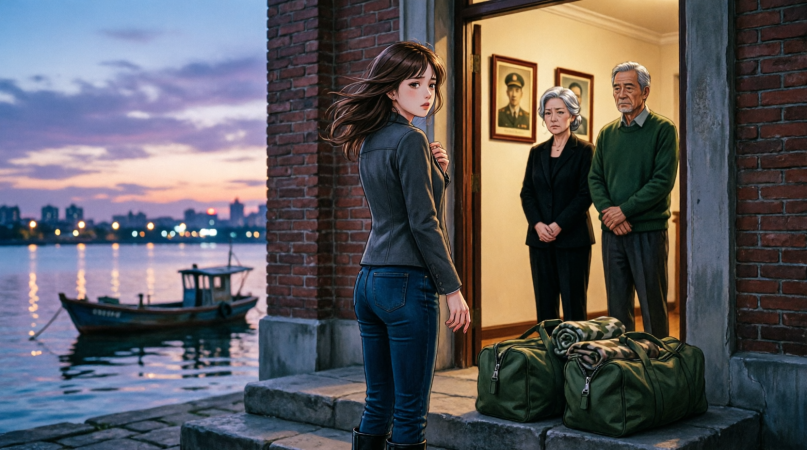
My mother liked being photographed beside people who were.
They loved receptions, boards, dinner invitations, charity galas, and introductions that came with titles.
Responsibility bored them.
Duty irritated them.
They stayed close to prestige and far from sacrifice.
People used to say that when I joined the Marines, I was continuing family tradition.
They were wrong.
I was not following a legacy.
I was choosing the only honest life I had ever seen modeled at close range.
Two days before Granddad died, he asked me to sit with him in the library.
The room was one of my favorites in the house—dark shelves, naval histories, leather chairs softened by age, and tall windows looking out over gray water.
He had grown thin by then, but his eyes remained clear enough to unsettle anyone who approached him with bad intentions.
“You came back,” he said when I sat beside him.
“Of course I did,” I told him.
He rested his hand over mine.
His skin felt papery, but his grip still had command in it.
“When the anchor line snaps, Amelia, people show what they were really built from.”
I smiled.
“That sounds like one of your lessons.”
“It is,” he said.
Then he leaned back and looked at me for a long time.
“Read everything carefully.
Especially when grief is making everyone else careless.”
At the time I thought he meant life in general.
I did not yet understand he was speaking with the precision of a man who had already charted the weather ahead.
At the funeral, my parents gave a flawless performance.
My mother wore grief like couture.
My father accepted condolences with solemn nods and grave pauses, as if he had lost a statesman rather than an inconvenience that had finally become an estate.
Retired officers, former aides, and old friends approached me instead.
A retired Marine colonel with a ruined knee told me, “He bragged about you every chance he got.
Said you were the only one in the family who understood service.”
Then came the reading.
It happened in Mr.
Callahan’s office, a paneled room lined with maritime paintings and shelves full of legal volumes that smelled faintly of dust and tobacco.
The summary sounded straightforward enough.
My parents were left the mansion, the Tesla, several investment accounts, and a collection of art and furnishings.
To me, Granddad left personal items—a watch, letters, his Navy shadow box, a few keepsakes.
When my name was read, my mother exhaled.
It was quiet, but I heard it.
The relieved little breath of a woman who believed the competition had ended exactly as she deserved.
By that evening I was in my old bedroom packing.
I placed uniforms in one duffel, civilian clothes in another, and stopped for a long time with my hand on the brass compass Granddad had given me before Officer Candidate School.
On the back he had engraved two words: Stand steady.
When I carried my bags downstairs, my parents were in the kitchen.
My father had bourbon in hand.
My mother was on her phone, probably already making plans for drapes, dinners, and whatever social resurrection she thought the house would provide.
“Finished already?” she asked without looking up.
“Yes,” I said.
My father followed me outside, but not to help. 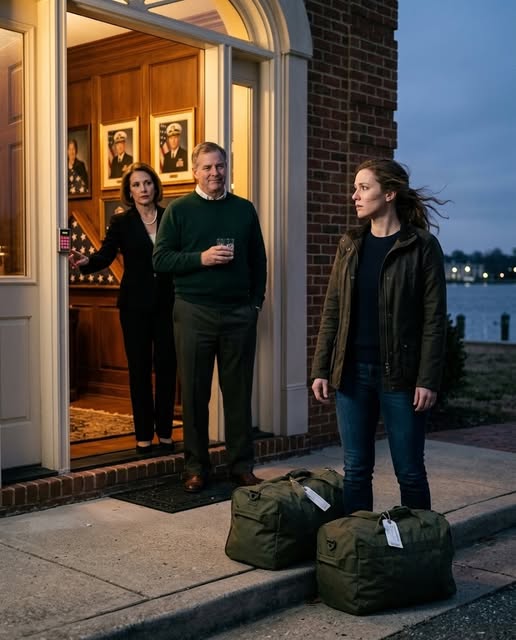
He took the bags from me and dropped them by the curb as though he were disposing of something unpleasant before the neighbors noticed.
My mother stood in the doorway behind him and said, “We’re changing the security codes tonight.”
Then they closed the door.
I spent Sunday night in a hotel near the interstate and Monday on base, functioning on training more than sleep.
By Tuesday morning, I was sitting in a diner near Quantico with a mug of coffee I had forgotten to drink when my phone rang.
Mr.
Callahan.
“Captain Whitaker,” he said, “did your parents actually read the whole will?”
I sat up so fast my knee hit the table.
“I assumed they did.”
He let out a low, disbelieving sound.
“Please come to my office immediately.
Bring anything you have—texts, voicemails, anything that proves what happened after the reading.”
An hour later, I was back in Norfolk, seated across from him at the same polished table where the summary had been read.
This time, however, the full estate binder lay open between us, tabbed, marked, and several inches thicker than the neat little summary my parents had listened to with such confidence.
Callahan removed his glasses and rubbed the bridge of his nose.
“Your grandfather did not leave that house to your parents in the way they seem to believe.”
He turned the binder toward me and tapped a page marked Article Nine.
“The property known as Bay Point,” he read, “shall remain in the Whitaker Legacy Trust.
My son, Daniel Whitaker, and his wife, Louise Whitaker, shall receive a conditional right of residence and stewardship, provided they preserve my granddaughter Captain Amelia Whitaker’s unrestricted right to reside in said home, to access all family spaces, and to remain under its protection for as long as she chooses.
Any attempt to dispossess, exclude, coerce, remove, or humiliate her into leaving within ninety days of my death shall constitute refusal of gift.
In that event, all rights, title, and privileges shall vest immediately and solely in Amelia Whitaker.”
For a moment, I simply stared.
Callahan slid another page forward.
“There is more.
Any forfeiture of their residential interest voids all associated bequests tied to Bay Point stewardship—including the vehicle, contents management, and disbursement privileges attached to the family trust.
In plain English: if they tried to force you out, they lost the house, the Tesla, and access to the discretionary accounts.”
The room went so quiet I could hear the clock on the bookshelf.
“He knew,” I said.
Callahan gave me a measured look.
“He suspected.
Your grandfather changed these provisions six weeks before his death.
He was very specific.”
Then he handed me a sealed envelope with my name on the front in Granddad’s handwriting.
I opened it with unsteady fingers.
Amelia,
If you are reading this, then the line snapped exactly where I expected it might.
Do not mistake foresight for bitterness.
A commander studies weaknesses because pretending they do not exist gets good people hurt.
If your parents chose comfort over character, let the document answer them.
Not your temper.
Home belongs with the one who understands what it is for.
Stand steady.
Granddad.
I read it twice before I could breathe normally again.
Callahan waited.
“Tell me exactly what happened.”
So I did.
The order to pack.
The word homeless.
The curb.
The security code change.
My father dropping my bags like trash.
My mother’s calm voice from the doorway.
When I finished, Callahan asked whether I had anything in writing.
I pulled out my phone.
My mother had sent a short message late Sunday night: Code changed.
Do not come back without notice.
We need space.
Callahan’s expression hardened.
“Good,” he said.
“Also unfortunate for them.”
He called the estate’s digital security contractor, who confirmed the front gate and main entry codes had indeed been changed the night of the funeral.
He then contacted the executor’s office, arranged for a deputy to be present, and had a locksmith meet us at Bay Point within the hour.
I drove behind his sedan down the familiar road to the house I thought I had lost forever.
The bay flashed silver through the trees.
My hands stayed steady on the wheel because Granddad had taught me long ago that rage is best used after it has been reduced to precision.
When we pulled into the circular drive, my mother was on the front porch in a pale sweater, speaking to a florist who was removing the last of the funeral arrangements.
My father’s bourbon glass sat on the side table beside him.
It was not even noon.
They both went still when they saw me.
My mother recovered first.
“You have some nerve,” she said.
My father stood.
“I told you not to come back.”
Callahan got out of his car, buttoned his coat, and walked up the steps with the exact calm of a man carrying bad news for someone who had mistaken arrogance for legal standing.
“Mr.
and Mrs.
Whitaker,” he said.
“We need to discuss your attempted dispossession of Captain Amelia Whitaker.”
My father gave a short laugh.
“Attempted what? The house is ours.
You read the will yourself.”
“I read a summary,” Callahan said.
“You were provided the full instrument.”
My mother folded her arms.
“This is absurd.”
Callahan opened the binder and, without raising his voice, read Article Nine aloud on the front porch where the salt wind carried every word into the yard.
I watched my mother’s face lose color line by line.
My father tried to interrupt twice.
Callahan did not stop.
When he finished, he looked directly at them.
“Did you order Captain Whitaker to vacate the premises the night of the funeral?”
Neither answered.
“Did you change the security codes?”
My mother looked at my father.
The security contractor stepped forward with a printed log.
“The codes were altered Sunday at 8:14 p.m.
from the primary administrator panel.”
“Did you place her belongings at the curb?” Callahan asked.
My father’s jaw tightened.
“This is ridiculous.”
The deputy, who had remained silent until then, spoke for the first time.
“Sir, I’d answer the question.”
My father glanced at the uniform, then at me, and something in his face changed.
Not remorse.
Calculation failing under pressure.
Callahan closed the binder.
“Then the conditional gift has been refused by your own conduct.
Effective immediately, your right of residence is revoked.
Bay Point and all attached benefits transfer to Captain Amelia Whitaker under the Whitaker Legacy Trust.”
My mother stared at him as though language itself had betrayed
her.
“No.
No, that cannot be right.”
“It is precisely right,” he said.
“You may remove your clothing and personal toiletries.
Nothing else leaves this property until an inventory is completed.”
My father stepped toward me then, his face darkening with a kind of rage I had seen before in men who were used to bullying weaker opponents and suddenly found themselves outnumbered by facts.
“You did this,” he said.
I looked at him for a long moment.
“No,” I said.
“Granddad did.”
The deputy shifted slightly, enough to make my father stop where he was.
What followed was not dramatic in the way movies imagine justice.
It was quieter.
More humiliating.
My mother cried in bursts, then demanded, then pleaded, then accused Callahan of misreading the document.
My father paced the porch, cursing under his breath, trying several times to call someone who would not rescue him from his own choices.
The locksmith reactivated the original access hierarchy and entered my name as primary resident steward.
The Tesla keys were collected pending trust transfer.
The florist stood frozen beside her van for a full minute before deciding she had seen enough and driving away.
I walked back into the house before either of them did.
The air inside was cool and still.
For a second I could almost imagine Granddad in the library, waiting with one hand on an armchair, already knowing exactly how this would unfold.
In his desk, where Callahan told me to look, I found a second envelope.
Amelia,
A home is not a reward for appetite.
It is a responsibility.
I did not build Bay Point so it could become a stage for vanity after I was gone.
You understand service.
You understand stewardship.
That is why this house is yours if events required it to be.
Do not let bitterness live here longer than it must.
Use the place well.
Keep the standards.
Open the doors to people who know the cost of standing up straight in a crooked world.
Love,
Granddad.
I sat in his library with that letter in my lap while, somewhere upstairs, my parents packed the only things the law still recognized as theirs.
I should have felt triumph, maybe.
What I felt instead was grief settling into a different shape.
He had known them.
He had planned for them.
And he had trusted me anyway.
By evening they were gone.
The house grew quiet in the deep, truthful way it used to be when it belonged to him.
I walked room to room turning on lamps.
In the kitchen I found the skillet he used for pancakes.
In the hall closet, the old raincoat he wore on the dock.
In the study, the brass compass I had nearly packed away forever.
Months later, Bay Point was still mine, but it was no longer only a mansion overlooking the water.
With Callahan’s help and the trust’s support, I turned the detached guest house into a transition residence for two recently retired service members at a time—men and women who needed a clean room, structure, and a few quiet weeks to remember who they were without a chain of command telling them every hour.
Granddad would have approved.
Sometimes, in the early morning, I stand on the back porch with coffee
and watch the bay go silver under the first light.
The house no longer feels like something saved from greedy hands.
It feels like what it always was meant to be: an anchor.
On my desk in the library sits Granddad’s compass.
I keep it where I can see it every day.
Stand steady.
In the end, that was the real inheritance.
Not the mansion.
Not the car.
Not the accounts.
Just the knowledge that character outlasts performance, and that when the line snaps, the truth always reaches shore first.