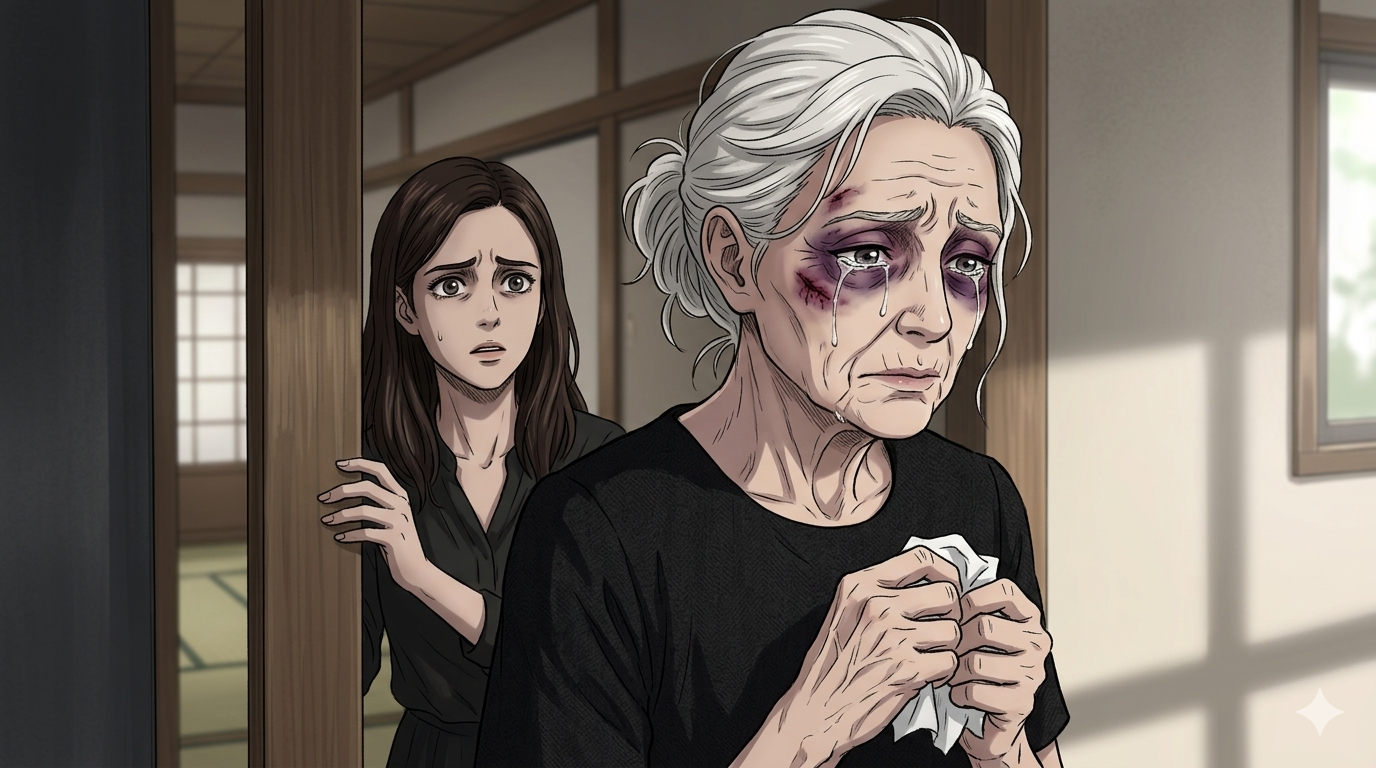
At first, the wood would not move.
My nails bent backward, splinters slid under my skin, and the seam only mocked me, thin and stubborn, like a mouth refusing to confess what it knew.
I searched the cabin for anything sharp enough to pry it open.
Near the stove, buried beneath damp newspapers and a cracked enamel pot, I found a rusted table knife with a bent tip.
I slid it into the seam and pushed.
Once.
Twice.
On the third try, the board lifted with a groan so low it sounded almost human, as if the cabin had been holding its breath for years.
Beneath it was a cavity no larger than a bread box.
Inside lay an oilcloth bundle, carefully wrapped, dry despite the damp that had ruined nearly everything else in that miserable place.
My hands shook harder than they had at the funeral.
Not from grief.
From recognition.
Only one person I knew wrapped things that carefully, folding every corner inward, tying the knot twice, as if order could protect what life could not.
My son.
I sat back on my heels and stared at the bundle for what could have been a minute or an hour.
Outside, branches scratched the window like fingernails.
Inside, the silence thickened until I could hear my own pulse in my ears.
I did not want treasure.
I did not want money.
I wanted one impossible thing: for whatever was inside to prove that my son had not left this world believing I would survive it alone.
I untied the knot.
The first thing I found was a letter.
My name was written on the front in Neftalí’s handwriting, the same slanted script he used when he labeled jars in the pantry or left notes beside my teacup.
For my mother. Only if something happens to me.
I pressed the paper to my mouth before opening it.
It smelled faintly of cedar and dust, and for one wild second I imagined he had just stepped out, that he would return and laugh at me for crying.
Then I unfolded it.
Mother,
If you are reading this, it means I waited too long.
I told myself I needed more proof, more time, one more week, one more conversation, one more chance to believe I was mistaken.
But every time I delayed, the danger moved closer to you.
So listen to me now, even if I no longer can say this aloud.
Do not trust Lucinda.
Her name struck me like cold water.
My daughter-in-law.
The woman who had stood at my son’s grave with a handkerchief pressed delicately to dry eyes that had shed almost no tears.
I kept reading.
Three years ago, I discovered debts in my accounts I did not recognize.
Transfers, forged authorizations, signatures that looked like mine until I studied them line by line.
At first I thought it was a mistake made by my office.
Then I found messages, hidden purchases, cash payments, and meetings she lied about.
She is not only spending what is mine.
She is preparing for the day I am gone.
I stopped there, my chest turning tight.
Neftalí had never been careless with money.
He had worked for every polished stone in that house, every heavy curtain, every silver spoon Lucinda displayed for guests as if wealth itself had raised her.
But suspicion alone was not a crime.
And suspicion alone was not enough to hide a letter under the floor.
There was more.
If anything happens to me suddenly, especially if it is called an accident, you must take the envelope beneath this page to Father Tomás in San Jerónimo.
No one else first.
Not the police.
Not the lawyers in the city.
Not Lucinda’s brother.
Not her cousin Esteban, no matter what uniform he wears.
Father Tomás knows who to contact.
Inside the second envelope are copies of records I could not keep in the house.
Insurance changes.
Property amendments.
Medical prescriptions I never requested.
And witness statements from two people who were too afraid to go public while I was alive.
I felt the cabin tilt.
I set the letter in my lap and closed my eyes, not because I doubted the handwriting, but because I believed it too quickly.
That frightened me.
Grief makes greedy creatures of us.
We grab at any version of the dead that helps us go on breathing.
Had I already decided Lucinda was guilty because I needed someone to blame for losing my son?
Or because some quieter, older knowledge had been living inside me for years, waiting for proof?
When I opened my eyes, I looked again into the cavity.
There were three more things inside.
A sealed brown envelope.
A small key.
And a velvet pouch heavy enough to mean something, though I did not yet know what.
I opened the pouch first.
Inside was my wedding ring.
I had not seen it in seventeen years.
After my husband d!ed, I sold nearly everything worth selling during a winter when money ran thin and Neftalí was still studying.
I thought the ring had gone with the rest.
Instead, my son had bought it back.
Or somehow found it.
Tucked beside it was a note no longer than a receipt.
You once told me that love should leave a person with dignity, not hunger. I never forgot.
My throat closed.
All day I had been angry with him for d!eing.
Now anger became something else, something heavier and far more difficult to carry.
He had known enough to prepare for danger.
He had known enough to hide this.
And yet he had not done enough to save himself.
That night I did not sleep.
I sat on the floor with the letter in my lap and watched the candle shrink while the cabin filled with cold.
Every hour, I read the pages again.
Each time, different words rose from them like accusations.
Do not trust Lucinda.
If it is called an accident.
Too afraid while I was alive.
My son had fallen from a retaining wall on the lower road returning from the city.
That was the official story.
Rain. Mud. Poor visibility. A tragic misstep.
Lucinda had repeated it so many times that people began speaking of it with the comfort of a familiar prayer.
A terrible accident.
No one to blame.
God’s timing.
But I remembered the bruise on Neftalí’s wrist at the funeral home.
Not the marks from the fall.
A darker band, almost circular, as if fingers had held him too hard.
I remembered asking Lucinda what happened.
She touched my elbow gently and said, “Please, Eulalia, don’t make this harder than it already is.”
At the time, grief made me obedient.
Now obedience tasted like shame.
Near dawn, I folded the papers back into the oilcloth.
The sensible thing would have been to take them at first light and do exactly as my son instructed.
Walk to San Jerónimo.
Find Father Tomás.
Hand everything over.
Let the truth belong to other hands.
But by morning, another thought had taken root.
If Lucinda had truly done what these papers suggested, then she had not merely stolen a house.
She had stolen the shape of my mourning.
She had stood beside me while I buried my son beneath a lie.
And if that was true, I did not want her arrested from a distance, by strangers, in offices, with documents and signatures and polite voices.
I wanted to look at her face when she understood that I knew.
That desire frightened me more than the letter.
Because revenge can dress itself as justice and sound very reasonable in the dark.
I spent the morning forcing my body through simple tasks so my mind would not split apart.
I fetched water from the pump outside.
I cleaned the knife.
I wrapped the documents in dry cloth.
I counted the money hidden in the envelope beneath them.
There were several bills, enough for bus fare, food, perhaps a room in town if needed.
My son had planned carefully.
Too carefully for a man expecting to live long.
By midday, fog had rolled down between the pines, whitening the world until the cabin seemed suspended in cloud.
I decided to leave.
Then I heard footsteps outside.
Not one set.
Two.
The cabin had no proper path leading to it.
No honest visitor arrived by accident.
I blew out the candle and slid the bundle beneath my skirt just as a fist struck the door.
“Señora Eulalia?” a man called.
His voice was falsely respectful, too loud, like an actor performing kindness from memory rather than instinct.
I did not answer.
The latch shook.
“Your daughter-in-law sent us,” he said. “She’s worried about you.”
That almost made me laugh.
Lucinda had never worried about me a single day in her life.
I backed away from the door and looked for somewhere to hide, but there was nowhere in that ruined cabin except the shadows themselves.
The second voice, lower, impatient, muttered, “Kick it.”
The door flew inward before I could move.
Two men entered smelling of wet wool and cigarettes.
One was thick around the shoulders with a scar across his chin.
The other wore a cap pulled low and kept scanning the room with the restless eyes of someone used to taking what was not his.
“Poor place,” the scarred man said, wrinkling his nose.
Then he looked at me and smiled without warmth.
“She said you might be confused.”
“She sent you to check whether I was still breathing,” I said.
He shrugged, as if the difference hardly mattered.
The man in the cap began opening drawers that were already empty, kicking aside broken chairs, lifting blankets, searching too quickly to be subtle.
My stomach turned to ice.
They were not there for me.
They were there for whatever Lucinda feared I had found.
“What are you looking for?” I asked.
The scarred man stepped closer.
“Old women live longer when they ask fewer questions.”
He spoke softly.
That softness frightened me more than a shouted threat would have.
I took another step back until my calves hit the altar.
Behind me, under loose boards near the stove, there was a narrow gap where I had stuffed the envelope moments earlier when the knock first sounded.
If they found it, everything ended there.
The cap-wearing man overturned the mattress.
Dust rose.
His boots came closer to the stove.
Closer.
Then from the floor, a metallic jingle.
The key.
I had forgotten the key in my apron pocket.
It must have slipped loose when I moved.
Both men looked down.
The scarred one bent first and picked it up between two fingers.
“This yours?”
His eyes had changed.
No more pretense.
He knew it belonged to something hidden.
My mind moved with an odd clarity, the kind that visits only when fear has burned away every useless thought.
I looked at the key, then at the old cradle in the corner.
“It opens the chest,” I said.
“What chest?”
I pointed to the broken trunk beneath a blanket, the one I had already searched and found empty except for mouse droppings and rotten linen.
The man in the cap dragged it into the center of the room and rattled the lock.
The scarred man tossed him the key.
It did not fit.
He swore and kicked the trunk hard enough to split one hinge.
While both men bent over it, arguing, I moved.
Not toward the door.
Toward the stove.
I dropped to one knee as if dizzy and shoved the hidden bundle deeper into the gap with the side of my shoe until it vanished into soot.
“Nothing here!” the man in the cap snapped.
The scarred man turned back to me, suspicious now.
He slapped the key against his palm.
“What else?”
“Ask Lucinda,” I said, before I could stop myself.
His expression sharpened.
He crossed the room in three strides and seized my arm.
Pain shot through my shoulder.
“She’s Madame Lucinda to you.”
“Then tell Madame Lucinda,” I said, tasting blood where I had bitten my cheek, “that she should have come herself.”
For a moment I thought he would strike me.
Instead he leaned close enough that I smelled stale coffee on his breath.
“She may still,” he whispered.
Then he shoved me away.
The two men searched another ten minutes, more violently now, tearing through everything useless the cabin possessed.
At last they left with the key, a handful of old coins from a jar, and the certainty that they had missed something.
I waited until their footsteps faded completely before pulling the bundle from its hiding place.
Only then did I let myself shake.
There are moments when a person realizes not that they are in danger, but that danger has been patient with them.
That was one of them.
Lucinda knew enough to send men.
Which meant she knew enough to be afraid.
By late afternoon I started down the mountain path with the documents tied beneath my clothes and a walking stick in hand.
The road to San Jerónimo wound through pine and stone, then dropped into a narrow valley where old farmland gave way to scrub and river mud.
I had not made that walk in years.
My knees complained at every descent, and twice I had to stop because my breathing turned shallow with pain.
Still I kept moving.
Not because I was brave.
Because staying still had become more dangerous than suffering.
As dusk approached, I reached the first cluster of houses at the edge of town.
Children chased one another between laundry lines.
A dog barked from behind a fence.
A woman carrying bread glanced at me, frowned as if trying to place my face, then hurried on.
Ordinary life continued around me with almost insulting steadiness.
My son might have been murd3red, and somewhere a grocer still argued over onions.
I found Father Tomás in the church courtyard, sweeping jacaranda blossoms from the steps.
Age had bent him but not softened him.
He looked up once, saw my face, and set the broom aside without greeting.
“You found it,” he said.
I could not answer.
He led me into a side room that smelled of candle wax and old books.
Only after the door was closed did I place the bundle on the table between us.
He stared at the handwriting on the letter a long while before touching it.
“He came to me twice,” the priest said quietly.
“The second time, he was terrified. Not for himself. For you.”
“Why didn’t you tell me?”
“Because he made me promise that unless he d!ed, I would say nothing.”
I almost hated him then.
Promises are noble things until they leave someone burying her child in ignorance.
He read the letter, though it was clear he already knew much of it.
Then he opened the brown envelope.
Inside were photocopies, bank records, insurance documents, and three typed statements signed at the bottom.
One came from a former housekeeper.
One from Neftalí’s driver.
One from a pharmacist in the city.
The housekeeper described hearing Lucinda argue with a man about debts and “the old woman” needing to be removed once Neftalí was no longer an obstacle.
The driver stated that, two weeks before the d3ath, Lucinda ordered him to refill a prescription under Neftalí’s name, though Neftalí had denied needing medication.
The pharmacist wrote that the prescription was for a sedative strong enough to impair balance and reaction if taken unexpectedly.
My hands went cold.
Father Tomás slid the last page toward me.
It was an insurance amendment increasing the payout in the event of accidental d3ath, signed only three months earlier.
Beneficiary: Lucinda Serrano de Álvarez.
There it was.
Not a confession.
Not certainty.
But a line of intention ugly enough to stain every memory I had.
I sat motionless.
The priest watched me with the caution one uses around a wounded animal that may still bite.
“There is more,” he said.
He reached into his desk and removed a small cassette recorder.
“I kept this because your son asked me to. I prayed I would never need to give it to anyone.”
He pressed play.
Static cracked.
Then Neftalí’s voice filled the room, thinner than life, but unmistakable.
If anything happens to me, my mother must hear this before anyone convinces her I was careless.
Lucinda has been trying to pressure me into signing over the mountain parcel and restructuring the house trust so my mother can be removed permanently after my d3ath.
I refused.
Yesterday, I confronted her about forged transfers.
She told me I would regret humiliating her.
If I die by accident, I did not trust the accident.
I covered my mouth with both hands.
The priest clicked the machine off.
Silence rushed in.
This was the moment I had wanted, was it not?
Proof.
Weight.
Direction.
Something solid enough to hold my grief in place.
Instead I felt split cleanly in two.
One part of me wanted to carry those pages straight to the authorities and let the machinery of truth grind forward.
The other part wanted to protect the last tender corners of my son’s memory from the ugliness now attached to it.
If Lucinda were charged, the town would feast on the story.
They would whisper about marriage, greed, poison, money, forged names.
They would say Neftalí had been blind, weak, foolish.
They would drag his dignity through every mouth in the province.
And yet if I stayed silent, then what?
Lucinda kept the house.
Kept the money.
Kept the story.
Kept the right to stand by his grave as widow while I carried the knowledge of what she may have done like a coal inside my chest.
Father Tomás seemed to read the war on my face.
“There is no clean choice,” he said.
“I know.”
“If you go forward, you may not get justice. Evidence goes missing. Witnesses recant. Powerful families protect their own.”
“I know.”
“If you stay silent, she will believe fear defeated you.”
I looked at him then.
“You think this is about pride.”
“No,” he said. “I think it is about what kind of burden you can survive.”
That was the truest thing anyone had said to me since the funeral.
There was no path here that did not cost me my son again.
Tell the truth, and lose the gentler version of him, the one who simply slipped on wet stone and left this world tragically.
Stay silent, and keep that gentler version alive, but live knowing I had helped bury him beneath a lie.
I asked for an hour alone.
The priest gave me the key to the chapel and left me there with the recorder, the documents, and a candle burning low before the Virgin.
I did not pray.
Not at first.
I argued.
With God.
With my husband.
With my son.
With the dead, who are so generous with silence that they can make your own thoughts sound holy.
At last I sat in the back pew and remembered something small.
Neftalí at twelve, coming home with a split lip after defending a boy everyone mocked for stuttering.
When I scolded him for fighting, he said, “I wasn’t protecting him from pain. I was protecting him from getting used to it.”
The memory broke me open.
That was it.
That was the choice.
Not between truth and revenge.
Not between scandal and silence.
Between allowing cruelty to become ordinary or refusing it one more time, even if refusal cost me the last uncomplicated image of my son.
By the time I returned to the side room, darkness had fallen.
Father Tomás stood when he saw my face.
“I’m going to the police,” I said.
He nodded once, as if he had expected no other answer, though I think he knew how close I had come to choosing otherwise.
We did not go to the local station.
Too many cousins, too many favors, too many men who drank together on Sundays and called each other brother even without blood.
Instead he took me by truck to the district office two towns away.
The journey lasted little more than an hour, but by the time we arrived, I felt older by ten years.
I gave my statement just before midnight.
My voice did not tremble until they asked me to repeat the sentence: I believe my son’s d3ath was not an accident.
Once spoken aloud, it ceased to be suspicion and became the shape of my new life.
There was no walking back from it.
At dawn, they sent officers to detain Lucinda for questioning and to secure the house.
I insisted on going.
The district inspector, a tired woman with a scar on her jaw and no patience for sentiment, told me it would be unpleasant.
“I have buried my child,” I said. “Unpleasant no longer frightens me.”
When we arrived, the gates were open.
Servants gathered in the courtyard whispering.
Lucinda stood on the front steps in a cream robe, pale but composed, as if all of this were an inconvenience she intended to outlast.
Then she saw me stepping out of the truck beside the inspector.
For the first time since I had known her, genuine fear crossed her face.
Not outrage.
Not indignation.
Fear.
It lasted less than a second, but it was enough.
She understood immediately.
“You,” she said.
Just that one word.
No greeting.
No performance.
No widow’s grief.
Only recognition that something she had tried to bury had risen.
The inspector spoke first, crisp and official.
Lucinda answered with the arrogance of someone accustomed to being protected by money, family, and the assumption that older women are easily dismissed.
She called me unstable.
She called my grief delusional.
She called the documents fabricated.
Then the inspector mentioned the pharmacy records.
The insurance amendment.
The witness statements.
Finally, the recording.
At that, Lucinda’s mouth went still.
She turned to me.
There are faces people wear for society and faces truth tears open underneath.
I saw both at once.
“You think this will bring him back?” she asked softly.
“No,” I said. “But it will stop you from rewriting him.”
That was the moment.
Not when the handcuffs appeared.
Not when the servants gasped.
Not when she lunged once, all composure gone, and shouted that Neftalí had ruined her life by refusing to choose her fully over me.
It was that single exchange on the steps of the house where I had spent years shrinking myself to keep peace.
In front of everyone, I did not lower my eyes.
I did not apologize for existing.
I did not let her define the story.
Later, there would be hearings.
Lawyers.
Disputes.
Experts arguing over toxicology, timing, intention, chain of custody, admissible evidence.
Perhaps she would be convicted.
Perhaps she would not.
Perhaps the law would fail in all the familiar ways law fails when wealth has already built itself a shelter.
I understood that even then.
But something irreversible had already happened.
I had chosen truth though it tore the last clean fabric from my grief.
I had chosen to know my son fully, not as a saint, not as a fool, but as a frightened man who tried too late to do the right thing.
And I had chosen not to disappear.
Three weeks later, with the investigation still unfolding, I returned to the mountain cabin once more.
Not because I belonged there.
Because I needed to stand in the place where the floorboard broke and divided my life into before and after.
The cabin was still poor.
Still cracked.
Still damp at the corners.
Yet it no longer looked like the place Lucinda had sent me to vanish.
It looked like the place where my son’s hand had reached back through fear, through secrecy, through d3ath itself, and found mine.
I lifted the board again and placed nothing under it.
No secrets.
No money.
No more waiting.
Then I set my wedding ring on my finger, where it fit more snugly than before, as if time had thinned me into someone harder and more exact.
Outside, the wind moved through the pines with the same cold voice it had the first night.
But this time it did not sound like a warning.
It sounded like a witness.
I stood in the doorway until evening settled over the mountain and thought about everything truth had cost me.
The softer story.
The easier mourning.
The temptation to let silence protect what love could not.
Then I thought about what silence would have cost.
My son’s final attempt to protect me.
My own face in the mirror.
Whatever years remained of my life.
People think the great turning points announce themselves with thunder, with dramatic words, with doors slamming and destinies declaring their names.
That is not how it happened for me.
My life changed because a rotten floorboard cracked under an old woman’s weight.
Because grief made her kneel.
Because her fingers found a seam in the dark.
And because when the truth finally rose from beneath the house of lies built around her, she chose to carry it, even knowing it would cut.
That is the part no one tells you.
Truth does not always save you.
Sometimes it only leaves you standing in the ruins with clearer eyes.
But clearer eyes can be enough.
They were enough for me.
For the first time since my son’s burial, I understood that loving the dead does not mean protecting the lies that swallowed them.
Sometimes love demands the opposite.
Sometimes love asks for the cruel, unsentimental thing.
To look directly.
To speak plainly.
To lose comfort.
To keep dignity.
I closed the cabin door behind me and started down the mountain before dark.
Not exiled.
Not forgiven.
Not healed.
But still here.
And after everything that had been taken from me, that was no small thing.

