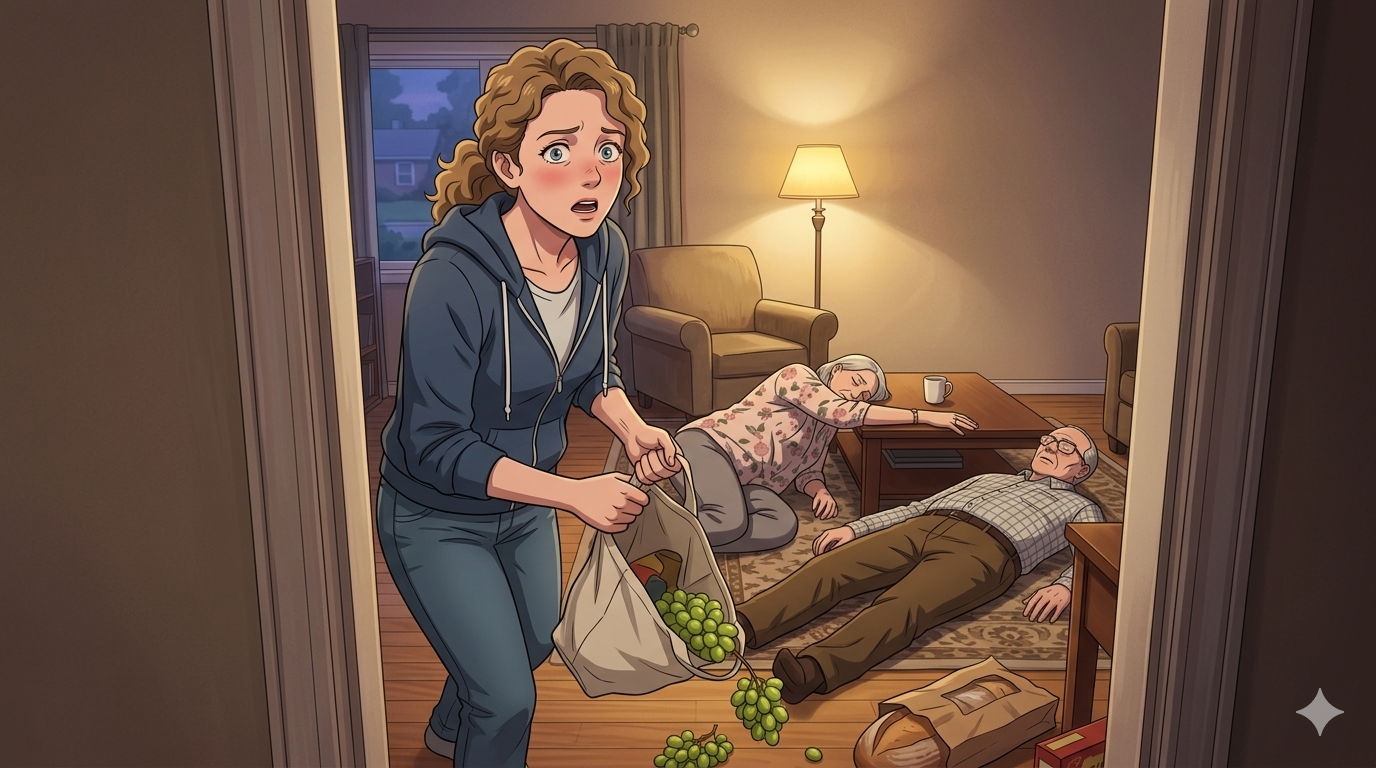
I went home smiling to surprise my parents, but when I entered… they were lying still on the floor unconscious. Doctors said: poisoned. One week later, what my husband discovered made my body tremble…
My name is Dorothy Olsen. I am 33 years old. I have been married to my husband, Elias, for eight years, and we have a daughter named Lily who just turned six.
I grew up in a small town called Ashford, about three hours north of the city where Elias and I live now. My parents, Harold and Beatrice Warren, still lived in the same house on Maple Street where I took my first steps and learned to ride a bike.
I have one younger sister, Camille, who is 29. She still lived in Ashford, just a few blocks from our parents, and worked at the local bank as a loan officer.
I did not get back to Ashford as often as I wanted. Life gets busy with work, school, schedules, and the thousand small responsibilities that come with being a wife and a mother, but I tried to go home at least once every few months.
The last time I had seen my parents was three months earlier, when Elias, Lily, and I made the drive up for my father’s sixty-fifth birthday. It was a quiet celebration.
My mother baked a chocolate cake from scratch, the same recipe she had used for every birthday in our family for as long as I could remember. Camille came over with her boyfriend at the time, a man named Derek who worked at the hardware store.
We sat around the dining table, the same oak table my father had refinished when I was a little girl, and laughed about old memories. My father told the story of the time I tried to flush my pet goldfish down the toilet because I thought it would swim to the ocean.
My mother corrected him on half the details. Lily fell asleep on the couch with her head in my lap.
It was a good day. A simple, warm, ordinary day.
I did not know then that it would be the last good day I would have for a very long time.
The drive to Ashford usually took about three hours, but with traffic that Friday, it took closer to four. I had decided to go alone because Elias had to work, and Lily had a school field trip she did not want to miss.
I told my parents I was coming. I called my mother on Wednesday and said I would drive up Friday afternoon and stay through Sunday.
She sounded happy the way she always did when I told her I was coming home. She said she would make my favorite dinner, pot roast with carrots and potatoes.
She said my father had been meaning to fix the loose step on the front porch and he would get to it before I arrived so I would not trip. I told her she did not need to go to any trouble, but I knew she would anyway.
That was just who my mother was.
I left the city around two in the afternoon. The weather was clear, one of those crisp autumn days when the leaves along the highway had just started turning copper and gold.
I listened to music and let my mind drift. I thought about the new project I was working on at the accounting firm where I had been employed for the past six years. I thought about Lily’s upcoming ballet recital and how she had been practicing her routine in the living room every night.
I thought about Elias and the way he had kissed me goodbye that morning, telling me to drive safe and give his love to my parents. I thought about how lucky I was to have the life I had.
It was the kind of peaceful drive that lets your mind wander through all the small joys and ordinary worries that make up a life.
I arrived in Ashford just before six in the evening. The sun was starting to set, casting long golden shadows across the familiar streets.
I drove past the old high school where I had graduated seventeen years earlier. I drove past the little park where Camille and I used to play on the swings.
When I turned onto Maple Street, I felt that same old sense of coming home, that deep comfort that comes from seeing the same houses, the same trees, the same mailbox at the end of your parents’ driveway.
I pulled in behind my mother’s sedan. The house looked the same as it always did: white shutters, a small front porch with two rocking chairs, and a line of marigolds along the walkway that my mother planted every spring.
I noticed the loose step on the porch that my father had not fixed yet, but that did not surprise me. He was a retired carpenter, but he moved slower now than he used to. His hands had bothered him for years, the joints stiff from decades of working with wood and tools.
I grabbed my overnight bag from the passenger seat and walked up to the front door.
It was unlocked, which was not unusual. My parents never locked the door during the day. They had lived in Ashford for forty years, and they trusted the town the way people do when they have lived in the same place for a lifetime.
I stepped inside and called out, “Hello? I’m here.”
I expected to hear my mother’s voice from the kitchen telling me to come in and sit down, that dinner would be ready soon. I expected to hear my father’s footsteps in the hallway coming to give me a hug and ask about the drive.
But there was no answer.
The house was quiet. Too quiet. The kind of quiet that feels wrong, the kind that presses against your ears and makes your heart beat faster.
I set my bag down by the door and walked toward the kitchen.
The kitchen was empty. The pot roast was sitting on the counter, still wrapped in butcher paper from the grocery store. The vegetables were in a bowl beside it, not yet peeled or chopped. The oven was cold.
A chill ran down my spine.
My mother would not have left dinner untouched if she knew I was coming. She would have started cooking hours earlier. Something was wrong.
I called out again, louder this time.
“Mom? Dad? Where are you?”
I walked through the kitchen into the hallway that led to the living room, and that was when I saw them.
My parents were lying on the floor.
My mother was on her side near the couch, her arms stretched out as if she had been reaching for something. My father was a few feet away, face down on the rug.
They were both completely still.
Their faces were pale, almost gray, and their lips had a faint blue tint I will never forget as long as I live.
I screamed.
I do not remember deciding to scream. It just tore out of me, something raw and frightened and beyond thought.
I dropped to my knees beside my mother and touched her face. Her skin was cold.
I pressed my fingers to her neck, searching for a pulse, but I was shaking so badly I could not tell if I was feeling her heartbeat or my own trembling. I pulled out my phone and dialed 911. My hands were shaking so hard I almost dropped it twice.
The operator answered, and I told her my parents were unconscious and not breathing.
“Please send help right away,” I said. “Maple Street. Please.”
She told me to stay on the line and check for breathing. I put the phone down on the floor and turned my mother onto her back. I leaned close to her mouth and nose and felt nothing.
I did the same for my father. Nothing.
I do not know how long I sat there between them holding my mother’s hand and waiting for the ambulance. It felt like hours, but it was probably ten or twelve minutes.
I remember talking to them.
“You can’t leave me,” I said. “Please wake up. Please open your eyes.”
I told them I was there, that I had come home, that dinner was not ready and I was hungry and I wanted to hear my mother tell me about her garden and my father complain about the loose step on the porch.
The paramedics arrived and moved quickly, checking pulses, checking for breathing, calling out numbers and instructions to each other. I stood in the corner of the living room with my arms wrapped around myself, watching them work on my parents.
One of the paramedics, a woman with kind eyes and a calm voice, came over and asked if I had any idea what had happened.
“I just got here,” I said. “I don’t know anything. I found them like this.”
She told me they were taking both of them to Ashford General Hospital immediately.
She asked if I had someone I could call to be with me. I called Elias first.
He answered on the second ring, and from the background noise I could tell he was still at work. I told him what I had found.
I heard him catch his breath. Then he said he was leaving right away, that he would be there as soon as he could. Three hours, maybe four, depending on traffic.
He told me to stay strong and that he loved me. He said he would call Camille for me because he did not think I should have to say the words again.
I do not remember the drive to the hospital. One moment I was standing in my parents’ living room, and the next I was sitting in a plastic chair in the waiting room staring at a wall clock that said 7:43.
The paramedics had taken my parents into the emergency room and I was not allowed to go with them. A nurse finally came out and told me they were both alive, but in critical condition.
She said they had been unconscious for some time, possibly hours, and that the medical team was doing everything they could.
Camille arrived about twenty minutes later. Elias had called her, and she had driven straight from her apartment.
She looked pale and terrified, and the second she saw me, she ran to me and we held each other and cried.
We did not say much. There was not much to say. Our parents were in the emergency room unconscious, and we did not know why. We did not know if they would wake up.
A doctor came to speak with us around nine. He was a tall man with gray hair and a tired face, and he introduced himself as Dr. Morrison.
He sat down across from us, and he did not have the kind of expression that gives you hope.
He said the medical team had run initial tests and the results were concerning. He said my parents showed signs of severe poisoning.
The toxicology reports would take more time, but the symptoms indicated exposure to something toxic, something that had entered their systems and caused their bodies to start shutting down. He said they were both in comas and were being moved to the ICU.
Poisoning.
The word did not make sense in my head.
My parents were retired. They lived a quiet life in a small town. They did not have enemies. They did not do anything reckless. They grew vegetables in their backyard, went to church on Sundays, and argued about which television show to watch in the evenings.
Poisoning was not a word that belonged in their world.
Camille asked Dr. Morrison what kind of poison.
He said they did not know yet. It could have been something they ingested, inhaled, or absorbed some other way.
He also said the police would have to be involved, because cases like this were treated as possible crimes until proven otherwise.
I sat there in that plastic chair holding my sister’s hand and felt like the floor had dropped out from under me. I had come home smiling, expecting pot roast and conversation and an ordinary weekend.
Instead I had found my parents unconscious on the floor, and now a doctor was telling me that someone might have done this to them on purpose.
That night was the longest night of my life.
Elias arrived around eleven after driving straight through without stopping. He found me in the ICU waiting room, sat down beside me, and put his arm around me.
He did not need to say anything. His presence was enough.
I leaned into him, closed my eyes, and tried to remember how to breathe.
The police came the next morning.
Two detectives, a man and a woman, both in plain clothes. They introduced themselves as Detectives Callahan and Reyes and asked me to tell them everything I knew from the moment I arrived at the house to the moment the paramedics came.
I told them about the unlocked door, the quiet house, the pot roast still wrapped on the counter, my parents on the floor. I told them about the loose step on the porch and the marigolds and the chocolate cake my mother had baked three months earlier for my father’s birthday.
I told them everything I could think of, even the things that seemed small, because I wanted them to have every piece of information that might help.
They asked about my parents’ habits, their routines, whether they had conflicts with anyone, whether they had mentioned anything unusual in recent weeks.
I told them my parents were the kind of people who went to bed early and woke up early. They had breakfast at the diner on Main Street every Saturday morning. They went to the grocery store on Tuesdays. They did not have any enemies that I knew of.
They were just ordinary retired people living a quiet life.
The detectives said they would investigate the house and surrounding property. They would speak to neighbors and anyone else who had been in contact with my parents in the days leading up to what happened.
They said they would keep us updated.
I spent that day and the next in the ICU waiting room, going back and forth to see my parents whenever the nurses allowed it.
They looked small and fragile in those hospital beds, surrounded by machines that beeped and whirred and breathed for them. My mother had tubes running into her arms and a ventilator helping her breathe. My father looked much the same.
Their faces were still pale, and that faint bluish tint around their lips had not fully faded.
I held my mother’s hand and talked to her. I told her about Lily’s ballet recital. I told her about the new project at work. I told her about the pot roast she never got to cook and said I did not care about dinner. I just wanted her to wake up.
I did the same with my father. I told him the loose step on the porch was still loose and he needed to fix it when he got home. I told him I loved him.
I told them both that I was not leaving until they opened their eyes.
On the third day, the toxicology reports came back.
Dr. Morrison called Camille and me into a small consultation room. He closed the door, sat down across from us, and I could tell from his eyes that he was about to tell us something terrible.
He said my parents had been poisoned with ethylene glycol.
He explained that it was a colorless, odorless chemical commonly found in antifreeze. He said it had a sweet taste, which made it especially dangerous because people and animals might ingest it without realizing what it was.
He said the amount in their systems was significant, enough to cause severe damage to their kidneys and central nervous systems. They were both still in critical condition, and their chances of recovery were uncertain.
He said the damage was extensive, and even if they woke up, there might be lasting effects.
Antifreeze.
Someone had put antifreeze in my parents’ food or drink. Someone had done this deliberately.
The words felt like stones in my throat.
I looked at Camille and saw my own horror reflected on her face. We had grown up in that town, in that house, with those parents who had never hurt anyone.
Now someone had tried to kill them.
I did not know then that the worst was still coming. I did not know that one week later, my husband would discover something that would make my body tremble and split my world open in a way it could never be closed again.
All I knew then was that my parents were fighting for their lives and I would not rest until I found out who had done this to them.
The days that followed blurred together into hospital waiting rooms, police interviews, sleepless nights, and the stale taste of cafeteria coffee.
I stayed at my parents’ house because I could not bear to be anywhere else. The house felt wrong without them in it, but it was still their house. Their things were still there. My mother’s lavender candles. The worn grooves in my father’s favorite armchair. The old clock in the living room.
I slept in my childhood bedroom with its pale blue walls and the same bookshelf lined with novels I had not touched in fifteen years.
Camille stayed with me for the first few nights, but she had to go back to work at the bank on Monday. She lived close enough to come and go.
Elias had to return to the city Sunday night because he could not take more time off from his job as a project manager for a construction company. He did not want to leave me, but I told him to go. I needed to be in Ashford for my parents, and he needed to be there for Lily.
He promised to come back the following weekend and call every day.
He kissed me goodbye on the front porch, and I watched him drive away with a hollow feeling in my chest.
Lily did not understand what was happening. She was six years old. All she knew was that her grandparents were sick and her mother was staying in Ashford for a while.
I talked to her every night over video call. She showed me drawings, told me about her friends at school, and asked when I was coming home.
I told her soon. I told her I would come home as soon as Grandma and Grandpa were better.
I did not tell her that they might never get better.
My parents remained in comas. The doctors had them on dialysis, trying to filter the poison from their blood, but the damage had already been done. My mother’s kidneys were failing. My father’s were damaged too, though not as badly.
Dr. Morrison was honest with us. He said the next few days would be critical. He said we should prepare ourselves for the possibility that they might not recover.
He also said that even if they did wake up, they would likely need long-term medical care.
Camille and I took turns sitting with them.
I spent mornings at the hospital reading aloud from the books in my old bedroom because I remembered how my mother used to read to me when I was sick. I read her favorite novels, the ones with happy endings and people who always found their way back to each other.
I read my father’s old carpentry magazines too, even though I did not understand half of what they said about wood grain, joints, or finishes.
I talked to them about everything and nothing. The weather. The news. The marigolds outside drooping because no one was watering them.
I told my mother I needed her to wake up so she could finally teach me her pot roast recipe. I told my father I finally understood why he spent so much time in his workshop.
The police investigation moved slowly.
On Tuesday, Detectives Callahan and Reyes came to the house to search for evidence. They wore gloves and moved through the rooms with a careful thoroughness that made my skin crawl.
I watched them from the kitchen doorway as they examined the refrigerator, the pantry, the water pitcher on the counter, the coffee maker, everything my parents might have eaten or drunk.
They took samples of the pot roast still wrapped in butcher paper, the vegetables in the bowl, the milk in the refrigerator, and the bottle of wine on the counter. They said everything would go to the lab.
They asked more questions. Had my parents mentioned any recent visitors? Had they seemed worried? Had they been acting differently?
I thought back through every conversation I had had with my mother lately. She had talked about her garden, the church potluck, my father’s aching hands.
Nothing unusual. Nothing alarming.
Detective Callahan asked me about Camille. He asked about her relationship with our parents. Was there any tension? Any arguments? Anything that might matter?
I told him no. Camille saw them almost every day. They were close.
He nodded and wrote something in his notebook.
At the time, I did not think anything of it.
On Wednesday, Detective Reyes called me with a question that caught me off guard. She asked whether I knew a woman named Janice Fuller and what her relationship was to my parents.
I told her Janice was our parents’ next-door neighbor, the widow with the rose bushes. She was in her seventies, a retired schoolteacher, and she had been one of my mother’s closest friends for as long as I could remember.
They played bridge together, walked their dogs together, and sat on the porch drinking iced tea in the summer.
I asked why she was asking.
Detective Reyes said Janice had come to the station on Monday to report that she had seen someone at my parents’ house on the day they were poisoned.
She had been standing at her kitchen window around noon and saw a dark sedan parked in the driveway. She did not recognize the car, but she saw a person get out and go to the front door.
That person was inside for about twenty minutes, then left.
Janice had not thought much of it at the time because she assumed it was somebody my parents knew. But after hearing what happened, she realized it might matter.
My heart started pounding.
I asked whether Janice had seen the person clearly. Detective Reyes said no. The person had been wearing a hooded jacket, and the angle was difficult.
The car was dark, maybe blue or black, but Janice could not be certain.
She asked if I knew anyone who drove a dark sedan.
I said I did not know. Then I said I would ask around.
The second I hung up, I called Camille. She stepped away from her desk at the bank to take the call.
I told her about Janice’s report. The dark sedan. The hooded figure. The twenty minutes inside the house.
Camille went quiet for a moment, then said she did not know anyone who drove a dark sedan. She said she would think about it and let me know if anything came to mind.
She sounded distracted, but I assumed she was as shaken as I was.
That evening, I walked over to Janice’s house myself.
She opened the door, saw my face, and pulled me into a hug before I could even speak. She told me how sorry she was, how she had been praying for my parents every night, how she could not believe something like this could happen in Ashford.
I asked her about the car.
She repeated what she had told the police: dark sedan, hooded jacket, about twenty minutes inside. She said she wished she had gone over and checked, but she had not wanted to interrupt.
Then she said something that made my blood run cold.
She told me my father had come to her house about a week earlier looking upset. He had asked whether she had seen anyone hanging around their property, anyone who did not belong.
She said she had not and asked him why.
He told her it was probably nothing, that some things had gone missing from the garage and he was probably just being forgetful.
Janice had not thought much of it at the time, but now she wondered whether it was connected.
I walked back to my parents’ house with my mind racing.
Things had gone missing from the garage. My father had been worried about someone around the house. Then someone had come there on the day they were poisoned and stayed long enough to slip antifreeze into something they would later eat or drink.
This was not random.
Someone had targeted my parents deliberately, and it had likely been planned at least a week in advance.
That night, I called Elias and told him everything.
He listened without interrupting. When I finished, he said, “Dorothy, I’ve been thinking about something.”
There was something in his tone that made my stomach tighten.
“When we visited for your father’s birthday three months ago,” he said, “did you notice anything strange about Camille?”
“No,” I said. “She seemed fine. She was there with Derek. Everything felt normal.”
Elias said he remembered something from that night, something he had not mentioned because it had not seemed important at the time. He said he had gone to the kitchen late for a glass of water and heard voices outside.
He looked through the window and saw Camille and my father arguing in the backyard near the garden.
He could not hear the words, but from the way they were standing, from the way my father was gesturing and Camille was rigid and sharp in response, he knew it was heated.
He had kept it to himself because he assumed it was just one of those tense family moments that would blow over.
I sat down on the edge of my childhood bed, phone pressed to my ear, trying to process what he was telling me.
Camille had argued with my father three months earlier. She had never mentioned it. I had never known.
And now my parents were in ICU with antifreeze in their systems and a dark sedan had been seen in their driveway the day it happened.
I did not want to believe it.
Camille was my sister. She was the one who ran to me in the hospital waiting room and held me while we cried. She was the one who brought coffee and sandwiches and forced me to eat when I forgot.
She could not be involved in this.
But once the thought planted itself in my mind, it would not leave.
I spent the next day trying to push it away.
At the hospital, Dr. Morrison told me my mother’s condition had worsened overnight. Her kidneys were failing faster than they had expected. My father was stable, but still unconscious.
I held my mother’s hand and prayed, though I did not even know anymore whether I believed in prayer.
I prayed for her to wake up. I prayed for my father to wake up. I prayed for the truth to come out, whatever it was, even if it destroyed me.
Camille came to the hospital that afternoon. She looked exhausted, with dark circles under her eyes and a paleness that matched the walls.
She sat beside me and asked how our mother was doing. I told her what Dr. Morrison had said.
She started crying, quiet tears sliding down her face. I put my arm around her and held her.
I looked at her then, really looked at her. The face I had known since the day she was born, when I was four years old and my mother brought her home from the hospital wrapped in a yellow blanket.
I tried to picture that face under a hood, in a dark sedan, walking into our parents’ house with something deadly in hand.
I could not make the image fit.
Still, I had to ask.
When we were alone in the waiting room, I took a breath and said, “Camille, what were you and Dad arguing about at his birthday party? Late that night. In the backyard.”
She froze.
Her face did not change much, but I saw something flicker in her eyes. A shadow. A calculation. A fear I could not name.
“What are you talking about?” she asked.
“Elias saw you,” I said. “He heard you. He saw you and Dad arguing. What was it about?”
She looked away from me.
When she finally answered, her voice was barely above a whisper.
“Money.”
“What about money?”
She said she had asked our father for a loan. A large one. He had refused. They argued. She got angry.
“How much?” I asked.
She hesitated before answering.
“Forty thousand.”
I stared at her. “What did you need forty thousand dollars for?”
She said she had gotten into debt. Credit cards. More than she could manage. She said she was ashamed and had not wanted me to know because I had always been the responsible one. The one with the stable job, the good marriage, the neat life.
She said asking our father for that much money had felt humiliating, and his refusal had only made it worse.
I asked whether she had asked him again later. She said no. She said she had taken out a consolidation loan through the bank where she worked and was paying it off slowly.
She said it was just a family disagreement. Nothing more.
I wanted to believe her.
I wanted to believe her so badly it hurt.
But there was something in the way she would not meet my eyes, something in the thinness of her voice, that kept the doubt alive.
I told her about the dark sedan Janice had seen.
“Do you drive a dark sedan?” I asked.
She said no. She drove a silver hatchback, the same one she had driven for five years. That much I knew was true.
I asked where she had been the day our parents were poisoned.
“At work,” she said. “All day. Nine to five.”
She said there would be records, cameras, coworkers. She went home afterward, had dinner alone, watched television, and did not go to our parents’ house because she had planned to see them the next day when I arrived.
Her alibi sounded solid.
I told myself it had to be enough. I told myself my sister could not do something like this.
But the doubt remained.
And in the days that followed, it grew.
The seventh day came like a storm I could feel in the distance even before it broke.
On Thursday morning, the sixth day, Dr. Morrison called Camille and me into his office and told us my mother’s kidneys had failed completely. She was on dialysis around the clock, but her body was not responding the way they had hoped.
There had also been severe neurological damage. He used words like irreversible, palliative, and quality of life.
After a while, I stopped hearing them. The sound of my own heartbeat was too loud in my ears.
My father was stable, but still unconscious. The doctors thought he might recover some function, maybe more, but they could not say for certain.
Camille took the news quietly.
For the first three days she had cried constantly. After that, she stopped. I thought she had simply run out of tears. I thought maybe she was trying to be strong because someone had to be.
I did not yet understand what had changed in her.
Elias came back on Friday morning. He had driven through the night after finishing a project at work and arrived at the hospital just after six.
When I saw him walk through those doors, I stood up and fell into his arms and finally let myself break. I cried for my mother. I cried for my father. I cried for the life we had before all of this, the ordinary life with pot roast and birthday cake and porch repairs.
He held me and did not say anything.
He stayed with me all day. We sat by my parents’ beds together, Elias on one side holding my hand while I held my mother’s.
He talked to my father about a renovation he had been working on downtown, the kind of woodwork my father would have appreciated. His voice was calm and steady, and just hearing it made something in me loosen.
That evening, Elias said he wanted to go back to the house and look around.
I told him I had already gone through everything. I had not found anything unusual. But he said sometimes an outside perspective catches what the person in the center of it cannot.
I stayed at the hospital while he went.
I sat by my mother and watched the ventilator do the work her body could no longer do. I talked to her about Lily and Elias and work and a dry pot roast I had tried to make the week before. I told her she needed to wake up and teach me how to do it properly.
Elias was gone about two hours.
When he came back, his face was pale and his hands were shaking.
He pulled me out of the waiting room and into a small consultation room and closed the door. He sat me down, knelt in front of me, and took both my hands in his.
“Dorothy,” he said, “I found something. I need you to stay calm.”
He said he had gone through the garage first. My father’s garage was really a workshop, full of tools, wood, paint cans, and half-finished projects.
Cluttered, but organized in the way my father liked it.
Elias looked for anything that seemed out of place, anything that might explain what had gone missing.
He found an empty space on a shelf where a container of antifreeze should have been. There was a ring of dust marking the exact outline of the jug that had once sat there.
He remembered seeing a blue container of antifreeze on that shelf when we visited three months earlier because my father had pointed it out and said he needed it to winterize the pipes before cold weather.
My stomach turned.
The missing antifreeze. The poison in my parents’ systems.
It connected too neatly.
But that was not what had made Elias’s hands shake.
After the garage, he went into the house. Kitchen. Living room. Bedrooms.
Then, for reasons he could not fully explain, he went into Camille’s old room.
He reached into his jacket pocket and pulled out a tissue-wrapped object. He unfolded it in front of me.
Inside was a small silver key.
It looked ordinary, the kind of key that might open a diary, a lockbox, or a cabinet. Familiar, somehow, though I could not place it.
Elias said he had found it hidden under the mattress in Camille’s old room, tucked between the box spring and the frame.
Camille had not lived there in ten years. My mother had turned the room into a guest room long ago. There was no reason for a hidden key to be under that mattress.
No good reason.
I held it in my palm and felt something cold settle in my chest.
I asked whether he had told the police.
“Not yet,” he said. “I wanted to show you first. I wanted to see whether you recognized it.”
He said he did not want to accuse anyone without more information, but he could not ignore what he had found.
The missing antifreeze. The argument with my father. The dark sedan. The hidden key.
It was too much to brush away.
I knew the rational thing was to give the key to Detectives Callahan and Reyes and let them follow the evidence.
But I could not do that. Not yet.
I could not hand over a key that might condemn my sister without first looking her in the eye and asking her why.
She was my sister. She was the little girl who used to trail me around the backyard, the one who cried when I left for college because she said she would miss me too much.
I had to give her one chance to tell me the truth.
That night, a little before eleven, I called Camille and asked her to come to the house.
She asked why.
“I can’t explain it over the phone,” I said. “I need to talk to you.”
She said she would be there in ten minutes.
Elias did not want me to meet with her alone. I told him to stay in the kitchen, close enough to hear if I needed him, but to give us privacy.
He agreed, though worry was written all over his face.
Camille arrived a few minutes later.
I was sitting in the living room, the same living room where I had found our parents seven days earlier. The rug had been taken by the police, leaving a bare patch of hardwood floor that made the room feel stripped and wrong.
Camille sat down across from me on the couch.
She looked tired, the same tired she had looked for days.
“What’s going on?” she asked.
I did not answer right away. I just looked at her.
At the face I had known my whole life. The face I was now trying to match to every terrible possibility that had begun circling this house.
Then I took the key out of my pocket and held it up.
“Do you know what this is?” I asked.
The change in her face was immediate.
Her eyes widened. The color drained from her skin. Her hands, resting on her knees, started to tremble.
Not confusion.
Fear.
Real fear.
“Where did you get that?” she asked.
“Elias found it under the mattress in your old room,” I said. “Tell me what it is.”
She did not answer. She stood up and walked to the window, her back to me, shoulders shaking.
I waited.
When she finally turned around, there were tears on her face.
“Dorothy,” she said, “I didn’t mean for any of this to happen. I didn’t know it would go this far. I was just angry. I was so angry.”
My heart slammed against my ribs.
“What are you saying?” I asked. “Did you do this? Did you poison them?”
She shook her head violently.
“No. No. I didn’t do that. But I know who did.”
I stared at her.
She sat back down, hands clasped hard in her lap, her whole body trembling. She said the key belonged to a lockbox she used to keep in her closet when she still lived in the house.
She said she used to hide things in it, things she never wanted our parents to find. When she moved out, she thought she had taken everything, but a few weeks earlier she had come back to the house while our parents were out and looked for it.
She found it in the back of the closet under old blankets. She took what was inside and, not knowing what else to do with the key, hid it under the mattress.
I asked what had been in the lockbox.
She closed her eyes.
“Letters,” she whispered.
“What kind of letters?”
She said they were letters she had written years earlier, when she was eighteen, to someone she trusted. Letters that would destroy our family if anyone ever read them.
I asked what could possibly be in those letters that was so terrible she would hide them for more than a decade.
Then she looked at me, and the fear in her eyes was deeper than anything I had ever seen.
She said the letters were about our father.
About what he had done to her.
About the way he had hurt her when she was a teenager.
The words hit me like a physical blow.
I could not breathe. I could not think.
My father. The man who fixed loose steps and refinished oak tables and told stories about goldfish swimming to the ocean. The man who was lying in a hospital bed fighting for his life. The man I had been praying would wake up.
I asked her whether she was saying what I thought she was saying.
She nodded.
She said yes.
She said it had started when she was fourteen. She had never told anyone because she had been too ashamed, too frightened, too convinced nobody would believe her.
She said the letters were written to a man she met online, someone who had become her confidant, the only person she had ever told. She wrote down everything in those letters. Dates. Details. Moments. All of it.
She had kept them in the lockbox because she was terrified our parents would find them.
A few weeks earlier, she had finally decided she was going to go to the police. She took the letters out and hid them elsewhere.
Then, before she could do anything, someone poisoned our parents.
I sat there staring at my sister while the world shifted under me.
Everything I thought I knew about my family, my childhood, my father was collapsing.
I thought about my father’s hands. The hands that had taught me to ride a bike. The hands that had refinished the oak table. The hands that had once seemed steady and safe.
Now Camille was telling me those same hands had hurt her for years.
I thought about my mother. The woman who baked chocolate cakes and tended marigolds and trusted the world enough to leave her door unlocked.
Had she known? Had she seen something and looked away? Had she chosen not to know?
I asked Camille whether our mother knew.
She shook her head. She said she did not think so. She had never told her. Never told anyone until she wrote those letters.
She said she believed our mother might have believed her if she had spoken, but at fourteen she had been too terrified to find out. Too terrified of what would happen to the family, to her, to all of us.
So she had kept it buried and carried it alone for fifteen years.
I asked her about the argument with our father at his birthday party.
She said she had confronted him. She had waited until he was alone in the backyard and told him she was going to the police. She told him she had proof. She told him she had written everything down and was not going to let him bury it forever.
She said he begged her not to. He cried. He apologized. He said he had been sick, broken, wrong, that he had loved her and never meant to ruin her life.
She told him it did not matter. He had already ruined too much.
Then I asked whether she had told anyone else about her plan.
She hesitated.
Then she said one name.
“Derek.”
She told him everything. What our father had done. The letters. The confrontation at the birthday party. Her plan to go to the police.
She said Derek had been supportive. He had told her she was brave. He said he would stand by her no matter what.
And then something clicked in my head so hard it made me feel sick.
Derek worked at a hardware store.
A hardware store that sold antifreeze.
Derek drove a dark blue sedan that looked almost black in the wrong light.
Derek had been to my parents’ house before.
Derek knew about the letters. Derek knew that if my parents disappeared, the truth might never come out in the way Camille had planned.
I asked Camille where Derek had been the day our parents were poisoned.
She said she did not know. She had been at work. She had not seen him that day. She called him later that night after hearing what had happened, and he sounded shocked, horrified.
But even as she said it, I heard doubt in her voice.
I saw it dawning on her face at the same time it was dawning on mine.
Janice’s dark sedan. The hooded jacket. The twenty minutes inside the house. The missing antifreeze.
The person Janice had seen was not my sister.
It was Derek.
Camille started sobbing, deep shaking sobs that seemed to tear straight through her. She said she was sorry. She said she had never wanted any of this. She had only wanted the truth to come out.
She never wanted anyone hurt. Never wanted anyone dead.
I sat beside her on the couch and put my arm around her, though I did not know what I felt anymore. Anger. Grief. Shock. Confusion. Love. All of it at once.
My father had hurt my sister in ways no child should ever endure. My mother might have known, or maybe not. My sister’s boyfriend had poisoned our parents. And I was sitting in the middle of it, trying to hold together the pieces of a family that had cracked long before I found them on that floor.
I told Camille we had to call the police.
We had to tell them everything. The key. The letters. Derek. All of it.
She nodded. Slowly, shakily.
“I’m ready,” she said. “I’ve been ready for weeks.”
I called Detective Callahan. It was after midnight, but he answered on the third ring.
I told him we had new information and needed to speak with him as soon as possible. He said he would be at the house in twenty minutes.
While we waited, Camille and I sat in the living room, the same room where our parents had fallen, and she told me everything she had carried alone for fifteen years.
She told me about the first time when she was fourteen and our father came into her room late at night.
She told me about the years that followed. The fear. The secrecy. The shame. The way she learned to move through the house pretending nothing was wrong.
She told me about the letters she wrote to a stranger online because she needed one place in the world where the truth could exist. She told me about the birthday confrontation, about saying the words out loud, about the mix of terror and relief when she finally stopped protecting him.
She told me about telling Derek, about believing his support was real, about the guilt she had carried every second since our parents were poisoned because some part of her feared her secret had brought all of it crashing down.
I held her hand and listened. I did not interrupt. I did not question. I just listened.
When she was done, I held her while she cried, and I cried too, for the little girl she had been, for the pain she had been forced to carry, for the family we had already lost before I even knew it was gone.
Detective Callahan arrived twenty minutes later.
He sat in my mother’s faded floral armchair with a notebook open across his knee while Camille and I told him everything we knew. He asked careful questions. Dates. Names. Locations. Details.
He asked where the letters were now.
Camille said she had put them in a storage unit on the edge of town two weeks earlier because she did not want them in her apartment where Derek might find them.
She gave him the unit number, the address, and the key.
He asked whether she had any other evidence besides the letters. She said no. She had never told anyone. Never filed a report. Never spoken to a doctor. The letters were the closest thing she had to a record because she wrote them when it was happening and remembered everything.
He asked what Derek knew.
She told him everything. Derek knew about our father. He knew about the letters. He knew she intended to go to the police.
She also told the detective Derek had been acting strangely after the poisoning. Calling constantly. Asking what the police were saying, what the doctors were saying, whether she had told anyone else.
At the time she thought he was worried about her.
Now she realized he had probably been worried about himself.
Detective Callahan said they would bring Derek in for questioning in the morning. He asked whether Camille would give a formal statement.
She said yes.
After he left, the house went quiet again.
Elias came in from the kitchen and sat with us, his hand resting on my knee, solid and warm and steady. The clock on the wall ticked past one in the morning, then two.
None of us moved.
I could not stop thinking about my father.
The man who had taught me to ride a bike. The man who told stories about goldfish swimming to the ocean. The man who refinished the dining table and fixed porch steps.
That man had also done something monstrous to my sister for years.
And now he was lying in a hospital bed unconscious, and I did not know what I wanted.
Part of me wanted him to wake up so I could scream at him. Part of me wanted him never to wake up so I would never have to see his face again. And part of me, the part I was ashamed of, wanted somehow for it not to be true because the truth meant my whole childhood had been built on rot.
But when I looked at Camille beside me, pale and hollowed out and trembling even in silence, I knew it was true.
I knew it in the way she spoke. I knew it in the way she held herself. I knew it in the existence of those letters and the fear that still lived in her bones.
Truth has a shape, even when it arrives late.
I asked her again whether she thought our mother knew. She said she did not think so. She had watched her over the years, searching for signs, but never saw anything certain. Maybe our mother had not seen it. Maybe she had seen shadows and looked away from them.
Camille said she would probably never know.
I asked why she had never told me.
She looked at me with tears in her eyes and said, “Because you were the good one. You got out. You went to college. You built a life. I didn’t want to ruin
She stood up from the couch and walked to the window, her back to me. She stayed there a long time, shoulders shaking. I didn’t say anything. I waited.
When she finally turned around, her face was wet with tears.
“Dorothy, I didn’t mean for any of this to happen.”
“I didn’t know it would go this far.”
“I was just angry. I was just so angry.”
My heart seemed to stop. I asked her what she was saying. I asked her if she did it. I asked her if she had poisoned them. She shook her head so hard it almost looked violent.
“No. No. I didn’t poison them. I didn’t do that. But I know who did.”
I stared at her, unable to speak. The words wouldn’t come. She walked back to the couch and sat down, her hands clasped in her lap, her whole body trembling. She told me the key belonged to a lockbox she had kept in her closet when she still lived in the house. She said she used to hide things in it, things she never wanted our parents to find. She thought she had taken everything when she moved out, but apparently she had missed something.
A few weeks earlier, she had gone back to the house while our parents were out so she could look for the lockbox. She found it shoved into the back of the closet under a pile of old blankets. She opened it, took what was inside, and then hid the key under the mattress because she panicked and didn’t know what else to do. I asked her what had been in the box. I asked what she had been hiding.
She closed her eyes. Tears slid down her cheeks. And when she finally spoke, the words came out as little more than a whisper.
“Letters.”
“Letters I wrote to a man when I was eighteen. Letters I should never have written. Letters that would destroy this family if anyone ever read them.”
I asked what was in the letters. I asked what could possibly be so terrible that she had hidden it for more than ten years. She looked at me then, and the fear in her eyes was deeper than anything I had ever seen in another human being.
She said the letters were about our father. About what he had done to her. About what he had done when she was a teenager.
The words hit me like a physical blow. I couldn’t breathe. I couldn’t think. My father. The man who fixed loose steps and refinished oak tables and told the story about the goldfish that was supposed to swim to the ocean. The man who was lying in a hospital bed, unconscious, fighting for his life. The man I had been praying would wake up.
I asked her what she meant. I asked her if she was saying what I thought she was saying.
She nodded.
“Yes.”
She told me he had hurt her for years, starting when she was fourteen. She said she had never told anyone. She had been too ashamed, too frightened, too convinced nobody would believe her. She said the man she had written those letters to was someone she met online, someone who became the only person she ever confided in. She wrote down everything in those letters. Every date she could remember. Every detail. Every moment.
She kept them in the lockbox because she was terrified our parents would find them. She had gone back for them a few weeks ago because she had finally decided she was going to the police. She had taken the letters and hidden them somewhere else. And then, before she could do anything, someone poisoned our parents.
I sat there on that couch staring at my sister while the whole world tilted off its axis. Everything I thought I knew about my childhood, my family, my father, began crumbling in front of me. I thought about my father’s hands. The hands that taught me to ride a bike. The hands that refinished the oak dining table. The hands that had stiffened with arthritis after a lifetime of carpentry. And now Camille was telling me those same hands had hurt her for years.
I thought about my mother. The woman who baked chocolate cake and tended marigolds and left the front door unlocked because she trusted her town. Had she known? Had she seen something and chosen not to see it? Had she looked away?
I asked Camille if Mom knew. She shook her head. She said she didn’t think so. She said she never told her, never told anyone until she wrote those letters. She believed Mom would have believed her, but she had been too scared to find out. Too scared of what it would do to the family. Too scared of what people in Ashford would say. She was fourteen years old and terrified, so she buried it and kept burying it for fifteen years.
I asked her about the argument in the backyard at Dad’s birthday party. She said she had confronted him. She waited until he was alone and told him she was going to the police. She told him she had proof. She told him she had written everything down and she wasn’t going to let him get away with it anymore.
She said he begged her not to. He cried. He apologized. He said he was sorry. He said he had been sick, that he had loved her, that he never meant to hurt her.
She told him it didn’t matter. He had ruined her life, and she was going to make sure the truth finally came out.
I asked if she told anyone else about her plan. She hesitated, and in that hesitation, everything in the room seemed to tighten. Then she said she had told one person. Derek. Her boyfriend. The same Derek who worked at the hardware store. The same Derek who had sat at my parents’ table three months ago, smiling and eating cake and laughing at old family stories.
She said she told him everything. About the letters. About confronting our father. About planning to go to the police. Derek had told her she was brave. He told her he would stand by her no matter what.
And then I remembered.
Derek worked at a hardware store. A hardware store that sold antifreeze.
Derek drove a dark sedan. I had seen it parked outside Camille’s apartment before, a deep blue car dark enough to look black in the wrong light. Derek had been inside my parents’ house before. Derek knew about the letters. Derek knew that if my parents were gone, or too sick to speak, everything might stay buried.
I looked at Camille and asked where Derek had been the day our parents were poisoned. She said she didn’t know. She had been at work all day at the bank. She went home alone that night and didn’t talk to him until later. When she called after hearing what happened, he sounded shocked. Horrified. Just like everyone else.
But I heard the doubt in her voice. I saw the realization spreading across her face at the same speed it was spreading across mine.
Derek had access to antifreeze. He had a dark sedan. He had a reason. He could have walked into that house, stayed twenty minutes, and poured poison into something my parents would later eat or drink. The person Janice saw in the hooded jacket wasn’t my sister.
It was Derek.
My sister’s boyfriend had poisoned our parents. Maybe he thought he was protecting her. Maybe he thought he was protecting himself. Maybe he thought he was ending the problem before it could explode. I didn’t know. I didn’t know anything anymore.
Camille started crying so hard her whole body shook.
“I’m sorry.”
“I’m so sorry. I never wanted this. I just wanted the truth to come out. I never wanted anyone hurt.”
I sat beside her and put my arm around her, but I didn’t know what I was feeling. Anger, grief, pity, confusion, horror. It all moved through me at once. My father had destroyed my sister’s life. My mother might have known, or might have failed her without ever realizing it. And my sister’s boyfriend had answered all of that darkness by trying to erase two people forever.
I told Camille we had to call the police. We had to tell them everything. About the letters. About Derek. About the key. About all of it. She nodded, wiping her face with the back of her hand. She said she was ready. She said she had been ready for weeks. She said she wasn’t going to be afraid anymore.
I called Detective Callahan a little after midnight. He answered on the third ring. I told him we had new information and that he needed to come to the house as soon as possible. He said he’d be there in twenty minutes.
While we waited, Camille and I sat in that living room, the same room where our parents had collapsed, and she told me everything. Everything our father had done. Everything she had carried in silence for fifteen years. She told me about the first time, when she was fourteen and he came into her room late at night. She told me about all the years after that, the fear, the shame, the way she learned to survive by acting normal in daylight.
She told me about the letters she wrote to a stranger online because a stranger felt safer than family. She told me about confronting our father in the backyard. She told me about Derek, about how supportive he sounded, how sure he seemed that she had to stop hiding. And then she told me about the guilt that had been eating her alive ever since our parents were poisoned, the fear that her secret had brought all of this crashing down.
I didn’t interrupt. I didn’t question her. I just listened. When she was done, I held her while she cried, and I cried with her for the little girl she had been, for the years she lost, and for the family we had already lost long before I found our parents on the floor.
Detective Callahan arrived twenty minutes later. He sat in my mother’s faded floral armchair with a notebook balanced on his knee while Camille and I told him everything. He didn’t interrupt much. He only stopped us for names, dates, details, places. He asked where the letters were now. Camille said they were in a storage unit she rented two weeks earlier on the edge of town. She had moved them there after taking them from the lockbox because she didn’t want them in her apartment where Derek might find them. She gave him the key to the unit and the address.
He asked whether she had any proof besides the letters. She said no. She had never reported it. Never told a doctor. Never told another person until Derek. The letters were all she had, but they were detailed. Dates. Incidents. Specific things no one else would know.
Then he asked about Derek. She told him about confiding in him. About telling him her plan to go to the police. About the way he had been acting in the days after the poisoning—calling too often, asking too many questions, sounding nervous instead of simply worried.
Callahan wrote everything down. He told us they would bring Derek in the next morning. He asked Camille if she would come to the station to give a formal statement. She said yes.
After he left, the house went quiet again. Elias finally came in from the kitchen and sat down with us, one hand on my knee, steady and silent. The wall clock ticked past one, then two. None of us moved.
I couldn’t stop thinking about my father. The man who taught me to ride a bicycle. The man who fixed loose steps and complained about his hands and loved to tell old stories. The man who had also done something monstrous to my sister. Part of me wanted him to wake up so I could scream at him until my throat gave out. Part of me wanted him never to wake up at all. And a smaller, uglier part of me wanted to believe it wasn’t true, because the truth was too devastating to carry.
But I looked at Camille beside me—pale, hollow, exhausted—and I knew it was true.
I knew it in the way her hands shook when she said his name. I knew it in the way she had hidden those letters for more than a decade. I knew it in the silence that filled the room after she finished speaking.
Near dawn, after Elias drove Camille home and returned an hour later, I told him I needed to go to the hospital. I needed to see my father. Really see him. He asked if I wanted him to come with me. I said no. He drove me there anyway and waited in the parking lot.
The ICU was quiet at four in the morning. Dim lights. Waxed floors. The smell of coffee gone stale hours earlier. I went to my father’s room first. He lay there exactly as he had all week, pale and still, the ventilator breathing for him. I stood at the foot of the bed and looked at his face. The face I had loved all my life. The face that smiled at me on my wedding day. The face that held Lily on his lap and read her storybooks.
And now, layered over that face, I could see another one.
The one Camille had seen in the dark when she was fourteen.
THE END!

